Editorial
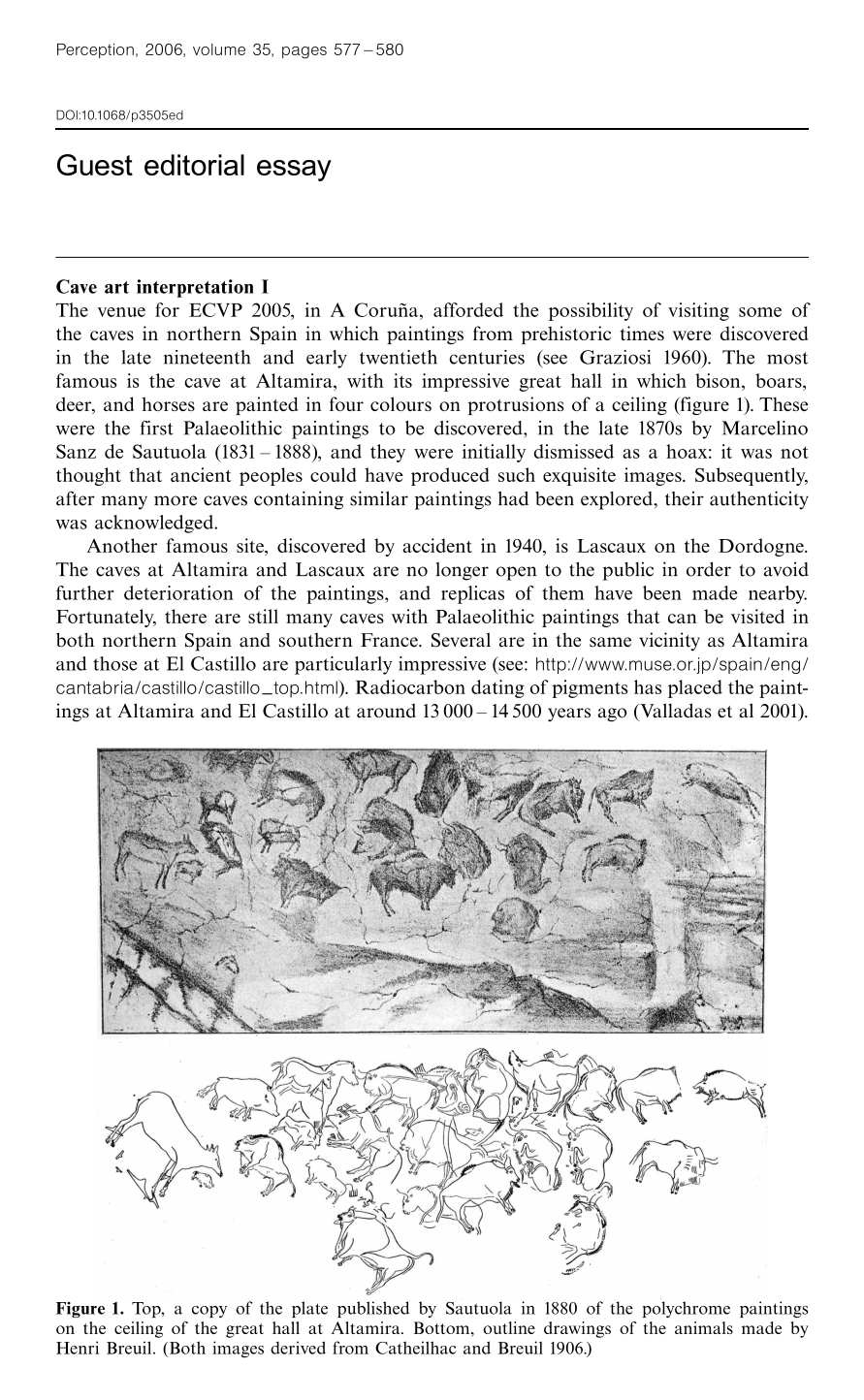
 Open accessEditorialFirst published May, 2006pp. 577-580

Select search scope: search across all journals or within the current journal


 Open accessEditorialFirst published May, 2006pp. 577-580
 Available accessResearch articleFirst published May, 2006pp. 581-603
Theoretical and empirical studies show that the visual system relies on boundary contours and surface features (eg textures) to represent 3-D surfaces. When the surface to be represented has little texture information, or has a periodic texture pattern (grating), the boundary contour information assumes a larger weight in representing the surface. Adopting the premise that the mechanisms of 3-D surface representation also determine binocular rivalry perception, the current paper focuses on whether boundary contours have a similar role in binocular rivalry. In experiment 1, we tested the prediction that the visual system prefers selecting an image/figure defined by boundary contours for rivalry dominance. We designed a binocular rivalry stimulus wherein one half-image has a boundary contour defined by a grating disk on a background with an orthogonal grating orientation. The other half-image consists solely of the (same orientation) grating background without the grating disk, ie no boundary contour. Confirming our prediction, the predominance for the half-image with the grating disk is ∼90%, despite the fact that the grating disk corresponds to an area with orthogonal grating in the fellow eye. The advantage of the grating disk is dramatically reduced to about 50% predominance when a boundary contour is added to the background-only half-image at the location corresponding to the grating disk. We attribute this reduced advantage to the formation of a corresponding binocular boundary contour. In experiment 2 the grating background was substituted by a random-dot background in a similar stimulus design. We found that the perceptual salience of the corresponding binocular boundary contours extracted by the interocular matching process is an important factor in determining the dynamics of binocular rivalry. Experiment 3 showed that vertical lines with uneven thickness and spacing as the background reduce the contribution of the monocular boundary contour of the grating disk in binocular rivalry, possibly through the formation of binocular boundary contours between the local edges (vertical components) of the vertical lines and the corresponding grating disk.
Available accessResearch articleFirst published May, 2006pp. 605-624Correct judgment of egocentric/absolute distance in the intermediate distance range requires both the angular declination below the horizon and ground-surface information being represented accurately. This requirement can be met in the light environment but not in the dark, where the ground surface is invisible and hence cannot be represented accurately. We previously showed that a target in the dark is judged at the intersection of the projection line from the eye to the target that defines the angular declination below the horizon and an implicit surface. The implicit surface can be approximated as a slant surface with its far end slanted toward the frontoparallel plane. We hypothesize that the implicit slant surface reflects the intrinsic bias of the visual system and helps to define the perceptual space. Accordingly, we conducted two experiments in the dark to further elucidate the characteristics of the implicit slant surface. In the first experiment we measured the egocentric location of a dimly lit target on, or above, the ground, using the blind-walking-gesturing paradigm. Our results reveal that the judged target locations could be fitted by a line (surface), which indicates an intrinsic bias with a geographical slant of about 12.4°. In the second experiment, with an exocentric/relative-distance task, we measured the judged ratio of aspect ratio of a fluorescent L-shaped target. Using trigonometric analysis, we found that the judged ratio of aspect ratio can be accounted for by assuming that the L-shaped target was perceived on an implicit slant surface with an average geographical slant of 14.4° That the data from the two experiments with different tasks can be fitted by implicit slant surfaces suggests that the intrinsic bias has a role in determining perceived space in the dark. The possible contribution of the intrinsic bias to representing the ground surface and its impact on space perception in the light environment are also discussed.
Available accessResearch articleFirst published May, 2006pp. 625-645We investigated the perception of illumination direction in images of 3-D convex objects under variations of light field and surface material properties. In a first experiment, we used an illumination-matching procedure in order to measure observers' ability to estimate the direction of illumination in images of 3-D polyhedra rendered under different light fields and illumination directions. Match deviations were larger in frontal direction than in rear directions, mainly counterclockwise in azimuth component, and diverged, in elevation component, from the image plane. In a second experiment, we examined whether the direction estimate was affected by the surface material type (BRDF), the light field, and the illumination direction. Angular deviations varied with material surface type and were largest in the test elevation direction 0°. Elevation component deviations also differed with surface type and were larger in hemispherical diffuse lighting than in collimated lighting. These results suggest that the direction estimation is better with images of evenly distributed intensity gradients than with those of drastically varying gradients, and that the visual system may not take intensity variations due to the surface material or the light field into account in estimating the direction of illumination.
Available accessResearch articleFirst published May, 2006pp. 647-657We investigated developmental changes in sensitivity to biological motion by asking 6-year-olds, 9-year-olds, and adults (twenty-four in each group) to discriminate point-light biological motion displays depicting one of a variety of human movements from scrambled versions of the same displays. When tested without noise dots, participants at all ages performed near ceiling levels and no differences in accuracy were found among the three age groups. Age differences emerged in the second task, in which we used a staircase procedure to determine threshold values of the number of noise dots that could be tolerated in producing a percentage correct value corresponding to a
Available accessResearch articleFirst published May, 2006pp. 659-670Other-race (OR) faces are less accurately recognized than same-race (SR) faces, but faster classified by race. This phenomenon has often been reported as the ‘other-race’ effect (ORE). Valentine (1991
Available accessResearch articleFirst published May, 2006pp. 671-700Five experiments were carried out to investigate under which conditions the apparent size of objects is computed and exploited optimally in visual search for size-defined targets. Observers searched for a target test circle that was retinally larger than the distractor test circles, with both types of circles surrounded by context circles modulating the apparent size of the test circles (Ebbinghaus illusion). RTs were the faster the better test circles could be differentiated from the context circles, ie with smaller numbers of context circles, larger distances, and higher lightness (or colour) contrast between test and context circles. Apparent-size modulation had a strong influence on search RTs, resulting in faster RTs with smaller, and slower RTs with larger, context circles. A model assuming overall facilitatory effects of the apparent-size modulation and interference effects arising from decreasing test-context circle discriminability can explain the present results.
Available accessResearch articleFirst published May, 2006pp. 701-707The glare effect is an illusion in which a region appears self-luminous when flanked by gradients that decrease in luminance with distance from the region (Zavagno, 1999
Available accessResearch articleFirst published May, 2006pp. 709-715Ambiguous figures are a special class of images that can give rise to multiple interpretations. Traditionally, switching between the possible interpretations of an ambiguous figure, or reversing one's interpretation, has been attributed either to top-down or to bottom-up processes (eg attributed to having knowledge of the nature of the ambiguity, or to a form of neuronal fatigue). Here we present evidence that is incompatible with both forms of explanations. Observers aged 5–9 years can reverse ambiguous figures when uninformed about the ambiguity, negating purely top-down explanations. Further, those children who make these ‘spontaneous’ reversals are more likely to succeed on a high-order theory-of-mind task, negating purely bottom-up explanations.
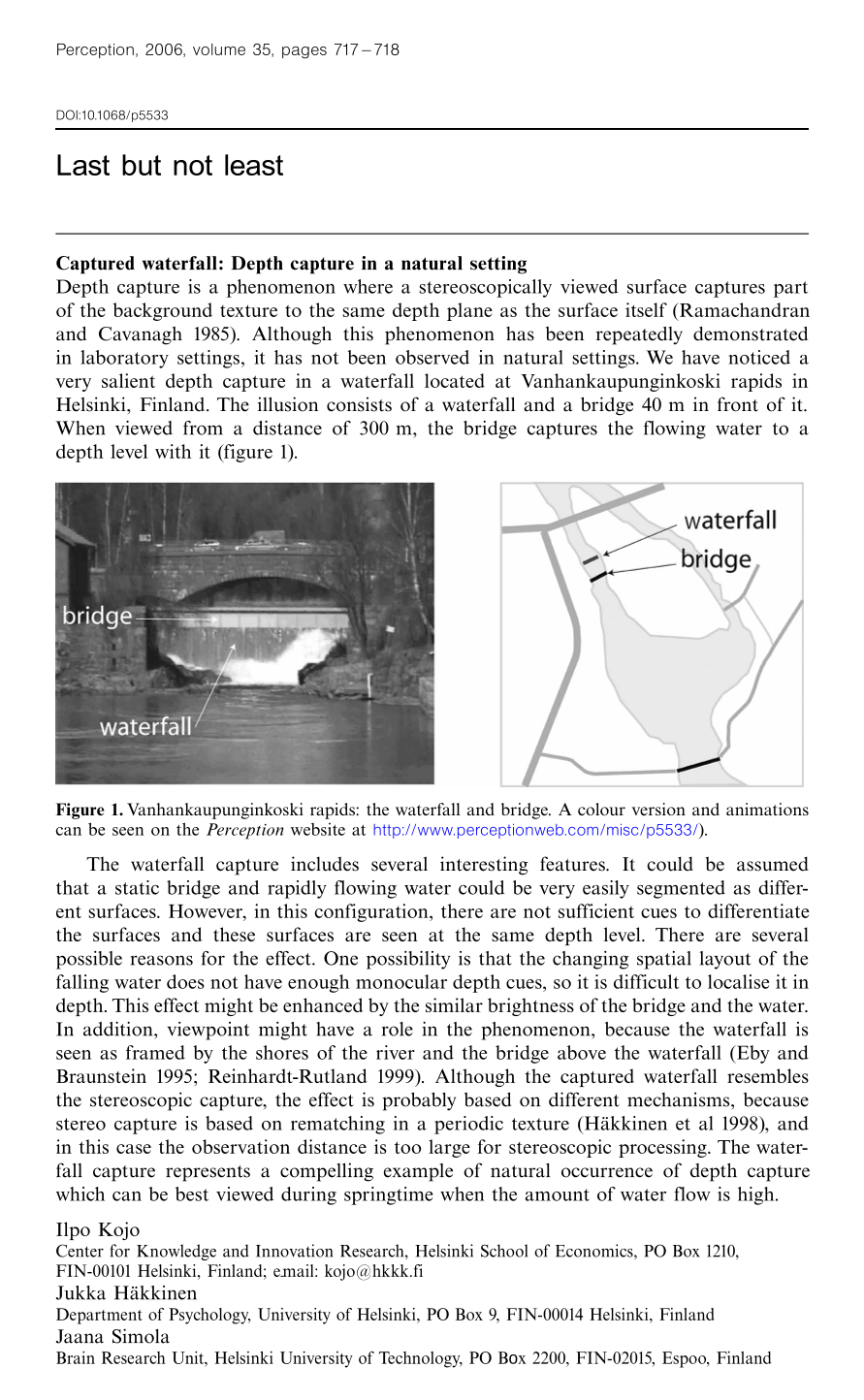
Available accessResearch articleFirst published May, 2006pp. 717-718