Editorial
Select search scope: search across all journals or within the current journal

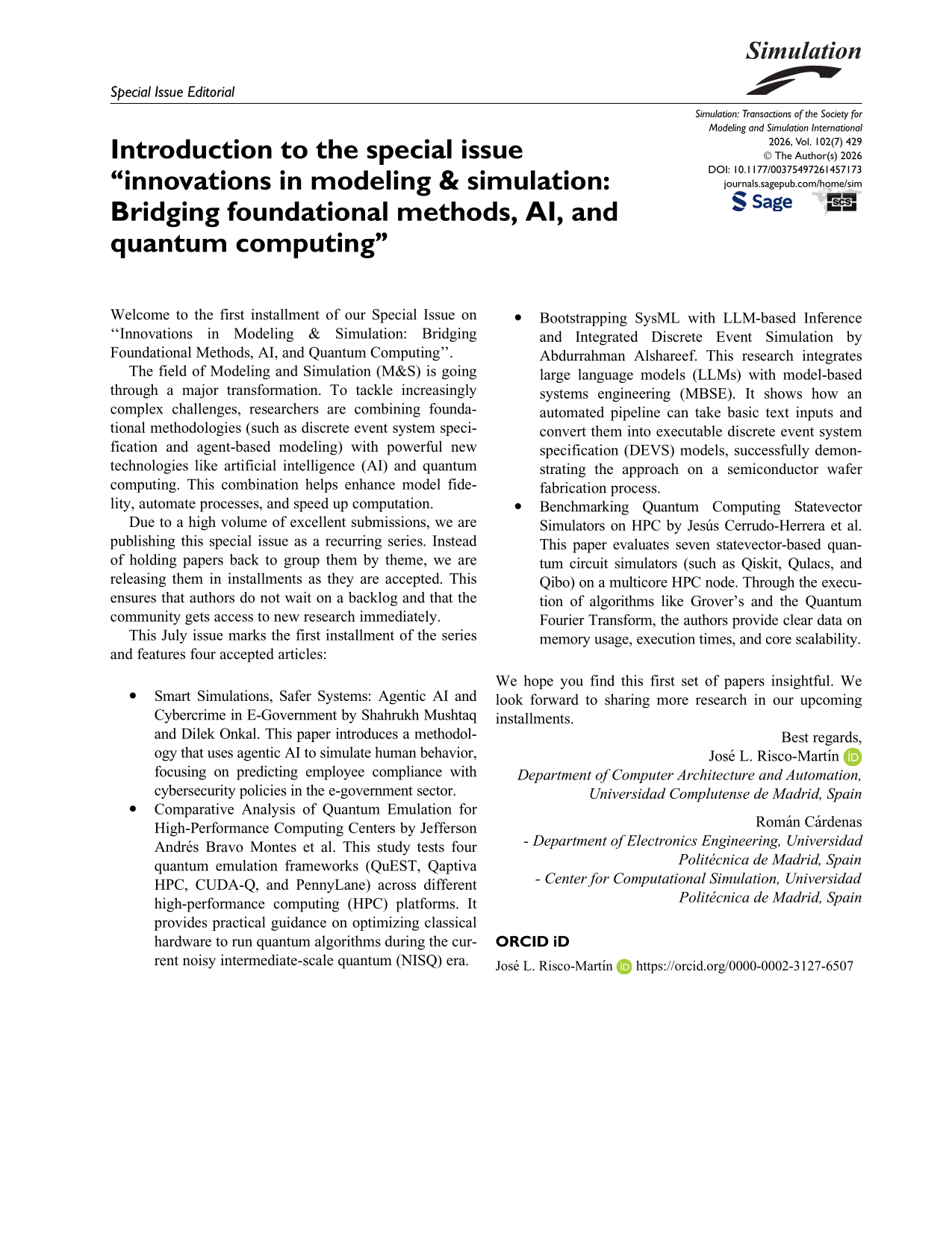
The emergence of agentic artificial intelligence (AI) presents a novel frontier for cybersecurity research, yet its potential to simulate complex human behaviours in controlled environments remains underdeveloped. While extensive literature examines employee compliance with cybersecurity policies, it lacks leveraging agentic AI. To bridge this gap, this study implements a novel four-phase research design to identify the configurations predicting employee compliance intentions (CI) with institutional policies in the e-government sector. The proposed approach integrates agentic AI simulations, where AI agents emulate employee responses to multi-scenario vignettes. The study first employs a grounded theory approach, following the Gioia methodology, to code AI-generated qualitative data into theoretically grounded themes. Subsequently, it utilises AI agents to weight quantitative responses. The analysis reveals distinct behavioural archetypes (i.e. embracers, negotiators and resisters). Finally, it reports fuzzy-set qualitative comparative analysis (fsQCA) to move beyond net effects and uncover specific pathways of conditions that consistently lead to high CI. This work foregrounds agentic AI simulations as a pioneering tool for behavioural analysis. It offers a replicable methodology for investigating complex socio-technical phenomena and suggests new avenues for simulation-based inquiry. This research establishes a conceptual foundation for facilitating theory development and methodological innovation using agentic AI in simulation.
Quantum computing in the NISQ era requires advanced emulation tools to facilitate the development and validation of complex quantum algorithms, as current quantum devices remain too noisy and resource-limited. This work presents a comprehensive review of quantum emulation software available for HPC centers using various comparison metrics to evaluate parallelization, precision, acceleration via Graphics Processing Unit (GPU), emulation with noise, among others. The comparative analysis evaluates four quantum emulation frameworks (QuEST, Qaptiva HPC, CUDA-Q, and PennyLane) across three hardware platforms with distinct characteristics: two HPC clusters (Spartan-Eviden and Joliot-Curie TGCC) and one quantum emulation appliance (Eviden Qaptiva 804). The scope of this analysis is fundamentally tied to the state-vector emulation paradigm. The experimental results of our evaluation reveal that performance depends on classical hardware configuration and circuit characteristics, that is, CUDA-Q excels in single-GPU environments, while Qaptiva HPC shows advantages in distributed multi-node configurations (both CPU and GPU).
The demand for systems engineering methodologies with integrative artificial intelligence (AI) has been increasing. Model-based systems engineering offers a disciplined, structured methodology. However, it encounters difficulties with semantic interpretation and domain adaptation, especially across different contexts. In this work, we examine the potential of generative AI to address this challenge. We implement a dual approach to enrich the modeling experience by incorporating domain adaptations via large language models and executable semantics via discrete-event simulation. The result is a bootstrapped, end-to-end automated system model construction from minimal entry points, featuring built-in, generic executable capability that adheres to the simulation-to-production system principle. We will demonstrate how a user of such an approach can produce a sound, semantically rich model with advanced simulations from a minimal textual entry. We also discuss mechanisms for incorporating knowledge and expertise through a convenient yet effective human-in-the-loop integration. We demonstrate the approach through a detailed semiconductor wafer fabrication experiment and further illustrate its generality across diverse domains through extensive generative and simulation-based evaluations.
The increasing complexity of quantum algorithms and the limitations of current Noisy Intermediate-Scale Quantum (NISQ) hardware underscore the importance of efficient classical simulators. To support informed decision-making by users of quantum circuit simulators, we benchmark seven statevector-based quantum circuit simulators (Qiskit, Qulacs, Qibo, Qsimov, Cirq, Pennylane and the Intel Quantum Simulator (IQS)) on a multicore node of the Lusitania high-performance computing (HPC) system. We evaluate their performance in terms of execution time, memory usage and core scalability using Grover’s algorithm, the quantum Fourier transform (QFT), and quantum volume (QV) circuits, across qubit counts ranging from 3 to 30. Our results reveal that Qulacs offers the best performance for circuits below 22 qubits, while Qiskit becomes the fastest for larger and more complex circuits. Qiskit and Qulacs achieve the most efficient parallel performance across multiple cores, while others display limited scaling benefits. IQS shows the lowest memory consumption in QFT and QV benchmarks for systems under 24 qubits; however, it suffers from higher execution times, particularly for Grover’s algorithm. The experimental implementation of Qsimov consistently underperforms in both runtime and scalability; for this reason, it is employed as a baseline in our measurements, serving to highlight the importance of performance optimizations in statevector-based quantum circuit simulators. Previous findings provide a comprehensive performance landscape to guide researchers in selecting appropriate simulators for both standard and large-scale quantum workloads on HPC infrastructures.