







Abstract
A new sampling protocol was developed to overcome the difficulties in sampling viscous unconsolidated mine tailings. This new procedure involved collection of the entire drill sample from the drill rig cyclone, (approximately 15 kg) which is delivered to the sample preparation laboratory where it was dried, crushed and subsampled. Comminution and subsampling parameters were deduced by estimating the fundamental sampling error and construction of the sampling nomogram. Based on this analysis, the optimal protocol was designed as follows:
Drying the entire 15 kg sample at 60°C Reporting of sample mass and free moisture content Crushing of entire sample to 90% passing − 2 mm Use of a rotary sample splitter to collect a 3 kg subsample Pulverising the entire 3 kg subsample to 74 µm Collecting of a 50 g aliquot for fire gold assay with atomic-absorption finish
The quality of sampling was rigorously monitored using sample duplicates, blanks and standards, which have confirmed the accuracy and repeatability of the data. Correlation between field duplicates and original samples was high at 98% with a precision error of 19.8%, which is considered excellent for gold mineralisation. The high quality of the data was important for the accurate evaluation of the project, and enabled the confidence in classifying a significant part of the mineralised endowment as an indicated resource.
Introduction
The Mount Morgan tailings retreatment project is located in Central Queensland, approximately 35 km southwest from Rockhampton and 500 km north from Brisbane (Figure 1). The project includes four historical mine tailings dumps referred to as No 2 Mill, Mundic Gully, Shepherd's Gully and Red Oxide (Figure 1), with gold grades varying in a range from 0.8 to 2.2 g t−1 gold. The potential economic value of these tailings have been recognised previously; however, accurate valuation of the project was hampered by difficulties encountered in drilling and sampling of the wet and unconsolidated tailings material. In particular, conventional subsampling devices routinely used during reverse circulation (RC) drilling were considered inapplicable for sampling of the Mount Morgan tailings because wet and viscous clay rich material cannot be subsampled using the conventional riffle or cone splitters. To overcome these sampling difficulties, a new sampling protocol was developed by Carbine Resources and implemented during the Feasibility Study of the Mount Morgan tailings retreatment project.
Mount Morgan tailings dump location map.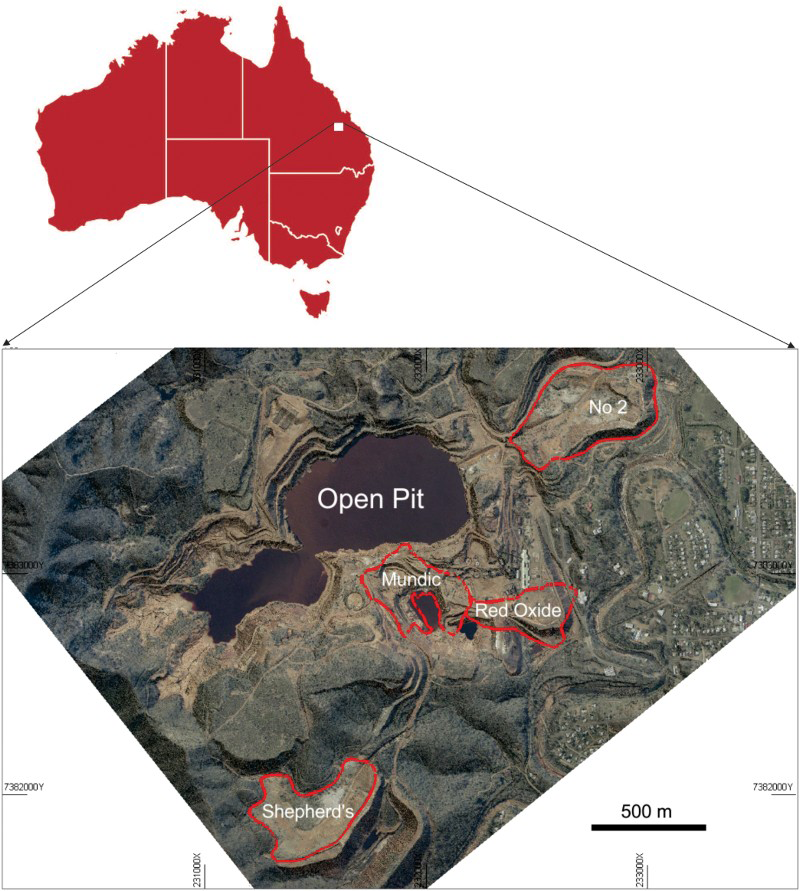
Project background
The historical mine tailings have been deposited over a 100 years from 1882 to 1981, from the mining and processing of the high grade gold–copper–pyrite ores from the Mount Morgan deposit. The tailings dumps have gradually been filled from the residual products of mineral processing, forming the stratified structure of the tailings mineralisation (Figure 2).
Oblique cross-section through the Shepherd's Gully tailings dump (location of section is shown in the insert): (a) distribution of gold in the drill holes and (b) estimated block model gold grade.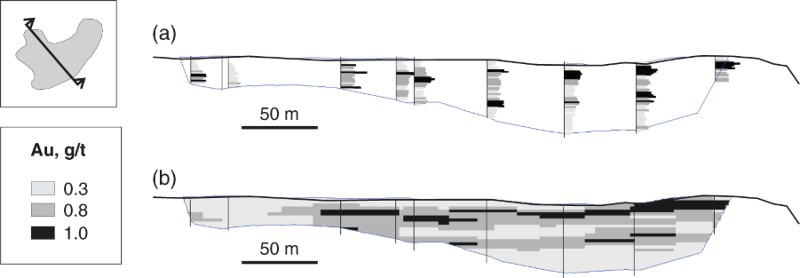
Understanding of the tailings deposition procedure implied the following interpretations:
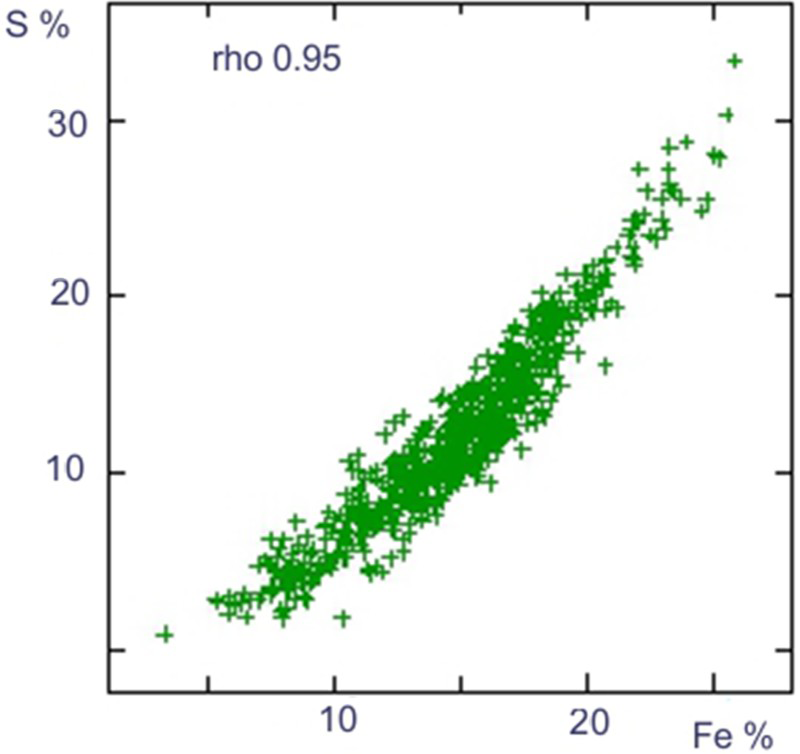
Two types of the tailings materials are identified as being red oxide tailings and sulphidic tailings. They have been discharged to the tailings dumps at different times in the history of the project from different metallurgical processes. Red oxide tailings are hence considered a separate domain, deposited below the footwall of the sulphidic tailings. Tailings were discharged evenly creating a stratified structure to the tailings mineralisation, forming thin quasi-horizontal layers and lenses of different composition (Figure 2). Gold grade appears a good continuity in the horizontal direction with significantly higher variability in the vertical direction (Figure 2). Pyrite is a key mineral within the sulphidic tailings. Sample assay data demonstrate a strong correlation between S% and Fe% which is consistent with a stoichiometric composition of pyrite (Figure 3). Sulphur vs iron scatter-diagrams constructed using Shepherds Gully tailings data (‘rho’ denotes coefficient of correlation).
Drilling and sampling
The tailings dumps were sampled using mostly RC drilling techniques. Coring was utilised in places where unconsolidated and overly soft material was encountered to ensure consistency in the best possible sample recovery.
Optimal drilling grids for classification resources into different categories were determined using geostatistical techniques. The geostatistical approach provides a quantitative measure of the resource estimation uncertainty. However, at present, there is no a single and universally accepted methodology for estimation the resource model uncertainty and there is no consensus among the resource estimation specialists regarding classification criteria and the levels of the errors which can be used as the thresholds for definition of the resource categories. The geostatistical criteria commonly used for the resources and reserves classification are as follows (Abzalov 2016):
kriging variance estimates of the kriging efficiency estimation variance of the resource blocks using conditional simulation probability estimates extension variances.
Most commonly used classification approaches are based on relating the resource uncertainties with the mine production volumes (Abzalov 2016). This approach is used in this project for classification resources of the Mount Morgan tailings. Underlying principle of the method is quantification of uncertainties in estimated tonnage and grade of the ore blocks which size is determined from the mine production plans. Most commonly these are annual and quarterly production volumes which are used as the reference points for classification resources into indicated and measured resources.
This approach was used in the current study for classification resources of gold distributed in the historic tailings at the Mount Morgan. The uncertainty was estimated using sequential Gaussian conditional simulation technique. The following criteria were applied for classification resources:
Measured resources are defined by estimating uncertainty of the mineralised bodies whose volume is equal to the quarterly production. The estimation error should not exceed threshold of ±15% at 95% confidence limits; Indicated resources are defined by estimating uncertainty of the parts of the deposit equal to the annual production volumes. It should be estimated with ±15% error at 95% confidence limits; Inferred resources include mineralisation for which global tonnage and grade are estimated with 30% uncertainty at 95% confidence limits.
Based on this study, the distances between the drillholes were kept in the range of 30–40 m that has allowed to classify resources into indicated category. The holes were in average 20 m deep and sampled at 1 m intervals.
Obtaining representative samples from RC drilling can be challenging as conventional subsampling devices that are routinely used are considered inappropriate for sampling wet viscous materials. The project team needed to develop a new sampling protocol that would overcome these difficulties.
A new procedure was developed that was based on the collection of the whole drill sample (totalling approximately 15 kg) from the drill rig cyclone. The obtained sample was then delivered in its entirety to the sample preparation laboratory, where it was dried and weighed. The dry sample was further processed in the laboratory following the theoretically deduced optimal sampling protocol.
Sample preparation and assaying
Every sample collected from the drill rig cyclone is approximately 15 kg in weight which is too large for pulverising in its entirety. Thus, it was necessary to find the optimal comminution (crushing and grinding) and subsampling (reduction) parameters, which will allow cost-effective sample preparation that assures the high precision (repeatability) of the assay results. Design and optimisation of the sampling protocol was made by estimating the fundamental sampling error (FSE) and finding the parameters producing the lowest practically achievable FSE values (Francois-Bongarcon 1993; Pitard 1993).
Designing the protocol
FSE is estimated using the formula (Equation (1)) (Francois-Bongarcon 1993)
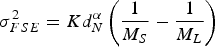
 – fundamental sampling error;
 – a nominal particle size in centimetres. This is the diameter of a mesh retaining the upper 5% of particles.
 – mass of sample in grams.
 – mass of lot in grams. K and
 – sampling constants.
Parameters (K) and (
 ) are constants with specific characteristics to the given mineralisation and they can be estimated experimentally (Francois-Bongarcon 1993). However, when experimental data for the accurate determination of the (K) and (
 ) constants are not available, the FSE can be approximated using default values (Francois-Bongarcon 1993). In particular, the FSE of gold mineralisation is commonly estimated using the values of K = 470 and
 , the suggested default values for gold deposits (Francois-Bongarcon 1993). These default parameters were used in this study.
The protocols are commonly expressed as a sampling nomogram which relates FSE with the sample weight and stage of comminution (Francois-Bongarcon 1993; Pitard 1993). The sampling nomograms were constructed using Excel spread-sheet available from Abzalov (2016) and optimal protocol that produces the desirable sampling error at the lowest cost was chosen. The nomogram of the protocol that was chosen for implementation at the Mount Morgan project is presented in Figure 4.
Nomogram of the sampling protocol proposed for the Mount Morgan project.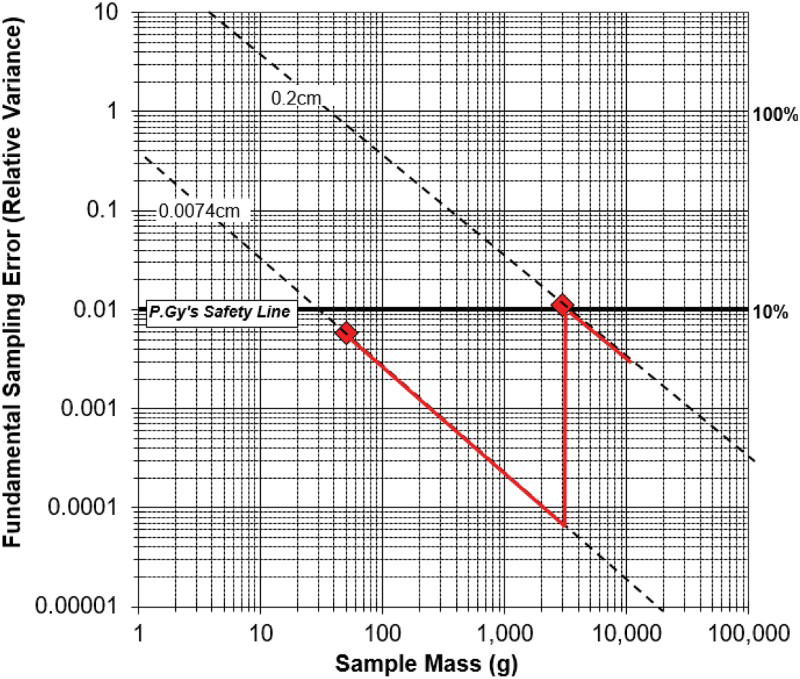
This protocol produced the best practically achievable repeatability (i.e. lowest error) of the gold assays (Figure 4). According to this protocol, the total FSE of the sample preparation procedure is 13.1%.
Practical implementation
Sample preparation
The protocol expressed as the nomogram in Figure 4 was implemented into the actual sampling procedures at the laboratory, which were as follows:
Drying the entire 15 kg sample at 60°C Reporting of sample mass and free moisture content Crushing of entire sample to 90% passing − 2 mm Use of a rotary sample splitter to collect a 3 kg subsample Pulverising the entire 3 kg subsample to 74 µm Collecting of a 50 g aliquot for fire gold assay with atomic-absorption finish
Practical implementation of the protocol included the choice of equipment used for grinding and reduction (subsampling) of the samples.
Assaying
Aliquots are dissolved using four acid digest (near complete dissolution) and peroxide fusion (complete dissolution). Results are compared one digest against the other.
Gold was assayed using conventional fire-assay methods with atomic-absorption finish. Reported detection limit is 0.01 g t−1 gold.
Cu, Ag, Fe and S have been analysed by inductively coupled plasma atomic emission spectroscopy (ICP-AES) (post aqua regia digestion) to determine approximate levels of chalcopyrite and pyrite. Detection limits are 0.2 ppm for Ag, 1 ppm for Cu, 0.01% for Fe and 0.01% for S. Total sulphur and sulphide–sulphur by LECO analysis was conducted on several holes to validate the ICP sulphur results for S > 10%.
Sample quality control
For both subsampling stages, duplicate samples were collected and analysed. Namely:
coarse duplicates, collected after 15 kg sample was ground to 2 mm fraction and reduced to 3 kg subsamples pulp duplicates, collected after the entire 3 kg subsample was pulverised and 50 g aliquot is taken.
QA/QC procedures also include using industry standard samples and blanks. Historic drilling was validated by drilling of twin holes.
Coarse duplicates
In total, 303 coarse duplicates were collected during the recent drilling campaign. The correlation between these duplicates and the original sample was 0.98, and precision error estimated as CV% was 19.8 (Figure 5(a)). This is significantly better than average precision of samples collected at the gold deposits, which commonly exceeds 30% (Abzalov 2008, 2016). Thus, the precision of samples achieved at the Mount Morgan project is considered as an example of the industry best practices.
Scatter-diagrams comparing the gold grade in the original sample and its duplicate: (a) field duplicates and (b) pulp duplicates.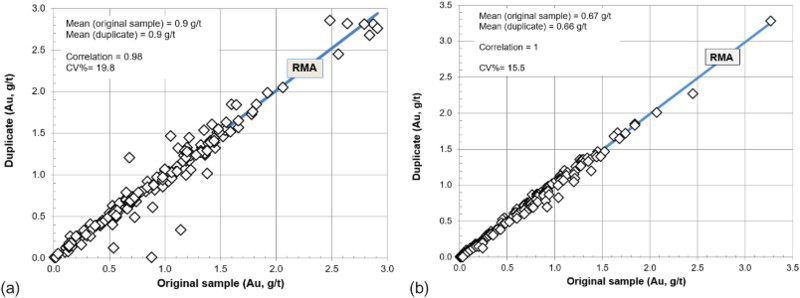
The precision error estimated from the field duplicates is comparable with the theoretically predicted FSE of 13.1% (Figure 3). This verifies validity of the chosen approach of optimising the sampling protocol which was deduced by estimating the FSE using the default values of the sampling constants (K and
 ).
).
Pulp duplicates
One hundred and seventy-eight pulp duplicates have been collected and analysed. Results, plotted on the scatter-diagram (Figure 5(b)), show excellent repeatability of the gold assay results, with a correlation coefficient equal to 1.
Standards and blanks
Standards and blanks were used throughout the programme to assess the accuracy and potential sample contamination in both the laboratory and the field. The supervising geologist ensured the insertion of both a blank and a certified standard at a minimum of 1 in 20 samples. Three certified reference materials (CRMs) were sourced from Geostats Pty Ltd of Perth
blank comprising 4 mm of crushed basalt, low Au grade standard (G314-4, 0.14 ppm Au, SD of 0.02 ppm) and standard near the projected deposit Au grade (G312-5, 1.60 ppm Au, SD of 0.11 ppm Au).
Except for evidence of minor contamination noted in some blanks on a small subset of samples early in the programme, no significant issues were identified by assays of CRMs and blanks.
Twinned holes
Several twin drill holes were completed to confirm the validity of the historic data. No biases were detected.
Conclusions
The new sample preparation procedure based on the collection of the entire sample from the drill rig cyclone, and delivery to the sample preparation laboratory where it was dried, crushed and subsampled following the theoretically deduced protocol has resulted in a significantly minimised precision error. Correlation between the field duplicates and original sample is 0.98, and the gold assay precision error (measure of repeatability of the sample assay) estimated as CV% is 19.8. This is considered excellent for gold mineralisation. The high quality of the data was important for the accurate evaluation of the project, and enabled the confidence in classifying a significant part of the mineralised endowment as an indicated resource.
Footnotes
Acknowledgements
The authors wish to thank T. Pilcher who was instrumental in the supervision of field data collection and sample handling in the sample preparation laboratory. The authors also thank the colleagues from the Carbine Resources and two anonymous reviewers who critically reviewed the paper and made useful comments. Permission for publishing this paper by Carbine Resources is gratefully acknowledged.
Disclosure statement
No potential conflict of interest was reported by the authors.