







Abstract
The present work reported a strategy involving the preparation of polypropylene (PP)/organic montmorillonite (OMMT)/poly(ethylene-co-octene) (POE), POE grafted with maleic anhydride (POE-g-MAH), and POE grafted with MAH and 2-hydroxy ethyl acrylate (POE-g-MAH/HEA) nanocomposites. The results of FTIR, X-ray diffraction, transmission electron microscopy, and SEM analyses show that the compatibilisation effect of POE-g-MAH/HEA was better than that of POE-g-MAH and pure POE, which can greatly increase intercalation and exfoliation for the clays. Correspondingly, the compatibiliser can significantly improve the notched impact strength and thermal stability of PP/OMMT nanocomposites and simultaneously effectively inhibit the decrease in the tensile strength. However, the heterogeneous nucleation of the clay nanosheets on PP was obviously inhibited by the presence of the POE-g-MAH/HEA.
Introduction
Polymer-layered silicate nanocomposites exhibit excellent properties and have been considered to be some of the most important commercial plastics [1]. A small amount of nanoclays can be dispersed into the polypropylene (PP) matrix to form nanoscale structures that can improve the mechanical, crystallisation, thermal stability, injection, and flame-retardant properties, attracting intense attention in the field of composites [2-5]. However, the good dispersion of clays in the PP matrix, which is key for obtaining good physical properties of the nanocomposites, is hindered by the poor interfacial compatibility between natural montmorillonite (MMT) and PP that leads to the macromolecular chains not having sufficient intercalation driving force.
Layered silicate clays such as MMT have been widely used in current nanocomposites. To enable the non-polar polymers to enter the interlayers of the clays, the clays must be modified by an organic modifying agent with long alkyl chains to organo-montmorillonite (OMMT) [6]. Chandramouleeswaran et al. [7] reported that polyetheramine had reduced the polarity of the clay and increased the interaction between the PP matrix and the filler. Peng et al. [8] suggested the modification of MMT with the octadecylamine via a wet process to obtain a large d-spacing and reported that the PP-based composites incorporating these nanoclays showed excellent mechanical properties. Furthermore, the addition of double-modified MMT is another effective method [9].
The polypropylene grafted with maleic anhydride (PP-g-MAH) is the most common compatibiliser of the PP/OMMT system owing to the low cost and high reactivity of MAH [2, 10, 11]. MAH can form hydrogen bonds or chemical bonds with oxygen radicals or negative charges on the clay surface, which may promote the intercalation and exfoliation of nanoclay in the polymer matrix [12, 13]. The PP-g-MAH is prepared by the common melt blending method, but results in severe fracture of the PP backbone together with a low grafting degree of MAH, limiting its application. Literature reports suggested that the addition of additives or co-monomers, such as furan and thiophene derivatives [14], diallyl phthalate [15], and styrene [16], is often employed to solve these problems.
Poly(ethylene-co-octene) (POE) markedly improves the impact toughness of the PP matrix but reduces its strength to various degrees [17, 18]. This has motivated researchers to investigate elastomer, PP and MMT for the preparation of new composites in order to obtain high-performance materials [19, 20]. The POE grafted with maleic anhydrid (POE-g-MAH), as a new compatibiliser for the PP/OMMT complex system, exhibits a superior compatibiliser effect compared to that of PP-g-MAH [21]. The boiling point of 2-hydroxyethyl acrylate (HEA) containing –OH and C=O groups is similar to that of MAH, which is expected to be used as a co-monomer. Therefore, this work aimed to compare the effect of pure POE, POE-g-MAH, and POE grafted with MAH and 2-hydroxy ethyl acrylate (POE-g-MAH/HEA) on the crystallisation behaviour, microstructure, and mechanical and thermal stability of PP/OMMT nanocomposites.
Experiment
Materials
Isotactic PP (trade name: T30S) pellets with a melt flow index (MFI) of 3.5 g/10 min (ASTM 1238, 230°C, 2.16 kg) was acquired commercially from the Daqing Petro chemical Co. The OMMT (trade name: DK2) was obtained from the Zhejiang Fenghong Clay Chemical Co. POE (trade name: 8450) was produced by Dow Chemical Co. and shows a MFI of 3.0 g/10 min (ASTM 1238, 230°C, 2.16 kg). Maleic anhydride and dicumyl peroxide were produced by the Damao Chemical Reagent Factory. The analytically pure 2-hydroxy ethyl acrylate was purchased from the Shanghai HaoHua Chemical Co. The MFI and maleic anhydride content of the laboratory-made POE-g-MAH and POE-g-MAH/HEA were 4.5, 1.7 g/10 min (ASTM 1238, 230°C, 2.16 kg) and 0.63, 1.17 wt-% (the results were measured by acid-base titration [22]), respectively.
The preparation of PP/OMMT nanocomposites
PP ((95−N) wt-%), OMMT (5 wt-%), and pure POE, POE-g-MAH, or POE-g-MAH/HEA, N wt-% were well-mixed. All samples were numbered P95-NOM5PN, P95-NOM5PMN, P95-NOM5PMHN (where N were 1, 3, 5, 7, 9). An SHJ-20 twin-screw extruder (Giant Electrical Co., Nanjing, China) with the screw revolution speed 120 r min−1 was used with temperature zones of 190°C, 220°C, 220°C, 225°C, 220°C, and 190°C. Plastic sheets with a thickness of 4 mm were prepared by a plate vulcanisation machine (Suzhou Keshengtai Machinery Co., Suzhou, China) at 200°C and 50 MPa, and then the tensile and impact specimens were obtained on a ZHY-W universal sampling machine (Chengde Dahua Testing Machine Co., Chengde, China).
Measurement and characterisation
The dried films were analysed using a TENSOR27 Fourier transform infrared spectrometer (Bruker Co., Germany) over the wave number range of 4000–400 cm−1.
X-ray diffraction (XRD) was performed in a D8X-ray diffractometer (Bruker Co., Karlsruhe, Germany) used to measure the variation of clay galleries. The samples were scanned in 2θ ranges 0.5–30° at the rate of 1.5°C∙min−1. The layer distance change of nanoclay is determined by the Bragg equation (d001 = λ/2sinθ), where λ is 0.154 nm. The crystallinity (XCX) of sample was calculated according to Equation (1):

Transmission electron microscopy (TEM) measurements were performed using an FEI Tecnai G2 F20 high-resolution transmission electron microscope (Philip Co., Amsterdam, Netherlands), and samples with the thickness of approximately 50 nm were cut at room temperature using a microtome.
Fracture surfaces of the impact test specimens were investigated using an S-4800 scanning electron microscope (JEOL Co.,Tokyo, Japan), and all specimens were sputter coated with gold prior to the examination.
The melting and crystallisation behaviour were analysed using a 200F3 differential scanning calorimeter (Netzsch-Geratebau GmbH Co., Selb, Germany) under nitrogen flow. The samples were heated at the rate of 20°Cmin−1 from 50°C to 220°C and were kept at this temperature for 5 min. Subsequent cooling and heating were performed at the rate of 10°C∙min−1. The crystallinity (XCD) of the samples was calculated according to Equation (2):

Thermogravimetry analysis was carried out using a TG/DTA thermo-gravimetric analyser (PerkinElmer co., New York, USA) under air atmosphere and at the heating rate of 15°C min−1.
Rheological measurements were performed using a Physica MCR301 rheometer (Anton Paar Co., Graz,Austria) fitted with a parallel-plate geometry using 25 mm diameter plates at 200°C and 1 mm gap. The shear rate ranged from 10−2∙s−1 to 102∙s−1, and a strain of 0.5% was used for all samples.
The notched impact strength tests were performed according to ASTM 256 using an XJJ-50 impact testing machine (Chengde Dahua Testing Machine Co., Chengde, China) at room temperature. The composite tensile strength modulus measurement was performed according to the ASTM D790 by a WDW3050 electron tensile testing machine (Changchun Kexin Automation Co.,Changchun, China) with the crosshead speed of 50 mm∙min−1.
Results and discussions
FTIR analysis
The FTIR spectra of pure PP and its nanocomposite are shown in Figure 1. The characteristic bands observed at 3430 cm−1 and 2923, 2849, 1475 cm−1, and 1038 cm−1 in the FTIR spectra for OMMT shown in Figure 1 (curve a) correspond to the symmetric stretching of O–H in the clay interlayers, the symmetric stretching, asymmetric stretching, shear vibration of C–H and the skeleton vibration of Si–O–Si, respectively [23, 24]. The new bands at 1865 cm–1, 1780 cm–1, and 1712 cm–1 for POE-g-MAH and POE-g-MAH/HEA that were absent in neat POE were assigned to the characteristic absorption of the acid anhydride and carbonyl groups, respectively. It was also noticeable that the band of the carbonyl group at 1712 cm–1 was shifted lower to approximately1697 cm–1, while the peak at 1865 cm–1 associated with acid anhydride in MAH shifted lower to 1834 cm−1 in Figure 1 (curve f). The above similar variations are also observed in Figure 1 (curve g). This could be due to the increase in the extent of the hydrogen bonding interactions between the compatibilisers and clay platelets.
FTIR spectra of: (a) OMMT; (b) POE; (c) POE-g-MAH; (d) POE-g-MAH/HEA; (e) P90OM5P5; (f) P90OM5PM5; (g) P90OM5PMH5.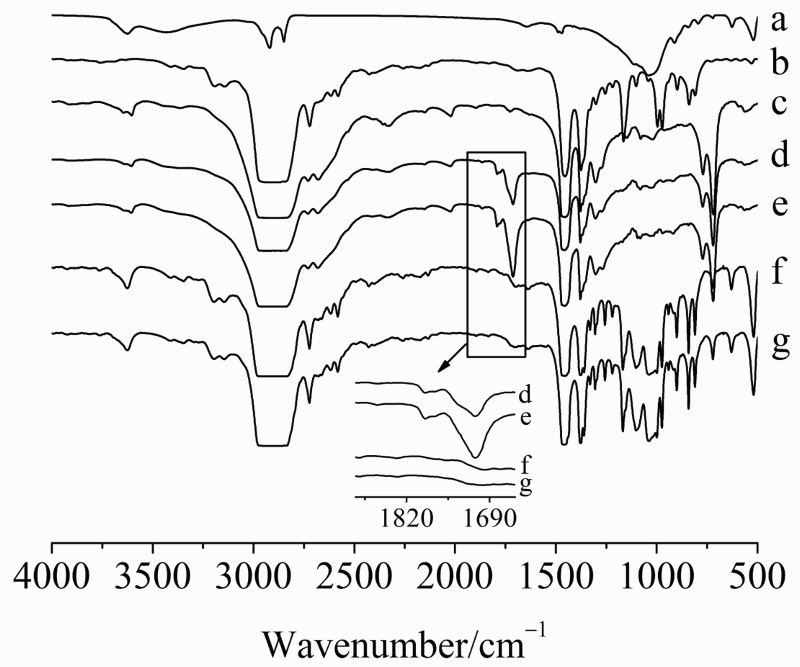
XRD analysis
Achieving a uniform dispersion of the nanoclay in the polymer matrix has been considered to be critically important to the preparation of high-performance polymer nanocomposites [8-10]. The low-angle XRD patterns for OMMT and its composites are shown in Figure 2(a). The X-ray pattern of OMMT (001) has the characteristic diffraction peak at 2θ = 4.2° (2.1 nm). It can be seen that the P90OM5P5 nanocomposite shows an increase in the basal spacing of clay layers compared to the OMMT, but the intensity of the diffraction peaks is not diminished. The results indicate the formation of an intercalated structure nanocomposite; however, sheet stacking is more serious. A high shear rate can suppress the OMMT accumulation [25], but this results in the shortening of the residence time of melt and insufficient PP intercalation. We observed that the characteristic diffraction peak of the OMMT (001) was further shifted to a low angle 2θ = 2.0° (4.3 nm), and its intensity decreased when POE-g-MAH was added, indicating that the nanoclays were wrapped, intercalated, and exfoliated by this compatibiliser during the processing. The small weak peak at 2θ = 1.6° (5.1 nm) was observed in the P90OM5PMH5 nanocomposite, illustrating that the addition of POE-g-MAH/HEA further promotes exfoliation/intercalation of the clay platelets in the polymer matrix [26]. In addition, it is also noticeable that weak secondary diffraction peaks at 2θ = 4.0°–5.0° were observed in these nanocomposites. This indicates that there is a small amount of clay stacks of the original spacing remaining in the PP matrix.
(a) Low-angle XRD patterns of OMMT, P90OM5P5, P90OM5PM5, and P90OM5PMH5. (b) Wide-angle XRD patterns of pure PP, P90OM5P5, P90OM5PM5, and P90OM5PMH5.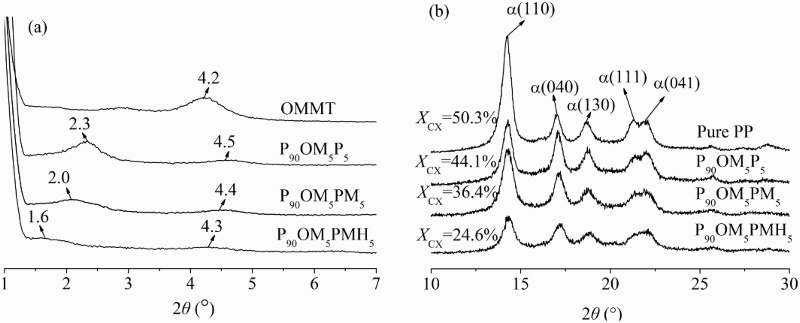
The wide-angle XRD patterns of pure PP and its nanocomposites are shown in Figure 2(b). These samples all show diffraction peaks at 2θ of approximately 14.2°, 16.8°, 18.4°, 21.0°, and 21.8°, corresponding to the (110), (040), (130), (111), and (041) diffraction planes of a typical α-monoclinic structure [11]. However, compared to pure PP, the diffraction peak intensities of P90OM5P5, P90OM5PM5, and P90OM5PMH5 decreased successively with this changing trend, which was also found in the corresponding crystallinity values. This result may be due to the dispersed clay platelets hindering the chain-segment diffusion, migration, and arrangement during melting crystallisation, especially for the POE-g-MAH/HEA compatibilised case.
TEM analysis
Usually, the TEM observations can be used in conjunction with XRD analysis to further determine the dispersivity of the nanoclay in the polymer matrix [2, 9, 12, 27]. TEM images of the PP-based nanocomposites are shown in Figure 3. The black lines represent the silicate layers, and the other areas correspond to the polymer matrix. As shown in Figure 3(a), the larger tactoids and few intercalated structures of clay layers could be detected in the P90OM5P5 matrix. Comparing Figure 3(b) and (c), randomly dispersed clay nanolayers with better distribution of P90OM5PMH5 nanocomposites were observed, probably owing to the enhanced interfacial interactions between the PP matrix and the clay platelets under the influence of the higher grafting maleic anhydride content in POE-g-MAH/HEA compatibiliser, in agreement with the XRD results [28].
TEM micrographs of: (a) P90OM5P5; (b) P90OM5PM5; and (c) P90OM5PMH5.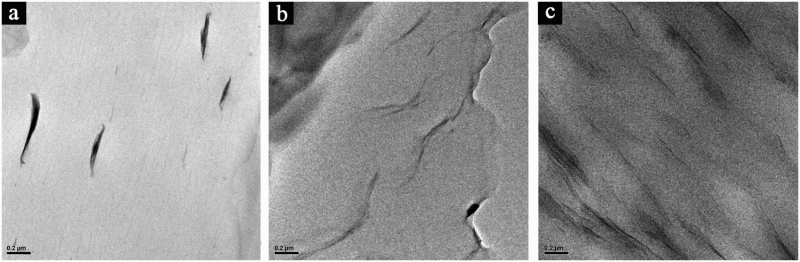
SEM analysis
The SEM images of impact section surfaces of the PP-based nanocomposites are shown in Figure 4(a–c). From Figure 4(a), we observed some intercalated/exfoliated clays dispersed in the PP matrix, but the poor compatibility between OMMT and the polymer matrix caused large-scale aggregates. The elastomers and clays were debonded, resulting in the hollowing of the matrix resin under external shock, which resulted in shear yield and prevented the further expansion of the cracks [29]. By contrast, the clay dispersion size was significantly reduced after the addition of the POE grafter, especially POE-g-MAH/HEA, which made exfoliated/intercalated nanosheets embedded in the polymer matrix more even; its fractured surface exhibited typical tough fracture features, showing that this compatibiliser had a good compatibilisation and synergistic toughening effect for the PP/OMMT nanocomposite system. Meanwhile, a similar compatibility change was observed in Figure 4(d–f). In particular, we noted that tight bonding between the nanoclays and the polymer matrix was still evident in Figure 4(f) even after the stretching process.
SEM micrographs of impact section surfaces and tensile fracture side surfaces of: (a) and (d) P90OM5P5; (b) and (e) P90OM5PM5; (c) and (f) P90OM5PMH5.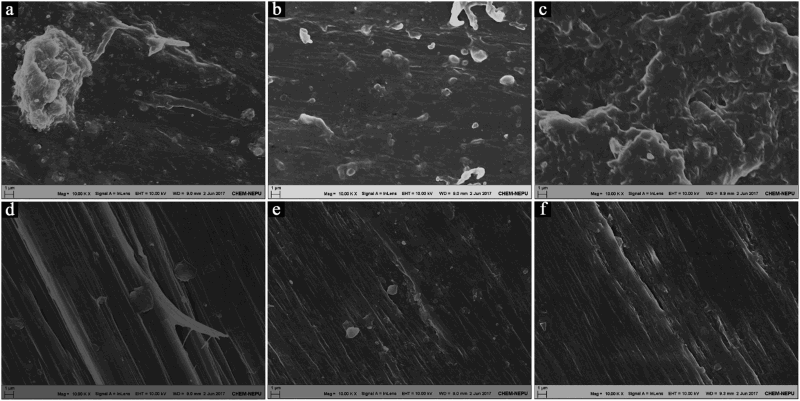
DSC analysis
Figure 5 shows the DSC thermograms of pure PP and its nanocomposites. It can be seen that the crystallisation temperature of P90OM5P5 was increased by approximately 5° compared to neat PP, but that of P90OM5PMH5 was approximately 1°C lower than that of pure PP; correspondingly, its XCD is minimal. The nanoclays are known for their significant promoting effect on the crystallisation of PP, facilitating the rapid crystallisation of the polymer at higher temperatures and causing grain refinement [30, 31]. However, the heterogeneous nucleation was reduced because of the clay being wrapped in the compatibiliser; at the same time, the clay nanosheets hinder the diffusion and the rearrangement of the polymer chains for crystallisation [32, 33]. The DSC results support and confirm the aforementioned XRD results for the crystallinity of PP. In addition, the addition of 5 wt%- POE and grafted POE does not have a significant effect on the melting temperature of PP.
(A) Crystallisation curves and (B) melting curves of: (a) pure PP; (b) P90OM5P5; (c) P90OM5PM5; and (d) P90OM5PMH5.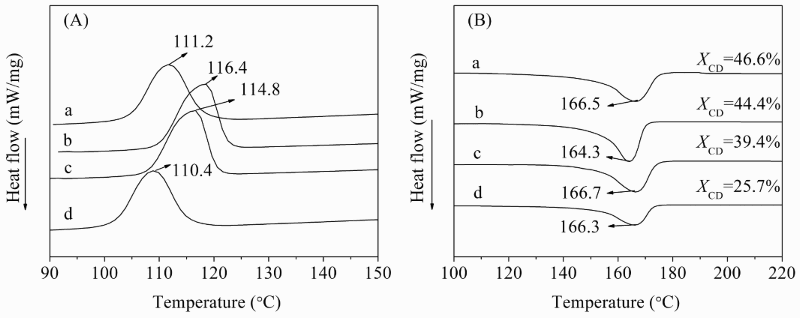
TG analysis
It is universally acknowledged that nanoclays can greatly improve the thermal stability of PP because clay nanosheets can suppress the heat diffusion and movement of polymer chains and ultimately increase the thermal degradation temperature [3, 27]. The TGA curves of PP and its nanocomposite are shown in Figure 6. It is revealed that the thermal stability of the nanocomposites was significantly improved compared to pure PP. The temperature corresponding to 5 wt-% weight loss for neat PP was recorded as 256.7°C, while those of P90OM5P5, P90OM5PM5, and P90OM5PMH5 were raised by approximately 29.7°C, 23.9°C, and 32.1°C, respectively. The TGA results were probably due to the co-monomer HEA reducing the degradation of POE main chains while increasing the grafting degree of MAH, facilitating the formation of a more compact three-dimensional nano-network structure by enhancing the interfacial interaction between the nanoclays and PP matrix and resulting in the material with a higher thermal stability [34].
TGA thermograms of pure PP and its nanocomposites.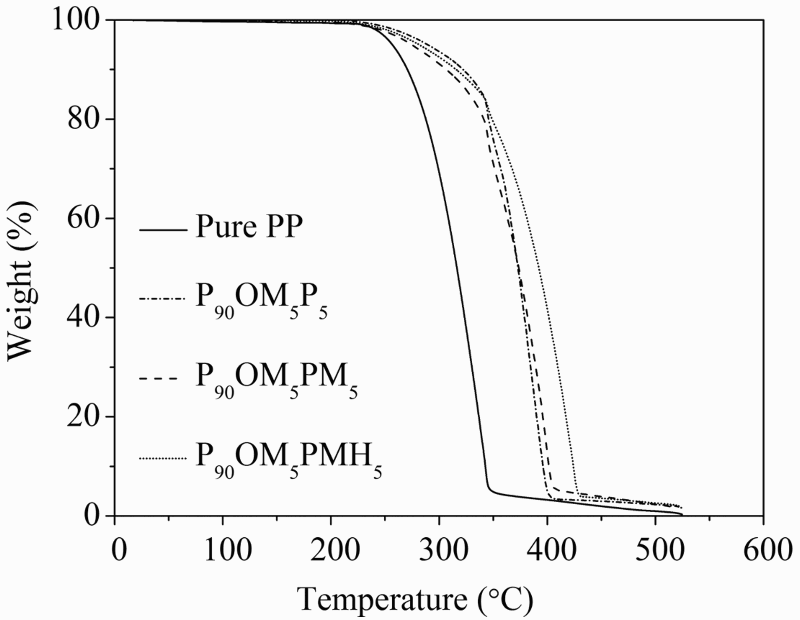
Rheological analysis
Rheological behaviour analysis is an effective method to assess the interfacial characteristics and dispersibility of nanocomposites [35-37]. The viscosity curves of pure PP and its nanocomposites are shown in Figure 7. In the entire explored shear rate range, a significant increase in the viscosity of the nanocomposites compared to that of pure PP can be observed, especially for P90OM5PM5; only the pure PP exhibited a short Newtonian plateau at lower shear rates. As mentioned earlier, this could be due to the better dispersion of the clay in the matrix and/or the strong interfacial interaction between the matrix and the clay owing to the effects of the grafted POE [36]. Zhao et al. [37] suggested that the POE had increased the viscosity of the PP matrix and improved the processing. Furthermore, the increased viscosity had contributed to the exfoliation of the silicate layers, leading to improved dispersion of the clay throughout the PP matrix [38].
Viscosity versus shear rate of pure PP and its nanocomposites.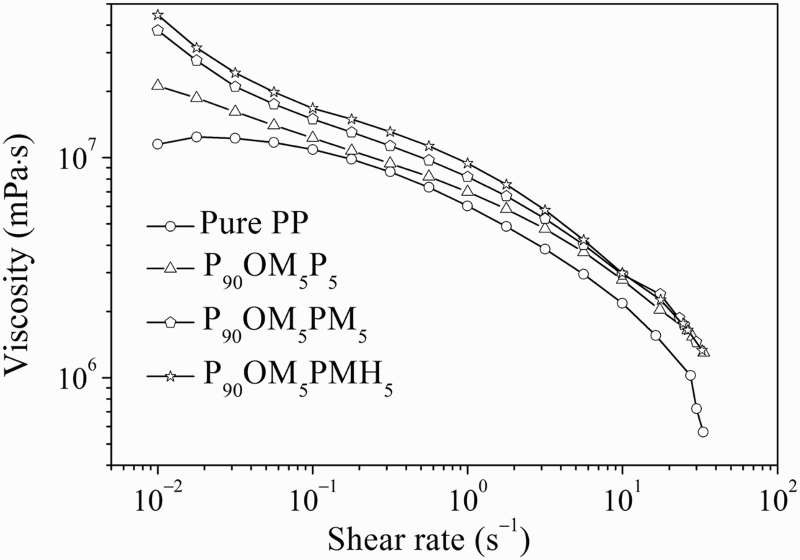
Mechanical performance analysis
The mechanical properties of pure PP and its nanocomposites are shown in Figure 8. Compared to the addition of POE and POE-g-MAH, the notched impact strength was increased strongly with increased compatibiliser from 5.97 ± 0.19 kJ·m−2 for pure PP to 19.62 ± 0.41 kJ·m−2 at 9 wt-% POE-g-MAH/HEA, meanwhile, the tensile strength still kept high at 26.47 ± 0.39%. In addition, the P90OM5PMH5 showed increased stress; however, it was expected that three nanocomposites would show a lower elongation at break than the pure PP. This is probably due to both free compatibiliser and nanoclays can also possess a synergistic toughening effect in the PP matrix. Furthermore, the polymer chains mobility during the stretching process was restricted by the strong interaction between the clay platelets and the polymer matrix [12], as confirmed in the SEM micrographs.
(a) Notched impact strength and (b) tensile behaviour of pure PP and its nanocomposites.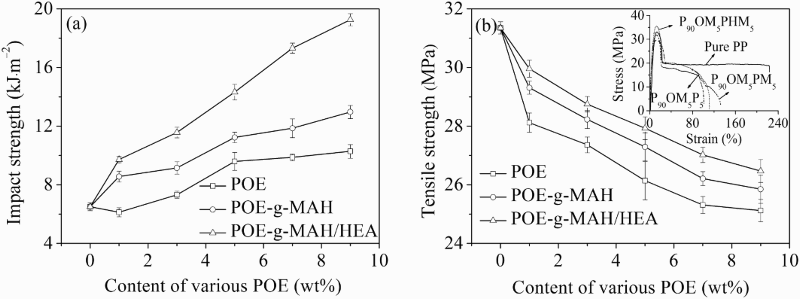
Conclusion
In this paper, the compatibility effect of POE, POE-g-MAH, and POE-g-MAH/HEA on PP/OMMT composites was compared. The results showed that the performance characteristics of POE-g-MAH/HEA were better than those of POE-g-MAH. The crystallisation behaviour of the composite system was sensitive to the type of the compatibiliser. This grafted POE formed the strong interaction with the surface of clay, promoting the dispersion of clay sheets in the PP matrix, the toughness and thermal stability of the materials were dramatically improved, and the reduction in the tensile strength was inhibited. Compatibility and other properties of PP/OMMT composite can be improved by regulating the grafted POE, which provides a reference for the fabrication of high-performance polymer-based nanocomposites.
Footnotes
Disclosure statement
No potential conflict of interest was reported by the authors.