






Abstract
Background
Methods
Results
Conclusion
Keywords
Introduction
Like in most other affluent countries also in the Netherlands cardiovascular disease is the most common cause of mortality, accounting for about one-third of all deaths [1]. Even slight shifts in the prevalence of cardiovascular risk factors such as hypertension and hypercholesterolemia would therefore have a large effect on death rates. As extensive evidence from clinical trials has shown the efficacy of statins and antihypertensive agents in reducing the incidence of cardiovascular events [2–10], there has been a tendency to start preventive treatment earlier and at lower values of blood cholesterol or blood pressure [11, 12]. This is also apparent when one compares the most recent Dutch guideline [13] for cardiovascular risk management with the ones it is meant to replace [14, 15]. An important novelty in the new guideline is the estimation of risk based on a combination of risk factors. In addition, the new guideline does not specify an age limit beyond which statins should not be prescribed, whereas the previous guidelines advised against starting statins in males aged 70 years or above (females aged 75 years or above). Finally, the cut-off value for total cholesterol was lowered from 5 to 4.5 mmol/l (LDL 2.5 mmol/l).
Currently, more than one million individuals in the Netherlands (population: 16 million) use statins as a prophylaxis against atherosclerotic disease, and approximately twice or thrice that number use antihypertensive agents (The Drug Information System of the Health Care Insurance Board estimated the number of statin users in 2004 to be 1 023 000, www.gipdatabank.nl). The criteria of the new guideline for initiating treatment imply that a considerably larger proportion of the population would be eligible for treatment with statins and/or antihypertensive agents than is currently the case. In this study, we estimated the number of additional individuals in different age categories who would require treatment if the guideline is fully implemented. On the basis of that estimate, we assessed the consequences in terms of costs, health gains, and cost-effectiveness.
Methods
Risk assessment: new versus old guideline
In line with the European guideline [16], the new Dutch guideline recommends the assessment of 10-year cardiovascular risk using an adapted version of the Systematic Coronary Risk Evaluation (SCORE) risk function [13, 14, 17]. This formula takes sex, age, smoking behavior, cholesterol level, and blood pressure as input. The adaptation presented in the Dutch guideline consists of a calculation of incidence of cardiovascular disease (i.e. including morbidity and mortality), instead of taking cardiovascular mortality as in the original score. To convert cardiovascular mortality to cardiovascular disease incidence, the Dutch guideline used a mathematical model to determine risk factor-specific conversion factors. A further complication was that the SCORE formula was restricted by its authors to ages up to 65 years but not beyond. The Dutch guideline explicitly states that no age limit applies. Hence, to determine risk for those aged 65 years or above, we assumed the SCORE function remains valid for older age groups.
Treatment is recommended for all individuals who are at a 10-year risk of 10% or higher; within the range of 5-9% risk, treatment is recommended as an option in the presence of additional risk factors.
Determining the increase in the number of treated individuals
Several studies pertaining to risk factor levels among the Dutch population were identified [18–22]. From these, the numbers of individuals were selected who would qualify for treatment with antihypertensives and/or statins according to the new guideline, as well as those already being treated. The difference between these two was then taken as the increase in the number of individuals requiring treatment. As suitable data for the age categories of 70 years and above were not available, we used the same risk factor level distributions as for the age group 65-69 years, assuming that this distribution would remain constant from 65 years of age onwards.
The RIVM Chronic Disease Model
Estimates of health gains [quality-adjusted life years (QALYs)] and cost-effectiveness were derived using the Chronic Disease Model (CDM), a mathematical model that has been developed at our institute RIVM (National Institute of Public Health and the Environment). The CDM simulates the yearly changes in prevalences of risk factors and diseases in the population. The potential effects of health care interventions can be studied by following the shifts that occur in these prevalences over time and the associated changes in health outcomes and health care costs [23–25]. Risk factors and diseases are linked by using the concept of relative risk. The remaining parameters of the model are initial prevalences, 1-year incidence and mortality probabilities, and 1-year transition probabilities of changing risk factor class. The values for these parameters, specified by age and sex, have been derived from a variety of sources, including national and local disease registries, mortality statistics, and the international literature. Demographic figures describing the Dutch population (as at the end of 2004) were obtained from Statistics Netherlands.
Blood pressure and cholesterol are modeled as categorical variables subdivided into eight classes each: first according to level [blood pressure (mmHg)]: < 120, 120- < 140, 140- < 160, and ≥ 160; cholesterol (mmol/l): < 5.0, 5.0- < 6.5, 6.5- < 8.0, and ≥ 8.0, and next according to whether or not drug treatment has been initiated. Information regarding the current distribution of the Dutch population over these eight classes was derived from the sources mentioned above [14, 18, 23, 24, 26].
Endpoints
Endpoints assessed were: cumulative incidences over a period of 20 years of acute myocardial infarction (AMI), other coronary disease, stroke, and all-cause mortality. In addition, life expectancy in years and in QALYs was calculated (by following the cohort to ‘extinction’), as were total costs.
Determination of costs, quality-adjusted life years, and cost-effectiveness
Health care costs are calculated in the CDM [27] on the basis of average costs of illness stratified by age and sex as estimated by the so-called second Dutch Cost-of-Illness Study [28]. Intervention costs, used as input to the model, were taken to include costs of diagnostics (in the first year only) and doctor's visits, repeat prescriptions, and drug costs. Using unit costs as valid for the Netherlands, this led to estimates of € 293 per year (€ 331, in the first year) for the use of statins, and € 258 (€ 286) for treatment with antihypertensives. All cost calculations were carried out from a health care perspective and did not include societal costs because of productivity losses. Apart from intervention costs, the calculation of total costs also included subtraction of cost savings from reductions in causally related diseases and addition of costs for causally nonrelated diseases in life years gained.
To adjust life years for quality of life (to derive QALYs), disease-specific disability ‘weights' were used that were determined recently in the context of a Dutch implementation of the Global Burden of Disease Study [29]. Applying these weights (or actually 1 minus the weight) yields 1 QALY in case of a year lived in full health, or a fraction of a QALY for a year spent in ill health, the more severe the disease the lesser the fraction (zero representing death).
In calculating cost-effectiveness, costs were discounted at 4% and QALYs at 1.5% [30]. Following the current Dutch recommendations for health economic assessment, a ratio of 20 000 € per QALY was taken as the threshold for cost-effectiveness [31].
Scenarios
Endpoints were compared running two different scenarios: continuation of the current situation (reference scenario) versus implementation of the new guideline. It was assumed that everyone meeting the criteria for treatment would receive treatment for their remaining lifetime.
Sensitivity analyses
Sensitivity analyses were performed in which effects, discount rates, time horizon, and compliance were varied. More conservative estimates for health effects were assumed by taking the lower boundaries of the confidence intervals for the relative risks as reported in two large meta-analyses [32, 33]. Discount rates were varied between 0 and 4% for both costs and effects. Regarding compliance, we assumed that 50% of patients stopped taking medication after 2 years, thus incurring expenses without the health benefits.
Results
Table 1 shows the percentages of currently untreated individuals who would require treatment according to the new guideline. In most cases, treatment with both antihypertensives and statins turned out to be indicated. The number of additional persons requiring treatment is especially high in the age group 70 years and above. Altogether, of all people aged 30-79 years, more than one million people would require initiation of drug treatment. Table 2 provides a comparison of the numbers of first time myocardial infarctions, new cases of other coronary diseases, strokes, and numbers of deaths predicted for a period of 20 years under the two scenarios considered. In addition, shown are the respective health gains achieved by the intervention (reductions in AMIs, etc.).
Currently untreated individuals requiring treatment according to the new guideline a
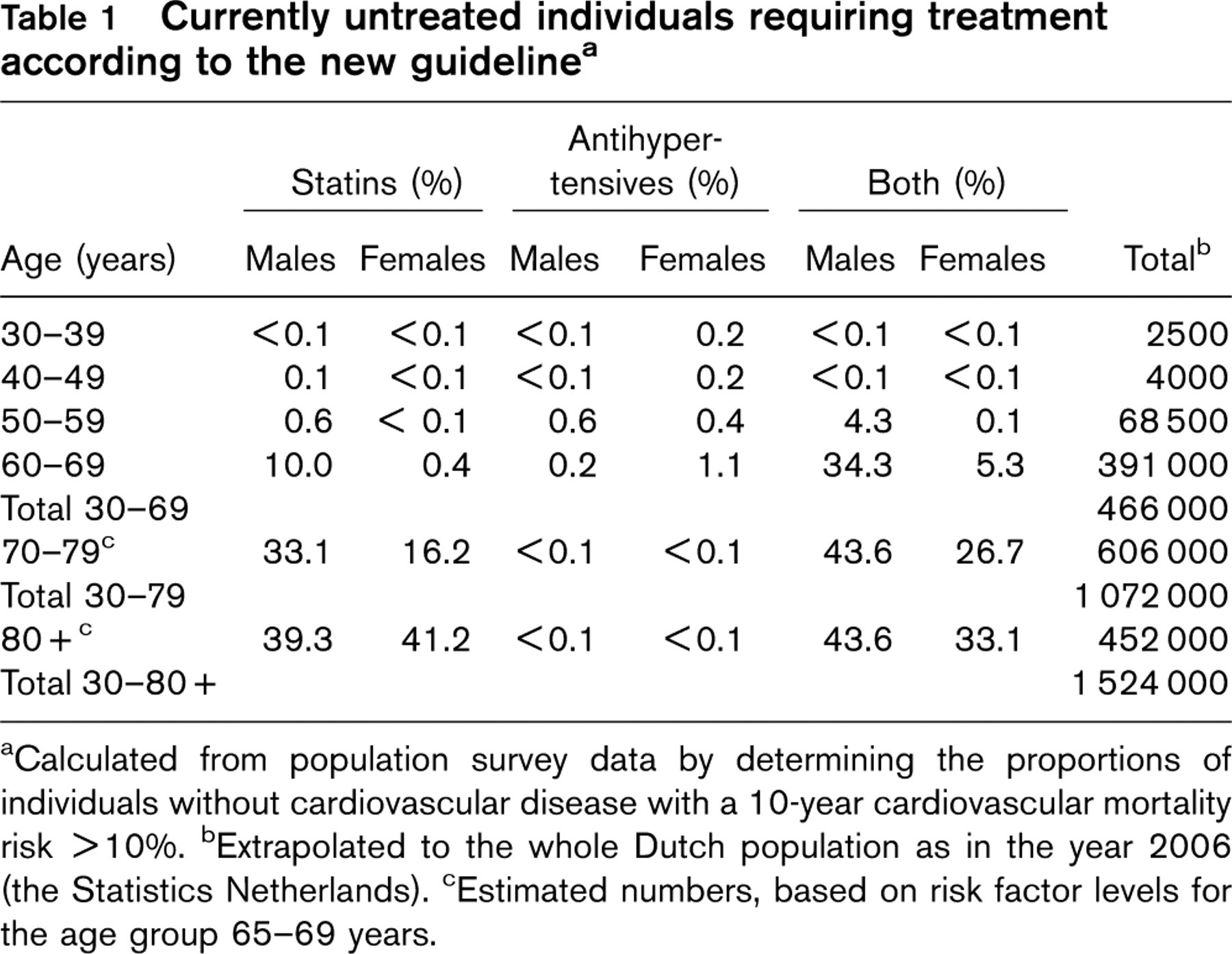
Calculated from population survey data by determining the proportions of individuals without cardiovascular disease with a 10-year cardiovascular mortality risk > 10%.
Extrapolated to the whole Dutch population as in the year 2006 (the Statistics Netherlands).
Estimated numbers, based on risk factor levels for the age group 65-69 years.
Table 3 shows QALYs gained, costs (intervention and total), cost-effectiveness ratios (CERs), and numbers of (healthy) life years gained.
The CER when treating all individuals who met the guideline criteria seemed to be reasonable (22 000 € per QALY). However, when taking a closer look into subgroups according to the age at intervention, the CER seems to be less favorable for the group of persons aged 80 years and above: 32 300 € per QALY (31 000 for males and 33 000 for females). For the age groups 30-69 years and 70-79 years, CERs were 15 000 € per QALY (14 700 for males and 15 900 for females) and 20 800 € per QALY (20 600 for males and 21 000 for females), respectively. We also show the CERs when not including all cost categories.
Sensitivity analyses
Results of the sensitivity analyses are presented in Table 4. As was to be expected a decrease in compliance or effect size yields fewer QALYs. However, for the age group 30-69 years, the intervention remains cost effective when compliance is as low as 50%. The shorter the time period considered the less cost effective the intervention.
Discussion
Implementing the recommendations of the new national guideline for cardiovascular risk management would imply the initiation of treatment with statins and/or antihypertensives in 1.5 million currently untreated individuals. Projected over a period of 20 years into the future, this would prevent a substantial proportion of the expected numbers of AMIs. Compared with the reference scenario, the cumulative incidence in the whole population would be reduced by 3.0% amongst 30-69-year-old individuals, by 14% in the age group 70-79 years, and 17.6% in those aged 80 years or above. For stroke, reductions would be comparable. This would translate into a reduction in total mortality of 0.9, 1.2, and 0.6%, respectively, compared with the situation in which current practice would continue unchanged. Intervention would be cost effective up to the age of 70 years. In all age groups, the CER was more favorable for men than for women.
Prevented 20-year cumulative incidence of cardiovascular disease and mortality as a result of full guideline implementation

The reference scenario is the continuation of current practice; cardiovascular disease prevented represents the difference in numbers of incident cases between the reference scenario and the scenario in which all eligible individuals receive treatment. AMI, acute myocardial infarction; CHD, coronary heart disease; CVA, cerebrovascular accident.
Lifetime costs and benefits of national implementation of the new guideline, because of the newly treated individuals

Results of the sensitivity analyses

QALY, quality-adjusted life year.
Discount rates for costs and effects.
In years.
Point of departure of our study was an estimation of the numbers of currently untreated individuals who would qualify for treatment according to the new guideline. This assessment was based on data from a Dutch population study [18]. Data collection for that survey took place in the period 1998-2002. Since then, the use of statins has become more common. On that account, we might have overestimated the number of people requiring treatment initiation. In contrast, it is likely that higher risk individuals, such as smokers, were under-represented in the population study. Obviously, any bias in this estimate would translate into corresponding deviations in calculated costs and benefits.
Cardiovascular risk calculation in the Dutch guideline is based on cardiovascular disease incidence, whereas the SCORE function took cardiovascular mortality as its endpoint. Transformation from one risk definition to the other has a consequence that for corresponding levels of risk factors the risk estimate is higher (maximum a doubling of risk), and hence the number of individuals requiring treatment is greater in the Dutch guideline compared with the SCORE function.
A further noteworthy aspect of the Dutch guideline pertains to the older age groups, whereas the SCORE function was limited to age groups up to 65 years; the Dutch guideline explicitly states that age is no longer a restriction. However, it entirely neglects the age restriction of the risk function. This is a shortcoming of the guideline that requires updating. Unfortunately, no data regarding risk factor levels were available for those aged 70 years or above. We therefore assumed these to remain constant from age 65 years onwards; but if they actually increase, the number of people eligible for treatment in that age group would be even greater, increasing both costs and health benefits.
In the previous guideline, treatment of the elderly and of patients with relatively low-risk profiles was not recommended on behalf of a CER that was deemed to be unfavorable. However, in the meantime the patents on the two agents that were singled out as cholesterol-lowering treatment of first choice, simvastatin and pravastatin, have run out of patent. Lowering of the prices of these drugs has shifted the balance between costs and effects. Moreover, further cost reductions could be achieved by cutting down on overtreatment, that is, by reducing the number of patients whose treatment is unjustified according to the guideline [34].
We found the relative reduction in cardiovascular disease as a result of guideline implementation to be more pronounced in the older age groups. In the elderly age groups, untreated persons qualifying for treatment initialization constitute a greater proportion of the population and the benefits to be achieved are correspondingly greater. However, as life expectancy is smaller, the CER, which is based on QALYs, is less favorable. The importance of age in determining cost-effectiveness was highlighted in a recent study among individuals aged 35-85 years with a history of occlusive arterial disease or diabetes [35]. However, that study did not take into account what we believe to be an important asset of our approach, namely the inclusion of costs of diseases that are not related to the intervention but that can occur in life years gained as a result of successful prevention (‘substitute diseases’).
When projecting future benefits and costs of treatment, we assumed that patient compliance would be optimal. However, a recent Dutch study [36] showed that 2 years after having been prescribed cholesterol-lowering agents, only 46.5% of patients were still filling their prescriptions. Similar findings have been described in a number of studies [37–40]. A lack of compliance would affect the CERs in an unfavorable manner, as patients discontinuing treatment incur costs while not, or only incompletely, benefiting from the treatment effects. Furthermore, the impact of side effects and drug-drug interactions, which we did not take into account, would probably tilt the CER in a slightly more unfavorable direction.
Conclusion
Large-scale implementation of the new guideline would imply a substantial increase in the number of individuals being treated with statins and/or antihypertensives. The effect of the intervention is most pronounced in the older age groups. However, the health gain per prevented case is largest in the younger age groups. Consequently, in terms of cost-effectiveness, the intervention is most favorable in the younger age groups. The calculations performed with our model show this to be a cost-effective intervention in the primary prevention of cardiovascular disease up to the age of 70 years.
Footnotes
Acknowledgements
The authors are grateful to Mr J. Hoekstra, MSc, Mr L. Tariq, Mrs S.M. Vijgen, Mrs P.D. Gumbs, MSc (National Institute of Health and the Environment, Bilthoven, The Netherlands) and Mrs J.C. Witteman, MSc, PhD (Erasmus University, Rotterdam, The Netherlands) for their contributions to this study. This research was sponsored by Grant V/260401/01/HK from the Ministry of Health, Welfare and Sport, The Netherlands. There are no conflicts of interest.