






Abstract
Aim
Methods
Results
Conclusion
Introduction
Worldwide, cardiovascular disease (CVD) accounts for the largest proportion of all-cause mortality and recent estimates suggest that over 80% of this global burden occurs in developing countries [1]. Although the effect of several cardiovascular risk factors on CVD risk is consistent across populations [2], there is emerging evidence of variation in cardiovascular risk profiles across different ethnic groups [3, 4]. To date, numerous studies have compared individual cardiovascular risk factors among different immigrant populations living in developed countries [5–8]; however, there has been limited investigation into the overall future cardiovascular risk among these populations [9].
The Systematic Coronary Risk Evaluation project (SCORE) was developed as a risk scoring system for use in the clinical management of cardiovascular risk in European clinical practice [10]. The SCORE risk charts have been included in the 2003 and 2007 versions of the European guidelines for prevention of CVD [11, 12]. Previously, we have shown that the SCORE high-risk model overestimated the number of CVD deaths in ethnic Norwegians [13, 14]. The model has not been assessed among the immigrants in Norway.
Immigration to Norway from developing countries is a phenomenon that dates back 35 years. Previously, ethnic variations in the prevalence of cardiovascular risk factors across five major immigrant groups that live in Oslo have been documented [8]. To further investigate overall cardiovascular risk between five immigrant groups in Oslo, and to compare this risk to that of the ethnic Norwegian population, we applied the total cholesterol and the total cholesterol/HDL cholesterol ratio SCORE models to data from the large, population-based Oslo Health Study (HUBRO) and the Oslo Immigrant Health Study.
Methods
Study population
Data were obtained from two population-based, cross-sectional surveys, HUBRO and the Oslo Immigrant Health Study, conducted in Oslo, Norway between 2000 and 2002. Both these studies used the same protocol. In HUBRO (2000-2001), a collaboration between the Norwegian Institute of Public Health, the University of Oslo and the Oslo Municipality, all Oslo residents born in 1924, 1925, 1940, 1941, 1955, 1960 and 1970 were invited and 18 770 (46%) attended the study [15]. Inclusion in the present analyses was restricted to participants born in Norway, Pakistan, Sri Lanka, Turkey, Iran and Vietnam, born between 1940 and 1970 (N = 11858). The Oslo Immigrant Health Study was conducted by the Norwegian Institute of Public Health and the University of Oslo [16]. Of the 7607 Oslo residents born in Pakistan, Sri Lanka, Turkey, Iran and Vietnam during 1942-1971, who were invited to participate and had not previously been invited to the HUBRO (N = 800), 3019 (39.7%) participated [8] and 2998 had a clinical examination. The combined study population included 14 856 individuals.
Risk estimation using the SCORE model was restricted to asymptomatic individuals in accordance with the European guidelines [11, 12]. Consequently, we excluded individuals with a history of myocardial infarction, stroke, angina pectoris, diabetes, and prior use of antihypertensive and/or lipid-lowering treatment (N = 1884). Further, we excluded 312 participants with missing systolic or diastolic blood pressure, total cholesterol, HDL cholesterol and/or smoking status. A total of 12 661 individuals were included in the total risk assessment.
Data collection
All invited individuals were asked to complete the main questionnaire at home and bring it to the screening station where it was reviewed by a trained nurse. The questionnaire included questions on smoking habits, physical activity, medication use and self-reported chronic diseases. At the screening station, body weight (kilogram) and height (centimeter) were measured with an electronic height and weight scale with the participants wearing light clothing without shoes. Body mass index (BMI) was computed as weight/height (kilogram/square meter). Waist and hip circumference (centimeter) were measured with a steel measuring tape to compute the waist-to-hip ratio (WHR). Systolic and diastolic blood pressures were measured with a Dinamap 845XT instrument (Criticon, Tampa, Florida, USA). Three different readings were taken with 1-min intervals, and the mean of the last two measurements was included in this analysis. A nonfasting venous blood sample was obtained and analysed for serum total cholesterol, HDL cholesterol and triglycerides (Hitachi 917 autoanalyzer, Roche diagnostics, Switzerland), at the Department of Clinical Chemistry, Ullevål University Hospital, Oslo, Norway.
Risk model calculations and statistical analyses
The predicted 10-year risk of a fatal CVD event was calculated using the high-risk versions of the SCORE algorithm [10], one based on total cholesterol and the other on total cholesterol/HDL cholesterol ratio. The following variables were included in the SCORE models: age, sex, serum total cholesterol, HDL cholesterol, systolic blood pressure and current smoking (yes/no). According to the 2007 guidelines, anyone with an estimated risk above 5% is considered as ‘increased risk’ and should be recommended lifestyle intervention or drug treatment [12]. This threshold is arbitrarily chosen. We have calculated how many would be considered as increased risk according to this threshold.
A recommendation to project age to 60 years in young individuals was suggested in the 2003 European Guidelines to account for the low absolute risk in young individuals [10, 11]. As the age distribution differed significantly between ethnic groups in our study population, we estimated age adjusted mean SCORE risk in two stages. First, we estimated the SCORE risk for all participants with age projected to 60 years. Second, we adjusted the projected SCORE estimates for age at screening because risk factors such as cholesterol and blood pressure increase by age. Therefore, the projected SCORE estimates adjusted for age at screening can be regarded as a risk estimate for a participant aged 42.6 years (i.e. the mean age of the study population at the time of study participation) when he/she is 60 years old. All age adjusted mean values were calculated using oneway analysis of covariance. To investigate the impact of smoking on ethnic differences in SCORE risk, we applied the total cholesterol/HDL cholesterol ratio model with all participants recoded as nonsmokers. Data were analysed using the SPSS package 14.0 (SPSS Inc., Chicago, Illinois, USA), P values and 95% confidence intervals were calculated and no attempt was made to adjust for multiple testing.
Ethics and approvals
The study protocols were evaluated by the Regional Ethics Committee and approved by the Norwegian Data Inspectorate.
Results
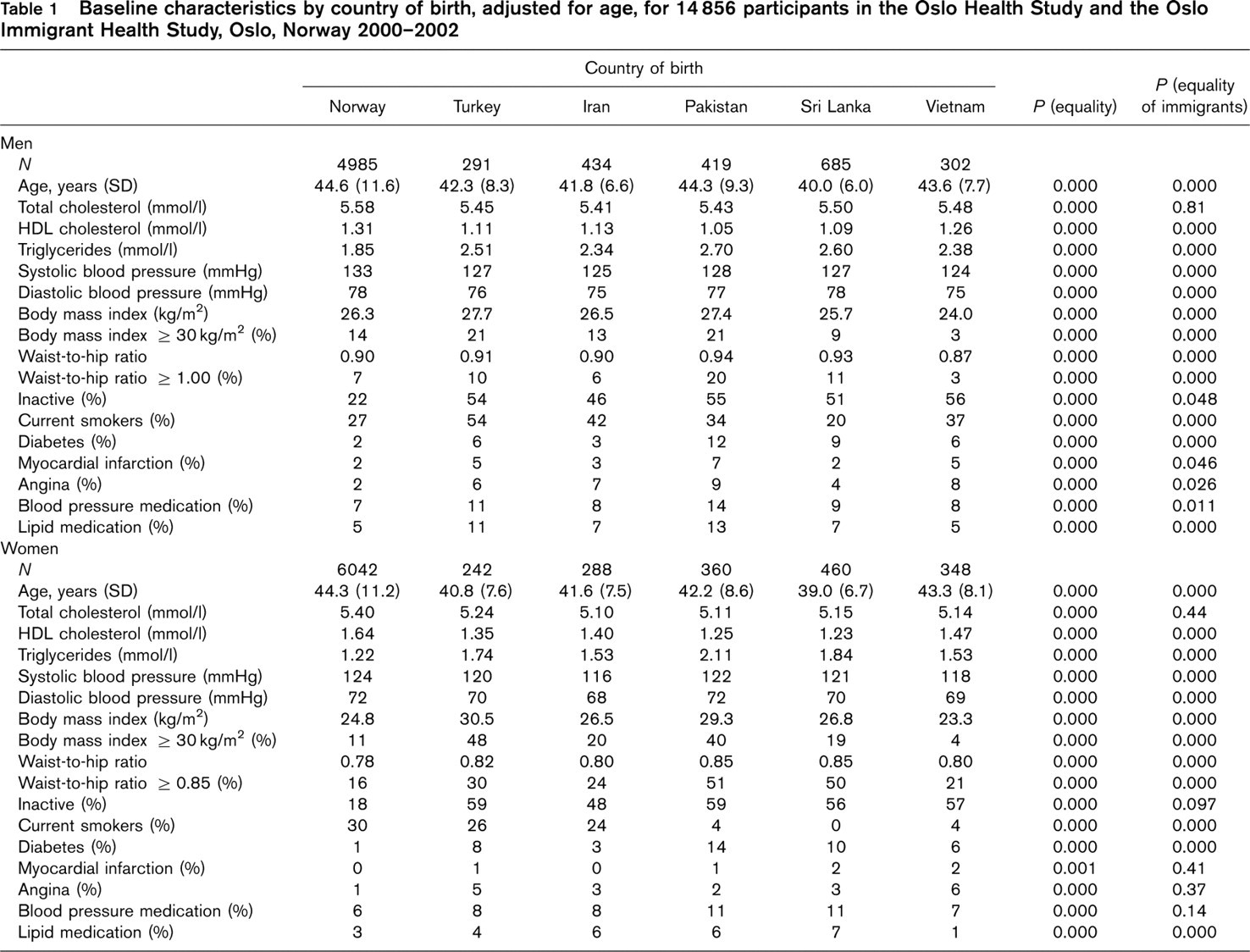
The mean age differed by almost 5 years between the oldest, ethnic Norwegians, and the youngest, Sri Lankans (Table 1). Among men, with the exception of Sri Lankans, the prevalence of smoking was much higher among immigrants than Norwegians. In contrast, smoking was uncommon among women from Pakistan, Sri Lanka and Vietnam. With the exception of the use of lipid-lowering medications among the Vietnamese, Norwegian men and women had the lowest prevalence of self-reported CVD, diabetes and use of antihypertensive and lipid-lowering medication. Ethnic Norwegians reported to be more physically active in leisure time than immigrants.
The prevalence of generalized and abdominal obesity varied across the ethnic groups (Table 1). Turkish women had a higher prevalence of generalized obesity (BMI ≥ 30) compared with abdominal obesity (WHR ≥ 0.85), whereas the opposite was observed in Sri Lankan women. Men from Vietnam had the lowest mean BMI and WHR compared with the other ethnic groups. Among women, the lowest mean BMI was observed in those born in Vietnam, whereas ethnic Norwegians had the lowest WHR.
Norwegians had higher levels of total cholesterol and blood pressure, but lower mean levels of triglycerides and higher HDL compared with the immigrant groups (Table 1). Concerning blood pressure, we found consistent results in sensitivity analyses restricted to participants aged 30-44 years, who had a low prevalence of antihypertensive treatment use (data not shown).
Baseline characteristics by country of birth, adjusted for age, for 14 856 participants in the Oslo Health Study and the Oslo Immigrant Health Study, Oslo, Norway 2000-2002
SCORE total cholesterol model
The mean estimated 10-year CVD mortality risk was higher in men than in women (Table 2). Turkish and Norwegian men had the highest risk levels and Sri Lankans the lowest according to the SCORE total cholesterol model. Among women, Norwegians had the highest estimated risk, 40% higher than women from Pakistan, Sri Lanka and Vietnam. Sixty-five percent of Turkish men had an estimated 10-year CVD mortality risk exceeding 5%, compared with 41% of Sri Lankan men, who had the lowest prevalence of all the ethnic groups of men. Four percent of Norwegian women and very few female immigrants had calculated risk above 5%.
SCORE total cholesterol/HDL cholesterol ratio model
The SCORE risk levels were higher with the ratio model compared with the total cholesterol model in all groups with the exception of Norwegians and Vietnamese (Table 2). The prevalence of exceeding an estimated 10-year risk of 5% was highest in men from Turkey (71%) and lowest in men from Vietnam (47%). Norwegian men had the second lowest proportion with 52%. The prevalence was 3% among Norwegian women, whereas less than five women in each of the other study groups had an increased 10-year fatal CVD risk according to the ratio model.
After reapplying the total cholesterol/HDL cholesterol ratio model under the assumption that all participants were nonsmokers, mean estimated 10-year risk (Table 3) was lowered by 20, 30, 27, 23, 14 and 25% in men from Norway, Turkey, Iran, Pakistan, Sri Lanka and Vietnam, respectively, compared with the previous model that included current smoking status (Table 2). In women, the estimates were 25, 16, 18, 0, 0 and 7% lower, respectively, assuming no smoking. Men and women from Sri Lanka and Pakistan had the highest estimated 10-year risk, and Vietnam the lowest, under the nonsmoking assumption.
Mean 10-year risk and percentage with 10-year risk ≥ 5%, estimated by two SCORE models in 12 661 participants reporting no history of CVD or diabetes or use of antihypertensives or lipid-lowering medication at baseline
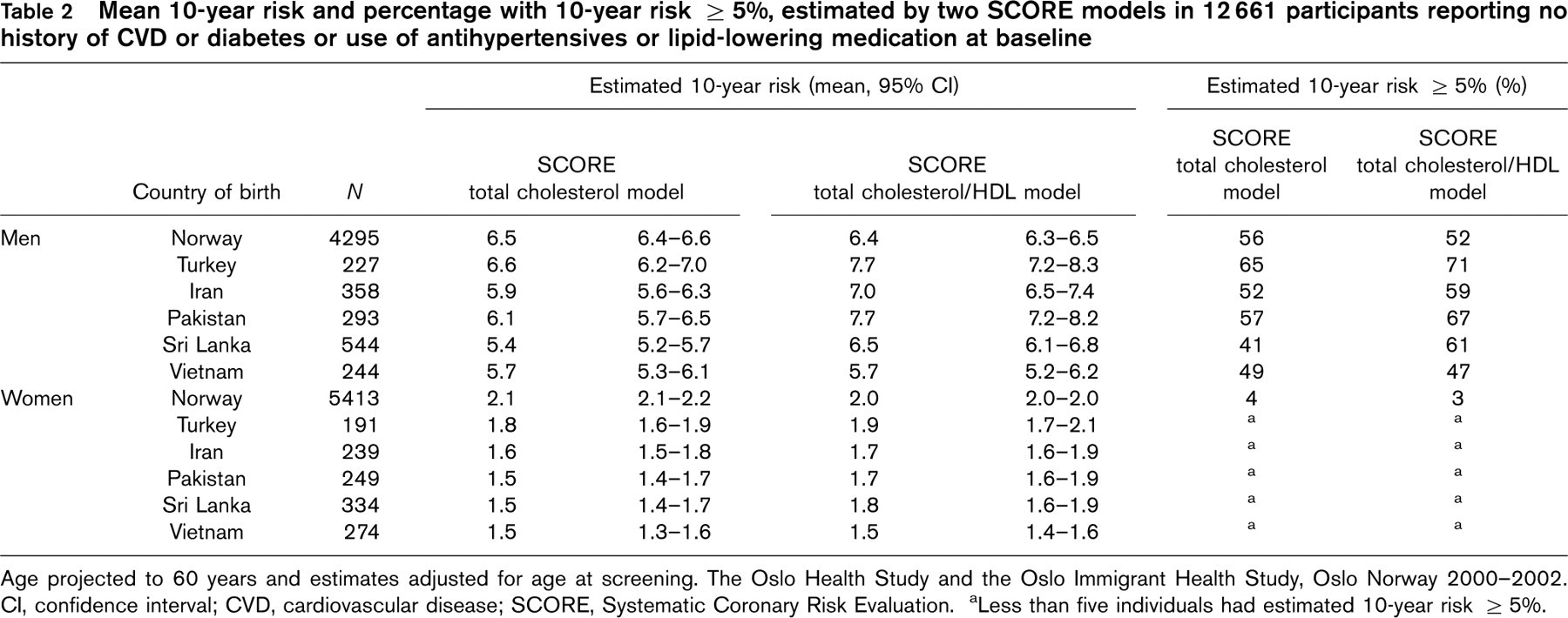
Age projected to 60 years and estimates adjusted for age at screening. The Oslo Health Study and the Oslo Immigrant Health Study, Oslo Norway 2000-2002. CI, confidence interval; CVD, cardiovascular disease; SCORE, Systematic Coronary Risk Evaluation.
Less than five individuals had estimated 10-year risk ≥5%.
Hypothetical mean 10-year risk in 12 661 participants reporting no history of CVD or diabetes or use of antihypertensives or lipid-lowering medication at baseline, estimated by SCORE total cholesterol/HDL cholesterol ratio model with age projected to 60 years and estimates adjusted for age at screening, assuming no smokers
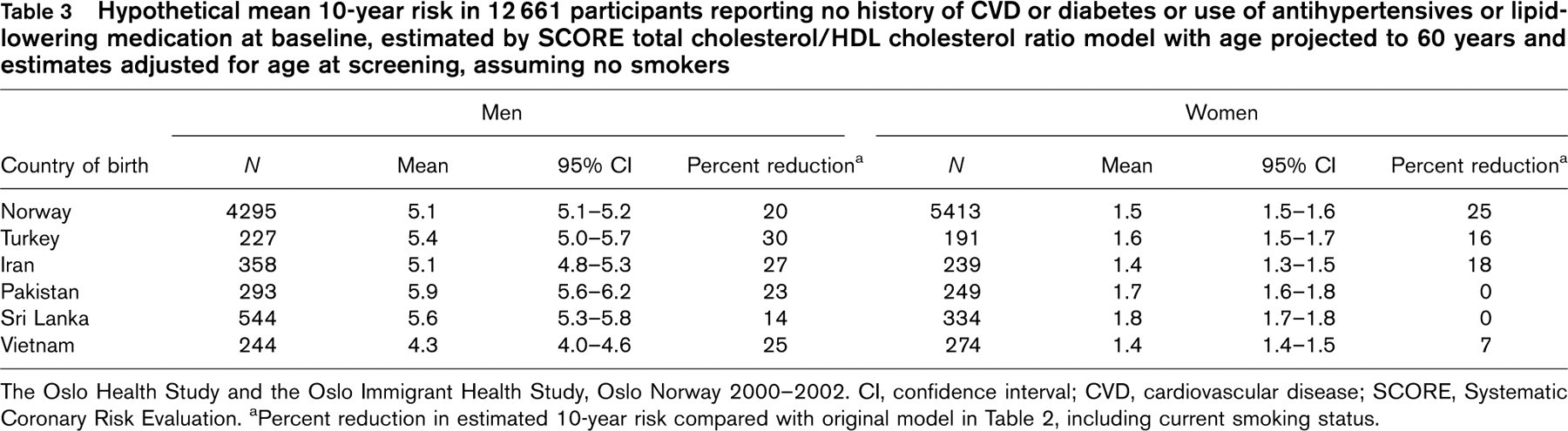
The Oslo Health Study and the Oslo Immigrant Health Study, Oslo Norway 2000-2002. CI, confidence interval; CVD, cardiovascular disease; SCORE, Systematic Coronary Risk Evaluation.
Percent reduction in estimated 10-year risk compared with original model in Table 2, including current smoking status.
Discussion
In this study, mean estimated 10-year CVD mortality risk was higher according to the SCORE ratio model compared with the total cholesterol model in all groups except for the Vietnamese and Norwegians. It was striking that the Norwegian men scored high along with Turkish men using the total cholesterol model, but ranked the last but one of all the ethnic groups using the cholesterol/HDL cholesterol ratio model, where Pakistani and Turkish men had the highest risk. Norwegian women had the highest estimated risk compared with the other ethnic groups according to both models.
The differences in SCORE estimates relate to the observed differences in individual risk factors. Norwegians had higher levels of total cholesterol and blood pressure, but lower triglycerides and higher HDL cholesterol compared with immigrants. With the exception of Sri Lankans, prevalence of smoking was much higher among immigrant men than among ethnic Norwegians. Among women, smoking was more common in Norwegians.
Despite the high prevalence of self-reported diabetes, CVD and use of blood pressure and lipid-lowering medication among Pakistanis in our study, application of the SCORE total cholesterol model did not suggest higher future CVD mortality risk among Pakistanis compared with Norwegians. However, application of the SCORE ratio model in men resulted in a ranking of mean future CVD mortality risk across the ethnic groups that was concordant with the prevalence of self-reported diabetes and medication use. This is also in line with findings from application of the FINRISK, Framingham and the SCORE total cholesterol models to the Newcastle Heart Project data in the United Kingdom [9]. It showed that the SCORE model gave unexpected low 10-year risk in south Asians compared with white Europeans, whereas the FINRISK and Framingham models resulted in higher estimated risk among south Asians as expected from national mortality data by country of birth. The authors concluded that the unexpected low SCORE risks probably reflected the lack of inclusion of HDL cholesterol and diabetes in the model.
Our study has several strengths. The unique opportunity in Scandinavia of sampling from population registries with a defined population base and information about the demographics of residents has advantages over other sampling techniques [17–19]. This allowed us to sample well-defined ethnic groups and avoid using broad, heterogeneous categorizations of ethnicity [18, 20]. Our study illustrates heterogeneity of the south Asian groups with respect to SCORE risks and individual risk factors. Another strength was that both studies were conducted with standard protocols and instruments.
Conducting population-based studies in urban settings, in particular, including ethnic minorities is challenging. The low participation rates observed in this study may introduce selection bias. A comprehensive study of the effects of nonattendance in the HUBRO (2000-2001) and the Oslo Immigrant Health Study concluded that prevalence estimates might be valid even in light of considerable nonattendance [15, 21]. Further, people aged 60 years and below, attending after one or two reminders reported similar health and smoking habits as people attending directly after first letter of invitation with no reminder, indicating little selection bias [22]. It is unlikely that the large differences in calculated SCORE risk between the ethnic groups can be explained by selective attendance alone.
Diabetes is not included in the SCORE models [10]. Further, the SCORE model does not take into account generalized or abdominal obesity, despite the relationship of abdominal obesity both to CVD and diabetes being well documented [23]. Among immigrants, particularly those from south Asia, both abdominal obesity and self-reported diabetes are much higher than among the Norwegians. Using the SCORE model, we are unable to assess whether diabetes or obesity alter the predicted future CVD risk in each of the ethnic groups.
The SCORE functions do not include other known risk factors such as socioeconomic position, physical activity and diet. Recently, a risk score taking family history, BMI, use of antihypertensive drugs and measures of social class has been derived in the United Kingdom [24]. The application of this score to our data would be of interest as it is likely that the distribution of risk in our ethnic groups will change.
Conclusion
The mean SCORE level varied between the ethnic groups, two percentage points in men and 0.5 percentage points in women, according to the ratio model, which translates into two cardiovascular deaths per 100 during 10 years in men and 0.5 in women. Norwegians ranked high with the SCORE total cholesterol model and Norwegian men low with the SCORE ratio model. Our results suggest that the SCORE ratio model may be more applicable to immigrant groups than the SCORE total cholesterol model. Inclusion of additional predictors needs to be tested in different ethnic groups. Till the predictive ability of the SCORE has been evaluated in immigrant populations using mortality outcome data, we are unable to draw firm conclusions about the accuracy of predictions of future CVD risk of immigrant populations using this tool. Findings with the model assuming no smoking indicate great potential for risk reduction in particular ethnic groups of men through targeted smoking cessation initiatives.
Footnotes
Acknowledgements
The data collection was conducted as part of the Oslo Health Study and Oslo Immigrant Health Study 2000-2002 in collaboration with the Norwegian Institute of Public Health. B.N.K., R.S., A.S.L., AT, K.F. and H.M. contributed to the conception and design of the study. B.N.K., R.S. and A.S.L. analysed the data and all authors contributed to the interpretation of the data. B.N.K. and R.S. drafted the article and H.M., A.S.L., A.T. and K.F. commented upon and revised all drafts. All authors gave their approval to the final version submitted for publication. The Oslo Health Study and the Oslo Immigrant Health Study were funded by the Norwegian Institute of Public Health, University of Oslo and Municipality of Oslo. This study was also funded by grants to B.N.K. and A.S.L. (post.doc grant) by the Norwegian Research Council; the authors do not have any financial interest in the article.
Conflicts of interest: none declared.