






Abstract
This article presents an easy and inexpensive method to elaborate superhydrophobic surfaces. A superhydrophobic surface was prepared by spray coating a mixture of calcium carbonate particles, stearic acid and polymer latex suspensions on an aluminum substrate. The Taguchi L18 orthogonal array was used to optimize the fabrication process parameters, namely the percentage of stearic acid, the calcium carbonate particles to copolymer weight ratio, and the spray distance from the substrate. Through the Taguchi method, it was found that the percentage of stearic acid plays the most significant role in affecting the coating’s wettability. The optimal condition proposed by this method has been verified through additional experiments which showed an increase in contact angle up to 158°.
Introduction
In recent years, superhydrophobic surfaces (water contact angle greater than 150°) have attracted enormous contribution for practical applications such as biomedical devices, liquid separation, antibiofouling surfaces, reduction of ice and snow adhesion, self-cleaning surfaces, stain-resistant textiles, corrosion prevention and turbulence reduction in water-bearing pipes.1–3 The wettability of solid surfaces is governed by the chemical composition and the geometrical microstructure of the surface. 4 It has been shown that on a flat surface the maximum contact angle achievable by lowering the surface energy is 120°. However, the addition of roughness to the surface can increase the contact angle of water without altering surface chemistry. Superhydrophobic surfaces can be achieved by a combination of low surface energy materials, and surface micro- and nanostructures. The most attractive methods to create superhydrophobic surfaces are self-assembly, layer-by-layer methods, plasma treatments, chemical vapor deposition, sol–gel methods, lithography, templates and electrochemical methods.5–10 However, most of these methods need an extensive use of materials and long fabrication time, require strict conditions and expensive facilities and possibly raise environmental concerns. The present study investigates a very simple; one-step and low-cost superhydrophobic coating prepared by spray coating of CaCO3 particles, stearic acid and polymer latex suspensions. This technique allows fast, easy and economic deposition of composite superhydrophobic films on the large surfaces. Also, CaCO3 is a very cheap and widely used material in the construction and oil refining industry, and in the fabrication of paint, ceramic, cement, glass and steel.
Several factors such as CaCO3 to polymer latex weight ratio, spraying distance and percentage of stearic acid can affect on the water repellency properties of the resulting coating. In most of the studies, influential parameters are investigated separately and kept constant one at a time, without attempting to show their synergistic or antagonistic effects. 11 However, by employing the tabulated basic orthogonal arrays introduced by Taguchi, 12 it is possible to obtain an inexpensive and easy-to-operate experimental design to study the influence of each parameter through a small number of experiments. In this study, the spray coating parameters were optimized using the Taguchi method and the Minitab software.
Experimental section
Orthogonal array L18 of the experimental runs and results
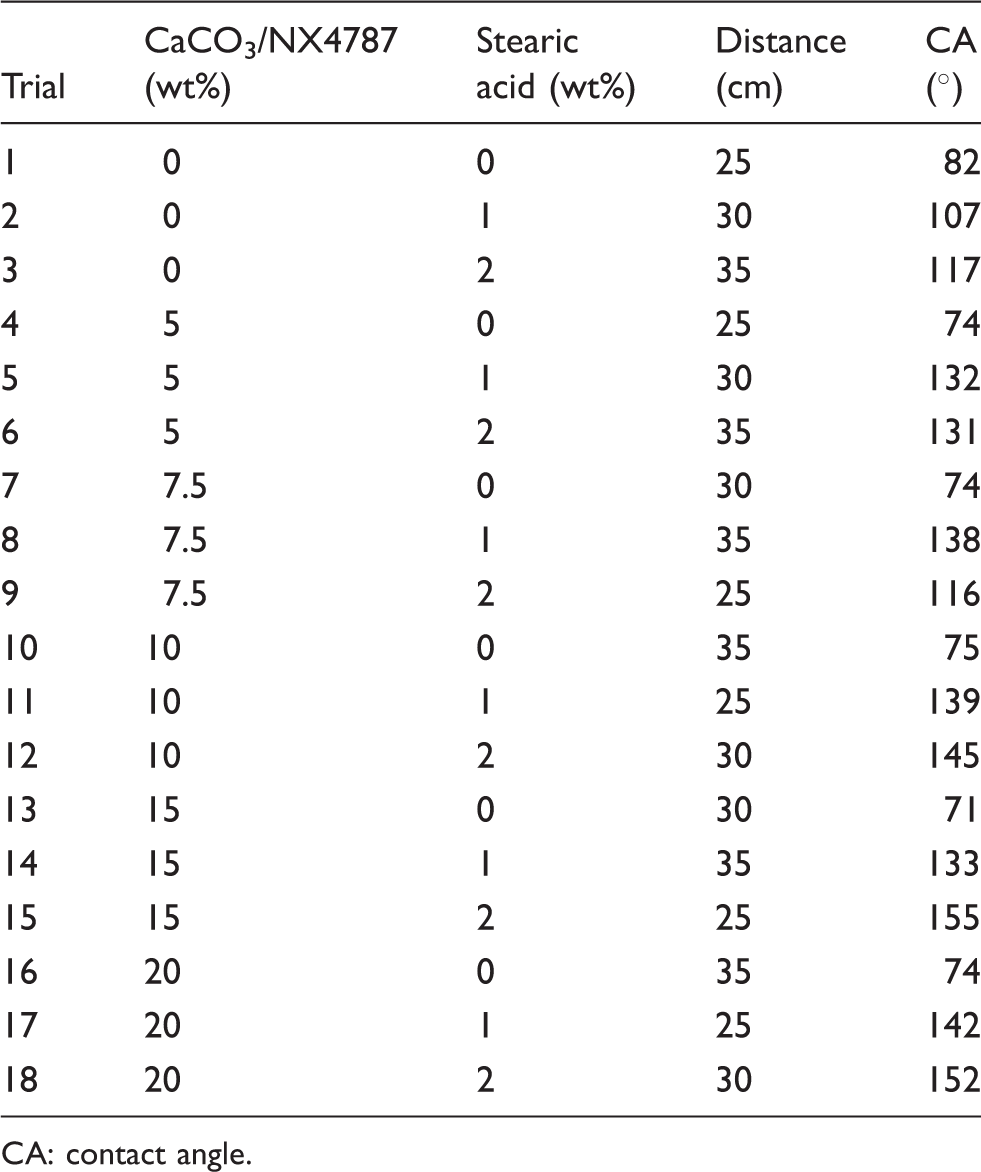
CA: contact angle.
Results and discussion
Three controlling parameters were considered to affect the coating water repellency properties: spraying distance and percentage of stearic acid, each one at three levels, and CaCO3/polymer latex weight ratio at six levels. Testing for these conditions in a full factorial experiment would require 6 × 3 × 3 = 54 trials, meaning a considerable expenditure both cost and timewise. On the other hand, Taguchi’s factorial experiment approach reduces the number of experiments. Table 1 shows the chosen design matrix based on a Taguchi L18 orthogonal array consisting of 18 sets of experimental conditions and the corresponding results for the contact angle measurement.
In the Taguchi method, the term ‘signal’ (S) represents the desirable value (mean) for the output characteristic and the term ‘noise’ (N) represents the undesirable value for the output characteristic. 13 In this method, signal-to-noise ratio (S/N) is used to represent a response or quality characteristic and the highest S/N is required. 13 There are three types of quality characteristics, i.e. nominal-the-best, larger-the-better and smaller-the-better. In order to obtain the maximum contact angle, the larger-the-better quality characteristic type was selected.
The graphical representation of the S/N ratios is shown in Figure 1. The factor levels with the largest S/N ratios are the optimum levels as they minimize the sensitivity over the range of noises. Therefore, the optimal condition for the spray coating to obtain a superhydrophobic film according to their high S/N ratios correspond to a distance of 25 cm between substrate and spray gun, a percentage of 2% stearic acid and a weight percentage ratio of CaCO3/NX7487 at 20%. Also, the difference between the highest and lowest values of S/N ratio is a decisive indicator with regard to the influence of a parameter. It can be observed that the percentage of stearic acid presents the most significant differences of S/N ratio at different levels and consequently plays the most important role as to overall water repellency performance. These results show that hydrophobicity is increased by increasing the stearic acid content of the coating. It was shown that stearic acid reacts with CaCO3 particles and covers them with a monolayer of calcium stearate bicarbonate which creates a hydrophobic tail oriented toward the air.14,15 As the concentration of fatty acid is increased, the quantity of hydrophobic groups covering the particles increases, resulting in an increase in the water repellency properties of the obtained coating. The CaCO3/NX7487 ratio also provides a quite large contribution to the hydrophobicity of the resulting coating. This increase in hydrophobicity with higher percentages of CaCO3/NX4787 could be mainly attributed to the increase in surface roughness due to the increase in CaCO3 particles. On the other hand, the distance between substrate and spray gun has a minor effect on the water repellency of the coating. However, at higher distances a decrease in water repellency was observed, which can be explained by the decrease in surface micro/nano roughness as the distance from the substrate is increased.
Variation of average S/N ratios with factor levels.
An additional experiment with the optimal conditions was carried out to confirm the influence of the optimal combination of the control factors and their levels on performance characteristics.
The SEM images of Figure 2(a) to (d), display a superhydrophobic coating deposited at the optimal conditions. They show the formation of a solid polymer foam-like structure where air can be trapped in the rough surface cavities. This surface morphology reduces the contact area between water and the surface, resulting in increased water repellency. The higher magnification images (Figure 2(c) and (d)) show the presence of micro/nanostructures on the superhydrophobic coating.
SEM micrograph of the superhydrophobic film deposited at optimal conditions on an aluminium alloy surface: (a, b) low magnification; (c, d) high magnification.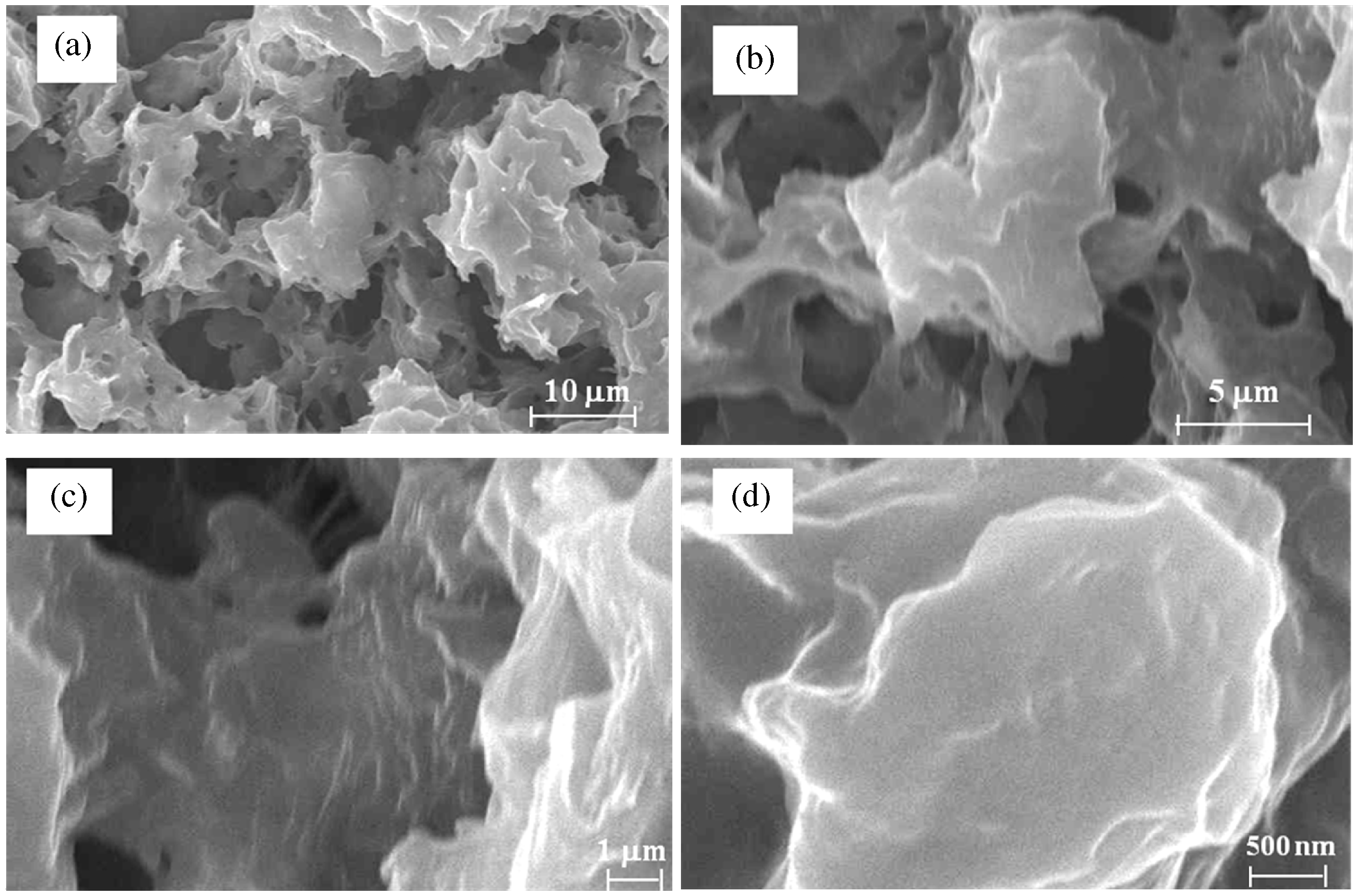
As we mentioned above, the wetting behavior of superhydrophobic surfaces is governed by chemical composition of surface and roughness of surface. The presence of the hydrophobic groups in our coating was analyzed with FTIR spectra (Figure 3). This figure shows the absorption infrared spectrum of the coating without stearic acid (line a), and without CaCO3 particles (line b), as well as the superhydrophobic film obtained at optimal conditions (line c). The typical spectrum of the CaCO3 bands can be observed at 2506, 1792 and 871 cm−1 (line a).
16
Both the asymmetric (υas (CH2)) and symmetric (υs (CH2)) methylene stretching peaks clearly appear at 2910 and 2840 cm−1 on the film spectra (lines b, c) of the stearic acid modified coatings.
9
The presence of this hydrophobic group on a surface can reduce its surface energy and increase its water repellent properties.
FTIR spectra of a mixture of: (a) stearic acid and polymer latex suspensions; (b) CaCO3 and polymer latex suspensions; (c) CaCO3, stearic acid and polymer latex suspension (superhydrophobic coating).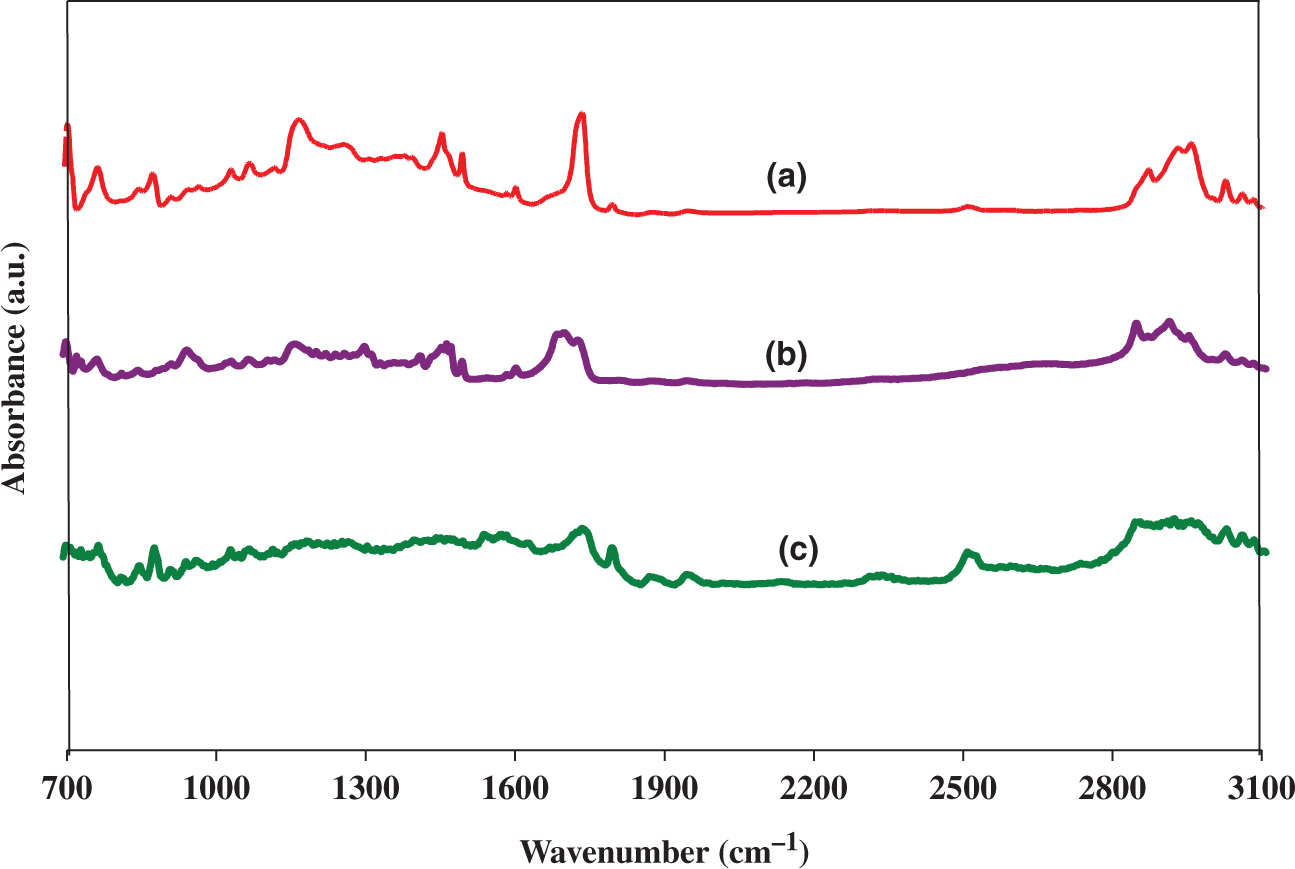
A polished aluminum surface showed a water contact angle of about 88°, as seen in Figure 4(a). The contact angle obtained at the optimal conditions resulted in greatly improved water repellency with the contact angle increasing to 158° (Figure 4(b)).
Images of 4 µL: (a) water droplets on polished aluminum; (b) water droplets on superhydrophobic surface obtained at optimal conditions.
Therefore, these results show that the application of spray coating and Taguchi method was successful in creating the ultra-water repellent micro/nanostructured composite coating on the aluminum surface.
Conclusion
A simple and low cost technique was proposed for elaborating superhydrophobic coatings by spray coating a mixture of CaCO3 particles, stearic acid and polymer latex. The Taguchi method was used to optimize the fabrication process parameters in order to obtain the maximum contact angle. The results showed that the percentage of stearic acid has the most important influence on the water repellency of coating. The wettability results obtained by using the optimal conditions proposed by this method showed that the resulting superhydrophobic surface had a very high contact angle of about 158°. The presence of CH2 groups and rough micro-nanostructure on the surface, contributing to its superhydrophobicity, were displayed by FTIR and SEM analyses, respectively.
Footnotes
Funding
The authors would like to thank the CIGELE partners (Hydro-Québec, Hydro One, Réseau Transport d’Électricité (RTE) and Électricité de France (EDF), Alcan Cable, K-Line Insulators, Tyco Electronics, Dual-ADE, and FUQAC) and the Canada Research Chair on Atmospheric Icing Engineering of Power Networks (INGIVRE) whose financial support made this research possible.
Acknowledgment
The authors wish to thank Jean-Philippe Mougnol for his assistance in sample preparation and characterization.
Conflict of interest
None declared.