






Abstract
Posidonia oceanica leaves (seagrass) are collected almost in all the Mediterranean seashores as spoils and disturbing material with additional cost for removal from the coastline. Seagrass, however, is known for its interesting properties, such as decay, fire and moisture resistance as well as insulation. Research for using this material in composing boards was initiated. This study looks into the possibility of using these waste marine plants for the production of alternative building material in the form of pressed panels. The paper describes the pretreatment of seagrass leaves before their processing for composite boards and the examination of its final product. The residence time for salts desorption was also determined. The main processes analyzed were the binder spraying and panel forming. Mechanical properties were evaluated by the standardized flexural tests. In addition, swelling properties were investigated. Results obtained from testing and observation of boards indicated that seagrass leaves are propitious for the application in construction and furniture industry.
Introduction
Over the last decades, cellulosic waste products and fibres have been widely used and there is an increasing tendency for their application. Particle and fibreboards are used in the building industry as thermal insulators in facades and walls. Combined mechanical, thermal and acoustic properties are found in them at a reasonable cost. However, the wide use of cellulosic fibres always makes it difficult to provide all users with a reasonable price. In addition to the application of particleboards in construction as structural and non-structural material, wood-based or other lignocellulosic materials are beneficial for the furniture industry. Its development, however, depends on easy access to timber in which global resources are limited. Therefore, the development of alternative raw materials is an increasing necessity.
Low-cost raw materials, good swelling properties, mechanical resistance and insulation are some of the most important issues taken into consideration when projecting the particleboards. Many scientists have done research in this field, working with several alternative materials for the manufacture of particleboards. Batiancela et al. 1 have investigated the use of waste tea (Camelia sinensis) and concluded that particleboards from waste tea leaves have slightly lower bending strength compared to wood particleboard, whereas concerning that some of the physical properties, such as moisture resistance and dimensional stability were little higher. The suitability of renewable biomass has been examined intensively over the last years. Rice straw and peanut hulls were studied by Guler et al., 2 rice husk by Ota and Okamoto, 3 tea leaves by and Yalinkilic et al., 4 coffee waste by Rachtanapun et al., 5 pineapple leaves by Tangjuank. 6 Seagrass, likewise, can be considered as biomass for the preparation of particleboards. It is well known for its ecological importance, because it protects beaches from erosion and serves as an indicator of water quality. But the seagrass collected on the coasts is a disturbing material for the community especially in the tourist seasons and its removal, transportation and landfilling cost a lot of money.
Seagrass, also known as eelgrass, seaweed and algae, is an aquatic flowering plant (of about 60 species) growing at the bottom of the sea. The entire area coverage of this plant worldwide is estimated at 177,000 km2. 7 Although they are very important habitats for many microorganisms living in the sea, they are considered as rubbish material, because after their growing season many leaves break away, and carried by wave action, settle on the seashores and decay. Their appearance becomes an eyesore. According to Cebrian and Duarte, and Cocozza et al.,8,9 a moderately wide belt of Possidonia oceanica (PO) seagrass may deliver more than 125 kg of dry material per square meter of the coastline each year. That is a large amount of waste material.
The PO (living plant), found mainly in the Mediterranean Sea shores, covers approximately 40,000 km2 of the seabed. 10 PO is a lignocellulosic material which can be found in the form of seagrass balls (Neptune Balls) and leaves. The first one has a fibrous form and it comes from the rhizome of Posidonia plant, while the second comes from its living leaves. While seagrass has been investigated mainly because it was considered a potential insulation material for buildings, fibres of PO plant have been used and investigated for various objectives. Ferrero et al. 11 and Puglia et al. 12 have worked on green composites using them as a reinforcing agent. PO leaves have also been examined chemically and morphologically by Bettaieb et al.13,14 for the cellulose nanocrystals generation. The researchers claim that PO waste products exhibit encouraging perspectives as nano-fillers for polymer matrices. Besides their use as filling material in the range of nanometres, there have been some efforts to manufacture fibreboards from PO fibres. Garcia et al. 15 examined some of the most important physical and mechanical properties of the PO fibreboard concluding that they represent a great alternative to the conventional natural fibreboards and they gave special consideration to the interaction between the lignocellulosic component and the binder. Although there is an intense research on the PO fibres, PO leaves have been less studied, even though their amount located as waste material on the shore is greater (wracks, dead leaves).
Research for the use of PO leaves in the manufacture of particleboards has been carried out by Saval et al. 16 who used an inorganic binder (cement), outlining the possibility of their application in construction. In this research, the fire resistance was additionally examined. Results confirmed the results of previous authors who studied other types of seagrass.17,18 Apart from flame and mould resistance of seagrass, much work has been done for the evaluation of thermal and acoustic conductivity of their composite boards. A deep research was undertaken by AITEX (Textile Industry Research Association). In this research, the revalorization of coastal algae wastes in Textile Nonwoven Industry with application in building noise isolation was investigated. Results indicate very good acoustic insulation properties. 19
The purpose of this study is to highlight the interesting properties of the raw material, to investigate the final product and show that it can be competitive with other lignocellulosic waste which can be used in construction and finally to evaluate the most determinant parameters for better mechanical and physical properties of the composite board.
Materials and methods
Materials
PO leaves were collected from the coastline of Albania (Mediterranean coast) in April 2016. Their size varies from 8 to 10 mm width and 50 to 150 mm length. The leaves were dried in natural conditions (average relative humidity 65%; average temperature: 25 ℃). In their dried form, they have brown appearance (Figure 1). Polymeric methylene diphenyl diisocyanate (PMDI-PA360 Pure Wood Glue – provided by Akfix) was used as a binder. An electrical spraying gun was used for spraying the PO leaves and two metallic forms were set up for the process of forming.
PO leaves. PO: Possidonia oceanica.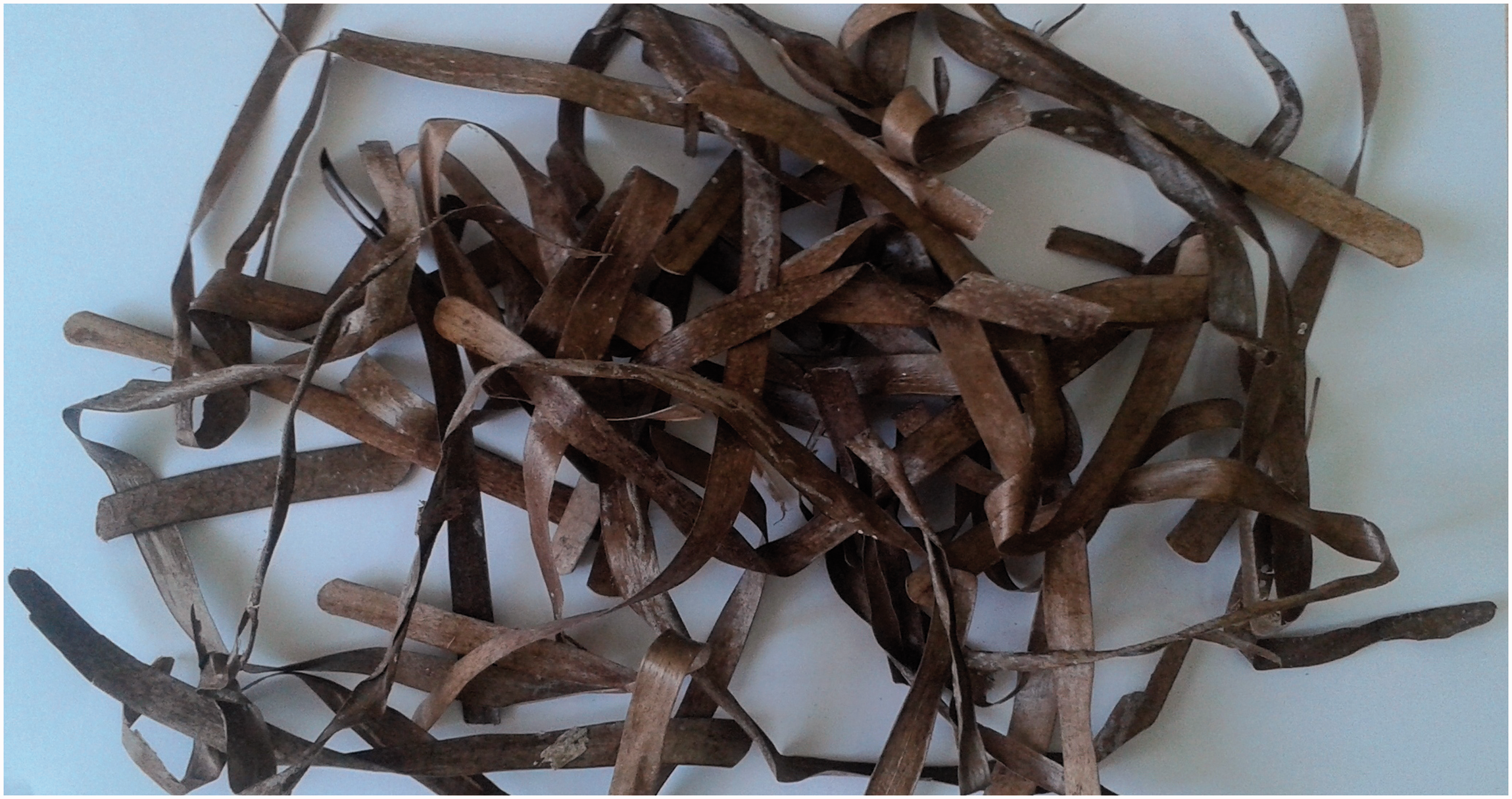
Preliminary treatment of PO leaves
PO leaves have different morphological features from PO fibres. Sand particles and other soil contaminants are deposited on their flat surface. Salt crystals, mainly NaCl, which are hygroscopic compound, are deposited on their surface. Soil contaminants and salts encumber the uniform distribution of the binder, consequently worsening the adhesion in this way. To remove those “contaminants,” PO leaves were preliminarily treated with tap water. An amount of 500 g of PO leaves were weighed and shoved into a 10 l glass vessel. The flow of the tap water was kept at 5.7 l/h, which led to a residence time for the water of circa 105 min. The removal of salts was attended using a conductivity meter and the respective calibration curve for salt concentrations. The process was stopped as soon as the conductivity of the outlet water reached the values of the tap water (298 μS). The leaves were there after letting them dry naturally for 24 h. The moisture content of leaves in room conditions was approximately 7%.
PO leaves board formation
Five different composite boards have been prepared by hand pressing machine, using various amounts of PO leaves and binder. The seagrass mass was weighed and partitioned. In due time, the binder (PMDI) was weighed and diluted with acetone in order to reduce its viscosity to the value range required for spraying process. Regardless of different amounts of the binder used in the first sample (35 g) and other samples (50 g), the ratio of the binder and the solvent was constant, and consequently the viscosity of the diluted binder was also constant. Leaves were sprayed uniformly with the diluted binder using an electrical spraying gun. The metallic formworks used in the forming process, were initially oiled in order to prevent sticking between the form and the leaves. The sprayed leaves were left in the open air for several minutes (4 min and 2 min), were put in random direction in the metallic forms and then were pressed with a hand pressing machine in room temperature (approximately 25 °) for 24 h. The applied pressure was constant for the first four samples, whereas for the last one it was slightly increased.
Composite boards were then weighed. Due to the low efficiency of spraying and the evaporation of the solvent, the final mass of the board was lighter less than the “theoretical” one. The content of binder in the board


Density and mechanical properties determination
The density of the composite boards was determined according to British Standard BS EN 323.
20
Flexural properties were determined using a laboratory testing equipment (Instron Universal Testing Machine). Samples were subjected to a three-point bending test. Five different samples were tested, and the flexural strength was calculated using the following formula (BS EN 310)
21

Water absorption test
Thickness swelling (TS) and water absorption (WA) were determined for the two board samples in accordance with ASTM D 1037 Standard with minor modifications. 22 Water absorption tests were conducted by immersing the specimens from the boards in water bath at 25 ºC, for three days. After the immersion process, specimens were taken out of the water and the surfaces were dried with a dry cloth. The amount of water absorbed from each specimen was calculated by the weight difference. The same procedure was conducted for the determination of TS. Each specimen's thickness was measured before and after the immersion process.
Results and discussion
Soil contaminants and salts encumber the uniform distribution of the binder, worsening the adhesion. In addition, the sodium chloride crystals present in the leaf surface have a negative effect on the thermal insulation properties of the composite board, because they absorb moisture from the air. Niemz
23
studied the influential factors affecting the wood-based panel properties, highlighting the moisture content. Those particles and crystals have been leached away with tap water, a process that seems to be a first-order one with a half time of 2.05 h. Figure 2 shows the decrease of salts concentration with time. The process of salts leaching continued for 8 h.
Salt removal: a first order process.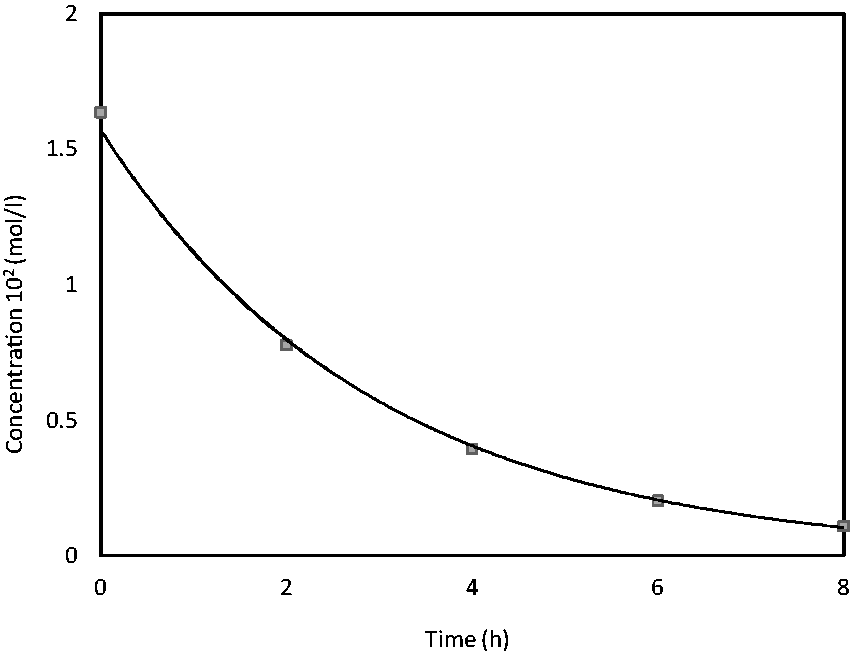
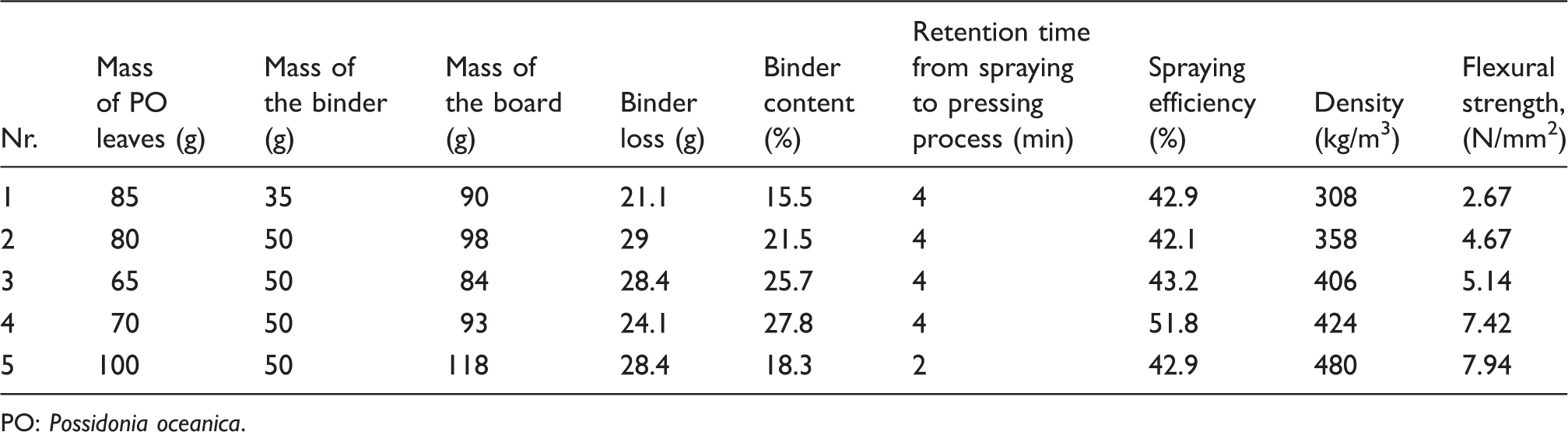
Composite boards made from PO leaves have a wood-like appearance (Figure 3). This is interesting for the applications of those boards in building and furniture industry, without any other finishing. Due to the uniform distribution of the binder in the seagrass mass, spraying proved to be a more advantageous process than a simple mixture. The process of pressing resulted to be a determinant step for the mechanical and physical performance of the composite board. The results for the composite boards made of different amounts of leaves and binder are summarized in Table 1. The densities of composite boards vary from 308 kg/m3 to 480 kg/m3. Spraying efficiency and binder content are also shown in the table. As it can be seen, the spraying efficiency achieved in laboratory conditions was approximately 50% as well as the binder loss. Naturally this process in industrial scale could be more efficient.
PO boards. PO: Possidonia oceanica. Summary of the results obtained for the composite boards made of different amounts of Possidonia oceanica leaves and binder. PO: Possidonia oceanica.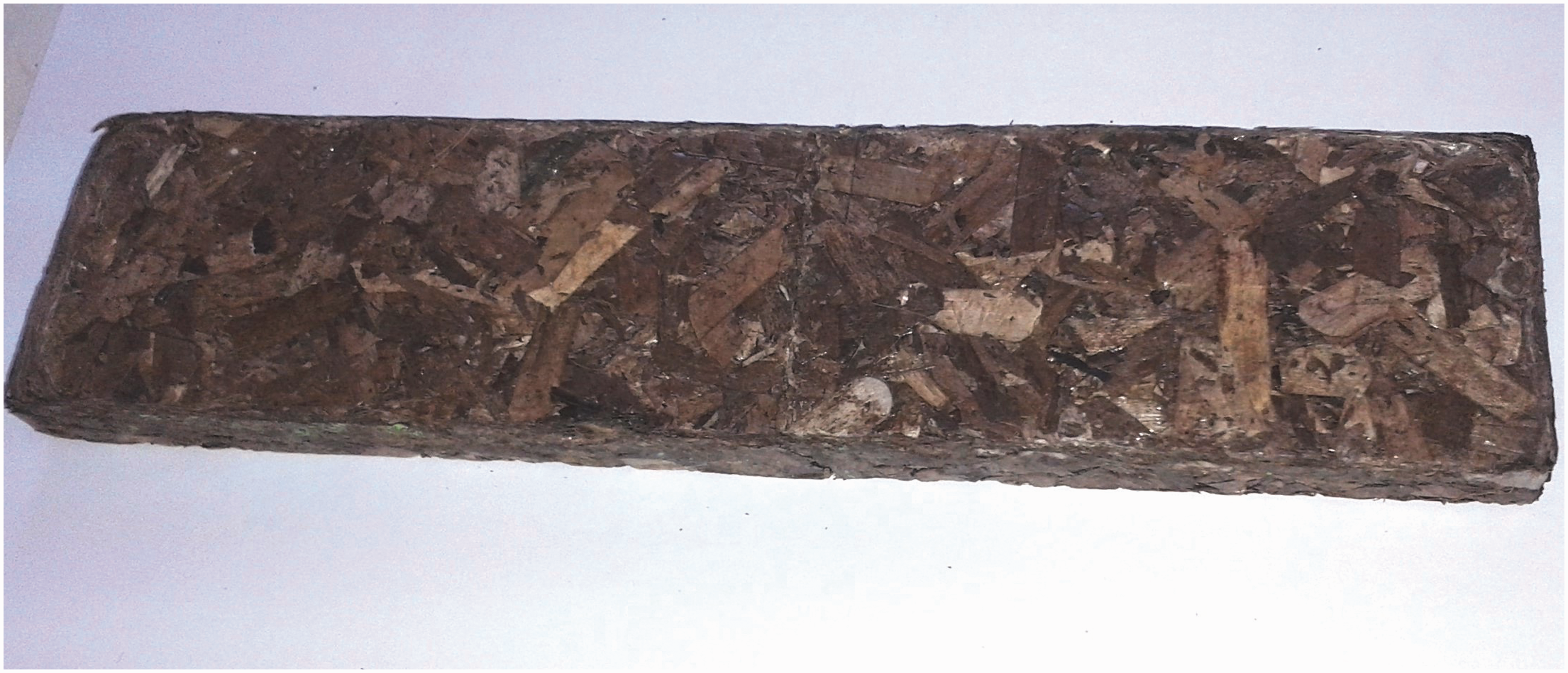
Physical properties and flexural strength of particleboards reported in the literature made from various agro-industrial fibers and wood particles.
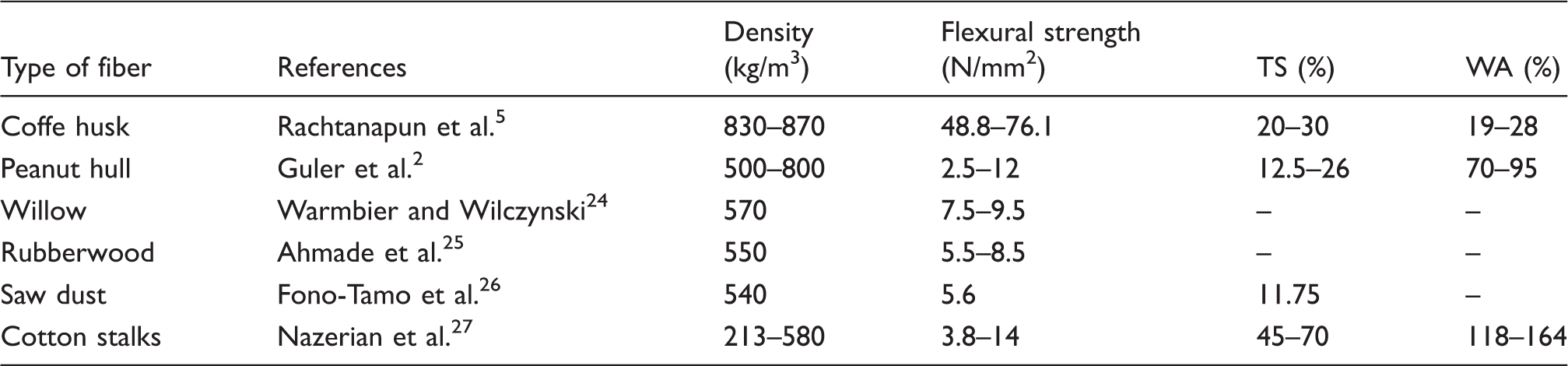
Regarding the mechanical performance, Table 1 shows that flexural strength ranges from 2.67 to 7.94 N/mm2, which can be considered comparable to the particleboards with similar densities. It can be seen that the flexural resistance is affected mainly by the density of the board which is a similar trend to that observed for the conventional particleboards28,29 and the binder content. Whereas in the first four testing pieces there is a correlation between the binder content and flexural performance, the last testing piece has lower binder content and the highest flexural resistance. This deviation can be explained and is attributed to different conditions in which the last PO board test piece was prepared. The first parameter that was changed was the pressing force of hand pressing machine, which was slightly increased. Compressibility of fibers is very important because it contributes to the general internal bond strength of the leaf board. The second parameter was the dimidiated time interval of stay of the PO sprayed mass between spraying and pressing processes. It seems that the high compression and low viscosity of binder solution few moments after spraying had a positive effect improving contact and naturally adhesion between leaves.
Regarding the swelling properties, it results that PO leaf boards absorb less water (Figure 4), i.e. their swelling thickness (Figure 5) indicates better moisture resistance compared to other lignocellulosic-based boards. We judge that low TS and WA are attributed to:
The type of binder, which is known for its water resistance. Previous studies observed that the use of an isocyanate binder could result in superior resistance to thickness swelling;30,31 The great firmness to the water that seagrass has as an aquatic plant; Flat shape of PO leaves can serve as a coating layer for protecting the internal part of the board. Water absorption against soaking time for two PO board specimens. PO: Possidonia oceanica. Thickness swelling against soaking time for two PO board specimens. PO: Possidonia oceanica.
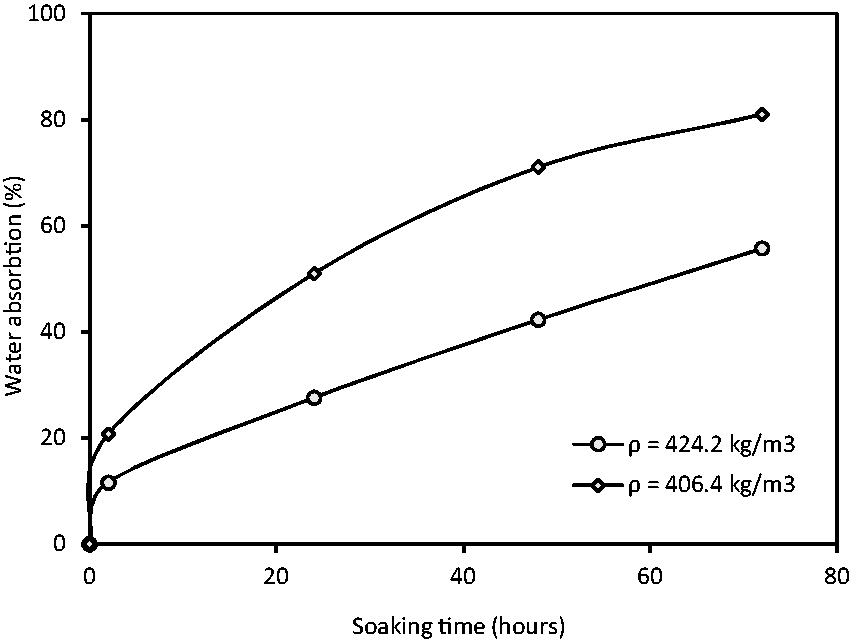
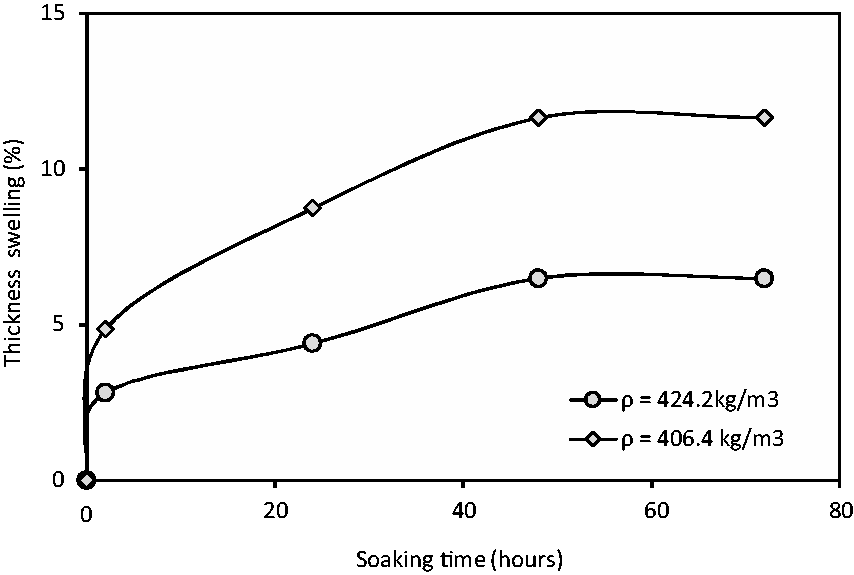
Differently from wood and other non-wood based particleboards, PO leaf boards seem to have a unique WA behavior. For the first period of soaking time, WA values are much lower and it seems that absorption (in %) increases constantly even after 72 h. Results indicate that, for a short contact time with water, composite boards have an impressive resistance. It may be assumed that the flat surface shape of the leaves prevents water to enter the inner part of the board. Differently from WA, TS reached a limit value for both specimens. Plots presented in Figure 5 show that the density plays a crucial role in the TS. Denser pieces have lower TS. As a consequence of this, we can say that the management of density could affect the mechanical properties of the composite boards as well as their physical properties, such as moisture resistance. The cutting and the inspection of the PO composite board were carried out in accordance with BS EN 326-1. 32 The examination of the inner part of the board was done visually. Observation showed the formation of layers of PO leaves which were placed over each other, forming a stable structure.
Conclusion
PO leaves can be used as an alternative material for the manufacture of leaf boards. Flexural strength which varies from 2.7 to 7.9 N/mm2 is fairly proportional with density. Addition of PMDI binder seems to increase the flexural resistance of the board. Other parameters that affect mechanical properties are pressing force and time of stay of PO sprayed mass in the ambient between spraying and pressing processes. Swelling test results indicate for an impressive moisture resistance, caused mainly by the flat form of leaves, which serves as a coat for the inner part of the board. Since it is not preferable to dump seagrass in the landfill, it could be beneficial to use this biomass in construction. This work has investigated only some of the properties and much work has to be done in order to create a clearer picture of the product. Further experimental investigations are recommended towards the binder compatibility, pressing process and spraying efficiency.
Footnotes
Declaration of Conflicting Interests
The author(s) declared no potential conflicts of interest with respect to the research, authorship, and/or publication of this article.
Funding
The author(s) received no financial support for the research, authorship, and/or publication of this article.