






Abstract
Deaths resulting from carbon-monoxide poisoning have been reported in the medical literature under diverse circumstances. Here, we report four deaths due to carbon-monoxide poisoning as a result of a traditional practice involving the application of heat to the abdomen to facilitate uterine involution during the immediate post-partum period. Four people died due to carbon-monoxide poisoning in two separate incidents, including two women in the post-partum period. In both instances, the women slept beside a stove with burning charcoal, which was supposed to provide warmth to the lower abdomen.
Introduction
Deaths due to carbon-monoxide poisoning are usually unintentional or suicidal in nature. Unintentional deaths from carbon monoxide are usually reported with fires, fuel-powered equipment and the use of faulty heating devices and cooking appliances. Automobile exhaust fumes are a major source of carbon monoxide for committing suicide, especially in the USA and Western countries, whereas the use of burning charcoal is popular among suicides in some East Asian countries. 1 Recent studies in England, Wales and the USA have shown that unintentional non-fire-related carbon-monoxide poisoning occurs mainly in the home environment.2,3
Carbon monoxide is a colourless, odourless, tasteless and non-irritant gas. These properties make carbon monoxide a greater danger to life when exposure takes place during sleep. Carbon monoxide is produced due to incomplete combustion of carbon-containing material. Carbon monoxide causes anoxia by competing with oxygen for binding with haemoglobin; the affinity of carbon monoxide for haemoglobin is 250–300 times greater than that of oxygen. 4 Additionally, carbon monoxide shifts the oxy-haemoglobin dissociation curve to the left, making less oxygen available to the tissues, and it also impairs the cellular respiration by inhibiting cytochrome oxidase. 4 The toxicity of carbon monoxide is enhanced in a confined environment.
Case 1
A married 28-year-old primiparous woman had been discharged from hospital on the fifth day following a normal vaginal delivery while the baby was undergoing treatment in the Neonatal Intensive Care Unit. On the morning of the third day following discharge from hospital, the woman was found dead on a mattress on the floor of her bedroom beside a metal container holding burning charcoal while her husband was found asleep on the bed. When the husband was woken, he was found to be confused and dazed. He made an uneventful recovery after being admitted to hospital. On visiting the scene, it was revealed that the metal container with burning charcoal beside the mattress on the floor was in close proximity to the bed in which the husband had slept (Figure 1). The entire room smelled heavily of smoke. It was revealed that an elderly woman in the house had advised the deceased to sleep beside the container with burning charcoal at around 11:00p.m. the previous night. All the windows and the door of their bedroom had been kept closed, and the air conditioner had been switched on for the entire night. The family members disclosed that it is a traditional practice for women in the immediate post-partum period to sleep beside a stove to provide warmth to the abdomen in order to help the womb recover faster. As the family did not agree to a post-mortem examination, only an external examination and drawing of blood for toxicology were undertaken.
View of the bedroom showing the mattress, bed and the stove.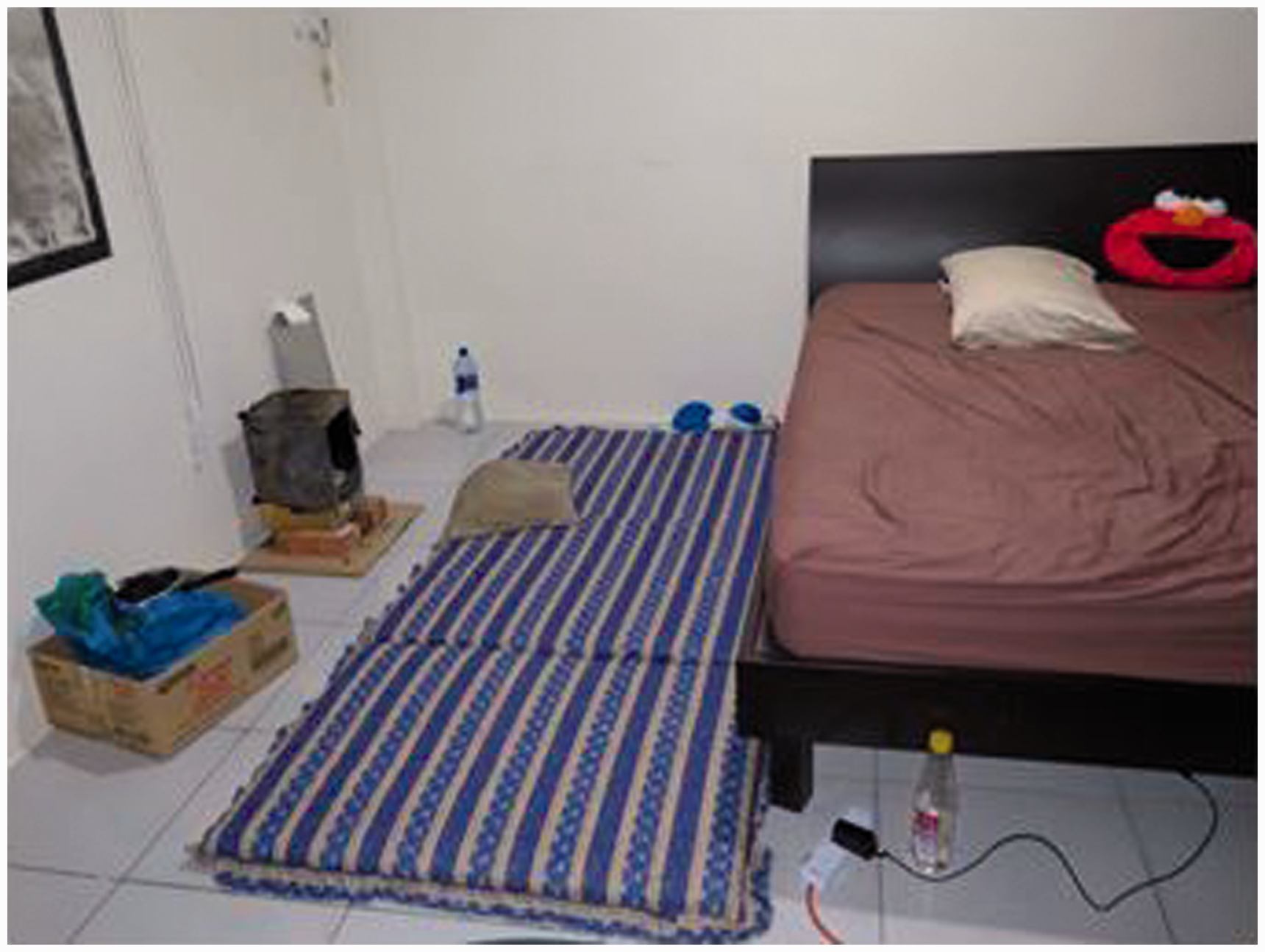
External examination and toxicological findings
There were no external injuries on the body. The most remarkable observation was the cherry-pink colour of the hypostatic areas, lips and the tongue. The blood carboxy-haemoglobin level was 63.3%, and the blood was negative for alcohol and drugs. The husband was found to be drowsy, and his blood carboxy-haemoglobin level was 10%. The probable cause of death of the woman was ascertained as carbon-monoxide poisoning.
Case 2
Three members of the same family – a 33-year-old male, his 33-year-old wife and her 63-year-old mother – were found dead in their home one evening. The deceased man’s brother-in-law made the discovery when the nine-year old son of the dead couple opened the front door of the house for him at around 7:00p.m. The child had told him that his parents were sleeping, and he had observed that the house was engulfed in smoke. Upon searching the house, the couple were found dead on a mattress beside a stove with burning charcoal.
The husband was lying closest to the stove, and his wife was next to him with a newborn baby by her side. The newborn baby had been sleeping directly under a ceiling fan, which had been switched on. The mother-in-law was found dead, having fallen face down in the adjoining toilet. All the windows and doors of the house leading to the exterior were found closed.
The investigations revealed that the 33-year-old woman had given birth to her second child in hospital three days prior to her death. The mother and baby were in good health at the time of discharge from hospital. The husband was known to be a heavy smoker. According to the police investigations, the deceased man had been talking to a colleague at around 10:00a.m. on the day the bodies were discovered, and it appears that thereafter the couple had gone to sleep beside a stove with burning charcoal.
Post-mortem examinations and toxicological findings
The post-mortem examinations were conducted the same day on all three bodies. The post-mortem examination of the husband revealed an emaciated body with a barrel-shaped chest. There were early signs of putrefaction. The blood was not cherry-pink in colour. There was bilateral emphysema of the lungs and pulmonary oedema. The stomach was empty. The blood carboxy-haemoglobin level was 32%.
The body of the wife showed bright cherry-pink coloured hypostasis. There was froth at the nose and mouth that was stained with bright cherry-pink-coloured blood. Apart from congestion, the internal organs were unremarkable, and the stomach was empty. The blood carboxy-haemoglobin level was 60%.
The body of the mother-in-law showed bright cherry-pink-coloured hypostasis on the front aspect of the body corresponding to the position of the body.
There was a lacerated wound on the chin and grazed abrasions on both knees. She had cardiomegaly; the heart weighed 420 g, with left ventricular hypertrophy probably secondary to hypertension. The coronary arteries were about 50% occluded by atherosclerosis. All organs were congested. Her carboxy-haemoglobin level was 54%.
Discussion
Traditional practices in dealing with mothers in the immediate post-partum period exist in many communities. Despite the availability of advanced medical care for pregnant women in developing and developed countries, deep-rooted beliefs in the society inherited from elders have led to the performance of numerous traditional practices during pregnancy and the post-partum period. Among them, the application of warmth to the lower abdomen during the immediate post-partum period, widely practised in many ASEAN countries, is believed to accelerate the involution of the uterus. One of the methods employed to achieve this is ‘mother roasting’, where the recently delivered mother is made to lie on a bamboo bed with a low fire under it. 5 Other methods include direct application of heat by placing a preheated stone wrapped in cloth on the mother’s abdomen5,6 and the mother lying by a fire.6,7 The latter methods have been practised in Brunei from the time that traditional birth attendants provided maternity care. 6 During that period, the majority of people were living in houses built on stilts on riverbanks and other inland water sources. The houses were built with wooden planks that allowed abundant ventilation. However, modern-day houses in Brunei are mostly air-conditioned, and ventilation during the night can become inadequate. Therefore, when the occupants fall asleep with the windows and doors closed, a stove with burning charcoal could lead to the accumulation of carbon monoxide in the house to dangerous levels. Due to the aforementioned properties of carbon monoxide, the victims will not sense the gas and be awoken from their sleep. Instead, they will gradually lose consciousness, leading to their death. Although this traditional practice had been widely used in the ASEAN countries, there are no reported deaths due to carbon-monoxide poisoning from this practice in the medical literature. A traditional practice among descendants of Mayans living in the Western Highlands of Guatemala, also aimed at hastening involution of the uterus after childbirth, carries a similar risk of carbon-monoxide poisoning. 8 Here, mothers in the immediate post-partum period are advocated to have regular sauna baths in wood-fired small airtight clay enclosures called ‘temazcal’. Studies conducted in Guatemala have shown elevated concentrations of carbon monoxide in the blood of frequent visitors to ‘temazcal’, including children and women in the post-partum period. 9
The deaths under discussion have some similarity to charcoal-burning suicides seen in some East Asian countries. However, the unintentional nature of the deaths under discussion was evident from the history of recent childbirth, the exposure of the entire household to the source of carbon monoxide and the absence of a suicide note.
The two women in the post-partum period had carboxy-haemoglobin levels >60%. However, the carboxy-haemoglobin levels of the male victim and the elderly woman were only 32% and 54%, respectively. These two victims had pre-existing chronic obstructive pulmonary disease and ischaemic heart disease, respectively. The main mechanism of action of carbon monoxide results in a state of hypoxia by reducing the oxygen-carrying capacity of the blood. Therefore, diseases that are aggravated by hypoxia, particularly ischaemic heart disease and chronic obstructive pulmonary disease, are known to bring about death at low carboxy-haemoglobin levels. 10 Exposure to air containing low concentrations of carbon monoxide is known to aggravate myocardial ischaemia in individuals with coronary artery disease. 11 Survival of the newborn baby in the second case can be explained by the fact that as she was sleeping directly under the ceiling fan, the smoke would have been driven away from the baby. The likely explanation for the elder child’s survival is that he had been out of the house for most of the time, playing with children in the neighbourhood. The recognition of the cherry-pink colour in the hypostatic areas and in the blood during the initial examination of the body is crucial for the post-mortem diagnosis of carbon-monoxide poisoning. The cherry-pink colour is said to be associated with carboxy-haemoglobin levels >30%. 10
These cases underline the importance of the awareness of traditional practices in the society during the investigation of sudden deaths. Since the occurrence of these deaths, a vigorous public-health campaign had been initiated to educate the communities on the dangers of this traditional practice of application of heat to the abdomen of mothers using stoves containing burning charcoal.
Footnotes
Declaration of conflicting interests
The authors declare that there is no conflict of interest.
Funding
This research received no specific grant from any funding agency in the public, commercial or not-for-profit sectors.