






Abstract
Abstract
Establishing identity from skeletal remains is a challenging task for forensic experts. Identification in such cases can be achieved by dental records, post-mortem radiography and DNA profiling. However, these methods require additional data for comparisons. Positive identification can also be achieved using implanted medical devices. This is a rapid and inexpensive method, as long as a central database is maintained for effective tracking of such devices. We present a case report in which identity was established from skeletal remains using information furnished on the implanted metallic dynamic hip screw and side plate. This case report discusses the legal scenario in India and globally with regard to medical devices and their utility for forensic application. It emphasises the need for legal provision relating to medical devices in India, which would compel the manufacturer to use unique identification numbers for each medical device and to maintain a person-specific database.
Keywords
Introduction
Identification is the determination of an individual, or person, based on specific physical characteristics. Decedent identification is a critical task in medico-legal work. This is routinely achieved by visual identification. Alternatively, positive identification is achieved by fingerprints, dental records, radiography and DNA profile analysis when visual identification cannot be used.1 However, these findings are of no use when no ante-mortem data are available for comparisons, such as registered fingerprints, dental records or DNA samples of the next of kin. Establishment of the identity of a person from skeletal remains is a challenging task. To establish identity, forensic anthropologists determine age, sex, stature and other anthropological parameters that constitute a biological profile of an individual. Positive identification of skeletal remains is established by comparison with previous dental records, radiographs and DNA profiling. However, these methods have their own hurdles. Implanted medical devices can be instrumental in establishing identity in such cases. Use of orthopaedic implants in the forensic identification from skeletal remains is well described in the literature.1–8 In the USA, the law mandates that batch numbers and serial numbers engraved on metallic implants are unique, and a database containing the details of the individuals to whom the implant is issued must be maintained.9 The present case report highlights the importance of metallic implants in identification from skeletal remains according to the serial numbers engraved on them. It also discusses the current status of laws relating to medical devices in India, and globally, and their utility in human identification. It emphasises the need for provision in Indian law that would compel manufacturers to emboss unique identification numbers on each implant, so it can be used as a primary means of identification.
Case report
The Department of Forensic Medicine of a tertiary care centre received skeletal remains and clothes for examination from the nearby police. The skeletal remains and clothes had been found in a forest by a farmer who informed the police. The clothes consisted of a blue jacket with two front pockets, four buttons and five buttonholes. The lowermost button was missing. There was a brown sweater with tears present along right lateral stitch, extending to the axillary stitch and right shoulder region. There was a white dhoti (long loincloth) and yellowish underwear with reddish strips. One monkey cap and pink dupatta (scarf) were also found. The clothes were stained with mud and decomposition fluid. Two black shoes, size 8, with the inscription ‘MIERO ART NO. B04’, were also retrieved. The skeletal remains consisted of one skull with mandible, atlas and axis vertebrae, a piece of the articulated pelvis with parts of hip bones, part of the sacrum and parts of both femora. Parts of two tibiae and part of one humerus were also identified (Figure 1). Based on comparative anatomy, the skeletal remains were thought to be human. The skull, mandible and pelvis showed male features. Sagittal suture, coronal suture and lamboid suture showed complete obliteration on both the ectocranial and endocranial surface. The findings of Sahni et al. were referred to for estimation of age from cranial sutures. In their study of the Indian population, it was concluded that age estimation from cranial sutures is erratic and unreliable. However, complete obliteration of all three sutures was found in 17–40% cases in the >60 years age group.10 Hence, we presumed that the deceased could be >60 years old. An examination of the mandible showed that mental foramen was near the alveolar border, and alveolar sockets showed loss of teeth and bone resorption. This further supported that the deceased was of old age. Stature from the long bones could not be estimated, as none of the long bones were intact. Stature was estimated from the length of coronal suture using the linear regression analysis formula of 117.98+(2.04×coronal suture length) given by Rao et al.11 The length of the coronal suture was 26 cm. Accordingly, the stature was estimated to be 165.35–176.69 cm, with a standard error of estimate of 5.67 cm.
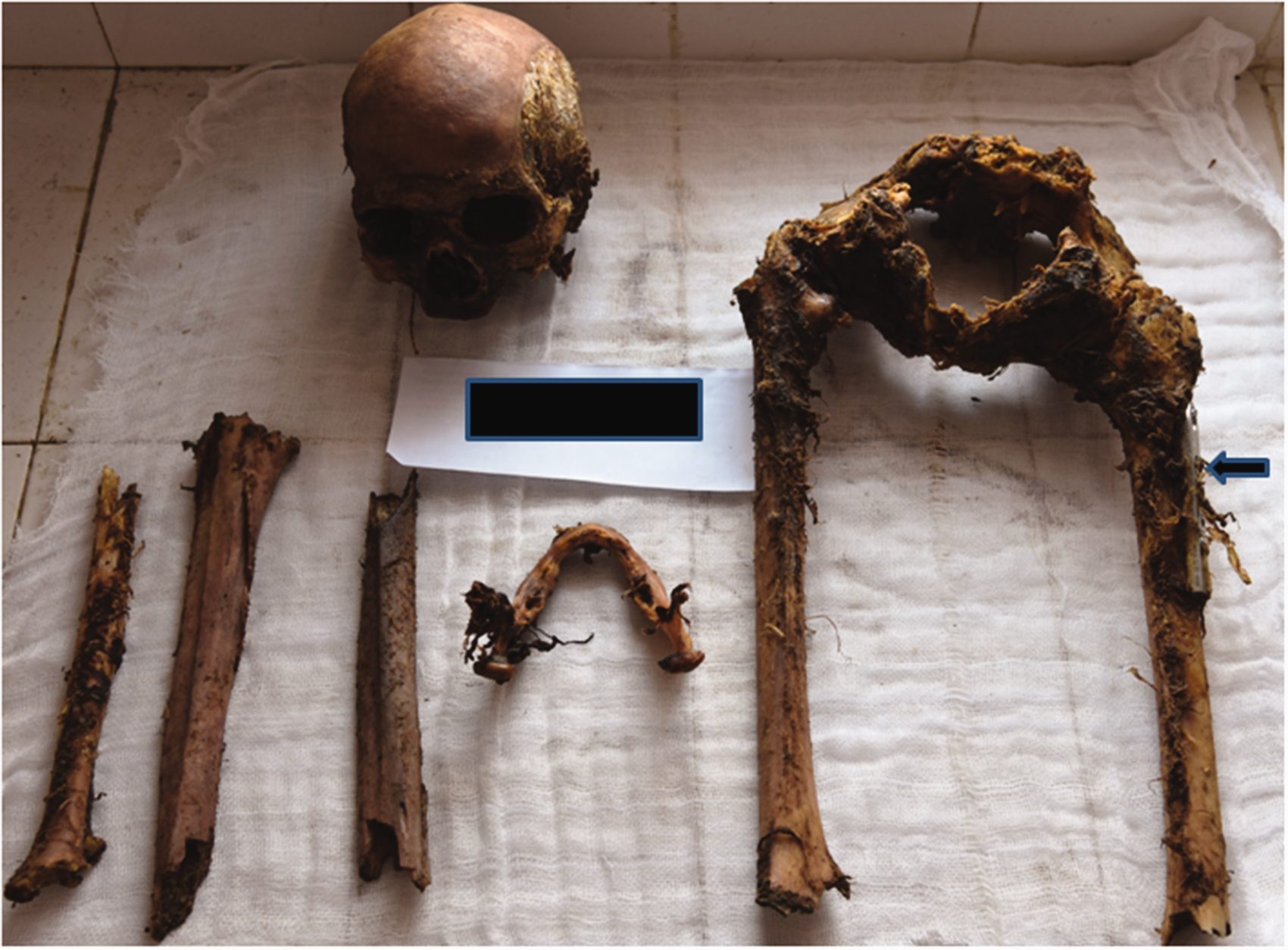
Skeletal remains brought for examination by the police. The arrow points to the dynamic hip screw (DHS) attached to the left femur.
There was evidence of surgical correction of intertrochanteric fracture of the left femur by dynamic hip screw (DHS) held in place by side plate and five nails. We noticed specific engravings over the plate which read as ‘SSEPL CE 1293 DHS PLATE 135* 5 HOLE (D/C HOLE L/B) 316L’ (Figure 2). The hip plate showed the marking ‘SSEPL’, meaning ‘Sharma Surgical and Engineering Private Limited’, that is, the name of the manufacturer. Investigating officers contacted a representative of the manufacturer and forwarded the pictures of the hip plate. It was confirmed that the DHS assembly was indeed manufactured by the aforesaid company and supplied to orthopaedic hospitals in the particular district of central India. As it is a rural region of India, major orthopaedic surgeries such as the one conducted in the present case are only performed in a few hospitals. Accordingly, police narrowed down the search to three major hospitals. They retrieved the surgical records of the patients >60 years of age who had undergone a similar type of surgery. The same serial number was noted down by the orthopaedic surgeons in the operative notes in three cases. The contact details of the patients were retrieved. Two of the patients were alive. The son of the third patient gave a history that the patient, who had dementia and had been missing for one month. He identified the clothes of his father that were found near the skeletal remains. The approximate age and stature of the deceased were also consistent with the estimated age and stature. The mandible and teeth were preserved for DNA analysis for additional confirmation.
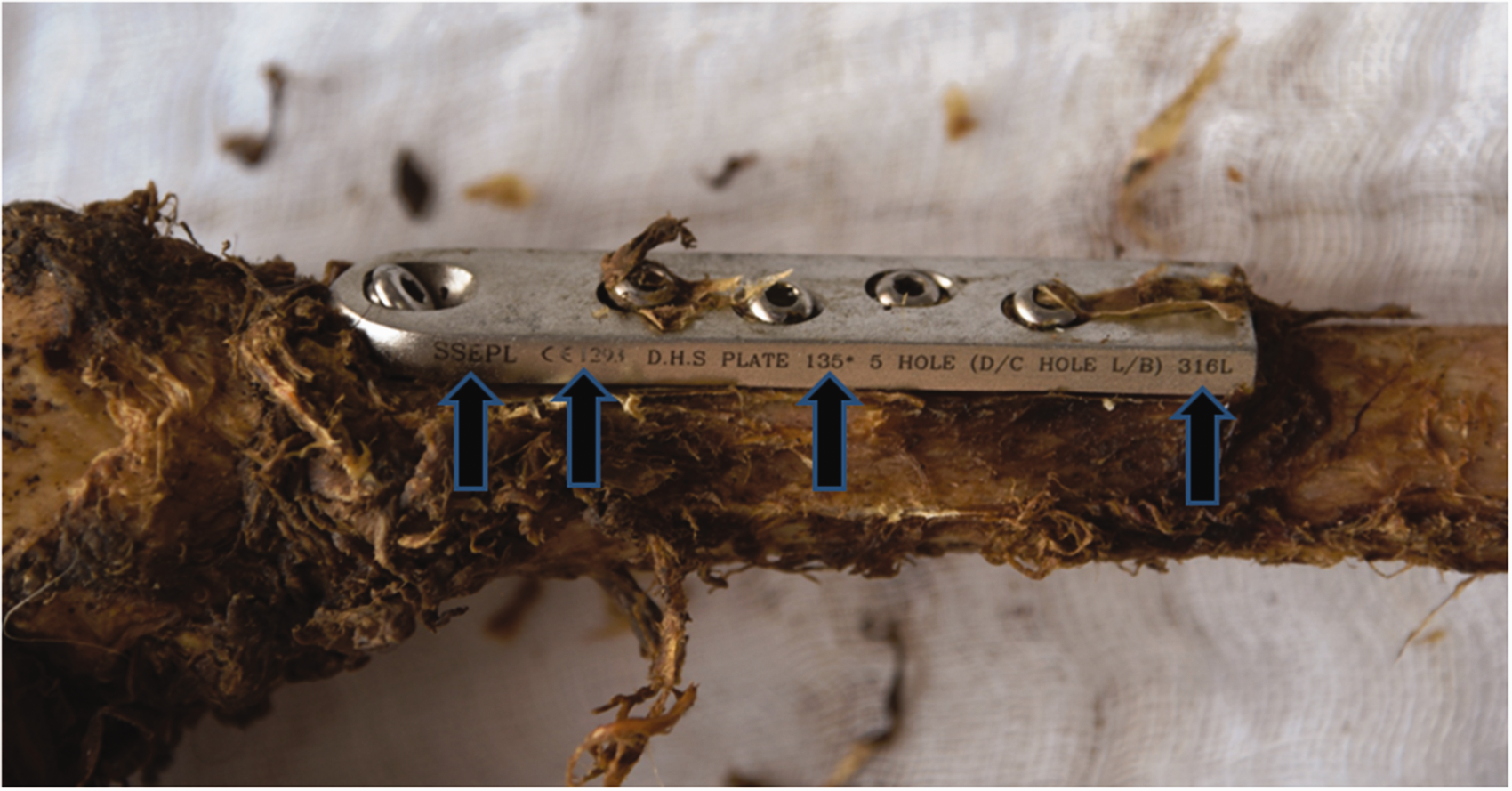
Left femur with surgical correction by DHS held in place by a side plate and five nails. The first arrow points to the engraving ‘SSEPL’ which indicates the name of the manufacturer. The second arrow points to ‘CE 1293’, where CE means that the device complies with the applicable EU regulations and is eligible for commercialisation in 32 European countries, and 1293 is the notified body number. The third arrow points to the engraving ‘135*’ which indicates the length of the plate. The fourth arrow points to the engraving ‘316L’, indicating type of stainless steel and its constituents.
Discussion
Decedent identification is an integral part of forensic examination. It has relevance in several civil as well as criminal proceedings. Failure to establish the identity of human remains can have social and economic ramifications for the family as well as the state.12 Conventionally, visual identification is used to verify identity in the majority of cases. However, visual identification is unreliable in cases of advanced decomposition, extensive facial disfigurement due to trauma or burns and skeletal remains.7 Forensic experts have to resort to alternate methods of identification in such cases. Identification from skeletal remains is a daunting task for forensic experts. Positive identity is established when all characteristic features of the skeleton point to a single individual.13 Clothing and jewellery can be useful as secondary means of identification. While establishing identity, forensic anthropologists take into consideration multiple evidence such as age, sex and stature that narrows the search to a limited number of individuals. Positive identification is achieved by dental comparison, radiography or DNA profiling. However, dental comparison or radiography is not always useful due to lack of ante-mortem records, and DNA is costly and time-consuming. In addition to these conventional identification methods, implanted medical devices can also be instrumental for positive identification of the person. Implanted medical devices include orthopaedic metallic implants such as plates, screws and artificial joints, intraocular lenses, breast implants, vascular stents, vascular occluding devices, prosthetic heart valves, ventricular assist devices, implantable cardiac defibrillators and pacemakers. The use of orthopaedic devices for forensic identification is well established.1–8 The manufacturer and model of the implanted device can be ascertained by examination of the logo and other specific details.14 Positive identification can be established if the manufacturer give each device a unique serial number. The manufacturer is also required to maintain a patient-specific database for effective tracking of the devices. If patient-specific data are lacking, then the manufacturer can at least provide the shipping details, details of the distributors or the hospitals that have procured the devices. However, the same serial number is required to be documented in the clinical records for positive identification.7
Identification by using implanted medical devices has been adequately described in the literature. Blessing et al. verified the utility of such devices for identification retrospectively. In their study, they found that out of 56 cases requiring a non-visual method of identification, eight cases had implanted orthopaedic devices. Positive identification was established in six cases by comparing the unique serial number from clinical records. In two cases, it indicated the lot number.7 Matoso et al. reported the case of identification of a burnt body using an implanted metallic plate. In this case, the metallic plate had an identifying number which allowed traceability in addition to details of the manufacturer, details of material, logo and manufacturing lot number.1 In another case report by Takeshita et al., positive identification was achieved by multiple lot numbers on intramedullary nails and the manufacturer’s and distributor’s record of use history of the product.6 Berketa et al. also studied the utility of hip and knee prosthetic devices for identification using national joint revision registries and company data.15 Simpsons et al. demonstrated the utility of orthopaedic devices in the establishment of identity in their case series of eight cases. However, instead of a unique serial number, they compared post-mortem radiographs with the ante-mortem records.4 This may not always be feasible, particularly when there is absolutely no clue about the possible identity of the victim.
In the present case, surgical correction of intertrochanteric fracture of the left femur was found in the form of application of a DHS held in place by side plate and nails. Dynamic compression hip screws allow sliding of the screw within a barrel attached to the side plate that is fixed to the femur to accommodate the inevitable collapse that occurs during fracture healing. These compression hip screws act according to tension band principles in that the screw is loaded in tension and the bone at the fracture site loaded in compression. This technique is most commonly used by experienced orthopaedic surgeons.16 This modality of treatment is commonly used in elderly patients with poor bone quality, as the fixation relies mainly on the gliding mechanism along the femoral neck.17 Hence, it was presumed that some experienced senior surgeon probably performed this surgery. It also indicated that the operated patient was elderly, which was consistent with age estimated on examination.
Information regarding the manufacturer of the implant, the dimensions of the implant, the materials used for manufacturing and the notified body number was engraved on the side plate. It read as ‘SSEPL CE 1293 DHS PLATE 135* 5 HOLE (D/C HOLE L/B) 316L’. SSEPL is the name of the manufacturer (i.e. Sharma Surgical and Engineering Private Limited). CE 1293 means that the medical device complies with the applicable EU regulations and is eligible for commercialisation in 32 European countries, 1293 is the notified body number18 and 316 L embossed on the plate stands for a particular type of stainless steel used for the production of the plate. Its primary alloying constituents are chromium (16–18%), nickel (10–14%) and molybdenum (2–3%). The addition of molybdenum provides greater corrosion resistance.19 The manufacturer also engraved the dimension on the plate, that is, 135* stands for the length of the plate, which was 135 mm.
Investigating officers contacted the manufacturer and obtained a list of hospitals that had procured similar metallic implants in this particular region. From the hospitals, they received the clinical records of such cases. This was possible because in this rural part of India, such major surgeries are mainly performed in only a few major hospitals. Retrieving treatment records would not have been so easy if such a case had occurred in a major city where these types of surgeries are routinely performed. The serial number embossed on the implant was compared to that mentioned in the operative notes, and the search was narrowed down to three cases. Two of the patients were found to be alive, and the third patient had been missing for a month. Later, the son of the deceased also identified the clothes of his father. As the number embossed on the device was not unique, DNA samples were preserved for further confirmation. Apart from DNA, ante-mortem dental records or radiographs can also be helpful for positive identification from skeletal remains.7 In India, it is not routine practice to preserve dental records. In this case, neither dental records nor previous radiographs were available for comparison.
In most countries, the law related to medical devices does not have provision for patient-specific tracking of devices. The USA enacted the Safe Medical Devices Act (SMDA) in 1990. It mandates for the device manufacturer to provide upon request to the Food and Drug Administration the unique device identifier, the lot number, the batch number, the model number or a serial number of the device or other identifier necessary in order to enable effective tracking of the devices, and the name, address, telephone number and social security number of the patient receiving the device.9 Japan revised its Pharmaceutical Affairs Law in 2005. Under the revised law, manufacturers and distributors became obliged to record the use history of implantable devices, which included the serial and lot numbers of the devices.6 In countries such as Australia and the USA, the national associations of orthopaedic surgeons have established their own registry for device tracking. These registries are meant for follow-up of the patient, but they can be used for forensic identification.5,15 In India, the standard of quality and safety of medical devices are regulated by the Drug and Cosmetic Act 1940. In India, there has been no central database for these medical devices until now. Recently, the Government of India issued the Medical Devices (Amendment) Rules 2020 under this Act which mandates compulsory registration of medical devices and the maintenance of a central database called the Online System for Medical Devices. It contains the generic name, model name, intended use, class of medical device, details of material, dimensions, shelf life, brand name and so on.20 This is a welcome step. However, this information and the number on the prosthesis may not be unique, and the catalogue number or lot number may be specific to the implant but can be used more than once.21 The Medical Devices (Amendment) Rules 2020 do not mandate for the device manufacturer to give a unique serial number to each device, and there is no provision to maintain a patient-specific database. If these recommendations were to be implemented in the future, then positive forensic identification could be achieved with medical devices quickly. It is also inexpensive in comparison to DNA analysis. However, due to the absence of such specific measures in India, metallic implants can be used for presumptive identification only to narrow down the search for potential candidates, as in this case, and not as the primary means for positive identification.
Hence, it is recommended that forensic experts should always search for metallic implants and other medical devices, especially in cases of decomposed, charred bodies and skeletal remains. Surgeons should always give the type of implanted metallic device, manufacturer’s name, dimensions of the metallic device, serial number and lot numbers engraved onto metallic devices in their operations notes. The law should have provisions such as unique device identifier and patient-specific database such as the Safe Medical Devices Act (SMDA) in the USA for more robust application in forensic identification.
Footnotes
Declaration of conflicting interests
The authors declared no potential conflicts of interest with respect to the research, authorship and/or publication of this article.
Funding
The authors received no financial support for the research, authorship and/or publication of this article.
