






Abstract
In this paper, an adaptive fuzzy sliding mode control strategy with bound estimation is proposed to control the position of a micro-electro-mechanical systems gyroscope in the presence of model uncertainties and external disturbances. The proposed adaptive fuzzy sliding mode control system is composed of a fuzzy controller and a sliding mode controller. The sliding controller is designed to compensate for the approximation error between fuzzy controller and optimal fuzzy control law. The adaptation laws based on the Lyapunov analysis can adaptively adjust the fuzzy rules, thus guaranteeing the stability of the closed loop adaptive fuzzy control system. Moreover, an estimation mechanism is derived to identify the unknown upper bound of approximation error. Numerical simulations are investigated to verify the effectiveness of the proposed adaptive fuzzy control scheme.
Introduction
Gyroscopes are commonly used sensors for measuring angular velocity in many areas of applications such as navigation, homing and control stabilization. The performance of the micro-electro-mechanical systems (MEMS) gyroscope is deteriorated by the effects of time varying parameters, environment variations, quadrature errors and external disturbances.
Advanced control such as adaptive control, sliding mode control and intelligent control are necessary to control the MEMS gyroscope. In the last few years, increasing attention has been given to the tracking control of the MEMS gyroscope. A sliding mode control for a MEMS gyroscope system is developed in Batur et al. (2006). A phase-domain design approach to study the mode-matched control of the gyroscope is derived in Sung and Lee (2009). An adaptive controller for a MEMS gyroscope, which drives both axes of vibration and controls the entire operation of the gyroscope, is presented in Park et al. (2007) and Leland (2006). An adaptive controller for triaxial angular sensors is investigated in John and Vinay (2006). Adaptive sliding mode control approaches have been developed to control the MEMS gyroscope in Fei (2010) and Fei and Batur (2009). A compact H∞ robust rebalance loop control for MEMS gyroscope is proposed in Ma et al. (2010).
System non-linearities are inevitable in actual engineering and require the controller to be either adaptive or robust to these model uncertainties. Intelligent control approaches such as fuzzy control have the ability to approximate non-linear systems. Wang (1994) demonstrated that an arbitrary function of a certain set of functions can be approximated with arbitrary accuracy using a fuzzy system on a compact domain. Therefore a fuzzy logic system to approximate arbitrary non-linear functions makes it a useful tool for adaptive application. Adaptive fuzzy controllers for robot manipulator are investigated in Guo and Woo (2004), and Yoo and Ham (2000). Adaptive fuzzy sliding-mode control with application to an electrical servo drive is presented in Wai (2007). Adaptive fuzzy output tracking control of multi-input–multi-output (MIMO) non-linear uncertain system is derived in Chen et al. (2007). An adaptive fuzzy control approach has been investigated with application to the piezo-actuated stage in Chen and Hisayama (2008). Novel adaptive finite-time controllers for synchronizing chaotic gyros with non-linear inputs are developed in Aghababa (2011) and Aghababa and Aghababa (2012). Robust sliding mode control of uncertain time-delay systems is presented in Li and Decarlo (2001). Sliding mode control for non-linear state-delayed systems based on observer design is investigated in Niu et al. (2004). New results on robust adaptive control of uncertain time-delay systems are introduced in Xu and Feng (2008).
In this paper, a robust adaptive fuzzy sliding mode tracking control approach is presented for a MEMS gyroscope. A fuzzy controller that can compensate for the system non-linearities is incorporated into the adaptive sliding mode control scheme in a Lyapunov framework. The proposed control strategy has the following advantages compared with the existing ones:
The advantage of using a fuzzy compensator for the system non-linearities is that we need not derive the linear formulation of the gyroscope dynamic equation and tune the parameters. The proposed control strategy does not depend on accurate mathematical models, which are difficult to obtain and may not give satisfactory performance under parameter variations. This is the most important feature of the proposed control compared with conventional control methods.
The contribution of this paper is the integration of the adaptive control, sliding mode control and the non-linear approximation of fuzzy control. An adaptive fuzzy control is used to compensate for the approximation errors, the unknown model uncertainties and external disturbances. The proposed adaptive fuzzy sliding mode controller can guarantee the stability of the closed-loop system and improve the robustness for external disturbances and model uncertainties. Moreover, in order to remove the requirement of that, the upper bound of the approximation errors need to be known in advance; a simple adaptive algorithm is designed to estimate the bound of the approximation errors.
A new adaptive fuzzy control is proposed to deal with system non-linearities in order to improve the trajectory tracking resolution and robustness of the control system compared with conventional control methods. The adaptive fuzzy control methods have been extended to the control of MEMS gyroscope in this paper. This is the successfully application example using fuzzy control with the MEMS gyroscope. Both of these features are an innovative development of fuzzy control method incorporated into conventional control for the MEMS gyroscope.
The paper is organized as follows. In the next section, the dynamics of the MEMS gyroscope is described through non-dimensional transformation. Then, adaptive fuzzy sliding mode control and robust adaptive fuzzy sliding control with bound estimation are derived in the Lyapunov framework. Simulation results are presented to verify the effectiveness of the proposed adaptive fuzzy sliding mode control, followed by the conclusions.
Dynamics of MEMS gyroscope
The dynamics of MEMS gyroscope is described in this section. A typical MEMS vibratory gyroscope configuration includes a proof mass suspended by spring beams, electrostatic actuations and sensing mechanisms for forcing an oscillatory motion and sensing the position and velocity of the proof mass as well as a rigid frame, which is rotated along the rotation axis. The dynamics of the MEMS gyroscope is derived from Newton’s law in the rotating frame.
In a z-axis gyroscope, by supposing the stiffness of spring in the z direction is much larger than that in x,y directions, the motion of proof mass is constrained to only along the x–y plan as shown in Figure 1. Assuming that the measured angular velocity is almost constant over a long enough time interval, the equation of motion of a gyroscope is simplified as follows.
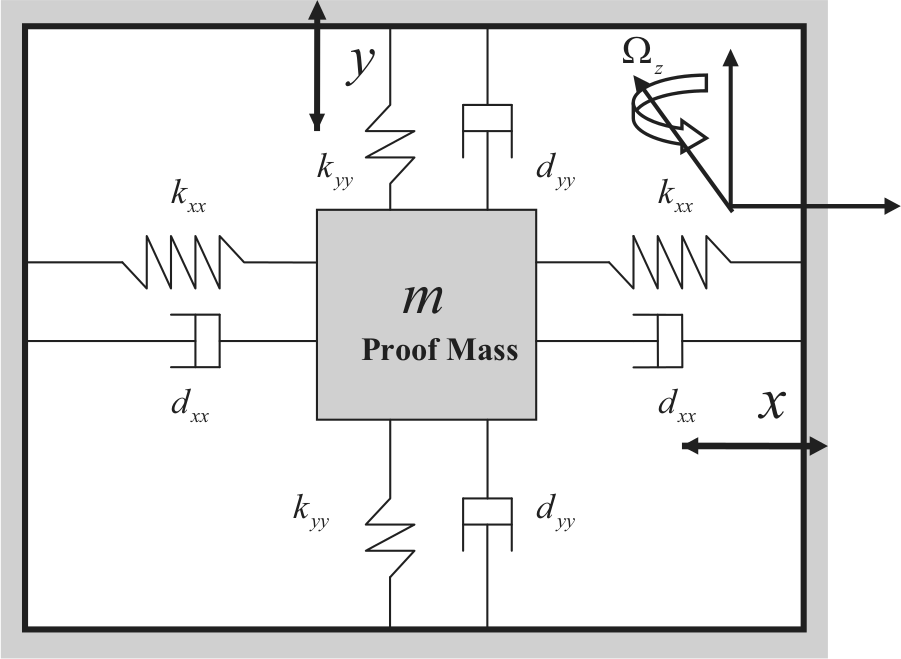
Simplified model of a z-axis micro-electro-mechanical systems (MEMS) gyroscope.
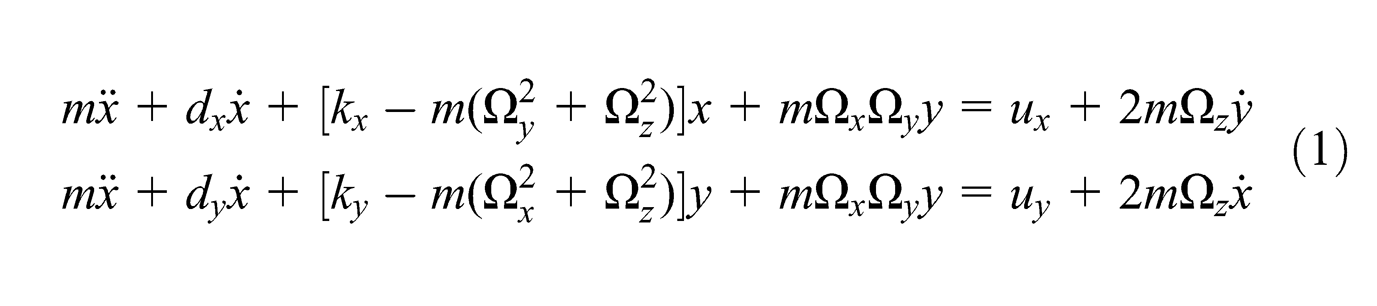
where x and y are the co-ordinates of the proof mass with respect to the gyro frame in a Cartesian co-ordinate system;
Taking fabrication imperfections into account, which cause extra coupling between x and y axes, the governing equation for a z-axis MEMS gyroscope is:
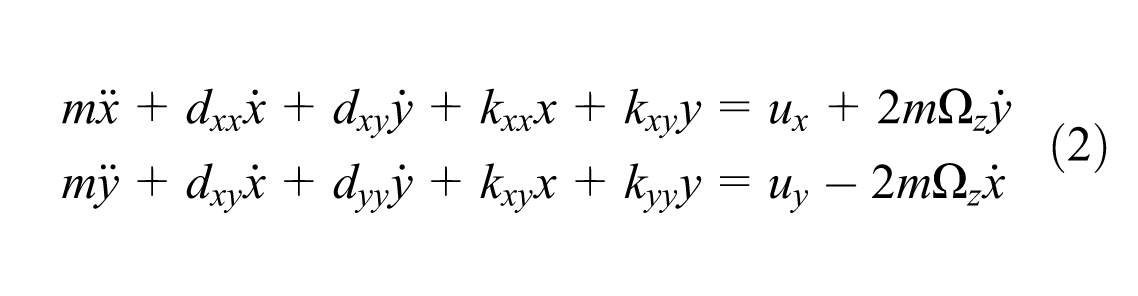
In Equation (2),
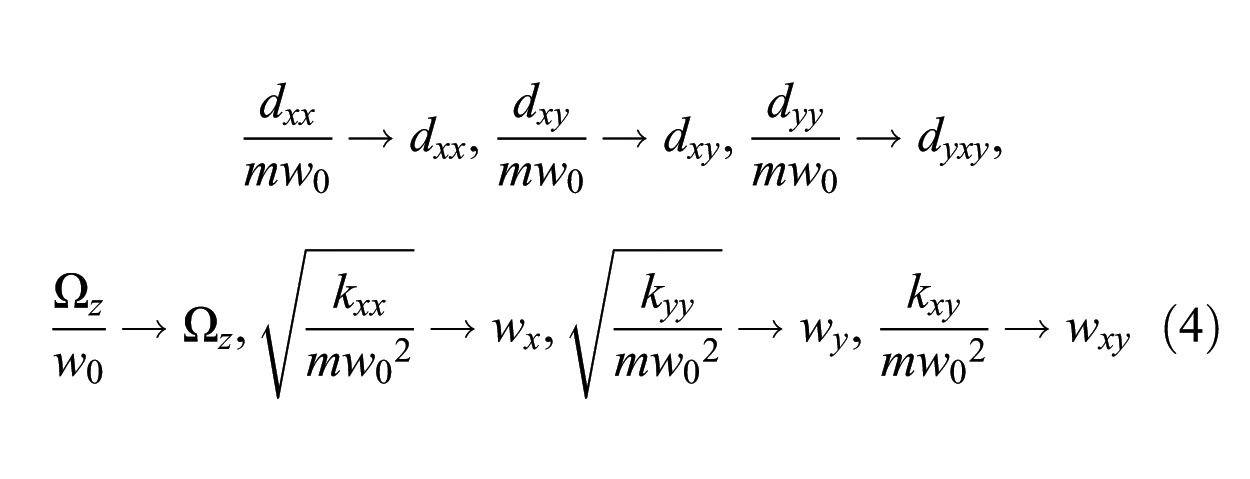
Dividing both sides of Equation (2) by
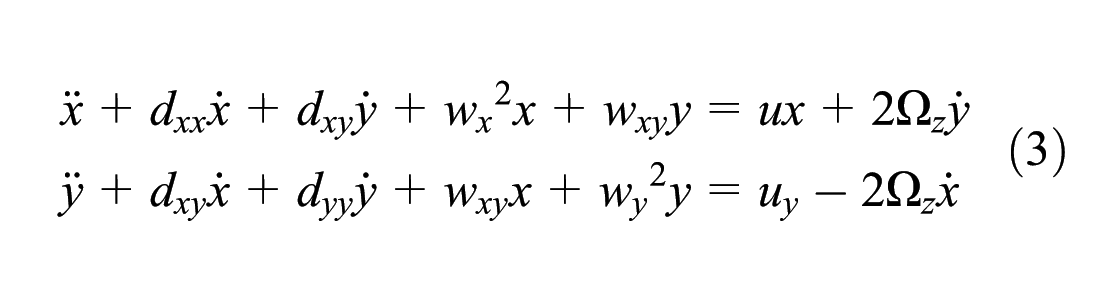
where
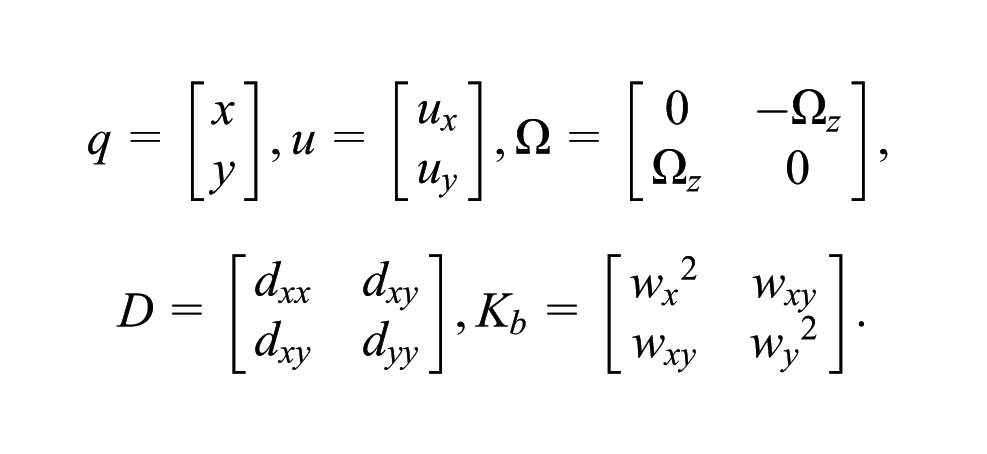
The vector form of MEMS gyroscope dynamic model can be written as

where
Adaptive sliding mode control
The procedure of the proposed adaptive fuzzy control with application to the MEMS gyroscope is described in this section. The block diagram of the adaptive fuzzy sliding mode control system for MEMS gyroscope is shown in Figure 2.
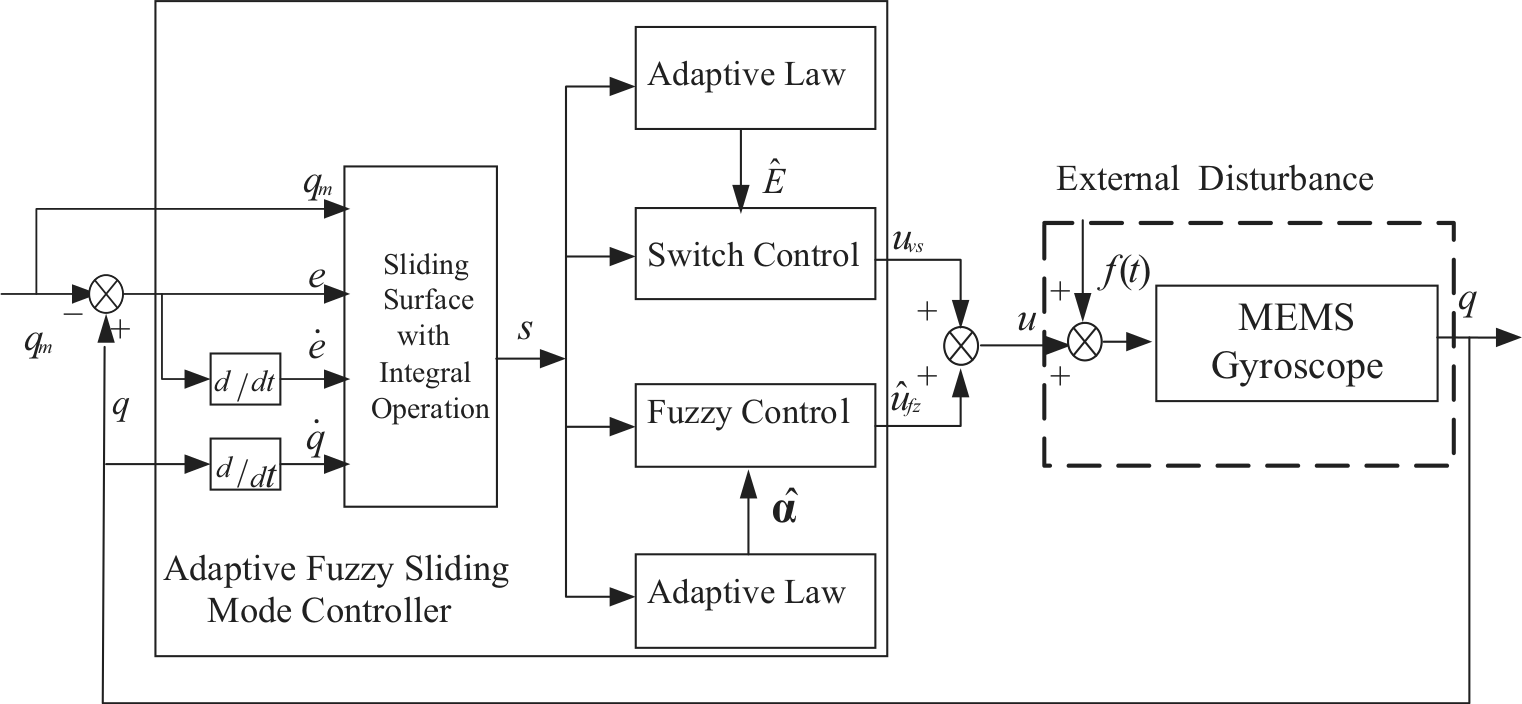
Adaptive fuzzy sliding mode control system.
The control target for MEMS gyroscope is to maintain the proof mass to oscillate in the x and y direction at given frequency and amplitude:

where
Define the tracking error as follows:

Now we define an integral operation sliding surface as
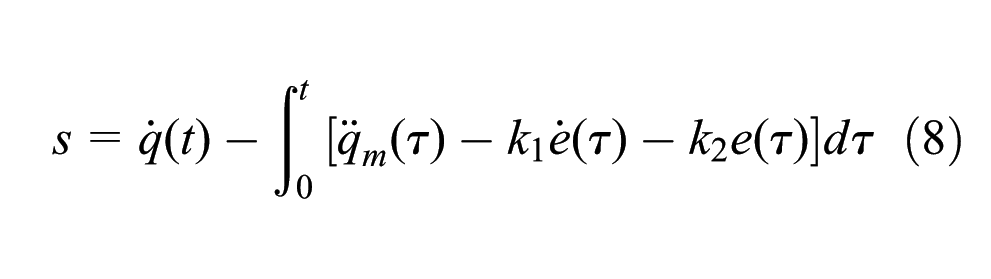
where
From Equation (8), if the state trajectory of system (5) lies in the sliding surface, namely

If
Assuming the

In fact,
Fuzzy control is generally very robust and capable of handling non-linear systems.
A fuzzy controller is composed of the following four elements: fuzzier, some fuzzy IF–THEN rules, a fuzzy inference engine and a defuzzifier. The fuzzy inference engine uses the fuzzy IF–THEN rules to perform a mapping from an input linguistic vector
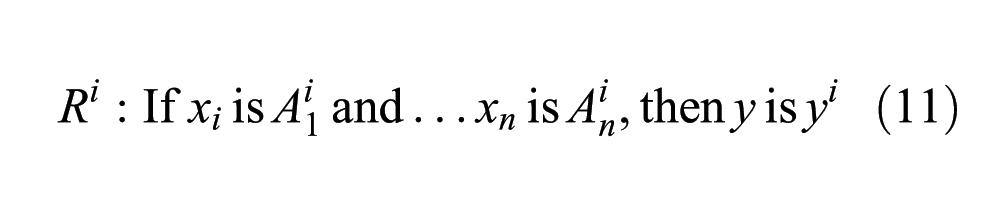
where
The output of the fuzzy system can be expressed using centre-average defuzzifier, product inference and singleton fuzzifier as:
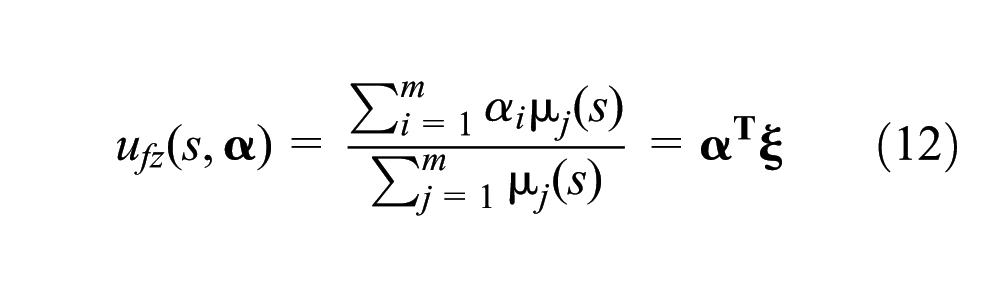
where

where
According to the universal approximation theorem, there exists an optimal fuzzy control system
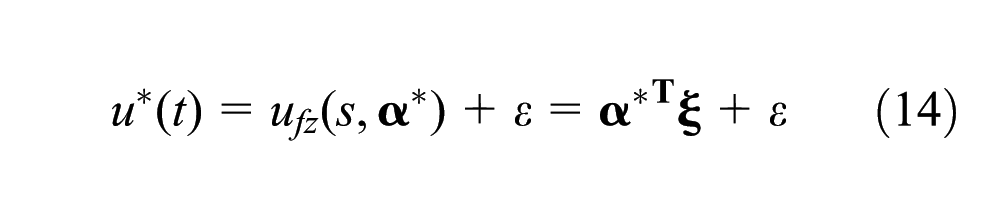
where
Using a fuzzy control system

where
By using switching control

where

Substituting (16) into (5) results in

According to Equations (9), (14) and (18), the sliding dynamics become
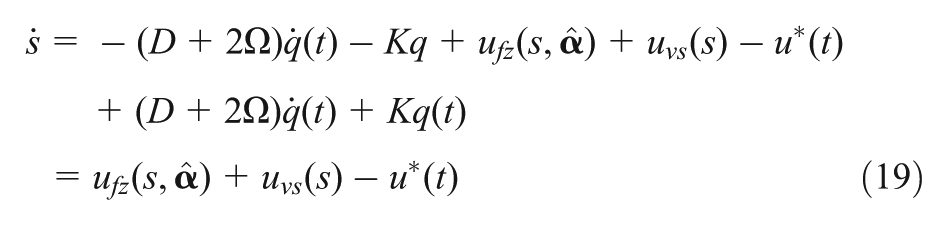
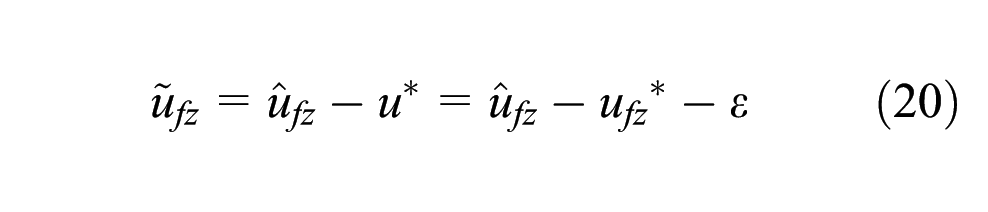
Defining
and defining

and sliding dynamics (19) become

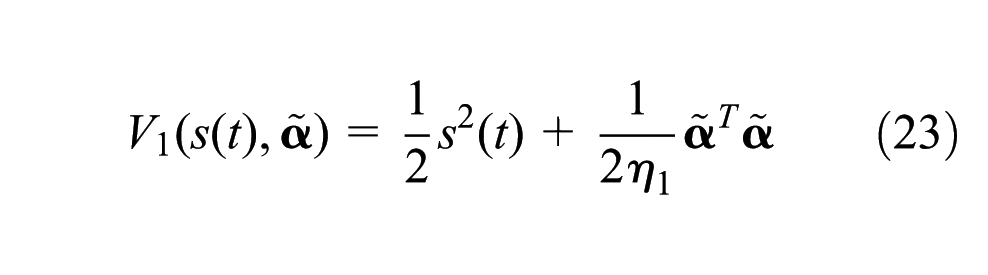
Define a Lyapunov function candidate as follows
where
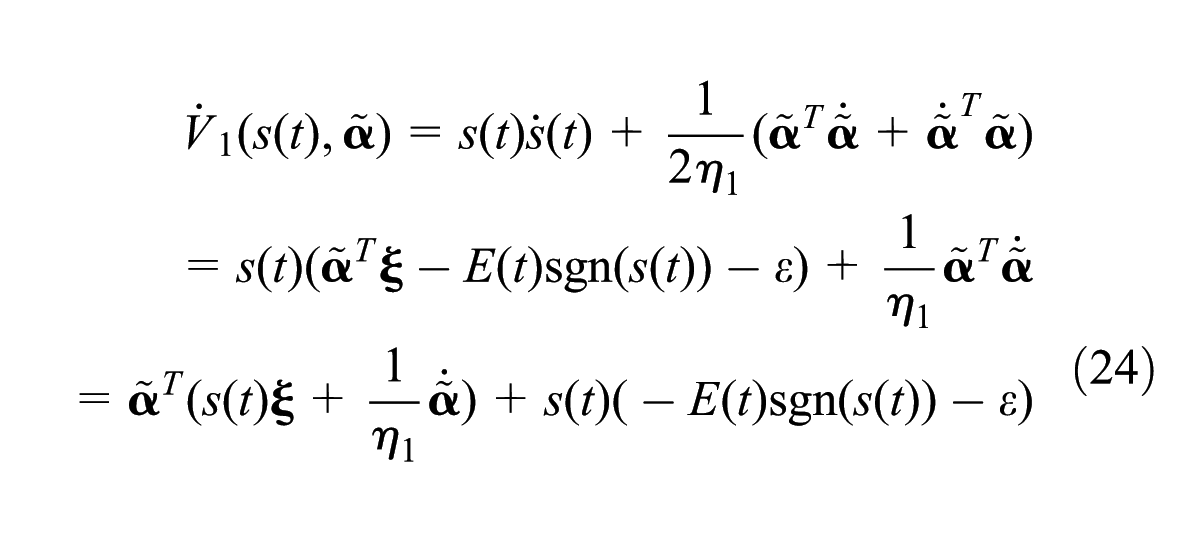
Differentiating (23) with respect to time yields
To make

where sgn(·) is a sign function. Then Equation (24) can be rewritten as
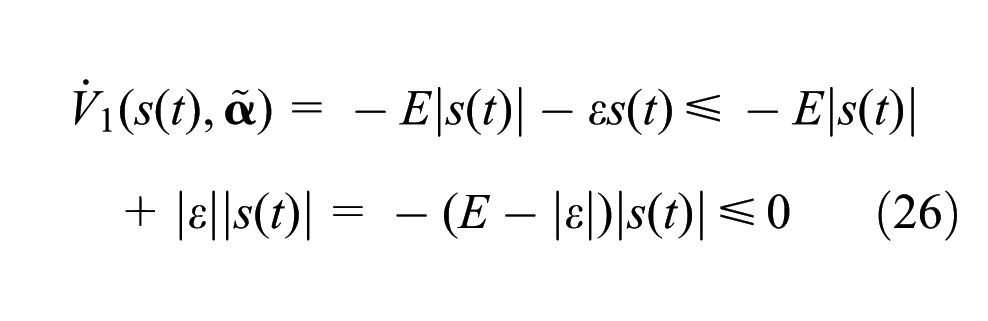
This implies that
Robust adaptive sliding mode control
In the previous section, we assume the bound of the approximation error is known. However, in the switching control (17), the bound of approximation error E is difficult to know in practical applications. If E is chosen too large, the control force has large chattering. If E is chosen too small, the control system may be unstable. To relax the requirement of bound of the approximation error, the adaptive estimation method of E is proposed to remove the bound requirement.
Replacing

where
Define the estimated error as follows:

Define a Lyapunov function
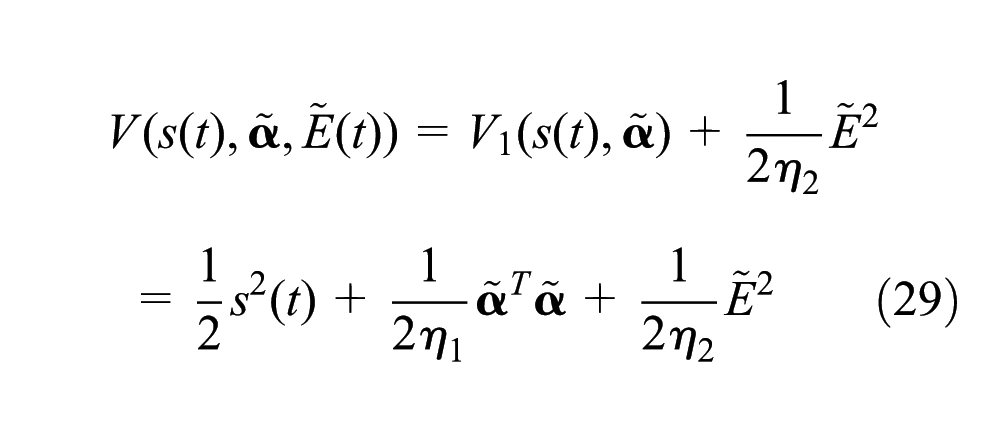
where
Differentiating (29) with respect to time yields
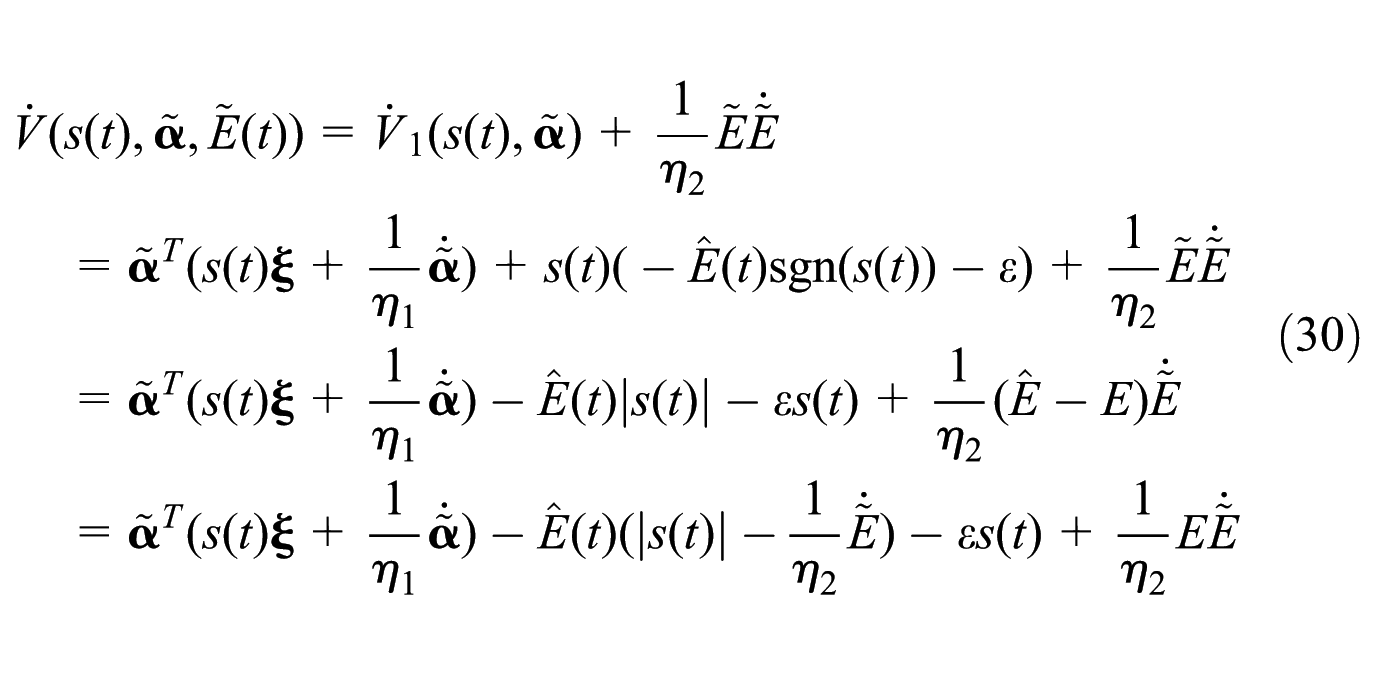
To make

Substituting (25) and (31) into (30) yields

This implies that
Simulation analysis
According to the proposed adaptive fuzzy sliding mode control approach, the simulation is performed in MATLAB/Simulink software. The parameters of the MEMS gyroscope are as follows:
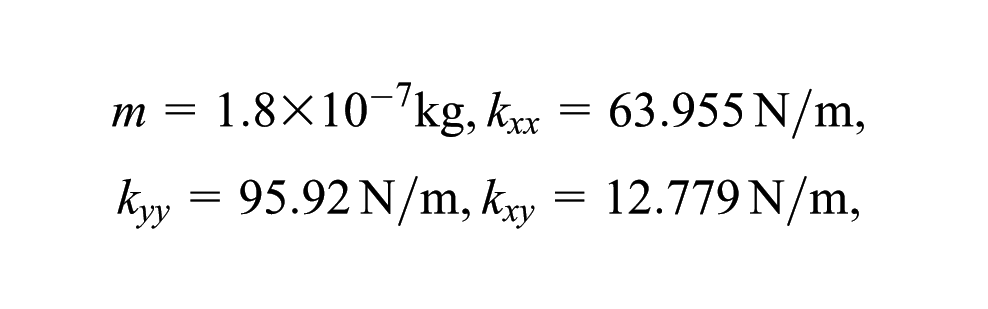

Choose the reference length
Through dimensionless computation, the following parameters can be obtained:
The control objective is to maintain the system to track the desired trajectory:
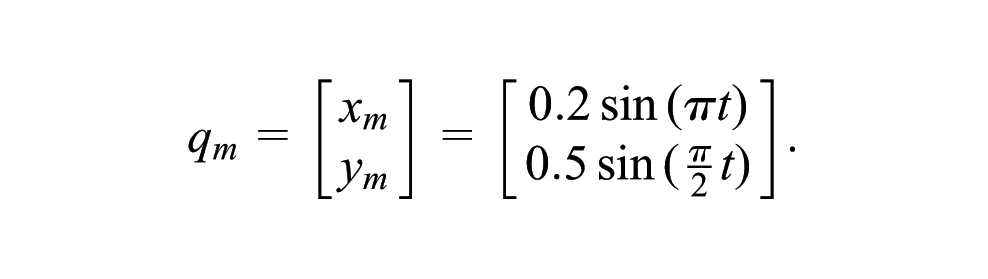
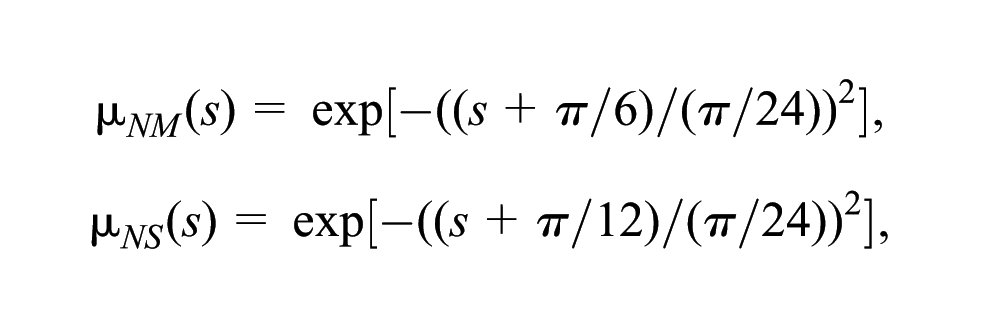
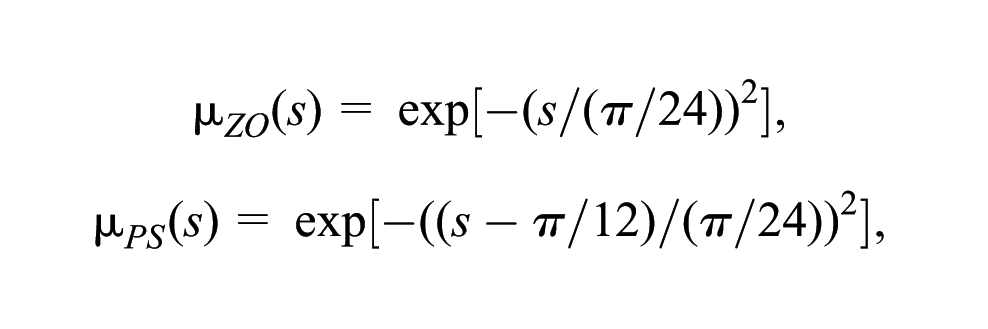
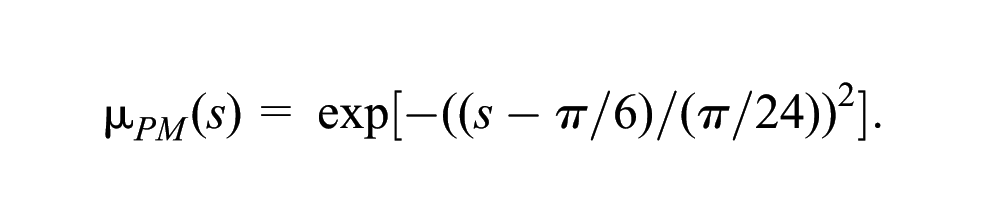
and the fuzzy membership functions of the fuzzy variable s are chosen as:
We choose the initial state condition as
Considering E as fixed value, i.e.
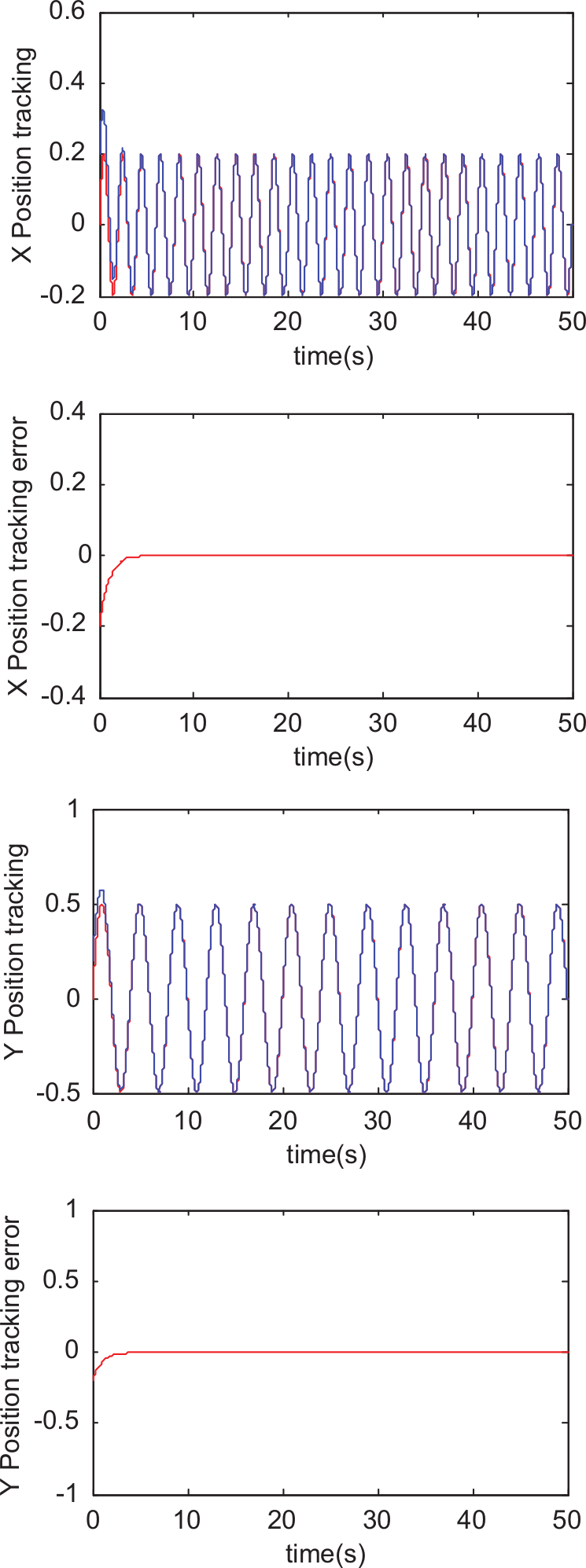
X and Y axis position tracking responses.
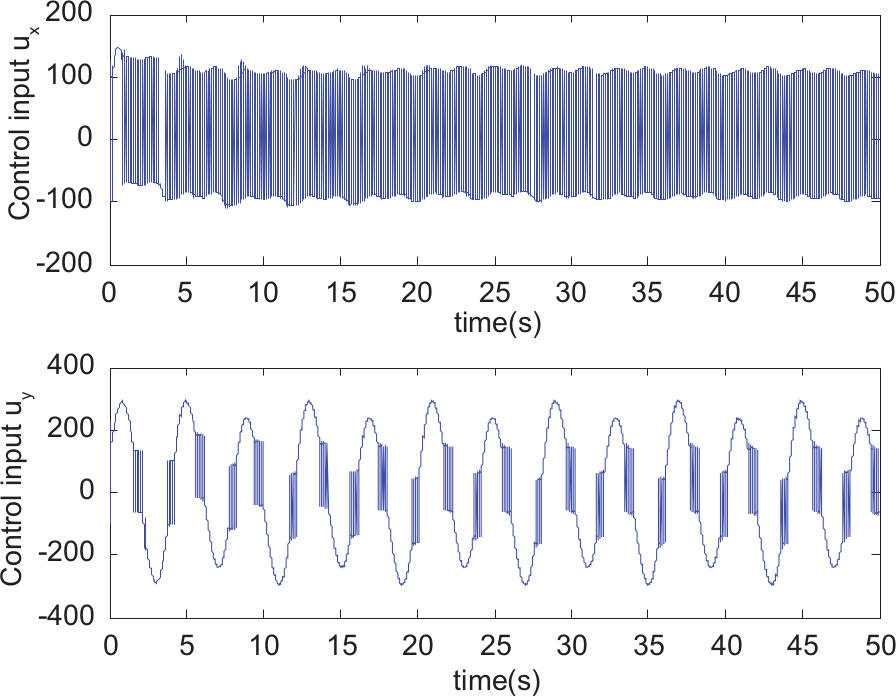
The control input with fixed E.
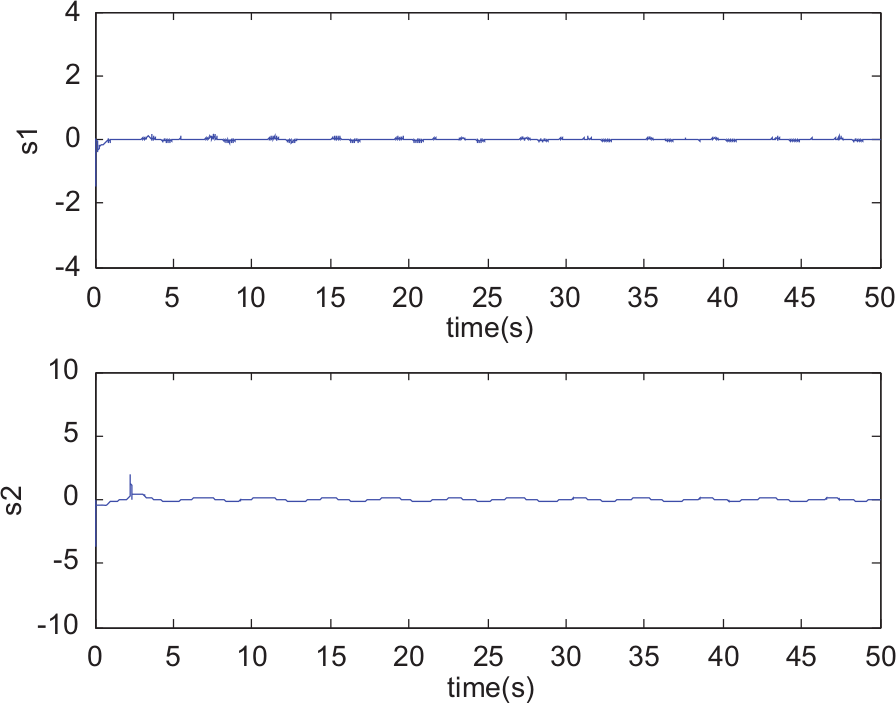
The sliding surface with fixed E.
Considering E is adjustable, the simulation results are shown in Figures 6–8. Figure 6 shows that the adaptive fuzzy sliding mode control with bound estimation also has good tracking performance. Figure 7 draws the adaptive fuzzy sliding mode control input with adjustable E. It can be observed that chattering is reduced obviously in the control input because of the online adjustment of E in the switching control. Figure 8 shows that the sliding surface s1 and s2 converge to zero asymptotically. Figure 9 plots the adaptation of
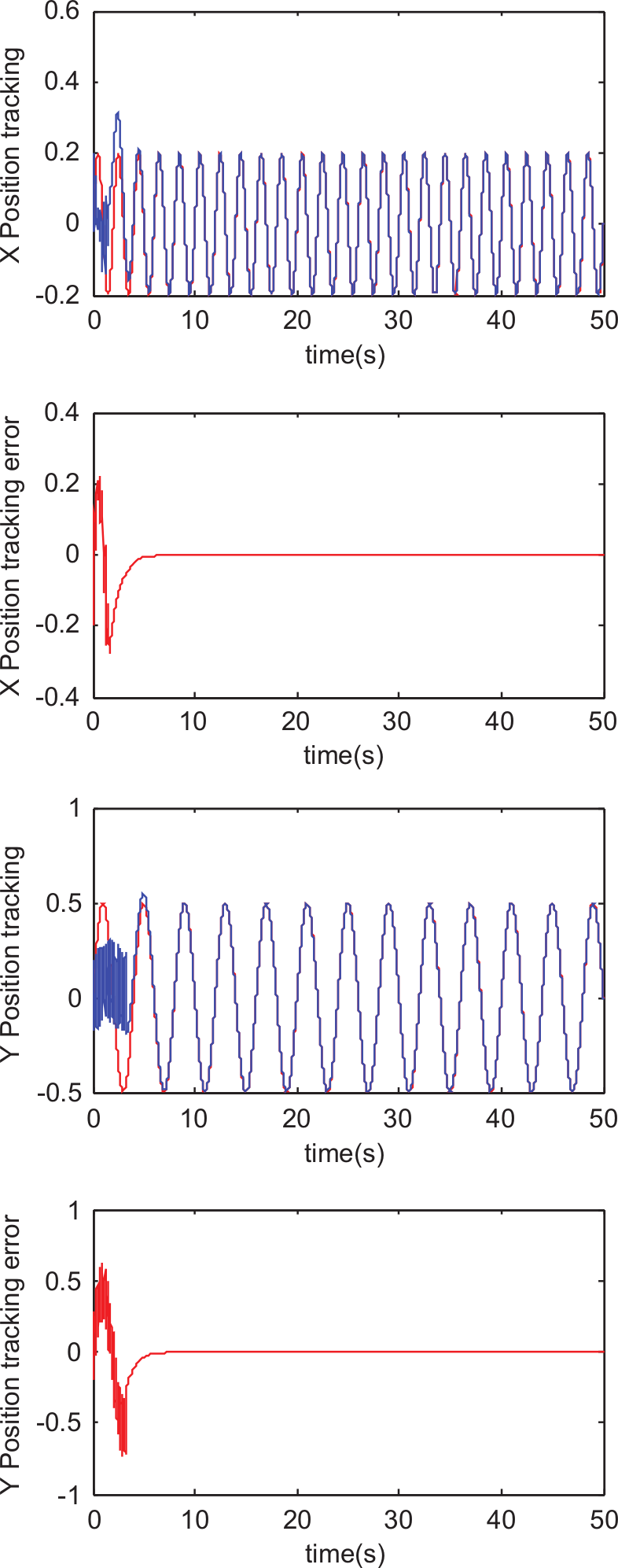
X and Y axis position tracking responses using adjustable E.
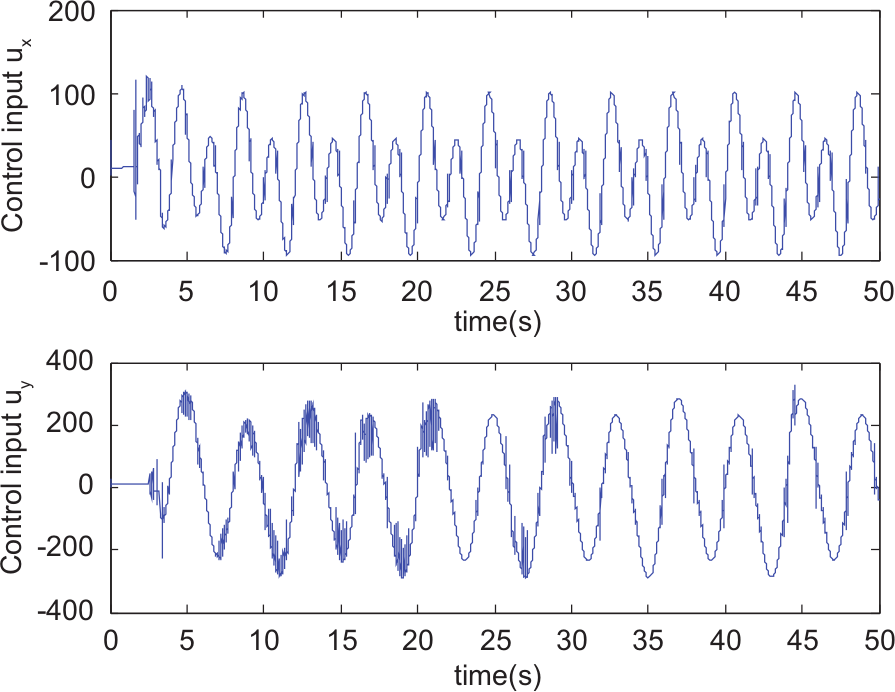
The control input using adjustable E.
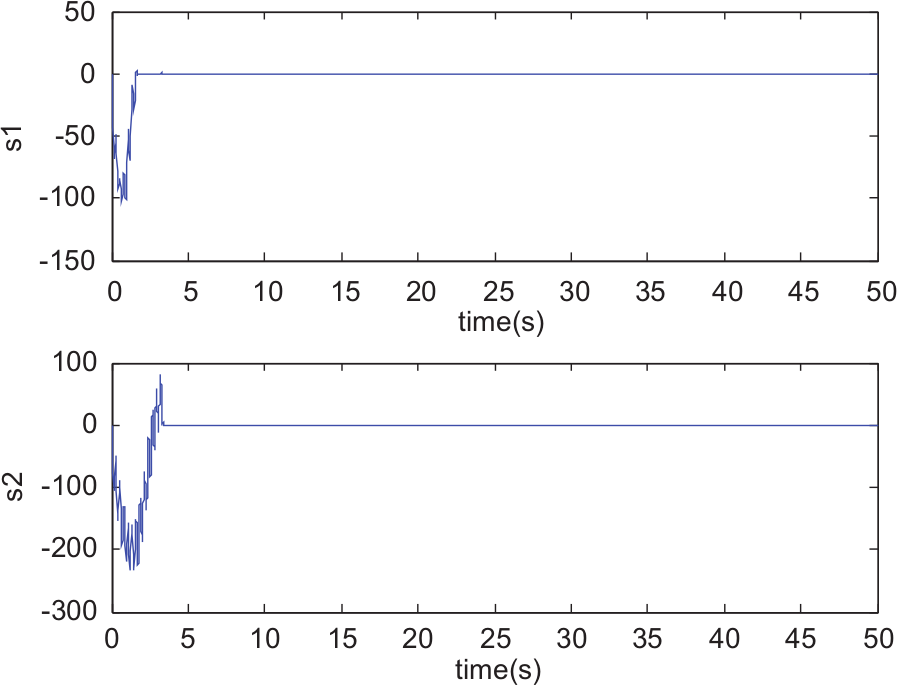
The sliding surface with using adjustable E.
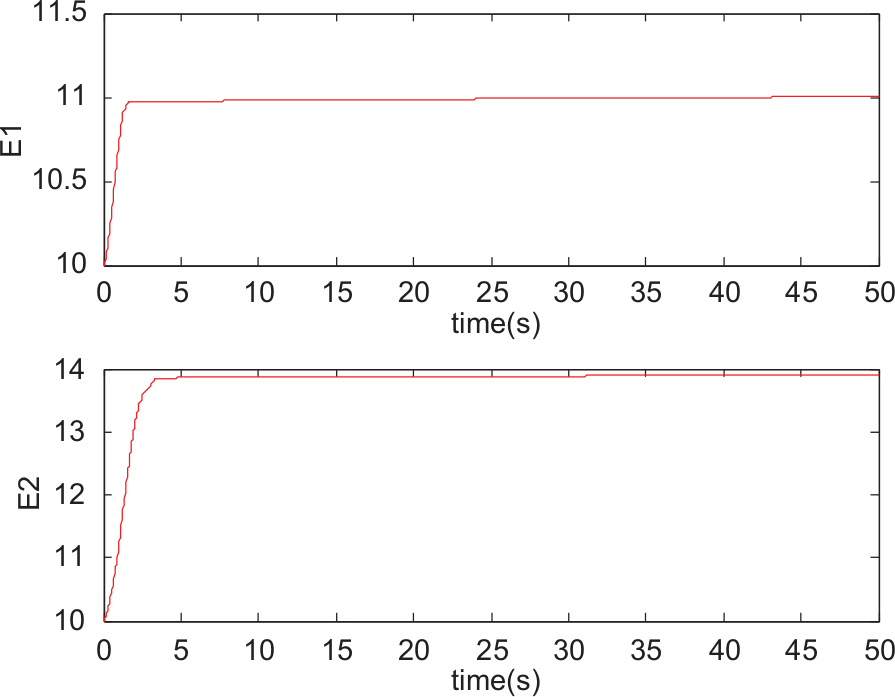
Adaptive estimation of E.
Conclusion
In this paper, a fuzzy logic-based adaptive sliding mode controller and adaptive fuzzy sliding mode controller with bound estimation are developed to control the trajectory of an angular velocity sensor and relax the requirement for the bound value in the sliding control. The stability of the closed-loop system can be guaranteed with the proposed adaptive fuzzy control strategy with bound estimation. Simulations are implemented to verify the effectiveness of the proposed adaptive fuzzy control and demonstrate that the proposed adaptive fuzzy control system with bound estimation yields superior control performance.
Footnotes
Acknowledgements
The authors thank the associate editor and anonymous reviewers for their useful comments to improve the quality of the manuscript. This work is supported by National Science Foundation of China under grant no. 61074056, the Natural Science Foundation of Jiangsu Province under grant no. BK2010201, the Fundamental Research Funds for the Central Universities under grant no. 2012B06714.
Funding
This research received no specific grant from any funding agency in the public, commercial, or not-for-profit sectors.