






Abstract
In this paper, the problem of global state feedback stabilization for a class of stochastic high-order feedforward nonlinear systems with different power orders and multiple time delays is investigated. A distinct property of the system to be investigated is that the control coefficients are not restricted to 1. By adding one power integrator technique and homogeneous domination approach, a state feedback controller design is recursively proposed, which ensures the global asymptotical stability in probability of the closed-loop system. Finally, a simulation example is given to illustrate the effectiveness of our results obtained in this paper.
Keywords
Introduction
It is well known that stochastic systems have received great attention since stochastic modelling has come to play an important role in many branches of science and engineering applications. In order to analyse this type of system, the authors in Khas’minskii (1980), Kushner (1967), Mao (2007) and Yin et al. (2011) presented the basic stability theory of stochastic systems. Ever since backstepping designs were extended to stochastic systems, there has been constant progress on the problem of global stabilization (Deng and Krstic, 1997a, 1997b, 1999; Deng et al., 2001) that has been further developed by recent work (Liu et al., 2008b; Yu and Xie, 2010).
On the other hand, global stabilization of triangular structural stochastic nonlinear systems has been fully investigated over recent decades. For lower-triangular systems (namely feedback systems), the stochastic asymptotic stabilization problem has been studied using the backstepping approach (see, e.g., Chai and Qian, 2013; Fan et al., 2012; Hou et al., 2013; Li et al., 2011; Wu et al., 2006, 2007, 2009; Yu et al., 2010; Zhai, 2013, and the references therein).
The other class of triangular structural nonlinear systems are upper-triangular systems, which are also called feedforward systems and have been fully used to model many physical devices, such as the ball-beam with a friction term (Sepulchre et al., 1997) and the cart-pendulum system (Mazenc and Bowong, 2003). Many important stabilization results have been proposed for feedforward nonlinear systems. By using a homogeneous domination approach, Qian and Li (2006) addressed the problem of global output-feedback stabilization for a class of upper-triangular systems with higher-order nonlinearities. The case of lower-order nonlinearities was considered by Ding et al. (2010). When uncertain nonlinearities appeared in a system model, a logic-based adaptive stabilizer for feedforward nonlinear systems was proposed by Ye (1999). A universal global stabilizer design was further developed by Ye (2003) for feedforward systems without a priori knowledge of system nonlinearities. However, in these results, time delays and stochastic perturbation effects had not been taken into account.
Since time delays will inevitably occur in many mechanical, physical and biological systems and their existence may lead to poor performance, even instability of systems, many researchers have paid more attention to studying stochastic nonlinear time-delay systems over recent decades. Various results concerning stochastic lower-triangular nonlinear systems with time delays have been reported by Chen et al. (2010, 2011), Fu et al. (2005) and Xie and Liu (2012). For deterministic upper-triangular systems, a state feedback controller for a class of input-delayed systems satisfying the linear growth condition was designed by Zhang et al. (2011a) based on a dynamic low-gain control method. When the nonlinear functions were quadratic and higher order in states, the adaptive stabilization problem for feedforward nonlinear systems with time delays was considered by Ye (2011) by taking a nested saturation feedback. For high-order feedforward systems, Zhang et al. (2010) was the initial attempt to solve the problem of global stabilization by introducing a transformation of coordinates. Furthermore, the problem of global strong stabilization in the sense of Kurzweil was investigated by Zhang et al. (2011b) for a family of high-order feedforward nonlinear time-delay systems. However, to the best of our knowledge, little work has been done on the feedback stabilization for stochastic feedforward systems (Liu and Xie, 2013, Zhao and Xie, 2013). It should be pointed out that the control coefficients are required to be 1 and the power orders be equal to
Inspired by the aforementioned discussion, we deal with the problem of global state feedback stabilization for a class of stochastic high-order feedforward nonlinear systems with multiple time-varying delays and time-varying control coefficients, which is more general than that in Liu and Xie (2013) and Zhao and Xie (2013) and more complex to analyse the value range of the system’s homogeneous degree
The outline of this paper is as follows. Sections 2 and 3 offer some preliminary results and problem formulation, respectively. The state feedback controller is designed and analysed in Section 4. In Section 5, a simulation example is presented to show the effectiveness of the state feedback controller. This paper is concluded in Section 6.
Notations
The following standard notations are used throughout this paper.
Preliminary results
Consider the following stochastic time-delay system:
with initial condition
In the following, we borrow some definitions and lemmas that play an important role to stabilize and analyse the stochastic time-delay systems for later development in this paper.
in which
The dilation
A function
A vector field
A homogeneous
where
there exists a unique solution on
the equilibrium
There is a constant c such that
Moreover, when
where
Problem formulation
In this paper, we consider the following stochastic high-order feedforward nonlinear system with time-varying delays in the form
where
In order to obtain the main results of this paper, the following assumptions are needed.
where
In this paper, we aim to constructively design a homogeneous state feedback controller
Controller design and stability analysis
In this section, a state feedback controller is explicitly constructed for the nonlinear system (9). The adding one power integrator technique and homogeneous domination approach are used for state feedback stabilization. The design procedure can be divided into two steps: (i) we first design a state feedback controller for the nominal system without the drift and diffusion functions using the adding one power integrator technique; (ii) then, by introducing a gain, a scaled controller is proposed to guarantee global asymptotic stability in probability of the closed-loop system.
For simplicity, we assume
Homogeneous state feedback control of the nominal nonlinear system
In this section, we firstly introduce a key lemma, which avoids the zero-division problem and serves as a basis in the following design procedure.
holds.
At first, by virtue of the apology in Li et al. (2011), we will prove that there exists
On the other hand, due to
Substituting (13) into (12) renders
Combining
To begin with, we embark on a homogeneous state feedback controller design for the nominal chain of power integrators:
Choosing the first virtual controller
leads to
such that
where
In the sequel, we will prove that (17) still holds for the ith Lyapunov function:
From (17), one obtains
Next, we focus on the last two terms in the right-hand side of (18).
When
When
where
On the basis of (19) and (20), one has
with
With the help of (16), Lemmas 4 and 6, one gets
where
Substituting (21) and (22) into (18) produces
Clearly, with the choice of the virtual controller and the parameters satisfying
(23) becomes
Therefore, in the last step, according to (23), we can find a Lyapunov function
With the above relations in mind, we have
by choosing
must be positive definite, proper and at least
Now, we firstly prove that
(1): When
(2): When
Therefore, (
In the following, we prove that
Based on Lemma 7, one has
from which we conclude that
By denoting
which is homogeneous of degree
is homogeneous of degree
Stability analysis
To state the main result in this paper, we first introduce the following coordinate transformation:
where
It follows from (34) that the system (9) can be transformed into
The closed-loop system (35) and (28) can be expressed as
where
Step 1: Firstly, we prove that the locally Lipschitz condition is satisfied for the closed-loop system (35) and (28). From (28), for
By Lemma 7, it results in
Step 2: Construct a Lyapunov–Krasovskii functional
which is positive definite, proper and
Then, with the notation in Xie and Liu (2012), it is easy to verify that
where
where
Step 3: Since
where
Combining Assumption 1 and (34) produces
and the power of
Owing to
For
In summary, there exists a positive constant
such that
with
According to Lemma 3, we deduce that
where
Similar to (44)–(46), there is a positive constant
such that
with
By virtue of Lemma 4 and (49), one obtains
where
By choosing
Apparently, by choosing
From Steps 1–3 and Lemma 1, one obtains that the closed-loop system (35) and (28) has a global unique solution and the equilibrium
Step 4: Because of the equivalence in (34), then there is a global unique solution for the closed-loop system consisting of (9), (28) and
A simulation example
In this section, we provide a simulation example to show the effectiveness of our results.
where
Based on the definition
Controller design: for the nominal chain of power integrators
Following the above design procedure, one obtains the controller
Introducing the following coordinate transformation:
where
from which one has
where
In the simulation, we choose the gain
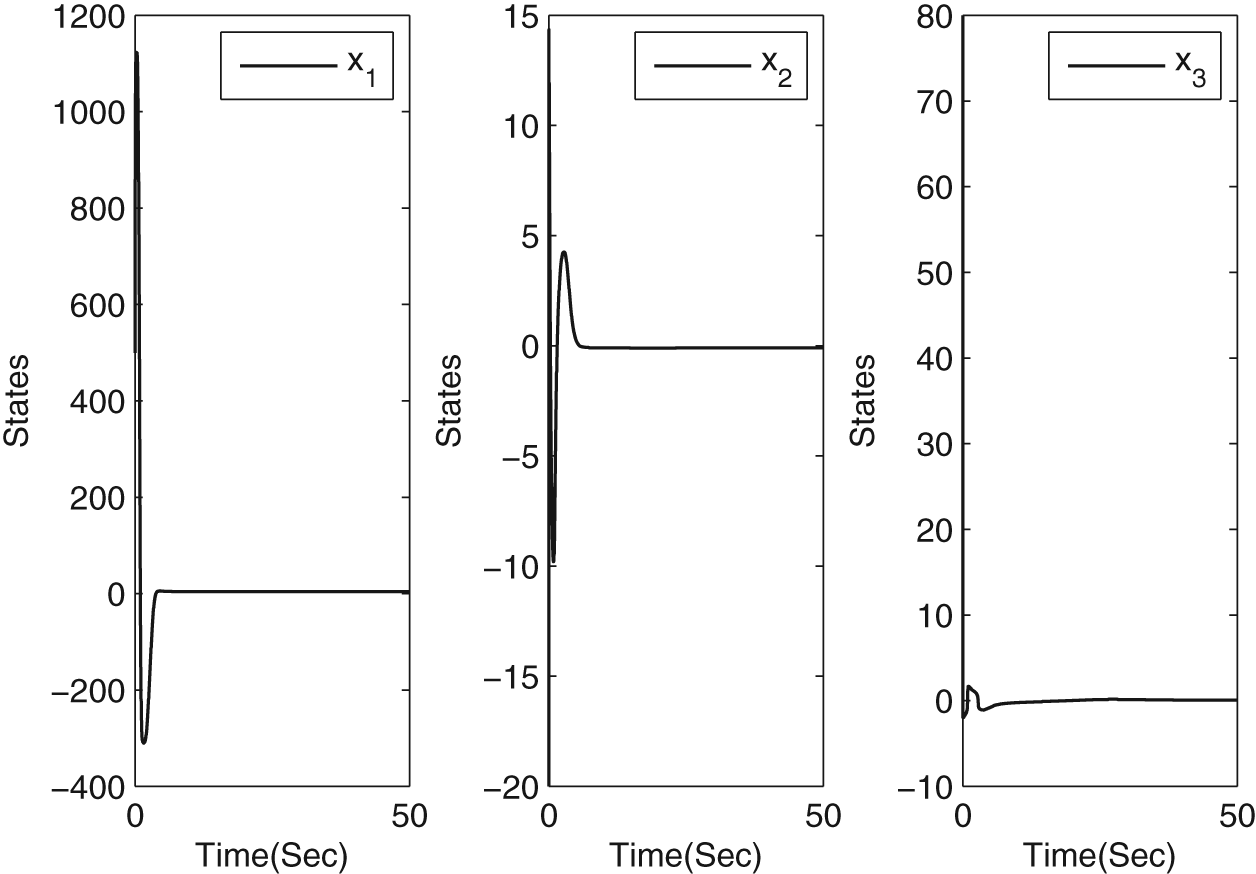
Transient response of
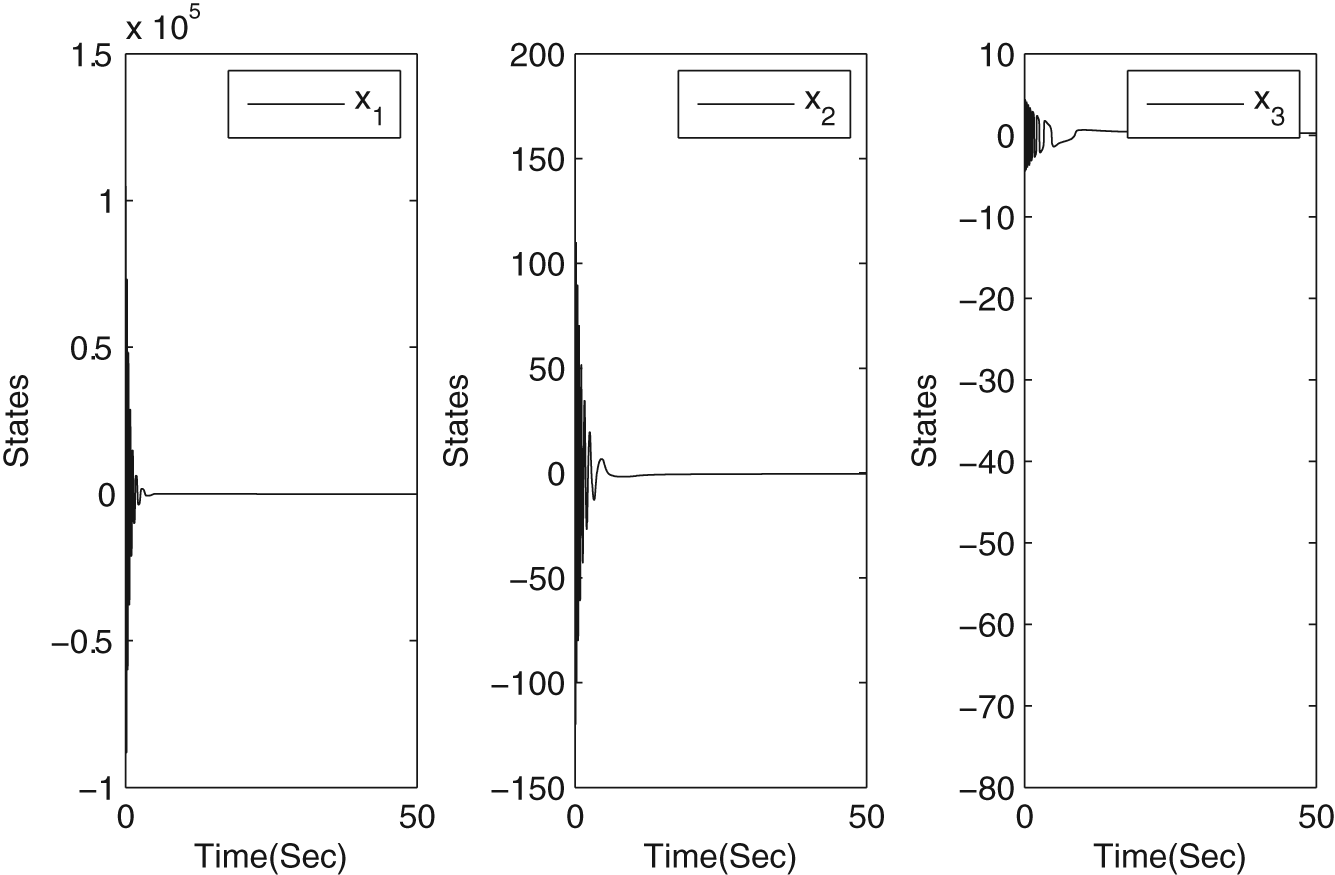
Transient response of
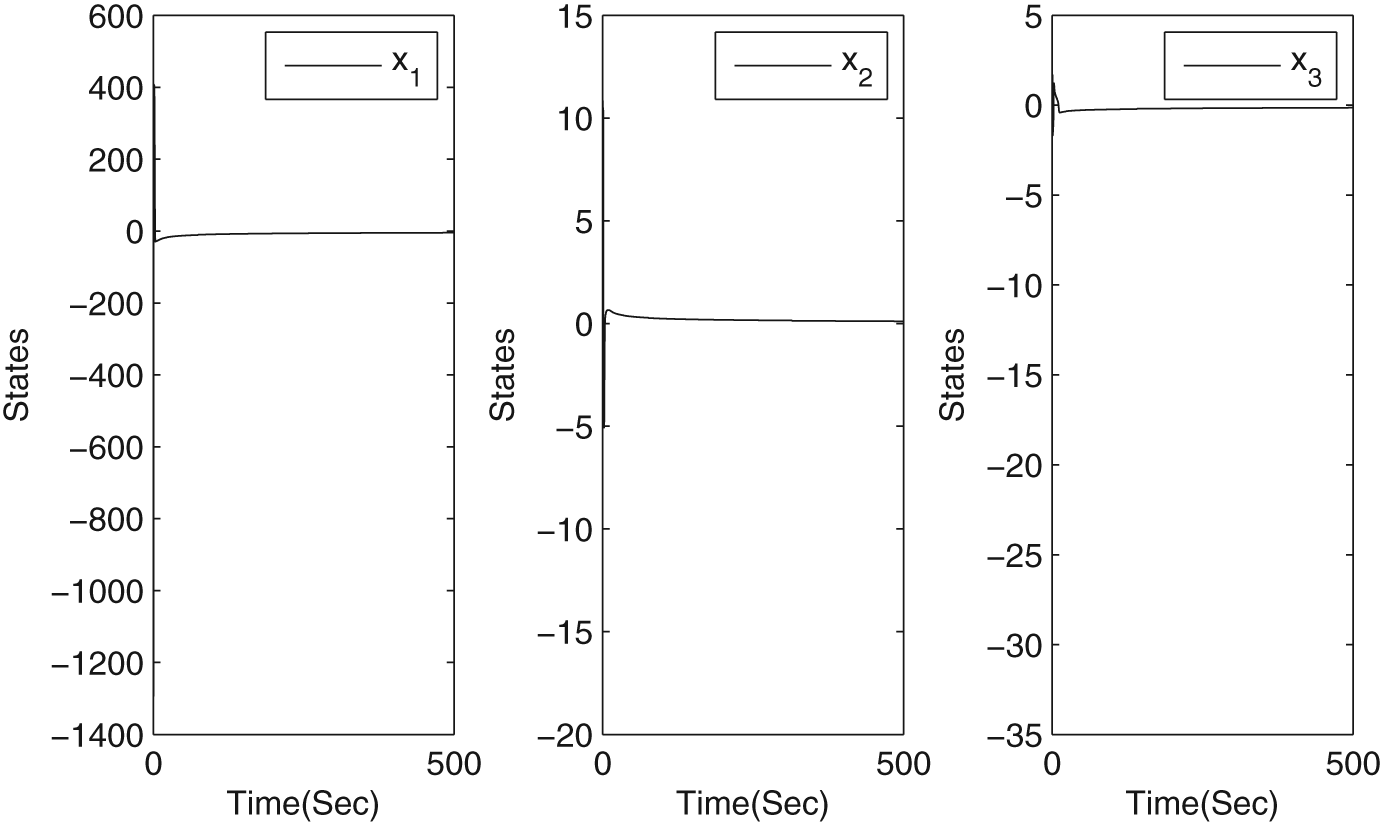
Transient response of
Conclusions
For a class of stochastic high-order feedforward nonlinear systems with different power orders, time-varying control coefficients and multiple time-varying delays, a state stabilizer has been recursively proposed on the basis of the adding one power integrator technique and the homogeneous domination approach. By constructing an appropriate Lyapunov–Krasovskii functional, GAS in probability of the equilibrium of the closed-loop system has been proved. Finally, the proposed method is demonstrated with an example.
Footnotes
Funding
This work was supported by the NSFC (grant numbers 61174137, 61203048, 61374086, 61374153), the 333 Project (grant number BRA2011143), the Qing Lan Project and the Program for Changjiang Scholars and Innovative Research Team in University.