In this paper, the robust non-fragile stabilisation and H∞ control problem is investigated for a class of uncertain discrete-time stochastic systems with Markovian jumping parameters and time-varying delay. The parameter uncertainties are supposed to be time-varying as well as norm-bounded. The aim of the robust non-fragile stabilisation problem is to design a non-fragile state feedback controller which guarantees the robust stability of the closed-loop system for all admissible uncertainties. At the same time, in addition to the robust stability requirement, a prescribed H∞ performance level is required to be achieved for the robust H∞ control problem. By Lyapunov stability theory, delay-segment-dependent conditions for the solvability of these problems are formulated in terms of linear matrix inequality technique. Finally, numerical examples are shown to demonstrate the usefulness and applicability of the proposed design method.
On the other hand, the Markovian jump system has been an attractive subject of research recently since it is appropriate to model the behavior of practical systems; including manufacturing systems, load prediction of power systems, maneuvered target tracking, robotics and premium adjustment of bonus-malus systems. It is well known that these systems can be modelled by a Markov chain taking values in a finite set. Recently, considerable attention has been devoted to the study of robust H∞ control problems concerning the Markovian jumping system. For instance, via sliding mode design method, the H∞ control for stochastic systems with Markovian switching and time-varying delay is considered (Gao and Wu, 2013). By the free-weighting method, non-fragile robust stabilisation and H∞ control for uncertain stochastic time delay systems with Markovian jump parameters and nonlinear disturbances is investigated (Senthilkumar and Balasubramaniam, 2012). The robust H∞ control problem for uncertain discrete-time stochastic bilinear systems with Markovian switching is discussed (Xu and Chen, 2005). The passivity-based control problem for stochastic jumping systems with mode-dependent round-trip time-varying delays and norm-bounded parametric uncertainties is studied (Shen et al., 2012). The problem of delay-dependent robust stabilisation for uncertain discrete-time fuzzy Markovian jump systems with mode-dependent time-varying delays is considered (Zhang et al., 2011).
The robust non-fragile H∞ control problem has not been fully investigated, especially for uncertain discrete-time stochastic systems. Robust H∞ control for uncertain discrete stochastic time-delay systems is studied, in which the controller gain uncertainties are not taken into account (Xu et al., 2004; Xu and Chen, 2005). The delay-independent results of non-fragile H∞ control for the discrete-time Markovian jump system is obtained in a deterministic setting rather than a stochastic setting (Ran et al., 2011). The non-fragile H∞ control problem is discussed in the context of continuous stochastic delayed systems with Markovian jumping parameters (Senthilkumar and Balasubramaniam, 2012). In fact, this paper stems from the following motivations. Firstly, the results in Xu et al. (2004) and Xu and Chen (2005) are not about non-fragile H∞ control for discrete-time stochastic systems. Secondly, the results in Ran and Zhang (2011) and Senthilkumar and Balasubramaniam (2012) are not about non-fragile control for discrete-time stochastic systems. To the best of our knowledge, no results on robust non-fragile H∞ control for discrete-time stochastic delayed systems with Markovian jumping parameters have been available in the literature to date. Considering all the factors aforementioned, the non-fragile stabilisation and H∞ control for uncertain discrete-time stochastic systems with Markovian jumping parameters is still open and challenging, which is also the motivation for this work.
In this paper, we deal with the problem of robust non-fragile stabilisation and the H∞ control problem for a class of uncertain discrete-time stochastic systems with Markovian jumping parameters and time-varying delay. By employing an appropriate Lyapunov functional, delay-segment-dependent conditions are formulated in terms of a linear matrix inequality (LMI) such that the closed-loop system is not only robustly, stochastically stable but also the required H∞ performance level is satisfied for all admissible uncertainties. Finally, numerical examples are given to show the effectiveness of the proposed method.
Notations: denotes the n-dimensional Euclidean space, is the set of n × m real matrices. I is the identity matrix. |⋅| denotes the Euclidean norm of vectors and ||·|| denotes the spectral norm of matrices. N denotes the set of all natural numbers, i.e. N = {0,1,2,…}. is a complete probability space with a filtration satisfying the usual conditions. MT stands for the transpose of the matrix M. For symmetric matrices X and Y, the notation X > Y (respectively X ≥ Y) means that X − Y is positive definite (respectively, positive semi-definite). * denotes a block that is readily inferred by symmetry. E{·} stands for the mathematical expectation operator with respect to the given probability measure .
Problem description
Consider the following uncertain discrete-time stochastic systems with Markovian jumping parameters and time-varying delay.
where is the state vector, is the control input, is the disturbance input in L2[0, ∞), is the controlled output. A(rk, k), A1(rk, k), A2(rk), A3(rk, k), D(rk, k), D1(rk, k), D2(rk), D3(rk, k), C(rk), C1(rk), C2(rk) are the matrix functions of the random jumping process rk, where rk is a finite system mode and takes discrete values in a given finite set . For simplicity, in the sequel, when , A(rk, k), A1(rk, k), A2(rk), A3(rk, k), D(rk, k), D1(rk, k), D2(rk), D3(rk, k), C(rk), C1(rk), C2(rk), are denoted by Ai(k), A1i(k), A2i, A3i(k) Di(k), D1i(k), D2i, D3i(k), Ci, C1i, C2i, respectively. w(k) is a scalar Brownian motion defined on the complete probability space with
where the scalar σ > 0, and d(k) represents the time-varying delay satisfying
The transition probability matrix Π = (πij)N×N is given by
where πij is the transition rate from mode i to mode j and satisfies . In system (1),
where Ai, A1i, A2i, A3i, Di, D1i, D2i, D3i, Ci, C1i, C2i are known real constant matrices. Norm-bounded parameter uncertainties ΔAi(k), ΔA1i(k), ΔA3i(k), ΔDi(k), ΔD1i(k), ΔD3i(k) are assumed to satisfy
where M1i, N1i, N2i, N3i, N4i, N5i, N6i are known real constant matrices. Fi(·) : is an unknown time-varying matrix function satisfying .
The parameter uncertainties ΔAi(k), ΔA1i(k), ΔA3i(k), ΔDi(k), ΔD1i(k) and ΔD3i(k) are said to be admissible if both (6) and (7) hold.
The following definitions are used throughout this paper.
Definition 1. (Xu et al., 2004; Xu and Chen, 2005) The uncertain discrete-time system Σ is said to be robustly stochastically stable if there exists a scalar such that
for all admissible uncertainties when u(k) = 0 and v(k) = 0.
Definition 2. (Xu et al., 2004; Xu and Chen, 2005) Given a scalar γ > 0, the system Σ with u(k) = 0 is said to be robustly stochastically stable with disturbance attenuation level γ if it is robustly stochastically stable, and under zero initial conditions the following inequity holds
for all nonzero v(k) ∈ L2[0, ∞).
This paper considers the problem of robust non-fragile stabilisation and H∞ control for an uncertain discrete-time stochastic system Σ. The main attention is paid to the design of a memoryless non-fragile state feedback controller
such that the closed-loop system is robustly stochastically stable, where Ki is the controller gain and ΔKi(k) satisfies
where M2i and N7i are known constant matrices. The time-varying uncertain matrix function F1i(k) satisfies .
Before ending this section, the following Lemma is provided which is essential in establishing our main results.
Lemma 1. (Xu and Chen, 2002) Matrices D and E are real matrices of appropriate dimensions with FTF ≤ I. For any vectors X, Y ∈ Rn and any scalar ϵ > 0, the following inequality holds
Robust non-fragile stabilization
In this section, we shall establish the design of non-fragile feedback controller for uncertain discrete-time stochastic system (1). According to Definition 1, first, we provide a sufficient condition for robust stochastic stability of system (1) with u(k) = 0 and v(k) = 0 in the following theorem.
Theorem 1. The system (1) with u(k) = 0 and v(k) = 0 is robustly stochastically stable for all admissible uncertainties satisfying (7), if there exist matrices Pi > 0, Q1 > 0, Q2 > 0, Q3 > 0, R1 > 0, R2 > 0, T1i, T2i, S1i, S2i, U1i, U2i and scalars ε1i > 0, such that the following matrix inequalities hold:
Where
Proof: For convenience, the following notations are adopted:
Choose the following Lyapunov functional
where
where η(l) = x(l + 1) − x(l), then we have
Calculating the difference of V(k) with u(k) = 0, v(k) = 0 and taking mathematical expectation, we have
where
Then, for arbitrary matrices Si, Ti and Ui with appropriate dimensions, the following equations hold
where
Combining (15)–(19), and considering the left sides of (20)–(22), we have
where
It remains to show that . According to Schur complement, is equivalent to
where
On the basis of (7) and Lemma 1, (24) is equal to
By Schur complement, (25) is equivalent to (12), which guarantees . Obviously, there exists a scalar α > 0 such that . From (23), it is easy to obtain
Then follow the same lines of the proof of Theorem 1 (Xu et al., 2004), according to Definition 1, we can obtain that system (1) with u(k) = 0 and v(k) = 0 is robustly stochastically stable. This completes the proof.
Next, we shall present the robust non-fragile stabilization problem for system (1).
Theorem 2. System (1) with v(k) = 0 is robustly stochastically stable for all admissible uncertainties satisfying (7) and (11), if there exist matrices Xi > 0, Yi, , , , Z1 > 0, Z2 > 0, , , , , , , L and scalars ε1i > 0, ε2i > 0, ε3i > 0 such that the following LMIs hold
Where
Furthermore, a desired non-fragile controller in the form of (10) with the state-feedback gains is given as follows
Proof Substituting the non-fragile controller (10) into (24) with v(k) = 0, then (24) is equal to
where
By Schur complement, we have
where
Now, by denoting
with
Pre- and post-multiplying the aforementioned inequality (30) by VT and V, respectively. For each
Then we have
Similarly,
By setting Yi = LKi, it can be easily seen that the resulting LMIs are equivalent to those of equation (27).
Remark 1. In this paper, inspired by the works in Zhang et al. (2011), free-weighting matrices were introduced. The problem of delay-dependent robust stabilisation for uncertain discrete-time fuzzy Markovian jump systems with mode-dependent time-varying delays is considered in Zhang et al. (2011). By using the same method, the newly obtained delay-dependent results are less conservative than the existing ones in Xu et al. (2004).
Robust non-fragile H∞ control
In order to solve the robust non-fragile H∞ control problem for system Σ, we first give a solution to the H∞ performance analysis for systems Σ with u(k) = 0.
Theorem 3. For a given γ > 0, the systems Σ with u(k) = 0 are robustly stochastically stable for all admissible uncertainties satisfying (7), if there exist matrices Pi > 0, Q1 > 0, Q2 > 0, Q3 > 0, R1 > 0, R2 > 0, T1i, T2i, S1i, S2i, U1i, U2i and scalars ε1i > 0, ε2i > 0 such that the following matrix inequalities hold
where
Proof. From (31), it is clear that (12) holds, which implies that the systems Σ with u(k) = 0 are robustly stochastically stable. Then, under zero initial conditions, we will prove that the system Σ with u(k) = 0 satisfies ∥z(k)∥2 < γ∥v(k)∥2 for all nonzero v(k) ∈ L2[0, ∞).
In the following, we suppose the zero initial condition and define
Choosing the Lyapunov-Krasovskii functional candidate V (k) as (13), we have
where
where are defined in Theorem 1. Then Theorem 3 can be easily proved by following the method of the proof of Theorem 1.
Next, based on Theorem 3, we are in a position to present the result on the robust non-fragile H∞ control problem for system Σ.
Theorem 4. For a given γ > 0, the systems Σ are robustly stochastically stable for all admissible uncertainties satisfying (7) and (11), if there exist matrices Xi > 0, Yi, , , , Z1 > 0, Z2 > 0, , , , , , , L and scalars ε1i > 0, ε2i > 0, ε3i > 0 such that the following LMIs hold
where
where are defined in Theorem 2. Furthermore, a desired non-fragile H∞ controller in the form of (10) with the state-feedback gains is given as follows
Proof. Substituting the non-fragile controller (10) into system (24), equation (34) can be formulated by following the same method used in the proof of Theorem 2 and Theorem 3.
Remark 2. In the following, in order to show that our result is less conservative than the one studied in Xu et al. (2004), we consider the case that there are no jumping parameters in system Σ, then the system Σ reduces to the following form
where
with
F(k)(·): is an unknown time-varying matrix function satisfying . In such a case, the robust H∞ controller is chosen as
The following corollary gives the result for the robust H∞ control problem for system (43) and (44), which is a consequence of Theorem 4 and hence the proofs are omitted.
Corollary 1. For a given γ > 0, the systems (36) and (37) are robustly stochastically stable for all admissible uncertainties satisfying (41), if there exist matrices X > 0, Y, , , , Z1 > 0, Z2 > 0, , , , , , , L and scalars ε1 > 0, ε2 > 0 such that the following LMI holds
where
Furthermore, a desired H∞ controller in the form of (39) with the state-feedback gains is given as follows
Remark 3. The results obtained in Theorem 4 and Corollary 1 are formulated in terms of LMIs. Hence, the controller gain matrix Ki (or K) can be effectively acquired by solving LMIs, which can be facilitated readily by resorting to the Matlab LMI Control Toolbox. At the same time the controller performance γ can also be optimised. For example, the H∞ performance index γ described in Corollary 1 can be optimised by a convex optimisation algorithm:
Algorithm. subject to LMI (40).
Numerical examples
Example 1. Consider system (36) and (37) with the matrices (Xu et al., 2004)
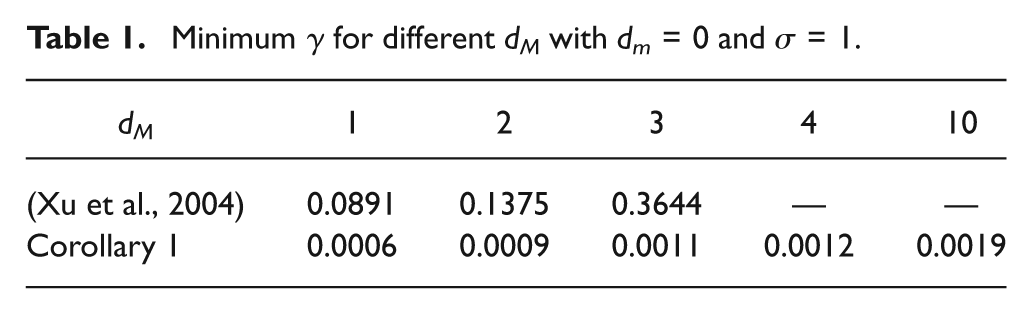
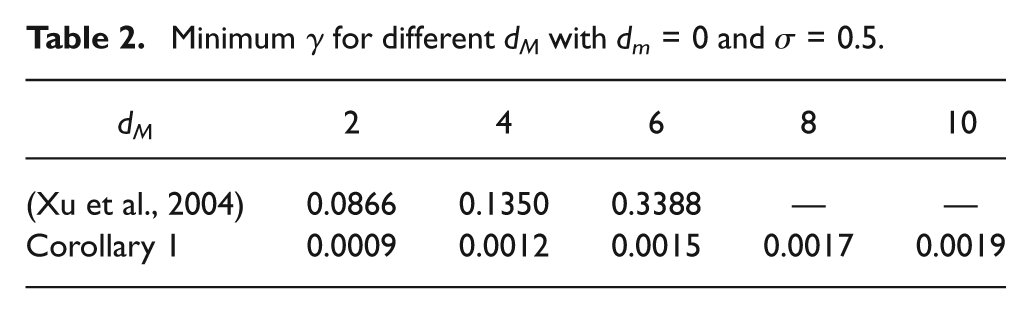
For different dM with dm = 0, by solving LMI (40), we can get the minimum controller performance γ in Table 1 and Table 2, respectively, in which “—” means that the results are not applicable to the corresponding cases.
Table 1 conclusively shows that our results are less conservative than those in Xu et al. (2004). When σ = 0.5, dm = 2 and dM = 4, γ= 0.1, the H∞ controller gain matrix is given as follows
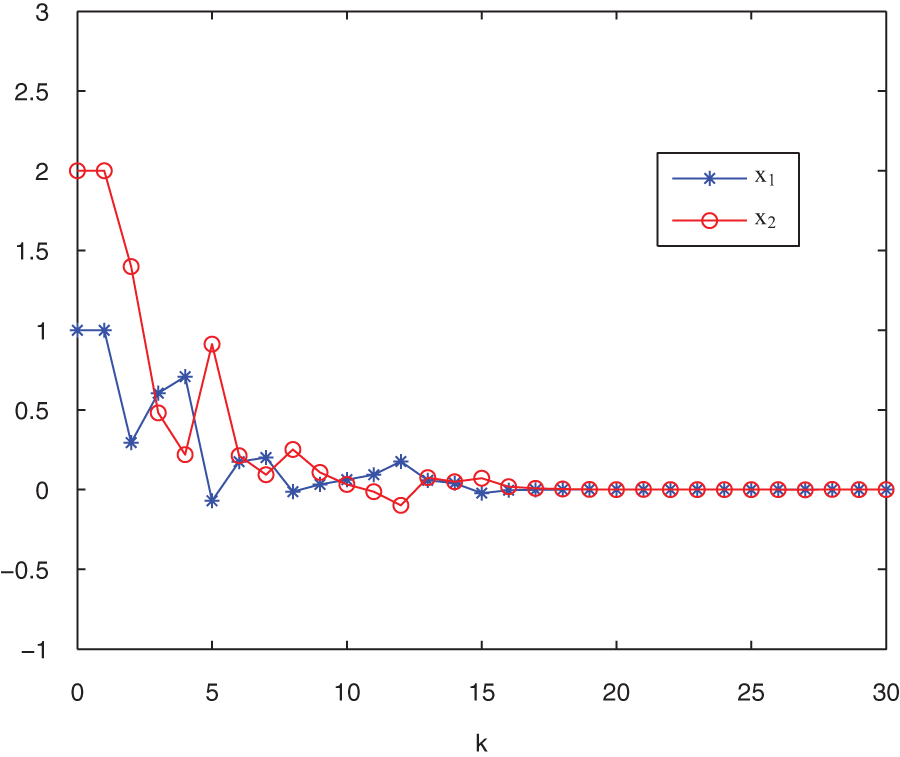
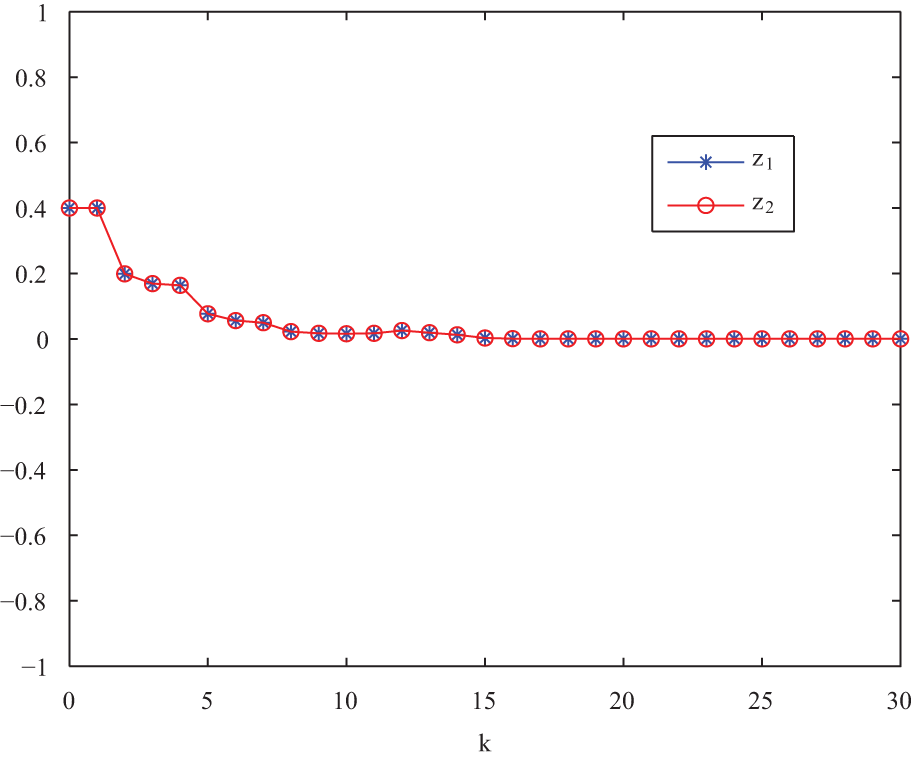
With the initial condition x(0) = [1 2]T, the trajectory of system states and the controlled output z(k) are plotted in Figure 1 and Figure 2, respectively. The disturbance input is given as v(k) = 2e−k/2sin(k/3) and F(k) = sin(k).
Trajectory of system states
The controlled output z(k).
Example 2. Consider the system Σ with the following the matrices:
Mode 1
Mode 2
Mode 3
with
The transition probabilities matrix is given as follows:
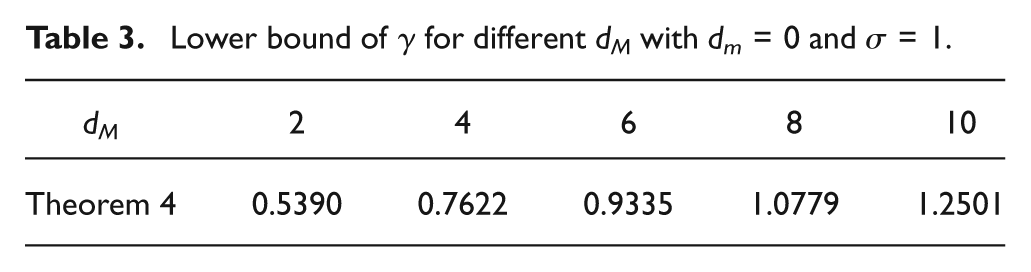
The purpose of this example is to illustrate the validity of non-fragile H∞ controller designed in Theorem 4. For different dM with dm = 0 and σ = 1, the lower bound of noise attenuation level γ are given in Table 3.
Lower bound of γ for different dM with dm = 0 and σ = 1.
dM
2
4
6
8
10
Theorem 4
0.5390
0.7622
0.9335
1.0779
1.2501
For given dm = 2, dM = 4 and σ = 1, by Theorem 4, we get the minimum allowance value is γ = 0.6601, and the non-fragile H∞ controller gain matrices of (35) is given as follows
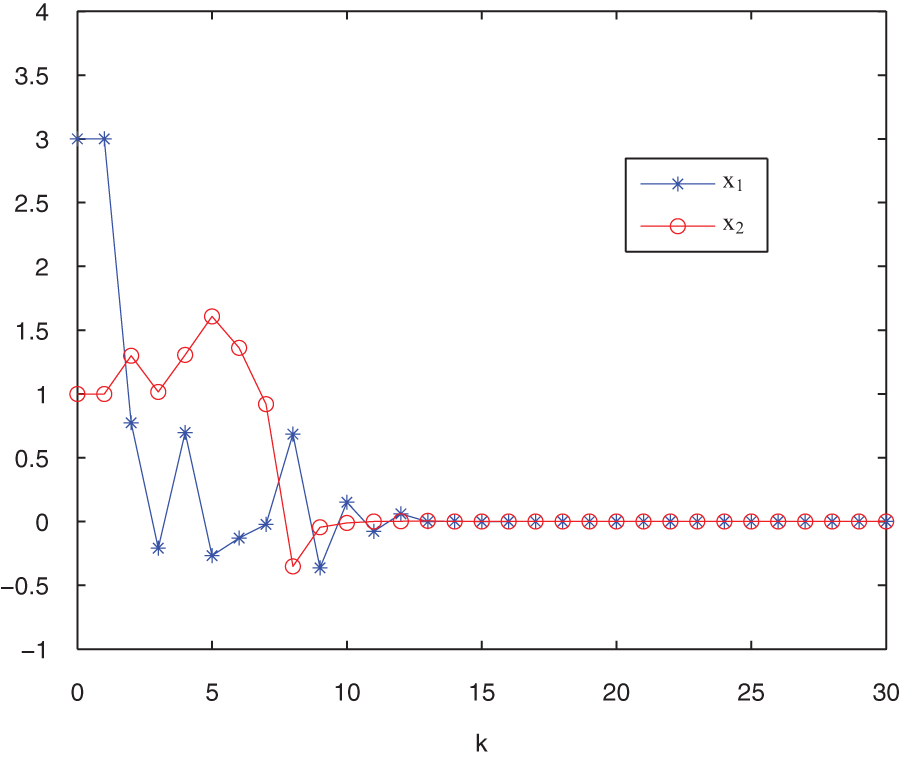
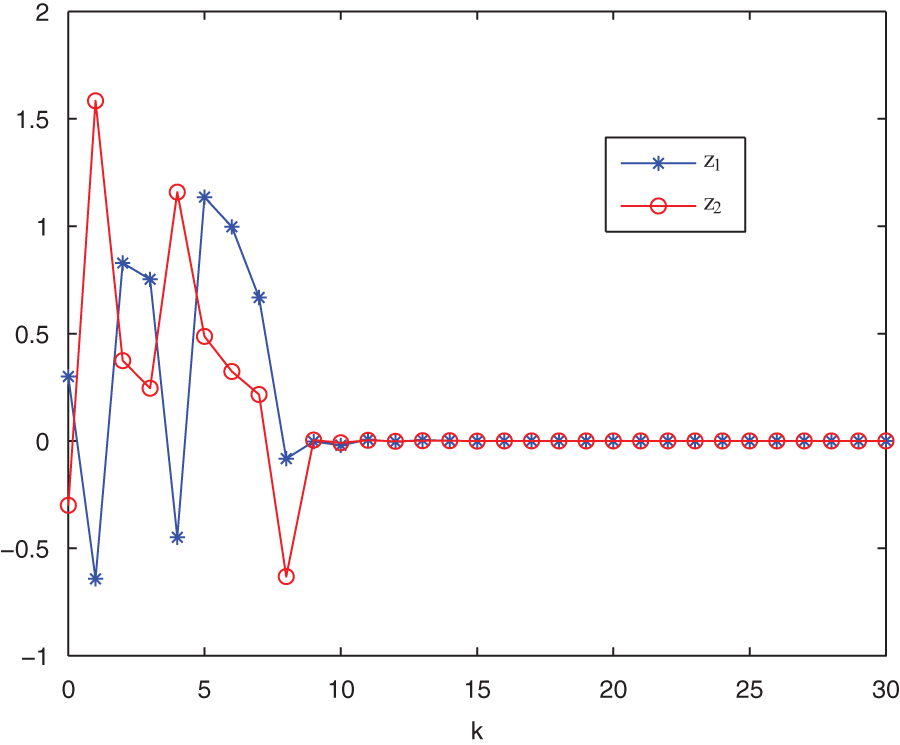
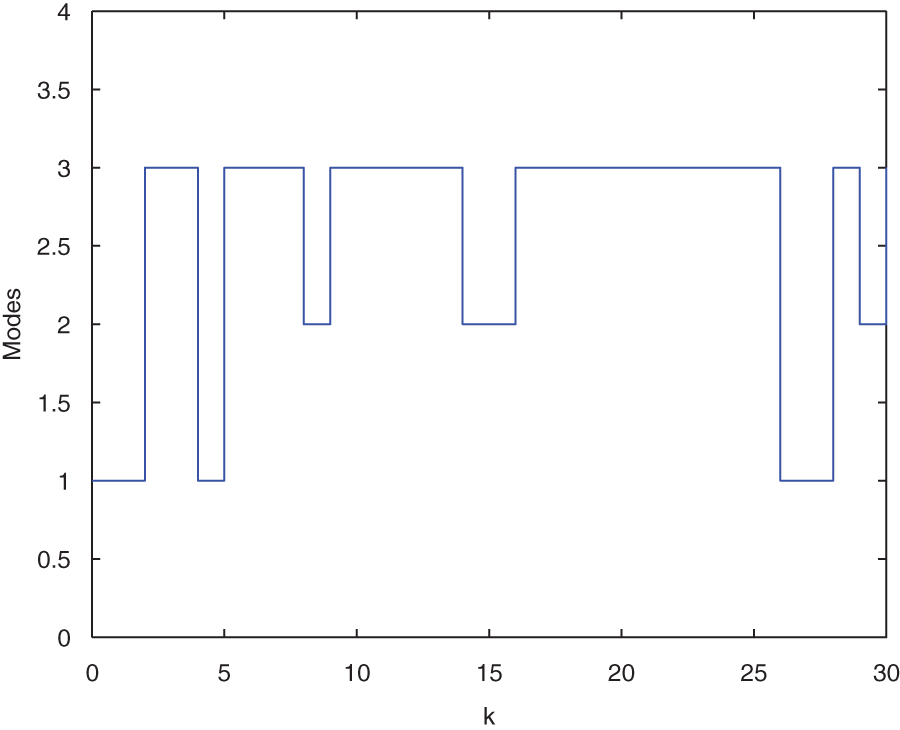
With the initial conditions x(0) = [3 1]T, the trajectory of system states, the controlled output z(k) and one of the possible realisations of the Markovian jumping modes are plotted in Figure 3, Figure 4 and Figure 5, respectively. The disturbance input is given as , and Fi(k) = sin(k),F1i(k) = sin(k),i = 1,2,3.
Trajectory of system states
The controlled output z(k).
Jumping modes.
It is clearly observed from the simulation results above that all the expected objectives are well achieved.
Conclusion
The robust stochastic stabilisation and H∞ control problem for uncertain discrete-time stochastic systems with Markovian jumping parameters and time-varying delay is investigated in this paper. The parameter uncertainties are assumed to be norm-bounded. On the basis of the Lyapunov-Krasovskii functional, delay-segment-dependent sufficient conditions for the solvability of the proposed problems are formulated in terms of LMIs. Finally, numerical examples have been provided to demonstrate the effectiveness and usefulness of the proposed design method. Our future work would be the extension of the present results to more complex discrete-time stochastic Markov jump systems, such as discrete-time network-based stochastic Markov jump systems (Lu et al., 2013) and discrete-time stochastic Markov jump with randomly occurring uncertainties and sensor failures (Shen et al., 2014).
Footnotes
Funding
This work was supported by the Natural Science Foundation of Jiangsu Province (No. BK20130239) and the Research Fund for the Doctoral Program of Higher Education of China (No. 20130094120015).
References
1.
BalasubramaniamPSenthilkumarT (2013) Delay-dependent robust stabilization and H∞ control for uncertain stochastic T-S fuzzy systems with discrete interval and distributed time-varying delays. International Journal of Automation and Computing10: 18–31.
2.
ChenGCShenYZhuS (2011) Non-fragile observer-based H∞ control for neutral stochastic hybrid systems with time-varying delay. Neural Computing and Applications20: 1149–1158.
3.
ChenGCTuLL (2012) Robust non-fragile H∞ control for stochastic delay systems with nonlinear perturbation. Advances in Intelligent and Soft Computings111: 281–288.
4.
ChenJDYangCDLienCHHorngJH (2008) New delay-dependent non-fragile H∞ observer-based control for continuous time-delay systems. Information Sciences178: 4699–4706.
5.
GaoLJWuYQ (2013) H∞ Control for stochastic systems with Markovian switching and time-varying delay via sliding mode design. Mathematical Problems in Engineering2013: Article ID 898172.
6.
KeelLHBhatacharyyaSP (1997) Robust, fragile, or optimal ?IEEE Transactions on Automatic Control42: 1098–1105.
7.
LuRQXuYXueAKZhengJC (2013) Networked control with state reset and quantized measurements: observer-based case. IEEE Transactions on Automatic Control60(11): 5206–5213.
8.
RanHJZhangT (2011) Non-fragile H∞ control for a class of discrete Markovian jump linear systems with time delay. In proceedings of the 2011 International Conference on Electric Information and Control EngineeringWuhan: 540–543.
9.
SakthivelRMathiyalaganKAnthoniSM (2012) Robust H∞ control for uncertain discrete-time stochastic neural networks with time-varying delays. IET Control Theory and Applications6: 1220–1228.
10.
SenthilkumarTBalasubramaniamP (2012) Non-fragile robust stabilization and H∞ control for uncertain stochastic time delay systems with Markovian jump parameters and nonlinear disturbances. International Journal of Adaptive Control and Signal Processing28: 464–478.
11.
ShenHParkJHZhangLXWuZG (2014) Robust extended dissipative control for sampled-data Markov jump systems. International Journal of Control87(8):1549–1564.
12.
ShenHXuSYLuJWZhouJP (2012) Passivity-based control for uncertain stochastic jumping systems with mode-dependent round-trip time delays. Journal of the Franklin Institute349(5): 1665–1680.
13.
ShenHWuZGParkJH (2014) Reliable mixed passive and H∞ fltering for semi-Markov jump systems with randomly occurring uncertainties and sensor failures. International Journal Robust and Nonlinear Control10.1002/rnc.3255.
14.
SuLQZhuXDQiuJQ (2011) Non-fragile H∞ guaranteed cost control for a non-linear stochastic system with both distributed delays and input delays. Circuits Systems and Signal Processing30: 1503–1520.
15.
WangCShenY (2011) Delay-dependent non-fragile robust stabilization and H∞ control of uncertain stochastic systems with time-varying delay and nonlinearity. Journal of the Franklin Institute348: 2174–2190.
16.
XuSYChenTW (2002) Robust H∞ control for uncertain stochastic systems with state delay. IEEE Transactions on Automatic Control47: 2089–2094.
17.
XuSYChenTW (2005) Robust H∞ control for uncertian discrete-time stochastic bilinear systems with Markovian switching. International Journal of Robust and Nonlinear Control15: 201–217.
18.
XuSYJamesLChenTW (2004) Robust H∞ control for uncertian discrete stochastic time-delay systems. Systems Control Letters51: 203–215.
19.
XuSYJamesLYangGHWangJL (2006) Stabilization and H∞ control for uncertian stochastic time-delay systems via non-fragile controllers. Asian Journal of Control8: 197–200.
20.
YangRNGaoHJShiP (2010) Delay-dependent robust H∞ control for uncertain stochastic time-delay systems. International Journal of Robust and Nonlinear Control20: 1852–1865.
21.
ZhangBYXuSY (2009a) Delay-Dependent robust H∞ control for uncertain discrete-time fuzzy systems with time-varying delays. IEEE Transactions on fuzzy systems17: 809–823.
22.
ZhangJHShiPQiuJQ (2009b) Non-fragile guaranteed cost control for uncertain stochastic nonlinear time-delay systems. Journal of the Franklin Institute346: 676–690.
23.
ZhangYSXuSYZouYLuJJ (2011) Delay-dependent robust stabilization for uncertain discrete-time fuzzy Markovian jump systems with mode-dependent time delays. Fuzzy Sets and Systems164: 66–81.