






Abstract
This paper proposes a discrete-time sliding mode control (DT-SMC) algorithm for uncertain linear systems with time-varying delay on the state. The parameter uncertainties and the external disturbances are assumed to be unknown but norm-bounded. The sliding mode existence depends on that of the stable linear sliding surface, which is ensured by a sufficient condition that depends on the delay bounds and is derived using LMI. A numerical example as well as an application to the Two-Area Four-Machine power system has been presented to illustrate and confirm the usefulness and the effectiveness of the proposed control strategy.
Introduction
Time-delays are frequently encountered in various physical processes such as network control systems, chemical systems, long transmission line systems, hydraulic systems, nuclear reactors and so on (see e.g. Brayton (1968), Fridman (2014), Halanay and Rasvan (1997), Musmade et al. (2015), and the references therein). These delays may result from many sources, in particular sensors and actuators. They are considered to be sources of instability and oscillation, and may dwindle the system performance. Similarly, the parameter uncertainties as well as the external disturbances may lead to instability and cause more degradation in performance. Therefore, the problem of stability-analysis and control of uncertain time-delay systems have been largely investigated. Recently, considerable attention has been devoted to the problem of delay-dependent stability analysis and controller-synthesis for uncertain systems with time-delay, and several analysis and control design approaches have been reported in Gu et al. (2003). A less-conservative delay-dependent criterion for robust stability of continuous-time systems with time-varying delay is proposed using the Leibniz–Newton formula and Linear Matrix Inequality (LMI) technique in Wu et al. (2004). In Gao and Chen (2007), promising results on stability are derived by defining a new Lyapuov function. When uncertainties are present, the robustness performance is sought through a control strategy qualified as a robust control technique. In this way, the sliding mode control (SMC) is well-known as a robust control method that copes with variable structure systems. SMC is often adopted due to its inherent advantages of easy realization, fast response and good transient performance, as well as its insensitivity to parameter uncertainties and external disturbances (Boukhobza et al., 1996; Edwards and Spurgeon, 1996; Fu and Xiet, 2005; Musmade et al., 2013; Seungrohk and Hassan, 1995; Castillo-Toledo et al., 2008; Ullah et al., 2015).
In recent years, the widespread use of digital computers and Digital Signal Processing (DSP) chips to implement a control algorithm requires a discrete-time control design. To do so, we have to extend the results obtained for continuous SMC to the discrete case. Pai (2008) studied a discrete-time output feedback SMC to stabilize a class of linear uncertain systems. While the study of continuous SMC in the presence of state delay has been ongoing (Lin et al., 2011; Pai, 2008, 2010, 2013; Xia, Zhu et al., 2010; Yan and Shi, 2008), results in the discrete-time case are rare in the literature (Bandyopadhyay et al., 2010; Hu et al., 2013, 2014; Ignaciuk and Bartoszewicz, 2011; Kumar et al., 2013; Pai, 2012; Sun et al., 2013; Xia, Liu et al., 2007; Xia, Fu et al., 2010), which motivates the current study. In Yan and Shi (2008), a sufficient condition for the existence of stable sliding surfaces depending on the delay bounds for a class of linear uncertain systems has been addressed. In Pai (2010), a DT-SMC method for the robust stabilization of linear uncertain multi-input discrete-time systems with constant state and input delays has been presented. However, it is worth mentioning that most of the results are concerned with the constant-delay case and research on the stability-analysis of discrete-time systems with time-varying delay on the state have seldom been reported in existing literature. Moreover, in practice, the delays we often encounter are assumed to be time-varying and bounded, which motivates the current study. This paper deals with the synthesis of a DT-SMC for systems with time-varying delay on the state and where the uncertainties are on the state and on the control input as well.
The paper is organized as follows. The second section states briefly the problem formulation and assumptions. The third section is structured in two phases: the first is concerned with the switching surface design and the stability-analysis while the second is concerned with the existence of the quasi-sliding mode (QSM) and the synthesis of the control law. In the fourth section we present some results from numerical simulations to validate the proposed approach. Finally, and in order to give more insight into the usefulness and the effectiveness of the proposed control strategy we illustrate, in the fifth section, results provided from the application of this strategy to a benchmark of the Two-Area Four-Machine (TAFM) system (Kundur et al., 1994).
System description and problem formulation
Consider the uncertain linear discrete-time system with time-varying state delay represented by
where
Equation (1) can be written
and
where
Let us define E,
where I is the identity matrix of appropriate dimensions, such that
The pair
Let us define the matrix
where
where
where
with
Equation (8) can be expressed in the following regular form
The main objective of this paper is to design a discrete-time sliding surface
Design of robust DT-SMC
For discrete-time uncertain systems with time-varying state delay, the linear sliding surface is chosen as
where
Here
The design of the sliding surface requires the determination of the matrix C, which is a difficult task as this matrix appears on the state and on its delay as well. This matrix should satisfy some constraints resulting from asymptotic stability of system (11). The following theorem formulates such constraints as an LMI problem.
and
subject to:
where
Design of the control law
In Yan and Shi (2008) the designed DT-SMC assumes that uncertainties on control are neglected. In this section we propose the appropriate discrete SMC law taking into account the uncertainties on the control signal. The design of a discrete sliding mode controller for uncertain systems with time-varying bounded state delay must guarantee that, once the system’s trajectory crosses the switching plane the first time, it will cross the plane again in every successive sampling period (Bartoszewicz, 1996). The design parameter
where
Let
The designed control law is formulated by the proposed Theorem 2.
where
with
and assuming that
Substituting equation (17) into equation (16) we get the following expression
From equations (18) and (19) we have
From equations (20) and (21) it can be seen that the proposed control law (17) satisfies the reaching condition (15). Thus, the increment
Using equation (20) we obtain
where
To determine the QSM band width
Using equations (22) and (23) we have
From equation (24) it is obvious that the sign of the first term on the right-hand side is
From equation (25), the QSM band width satisfies
Hence
It is important to point out that
Illustrative example
To illustrate the efficiency of the proposed control algorithm, we present simulation results obtained for a numerical example of a Multiple Input Multiple Output (MIMO) system described by the state equation (8). A comparative study between the proposed control algorithm and that developed in Yan and Shi (2008) has been presented to raise the sufficiency and the supremacy of our proposition in terms of precision, robustness and time convergence.
Let us consider a time-varying state delay function chosen as a random integer variable and illustrated in Figure 1.
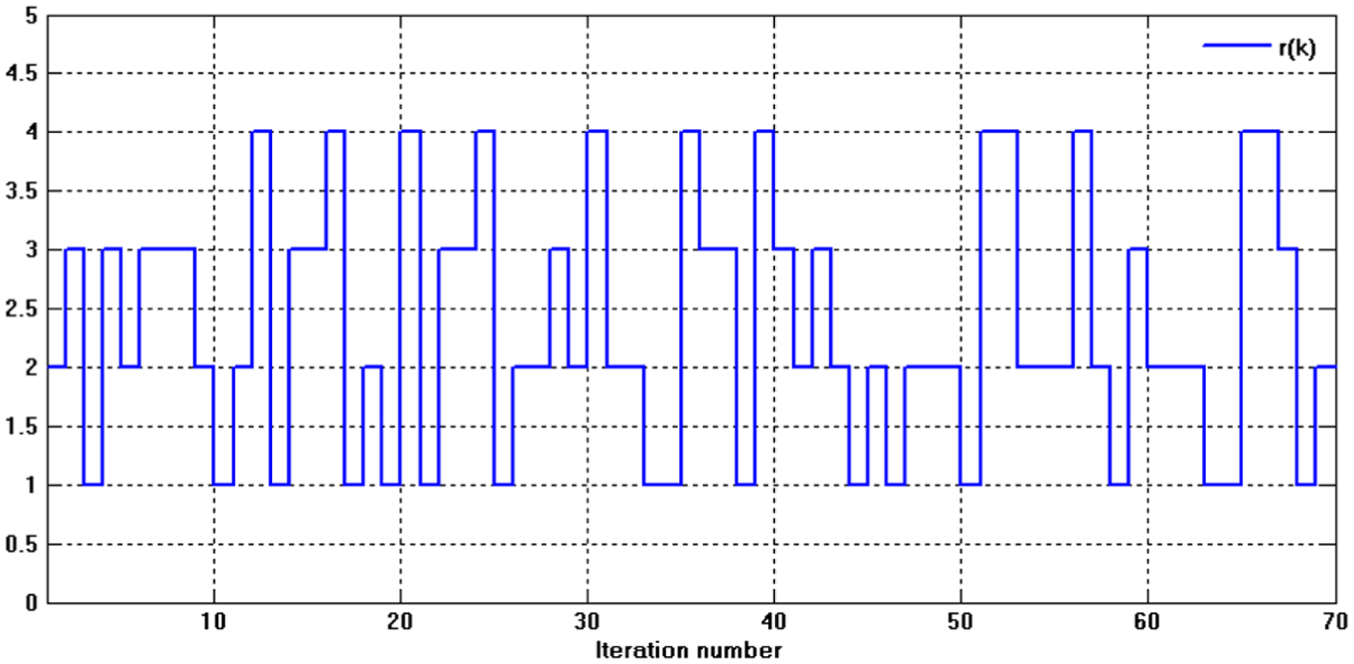
Time-varying delay function.
To have a complete description of the handled system, let us take
Using CVX Toolbox we obtain the following feasible solutions
Under the same simulation framework, we illustrate the results of the Monte Carlo simulations that were performed over 100 runs using different sequences of delay. In each of the figures below we present simultaneously simulation results corresponding to the proposed controller as well as those corresponding to the control strategy given in Yan and Shi (2008). In Figure 2 we draw system states. Sliding surfaces are illustrated in Figure 3, while the control inputs are depicted in Figure 4.
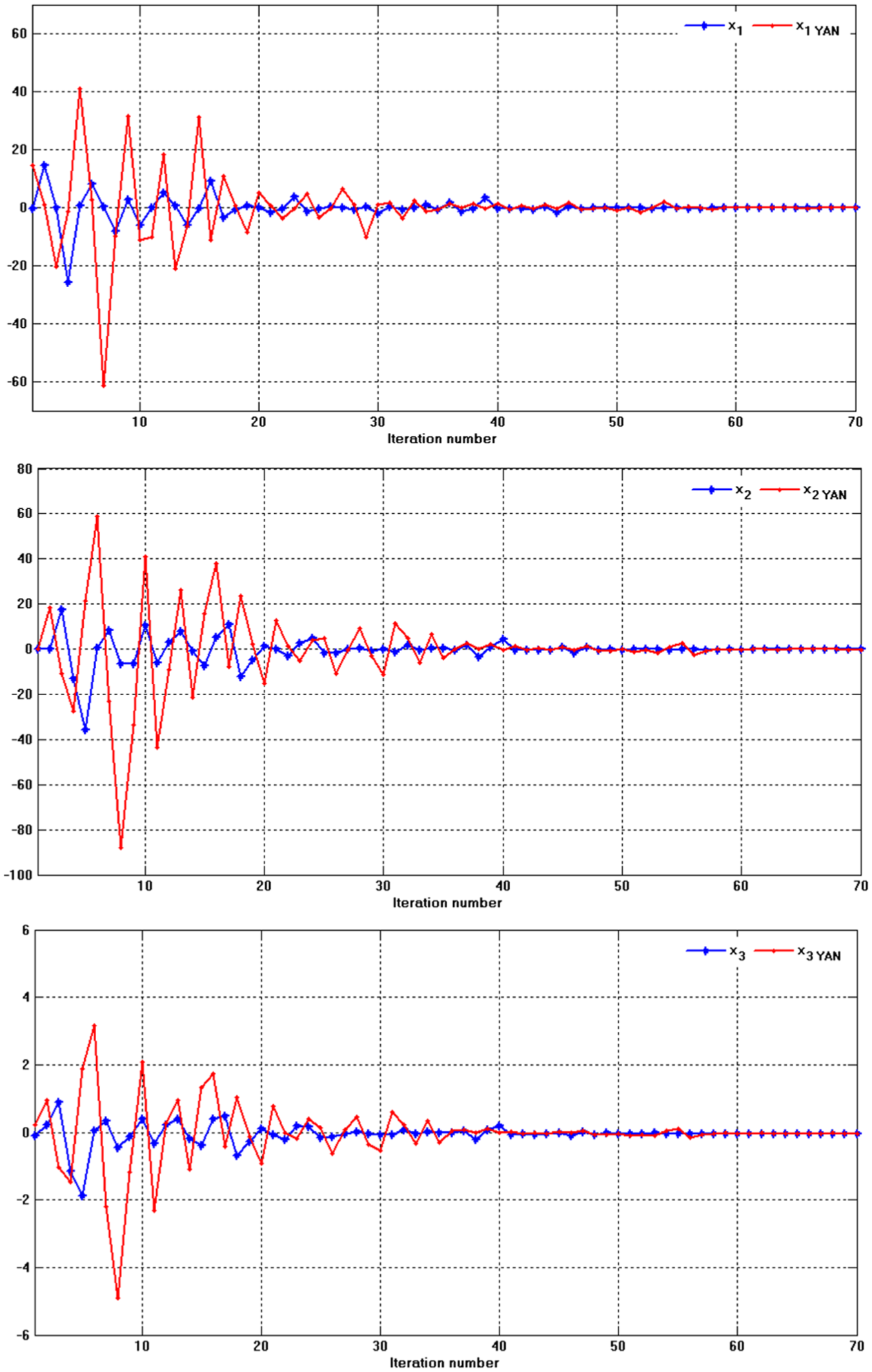
System states.
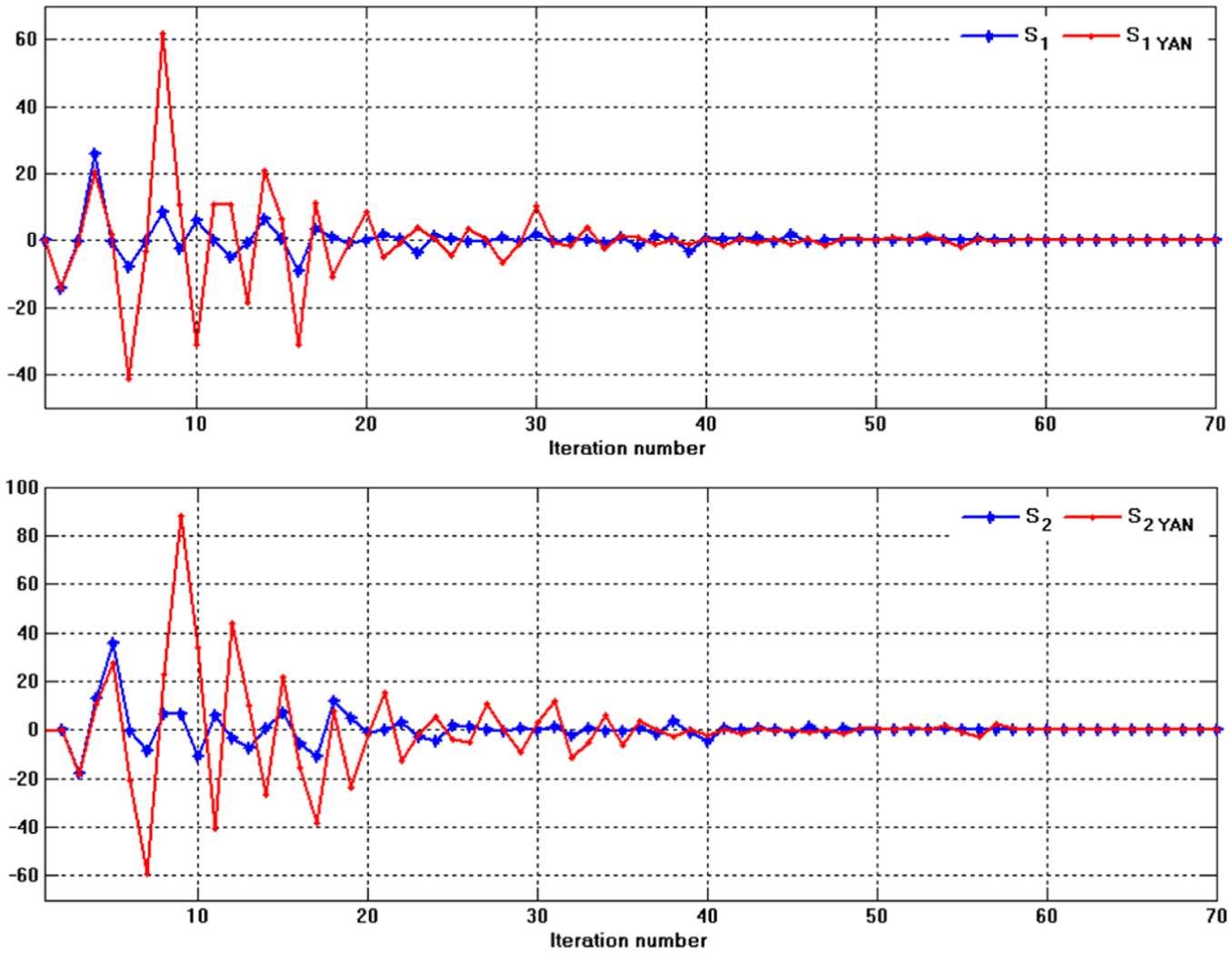
Sliding surfaces.
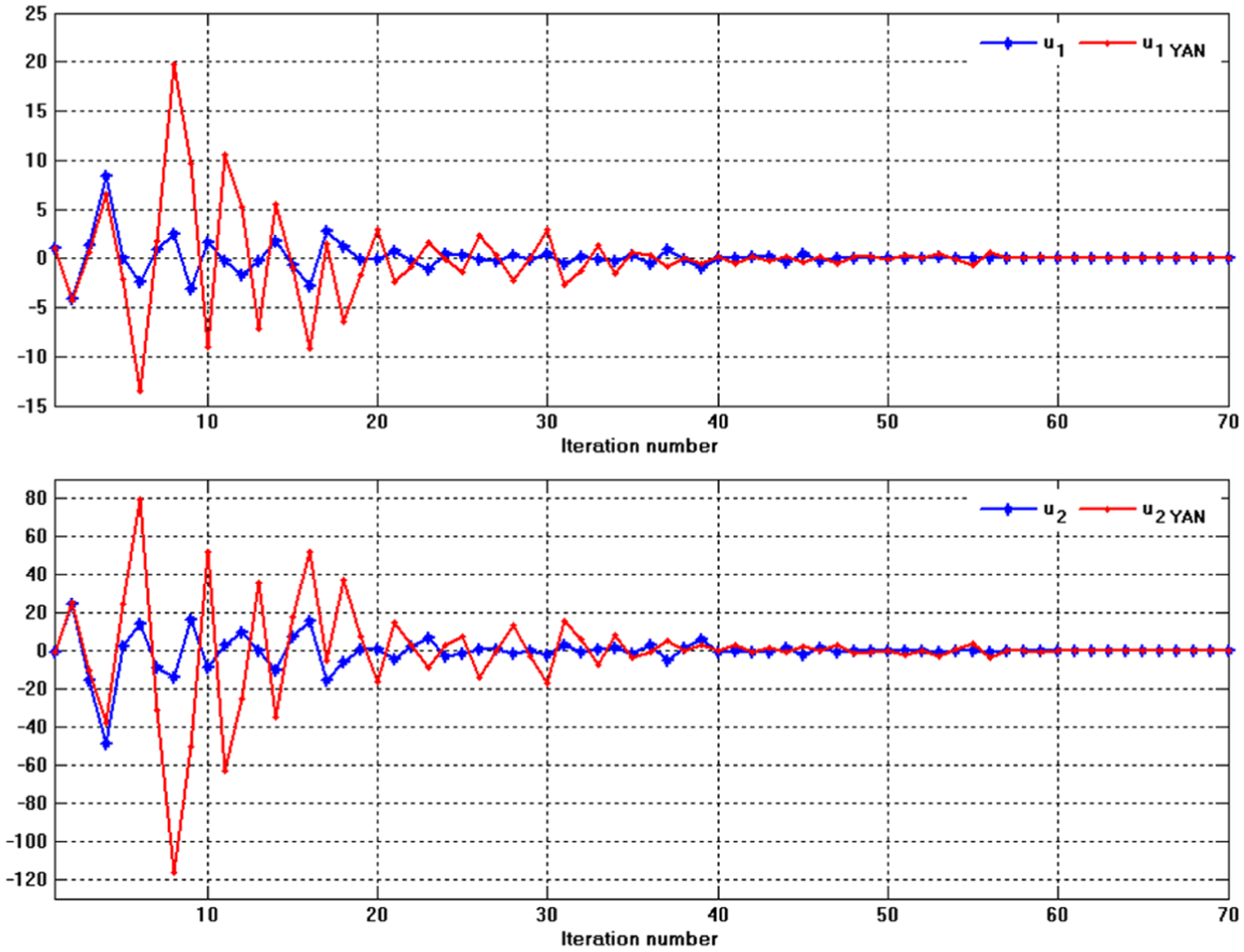
Control inputs.
Figure 2 shows that the system states are asymptotically stable, and
Moreover, the amplitude of oscillations of state components concerning the method in Yan and Shi (2008) are greater. Thus, in the transient response, the maximum absolute value obtained by
Through Figures 3 and 4 and comparing amplitudes of the sliding surfaces as well as the control input signals corresponding to both methods, we can observe that the amplitudes corresponding to the designed control strategy are smaller than those of the method given in Yan and Shi (2008). Besides, our algorithm is advantageous since it takes into account uncertainties on control inputs.
Applying the Monte Carlo simulation to 100 sequences of delay, and respecting the same system structure defined previously in equation (28), we present in Figure 5, simultaneously for both control strategies, the time taken by
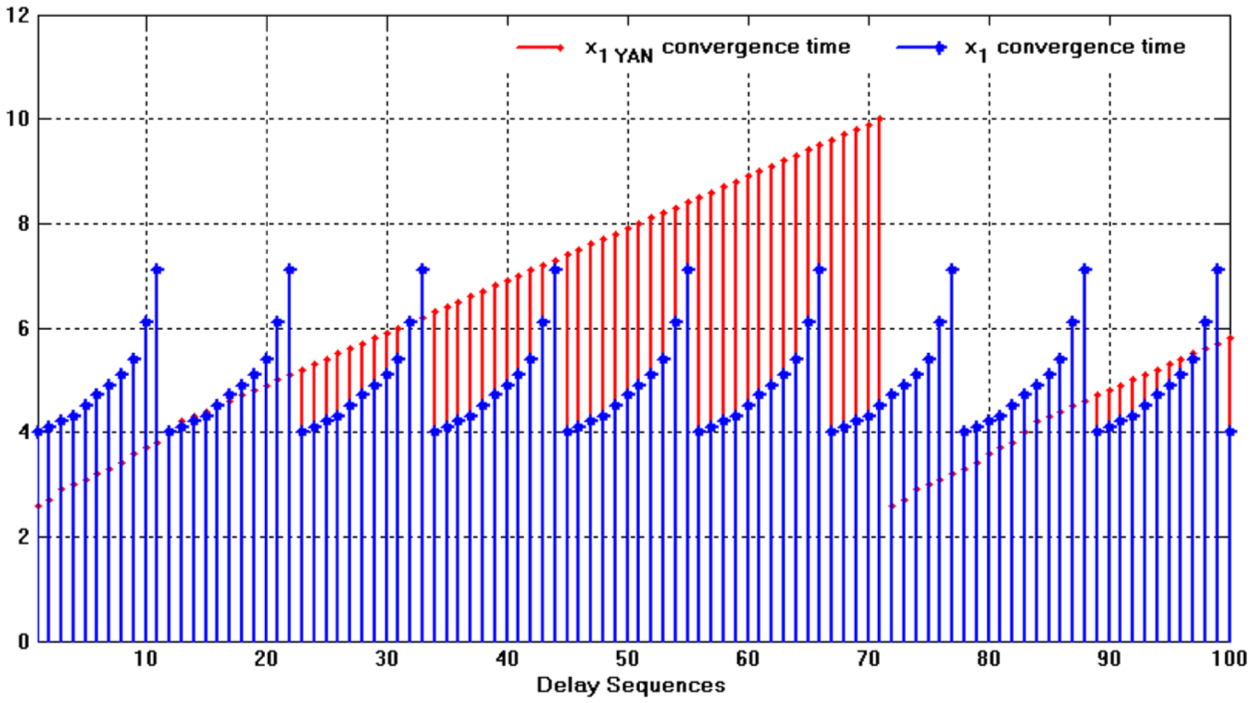
Convergence time for 100 sequences of delay.
As can be seen from Figure 5, when Yan and Shi (2008) is applied, the convergence time increases until the
This confirms that the proposed controller is faster, less influenced by the delay variations, and has a better transient behaviour than that of Yan and Shi (2008). In Figure 6, we illustrate simultaneously the steady-state errors for
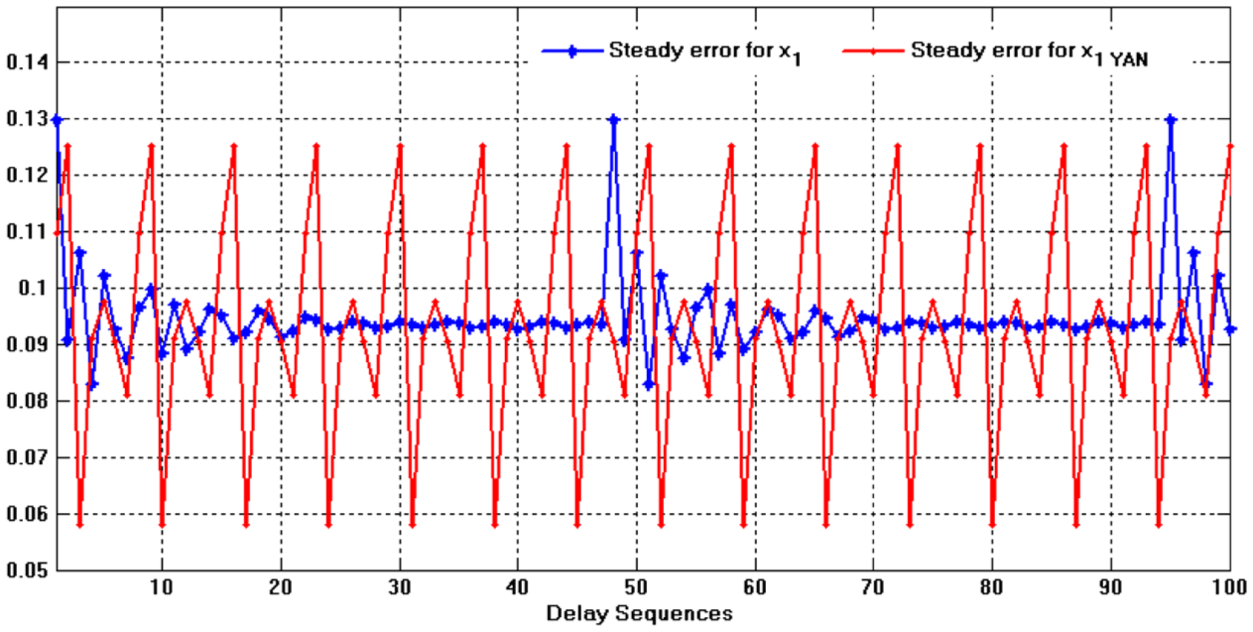
Steady error for 100 sequences of delay.
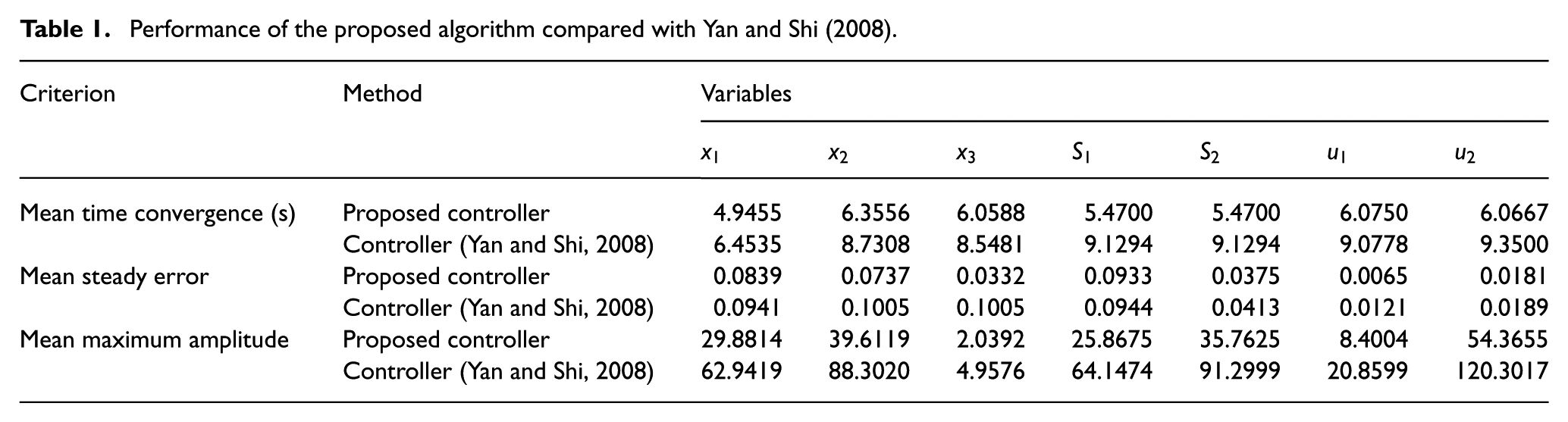
In Table 1 we give the values of time convergence, steady-state errors and maximum amplitude obtained as the mean values of the Monte Carlo simulations that were performed using 100 sequences of delay. The results summarized in this table refer to both approaches and are obtained under a similar simulation framework. In fact, different values shown in Table 1 had been procured via the use of a computing loop which had been repeated until the satisfaction of a convergence test. This latter depends on the fact that the absolute value of the difference between each state component at the
Performance of the proposed algorithm compared with Yan and Shi (2008).
Application to the Two-Area Four-Machine power system
To provide valuable insight into the effectiveness of the proposed control strategy, simulation results are provided from the application of such a control approach to the TAFM power system shown in Figure 7, subject to norm-bounded disturbances and uncertainties as well as bounded time-varying state delay.
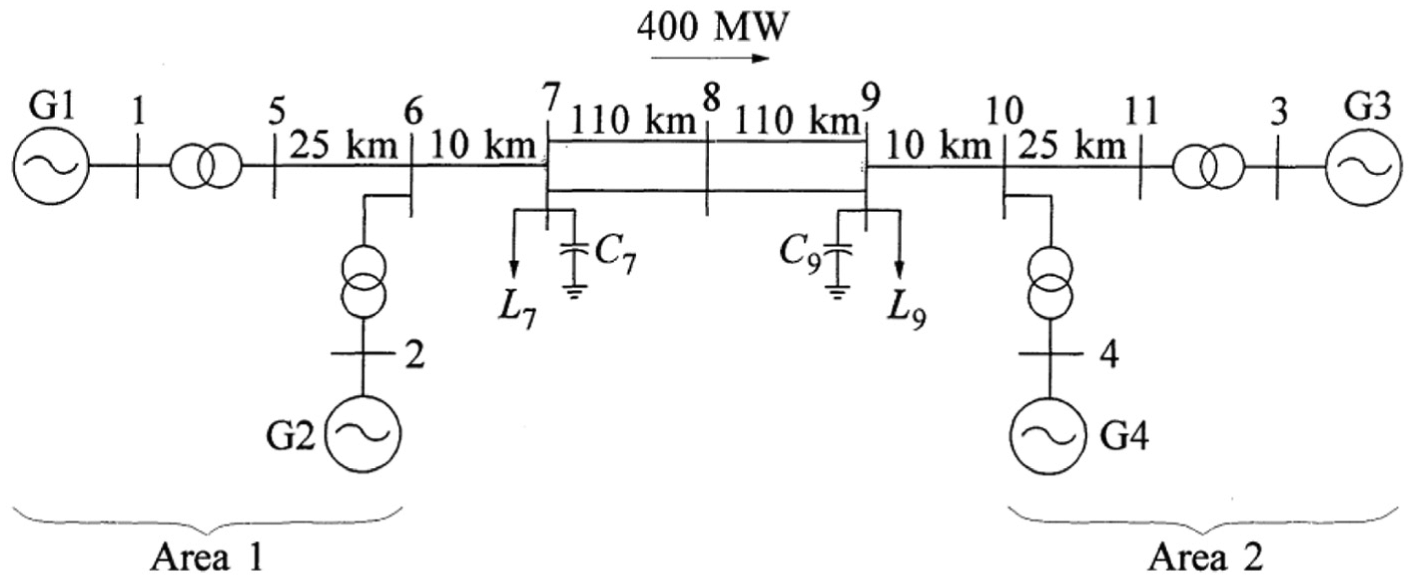
TAFM system (Kundur et al., 1994).
Process description
The TAFM power system consists of two similar areas connected by a weak tie. Each area is composed of two coupled units with 900 MVA and 20 kV for each unit. Further details and a complete description of different parts of the TAFM power system (including the exciter, the power system stabilizer, the generator parameters and initial values, transmission line data and power flow) can be found in Kundur et al. (1994).
The nonlinear model of the TAFM power system is linearised at a nominal operating point (Kundur et al., 1994). In Li et al. (2015), the authors presented a linearised power system model of the following compact form
where the state vector is
The control input is
Where
The TAFM power system model given by equation (29) is modified so that all time-delays are equal, i.e.
Using the Euler method, the discretised TAFM power system is therefore given by
where T is the sampling period. The state representation (31) can be also written as
where
Validation
This section aims to sustain the effectiveness of the proposed control strategy. To do so, an application to the TAFM system described in equation (32) has been presented. A comparative study between our approach and Yan and Shi (2008) has been provided to corroborate the sufficiency and the supremacy of our proposition in terms of precision, robustness and time convergence.
Let us consider the time-varying state delay function as a bounded random integer variable, depicted in Figure 8. System parameters, an LMI solution as well as matrices concerning the simulation tests on the TAFM power system are listed in the Appendix.
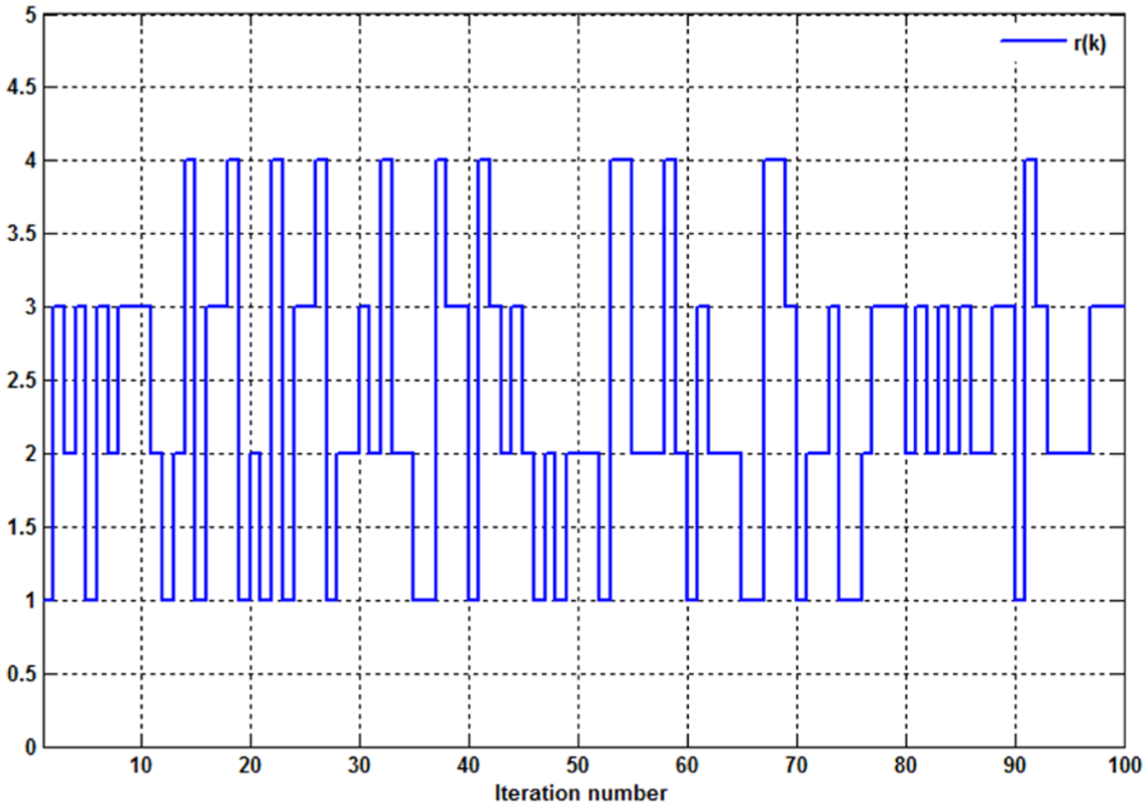
Time-varying delay function.
With respect to a common simulation framework, we illustrate the results of the Monte Carlo simulations that were achieved over 100 runs using different sequences of delay. In Figures 9–14 we depict simultaneously results generated by the proposed control algorithm and the control approach (Yan and Shi, 2008). In Figure 9 we draw the deviation of rotor angle for all generators, in Figure 10 we depict the deviation of rotor speed angle for each generator, sliding surfaces are illustrated in Figure 11 while the control inputs are shown in Figure 12.
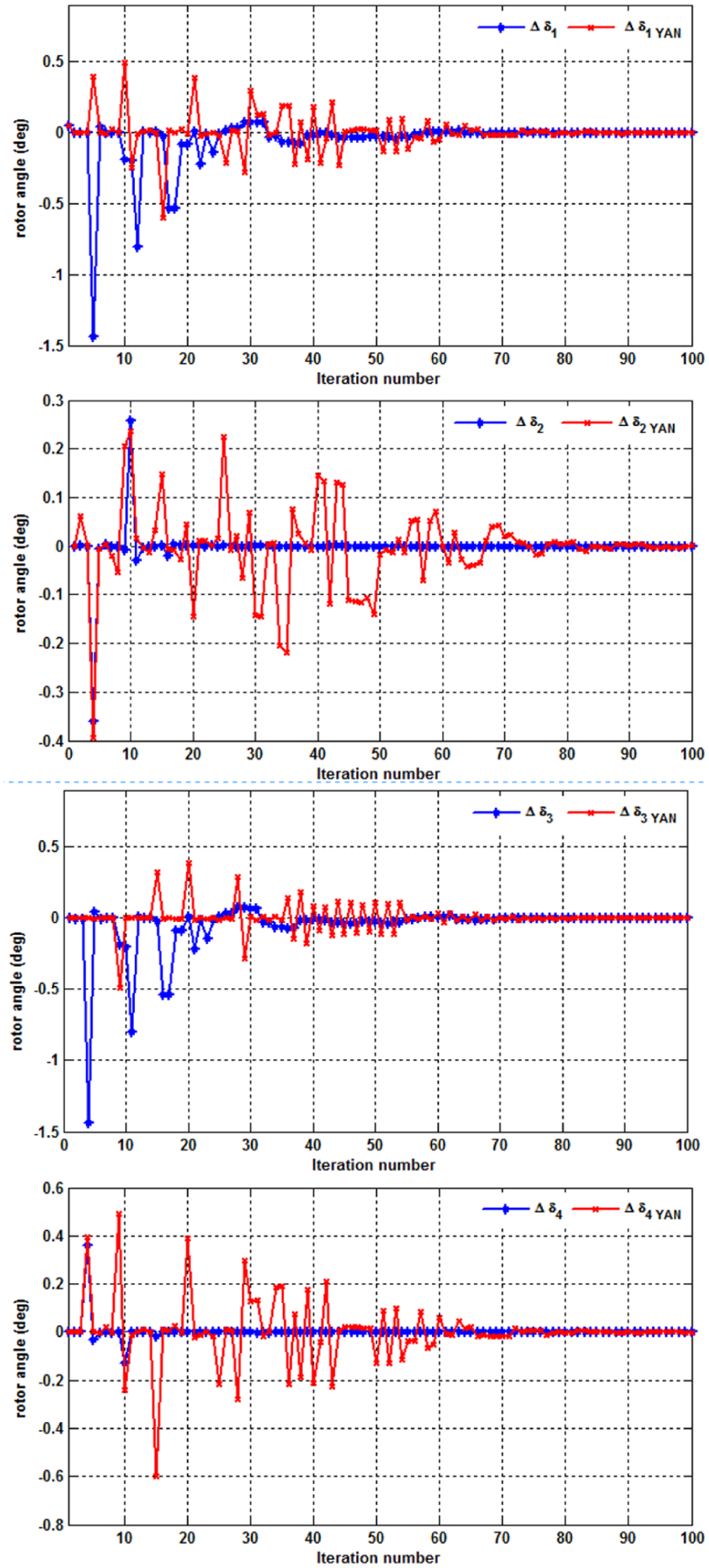
Deviation of rotor angle.
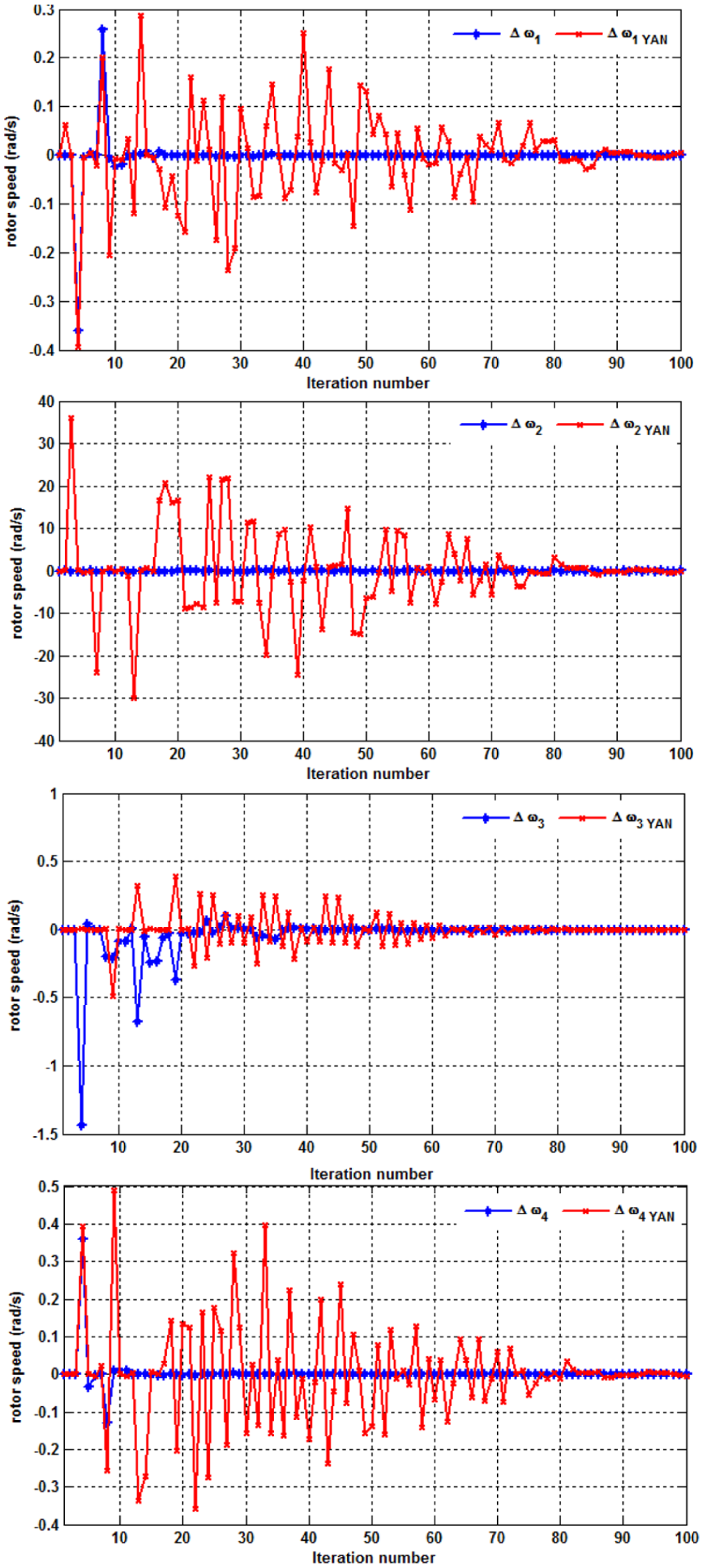
Deviation of rotor speed angle.
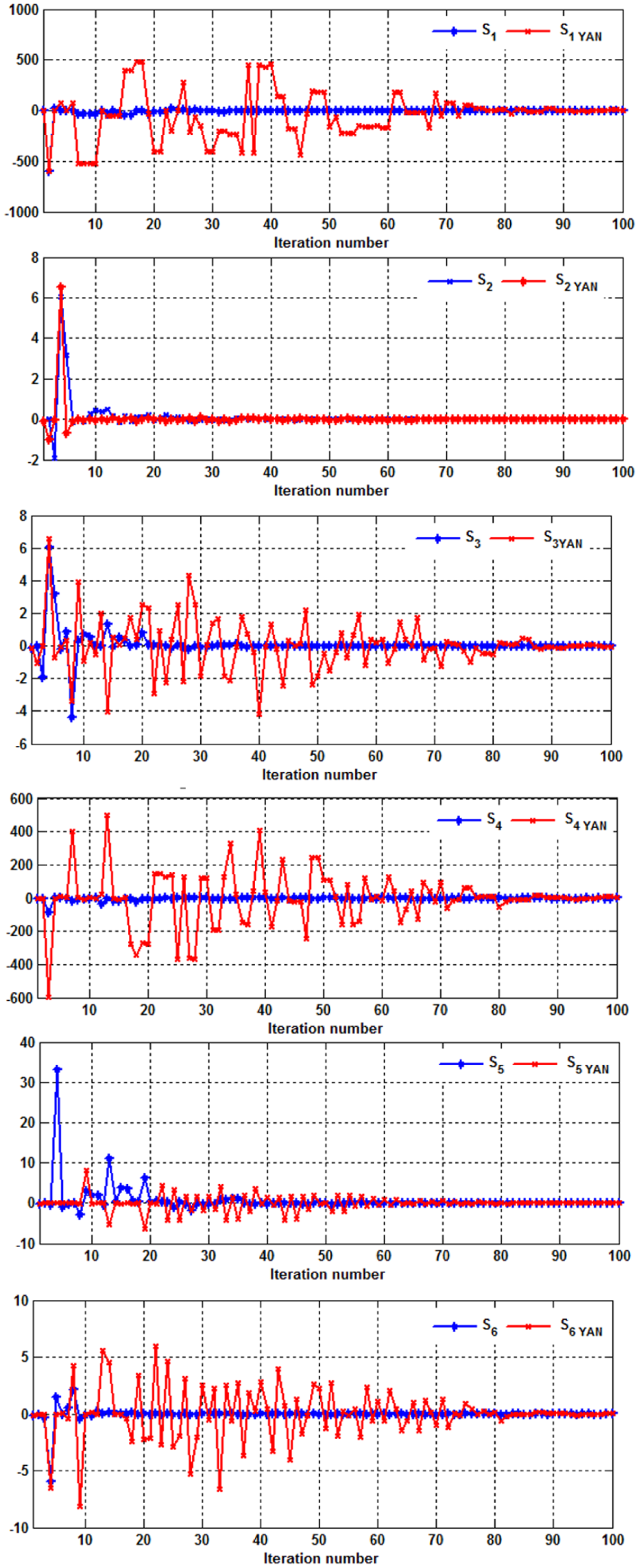
Sliding surfaces.
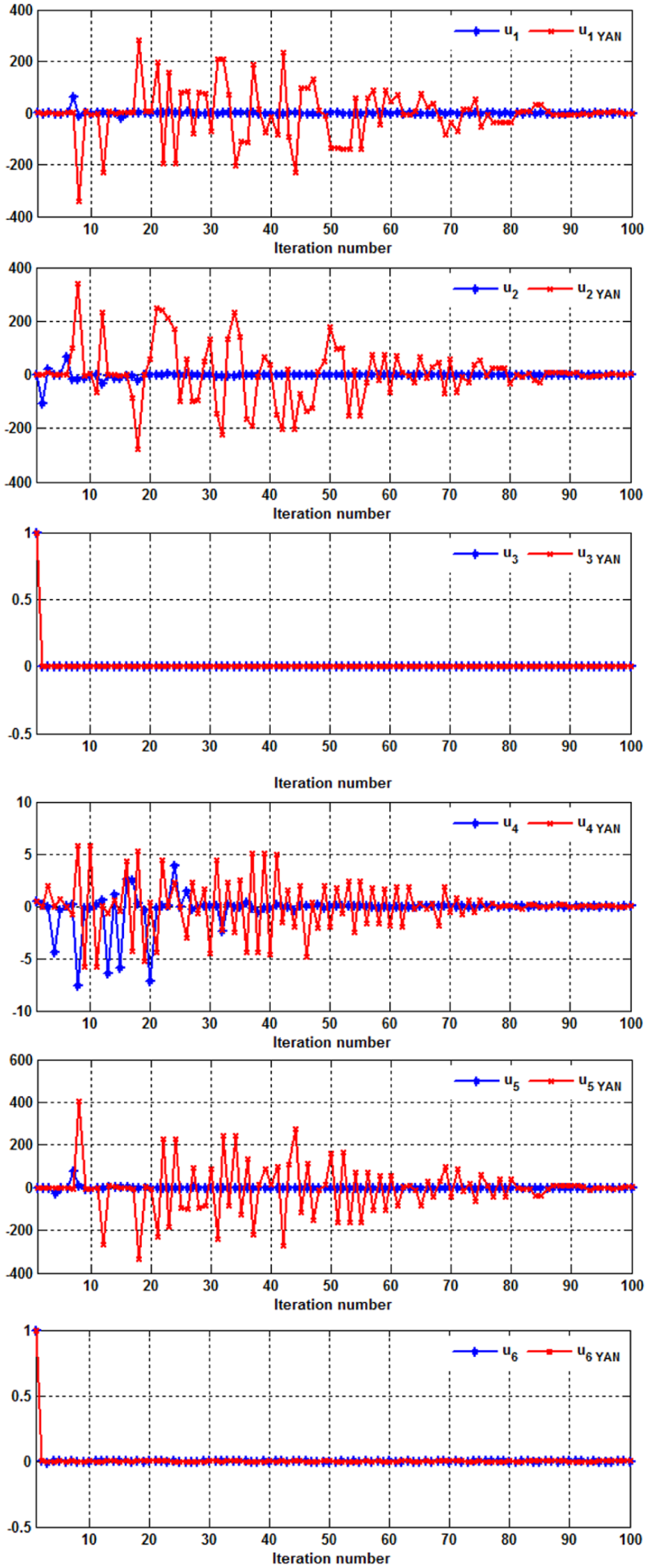
Control inputs.
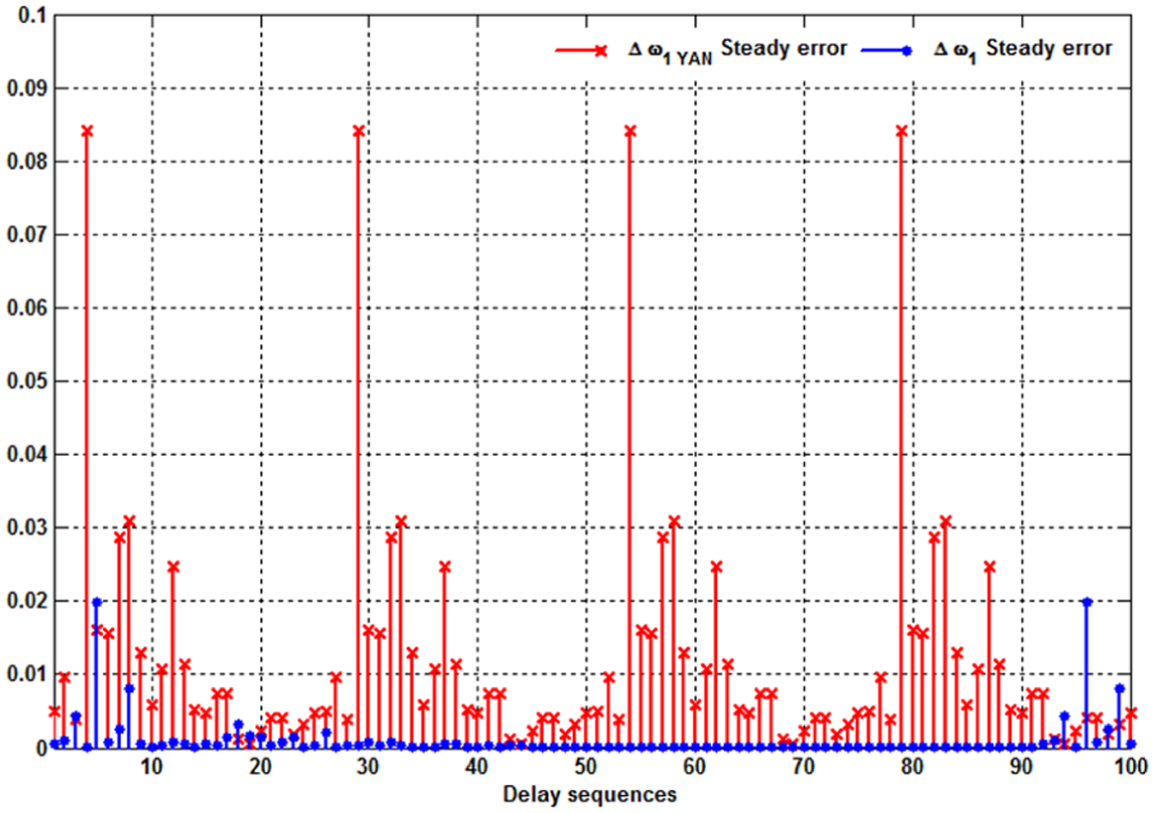
Steady error for 100 sequences of delay corresponding to the first rotor speed.
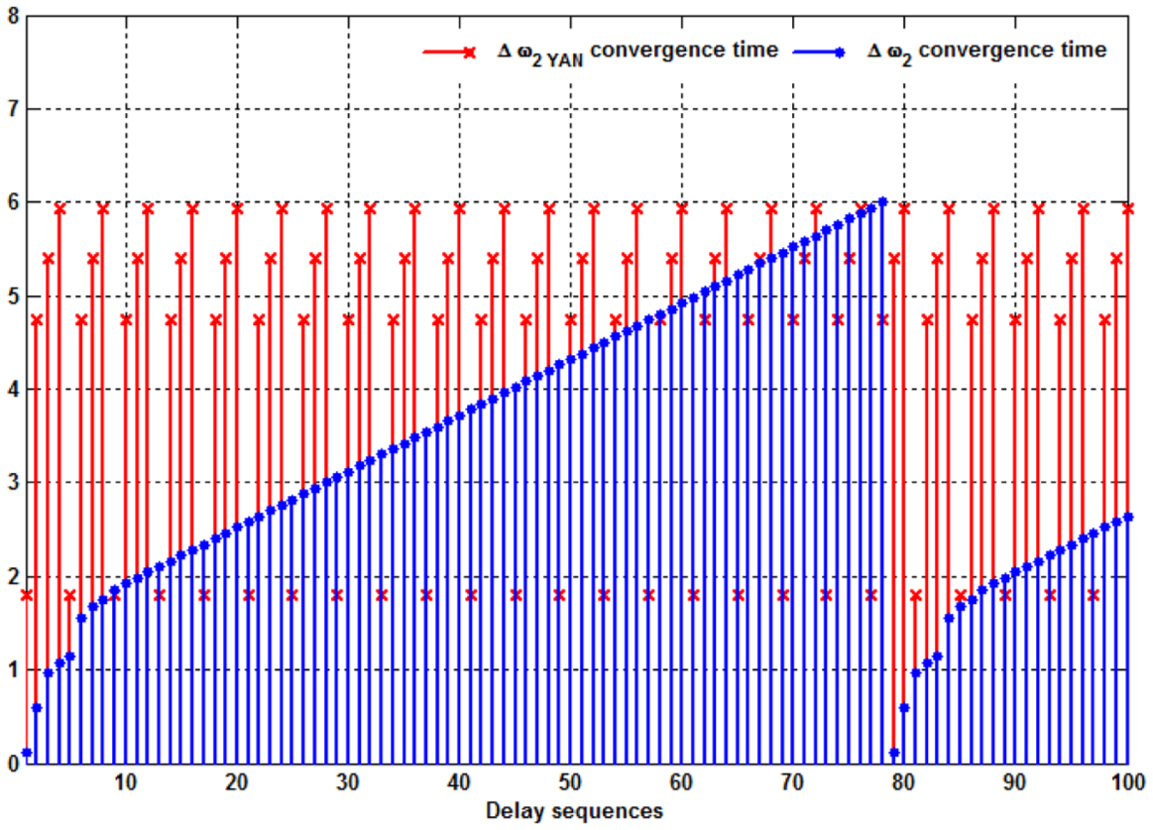
Convergence time for 100 sequences of delay concerning the second rotor speed.
From these simulation results it can be clearly seen that the system is asymptotically stable. The convergence times and the maximum amplitudes of the rotor angle deviations and rotor speed angle are summarized in Table 2 for the case of our proposed approach and that of Yan and Shi (2008). From Table 2 we notice that the proposed control algorithm provides faster response and better transient behaviour compared with Yan and Shi (2008).
Convergence times and maximum amplitudes for both approaches.
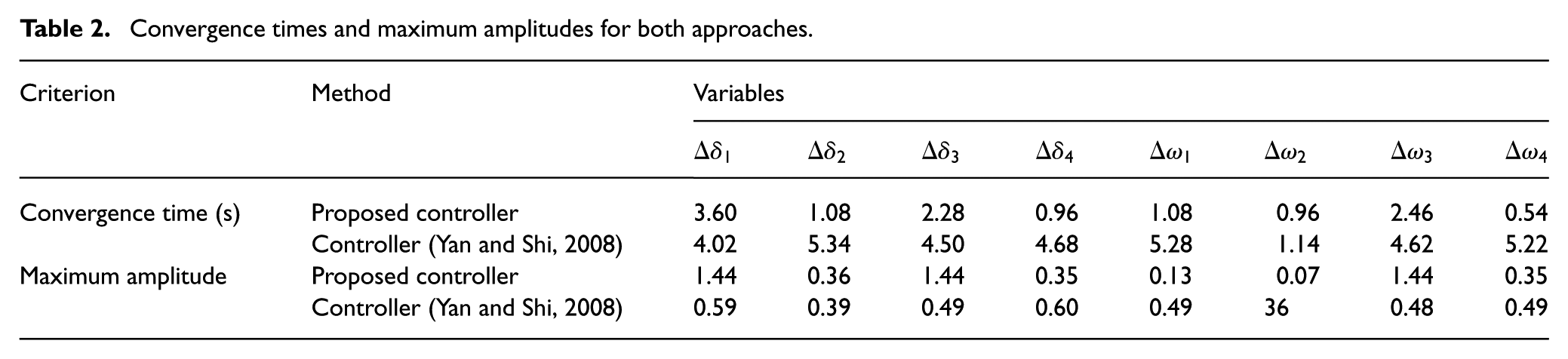
Moreover, oscillations are damped faster and very well once the proposed control algorithm is used. As illustrated in Table 2, there is a huge difference between the maximum amplitude of oscillations concerning the deviation of rotor speed when comparing both control strategies. Furthermore, although the maximum oscillation amplitudes for
From Figures 11 and 12 a comparison between both algorithms in terms of the oscillation amplitude and the convergence time of sliding surfaces and control inputs raises the supremacy of our proposition.
In Figure 13 we illustrate for both control methods the steady-state error for
In Figure 14 we draw for both control strategies the convergence time for
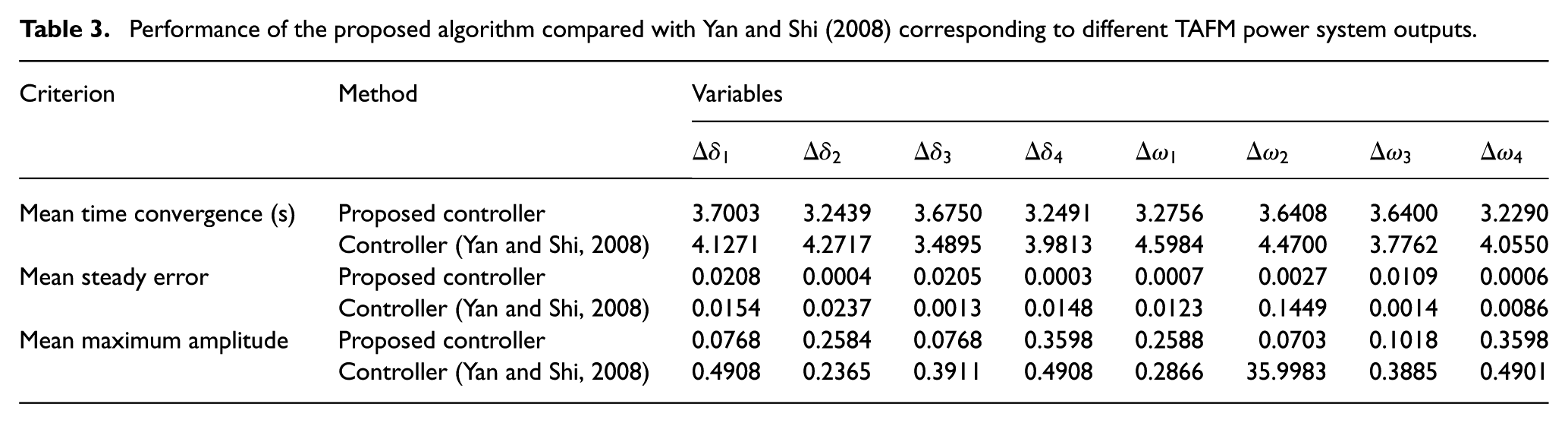
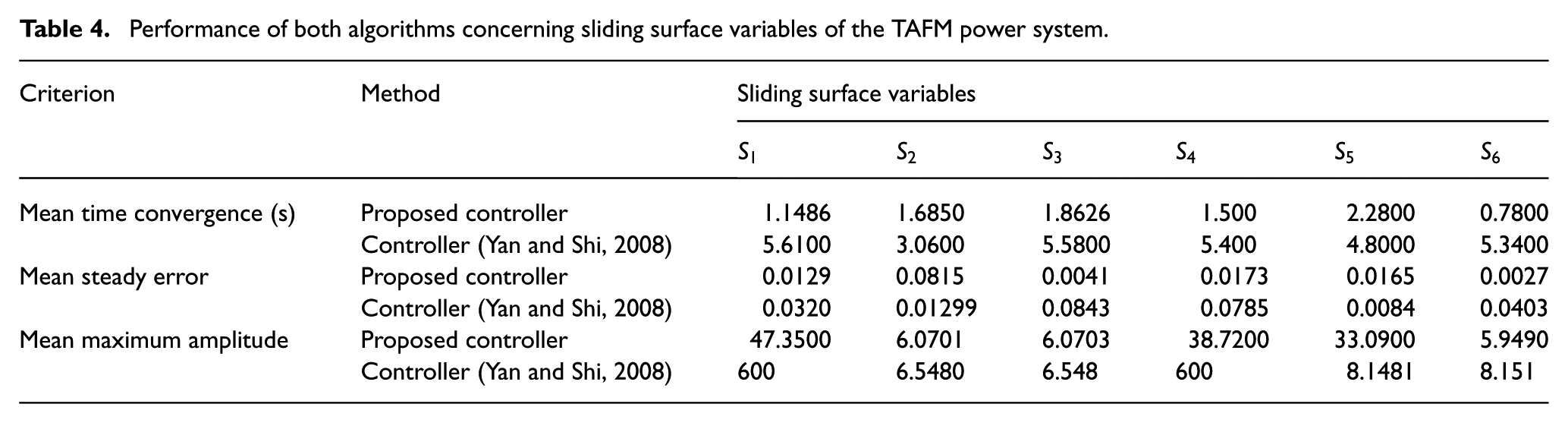
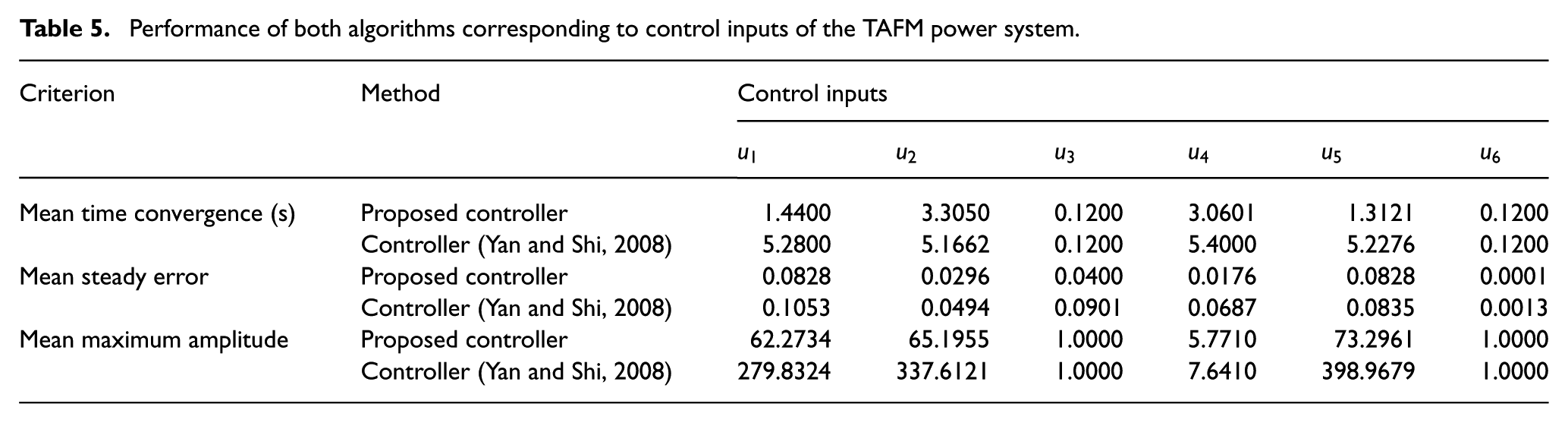
In Table 3 we give the values of time convergence, steady-state errors and maximum amplitude obtained from the Monte Carlo simulations averaged over 100 runs of the program. We present in this table values corresponding to deviation of rotor angle and deviation of rotor speed. Similar tasks are done in Tables 4 and 5 for sliding surfaces and control inputs. The results illustrated in Tables 3, 4 and 5 are related to both approaches and are obtained under a similar simulation framework. To avoid redundancy we have fixed a threshold
Performance of the proposed algorithm compared with Yan and Shi (2008) corresponding to different TAFM power system outputs.
Performance of both algorithms concerning sliding surface variables of the TAFM power system.
Performance of both algorithms corresponding to control inputs of the TAFM power system.
Conclusion
The DT-SMC algorithm for uncertain linear systems with time-varying state delay with uncertainties on the state and input control has been discussed. Based on linear matrix inequalities, a sufficient condition for the existence of a stable sliding surface, depending on delay bounds, has been derived. An SMC law has been designed. Finally, a comparative study performed on a numerical example as well as on the TAFM power system has been presented to assess the effectiveness and the supremacy of the proposed control methodology compared with that developed by Yan and Shi (2008).
Footnotes
Appendix
where
Using the CVX toolbox we obtain the following feasible solutions
Funding
This research received no specific grant from any funding agency in the public, commercial, or not-for-profit sectors.