






Abstract
This paper presents a new robust decentralized control of nonlinear interconnected systems, which is applied and validated on a large scale power system. Our work is performed in three steps. Firstly, we have developed the polynomial description of the nonlinear uncertain and interconnected system using odd Kronecker power of state vectors, which is an easy-manipulation model for such complex systems. Then we applied Lyapunov’s direct method of stability analysis, associated with a quadratic function, in order to determine a sufficient condition for global asymptotic stability by applying a nonlinear, decentralized and optimal polynomial control. Finally, we carried out a simulation study on a nonlinear uncertain power system with three interconnected machines. We considered different cases of perturbations on its state variables as well as different cases of fault locations. We prove via advanced simulations, the effectiveness of the proposed control technique which is able to mitigate the successive amplitudes of the oscillations, to limit the control actions and to enhance the power system transient stability.
Keywords
Introduction
Modeling, stability analysis, and control of nonlinear and complex systems is one of the most important problems that have attracted the attention of researchers (Benhadj, 1995; Bouzaouache and Benhadj, 2008; Elloumi and Benhadj, 2014; Elloumi et al., 2016; Lakshmikantham et al., 1991; Loussifi et al., 2016; Ortega et al., 1998; Phulpin et al., 2011). The resolution of such problems should take into account several factors. Firstly, the complex systems are generally characterized by several interconnections of many subsystems that are geographically distributed, thereby the stabilization of such large scale interconnected systems is generally based on decentralized schemes (Elloumi et al., 2013). The main objectives of decentralized control are to find some feedback laws for adapting the interactions from the other subsystems where no state information is transferred. In other words, each subsystem is controlled using only its locally available state and should obviously guarantee the stability of the global interconnected system. The advantage of decentralized control designs is to reduce complexity and therefore allow the control implementation to be more feasible.
Secondly, these processes are characterized by complex nonlinear dynamic models with varying parameters and can be subjected to important perturbations. The application of a decentralized robust control is then required to guarantee system stability under model parametric perturbations and different system configurations.
Decentralized robust control problems of large scale interconnected systems have been widely studied in the literature. In this context, several design approaches have been proposed and successfully applied to improve the transient stability, we can cite the feedback linearization technique (Wang et al., 1997; Wang and Hill, 2000), Hamiltonian techniques (Hill and Wang, 2000; Maschke et al., 2000; Wang et al., 2003; Xi et al., 2002), H∞ synthesis (Tlili, 2017), guaranteed cost control approach (Rtibi et al., 2015), and sliding-mode control (Huerta et al., 2010; Yan et al., 2004). However, these researchers were limited to some special classes of nonlinear systems because there is no common method to investigate stability of general large scale interconnected systems, as it is known in the case of linear systems. Therefore, researchers in this direction are still actively in progress, aiming to develop and apply some advanced approaches for the study and the control of nonlinear interconnected systems.
The polynomial model constitutes an important class of nonlinear systems. It presents the advantage to permit the use of the Kronecker product and the power of matrices and vectors (Brewer, 1978; Graham, 1981) allowing important algebraic manipulations as shown in Bouafoura et al. (2011) and Rotella and Dauphin-Tanguy (1988). This class is able to describe the dynamic behavior of a large set of processes like electrical machines, power systems and robot manipulators (Elloumi and Benhadj Braiek, 2012). Moreover, since analytical nonlinear function can be approximated by a polynomial expansion, then the polynomial class allows to approach any nonlinear system.
Based on considerations cited above, this work aims mainly to provide a new design of a decentralized robust nonlinear controller for the stability of uncertain polynomial large scale interconnected systems. The description of these systems using Kronecker product and the use of the quadratic Lyapunov function have allowed the definition of sufficient conditions for the global asymptotic stability of the system equilibrium.
The second part of our contribution concerns the implementation of the developed approach on a large scale interconnected power systems. In fact, power system stability has been recognized as an important problem for secure system operation; so we aim in this paper to improve system transient stability, considering different fault locations and different cases of perturbations on its state variables.
The subsequent sections of this work are organized as follows. In section 2, the studied system is presented. Section 3 focuses on the presentation of decentralized robust control law and the determination of modified Algebraic Riccati Equation (ARE). Section 4 is devoted to the development of the decentralized nonlinear robust control and the establishment of some sufficient conditions for global stability of a nonlinear polynomial system. Some simulation results of the studied multimachine power system are presented in section 5. Finally, conclusions are provided in section 6.
Description of the studied system
We consider the class of nonlinear systems, composed of the interconnection of n subsystems, and for which the r order polynomial development is composed only by odd Kronecker power of vectors, that is,
where
The overall interconnected system is described by the following compact form
where
We suppose now, that the considered interconnected system presents some parametric fluctuations, then it can be described by the following uncertain expression
with
and
where
where
where
The corresponding overall uncertain interconnected system is then described by the following compact form
where
The proposed polynomial decentralized robust control law
In this section, we propose a nonlinear decentralized control structure of the polynomial uncertain system. The local decentralized control law is expressed by the following polynomial form
This corresponds to an overall control law given by
with
where the mat-function
The determination of this modified Riccati equation is based on the consideration of decoupled uncertain subsystems defined by the following state equations
with the associated modified quadratic criterion
with
Consider the following variable changes
Based on the expression (14), equation (12) becomes
with
then
and
with
where
Then using (20), we obtain the following modified Algebraic Riccati Equation that depends on the uncertainty matrices
Stability study
In this section, we present our contribution concerning the development of a sufficient condition to guarantee the global asymptotic stability of the uncertain interconnected polynomial system (8) with the decentralized polynomial control law (10).
This stability study is based on the Lyapunov direct method. Let the Lyapunov function V to be defined by the following quadratic form
where
Using equations (8) and (10), the development of
By applying the ‘vec’ function property given by (62) in Appendix A, relation (24) can be written as
Now, when applying (63), (25) becomes
This result and the following equation
imply
Since
where
Then (29) can be written as
where
To ensure the asymptotic stability of system (8) with the decentralized control law
The uncertainty matrix
Using equation (6) and hypotheses (7), inequality (35) becomes
where
So the uncertain part of
On the other hand, the uncertain part of
From (6) and (7), it follows
then
where
Consequently, it becomes
By substituting the results of equalities (38) and (43) above in equation (33), we conclude that
We note that for
Now, we focus on determining a minorant to
where
where
where
Substitute the conditions aforementioned in (46) and (47) into (45) yields
Then applying the linear ’mat’ function, defined in Appendex A, inequality (48) becomes
On the other hand, we have
now let
then
and
Combining (53) with (49) allows
Consequently, for
Application of the proposed control to a multimachine power system
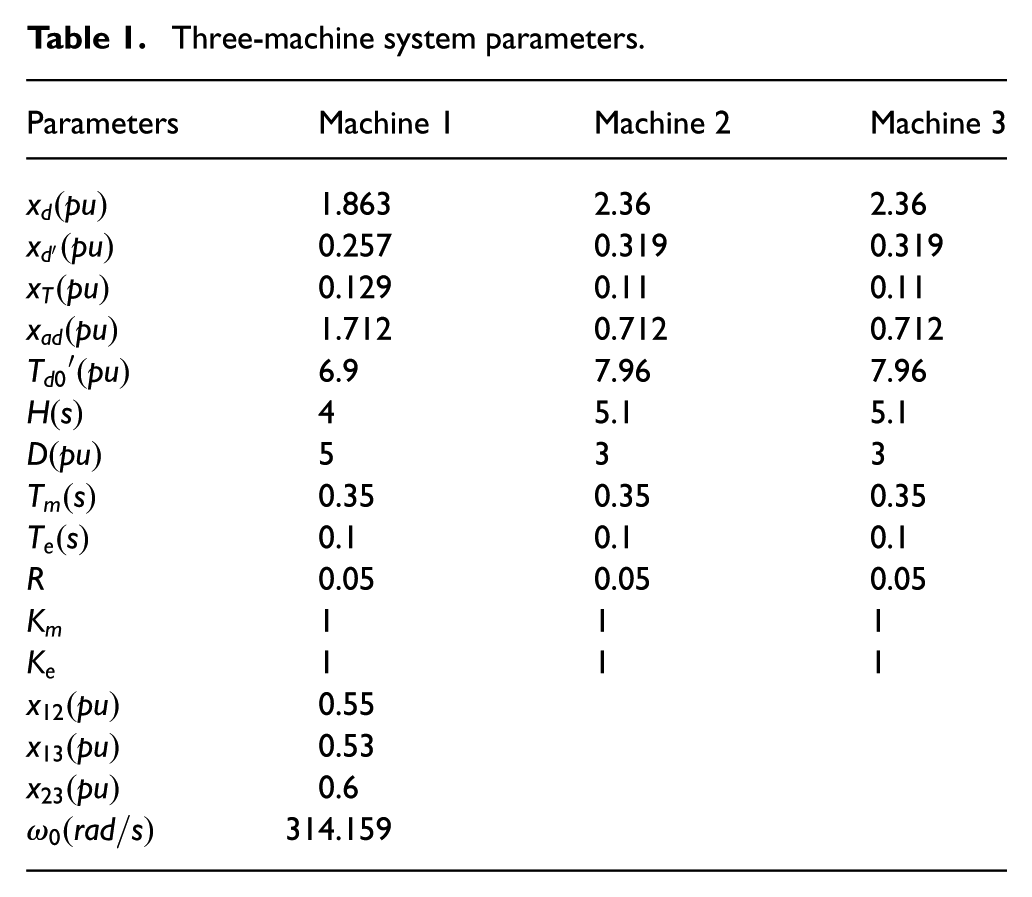
In this section, we consider the application of the above method, presented in section 4, to the synthesis of a decentralized robust control, applied to an uncertain three-machine power system model (Figure 1) (Elloumi and Benhadj Braiek, 2002; Wang et al., 1998), characterized by the parameters (Table 1) (Elloumi and Benhadj Braiek, 2002).
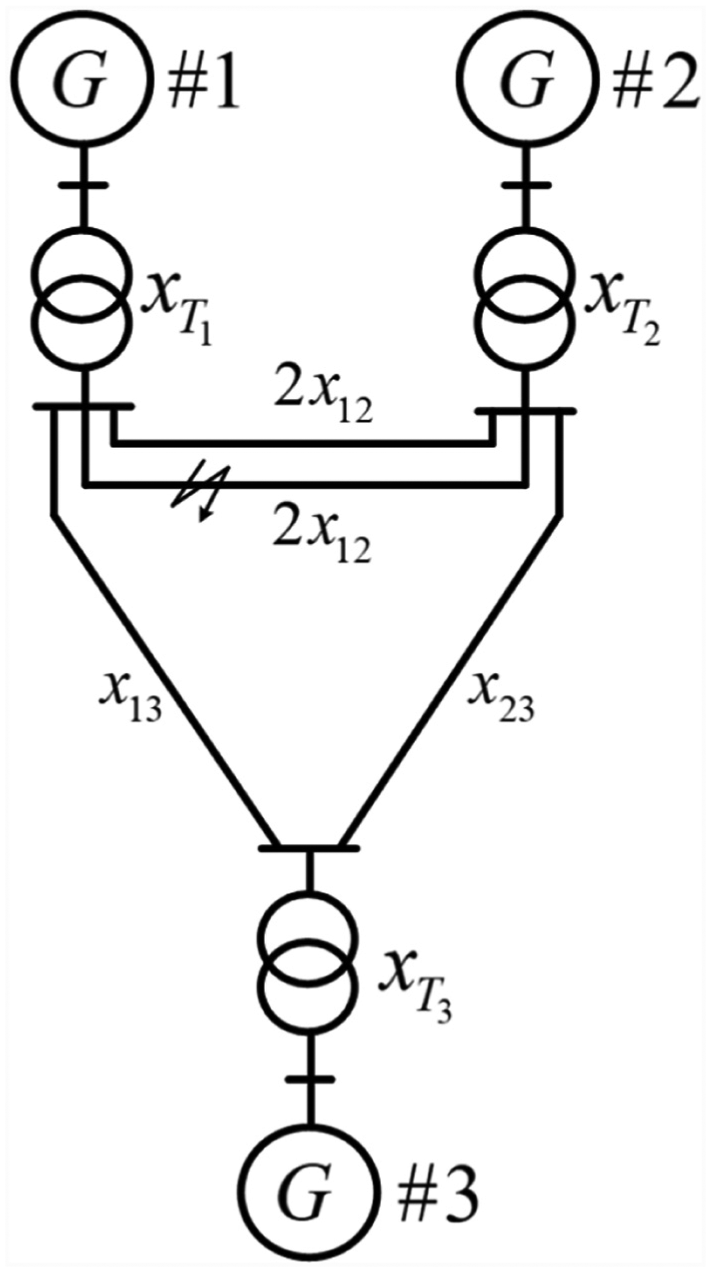
Three-machine example system.
Three-machine system parameters.
Multimachine power system modelization
A three-machine power system controlled by the steam valve opening, can be described with the interconnection of three subsystems as follows (Wang et al., 1998)
where
with
with
Polynomial model of the electrical system
The multimachine power system model (55) can be transformed to the nonlinear analytic model (3), after a usual limited development of the ‘sinus’ function. Then the power system model can be represented by a third order truncated polynomial form, which can be considered sufficient to reproduce the nonlinear analytical model; that is, for
We obtain the following form
with
The uncertainties matrices are chosen such that
The global interconnected system can be defined by the following polynomial form
with
with
Calculation of the control law
The decentralized control laws, for the three machines are expressed in the following form
which corresponds to the overall control law
where
The gains
We obtain
It can be easily checked that the matrix
is positive definite, where
Simulation results
In this section, the dynamic performances of the controllers are evaluated. Simulation studies are carried out under different contingencies. The following cases are considered.
Effect of small disturbance on the dynamic performance of the system: Perturbations of state variables
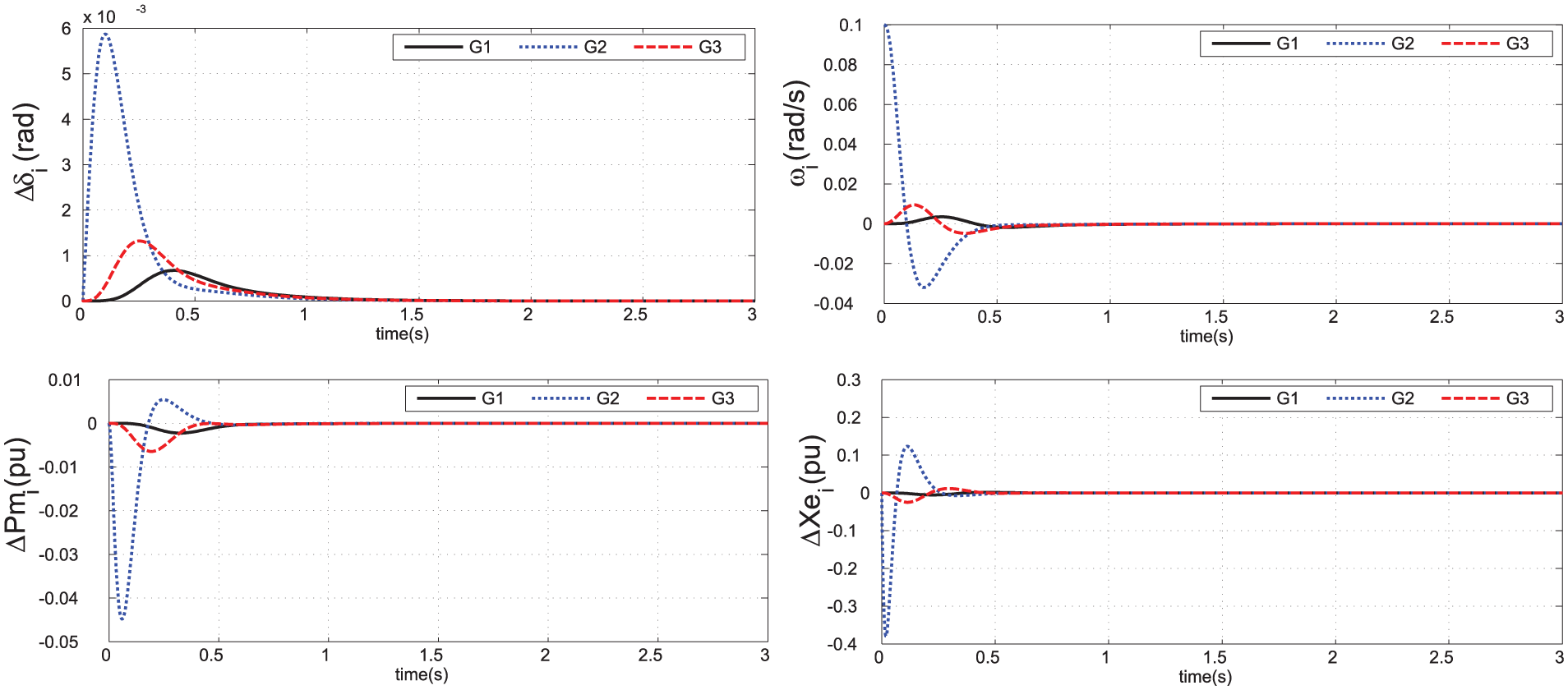
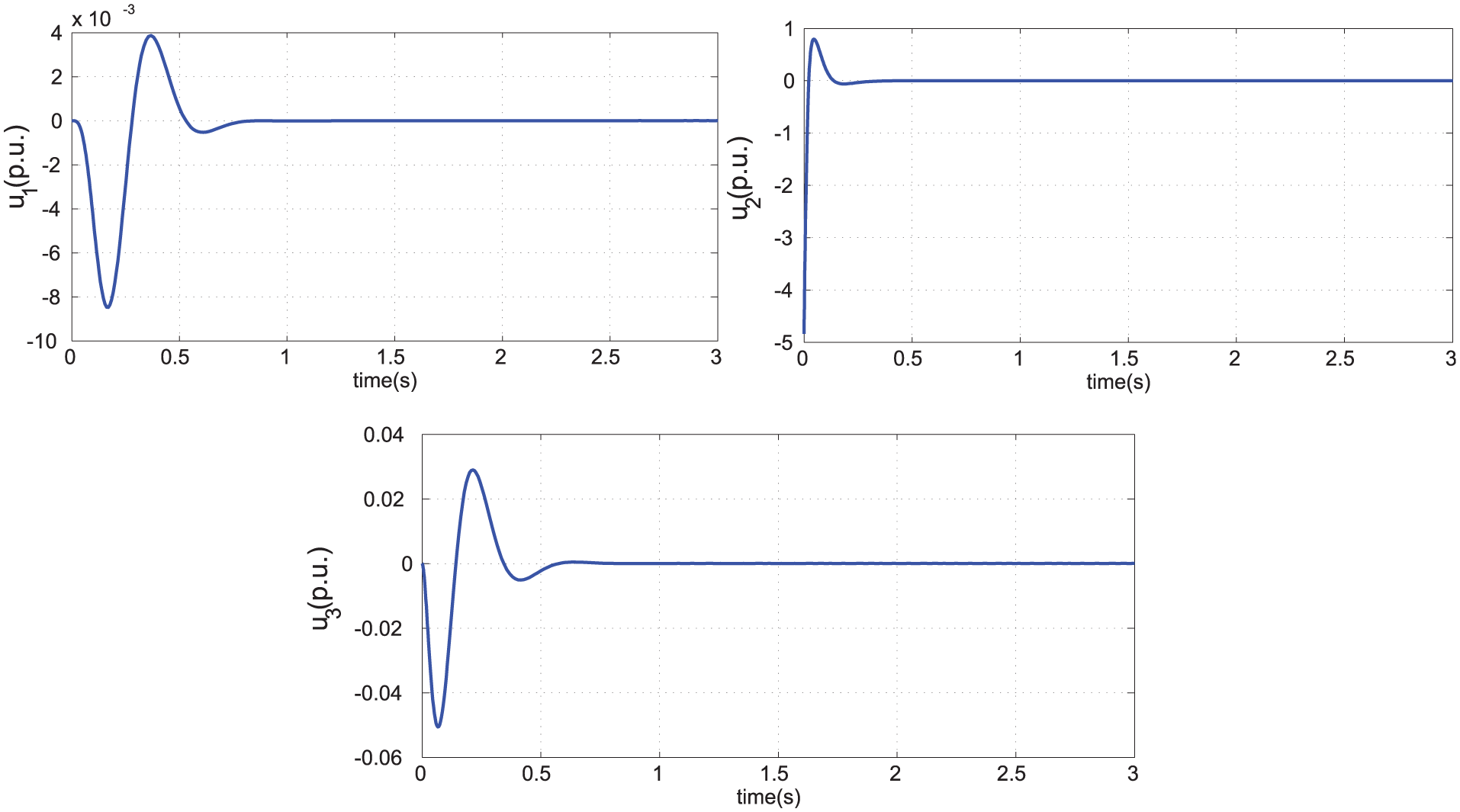
The performances of the designed control are shown in Figures (2) and (3), on which the evolution are simulated of the system state variables
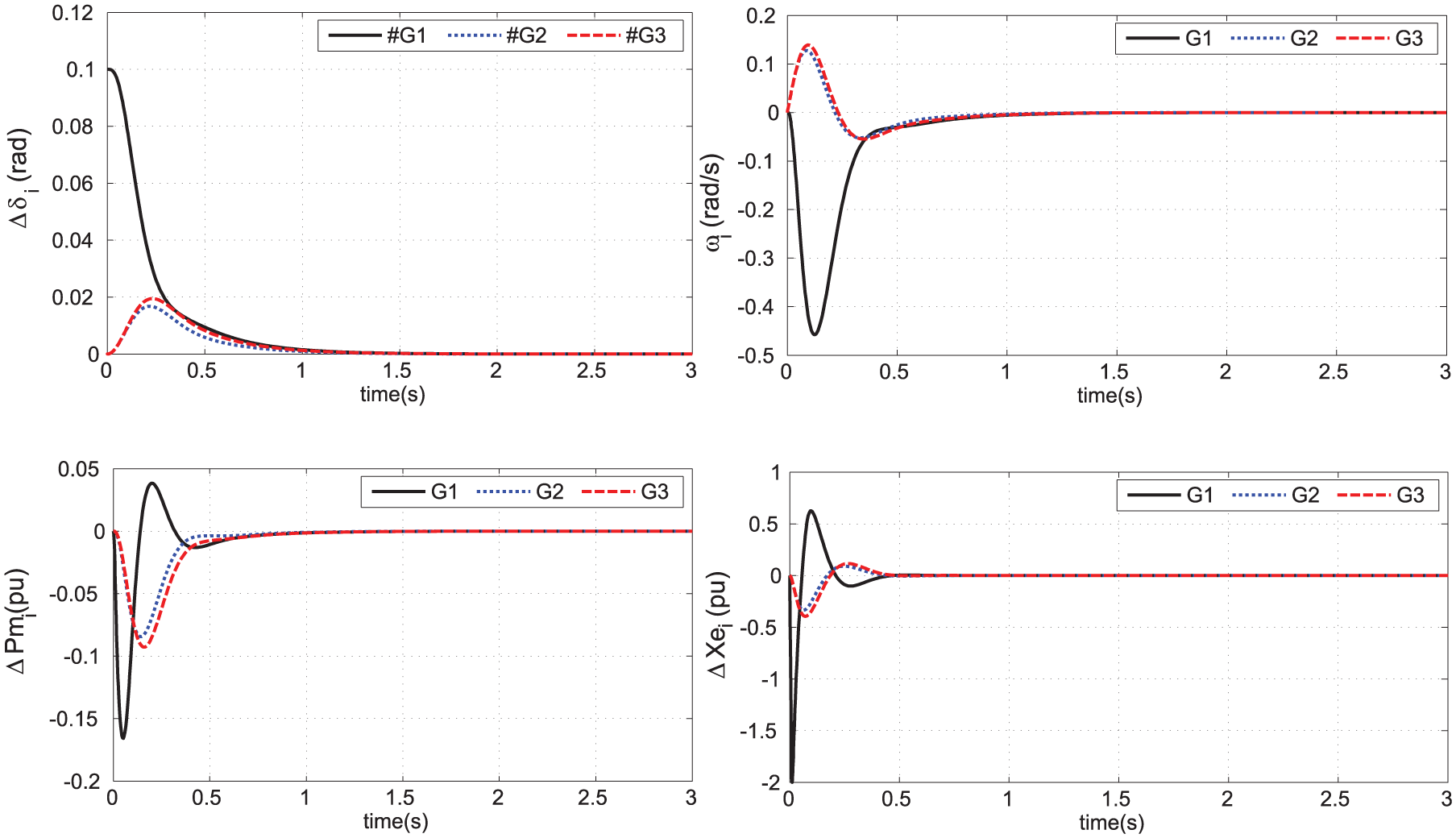
State variables response towards a perturbation on the variable
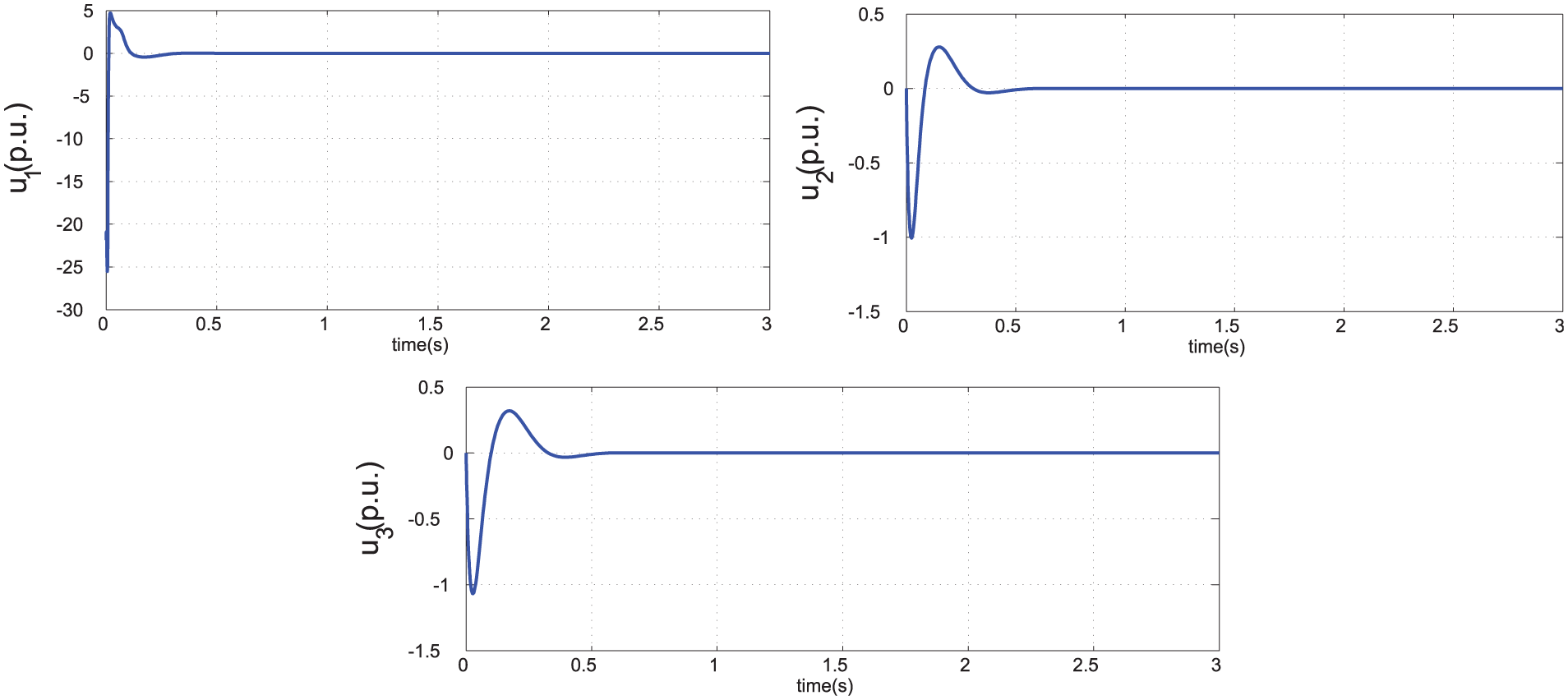
Control signals evolution towards a perturbation on
The curves of Figures (4) and (5) show, respectively, the evolution of the three machine state variables when a perturbation has occurred on the relative speed variation of the second machine, and the corresponding decentralized control signals.
State variables response towards a perturbation on the variable
Control signals evolution towards a perturbation on
The simulation results presented in these figures demonstrate clearly the ability of the decentralized nonlinear control to neutralize rapidly the effect of the occurred perturbations by enhancing rapidly the transient stability of the multimachine power system.
Effect of severe disturbance on the dynamic performance of the system: Perturbations of state variables with temporary three-phase short-circuit fault
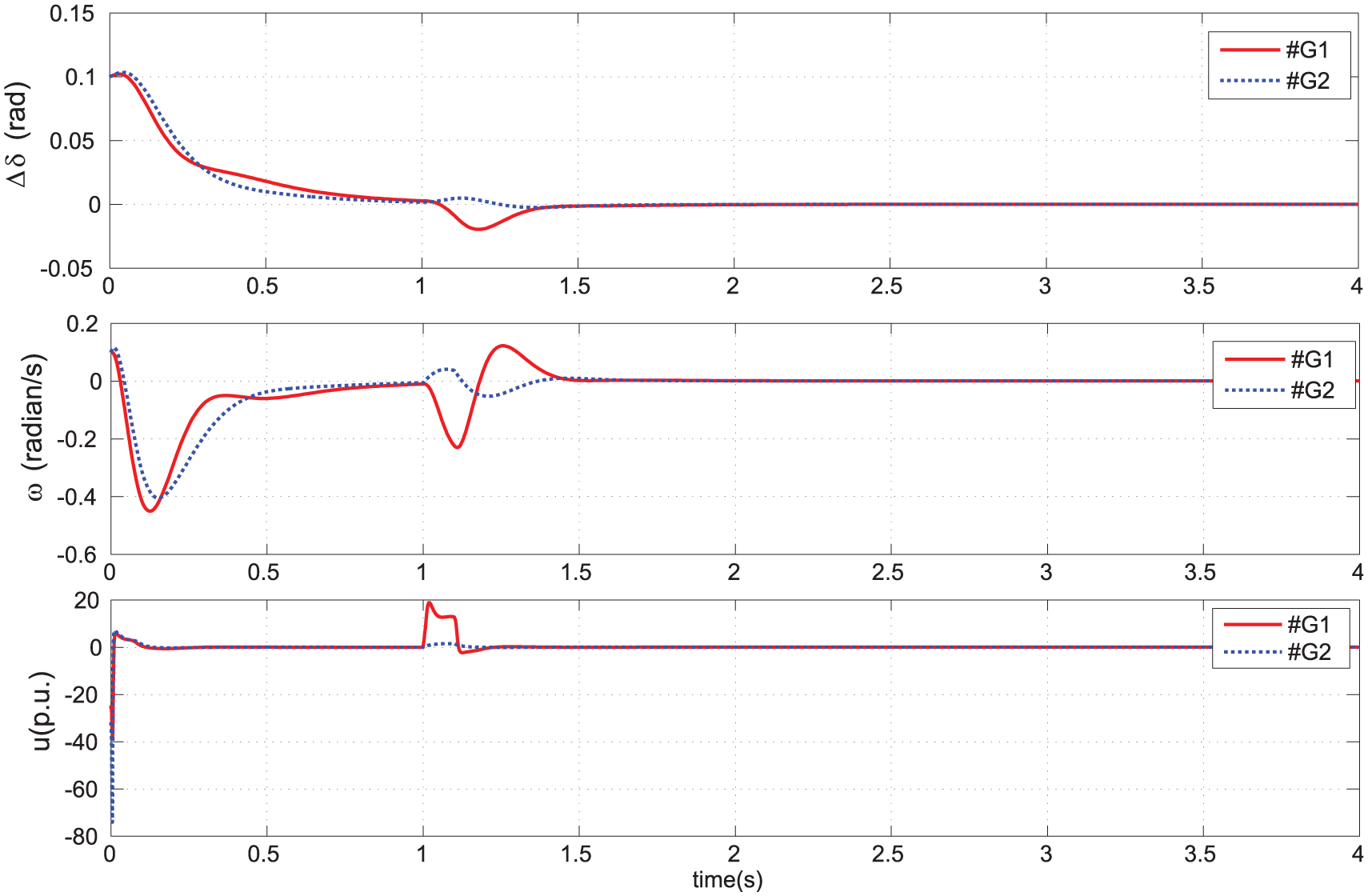
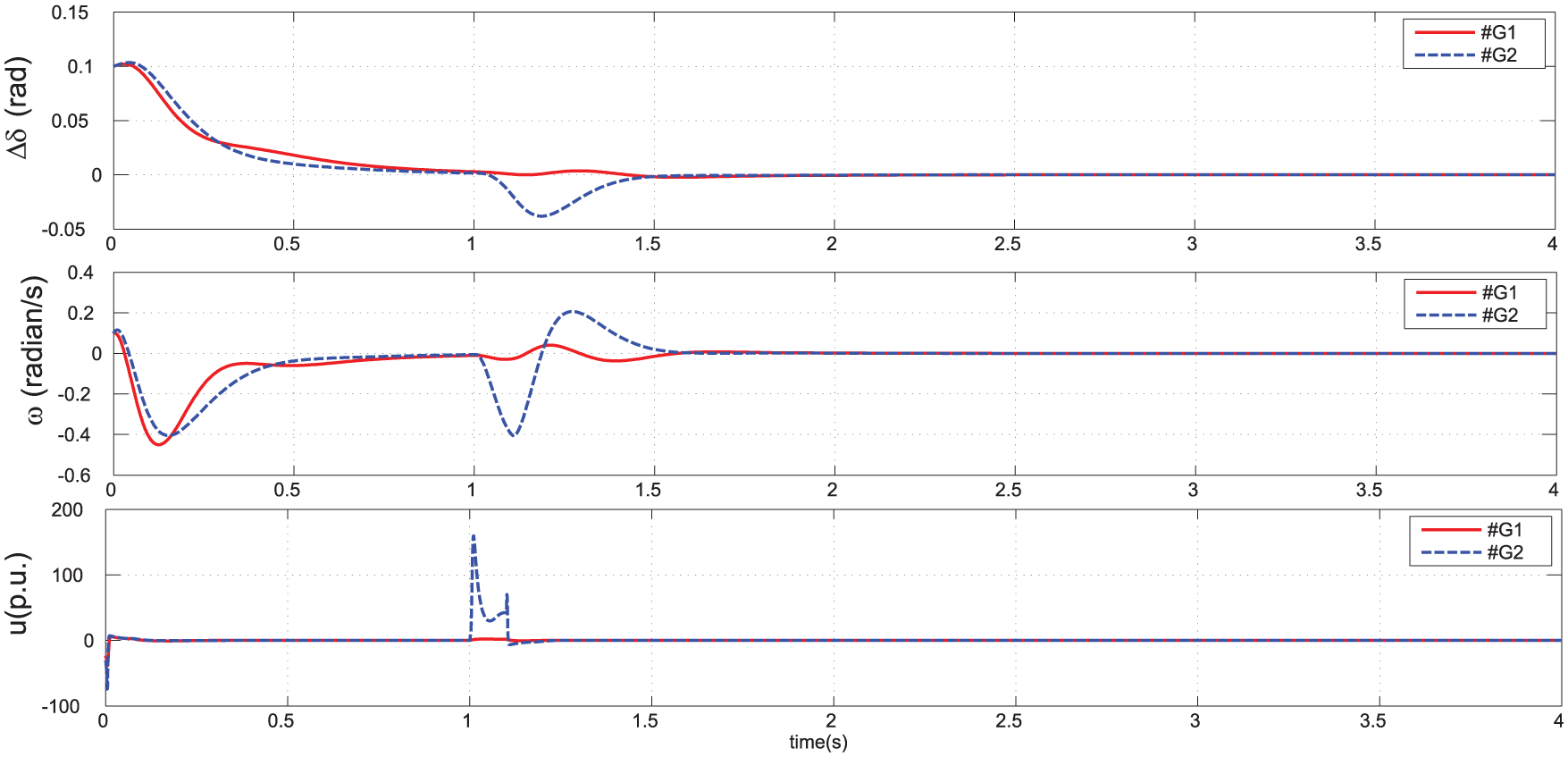
We consider a symmetrical three-phase short-circuit fault as in Wang et al. (1998) and Wang and Hill (2000), which is assumed to be on the transmission line between the first and the second machine at 1s and is cut off at 1.1s. The original system is restored after the fault clearance. Let
Case 1: The fault location is
Case 2: The fault location is
Case 3: The fault location is
Responses of excitation control: Case 1.
Responses of excitation control: Case 2.
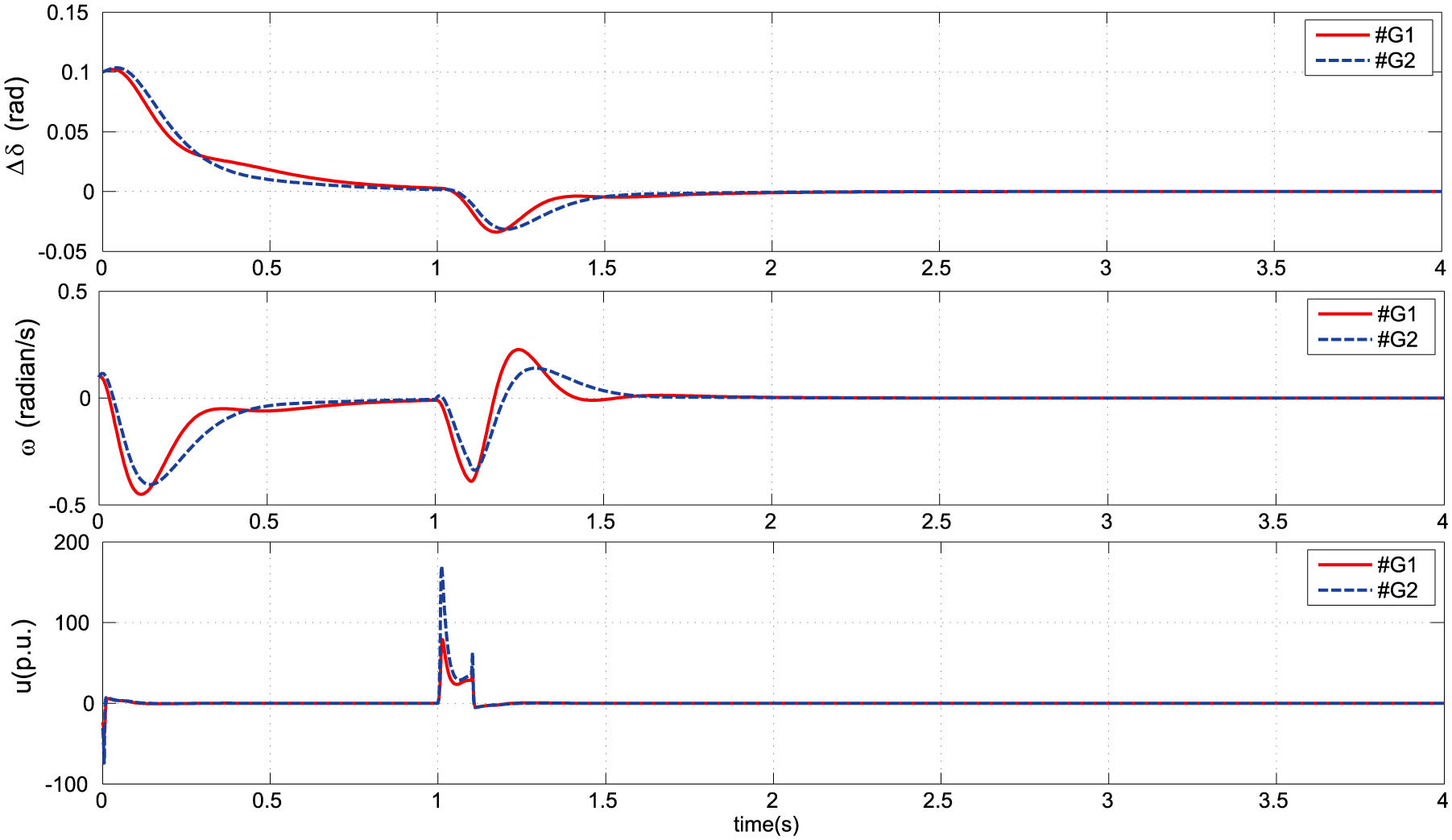
Responses of excitation control: Case 3.
From the simulation results shown in these figures, it can be seen that the robust decentralized control law is able to damp the oscillations of the state variables and to enhance transient stability of the multimachine power system despite the different cases of perturbations and fault locations. So the proposed nonlinear decentralized control ensures an effective stability for the global system.
Conclusions
In this paper, we have developed and validated a new decentralized control approach of uncertain polynomial interconnected systems. The studied systems are described by a polynomial model with odd Kronecker power of state vectors. The nonlinear decentralized control law, which was described by a polynomial form, was able to guarantee the asymptotic stability of the overall interconnected system when some sufficient conditions were verified. The numerical simulation results have confirmed the validity and the feasibility of the proposed approach that was able to damp the system oscillations, and to enhance the power system transient stability, despite the high nonlinear interconnection between generators, and the different perturbations that would occur on the system state variables.
Although the proposed control structure seems to be strongly nonlinear and complex, it succeeds to resolve the problem of robust decentralized control of nonlinear interconnected process. Due to the continuous huge progress of the computer technology, the proposed nonlinear control structure can be easily implemented on real processes such as electrical power systems.
Footnotes
Appendix A
We recall here the useful mathematical notations and properties used in this paper concerning the Kronecker tensor product.
Declaration of conflicting interests
The author(s) declared no potential conflicts of interest with respect to the research, authorship, and/or publication of this article.
Funding
The author(s) received no financial support for the research, authorship, and/or publication of this article.