







Abstract
Employees’ career trajectories in project-based organizations are closely associated with their project participation history. Yet, little is known about what features make a project stand out as a career booster for its participants and who obtains more career benefits than others from working on “hotshot” projects. In this study, we focus on a unique feature of projects—project status—and theorize about potential network-related sources from which it derives. Specifically, we develop arguments for how the pattern of a project’s social relations with other projects in the project network reflects the project’s status. Then, we deduce hypotheses regarding the impact of project status on employees’ career advancement and the moderating role of one’s hierarchical level in this relationship, drawing on the literature on status diffusion, endorsement, evaluative uncertainty, and attribution. Our empirical examinations entailed two studies. Study 1 provides evidence for the validity of using a network structural feature of a project to indicate its status using data from a high-tech company’s R&D projects. Study 2 tested our hypotheses by leveraging a sample of over 1,000 IT specialists in a multinational accounting firm tracked over five years. We found that employees assigned to higher-status projects received faster promotions. This career advantage was moderated by a person’s organizational hierarchical level in a complex way such that middle-level people obtained more rapid promotions when assigned to high-status projects than their bottom- or top-level counterparts.
Introduction
The past decades have witnessed organizations across different sectors increasingly adopting project-oriented approaches to organize their labor force and other resources for daily operation, task completion, and delivery of new products and services (Miterev, Mancini, & Turner, 2017). Employees in these project-based organizations are assigned to a sequence of different projects, and as a result, they accumulate divergent project experiences over time (Bredin & Söderlund, 2011). While one might surmise that the variation in people’s project participation would differentially impact career trajectories (Alkhudary & Gardiner, 2021; Palm & Lindahl, 2015), little has been done to investigate what features make a project stand out as a career booster. More importantly, the question of who benefits most from participating in a “hotshot” project to advance their career development remains insufficiently understood.
To address this question, we focus on a core concept—project status—and propose that project workers who get assignments to high-status projects obtain substantial career advantages. Specifically, we argue that the status of a project per se can be reflected by the pattern of its relations with other projects in the project network derived from the multi-membership project system. Our rationale for employing this relational view of status is inspired by Podolny’s (1993) original idea that an entity’s status is influenced by the status of the entities with whom the entity affiliates. Extending his contexts of social networks in product markets, we argue that a project’s status is enhanced if it shares employees with other higher-status projects, which themselves are highly connected in the project network.
We then draw on the status diffusion literature (Ertug & Castellucci, 2013; Graffin, Wade, Porac, & McNamee, 2008; Kilduff, Crossland, Tsai, & Bowers, 2016) and contend that project status will likely bestow commensurate status on its participants. Employees assigned to high-status projects will gain considerable privilege in the workplace: the evaluations of their underlying competence and potential will be enhanced, over and above their actual performance. This positive assessment bias, in turn, leads to advantages in career advancement.
Furthermore, we suggest that this status diffusion does not work similarly for everyone: some employees tend to benefit more from working on high-status projects than others. Drawing on the evaluative uncertainty (Podolny, 1993) and credit attribution (Kelley, 1973) literatures, we argue that employees’ organizational hierarchical level plays a vital role in determining the extent to which high-status assignments enhance one’s career development. Specifically, bottom-level employees tend to be constrained in their potential to benefit from high-status assignments due to a lack of acknowledgment of their contributions. In contrast, top-level employees enjoy limited advantages of high-status affiliations because their small population broadens evaluators’ access to their performance-related information. The easy access to direct competence indicators in the evaluation processes downplays the importance of project status as an indirect competence signal. Therefore, we propose that the benefits of participation in high-status projects are more substantial for middle-level than for low-level or high-level employees.
To empirically examine these ideas, we look into the career trajectories of 1,092 technical employees in one of the largest accounting multinationals in light of their participation in over 35,000 projects over five years. We leverage the firm’s longitudinal archival records of monthly observations of individual project assignments to construct the project networks and operationalize a project’s status as its eigenvector centrality in these project networks (Bonacich, 1972). We then investigate the relationship between the status of the technical employees’ assigned projects and their promotion speed, controlling individual-level status and competence. Next, we explore the potential moderating effect of one’s hierarchical level on this relationship.
Our study contributes significantly to the literature on career success by considering the status of projects employees work on. Traditionally, a project team is often viewed as a “social focus” (Feld, 1981), which provides opportunities for its members’ social capital development. We, instead, treat the project as a unique level of entity that can obtain a type of status per se, which, in turn, impacts how its members’ competence and potential are evaluated in the promotion decision-making processes. We demonstrate that project status boosts employees’ career advances beyond what can be explained by their individual status and competence and those of their social contacts cultivated during project participation (Brass, Galaskiewicz, Greve, & Tsai, 2004; Ng, Eby, Sorensen, & Feldman, 2005; Seibert, Kraimer, & Liden, 2001). More remarkably, we add to the boundary conditions of status’s competence signaling effect by incorporating the idea of credit attribution into evaluative uncertainty. The empirical evidence of the complicated, curvilinear relationship between employees’ hierarchical level and the positive effect of project status on promotion speed facilitates our understanding of the underlying mechanisms through which employees benefit from project participation.
Theoretical Background
What Is the Status of a Project, and Where Does It Come From?
Status, for individuals as well as teams and organizations, is broadly understood as a “socially constructed and accepted ordering or ranking of actors according to various ascribed and achieved criteria” (Weber, 1978: 306). High status confers respect, standing, and prestige, often accompanied by a range of reputational, financial, or evaluative advantages (Piazza & Castellucci, 2014). Various attributes and behaviors of an entity serve as informational cues about its competence and possession of valued resources, impacting status-organizing processes (Berger, Cohen, & Zelditch, 1972). Among these status characteristics, the pattern of an entity’s social relations with others stands out as a significant contributor to the stratification of the entity within the status structure (Podolny, 1993; Thye, 2000).
In his status-based model of market competition, Podolny (1993) noted that a producer’s status has a critical function in helping market participants discern the underlying quality of its products (p. 830). Such quality signaling effect of status is particularly pronounced when the uncertainty surrounding actual product quality is high, and the search costs of gathering complete information are substantial. Moreover, a producer’s ties to other producers, consumers, and third parties serve as a proxy for status because network ties act as conduits for the flow of tangible and intangible assets between connected entities. An actor connected to high-status network participants gains status not only by accessing these partners’ prestigious resources but also through endorsement, as status flows from high-status neighbors to the focal actor.
Extending these ideas to our contexts of projects within a project-based organization, we argue that a project’s status is coupled with the perceived quality of its outputs (i.e., service, products, etc.). Projects are temporary working units to which resources are assigned to do work to deliver beneficial change (Miterev et al., 2017). In project-based organizations, different projects vary widely in scale, duration, and specialty areas. Projects also undergo constant adjustments throughout their lifespans, including changes in team composition, resource allocation, practices, routines, strategies, and objectives. These continuous modifications are essential to meet evolving requirements, adapt to environmental uncertainties and complexities, and swiftly incorporate new knowledge and feedback (Wiewiora, Chang, & Smidt, 2020).
The variations within and between projects add to the elusiveness and ambiguity of direct quality indicators, thereby increasing the search costs for workers to investigate, compare, and evaluate different projects’ actual quality based on these indicators. The difficulty of obtaining direct quality information incentivizes workers to rely on other indirect yet easily accessible cues and signals to infer the potential quality of projects. Drawing on Podolny (1993), we focus on the status of a project as an indicator of its quality and link project status to the pattern of its relationships with other entities in the network. Specifically, we consider four types of ties that may influence workers’ perceptions of a project’s status: (1) the ties between the project and the entities that receive products or services from it, (2) the ties between the project and the actors who lead and manage it, (3) the ties between the project and the actors who work on it, and (4) the ties between the project and other projects with which it shares resources. Since the fourth type of tie is the central focus of this study, we will provide a brief overview of the first three types before delving deeper into the fourth.
It is well established that organizations have strong incentives to work with high-status service providers and terminate their contracts with business partners whose status is compromised (Acharya & Pollock, 2013; Jensen, 2006; Pollock, Chen, Jackson, & Hambrick, 2010; Pollock & Gulati, 2007). Such practices help organizations enhance their own status because audiences, such as consumers, shareholders, and investors, generally expect resources exchanged with high-status partners to be of high quality (Ertug & Castellucci, 2013). For example, Pollock and Gulati (2007), Pollock, Chen, Jackson, and Hambrick (2010) showed that firms gained status through endorsements from prominent venture capitalists, respected lead underwriters, and renowned analysts. Building on their findings, we expect projects serving higher-status clients to be conferred higher status because workers anticipate better resource allocation to prioritize prominent contractors or believe high-status clients demand higher standards, prompting delivery of superior outputs.
Beyond clients, a project’s status can also derive from its leaders and members. Due to their critical and visible roles in project management, leaders’ status naturally extends to the projects they lead. High-status leaders are believed to leverage their prestige to secure essential resources, such as financial support, advice, and advocacy, which are crucial for group success (Acharya & Pollock, 2013; Graffin et al., 2008; Pollock et al., 2010). For instance, Graffin et al. (2008) suggested that the status of star CEOs transferred to the entire top management teams they led, expanding the teams’ compensation pools. Similarly, the status of project members can also elevate their teams, as higher-status individuals are perceived to contribute higher-quality inputs. Ertug and Castellucci (2013) showed that NBA teams hiring more high-status players—such as MVP awardees or All-Star team members—generated greater revenues from ticket sales due to the visible endorsement effect of these star players.
So far, we have discussed how a project’s status originates from three types of actors: clients who designate the project, leaders who lead it, and members who work on it. Now, we turn to the fourth potential source of a project’s status—the pattern of its affiliations with other projects through shared members.
When a focal project aims to deliver a high-quality product, its leader and project assignment coordinators in the Human Resource Department are incentivized to draw people from other high-quality projects. This member-sharing strategy expands the focal project’s access to critical assets for successful implementation and goal accomplishment. Multi-membership employees serve as conduits, bringing valuable resources such as information, materials, and support from other projects. Additionally, they can share intangible assets, including best practices, lessons learned from failures, insights from trials and errors, and novel ideas and knowledge generated during brainstorming and experimentation. Specifically, individuals co-participating in multiple projects can actively search for needed resources from other high-quality projects and facilitate their transfer and adaptation to the focal project. They can help teammates accurately decode, interpret, and assimilate tacit knowledge. Additionally, they bring personal insights, perspectives, and reflections on how a high-quality project team operates, complementing the formal resource sharing between projects.
The quality advantages for the focal project are proportionate to (1) the number of its members co-participating in other high-quality projects and (2) the number of distinct high-quality projects it shares members with. For the former, a large overlap of employees with a high-quality project allows shared members to join forces to streamline processes, broaden channels, and reinforce resource-sharing norms. For the latter, sharing employees with various high-quality projects brings non-redundant information, diverse perspectives, and distinct knowledge, skills, and practices. The focal project, hereby, can obtain a rich pool of tangible and intangible assets, such as an interdisciplinary knowledge repository. Being a hub of resource flows also encourages the focal project to design efficient cross-domain coordination routines, develop cognitive flexibility, and increase openness to novel ideas and radical innovations. The theoretical claims above hinge on the assumption that organizations recognize and consider the benefits of resource exchange via shared members when assigning people to projects; we substantiate this premise with qualitative evidence based on interviews (see Supplement 1).
Taken together, the more a focal project shares employees with various other high-quality projects, the better its ability to meet quality standards for deliverables. Consequently, a project’s member-sharing relations with other projects are likely regarded as a signal of the underlying quality of its output. Workers are more likely to accord higher status to a project when they perceive its product quality to be high (Ertug & Castellucci, 2013).
Notably, we do not assume that workers must map out the projects’ member-sharing relations to evaluate their status. Instead, we argue that a project sharing many members with various well-connected projects (a so-called highly central project) tends to attract considerable attention. People often discuss projects at work, and those involved in multiple projects share their experiences of engaging in one project’s efforts to deliver quality output with colleagues on other projects. Given its potential to generate high-quality outputs, a highly central project will likely be widely discussed through word-of-mouth. Such word-of-mouth enhances the visibility and prominence of well-connected projects, spreading admiration even to distant projects. Thus, the more central a project is, the more visible and valuable it becomes in the workplace. A social consensus forms about a project’s status based on its member-sharing patterns with other projects. Higher status is ascribed to more central projects.
This structural feature, where high-status projects connect to other high-status projects, is captured by eigenvector centrality (Bonacich, 1972; Podolny, 1993). Eigenvector centrality has been widely used to measure social status in various contexts (Piazza & Castellucci, 2014). Actors connected to others who are themselves central are viewed positively and ascribed high status. In project-based organizations, the positional characteristics of high-status projects are well reflected by eigenvector centrality.
How Does the Status of One’s Assigned Projects Impact One’s Upward Mobility?
While the link between individual human capital and career outcomes is well established (Chattopadhyay & Choudhury, 2017; Ng et al., 2005), evidence also accumulates that the relative standing of social groups employees belong to can influence their workplace evaluations and, in turn, career outcomes (George, Dahlander, Graffin, & Sim, 2016; Piazza & Castellucci, 2014). Here, we focus on promotions as a particular dimension of career outcomes.
The “status diffusion” literature suggests that individuals on high-status teams are often accorded high status because they are believed to have access to valuable resources that help them develop competence and create value for their employer (Graffin et al., 2008; Kilduff et al., 2016). For example, Graffin et al. (2008) found that non-CEO members from higher-status top management teams are more likely to be promoted to CEO, either within their current company or another. Directors may view prior affiliations with high-status teams as signals of a candidate’s potential, believing that such experience helps cultivate desirable qualities like management style, personality, and charisma necessary for CEO roles. Similarly, workers with prior employment in high-status organizations tend to advance faster in their new workplace, particularly early in their careers, due to the perception that they were well-trained and built valuable connections at their prestigious former employers (Bidwell, Won, Barbulescu, & Mollick, 2015; Kilduff et al., 2016).
In our case, the social groups are the project teams to which employees are assigned. In a dynamic environment where people frequently change project memberships, colleagues and supervisors find it difficult to accurately evaluate a person’s contributions and performance. As a result, they turn to a more visible indicator—the status of the projects the person has worked on—to infer the person’s underlying competence and potential for successful performance after promotions. Such reliance on project status stems from the belief that high-status projects provide broader access to valuable resources and opportunities to acquire skills and knowledge beneficial for future performance. As such, the experience on high-status projects confers status on individuals. Regardless of their actual contribution, being part of a high-status project provides an endorsement. Just as a bench warmer on a championship team gets to wear a Super Bowl ring, individuals assigned to high-status projects are seen as having an enhanced capacity. We thus anticipate that experiences in high-status projects are viewed as a positive indication of potential, increasing one’s chance to receive speedy promotions.
Hypothesis 1: The average status of the projects that an employee has been assigned to will be positively associated with their subsequent promotion speed.
Who Benefits More From Being Assigned to High-Status Projects?
A fundamental factor that has been found to influence the extent to which observers rely on an entity’s status to imply its quality is the level of uncertainty they face in the evaluation process (Kilduff et al., 2016; Podolny, 1993). The signaling effect of status is more pronounced in high-uncertainty situations, where external parties often turn to socially agreed characteristics, such as the status of those affiliated with the entity, to gauge its quality (Piazza & Castellucci, 2014). In career research, evidence shows that candidates benefit more from ties to highly reputable and influential figures when uncertainty about other direct quality-related indicators is high (Burt, 1998; Kilduff et al., 2016). Thus, status serves as an informational cue to differentiate individuals’ underlying quality when other actual performance-related information is lacking.
For example, Kilduff et al. (2016) studied the careers of acolytes in the National Football League and found that working with high-status NFL leaders significantly boosted promotion prospects for those with less available information on their performance. In contrast, acolytes with more coworkers, longer tenure, and richer employment history benefited less from these ties because their expertise could be evaluated with greater certainty.
These findings can be adapted to our study, shedding light on how the career benefits of high-status assignments may vary across individuals. Specifically, uncertainty in evaluating an employee’s competence growth and post-promotion potential may arise from variations in their performance across projects, challenges in obtaining comprehensive performance data, and the employee’s efforts to shape their workplace image. We expect notably higher uncertainty for lower-level employees due to fewer available information sources, such as cumulative records and past observations, which evaluators rely on for accurate judgments. Conversely, the uncertainty in assessing higher-level employees’ quality is lower due to the greater availability of objective performance information. Therefore, evaluators are more likely to use the status of assigned projects to infer competence growth and post-promotion potential for lower-level employees than for higher-level employees.
However, we do not expect uncertainty to decrease linearly with employees’ hierarchical level. The attention paid to top-level actors versus the next level down differs considerably. The in-project activities and consequences of the highest-level actors, where attention is focused, are well known, while those of the next level receive substantially less attention. At the bottom levels, there is minimal attention paid, effort discerning, or concrete information on personal growth and competence building. Thus, the marginal differences in lower levels, in terms of the difficulty in obtaining direct indicators of expertise and potential, become less pronounced. We anticipate a non-linear, concave-down relationship between hierarchical level and evaluative uncertainty, as depicted by the solid curved line in Figure 1. Since status becomes a more important competence signal as uncertainty increases, this translates to a similar concave-down relationship between hierarchy and the impact of project status on promotion speed.
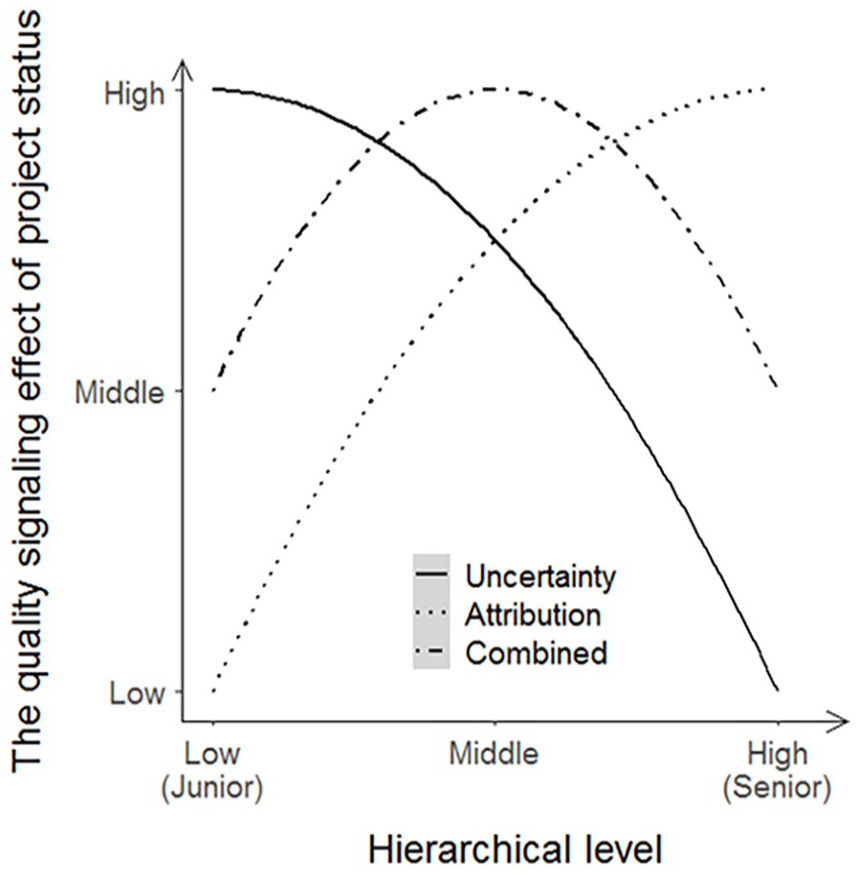
A Stylized Picture of the Moderation Effect
While the uncertainty argument indicates a negative moderating effect of hierarchical level on the relationship between project status and promotion speed, an attribution-theory argument provides an opposing view. A fundamental premise for the status attainment from high-status projects hinges on the belief that such assignments broaden access to valuable resources for personal growth and competence building. However, not everyone is seen as equally able to leverage these opportunities. Observers’ attributions of a focal person’s engagement in core tasks and contributions to deliverables vary based on situational and personal factors (Kelley, 1973).
Smirnova, Reitzig, and Sorenson (2022) showed that community members rarely accorded status to those at the bottom levels for performing expertise-required activities, such as answering or commenting on questions, due to low expectations of their competence and quality of actions. However, as individuals climbed the hierarchical ladder, their engagement in these activities garnered increasing positive attention and interpretation from the community. Elevated rankings signal human capital development, enhancing perceptions of their ability to contribute high-quality work. High-level actors, whose contributions are more easily recognized, earn higher status, exert more influence, and receive more valuable gifts than their low-level counterparts (Halevy, Chou, Cohen, & Livingston, 2012; Willer, 2009).
Similarly, we expect observers to credit higher-level members more for helping the project team accomplish its objectives. Higher-level employees are believed to have received better training and accumulated relevant experience, specialized knowledge, and coordination tactics, enabling them to reach higher hierarchical levels. They are also more influential in decision-making, including managing and allocating the project team’s tasks and resources. In contrast, lower-level members are seen as lacking the expertise and skills needed for core roles in collective activities. Thus, a high organizational level is viewed as a credential that grants access to valuable resources necessary for making crucial contributions and improving abilities to produce high-quality work outcomes. Consequently, the status rewards of being affiliated with a high-status project are more likely to be realized for higher-level members.
Another aspect of this attribution argument is the diminishing marginal benefit of being at the top of the organizational hierarchy. New people have a steep learning curve (Argote & Epple, 1990). Over time, the benefit of work experience to one’s knowledge base diminishes as familiarity with situations increases. Experienced employees often encounter familiar tasks, leading to smaller marginal expertise gains. For instance, the added benefit of being in a position for five versus six years is small compared to one versus two years. The hierarchical level serves as a proxy for such human capital accumulation. A proxy for this experience/knowledge is the hierarchical level in the organization. While higher-level members are accorded more status for their vital roles in collective tasks, the increase is less substantial higher up the hierarchy. Such a diminishing marginal attributional effect is depicted in Figure 1 by the concave down dotted line.
To sum up, an employee’s hierarchical level imposes two opposing forces on the relationship between project status and career success. Higher levels reduce evaluators’ reliance on project status due to decreased uncertainty, while increased attribution boosts their confidence in project status as a competence cue. With the level-uncertainty line showing an inverse positive-power shape and the level-attribution line an inverse negative-power shape, we expect an inverted U relationship between the hierarchical level and the benefits of high-status assignments on promotion speed. Thus, we hypothesize that the effect of project status on promotion speed will first increase and then decrease as the hierarchical level rises.
Hypothesis 2: The hierarchical level moderates the positive association between the average status of the projects that an employee has been assigned to and their subsequent promotion speed such that this positive relationship is stronger for employees who occupy middle levels in the organization than those who occupy higher or lower levels.
Study 1
Our theoretical arguments are built upon a central claim that a focal project’s member-sharing patterns with other projects reflect the status employees in organizations accord it. To examine this claim, we collected archival data from a project-based, high-tech R&D company in China, referred to as the company hereafter, between February 2022 and August 2023.
The company, with around 800 employees, organizes its workforce around intensive R&D projects. We obtained eighteen months of data on its large-scale projects. The company adjusts project member compositions monthly and assigns some employees to multiple projects to optimize resource allocation. We acquired the monthly records of people’s project assignments from February 2022 to August 2023. We also asked twenty-one top management team members to rate the status of all projects four times: in August 2022, December 2022, April 2023, and August 2023 (Number of projects = 36, 38, 38, and 44, respectively).
Project Network Construction
We summarized the data on employees working on projects as a time-varying two-mode project affiliation network (Breiger, 1974). We assumed a tie existed between an employee and a project in a given month if the employee worked a certain number of hours on that project. This approach identified 13,880 employee-project ties over eighteen months. We then projected these two-mode networks into weighted (one-mode) project-by-project networks using a six-month moving window: (1) Two projects were connected in a given month if at least one employee worked on both projects that month; (2) A tie between two projects lasted six months once established and dissolved afterward. The six-month window was chosen because individuals’ presence on a project tends to leave a short-term impression even after they leave (Maloney, Shah, Zellmer-Bruhn, & Jones, 2019). The weight of the link between two projects was defined by the number of hours contributed by employees who worked on both projects during any of the six months. This method yielded four project networks for August 2022, December 2022, April 2023, and August 2023.
Methodology and Results
Project Eigenvector Centrality
The primary independent variable of our interest, a project’s eigenvector centrality in the project network as a proxy of the project’s status, recursively defines a project’s status in terms of the status of the projects to which it is connected (Bonacich, 1972). Based on this measure, the centrality of a project is proportional to the sum of the centralities of the projects with which it shares joint members.
Let n denote the total number of projects and A the n × n adjacency matrix with its entries aij indicating the value of the link (i.e., common employee working hours) between projects i and j. Mathematically, the eigenvector centrality ei of a project i is given by the ith element of the eigenvector corresponding to the largest eigenvalue λ of adjacency matrix A, and is defined as

for i = 1, 2, . . ., n. In matrix notation, this set of equations can be written as Ae = λe, where e = (e1, . . ., en). We normalized the status scores e using the Euclidean norm, making them range between 0 and 1.
Project Status Ranking
Twenty-one members of the company’s top management team were asked to rank the status of all projects based on three dimensions: respect, esteem, and prestige (Hays & Bendersky, 2015). The projects were ranked from highest (= 36 for August 2022, 38 for December 2022 and April 2023, and 44 for August 2023) to lowest (= 1). We found high internal reliability across the three items (Cronbach’s alpha = 0.90) and high consensus among raters (ICC(2) = 0.98). Thus, we averaged all managers’ rankings for each project and treated this mean ranking as the project’s status.
Results
We computed the correlation between project eigenvector centrality and project status ranking, finding a correlation of 0.93 across four time points, as illustrated in Figure 2. Specifically, the correlations at each time point were 0.96, 0.94, 0.95, and 0.97. Additionally, we ran fixed models to predict project status ranking while accounting for other potential sources of both project status and eigenvector centrality, such as project size. Including these controls did not alter our main findings (see Supplement 2 for details). Overall, our results confirm that a project’s eigenvector centrality in the project network is a valid indicator of its status.
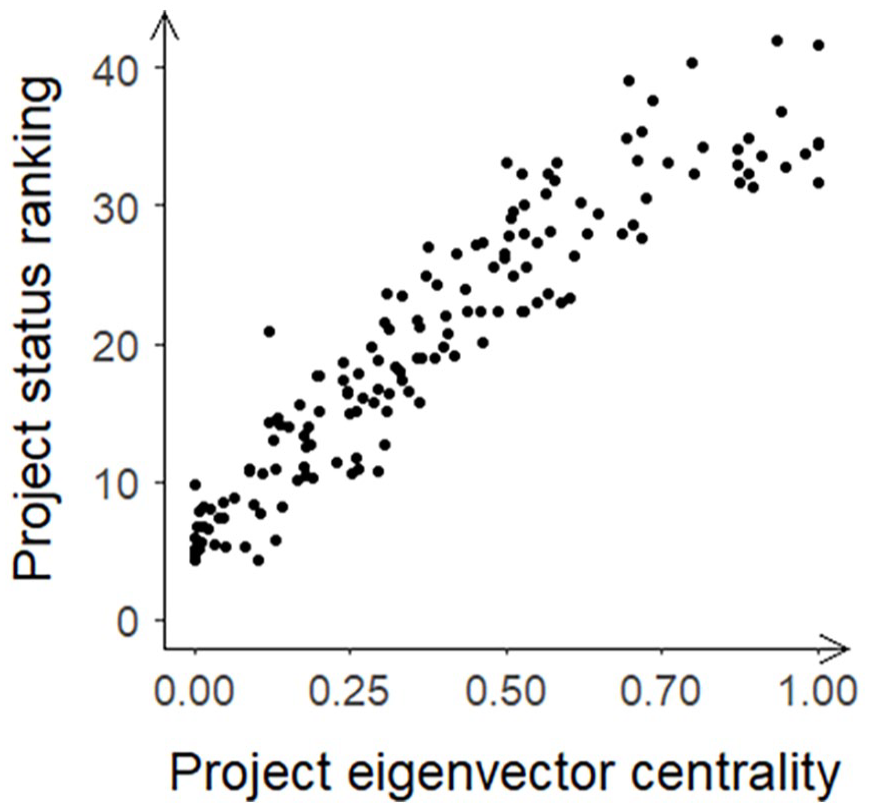
Study 1 Relationship Between Project Eigenvector Centrality and Project Status Ranking Over Four Time Points
Study 2
Study 2 aims to test our hypotheses regarding the relationship between project status and promotion speed and the moderating role of hierarchical level in this relationship. We used archival data from one of the largest accounting multinationals, referred to here as the firm, to maintain anonymity. The firm provides accounting, consulting, and other professional services to external clients, organizing its workforce and resources through a project-based system.
The archival data included a five-year monthly billing history, from July 2014 to May 2019, of projects involving technologists—employees with STEM/technical backgrounds. The dataset encompassed all submitted invoices for projects that had at least one technologist working on them at any point during the project’s life cycle. It contained 2,493,214 billing records from 75,475 employees assigned to 36,837 projects, representing one-third of the firm’s total billing records over the five years. Among these employees, 1,092 were technologists, accounting for about 2% of the total employees in the dataset.
Technologists represented an elite group within the firm. They were expected to contribute sophisticated knowledge, specialized expertise, honed skills, and well-trained tactics to their assigned projects, enhancing projects’ capacity to deliver high-quality services to clients. As higher-valued labor, technologists were offered more upward opportunities than regular employees. They were also more likely to be assigned to high-status projects serving prominent clients, as the firm aimed to demonstrate that solutions for these clients were based on solid data analyses and concrete technical considerations. These differences are evident in the comparison between the descriptive statistics of the technologist sample (Table 1) and the regular employee sample (see Table S12 of Supplement 13).
Study 2 Descriptive Statistics and Correlation Coefficients for Promotion Analysis
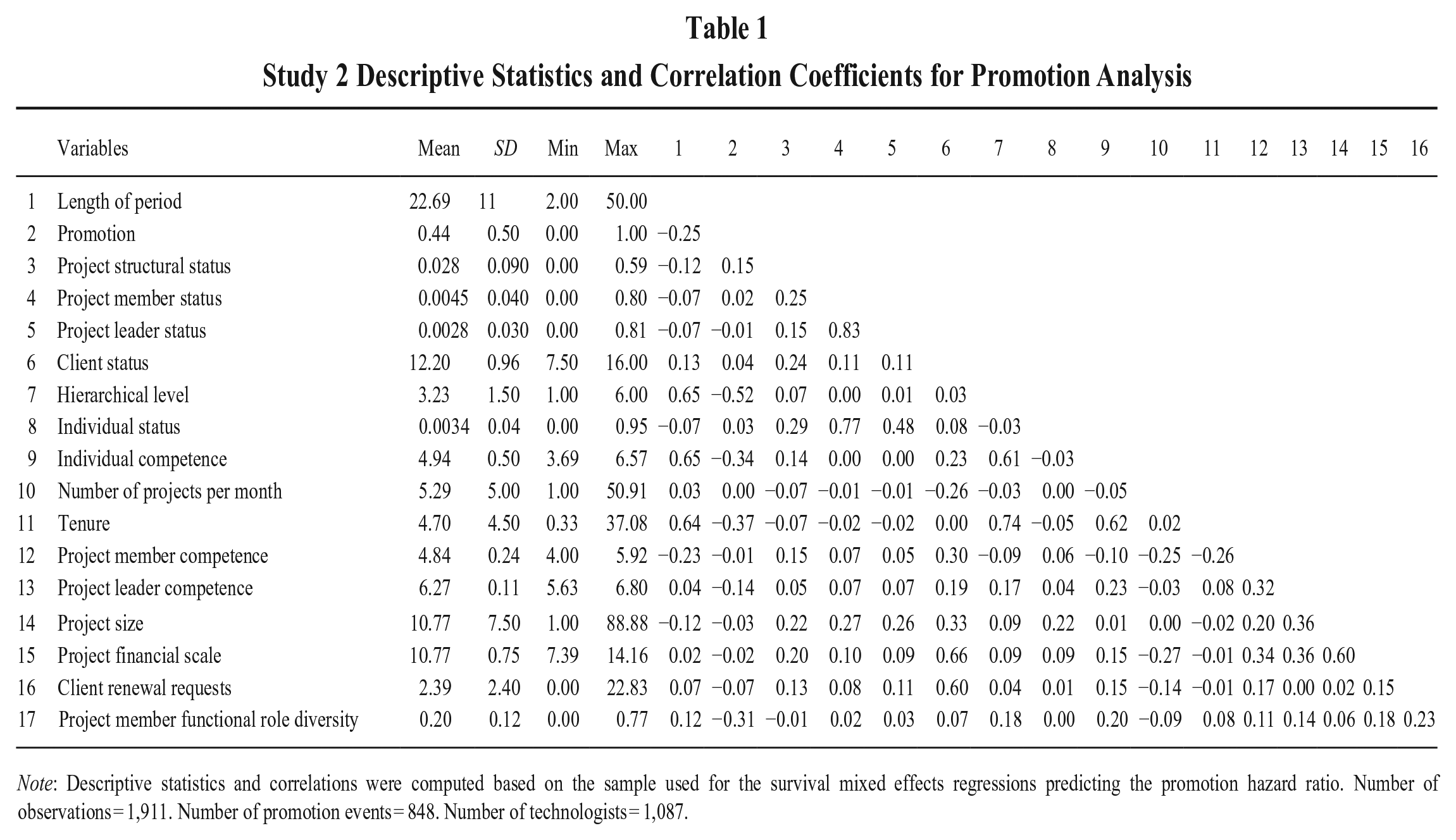
Note: Descriptive statistics and correlations were computed based on the sample used for the survival mixed effects regressions predicting the promotion hazard ratio. Number of observations = 1,911. Number of promotion events = 848. Number of technologists = 1,087.
Since we only had access to the complete billing records of technologists, we used this subsample for hypothesis testing in our main analyses. In the robustness check, we showed that the results were similar for regular employees (see Supplement 13). We leverage individual-, project-, and client-related information contained in the billing records.
Project Assignments, Evaluations, and Promotion Decision-Making
Before conducting statistical analyses, we consulted with three seasoned partners who had led numerous projects and had “sabbaticals” 1 in the HR division, where assignments, evaluations, and promotion decisions were made. They explained that employees’ project assignments were determined by a range of individual and situational factors, such as availability, technical expertise, and the preferences of project leaders. While these assignments were not random, they were often influenced by unexpected circumstances, events, and opportunities over time. Consequently, even those who did not excel in their performance or were not initially seen as a good fit might still be assigned to prestigious “hotshot” projects.
At the middle and end of each fiscal year, supervisors evaluated their subordinates and decided on promotions. The senior partners shared that, both intuitively and theoretically, promotion decisions were supposed to be based on employees’ average performance across projects they participated in during the prior half-year. However, in practice, supervisors often considered various indirect factors, such as project-related features, for two major reasons.
First, supervisors were not project leaders and did not directly observe employees’ performance on projects. A supervisor typically had many subordinates to assess, each of whom worked on multiple projects during a given period. Thus, obtaining direct performance-related information for each subordinate across all their projects was costly and administratively demanding. Instead, a supervisor could save considerable time and effort by identifying which projects their subordinates had participated in and using certain observable characteristics of these projects to estimate the subordinates’ competence growth and post-promotion potential.
Second, most projects were large-scale and lasted more than six months (mean = 11.0, SD = 6.8, min = 1, max = 59 months). It was hard for supervisors to accurately evaluate members’ performance and contributions until a project ended or at least produced some stage outcomes. Additionally, project team compositions changed frequently, and members varied in the length of stay on different projects (mean = 5.2, SD = 6.6, min = 1, max = 55 months). Short stays made performance evaluation challenging due to limited observations. Therefore, supervisors faced substantial challenges collecting and integrating subordinates’ performance data across different projects, especially for those with multiple, changing assignments. Consequently, they often relied on indirect competence signals, such as project status, to help make promotion decisions.
Network Construction
Similar to Study 1, we constructed monthly two-mode employee-project affiliation networks for the firm over fifty-nine months, from July 2014 to May 2019, resulting in 6,389,474 employee-project ties. We then projected these two-mode networks into one-mode individual and project networks using a six-month moving window, with tie weights defined by shared working hours. This approach yielded fifty-nine monthly project networks and individual networks, respectively. For the first five months, the networks were constructed using all employee-project assignment relations from the start to the given month, due to the lack of data for a complete six-month window.
Variables
Promotion
Promotion was indicated by an increase in a person’s organizational hierarchical level. In the original data, all employee positions were categorized into eight levels: Staff, Staff-experienced, Senior, Manager, Senior Manager, Director, Senior Managing Director, and Partner. We focused on periods before promotions for which we had complete observations. This led to the exclusion of five individuals (out of 1,092) who entered the firm before July 2014 and were never promoted during the archival period. Among the remaining sample (N = 1,087), we dropped records before the first observed promotion for those who joined the firm before July 2014 (N = 562) due to incomplete information. We retained all billing records for those who started at the firm after July 2014 (N = 530). It is worth noting that Partner was the highest level in the firm, and those who reached this level were unlikely to advance further. Thus, we excluded post-Partner periods for twenty-four employees who became Partners.
We then aggregated the monthly data for each period at the individual level, making it suitable for repeated-events Cox proportional hazard modeling. A period started in the first month an individual occupied a certain hierarchical level and ended either upon promotion to the next level or when the data was right-censored (i.e., in May 2019). For example, if an individual became a Senior in June 2015 and a Manager in June 2017, all monthly records during this period were aggregated into one observation. Among those who entered the firm during or after July 2014 (N = 1,087), 441 never got promoted, 459 got promoted once, 172 got promoted twice, and 15 got promoted three times. As such, we obtained 1,911 observations, 848 of which were promotions. The breakdown of promotions was as follows: 281 from Staff to Staff-experienced, 246 from Staff-experienced to Senior, 171 from Senior to Manager, 73 from Manager to Senior Manager, 53 from Senior Manager to Director, 2 from Director to Senior Managing Director, 21 from Director to Partner, and 1 from Senior Managing Director to Partner.
According to the firm’s HR division and seasoned partners, Senior Managing Director was a temporary transition position between Director and Partner, with most Directors being promoted directly to Partners. Therefore, we coded both Director to Senior Managing Director and Senior Managing Director to Partner as Director to Partner promotions.
Project Structural Status
We used the normalized eigenvector centrality (Bonacich, 1972) of a project as a proxy of its status, a measure validated in Study 1. To distinguish this specific project status indicator—derived from the structural feature of projects’ member-sharing relations with other projects in the project network—from other potential sources of project status, we referred to it as project structural status throughout Study 2.
Alternative Sources of Project Status
As discussed in the theory section, members, leaders, and clients are likely alternative sources of project status (Ertug & Castellucci, 2013; Graffin et al., 2008; Kilduff et al., 2016). We considered these three types of actors whose status might diffuse to a project they are affiliated with: (1) project members (referred to as project member status), (2) the project leader (referred to as project leader status), and (3) the client for whom the project was created (referred to as client status).
Specifically, project member status was measured by the average eigenvector centrality (in the individual network) of all workers on a project. Each project was led by an engagement partner responsible for overseeing the project, attending to the client, and coordinating with other project teams. Only those capable of handling client and inter-project relationships served as engagement partners. Given their elite status and high visibility, their status likely flowed to the projects they led and subsequently to the project members. We measured project leader status as the engagement partner’s eigenvector centrality (in the individual network). Each project was designed to address a specific client request, and client status was measured by the natural logarithm of the client’s total expenditure on all its projects with the firm. While we did not find evidence in Study 1 that project members’ average eigenvector centrality and project leaders’ eigenvector centrality significantly predicted project status ranking, we still accounted for these two potential sources of project status to align with prior studies.
Hierarchical Level
Similar to promotion events, we combined the Senior Managing Director and Director levels, treating both as the Director level. We excluded the highest level, Partner, due to the absence of further promotion possibilities. Our moderator, hierarchical level, was operationalized as an ordinal variable with six levels: Staff, Staff-experienced, Senior, Manager, Senior Manager, and Director. This variable indicated employees’ hierarchical level at the beginning of each period. We chose Staff as the reference level and created interaction terms between the other categories (as dummy variables) and project status in the moderation analysis. For clarity, we referred to these as levels 1 through 6 in the analytical strategy and results sections (e.g., Staff is level 1, and Director is level 6).
Individual Status
One issue to consider is that projects served as opportunities for creating social ties. As Feld (1981) noted, networks form through social foci, and the firm’s projects are precisely the foci likely to spawn collaborative ties. We assumed this to be the case, inferring the network structure among individuals based on their shared project experiences. The project and individual networks stemmed from the same affiliation network between individuals and projects. Due to this direct relationship, there might be a concern that project status merely provided high-status individuals with opportunities to congregate and form ties.
From this perspective, individual status and project status would be tautologically related, not separate measures or concepts. In our sample, the average status of projects an individual worked on, defined as the mean of these projects’ eigenvector scores in the project-by-project projection of the two-mode network, was correlated with the individual’s status, defined as their eigenvector score in the individual-by-individual projection of the two-mode network (r = 0.29). While this correlation was satisfactorily low, we still controlled for individual status in our models to address this potential issue.
Individual Competence
Intuitively, one would expect a person with higher competence to be assigned to higher-status projects and be promoted faster due to their ability to produce higher-quality output, helping the firm satisfy clients and generate more profits. Thus, we considered individual competence and operationalized it as the natural logarithm of one’s monthly billing rate. The monetary value associated with one’s labor input reflects the firm’s appreciation of the person’s technical expertise, serving as a good indicator of their competence.
Project Member Competence and Project Leader Competence
Another concern was that projects led by highly competent leaders or composed of highly competent members were more likely to produce high-quality outcomes and thus be regarded as high-status. To address this, we controlled for project member competence, proxied by the log of the average monthly billing rate of all workers on a project, and project leader competence, proxied by the log of the project’s engagement partner’s monthly billing rate.
Project Size and Project Financial Scale
A project with more labor and capital inputs was likely to be ascribed higher status, meanwhile garnered attention for those assigned to it, making these individuals more likely to stand out in the promotion process. We controlled a project’s size, indexed by the number of employees working on the project, and the financial scale, indexed by the project’s log total cost to the client.
Client Renewal Requests
Project success was a critical confounder as it could influence how a project was viewed in terms of status. Assessing project success was challenging due to noisy and multidimensional signals. For instance, the firm and clients might have different definitions of “success,” and solutions to client requests could take time, complicating short-term evaluations. We used client responses as a proxy for project success. If clients were satisfied, they were likely to solicit more business with the firm. Thus, we used the number of a client’s newly added projects (referred to as client renewal requests) as an indicator of project success, mapping this variable to all projects of that client. We recognized that variations in success levels could exist across multiple projects for the same client. A client might continue with the firm if a major project was successful, even if smaller ones were not. Conversely, a client might end contracts if key projects fail. While using client-level behaviors (adding new projects) to indicate project-level outcomes has potential inaccuracies, this measure still provides insights into clients’ overall satisfaction with their ongoing and past projects.
Project Member Functional Role Diversity
Another confounder of project structural status was the interpersonal functional role diversity of project members, referring to the distribution of project members’ functional roles across various categories. Higher diversity in members’ functional roles might enhance a project’s ability to develop non-routine, novel solutions, thereby generating positive publicity. We accounted for this possibility by including Blau’s (1977) index of members’ functional roles. Our dataset included 68 functional role categories, such as Administration and Secretarial Services, Cybersecurity and Privacy, and Corporate and Business Strategy. Each individual typically had one fixed functional role throughout their career, with rare exceptions occurring mainly at promotion.
Other Individual-Level Controls
We controlled for individuals’ tenure, measured by the number of years they had spent in the firm, and the number of projects an employee had been part of per month. As to categorical variables, we included the employees’ office locations (e.g., Greater Texas, New York Metro), business unit specialty (e.g., Energy, Health Services, Technology), and line of service (e.g., Assurance, Tax, and Advisory).
Analytical Strategy
We leveraged a repeated-events Cox proportional hazards model with robust individual-level standard errors to analyze technologists’ promotions during the five years (Box-Steffensmeier & Jones, 2004; Cox, 1972). The Cox proportional hazards model is one of the most widely used event-history techniques (Allison, 2014; Zhang, Reinikainen, Adeleke, Pieterse, & Groothuis-Oudshoorn, 2018). It accounts for longitudinal data, time-varying covariates, and right-censoring, and has the advantage of not restricting the shape of the baseline hazard (Cox, 1972). We used a conditional gap-time approach to account for the multiple promotions because, among the 646 employees who never got promoted, almost one-third were promoted more than once. Specifically, we stratified the data using the number of promotions by resetting the clock after each promotion. As such, each before-promotion period has its own baseline hazard rate of ending in a promotion, and an employee is not at risk for a later event (third promotion) before all earlier events (first and second promotion) have occurred (Box-Steffensmeier & Jones, 2004; Prentice, Williams, & Peterson, 1981). To correct for the individual-level dependence in promotion events, we included a random intercept for individuals and an individual random slope for our key independent variable of interest—project status. We also clustered the estimated standard errors by individuals.
Before conducting Cox regressions, we averaged all continuous variables for each observation over the period before exit (i.e., either promotion or right-censoring). The exception was individual tenure, for which we used the value from the last month. For instance, if a person remained at a certain level for 24 months, we calculated the average status of the projects they were involved in during that time as their project status.
We applied a stepwise procedure to build models. We first estimated a control-only Model 1, followed by including alternative sources of project status—project member status, project leader status, and client status—through Models 2 to 4, respectively. Next, we entered project structural status in Model 5 with all control variables and further accounted for alternative sources of project status in Model 6 to test Hypothesis 1. Then, we included the interaction term between project structural status and hierarchical level in Model 7 to test Hypothesis 2. Models 1 through 7 contained the random intercept for individuals. Model 8 replicated Model 7 with a random slope for project structural status. Model 9, not accounting for random effects, used a variance–covariance matrix adjustment to the maximum partial-likelihood estimate for robust estimates (Blossfeld & Rohwer, 1995; Lin & Wei, 1989).
For several reasons, we did not test our hypotheses regarding the three alternative sources of project status in our primary analyses. First, project member status and project leader status were not shown to be good indicators of managers’ evaluations of project status in Study 1. More importantly, the diffusion of status from members, leaders, and clients to individuals might occur directly through their interpersonal ties rather than indirectly through their connections to the same projects. For instance, promotion benefits from working with a high-status leader might be explained by the endorsement effect coming directly from working with the high-status leader, not from the project as an intermediate.
Due to data limitations, we could not tease out this alternative explanation. Thus, we focused on hypothesis testing regarding project structural status, hierarchical level, and promotion in our primary analyses, accounting for the main effects of project member status, project leader status, and client status. In the robustness check, we explored whether these effects varied as a function of hierarchical level (see Supplement 9). While the additional interactions showed interesting patterns, their inclusion did not change our main findings.
Results
Table 1 presents the means, standard deviations, and correlations for all continuous variables. Both project structural status and individual status exhibited considerable skewness, highlighting the disproportionate role of certain projects and individuals in the networks. Notably, individual status and project member status were correlated at 0.77, while project member status and project leader status were correlated at 0.83. These high correlations were expected, as individuals on the same projects often had similar network structures. High correlations were also observed between individuals’ tenure, hierarchical level, and competence (ranging from 0.61 to 0.74), which aligns with the intuition that longer tenure correlates with greater expertise and higher hourly rates. Given that these control variables showed low correlations with project structural status, the risk of multicollinearity is minimal. We also investigated if projects designed for various client requests differed in structural status and found no evidence (see Supplement 3).
Figure 3 displays a subnetwork from the October 2017 project network centering around a “seed project” with the highest eigenvector centrality (= 1). This subnetwork includes the seed project’s neighbors and their neighbors, featuring all existing ties among these nodes. In the subnetwork, projects with higher eigenvector centrality are represented by larger and darker nodes, indicating greater interconnectivity.
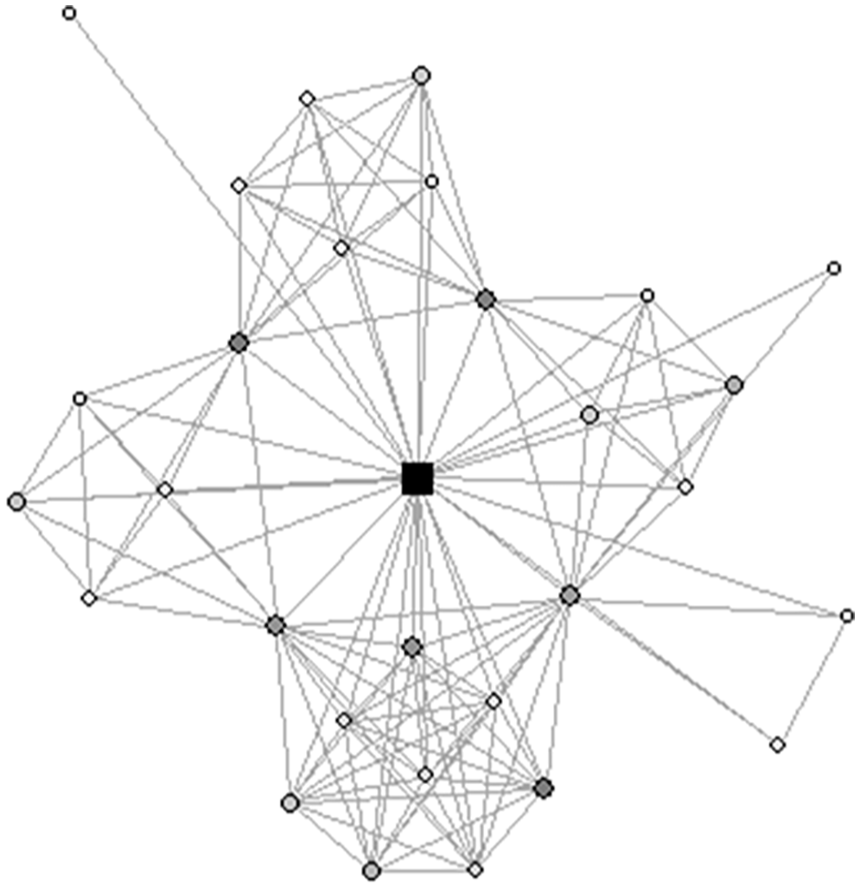
A Subnetwork of the Project Network in October 2017
Survival Analyses
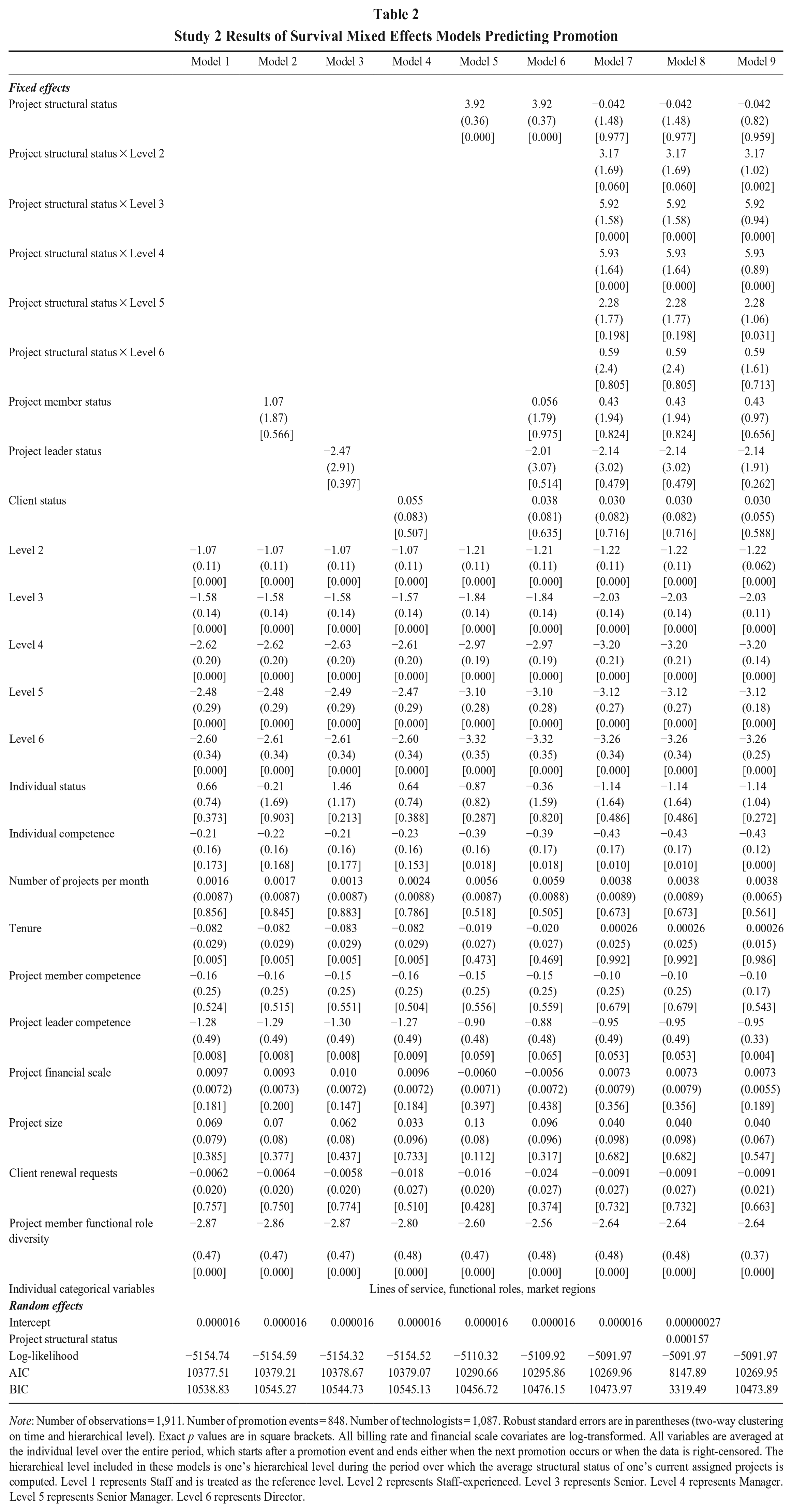
Table 2 summarizes the stepwise Cox regression results. Model 1 served as the baseline, including only control variables. Consistent with expectations, the difficulty of promotion increased up the hierarchical ladder, as evidenced by the negative coefficients for levels 2 through 6, with effect sizes escalating at higher levels.
Study 2 Results of Survival Mixed Effects Models Predicting Promotion
Note: Number of observations = 1,911. Number of promotion events = 848. Number of technologists = 1,087. Robust standard errors are in parentheses (two-way clustering on time and hierarchical level). Exact p values are in square brackets. All billing rate and financial scale covariates are log-transformed. All variables are averaged at the individual level over the entire period, which starts after a promotion event and ends either when the next promotion occurs or when the data is right-censored. The hierarchical level included in these models is one’s hierarchical level during the period over which the average structural status of one’s current assigned projects is computed. Level 1 represents Staff and is treated as the reference level. Level 2 represents Staff-experienced. Level 3 represents Senior. Level 4 represents Manager. Level 5 represents Senior Manager. Level 6 represents Director.
Models 2 through 4 entered the main effect of three alternative network-related sources of project status—project member status, project leader status, and client status respectively. Surprisingly, none of their coefficient estimates were significant (β = 1.07, p = 0.566 for project member status; β = −2.47, p = 0.397 for project leader status; β = 0.055, p = 0.507 for client status). Thus, no evidence supported that working on projects with averagely higher-status members, led by higher-status engagement partners, or dealing with requests from higher-status clients speeded up promotions. Additionally, including these variables only marginally increased the log-likelihood, suggesting that they merely explained the variance in promotions.
Model 5 included the main effect of project structural status without the three alternative network-related sources of project status. As expected, project structural status had a highly positive and significant coefficient estimate (β = 3.92, p < 0.001), indicating that being assigned to projects with high eigenvector centrality significantly accelerated advancement up the organizational hierarchy. This pattern persisted in Model 6 (β = 3.92, p < 0.001) after project member status, project leader status, and client status were controlled. Specifically, one standard deviation (i.e., 0.090) increase in project eigenvector centrality corresponded to a 42% increase in the expected hazard ratio for promotion, with covariates held at the mean or reference level. Thus, Hypothesis 1 was supported.
In Hypothesis 2, we posited that middle-level employees would gain the most from affiliations with high-status projects. To test it, we assessed the effect of project structural status on promotions across hierarchical levels in Model 7, using Staff (level 1) as the reference group and estimating interactions between project structural status and each subsequent level. As shown, the interactions for levels 3 and 4 showed positive and significant coefficients (β = 5.92, p < 0.001 for level 3; β = 5.93, p < 0.001, for level 4), suggesting that employees at these levels experienced more substantial benefits from high-status project assignments than those at level 1. These findings were consistent in Model 8, which included a random slope for project structural status, and in Model 9, which used an alternative correction for non-independent events.
To illustrate these marginal benefits, we computed the conditional effect of project structural status on promotions, along with 95% confidence intervals for each hierarchical level, displayed in Figure 4. For levels 2 through 6, these conditional effects were derived by adding the main effect of project structural status (i.e., −0.042) to its interaction effect with each respective level. For example, the conditional effect of project structural status on the promotion from level 3 to level 4 was 5.88 (= −0.042 + 5.92). The standard errors of these conditional effects were calculated based on the variance-covariance matrix of Model 7. The observed pattern aligns with our initial predictions illustrated by the dotted dash line in Figure 1, indicating that benefits of high-status project assignments increase from level 1, peak at levels 3 and 4, and then slightly decline at levels 5 and 6.
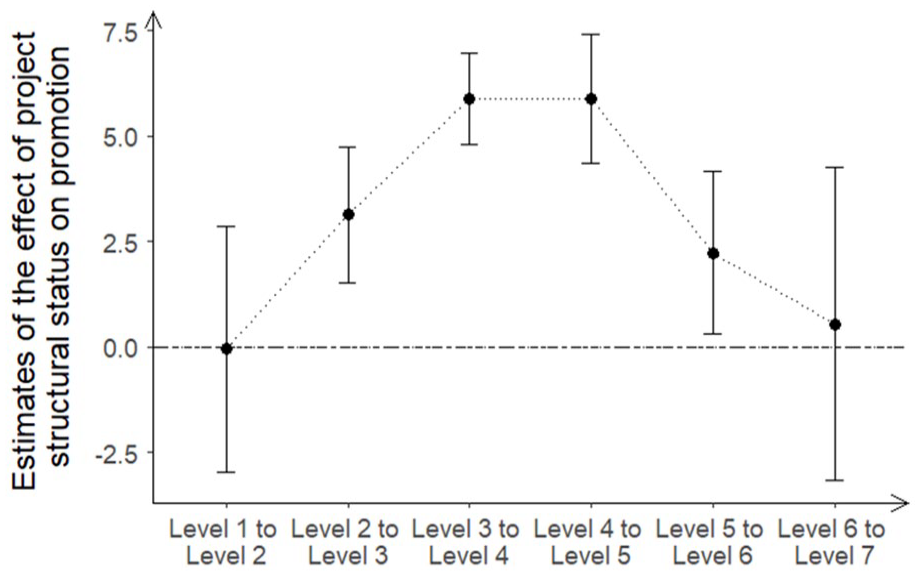
The Moderating Effect of Hierarchical Level on the Promotion Benefits of Being Assigned to Projects with High Structural Status
To statistically test Hypothesis 2, we calculated the differences between pairs of coefficient estimates of project structural status conditional on hierarchical levels, presented in Table 3. Congruent with our expectation, the promotion benefit of assignments to projects with high structural status was significantly stronger for the middle two levels than the lower and upper levels. The tests confirmed that the coefficients for levels 3 and 4 were significantly different from those of other levels, supporting the patterns predicted in Hypothesis 2.
Pairwise Differences in the Coefficient Estimate of Project Structural Status for Each Pair of Levels
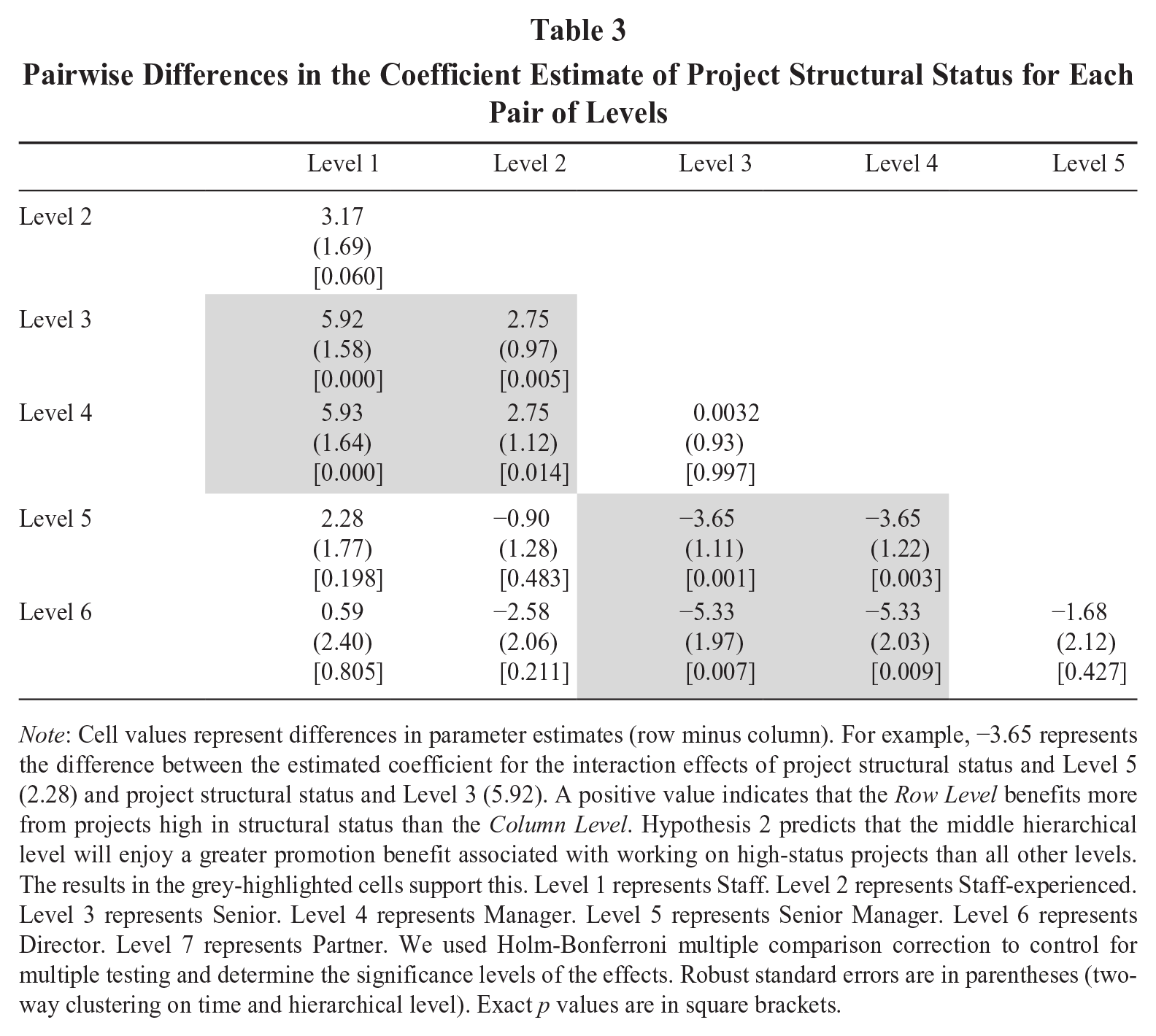
Note: Cell values represent differences in parameter estimates (row minus column). For example, −3.65 represents the difference between the estimated coefficient for the interaction effects of project structural status and Level 5 (2.28) and project structural status and Level 3 (5.92). A positive value indicates that the Row Level benefits more from projects high in structural status than the Column Level. Hypothesis 2 predicts that the middle hierarchical level will enjoy a greater promotion benefit associated with working on high-status projects than all other levels. The results in the grey-highlighted cells support this. Level 1 represents Staff. Level 2 represents Staff-experienced. Level 3 represents Senior. Level 4 represents Manager. Level 5 represents Senior Manager. Level 6 represents Director. Level 7 represents Partner. We used Holm-Bonferroni multiple comparison correction to control for multiple testing and determine the significance levels of the effects. Robust standard errors are in parentheses (two-way clustering on time and hierarchical level). Exact p values are in square brackets.
Robustness Checks
Enhancing Causality
A natural alternative explanation for our findings might be attributed to omitted variable biases. For instance, the indicator of individual competence (i.e., hourly charge rate) included in our models might not capture all aspects of one’s capabilities. It’s conceivable that employees demonstrating exceptional skills were assigned to high-status projects, positively evaluated, and promoted more quickly. The delay in career recognition markers created a temporal correlation like what we observed. Or, a self-reinforcing cycle could exist where a previous fast promotion signaled competence, leading to high-status assignments, which, in turn, facilitated further career advancement.
To explore these possibilities, we first ran linear fixed effect models with prior promotion speed (i.e., the negative of the number of months of the pre-promotion period) as the independent variable and project structural status of the post-promotion period as the dependent variable (see Supplement 4). Prior promotion speed served as an alternative proxy of competence, as a fast promotion in the past might suggest a person being highly valued by the firm. We did not find evidence that the main effect of the prior promotion speed and its interactions with the hierarchical level significantly impacted the post-promotion project structural status.
Second, we accounted for prior promotion speed and lag project structural status in predicting the current promotion (see Supplement 5). The findings mirrored our main analysis, where higher-status assignments predicted faster promotions, particularly for middle-level employees. Interestingly, prior promotion speed was positively correlated with faster current promotions, suggesting that some employees continued to receive rapid promotions.
Third, we investigated the first promotion of newcomers who entered the firm after July 2014 (see Supplement 6). This subsample mitigated concerns about non-random assignments, as the status of projects newcomers were assigned to was less likely influenced by their prior performance and contribution—due to insufficient work history—and more by situational factors and noises. The findings from this analysis aligned with our main results.
Fourth, we conducted a matched sample analysis using the nearest neighbor matching on the propensity score to create a balanced distribution between treated and control groups based on project structural status (see Supplement 7). The matched sample analysis confirmed the results from the full sample.
Fifth, to account for unobservable individual differences, we ran fixed-effect survival models for technologists with at least two observations (see Supplement 8). This strategy allowed us to make the within-individual comparison. The models revealed that the variance in the status of a person’s assigned projects significantly explained the variance in this person’s promotion speed over time, consistent with our main analysis.
Sensitivity to Model Specification
We performed several additional analyses to verify that our results were robust to different analytical approaches. First, we tried different month windows—assuming ties would last 1, 12, 24, 36 months or never decay—in constructing the networks (see Supplement 9). We found that our main findings held across all windows, though the significance of project structural status and its interactions with levels 3 and 4 decreased with longer tie durations.
Second, we quantified hierarchical levels continuously from 1 to 6 and analyzed the main and quadratic effects of this variable and its interaction with project structural status on promotion (see Supplement 10). The results were in line with our main analysis, showing a positive and significant interaction between project structural status and hierarchical level (β = 7.44, p < 0.001) and a negative and significant interaction between project structural status and the quadratic term (β = −1.10, p < 0.001). The conditional effect of project structural status was lowest at 3.38, close to levels 3 and 4.
Third, we dropped observations associated with Senior Managing Director and redid the analysis based on the remaining sample (see Supplement 11). The findings remained unchanged.
Fourth, we explored the interaction effects between the three alternative network-related sources of project status—project member status, project leader status, and client status—and the hierarchical level in predicting promotion (see Supplement 12). We noticed that (1) the promotion benefit of project member status was only realized for Staff level workers, and (2) the promotion benefit of client status was only realized for Senior level workers. Our main findings remained unchanged with the inclusion of these extra interaction terms.
Enhancing Generalizability
Though we lacked access to the complete billing records of regular employees (non-technologists), we investigated whether our findings could extend to them in our subsample. We replicated all analyses conducted on technologists with regular employees (see Supplement 13). The results revealed similar patterns, suggesting that our findings might be generalizable across different employee groups.
General Discussion
Our study began with two related questions: What specific features of a project make it stand out as a promotion booster for employees assigned to it, and who obtains more promotion benefits from being assigned to “promotion-boosting” projects? We addressed these questions by stratifying projects into the status structure through a network perspective and leveraging status diffusion, status endorsement, evaluative uncertainty, and credit attribution arguments to explain the promotion benefits of assignments to high-status projects and individual differences in the potential to capitalize on these promotion benefits. Study 1 provides preliminary evidence for the validity of project eigenvector centrality as a status indicator. Study 2 demonstrates that the status of one’s assigned projects plays a prominent role in determining promotion.
Theoretical Implications
Our study enriches the status literature by viewing projects as distinct entities capable of developing their own status. Traditionally, projects are equated with teams whose status is seen as deriving from star members, leaders, or exchange partners (Ertug & Castellucci, 2013; Graffin et al., 2008; Pollock et al., 2010). To the best of our knowledge, our study is the first systematic effort to theorize project status. Leveraging a network lens (Podolny, 1993; Thye, 2000), we differentiate different network-related sources of project status. We further propose a novel theoretical framework to explain how a project’s network connections, in our context, member-sharing relations, contribute to the status ascribed to it. This conceptualization of project status resonates with Podolny’s (1993) relational perspective of status, yet it introduces new arguments for how well-connected projects are bestowed with high status.
Unlike individuals who can actively form and dissolve network ties, projects—as designed task operation units—lack such agency. Their connections are primarily shaped by the firm’s project personnel assignment system. Consequently, we cannot directly apply the same principles that explain how a firm’s status is associated with its market exchange patterns (Podolny, 1993) to project status. Projects play a more passive role, suggesting that status is conferred more subtly and indirectly. We propose a novel theory that explains how a project’s member-sharing relationships with other projects affect its access to valuable resources and its potential to deliver quality products. This member-sharing also impacts the project’s visibility in the workplace, whereby well-connected projects attract positive attention and thus are ascribed high status in the organization. Our theory advances the understanding of how social relationships serve as status signals for non-agentic entities in complex organizational settings.
Our paper also extends research on career advancement in project-based organizations. Typically, projects are viewed as social foci where employees enhance human capital through learning by doing tasks and build social capital through networking with project mates (Alkhudary & Gardiner, 2021; Palm & Lindahl, 2015; Wiewiora et al., 2020). These views predominantly link career benefits to increased human and social capital, often overlooking how the status of assigned projects may serve as an endorsement of an individual’s competence and potential value. We add to the career literature by theorizing about how the status of employees’ assigned projects shapes their promotion prospects. Our findings reveal that project status is a crucial factor in understanding how employees in project-based organizations gain career advantages from their assignments.
Moreover, our study adds to the boundary conditions for status’s quality-signaling effect (Podolny, 1993) by incorporating the attribution perspective (Kelley, 1973). Previous studies have shown that the benefits of connections with high-status sponsors or groups are amplified when evaluative uncertainty about a candidate is high (Burt, 1998; Kilduff et al., 2016). Our analysis partially supports this idea, revealing that the marginal benefit of working on high-status projects diminishes at higher hierarchical levels. This reduction is likely due to increased access to information about a high-level employee’s competence, which reduces evaluative uncertainty and, consequently, the signaling effect of high-status affiliations.
However, focusing solely on evaluative uncertainty may not fully explain individual differences in benefiting from high-status assignments. We introduce the concept of attribution to explain why the positive impact of project status may be less pronounced for employees at lower hierarchical levels. Unlike high-level members, who are often seen as key contributors to problem-solving, lower-level members receive less recognition for their contributions to high-status projects. Thus, when observers attribute the status of a project to its participants, they tend to give less credit to those at lower levels than those at higher levels.
The attribution judgments are based on salient individual characteristics in the workplace, particularly when direct information about teamwork contributions is not readily available to external evaluators (Halevy et al., 2012; Willer, 2009). By incorporating this attribution perspective, we theorize how biased attributions affect the validation of individual-project ties by observers, influencing the extent to which project status is transferred to affiliated individuals and impacts their career progression. Our findings underscore the need to consider both attribution processes and evaluative uncertainty to fully understand how project status influences career advancement across individuals.
Lastly, our paper highlights broader implications for how social status is perceived and functions as an endorsement of employees’ competence in the workplace. While prior research links individual status with competence (Bunderson, 2003; Piazza & Castellucci, 2014), our study shows that this status-competence alignment also extends to the status of affiliated projects. However, this finding should be interpreted with caution. Individual status is a more direct and unambiguous indicator of competence than project status. The ambiguity with the latter arises because different evaluators may access varying information about a person’s project assignments and have attribution bias when using these affiliations as competence signals.
Organizational Implications
Our findings have practical implications for employees and managers. We recommend that employees appreciate not only the tangible resources—such as skills, knowledge, and social connections—gained from their assigned projects but also the endorsements these projects provide. Employees can learn to strategically leverage their project participation records. For example, they can actively seek involvement in and highlight their contributions to high-status projects while minimizing participation in lower-status ones. However, this “borrowing status” strategy must be applied carefully, considering the moderating effect of the hierarchical level. Lower-level employees, who often have limited control over project assignments, should focus on making any high-status assignments more visible to evaluators, although their efforts may be overlooked due to their low standings in the organization. Luckily, previous research shows that group members can enhance credit received for their inputs into group tasks by shaping observers’ attentional processes (Berger et al., 1972; Hays & Bendersky, 2015; Smirnova et al., 2022). Thus, low-level employees should adopt strategies to ensure that their contributions are recognized, thereby maximizing the endorsement effect of project status on promotions.
Moreover, our results underscore the challenge for the HR division in creating a fair and effective project assignment system. While aiming to provide equitable access to high-status projects, addressing the attribution biases that prevent lower-level employees from fully benefiting from high-status assignments is crucial. One solution is education—encouraging low-level employees to actively demonstrate their contributions when assigned to high-status projects. Conversely, high-level employees should hone their skills and expertise, as evaluators tend to focus on these tangible competence signals when assessing promotability.
Limitations and Future Research
While Study 1 offers initial evidence that a project’s eigenvector centrality in the network reflects its status as evaluated by organizational members, further research is necessary to fully elucidate this connection. We suggest that the pattern of member-sharing among projects likely reflects efforts by managers and coordinators to enhance communication, coordination, and resource sharing. This claim is supported by preliminary qualitative evidence but has not yet been subjected to rigorous quantitative analysis. We also acknowledge the existence of many other potential mechanisms. For instance, a project designed to address complex issues may draw many people from other projects to facilitate better inter-project collaboration, thereby becoming well-known for its ability to tackle these challenges. Additionally, we propose that shared members might act as channels for spreading information, enhancing the visibility and workplace attention given to a central project. This claim remains untested due to our limited data. These critical underlying mechanisms required further empirical validation.
It is also worth noting that shared members may vary in effectiveness as resource exchange intermediaries. For instance, people at high hierarchical levels or with seniority often possess the legitimacy and ability to locate, mobilize, and transfer resources. In contrast, those in low hierarchical positions or junior roles may lack the eligibility and capability to effectively facilitate resource exchanges between projects. Hence, the potential for well-connected projects to produce high-quality output may heavily depend on the personal attributes of the members they share with other well-connected projects. In addition, we only surveyed managers from the top management team regarding their assessments of project status. Future research can investigate whether non-managerial workers share the same views in such evaluations.
Moreover, inter-project connections can be multifaceted, extending beyond shared personnel to include various direct interpersonal relationships, such as communication, collaboration, advice, and friendships. Employees from different projects often discuss work-related matters, provide or solicit advice, and exchange experiences and insights. Such interpersonal interactions may be more critical than shared personnel in facilitating resource flow between projects and influencing workplace attention distribution, ultimately affecting the perceived quality and status of projects. Future research should examine whether the patterns of cross-project interpersonal ties better reflect the relation-based project status.
One key limitation in Study 2 is that the billing records provided were only for projects staffed with at least one technologist throughout their lifecycle, representing about one-third of all firm records. Thus, the project network constructed based on the data was incomplete and did not reflect the overall project affiliation patterns. The project status indicator—eigenvector centrality—might not fully capture projects’ positions in the complete project network. However, the partial missingness of networks did not delegitimize our findings for two reasons.
First, within our dataset, the connections between projects staffed by technologists were complete. The unknown part was the linkage of these projects to others without technologists, which may differ significantly in work nature and operational procedures—often being less innovative or lucrative. Therefore, the connections between the former and the latter might convey less valuable information. Second, technologists, who constitute only 2% of the workforce but are considered key talent, play a pivotal role in projects. The network ties represented by technologists, rather than regular employees, are likely more crucial for facilitating resource exchanges that boost project quality and output. Hence, despite the absence of some data from regular employees, our analysis of how project status affects promotions within the technologist subgroup remains valid and informative.
Our study’s focus on technologists may limit its generalizability. Although analyses replicated with regular employees showed similar patterns, the promotion benefits from high-status projects were less pronounced for regular employees than for technologists. This discrepancy likely stems from the unique characteristics of technologists, who are vital in knowledge provision, financial value creation, and production of quality deliverables. Their contributions to high-status projects are more visible and valued due to the evaluators’ confidence in their abilities. In contrast, regular employees often perform more routine tasks and thus gain less recognition from high-status assignments. While the patterns we identified were consistent across populations, further research is necessary to explore the nuanced differences.
Another important direction for future exploration involves delving into how employees assigned to high-status projects gain career benefits and how the hierarchical level moderates this relationship. In our theoretical development, we attribute the career benefits of high-status project assignments to the positive endorsement effect. We suggest that the curvilinear moderating effect of the hierarchical level is due to the competing forces of evaluative uncertainty and attribution. Unfortunately, we were unable to empirically validate these proposed rationales due to data constraints. Other mechanisms might also explain our findings. For example, assignments to high-status projects can facilitate individual learning because these projects are often designed to resolve complex issues for clients and pool rich resources, making them ideal platforms for employees to acquire new tactics and effective practices. Handling complex requests may also require intensive teamwork, which can enhance interpersonal knowledge exchange and help employees refine their coordination skills. These learning experiences are essential for building human capital, which, in turn, facilitates promotion. Future research should aim to unravel the micro-foundations underlying our findings.
Last but not least, our data violated one of our models’ assumptions due to the non-independence of observations. Individuals were connected through co-assignments to projects, creating a network based on shared personnel and inherent interdependencies. This endogeneity issue, common in organizational network research, likely influenced our standard error estimates and constrained our capacity to establish causality. Despite these limitations, the consistency of our findings across various robustness checks lends strong support to our hypotheses.
Conclusion
Following Coleman’s (1994) admonition that good social science bridges different levels of analysis, we introduce a multi-level theory that highlights how project status enhances employee promotions. We recognize that the endorsement effect of project status varies across individuals, with middle-level employees gaining more from high-status projects than those at higher or lower levels. Projects are not merely aggregations of individuals but are organizational social units with their own reputations, identities, and statuses derived from complex networks of relationships with other projects. This status influences the career trajectories of its members, aligning with Durkheim’s (1982) notion of “social facts” in organizations. Studying these social structures provides crucial insights into organizational dynamics.
Supplemental Material
sj-docx-1-jom-10.1177_01492063241282649 – Supplemental material for The Importance of Project Status for Career Success: A Network Perspective
Supplemental material, sj-docx-1-jom-10.1177_01492063241282649 for The Importance of Project Status for Career Success: A Network Perspective by Shihan Li, David Krackhardt and Nynke M. D. Niezink in Journal of Management
Footnotes

References
Supplementary Material
Please find the following supplemental material available below.
For Open Access articles published under a Creative Commons License, all supplemental material carries the same license as the article it is associated with.
For non-Open Access articles published, all supplemental material carries a non-exclusive license, and permission requests for re-use of supplemental material or any part of supplemental material shall be sent directly to the copyright owner as specified in the copyright notice associated with the article.
