







Abstract
The impact of corruption charges on the electoral performance of parties is conditioned by specific institutional factors. This article shows the extent to which the effects of political corruption depend on the control that party leaders exercise over the ballot. It is argued that voters might abstain or support other lists if they cannot select individual candidates to revitalize the reputation of the political party. Employing data on judicial investigations in Italy from 1983 to 2013, we provide evidence of the role of electoral rules and intra-party xcandidate selection in shaping the relationship between corruption and voters’ behaviour. Parties implicated in corruption or related crimes experience a loss of votes when they compete under a closed list formula or when the candidate selection process is strongly centralized.
Introduction
Political accountability is one of the pillars of democratic systems. Competitive elections, in fact, give voters the opportunity to hold ruling parties accountable (Fiorina, 1981; Lewis-Beck and Stegmaier, 2000) and sanction their bad behaviour, such as their involvement in corrupt practices. Because corruption is a prominent valence issue, parties whose representatives are charged with bribery or related crimes are expected to lose considerable electoral support. Indeed, the anticipation is that corruption would damage the reputations of the parties involved and consequently lead to lost votes in the next election.
However, as detailed in the next section, empirical studies offer very different findings. Some of them show that parties and candidates lose support because of their involvement in scandals, while others suggest that corruption does not seem to reduce their chances of being re-elected. The present analysis attempts to shed light on this puzzle by taking into account the moderating effects of electoral institutions (Eggers, 2014; Rudolph and Däubler, 2016) and intra-party rules.
In this regard, our study illustrates the extent to which the control that party leaders exercise over the ballot affects the impact of corruption charges on the party’s share of the votes. We argue that support for corrupt parties depends on the opportunity that voters have to choose individual candidates within a party. If voters can select candidates, they may consider supporting those politicians who are able to revitalize the party label. As a result, the charges are expected to cause little or no damage to the party’s share of the votes. Conversely, when the selection process relies only on party leaders, the voters are unlikely to support the party. Although few rotten apples are involved in corrupt practices, voters are inclined not to trust the choices of leaders and, as a consequence, are prone either to abstain or to vote for other parties.
Voters can choose candidates according to the characteristics of electoral rules and the intra-party process of candidate selection. They take part in candidate selection under two sets of circumstances: in those countries that employ open list proportional systems; and when the internal process of candidate selection is decentralized. As did Rudolph and Däubler (2016), we investigated the role of electoral rules. In addition, we extended the existing literature by taking into account intra-party rules. In particular, we focused on the centralization of the candidate selection mechanism within parties.
We tested the effect of corruption and related crimes on Italian political parties between 1983 and 2013. Although Italy is not the only democracy affected by political corruption, in light of relevant institutional reforms involving the electoral system and intra-party rules, it is a particularly appropriate case for analysing the conditional effects of corruption charges. As such, the Italian case provides us with the means to test hypotheses by comparing very different institutional contexts.
The involvement of parties in corruption was estimated using information on judicial proceedings against Members of the Parliament with regard to public administration crimes. In line with to our expectations, these results provided evidence of the influence of electoral systems and intra-party rules. Parties lose support under closed-list rules; in contrast, they do not suffer significant losses under an open list proportional system. Moreover, the parties’ share of the votes declines when the candidate selection process presents the highest levels of centralization. These results also hold after controlling for confounding factors, such as the incumbent parties at both national and local levels, party positions along the left–right spectrum, the occurrence of party fissions, and the salience of corruption in parliamentary debates.
The next section examines the relationship between accountability and political corruption. We then focus on the effects of electoral institutions and develop two hypotheses. After describing the features of the Italian case and the operationalization of variables, we present our findings and concluding remarks.
Electoral accountability and political corruption
Competitive elections constitute the most powerful means of sanctioning the political élite. Elections give voters the chance to hold politicians accountable for policies, and vote them out of office if dissatisfied with the politicians’ behaviour. The idea of voting as a mechanism for imposing sanctions has traditionally been investigated with respect to the economic performance of ruling parties. If voters are not happy with economic outcomes, they are expected in the next elections to replace the incumbents with other parties (e.g., Fiorina, 1981; Lewis-Beck and Stegmaier, 2000).
This argument can be applied to other valence issues, such as corruption. Most voters are expected to dislike the waste of public resources, the absence of transparency, and betrayal of public trust. It follows that they would want to remove those representatives involved in corrupt networks and vote for people who appear more promising. Accordingly, they should beware of those parties whose representatives have been prosecuted for corruption. In this regard, democratic elections represent the opportunity to ‘throw the rascals out’ (Przeworski et al., 1999) and appoint politicians with better reputations (see Ferejohn, 1986; Crisp et al., 2014).
Many studies have tested the effects of political corruption on the electoral performance of incumbents. Several works perform cross-national comparisons based on macro-level data (Choi and Woo, 2010; Clark, 2009; Ecker et al., 2016; Zechmeister and Zizumbo-Colunga, 2013), whereas many others investigate a single country (Anderson and Ishii, 1997; Anduiza et al., 2013; Asquer, 2015; Chang et al., 2010; Nannicini et al., 2013; Peters and Welch, 1980; Reed, 1996; Welch and Hibbing, 1997; Winters and Weitz-Shapiro, 2013), or a single corruption scandal (Eggers, 2014; Fernández-Vázquez et al., 2016; Jacobson and Dimock, 1994; Rudolph and Däubler, 2016).
These contributions provide conflicting findings about the impact of corruption on electoral outcomes. A few analyses emphasize how scandals damage parties’ vote shares and candidates’ probabilities of being re-elected (e.g., Clark, 2009; Eggers and Fisher, 2011; Jacobson and Dimock, 1994; Peters and Welch, 1980; Welch and Hibbing, 1997). However, other studies report results that are quite different in magnitude. For instance, in the United States electoral support for Congressmen charged with corruption falls by 5 to 10 percentage points (Peters and Welch, 1980; Jacobson and Dimock, 1994; Welch and Hibbing, 1997), while in the United Kingdom representatives involved in scandals suffer a vote loss of 1.5 points (Eggers and Fisher, 2011). Furthermore, Anderson and Ishii (1997) showed a negative association between political corruption and the vote share of Japanese parties, and Clark (2009) found that in nine Western European countries parties suffered a loss of votes because of scandals (in addition to the influences of internal disunity and incompetence).
Nevertheless, several studies do not confirm the negative consequences of corruption charges on re-election. For instance, until the early 1990s, approximately 60% of Japanese legislators charged with corruption were re-elected and some of them even enjoyed increased support (Reed, 1996). Moreover, during the so-called First Republic (1948–1993) in Italy, the re-election rate of MPs investigated by the judiciary was not significantly different from that of any other representative (Chang et al., 2010). Even studies based on experimental designs provide different results regarding the effects of political corruption. Winters and Weitz-Shapiro (2013) showed that voters are willing to punish corrupt politicians, with the partial exception of high-income voters, who are more concerned with competence than integrity. In contrast, Franchino and Zucchini (2015) illustrated that voters can support a candidate involved in corrupt activities if they identify very closely with the candidate’s platform or obtain benefits from corruption.
Because of the linkage between corruption and clientelism, this mixed evidence is only partially surprising (Della Porta, 1992; Kitschelt and Wilkinson, 2007; Manzetti and Wilson, 2007). On the one hand, corruption may have serious repercussions for electoral support. In particular, it can alienate the voters who pay the public costs of illegal practices, especially middle-class or skilled voters (Weitz-Shapiro, 2012). On the other hand, corruption allows politicians to transfer resources to specific constituencies. In other words, the recourse to corruption may represent a strategy to mobilize certain groups.
In light of these opposing consequences, scholars have examined the conditional effects of corruption on voting. The capacity of illegal activities to influence electoral behaviour can be moderated by multiple elements. Voters are less likely to sanction representatives when corruption provides side benefits (Fernández-Vázquez et al., 2016) and the level of social capital is lower (Nannicini et al., 2013). The economic context is also important: the electorate is more prone to vote politicians out of office when overall economic conditions have worsened (Zechmeister and Zizumbo-Colunga, 2013). In addition, support for corrupt parties is affected by individual ideology and the features of party systems (Charron and Bågenholm, 2016).
Furthermore, several works argue that voters’ propensity to punish politicians depends on the strength of the information available about scandals (Asquer, 2015; Chang et al., 2010). Similarly, Ecker et al. (2016) showed that corruption damages parties and candidates only when the media give wide coverage of the scandals, or when corruption is a salient issue in the electoral arena. Finally, the politicization of the debate on corruption may discredit judicial activity, thus biasing the perceptions of partisan voters and reducing the effects of scandals on electoral choices (Anduiza et al., 2013; Eggers, 2014; Sberna and Vannucci, 2013).
The effects of electoral institutions on the relationship between corruption and voting
To date the literature has devoted little attention to the electoral context. Scholars have mainly examined the electoral incentives for corruption (e.g., Chang and Golden, 2006; Kunicovà and Rose-Ackerman, 2005; Tavits, 2007). However, few studies investigate to what extent electoral institutions condition the relationship between scandals involving the political élite and the behaviour of voters. Eggers (2014) found that party competition in a district influences the propensity to sanction MPs: in the United Kingdom, after the 2009 scandals on parliamentary expenses, candidates were punished when the electoral cost of sanctioning was lower – for example, when the Labour and Conservative parties (the two main rival parties at national level) were not the two main competitors in the district. Rudolph and Däubler (2016) focused on electoral systems. They showed that in Bavaria the 2013 nepotism scandal produced vote losses in single member districts, even though parties’ lists did not include the politicians charged with nepotism. 1 Despite their involvement in the scandal, some politicians decided to run for re-election on open-list ballots, but, because partisan voters opted for other candidates, they failed to secure sufficient support.
Following Rudolph and Däubler (2016), we pay attention to electoral institutions. We extend previous studies by scrutinizing in greater depth the role of the intra-party mechanism of candidate selection. The present analysis takes into account the control party leaders have over access to the party labels. We argue that control over the ballot influences the impact of corruption on the electoral outcome of parties.
Let us consider a case of corruption that concerns some representatives belonging to the same party. Involvement in corrupt activities spoils the reputation of politicians even when they are only charged with alleged crimes. In addition, the judicial investigations damage the image of the party, which is indicted by public opinion as having enlisted candidates involved in illegal networks. Although party leaders distance themselves from corrupt practices and claim that the politicians charged are only a few ‘rotten apples’, those citizens who traditionally vote for the party might seriously consider withdrawing their support. In short, despite the leaders’ efforts to restore the valence endowment, the party is likely to experience a loss of votes.
We expect that, in spite of corruption charges, voters support the party provided that they have the opportunity to select candidates. If the selection of candidates only depends on party leaders, voters may opt for other labels. Because of the involvement of some representatives in corrupt activities and the resulting investigations, voters are unlikely to continue trusting party leaders’ choices. As a consequence, they can decide to abstain or vote for another party. In contrast, if voters can choose the candidates, they can support new figures within the party: they throw the rascals out and vote for those politicians who are more appropriate for revitalizing the party label.
In other words, according to the traditional exit-voice-loyalty framework, where voters take part in the selection of candidates, they are more likely to stay loyal to a party label, because they can voice their disapproval of the involvement of certain representatives in corrupt activities. This voice option can prevent voters from opting for an exit strategy, or rather, withdrawing their support from the label: they stop supporting some representatives, but still vote for the party. However, in cases where voters have no voice option – for example when the selection of candidates only concerns party leaders – they consider voting for other labels or abstain rather than continuing to support the party.
Voters play an active role in selecting candidates in two instances: when the electoral rules give them the opportunity to choose one candidate over the others listed on the ballot or, alternatively, when the candidate selection process is decentralized. Let us focus first on the features of the electoral system. Carey and Shugart (1995: 424–425) rank electoral rules from ‘most party-centred’ to ‘most candidate-centred’. Party leaders retain the highest degree of control over access to the ballot in proportional systems with a closed list formula (CLPR): they present fixed ballots and, as a result, voters can only choose among parties. Single member-districts (SMD) without primaries display similar features. In contrast, voters express their preferences for certain politicians in open list systems, where parties compose the list, but voters determine which candidates are appointed. The open list proportional system (OLPR) adopted in Italy during the First Republic (1948–1993) is a case in point. 2
Under OLPR, voters who harbour some reservations about supporting parties whose representatives are charged with corruption can select those candidates who are more credible in terms of integrity (for a similar argument applied to the German case, see Rudolph and Däubler 2016). Conversely, under a CLPR system, those voters who are not convinced about the reputation of the candidates may opt out. Based on this argument, the parties involved in corruption are more likely to experience vote losses in a closed list system rather than under other electoral rules. Hence, our first hypothesis states that:
Hypothesis 1 (H1): a party whose representatives are charged with corruption is more likely to lose support if the electoral system does not allow voters to select individual candidates.
The selection of MPs is affected not only by the electoral system, but is also determined by intra-party candidate selection mechanisms. If intra-party selection is decentralized, local party members can participate in party meetings to establish the party list and nominate party candidates at the district level. In contrast, when the selection process is centralized, party leaders at the national level are the only ones responsible for the party list: they decide which politicians to include and in which order. Voters and local activists cannot express their preferences or amend the choices of party leaders. If representatives are charged with corruption, voters may be disappointed with the choices made by the party elite. And since they do not trust party leaders any more, one would expect them to withdraw their support.
A strong centralization of candidate selection and a closed list system produce similar effects on voting, but the former varies across parties rather than countries. It follows that, all electoral formulas being equal, corruption charges are expected particularly to damage those parties characterized by centralized procedures. Accordingly, our second hypothesis is:
Hypothesis 2 (H2): a party whose representatives are charged with corruption is more likely to lose support if the intra-party candidate selection process is centralized.
In light of our expectations, charges of corruption should produce a significant decrease in votes when countries adopt a closed list system or when intra-party mechanisms are centralized. Electoral support should not decrease when parties compete under an open list formula or use a decentralized process of candidate selection.
Corruption charges in Italy: data and variables
We tested our hypotheses in the Italian case by studying judicial investigations between 1983 and 2013. Due to the frequent charges against politicians, scholars have deemed the Italian case suitable for studying political corruption (e.g., Asquer, 2015; Chang et al., 2010; Della Porta, 1992; Golden and Chang, 2001). Furthermore, given the institutional reforms implemented since 1993, Italy serves as a political laboratory and represents a quasi-experimental context that allows us to compare alternative institutional settings (Curini and Pinto 2016), such as electoral systems and intra-party rules (while keeping all the country-level features constant). First, in 1993 the electoral system changed from an OLPR to a mixed system, in which 75% of deputies were appointed by SMD and 25% of seats were assigned to party lists through CLPR. Then, in 2005, a new reform stipulated that deputies were to be elected by CLPR. Second, the various parties that usually contest general elections – even after the restructuring of the party system in 1993 – have essential differences in their candidate selection rules. These rules sometimes vary over the years, even within the same party.
We tested the effects of corruption charges on the vote share of parliamentary parties in seven general elections. The unit of analysis was the electoral district: we contrasted the performance of a party (based on the party list ballot paper) in an electoral district in which it was affected by a judicial corruption investigation and in electoral districts in which the party was not charged with corruption. The dependent variable, Vote Shift, records the difference between the gain/loss of votes in one electoral district compared to the average gain/loss of votes at the national level or, rather, in all the other districts. This operationalization aims at controlling for all the idiosyncratic party features that explain variation in vote shares at the national level but do not vary across districts.
More precisely, for each district i we measured the difference between the share of votes won by party j in the current election (t) compared to the votes won in the previous one (t-1). This value represents the gain or loss of the proportion of votes in each district. From this number, we subtracted the average gain or loss that the party had experienced in all other districts (which is almost identical to the average change in vote share at the national level). Accordingly, positive values of Vote Shift indicated that the performance of party j in district i was better than average (higher gain or lower loss in the party votes share); conversely, negative values suggested that the electoral outcome of the party in that district was worse (higher loss or lower gain than the average).
To measure the charges of corruption, we collected the judicial requests sent to the Chamber of Deputies. In Italy, public prosecutors in trial courts cannot proceed against a MP unless they have the authorization of the Parliament. Hence, prosecutors send a formal request (RAP – Richiesta di Autorizzazione a Procedere) to the Chamber of Deputies to lift the immunity of deputies who are suspected of involvement in corrupt activities. The Parliament then either approves or rejects the request on the basis of a simple majority vote (for details see Ceron and Mainenti, 2015). Our main independent variable is RAP: it accounts for the number of requests to lift parliamentary immunity sent to a party’s MPs by judicial courts located in each electoral district during the last legislative term. We focused on a very homogeneous set of charges concerning public administration crimes, such as corruption, abuse of power and misappropriation of public resources.
We argue that the impact of RAP is conditional on the features of electoral rules and the intra-party process of candidate selection. The variable Open List takes the value 1 when parties compete under OLPR and the value 0 (zero) under a CLPR or SMD. The nature of intra-party mechanisms is tested through Centralization. This variable is built by standardizing the existing data on candidate selection within Italian parties and has been updated following Ceron (2014); it ranges between 0 (zero) and 10, with 0 indicating that the selection process is decentralized, and the value of 10 indicating that parties adopt centralized methods. The variable Centralization varies both across parties and within the same party over time. It reaches its highest values in the Second Republic, when the electoral system is mixed or CLPR. For this reason, we tested the interactions of judicial investigations (RAP) with Open List and Centralization in two separate models.
The analysis also takes into account several confounding factors. Because the literature emphasizes the importance of incumbency effects, the dummy variables Incumbent and Local incumbent check whether the party was in office at the national or local level, respectively. In addition, we control for party splits and alignment. Party Fission is a dummy variable that takes the value 1 if the party suffered a split before the election (Ceron, 2015). Party Position records the position of the party along the left–right spectrum; it has been measured according to the Italian Legislative Speeches Dataset (ILSD), which is built through hand-coding analysis of the investiture debates of Italian governments (Curini, 2011). The ILSD follows a coding scheme comparable to that of the Comparative Manifesto Project (CMP), and its estimates are strongly correlated both with CMP data and with expert surveys (see Curini, 2011).
Finally, we paid attention to the politicization of the debate on corruption. It is arguable that politicians might question the impartiality of the judiciary. Italian party leaders have often defended their politicians involved in scandals, underlining the political bias of judicial activity (Ceron and Mainenti, 2015). Indeed, they have not kept anti-corruption inquiries out of the debate, but they have strategically questioned their impartiality, reducing the overall risk of electoral sanctioning (Sberna and Vannucci, 2013: 590). For instance, Silvio Berlusconi, leader of the main centre-right party, has repeatedly argued that left-wing judges ‘carried out political activity in the form of investigations, trials, sentences’ (Edwards, 2005: 27) and used ‘judicial mechanisms to eliminate their political opponents, treading on the law, judicial procedure and reality with false inquiries, inventing witnesses, contradictory accusations, show-trials and hideous sentences’ (Sberna and Vannucci, 2013: 588).
Whenever political actors question the impartiality of a prosecution, other parties react to defend the independence of the judiciary. Such debate increases the salience of corruption on the political agenda and can influence the trust that citizens place in the judicial system. We controlled, therefore, whether the debate within the Parliament affects the choices of voters: the variable Corruption Salience is based on ILSD and records the relevance of corruption in parliamentary debates, measuring how often parties refer to the need to fight corruption. The Corruption Salience value corresponds to the average percentage of quasi-sentences provided by parliamentary parties to emphasize the need to eliminate corruption in political life. This variable varies across Legislatures, although its average values during the First and the Second Republic are similar. Table 1 reports the sources of data and summarizes the descriptive statistics of the variables included in the analysis. 3
Descriptive statistics.
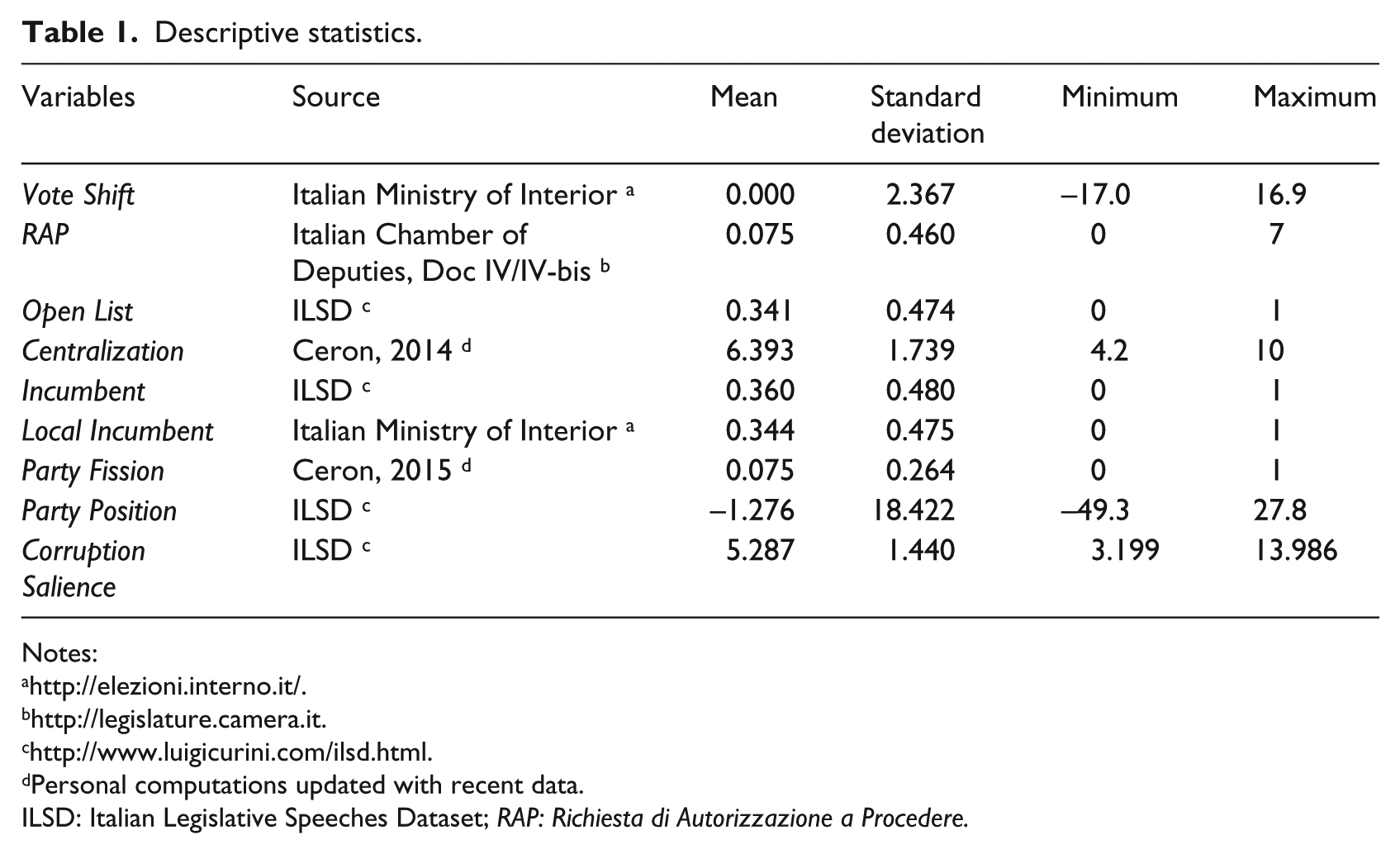
Notes:
Personal computations updated with recent data.
ILSD: Italian Legislative Speeches Dataset; RAP: Richiesta di Autorizzazione a Procedere.
Findings
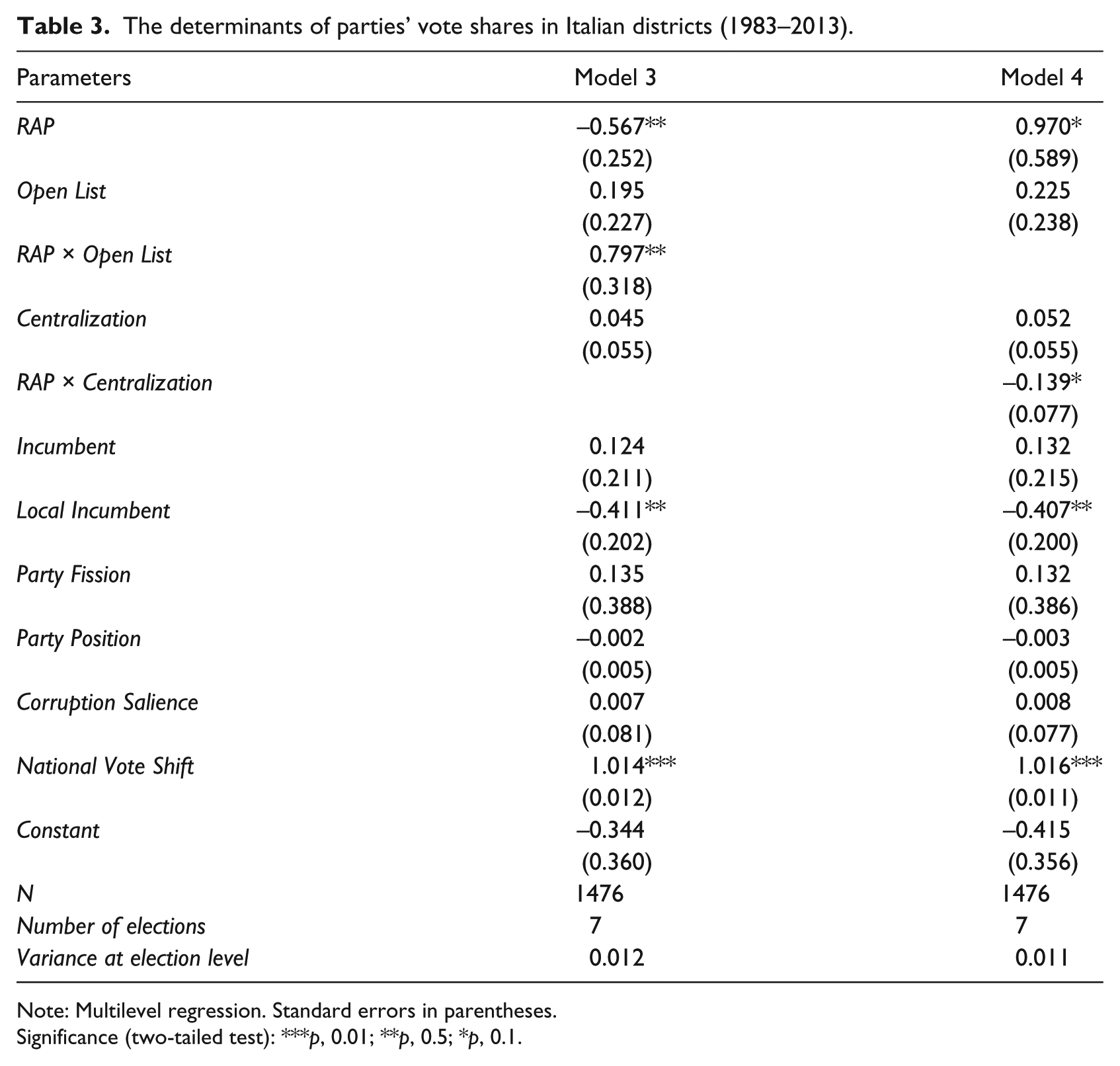
Table 2 shows the results of our ordinary least squares regression. Model 1 tests the impact of the electoral system discussed in H1, and Model 2 tests the role of intra-party candidate selection (H2). Model 3 and Model 4 replicate these two models, including control variables. Because we have multiple observations nested within districts, for each election we clustered observations by district, and we provide standard errors accordingly. As a result, the models display heteroskedastic and autocorrelation consistent standard errors. Note that our results are valid even when using a multilevel model (see Table 3 in the Appendix). 4
The determinants of parties’ vote shares in Italian districts (1983–2013).
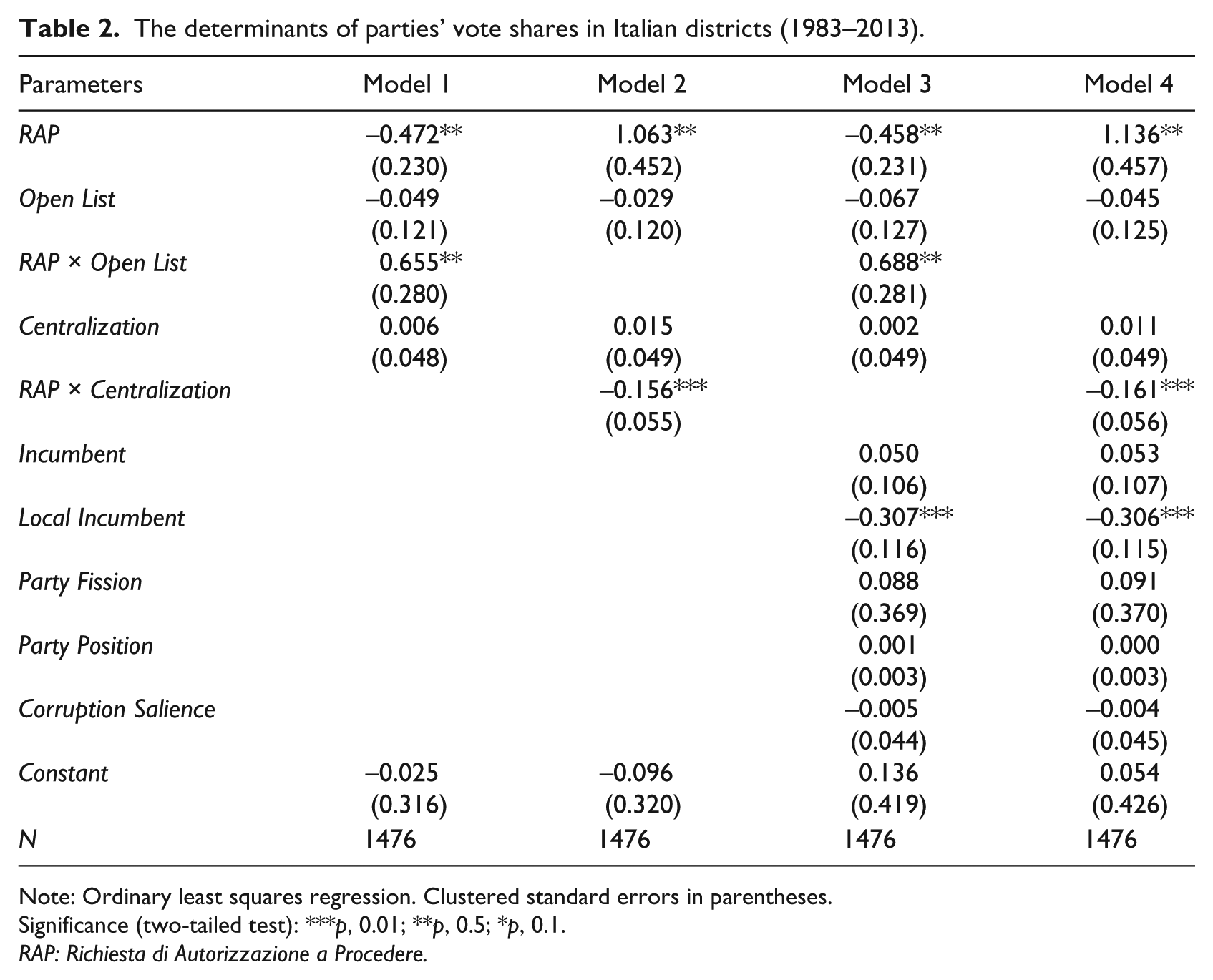
Note: Ordinary least squares regression. Clustered standard errors in parentheses.
Significance (two-tailed test): ***p, 0.01; **p, 0.5; *p, 0.1.
RAP: Richiesta di Autorizzazione a Procedere.
The results provide support for our hypotheses. First, judicial investigations damage parties only if there is no preference voting. The marginal effect of RAP under CLPR is −0.458 and it is statistically significant (the 95% confidence interval ranges between 0.911 and −0.005); this means that when the number of representatives under investigation for corruption in a district increases by one unit, the performance of the party in that district is approximately 0.5 points worse compared to the national average. Conversely, the marginal effect of RAP under OLPR (0.230) is not significantly different from zero. 5
Let us consider, for instance, the two major ruling parties of the Italian First Republic: Democrazia Cristiana (Christian Democracy) and the Partito Socialista Italiano (Italian Socialist Party). Despite their involvement in several scandals, they did not suffer any considerable loss of votes. In the districts where accusations were relevant, the former party increased its average support by approximately one point, whereas the latter experienced an electoral performance comparable to that reported when its representatives were not charged with crimes against the public administration.
The effect of corruption charges on electoral outcomes becomes noteworthy only when parties no longer compete under an OLPR system. The centre-right party Forza Italia/Popolo delle Libertà (Go Italy/People of Freedom), which since 1993 has been the most frequently implicated in corruption charges, lost an average of 0.4 points when it was under investigation. The loss of support was even higher for the Lega Nord (Northern League), which experienced a decrease of three points.
The candidate selection process is also important. Figure 1 (based on Model 4) displays the marginal effect of RAP on Vote Shift (with a 95% confidence interval) at different levels of Centralization. Judicial investigations affect the parties only if the candidate selection process is strongly centralized. Overall, the decline in votes is approximately 0.5 points (compared to districts that were not affected by scandals) for the most centralized parties and 0.2 when the degree of Centralization is equal to 8.5. In the First Republic we find similar levels of Centralization only in the right-wing party Movimento Sociale Italiano (Italian Social Movement), which had a score of 8.25. Conversely, after the reshuffling of the Italian party system in the early nineties, several parties displayed strong Centralization, namely, Forza Italia/Popolo delle Libertà, Alleanza Nazionale (National Alliance), Italia dei Valori (Italy of Values) and two smaller parties – the Nuovo Partito Socialista Italiano (New Italian Socialist Party) and the Partito dei Comunisti Italiani (Party of Italian Communists). The electoral performance of the main centre-left party, Partito Democratico (Democratic Party), which is one of the most decentralized parties in the Second Republic, was negatively associated with judicial investigations, though this relationship was not statistically significant.
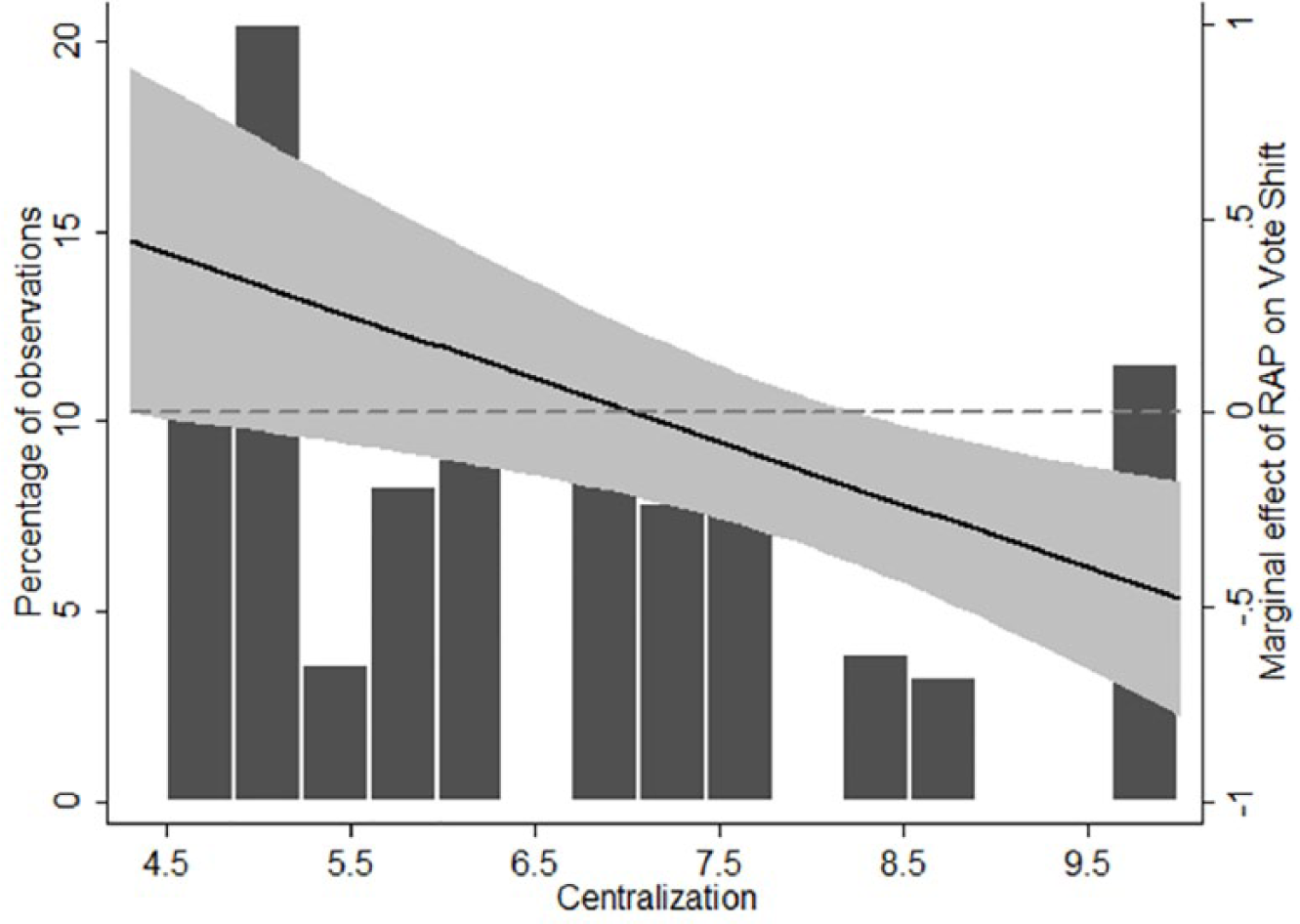
The marginal effect of judicial investigations on parties’ vote shares at different values of Centralization.
The effect of corruption charges is not correlated with the party’s position on the left–right spectrum. Among the other control variables, only Local Incumbent has a considerable impact on Vote Shift. We found that parties tended to lose votes when they were in power at the local level. Conversely, being in office at the national level does not seem to have any effect. Finally, the salience of corruption on the political agenda and the possible occurrence of party splits are not significantly associated with the electoral performance of parties.
Although in recent decades the electoral consequences of corruption charges in Italy have increased in their level of severity, they remain considerably lower than in the United States, where support for a Congressman charged with corruption dropped by at least 5 points (Peters and Welch, 1980; Jacobson and Dimock, 1994; Welch and Hibbing, 1997). The impact of corruption in Italy seems closer to the impact of corruption scandals on Parliamentary elections in the United Kingdom (Eggers and Fisher, 2011). At present, in Italy the loss of votes due to corruption charges may damage significantly the electoral performance of two types of parties. First, due to the majority prize, corruption can be detrimental to the lists of politicians who compete to win elections, especially when their shares of votes are similar to each other (as in the 2013 national elections). Second, due to thresholds of representation, charges may damage the small parties that aim to win the minimum percentage of votes required to obtain a seat in the Parliament. 6
Conclusions
Electoral institutions shape the effects of political corruption on the support of voters for political parties. In particular, the electoral performance of parties charged with corruption is moderated by electoral rules and intra-party candidate selection mechanisms. Corruption charges result in a decline in votes when parties do not compete under open list systems or when the process of candidate selection is strongly centralized. Conversely, if judicial investigations of corrupt practices take place under open list proportional systems or involve parties that adopt decentralized candidate selection procedures, we do not observe punishments in the districts under investigation.
This work shows the effects of electoral institutions on parties’ vote shares in Italy. Focusing on seven general elections between 1983 and 2013, we found that charges of corruption had repercussions on parties after 1993, when legislators replaced an open list system with closed list representation. Although Italian deputies were frequently charged with corruption or related crimes in both the First (1948–1993) and Second Republics (1994–present), judicial investigations affected the parties in the latter period only. On average, the electoral performance of parties during the First Republic did not suffer from the effects of political corruption. Conversely, after 1993 corruption charges consistently damaged the electoral results of parties. The most well-known corruption scandal, Tangentopoli, should be treated as a separate episode with distinct characteristics, because it contributed to the dissolution of the entire Italian party system in the early 1990s (e.g., Asquer, 2015).
Furthermore, this analysis provides evidence of the role of intra-party rules. When the party leadership has sole responsibility for candidate selection, corruption charges produce a decrease in votes. Conversely, corruption does not affect the electoral results when voters can take part in the candidate selection process. In other words, when access to the ballot depends on the preferences of leaders, the party is more likely to suffer a vote loss because of its involvement in corrupt activities.
Such results highlight the relationship between ballot control and the consequences of political corruption: whenever voters do not have the opportunity to directly appoint politicians in their effort to revitalize the party, the electoral performance of the party is negatively affected. On the one hand, this implies that leaders should pay more attention when creating the party list in closed list systems (to ensure that it will be free from rotten apples) and when candidate selection is strongly centralized. On the other hand, this has implications for the policy debate on the reform of electoral systems and the organization of political parties.
To avoid the negative consequences of corruption charges on electoral performances, legislators could adopt an open list system or decentralized intra-party rules to maintain voter loyalty. Substantial reforms concerning voting systems and party organization can indeed moderate the electoral effect of judicial investigations. Within traditional parties, such reforms can also limit the rise of anti-system parties when corruption scandals occur. In light of this, future studies could seek to account for the effects of the recent reform of the Italian electoral system: in 2015 the Parliament approved a two-round proportional system where voters could express their preferences for two candidates. This formula restores the possibility of choosing individual candidates; however, the party leaders can retain control over selecting the top candidate in each district.
The present study contributes to the literature investigating the factors that moderate the relationship between political scandals and electoral behaviour. Following recent analyses (Eggers, 2014; Rudolph and Däubler, 2016), it examines in depth the interactions between corruption charges and electoral institutions. In addition to considering the features of the electoral system, it extends the existing literature by demonstrating the relevance of intra-party democracy. Further investigations might aim to compare the effects of electoral institutions in different democracies. In addition, they could focus on one country in order to analyse the consequences of political corruption on various types of elections (for instance at national, regional and local levels) whose voting systems present distinct characteristics.
Footnotes
Appendix
The determinants of parties’ vote shares in Italian districts (1983–2013).
| Parameters | Model 3 | Model 4 |
|---|---|---|
| RAP | −0.567** | 0.970* |
| (0.252) | (0.589) | |
| Open List | 0.195 | 0.225 |
| (0.227) | (0.238) | |
| RAP × Open List | 0.797** | |
| (0.318) | ||
| Centralization | 0.045 | 0.052 |
| (0.055) | (0.055) | |
| RAP × Centralization | −0.139* | |
| (0.077) | ||
| Incumbent | 0.124 | 0.132 |
| (0.211) | (0.215) | |
| Local Incumbent | −0.411** | −0.407** |
| (0.202) | (0.200) | |
| Party Fission | 0.135 | 0.132 |
| (0.388) | (0.386) | |
| Party Position | −0.002 | −0.003 |
| (0.005) | (0.005) | |
| Corruption Salience | 0.007 | 0.008 |
| (0.081) | (0.077) | |
| National Vote Shift | 1.014*** | 1.016*** |
| (0.012) | (0.011) | |
| Constant | −0.344 | −0.415 |
| (0.360) | (0.356) | |
| N | 1476 | 1476 |
| Number of elections | 7 | 7 |
| Variance at election level | 0.012 | 0.011 |
Note: Multilevel regression. Standard errors in parentheses.
Significance (two-tailed test): ***p, 0.01; **p, 0.5; *p, 0.1.
Funding
This research received no specific grant from any funding agency in the public, commercial, or not-for-profit sectors.
Notes
Author biographies
References
Supplementary Material
Please find the following supplemental material available below.
For Open Access articles published under a Creative Commons License, all supplemental material carries the same license as the article it is associated with.
For non-Open Access articles published, all supplemental material carries a non-exclusive license, and permission requests for re-use of supplemental material or any part of supplemental material shall be sent directly to the copyright owner as specified in the copyright notice associated with the article.
