






Abstract
Recent literature on democratic backsliding shows how authoritarian populist leaders reshape policymaking by weakening institutions and dismantling policies. In Brazil, Bolsonaro’s presidency (2019–2022) was marked by systematic attacks on science, targeting higher education and the scientific community. This article investigates the strategies Bolsonaro used to weaken science, adopting a descriptive and mixed-methods approach: analysis of budgetary data from the Integrated Planning and Budget System, documentary evidence from the National Union of Faculty of Higher Education Institutions, and content analysis of all presidential speeches. Findings reveal a dual strategy: (a) weakening the public science infrastructure and an attack on university autonomy; and (b) discursive attacks that framed universities as sites of denied scientific consensus and subordinated science to political projects. The Brazilian case shows that policy dismantling under authoritarian populism combines material retrenchment and discursive delegitimization, using attacks on science to weaken institutions and reshape policymaking during democratic backsliding.
Introduction
The literature has identified multiple forms of democratic backsliding worldwide (Levitsky and Ziblatt, 2018). Unlike earlier experiences marked by military coups or overtly violent ruptures, contemporary backsliding processes are increasingly driven by institutional and policy dismantling carried out by democratically elected governments with authoritarian ambitions (Bauer and Becker, 2020; Bauer et al., 2021; Lotta et al., 2022; Oliveira and Fernandez, 2021; Peters and Pierre, 2019; Yesilkagit, 2018). Democratic backsliding led by authoritarian populist governments has therefore drawn growing scholarly attention across disciplines, particularly regarding its effects on political processes and public policy delivery. Among these effects, policy dismantling has emerged as a central mechanism shaping contemporary democratic erosion (Levitsky and Ziblatt, 2018; Lynch and Cassimiro, 2022; Nord et al., 2024).
The phenomenon of democratic backsliding led by authoritarian populist governments in some parts of the world has attracted growing attention from researchers across multiple fields, particularly regarding the potential effects of these new dynamics on political processes (Levitsky and Ziblatt, 2018; Lynch and Cassimiro, 2022; Nord et al., 2024). In this sense, authoritarian populism can be understood as a mode of political leadership in which elected leaders claim exclusive representation of “the people,” reject pluralism, minority rights, and institutional checks, and centralize power through polarizing rhetoric and illiberal practices that transform and erode democratic governance from within (Lynch and Cassimiro, 2022; Norris and Inglehart, 2019; Urbinati, 2019). Among the consequences of the authoritarian populist leader’s action, the impacts on public policy delivery and processes of policy dismantling are especially salient, as authoritarian populist leaders increasingly reshape policy agendas to prioritize political survival over institutional continuity and problem-solving capacity (Bauer and Becker, 2020; Bauer et al., 2021; Morais and Gomide, 2024a).
Policy dismantling involves the deliberate reduction or elimination of policy objectives, implementation instruments, or administrative capacities, often through the manipulation of state capacities to alter or undo existing policies (Bauer et al., 2012). Recent scholarship has expanded this debate to examine dismantling dynamics in authoritarian contexts, including under authoritarian populist governments (Gomide et al., 2023; Milhorance, 2022; Morais and Gomide, 2024a; Niederle et al., 2023). Building on this literature, this article advances the analysis of policy dismantling by examining the strategies employed within such political settings.
In January 2019, Jair Bolsonaro assumed the presidency of Brazil, aligning the country with others such as Turkey, India, and the United States, where authoritarian populist leaders have risen to power. From the outset, Bolsonaro relied on conservative, ultranationalist, and religious rhetoric to intensify social and political polarization and mobilize supporters (Borges and Rennó, 2021), while simultaneously neglecting and attacking established public policies across multiple sectors (Medeiros et al., 2021). Against this backdrop, this article asks: What strategies did Bolsonaro use to attack science and erode the scientific community? To answer this question, this article aims to trace the paths by which attacks on science were mounted during Bolsonaro’s government. The analysis contributes to the literature on policy dismantling by demonstrating how far-right governments combine material retrenchment with discursive delegitimization to weaken science.
Policy dismantling in authoritarian contexts
Science can be undermined through multiple strategies, ranging from dismantling policies that support research and innovation to delegitimizing scientific authority. Drawing on the literature on democratic backsliding, policy dismantling, and the political use of science, this study explains how these dynamics intersect in the Brazilian case, offering an integrated account of the strategies used to attack science.
Democratic backsliding reshapes the policy process by weakening institutional constraints while preserving the façade of electoral legitimacy. Rather than abrupt regime breakdowns, backsliding unfolds incrementally, eroding pluralism and delegitimizing expertise through polarization and attacks on oversight institutions (Bauer and Becker, 2020; Levitsky and Ziblatt, 2018). These dynamics challenge core assumptions in policy process theories that presuppose institutional stability and bureaucratic resilience (Lotta et al., 2022; Mahoney and Thelen, 2010; Pierson, 2000).
The concept of “institutional hardball” helps explain how authoritarian populist leaders contribute to democratic backsliding by strategically stretching, subverting, or dismantling formal and informal institutional constraints to impose policy change and advance partisan goals, often in violation of democratic norms. These strategies normalize the weakening of democratic standards, undermine administrative and governance capacities through practices such as the politicization of appointments, budgetary retrenchment, and interference in regulatory agencies, and leave enduring organizational legacies, including degraded routines, reduced professional autonomy, and diminished trust in public institutions, that persist beyond leadership changes (Morais and Gomide, 2024a).
Hardball strategies generate three recurrent outcomes: policy dismantling, as illustrated by Bolsonaro’s rollback of environmental and health programs (Gomide et al., 2023); nondesign, understood as the refusal to address urgent crises, exemplified by the neglect of COVID-19 responses in Brazil and other Latin American countries (Fernandez and Machado, 2021; Medeiros et al., 2021); and scapegoating, in which symbolic conflicts mobilize supporters through cultural wars (Norris and Inglehart, 2019). Comparative evidence indicates that, despite contextual variation, authoritarian populists consistently redefine public policy logics to prioritize political survival over societal problem-solving (Morais and Gomide, 2024b).
Mechanisms traditionally viewed as stabilizing, such as path dependence and policy feedback, are subverted when leaders deliberately dismantle programs, neglect pressing policy problems, or advance symbolic policies that scapegoat minorities, transforming policymaking from problem-solving into an instrument of power consolidation (Bauer et al., 2012; Lotta et al., 2022). In this context, policy dismantling emerges as a key mechanism through which democratic backsliding materializes, offering a concrete lens to analyze how governments intentionally weaken or eliminate existing policies.
Policy dismantling refers to the process of cutting, reducing, or eliminating existing policies, including their objectives, instruments, or implementing institutions (Bauer et al., 2012; Milhorance, 2022). This literature seeks to explain why policymakers choose dismantling, the strategies they adopt, and why rational actors pursue such actions despite their potential political costs (Bauer et al., 2012).
Bauer and Knill (2014) define and operationalize policy dismantling through four ideal-type strategies that vary according to political preferences and capacity for action. These include: (a) dismantling by default, characterized by nondecision and low visibility, where reductions result from inaction or external conditions; (b) dismantling by change of arena, involving active decisions with low visibility, as responsibilities are shifted to other political arenas to avoid direct political costs; (c) dismantling by symbolic action, marked by high visibility but limited concrete change due to institutional constraints or conflicting preferences; and (d) active dismantling, combining high visibility and active decision-making, in which policymakers intentionally dismantle policies driven by ideological commitments or political demands. Together, these strategies reflect rational calculations of political costs and benefits shaped by actors’ interests, resources, and institutional contexts (Bauer and Knill, 2014).
By recognizing the importance of scientific legitimacy for strengthening the public sphere and monitoring political action, it becomes evident that, in contexts of authoritarian populism, policy dismantling goes beyond the logic of expanding or retrenching state action and increasingly operates through the delegitimization of scientific knowledge. Science, while traditionally seen as an objective pursuit of knowledge (Merton, 1973), can be strategically mobilized to legitimize political decisions, influence public opinion, and reshape policy debates (Mede and Schäfer, 2020). This dual role highlights both its potential to inform policymaking and the risks of its manipulation, as governments may distort or delegitimize science in order to advance partisan projects and weaken institutional safeguards (Gramacho and Turgeon, 2021).
Science is frequently used to legitimize public policies and governmental decisions, particularly in areas such as public health, the environment, and technology, by framing them as evidence-based and objective (Pielke, 2007). However, the use of science in policymaking is often shaped by political and economic interests, influencing how evidence is interpreted and mobilized (Moat et al., 2013). The manipulation and selective use of scientific data are common when science serves political purposes. Evidence may be distorted or selectively highlighted to support specific agendas, producing a skewed representation of scientific consensus (Maciel et al., 2022; Oreskes and Conway, 2010). Beyond data manipulation, this process also involves privileging certain studies while marginalizing others. Science can thus function not only to justify but also to undermine and dismantle public policies. Attacks on scientific authority, selective communication, and research marketing have been used to shape public opinion, as illustrated by the tobacco industry’s long-standing efforts to cast doubt on the health risks of smoking (Proctor, 2012).
While the political use of science can foster evidence-based policymaking, its distortion undermines scientific integrity, erodes public trust, and can enable harmful or regressive policies. The COVID-19 pandemic exemplifies these dynamics, as the politicization of scientific information weakened public health responses and trust in expert guidance (Gollust et al., 2020; Gramacho et al., 2024). Building on these debates, this article advances an analytical framework that examines policy dismantling under authoritarian populism, highlighting the political use of science as a central mechanism.
Methodology
Context
In 2018, Brazil elected a far-right populist politician as president. Between 2019 and 2023, Jair Bolsonaro promoted the dismantling of longstanding public policies (Peci et al., 2021), alongside a broader process of democratic weakening and institutional crisis marked by attacks on institutions and bureaucracy (Cardoso et al., 2022; Milhorance, 2022; Peters and Pierre, 2022).
Since 2013, Brazil has experienced growing political polarization driven by social movements, a dynamic that intensified and became more visible to political and economic elites, culminating in the 2018 elections (Hunter and Power, 2019; Kingstone and Power, 2017; Pereira et al., 2020). The electoral dispute was structured around two poles: the Workers’ Party (PT), associated with traditional politics and corruption scandals, and Bolsonaro’s far-right movement, which mobilized anti-establishment and anti-PT sentiment (Bertholini, 2022; Pereira et al., 2020). Bolsonaro’s rise signaled a broader reorganization of the Brazilian right, with new actors and organizations emphasizing the politicization of noneconomic issues such as public security, abortion, and LGBT+ rights, reflecting deep ideological and affective polarization (Almeida, 2019; Borges and Vidigal, 2023). In this context, attacks on science and the scientific community became a recurrent strategy to advance the government’s agenda.
After the election, relations between the Bolsonaro government and the public administration were shaped by competing agendas, combining neoliberal deregulation with far-right conservative priorities (Cardoso et al., 2022). These agendas coexisted with efforts to politicize state apparatuses, producing varied interactions with bureaucracies, including co-optation, marginalization, or direct attacks. Where resistance emerged, the government adopted strategies to undermine institutions and actors opposing its goals (Lotta et al., 2022, 2023), particularly in ideologically sensitive areas such as Human Rights, Health, Education, and the Environment (Cardoso et al., 2022; Oliveira and Fernandez, 2021). Within this setting, science became a frequent target of presidential attacks (Hallal, 2021), with policy decisions contradicting scientific evidence (Fernandez, 2022; Maciel et al., 2022) and critics framed as enemies of the nation or obstacles to the government’s agenda (Hunter and Power, 2019).
Data collection and analysis
Description plays a critical role in qualitative research because it grounds abstract arguments in the richness of empirical cases. Careful descriptive work is not merely a preliminary stage but can also be a central component of analysis. By systematically identifying patterns in the join of qualitative and quantitative data, researchers provide the foundation upon which causal or interpretive claims can be built (Avant, 2024). The descriptive strategies allow scholars to move beyond anecdotal evidence, making their interpretations replicable and comparable. In this sense, description is not an end in itself but a methodological bridge that connects the empirical material with broader theoretical debates, enabling readers to understand both the internal logic of a case and its wider significance in comparative perspective (Avant, 2024). Building on this approach, the article turns to the Brazilian case to examine how descriptive analysis can illuminate the strategies through which far-right governments actively dismantle science.
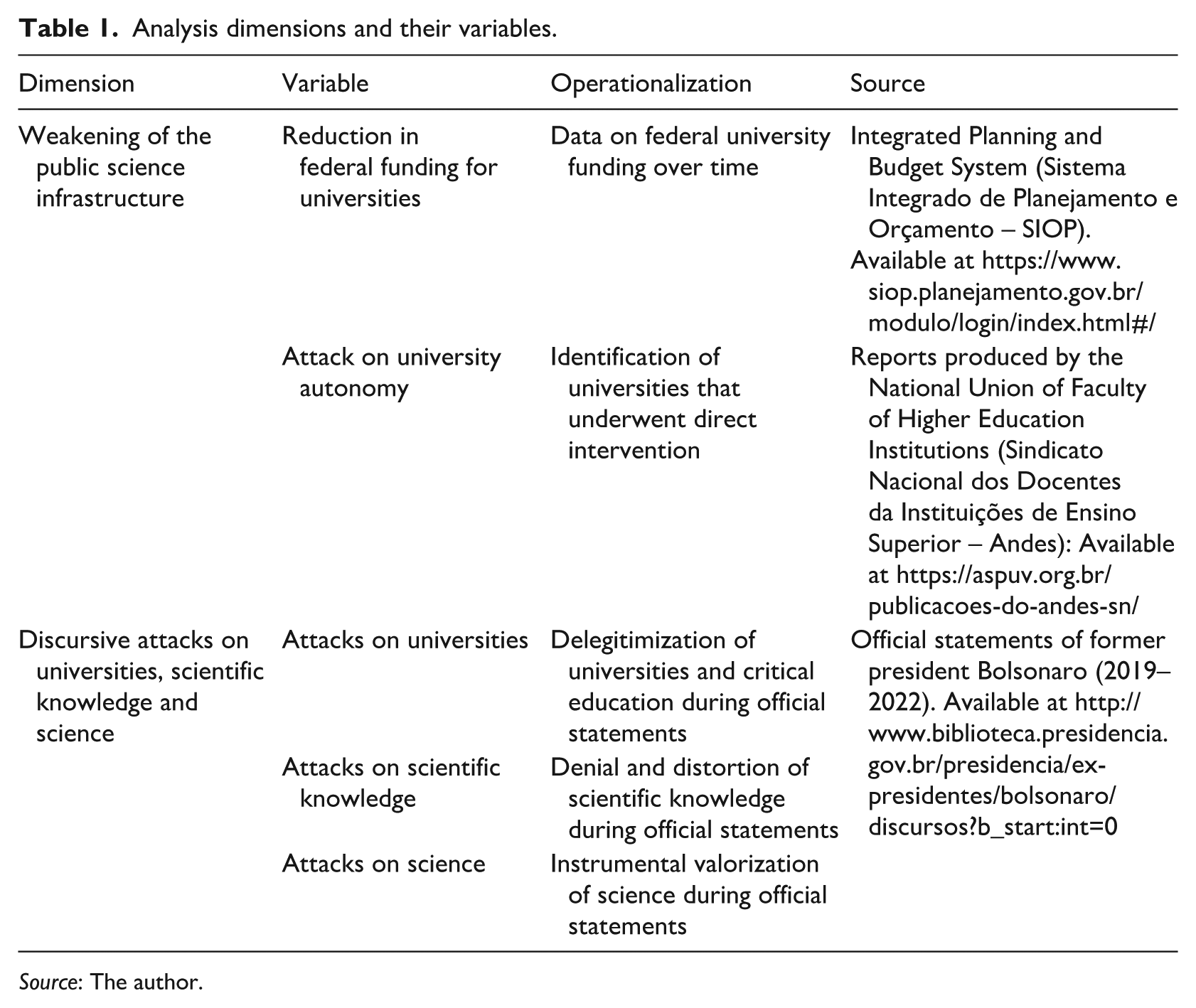
In this way, I ask, what strategies has Bolsonaro used to attack science and erode the scientific community? To answer this question, the article examines the offensive orchestrated by the Bolsonaro government against science and the Brazilian scientific community with the aim of identifying the strategies used. In this article, I define “strategy” as a recurrent set of material and discursive actions employed by governments to deliberately weaken the institutional, financial, and symbolic bases of science. Based on the literature on policy dismantling (Bauer and Knill, 2012, 2014; Morais and Gomide, 2024a), the political use of science (Fernandez, 2022; Mede and Schäfer, 2020) and the empirical evidence from the Brazilian case, I analyze these strategies along two complementary dimensions: (1) weakening of the public science infrastructure, 1 and (2) discursive attacks on universities, scientific knowledge and science.
To conduct this research, I drew on multiple data sources. First, I analyzed primary data on federal university budgets from the Integrated Planning and Budget System (Sistema Integrado de Planejamento e Orçamento – SIOP), considering the central role of public universities in scientific knowledge production by providing infrastructure, resources, and intellectual environments that foster innovation, as well as training future scientists and developing research skills and critical thinking (Becher and Trowler, 2001; National Science Foundation, 2020). Second, I used secondary data produced by the National Union of Faculty of Higher Education Institutions (Sindicato Nacional dos Docentes das Instituições de Ensino Superior – Andes), including the reports “A invenção da balbúrdia: dossiê sobre as intervenções de Bolsonaro nas Instituições Federais de Ensino Superior,” “Dossiê Militarização do Governo Bolsonaro,” and “Intervenção nas Instituições Federais de Ensino” to analyze interventions in federal universities. Finally, I compiled official presidential statements on science and the scientific community and conducted a content analysis of all speeches delivered between 2019 and 2022 to identify and document instances of official discourse targeting science (see Appendix 1 for the content analysis protocol).
Methodologically, the study combined descriptive statistical analysis of budgetary data to capture trends in resource allocation and retrenchment with documentary analysis of two reports produced by the National Union of Faculty of Higher Education Institutions (Sindicato Nacional dos Docentes das Instituições de Ensino Superior – Andes), which offer critical insights from faculty unions on political and institutional pressures in higher education. In addition, a content analysis of presidential speeches was conducted using Dedoose software to identify recurring themes, discursive strategies, and patterns of delegitimization. The data were coded according to categories established in the literature on illiberal authoritarian rulers and policy dismantling (Bauer et al., 2012, 2021; Peci et al., 2021). Together, these methods integrate quantitative and qualitative evidence, enabling a multifaceted analysis of attacks on science. Table 1 presents the analytical dimensions, variables, operationalization, and data sources.
Analysis dimensions and their variables.
Source: The author.
This research employs a primarily descriptive, multimethod approach to outline attacks on science during Bolsonaro’s administration. The budgetary analysis reveals resource retrenchment that undermined the sustainability of science and technology policies, while the documentary analysis of university rector appointments highlights political intervention and the erosion of institutional autonomy. The content analysis of official statements captures the symbolic and discursive dimension, showing how rhetoric contributed to delegitimizing science and shaping public perceptions of universities, scientists, and knowledge production. Together, these dimensions provide a comprehensive account of how attacks on science materialized both materially and symbolically.
Findings
Weakening of the public science infrastructure
Universities generate and apply scientific knowledge and play a crucial role in training future researchers and promoting innovation. The relationship between science and universities is a fundamental pillar for advancing knowledge and innovation. Universities act as research and education centers that support scientific and technological progress. In this way, understanding federal universities’ funding and political interventions is equivalent to analyzing the very structure of scientific production in Brazil, since these institutions constitute the backbone of the national science system.
Funding for public higher education is a major challenge in Brazil. Federal public universities play a central role in training qualified professionals and producing knowledge and research, accounting, together with state universities, for approximately 95% of the country’s research output (Moura, 2019). Over the past decade, however, federal universities have faced progressive budget cuts, a trend that intensified during the Bolsonaro administration. Although budget reductions began in 2015 amid an economic crisis, they deepened significantly from 2019 onward. As illustrated in Table 2, federal revenues increased by 49.04% between 2013 and 2020, while expenditures on federal universities declined by 0.24%. Throughout this period, university funding remained below 2.5% of federal revenues on average, worsening after 2018 under the Temer administration and reaching only 1.74% of Union revenues in 2020 during Bolsonaro’s presidency.
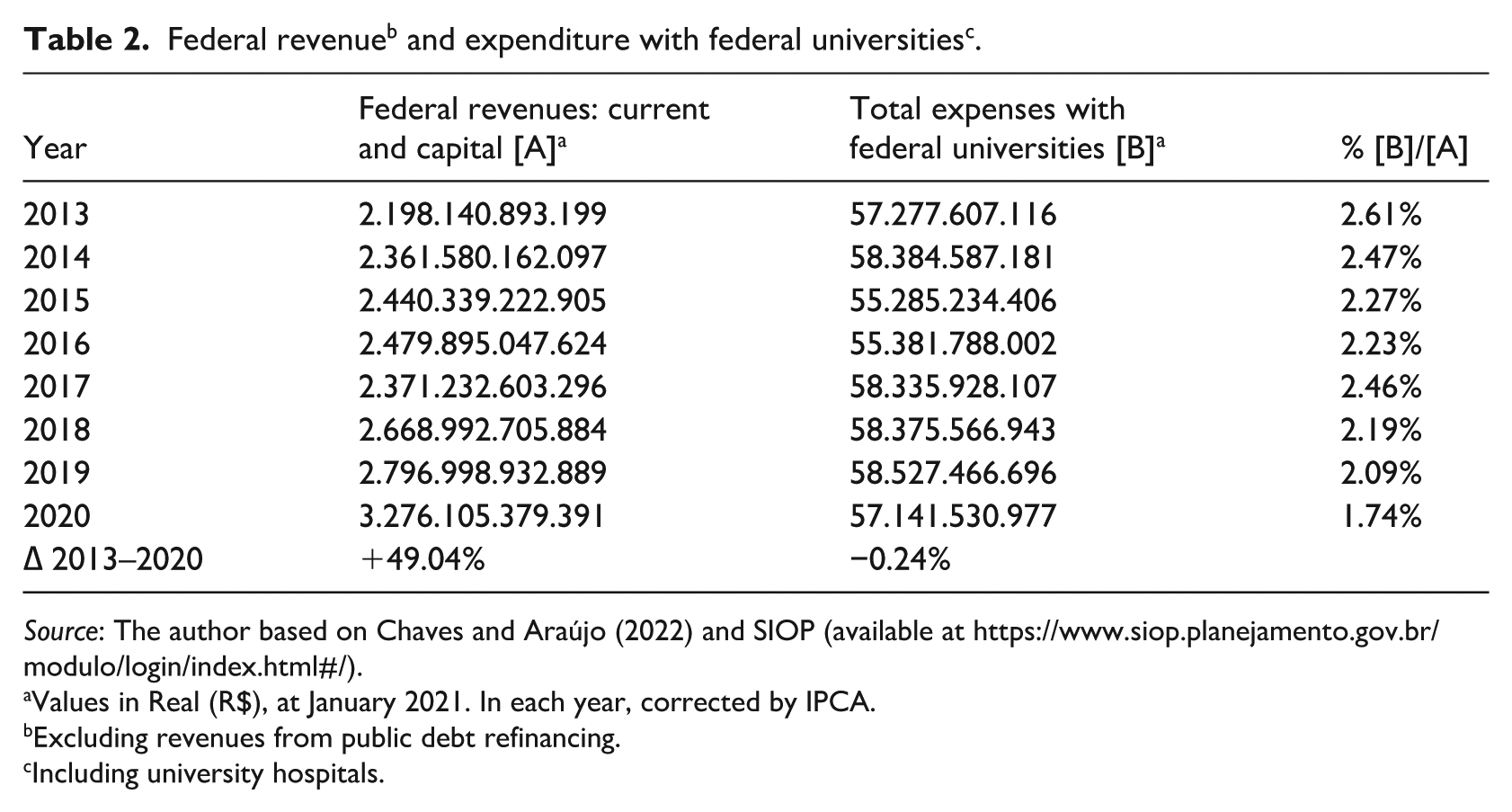
Source: The author based on Chaves and Araújo (2022) and SIOP (available at https://www.siop.planejamento.gov.br/modulo/login/index.html#/).
Values in Real (R$), at January 2021. In each year, corrected by IPCA.
Excluding revenues from public debt refinancing.
Including university hospitals.
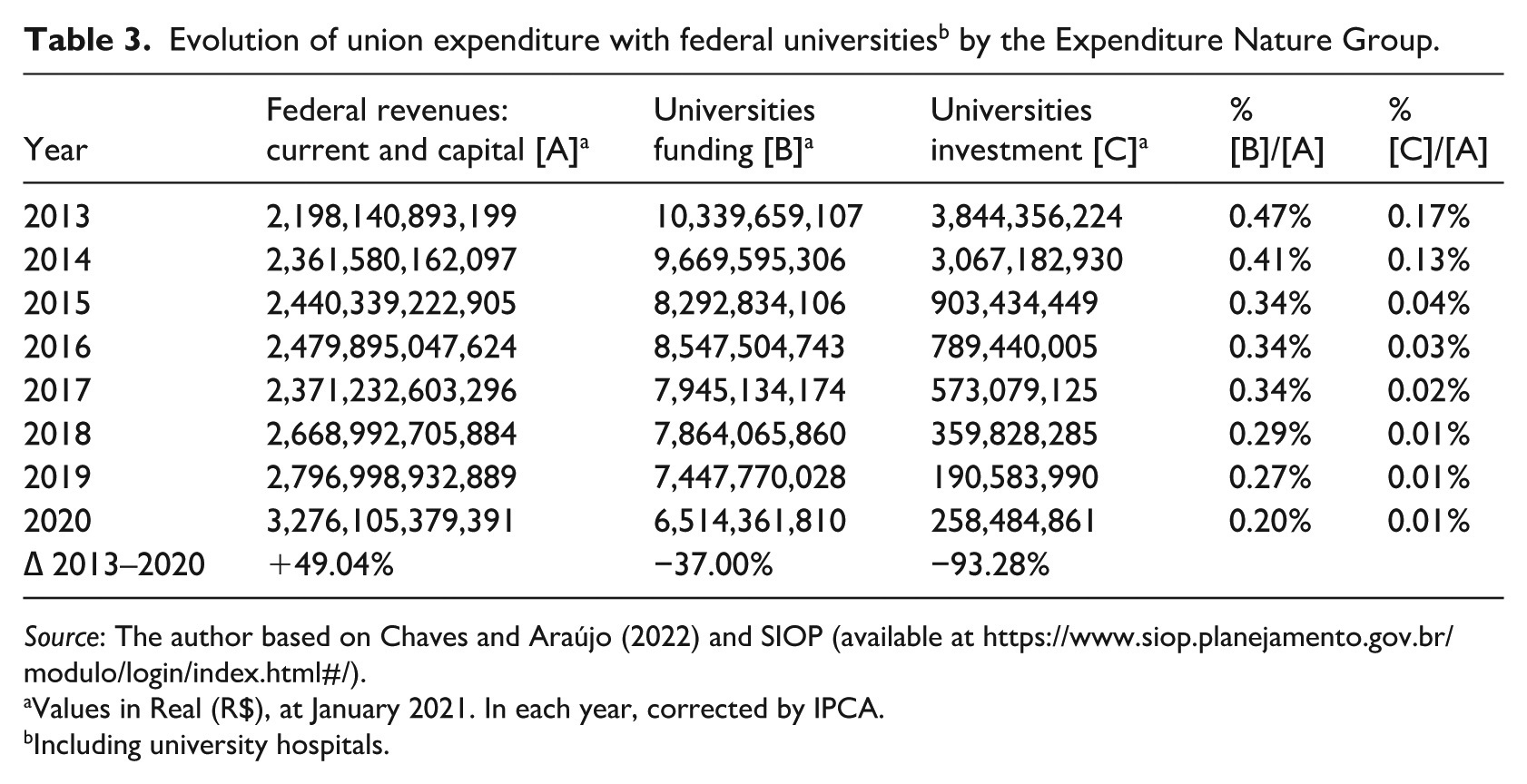
A more detailed analysis of the executed budget at federal universities, by expense nature group, reveals the severity of the situation these institutions face. There has been a significant reduction in the budget for investment and expenses, known as “Other Current Expenses” (Chaves and Araújo, 2022), as demonstrated in Table 3. In 2013, universities received BRL 10.339 billion to cover their activities, and in 2020, they received BRL 6.514 billion, a 37% reduction. The expenses financed by these funds are essential to maintaining university operations. These include payments for electricity, water, telephone, equipment maintenance, classrooms and laboratories, and outsourced services (security and cleaning), among others. In the case of investments—funds allocated for the expansion and maintenance of the university’s physical infrastructure—the situation is even more dire. Investment resources were reduced by 93.28% from 2013 to 2020.
Evolution of union expenditure with federal universities b by the Expenditure Nature Group.
Source: The author based on Chaves and Araújo (2022) and SIOP (available at https://www.siop.planejamento.gov.br/modulo/login/index.html#/).
Values in Real (R$), at January 2021. In each year, corrected by IPCA.
Including university hospitals.
Attacks directed at federal universities through the reduction of public investments are complemented by interventions in university autonomy. The prerogative to freely choose rectors, through consultation processes with the university community and subsequent decisions by the university councils, remains a contested area (Chaves and Araújo, 2022). The provision contained in Law 9192/95 (Brasil, 1995) grants the president of the Republic the authority to appoint the top leadership of federal universities based on a triennial list prepared by each institution’s highest collegiate body. This list is the result of consultations with the university community. Under the Bolsonaro administration, several rectors outside the triennial list presented by the universities were appointed by the president to lead these institutions.
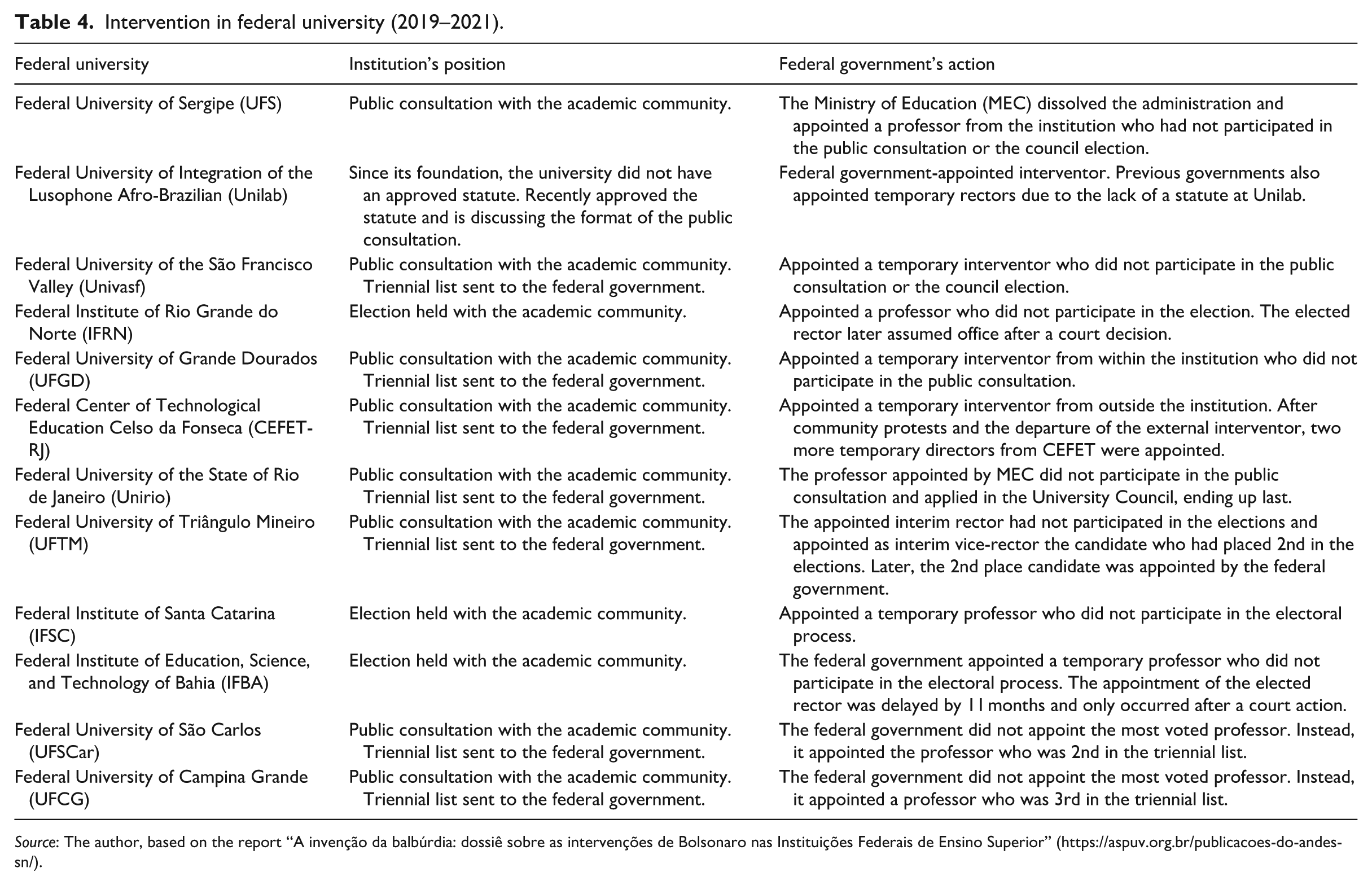
Table 4 presents the federal universities that underwent intervention, showing the positions defined by the institutions and those imposed by the federal government, often disregarding the outcomes of public consultations or the decisions of university councils. In these cases, temporary intervenors were appointed without participation from the academic community, reflecting the authoritarian impact of the federal government on universities under the Bolsonaro administration. Such actions sought to silence dissenting voices and systematically undermined institutional autonomy, revealing a consistent strategy of delegitimizing collegial governance mechanisms that had historically safeguarded the independence of Brazilian federal universities.
Intervention in federal university (2019–2021).
Source: The author, based on the report “A invenção da balbúrdia: dossiê sobre as intervenções de Bolsonaro nas Instituições Federais de Ensino Superior” (https://aspuv.org.br/publicacoes-do-andes-sn/).
The breadth of interventions is noteworthy. Institutions such as the Federal University of Sergipe (UFS), Federal University of Grande Dourados (UFGD), and Federal University of Triângulo Mineiro (UFTM) experienced the appointment of interim rectors who were not elected by their communities. In the case of the Federal Center of Technological Education Celso da Fonseca (CEFET-RJ), the disregard for autonomy was even more severe: the government initially appointed an outsider as interventor, sparking strong internal protests until a succession of temporary rectors from within the institution took over. Similar patterns of federal disregard can be seen in Unirio, where the professor appointed had not only lost in the council process but was placed last, and at IFBA, where the appointment of the elected rector was delayed by nearly a year, only occurring after judicial intervention.
These actions reveal more than isolated episodes of political interference; they also reflect a deliberate authoritarian strategy aimed at reshaping higher education governance in alignment with the government’s ideological agenda. By bypassing institutional procedures and undermining the legitimacy of elected leadership, Bolsonaro’s government signaled hostility toward pluralism, critical thinking, and the role of universities as spaces for democratic debate. This pattern aligns with broader international tendencies of authoritarian populist regimes—such as in Turkey and Hungary—where academic autonomy and universities have become primary targets for political control, given their symbolic and practical role in sustaining democratic life.
In the Brazilian case, the systematic imposition of intervenors illustrates how authoritarian populism translates into concrete institutional practices, weakening long-established norms of university self-governance. More broadly, it provides empirical evidence of how democratic backsliding operates not only through electoral manipulation or judicial pressure but also via the incremental dismantling of policy arenas central to rights, autonomy, and knowledge production.
Discursive attacks on universities, scientific knowledge, and science
During Jair Bolsonaro’s presidency, Brazil witnessed a series of attacks directed at universities, scientific knowledge, and science, reflecting a clear attempt to align scientific and academic policies with the government’s ideology. This scenario was marked by notable hostility toward sensitive topics and research areas that did not align with the Bolsonaro administration’s conservative views. Analyzing official statements of the former president, I can identify three strategies of attack used by Bolsonaro: (1) delegitimization of universities and critical education; (2) denial and distortion of scientific knowledge; and (3) instrumental valorization of science (Table 5).
Categories of Bolsonaro’s speeches on science.
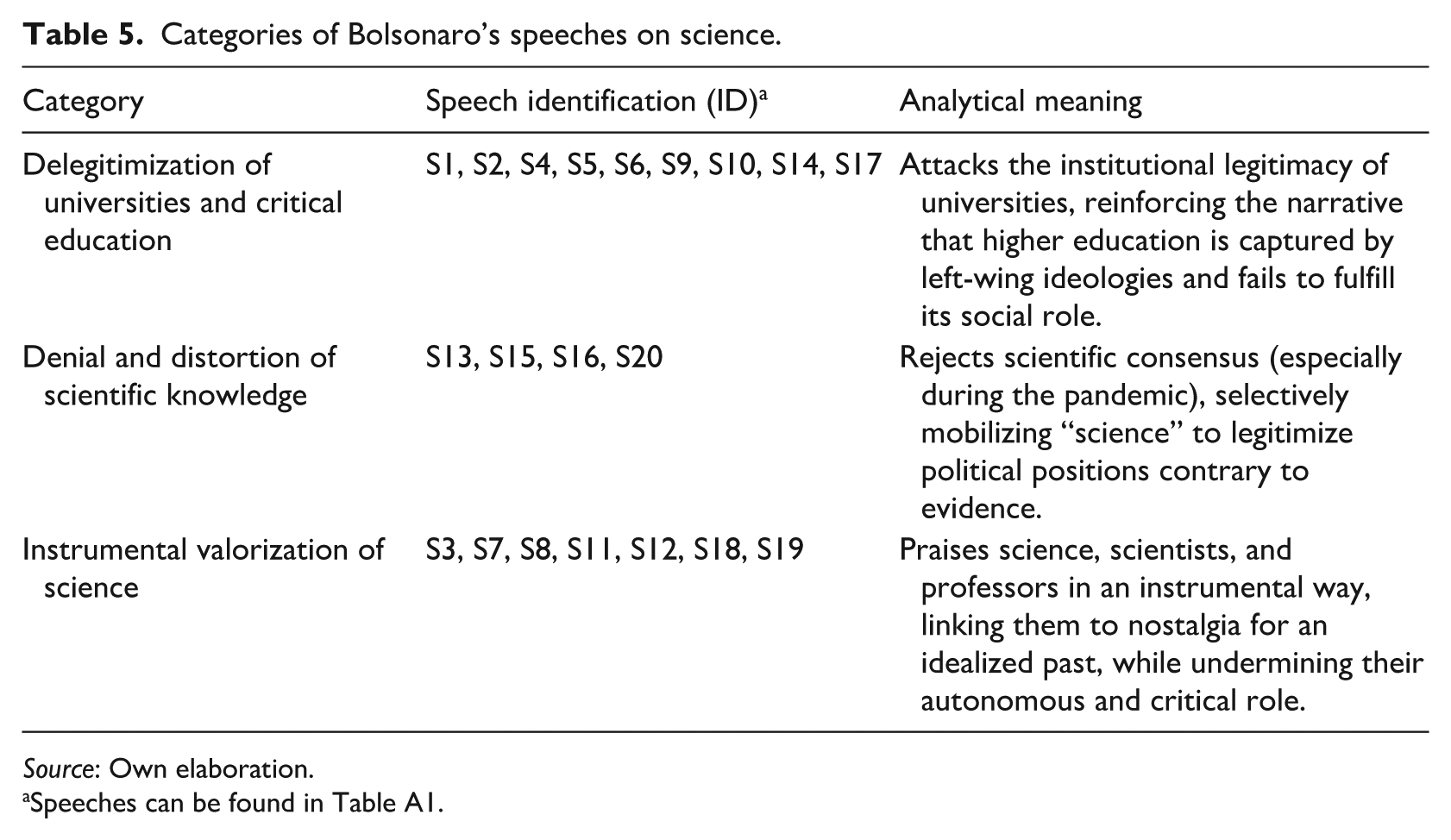
Source: Own elaboration.
Speeches can be found in Table A1.
One central feature of Bolsonaro’s discourse was the delegitimization of universities and critical education. In several speeches, he portrayed universities and schools as arenas dominated by ideological indoctrination, militancy, and partisan activism. By framing educational institutions as spaces of political manipulation rather than knowledge production, these discourses denied their scientific and formative role. This rhetorical strategy recast education as an obstacle to, rather than a foundation for, Brazil’s democratic and developmental trajectory.
Examples of this delegitimizing discourse appear in speeches such as S1, S2, S4, S5, S6, S9, S10, S14, and S17 (Table A1). Across these interventions, Bolsonaro repeatedly suggested that universities had abandoned their mission of training professionals to become centers for ideological reproduction. The frequent invocation of Paulo Freire as a negative symbol further reinforced this narrative. Such framing not only attacked individuals or methods but also systematically undermined the institutional legitimacy of universities as autonomous spaces of knowledge.
It started with the government of Fernando Henrique Cardoso and worsened under Lula and Dilma, the ideological issue that took over universities, including elementary schools. Five-year-old children were indoctrinated in Brazil, and this also took over the mainstream media. (S1)
Analytically, these discourses work by constructing higher education as “captured” by left-wing ideologies and therefore as failing in its social role. This rhetoric delegitimizes the authority of academic institutions to participate in public debate, policymaking, or critical inquiry. By doing so, it weakens the broader legitimacy of science and education in shaping public life and creates a discursive justification for reducing their autonomy, funding, and influence. The attack is thus both symbolic and material, opening space for policy dismantling.
We need to make universities, instead of being centers for training militants, into centers for training good professionals. That’s what we want for Brazil. (S5)
A second strand of Bolsonaro’s discourse centered on the denial and distortion of scientific knowledge. Particularly during the pandemic, Bolsonaro rejected or minimized scientific consensus on key issues such as lockdowns, vaccines, and treatment protocols. Instead, he selectively mobilized references to “science” or international authorities—such as the World Health Organization—when their statements could be interpreted as supportive of his positions. In this way, the notion of science was appropriated strategically to legitimize decisions that ran contrary to evidence-based recommendations.
This denialist discourse is exemplified in speeches S13, S15, S16, and S20. In these statements, Bolsonaro not only contested public health measures but also reframed them as ideologically motivated impositions, dismissing their scientific foundations. By undermining the epistemic authority of science, these interventions eroded its centrality in policymaking, encouraging policies detached from evidence and oriented instead by political expediency. The analytical implication is clear: the rejection of science served to justify governance practices that subordinated knowledge to ideology and power.
Last year, with the Emergency Aid, it was equivalent to ten years of Bolsa Família, because jobs were destroyed by those who, without criteria, without scientific proof, closed their entire state, and here it was no different. (S15) We support vaccination; however, our government has taken a position against the health pass or any vaccine-related obligation. Since the beginning of the pandemic, we have supported the autonomy of the doctor in seeking early treatment, following the recommendation of our Federal Council of Medicine. (S16)
Finally, Bolsonaro’s rhetoric also included moments of instrumental valorization of science. In speeches such as S3, S7, S8, S11, S12, S18, and S19, he praised scientists, professors, and technological advances, often portraying them as symbols of national pride and development. However, this praise was never directed at reinforcing the autonomy of science or acknowledging its critical role in democratic debate. Instead, it was framed in highly instrumental terms, frequently associated with technological sovereignty, economic modernization, or nostalgia for an idealized past in which the nation was supposedly stronger and more self-sufficient.
My friend Netanyahu and I intend to take advantage of bringing our peoples, our militaries, our students, our scientists, our entrepreneurs, and our tourists closer. (S3) So yes, I have a foot and a hand in this kind of work, I’m passionate about it, and I pay my respects to the scientists, the researchers, the engineers, and the humblest workers who are here. Everyone builds the future, here we can truly seek the independence of our nation. (S12)
In this sense, science was not treated as an independent field of inquiry but rather as a resource subordinated to a political project. Such discourses transformed science into a political tool to legitimize government authority and consolidate state power. While these statements did not constitute explicit attacks, they worked subtly to strip science of its critical and independent role, reducing it to a functional element of authoritarian populist government. This strategic appropriation demonstrates how, even when science was praised, it was simultaneously constrained, redefined, and disciplined to fit the ideological boundaries of the Bolsonaro administration.
Taken together, these three discursive strands reveal a broader pattern of science dismantling under Bolsonaro. The delegitimization of universities eroded institutional credibility, the denial and distortion of scientific knowledge weakened the authority of evidence in policymaking, and the instrumental valorization of science confined its role to serving nationalist and political ends. Interacting as complementary strategies, they reshaped the place of science in Brazilian society—from an autonomous, critical field to a contested and subordinated domain—thereby undermining both democratic debate and the long-term capacity for evidence-based governance.
Discussion
Science plays a crucial role in democratic societies by fostering innovation, supporting informed decision-making, and underpinning public policy formulation. Attacks on science are closely linked to democratic backsliding, as they undermine institutional integrity and public trust. In this context, assaults on higher education—through budget cuts, political interventions, and discursive delegitimization—not only targeted specific institutions but also weakened the broader infrastructure of scientific knowledge production by eroding research capacity, undermining the training of future scientists, and constraining the autonomy necessary for critical and innovative inquiry.
In this way, the findings show that these actions did not merely affect science policy. They also undermined democratic functioning. By weakening institutions responsible for knowledge production, delegitimizing expert authority, and centralizing power over university governance, Bolsonaro’s administration reduced the autonomy of epistemic institutions essential for accountability and plural public debate, key elements of democratic resilience (Nichols, 2017).
Under Bolsonaro’s government, federal universities became central targets of authoritarian populist strategies, combining severe budget cuts, declining support for infrastructure and research, and discursive attacks portraying universities as sites of ideological indoctrination. These measures weakened the training of future researchers, deepened institutional inequalities, and were reinforced by political interventions in rector appointments that bypassed internal democratic processes and undermined institutional autonomy. Together, these material, institutional, and symbolic strategies exemplify the dismantling of education policy in authoritarian populist contexts (Gomes and Segatto, 2024), compromising higher education’s role in reducing inequality and eroding Brazil’s long-term capacity for scientific innovation and democratic debate.
The dismantling of federal universities also severely affected Brazil’s innovation capacity: cuts to research infrastructure disrupted the training of highly qualified personnel, reduced project continuity and international collaborations, and isolated Brazilian science from global innovation networks. By undermining institutional autonomy, discouraging critical inquiry, and generating instability, Bolsonaro’s government damaged the foundations of scientific production, leaving lasting effects on Brazil’s ability to generate knowledge, foster technological development, and compete globally (Cavalcante, 2023).
Discursive attacks further operated as a mechanism of delegitimization, eroding trust in science and recasting knowledge production as an instrument of political polarization. Such erosion of trust has direct implications for public policymaking, as leaders who dismiss scientific evidence may privilege ideological interests over expertise, with harmful consequences for public health, environmental protection, and social justice (Peci et al., 2022). The COVID-19 crisis illustrates how the denial of science and the spread of conspiracy theories undermined public health responses in several democracies (Gollust et al., 2020).
In addition, the proliferation of misinformation constituted a central attack on science, diminishing public trust in scientific and democratic institutions alike. Evidence shows that widespread dissemination of false and pseudoscientific information weakens confidence in science and the institutions that rely on it for policy formulation (Lewandowsky et al., 2017). In Brazil, science denial under Bolsonaro contributed to setbacks in vaccination, maternal health, and the Yanomami humanitarian crisis, undermining the functioning of the national health system (Ferigato et al., 2020; Massuda et al., 2023).
The Brazilian case offers a particularly relevant perspective for analyzing attacks on science through policy dismantling, as it shows how authoritarian populism extends dismantling beyond fiscal retrenchment or administrative reform to include systematic assaults on science and higher education as tools of ideological control and political polarization. While dismantling in Mexico focused on administrative restructuring framed around austerity and anti-corruption (de Vries, 2024), in Brazil it combined budget cuts with interventions in federal universities and explicit ideological attacks, including the denial of scientific consensus during the COVID-19 pandemic. Although both cases align with Bauer and Knill’s (2014) concept of active dismantling, Brazil more clearly illustrates how democratic backsliding intensifies the symbolic and ideological dimensions of dismantling, transforming science into a political instrument for polarization and power consolidation.
In this comparative perspective, the Brazilian case aligns with patterns observed in other authoritarian populist contexts, where democratic backsliding occurs through incremental institutional erosion rather than overt ruptures. In Turkey, Erdoğan’s government curtailed judicial independence, centralized executive power, and restricted academic freedom, echoing Bolsonaro’s interventions in universities and delegitimization of scientific expertise (Esen and Gumuscu, 2025). Similarly, in India, Modi’s administration combined nationalist rhetoric with legal and administrative constraints that weakened minority protections and civil society while preserving formal democratic procedures (Chatterji et al., 2019). These cases reveal convergent strategies, including symbolic attacks on dissent and the repurposing of state capacities for ideological consolidation under electoral legitimacy.
Building on this comparative perspective, the Brazilian case adds empirical depth by showing how rhetoric and policy dismantling operated together during Bolsonaro’s presidency. By analyzing the full corpus of presidential speeches, this study demonstrates how discourse functioned as both a political instrument and a governing strategy, systematically delegitimizing scientific knowledge, undermining institutions, and mobilizing polarization. The findings highlight the convergence between symbolic attacks and material forms of dismantling—particularly spending cuts—offering original insights into how authoritarian populist leaders erode democratic norms within electoral regimes. Brazil can be considered a paradigmatic case because it combines a previously consolidated democratic and scientific institutional structure with the simultaneous occurrence of spending cuts and intense discursive attacks on science, allowing the mechanisms of science dismantling under democratic backsliding to be observed with particular clarity.
Engaging with Bauer and Knill’s (2014) typology, this article recognizes the authors’ foundational contribution but emphasizes that their typology was developed in consolidated democracies, where dismantling is typically linked to fiscal retrenchment or ideological adjustment within stable institutions. In authoritarian populist contexts, dismantling acquires additional political and symbolic functions (Bertholini et al., 2025). By situating these dynamics within the literature on democratic backsliding and policymaking under authoritarian populism (Koga et al., 2023), this article demonstrates how science is recast from an autonomous domain of knowledge production into a subordinated political instrument used for governance and power consolidation.
Building on Bauer and Knill’s (2014) framework, this article extends the symbolic action dimension by incorporating the discursive delegitimization perspective. Discursive delegitimization is thus conceptualized as a mechanism commonly observed in authoritarian populist settings, where policy dismantling operates not only through material retrenchment but also through the erosion of epistemic authority. Accordingly, this study treats discursive delegitimization as an analytically distinct yet complementary dimension of policy dismantling, grounded in empirical evidence from the Brazilian case.
As Morais and Gomide (2024a) suggest with their notion of “hardball” strategies, authoritarian governments use dismantling not only to reshape policies but also to undermine democratic institutions and evidence-based policymaking. The Brazilian case illustrates this shift: Bolsonaro’s political strategies, delegitimization of universities, denial of scientific consensus, and the instrumental use of science for political purposes highlight the symbolic and ideological dimensions of dismantling that go beyond Bauer and Knill’s (2014) categories. In this sense, this article advances the argument that policy dismantling under conditions of democratic backsliding is shaped by discursive delegitimization and the strategic political use of knowledge deconstruction as central mechanisms of authoritarian government.
Taken together, these material and discursive strategies reveal how policy dismantling functioned as a key mechanism of democratic backsliding in Brazil. Budget cuts, interventions in university governance, and delegitimizing rhetoric not only weaken science policy, but also eroded institutional checks, reduced bureaucratic autonomy, and mobilized polarization, core features of backsliding dynamics. Thus, the Brazilian case illustrates how the dismantling of institutions directly contributes to democratic erosion by undermining epistemic institutions essential to deliberation and accountability.
Conclusion
During his administration, Jair Bolsonaro adopted a populist authoritarian strategy aimed at dismantling public higher education, discrediting scientific knowledge, attacking the scientific community, and promoting alternative forms of “scientific” evidence. Policy dismantling and the erosion of trust in science were central to this strategy, as science, traditionally a foundation for public policymaking, was manipulated to serve political interests, compromising its integrity and effectiveness. Attacks on science, including misinformation, political manipulation, and academic repression, were thus intertwined with democratic backsliding, underscoring the need to defend scientific integrity, academic freedom, and scientific education to protect democratic institutions.
Overall, this article contributes both academically and practically. It advances the literature on policy dismantling by showing that under authoritarian populism, dismantling extends beyond material retrenchment to include discursive delegitimization and the political deconstruction of scientific knowledge. Empirically, it demonstrates how these strategies undermined Brazil’s scientific community and higher education system, with lasting consequences for democratic governance and evidence-based policymaking.
This study has limitations, including reliance on secondary sources for some budgetary data and the absence of systematic interviews with key actors. These constraints nevertheless point to avenues for future research, such as comparative analyses of science dismantling in other countries, longitudinal studies on the long-term effects of Bolsonaro’s policies on Brazil’s science system, and the incorporation of interviews with policymakers and scientists to complement the discursive evidence. Future research should also assess whether the symbolic-discursive dimension of dismantling appears across other authoritarian populist contexts, and whether it precedes, accompanies, or intensifies material retrenchment, helping to clarify when discursive delegitimization becomes a central mechanism of democratic backsliding.
Footnotes
Appendix
The data collection aimed to examine how former President Jair Bolsonaro addressed science and universities in his official statements. The period analyzed spans from January 1, 2019 to December 31, 2022. A total of 622 speeches by the former president, available at the Online Library of the Presidency of the Republic (http://www.biblioteca.presidencia.gov.br/presidencia/ex-presidentes/bolsonaro/discursos?b_start:int=0), were reviewed in full.
For this research, specific keywords were selected: Science, Scientists, Professors, and Universities. These terms served as the basis for identifying and selecting speeches containing relevant references, focusing on contexts directly related to these topics. The citations included in the study were those in which former President Jair Bolsonaro directly referenced the aforementioned keywords. In these instances, he explicitly used the words “Science,” “Scientists,” “Professors,” or “Universities” in his speeches, addressing themes related to these terms directly, without intermediaries or variations. These citations were deemed relevant because they directly addressed the research’s topics of interest without diverging from the focus. As a result, 20 speeches were selected for analysis out of the 622 reviewed.
Conversely, citations were excluded if the keywords were used to refer to ministers or other political figures rather than concepts directly related to the fields of scientific knowledge and education. These exclusions were made because such mentions did not contribute to the analysis of the former president’s impact or perspective on the research’s core themes, instead reflecting specific institutional relationships. Table A1 lists the 20 speeches considered for analysis.
Acknowledgements
I thank the four anonymous reviewers for their critical and constructive feedback, which greatly contributed to improving the manuscript. I also appreciate the comments received at the American Political Science Association Annual Meeting 2024 in Philadelphia, where an earlier version of this paper was presented on the panel titled “Democratic Backsliding and Academic Freedom.”

Funding
The author disclosed receipt of the following financial support for the research, authorship, and/or publication of this article: The author received funding from the Global Faculty Program, Universidad Autónoma de Bucaramanga (UNAB), 2025 – II. Principal Investigator: Michelle Fernandez.
Declaration of conflicting interests
The author declared no potential conflicts of interest with respect to the research, authorship, and/or publication of this article.
Notes
Author biography
References
Supplementary Material
Please find the following supplemental material available below.
For Open Access articles published under a Creative Commons License, all supplemental material carries the same license as the article it is associated with.
For non-Open Access articles published, all supplemental material carries a non-exclusive license, and permission requests for re-use of supplemental material or any part of supplemental material shall be sent directly to the copyright owner as specified in the copyright notice associated with the article.
