






Abstract
This paper explores the trends, patterns and determinants of research productivity at the Technical University of Kenya (TU-K). It analyses the research output of full-time academic staff collected from Google Scholar using Harzing’s “Publish or Perish” software. Further information was obtained from the top ten researchers based on productivity from the analysed research output. Additional information was obtained from purposively sampled officers of the university, including the Deputy Vice-Chancellor in charge of Academics, Research and Students; three executive deans of faculties; and the Director of Research and Knowledge Exchange. The study revealed gradual growth in research productivity at TU-K. The study also revealed that insufficient funding, lack of motivation, limited time and lack of equipment are some of the factors affecting research productivity at TU-K. Full implementation of performance contracting targets and establishment of the Directorate of Research and Knowledge Exchange are some of the strategies being implemented to increase research output, visibility and impact. The authors recommend that the university should nurture interest in, as well as enhance capability for inquiry and investigation to increase research productivity. The university should also create mechanisms for building intrinsic motivation and address the extrinsic factors in order to catapult research productivity.
Keywords
Introduction
Research, as defined in this article, is the systematic search, inquiry and investigation to find answers to unknown or lesser known problems through scientific application of procedures (Kothari, 2004; Collis and Hussey, 2014). Research may involve searching through literature, conducting empirical observation or experiments, or all of these. The result of this process is a research output which ought to be original and systematically investigated. Research output not only aids decision making, but also contributes to the body of literature (Ocholla, Ocholla and Onyancha, 2013).
The quality and quantity of institutional research output are some of the key hallmarks of academic excellence. They impact institutional funding, research grants, as well as the quality of staff and students attracted (Parker and Guthrie, 2012). In institutions of higher learning, research productivity serves a major role in determining academic success and is used for decision making in employment, promotion, tenure, prestige, marketability and salary of academic staff (Bloedel, 2001; Kotrlik, Bartlett, Higgins and Williams, 2002). Governments depend on universities as the epicentre of knowledge production. Therefore, governments expect universities to fuel economic growth and competitiveness through innovation and knowledge generation (Allen, 2012).
The impetus for engaging in research varies among lecturers. Their engagement in research activities is fuelled by curiosity, egotistic motives, career-related benefits or self-development reasons (Ocholla, Ocholla and Onyancha, 2013). In spite of the significance attached to research, Kenyan universities are still experiencing stunted growth (Rotich, 2010) and TU-K is not an exception. While some researchers (Magoha, 2006; Sulo, Kendagor, Kosgei, Tuitoek and Chelangat, 2012) associate this with financial challenges, others (Bland, Center, Finstad, Risbey, and Staples, 2009) relate it to the interplay between the progressive interaction of individual and institutional attributes complemented with competent leadership.
There is need for strategies to explore not only the trends, but also the patterns and determinants of research productivity as a means of promoting research excellence. Some researchers (Lee and Bozeman, 2005; Stephens, 2013; Muia and Oringo, 2016) have explored several determinants for increased productivity in faculty members and universities, in general. Among these are training in research, availing incentives, provision of research funding, formulation of favourable policies and increased collaboration. Better productivity translates to visibility and impact, which places faculty members on a new global spot from which they can maximally relish the benefits of their research efforts.
There is increased recognition of research productivity as a critical aspect in the advancement of institutions of higher learning. As a result, substantial research has been generated on trends, patterns and determinants of research productivity. However, there is dearth of research with a focus on bibliometric unearthing of the research trend, its causes and resolves in technical universities in Kenya. An understanding of these research aspects will provide crucial insights for engendering improved productivity in the technical institutions of higher learning.
Contextual setting
TU-K was established through the elevation of the Kenya Polytechnic University College (KPUC) to a fully-fledged university status. It was established as the first technical university in Kenya in line with the provisions of the Universities Act, 2012 (TU-K, 2018). Its mandate is to offer higher education in research and technology, with the objective of being the technological force behind Kenya’s Vision 2030 and economic development of the nation (TU-K, 2018). At the time of this research, TU-K had three faculties with 273 courses steered by both full-time and sessional (part-time) academic staff. One of the roles of these academic staff is to conduct research whose visibility and impact contribute to the survival of the staff and the university, at large. This research contributes to rankings, promotions, as well as attracting students and faculty.
Literature review: a brief overview
Research productivity refers to the research output produced by academics and measured on the basis of the number of publications by a researcher (Wills, Ridley and Mitev, 2013). The quality and quantity of an institution’s research has become one of the key standards in academic achievement and excellence (Wichian, Wongwanich and Bowarnkitiwong, 2009). As a result, key decisions affecting lecturers and academic institutions have been made with research output as a major criterion. These decisions comprise provision of tenure, promotions and salary increase awards (Bloedel, 2001; Kotrlik et al. 2002; Hadjinicola and Soteriou, 2006; Cummings, 2014) for academics, and ranking in the case of academic institutions. Additionally, it is believed that there exists a synergistic relationship between teaching and research, whereby more research output by a lecturer translates to more knowledge, interest and enthusiasm (Nguyen, 2015).
The trend of research productivity shows the evolution of an institution’s intellectual journey. In universities, this can be seen in the varying interests of the researchers’ over time which also points to the motivators behind such interests. For instance, the ranking and evaluation of universities is based on the number of papers it has published. This incentive has led to an increase in publications (Larivière and Costas, 2016). Quantity fluctuation may point to funding availability and an increase in the number of academic staff with masters’ and doctorate’s degree qualifications. It also focuses on the introduction of new rules which may require a publishing portfolio as a mandatory metric for promotion, tenure increase and recruitment, among others.
The future of research is mostly pegged on the current trend in research. The question of whether a particular subject area may change or the quantity of publication in the given field may increase in the future, can be predicted by the current state. This information can, therefore, be used to plan for the required or desired future. The knowledge of trends in research publication, in a university, provides an opportunity for sound planning. It can also inform the process of policy development, especially research policies, and in decision making (Schemm, 2013).
Research productivity among lecturers is commonly determined by a number of factors which are categorised as either intrinsic or extrinsic (Meneses and Moreno, 2019). Intrinsic factors include academic discipline, educational qualification, interest, an early orientation to research, research self-efficacy, autonomy and time spent on research. Extrinsic factors comprise workload allocation (teaching, research and service assignments), leadership styles of departmental leaders, access to research funds and resources, research support provided by the institutions, reward system (promotion, tenure), research environment within departments, number of postgraduate training programmes, and research culture of the departments (Nguyen, 2015; Chen, Gupta and Hoshower, 2006; Law, Chan and Ozer, 2017).
Wichian, Wongwanich and Bowarnkitiwong (2009), in a study of factors affecting faculty members in government universities, categorised the factors into researchers’ characteristics (age and academic position), researcher-ship (thinking factor, research mind, volition and control, and meeting of international standards), research competence (research skills and techniques, research fund, research management, communication skills, networking and team working) and institutional support for research work (institutional policy that encouraged instructors to do research, institutional library budget and computing facility). Hadjinicola and Soteriou (2006) also mentioned funding from external sources for research purposes, library facilities and the number of doctoral students as influencers of research productivity.
Knowledge of influencers of research productivity is of great importance for policy makers of institutions of higher learning. This is because it is only through this knowledge that relevant policies can be designed and a balance in groups achieved to recompense for the possible existence of age, cohort or other factors (Meneses and Moreno, 2019; Gonzales-Brambila and Veloso, 2007). University policy is a powerful tool in the control of both extrinsic and intrinsic influencers of research productivity. Therefore, it should comprehensively cover all elements of research and, consequently, be understood by lecturers in order to bolster research (Ghabban, Selamat, Ibrahim, Krejcar, Maresova and Herrera-Viedma, 2019; Amanor-Boadu and Metla, 2008).
There exist several strategies that can be employed by universities to improve research productivity among lecturers. Migosi, Migiro and Ogula (2011), for instance, emphasised the matter of building research capability for academics as early as possible, since this is the period when most of them aim for tenured positions. Aithal (2016) suggests strategies like development of research centres as per faculty members specialisation; creation of infrastructure for the research centres, such as information technology facilities; provision of computation and data analysis facilities to academics and students; motivation of students to convert their projects into publishable papers or case studies; creation of institutional research funds; and honouring, on an annual basis, the students and lecturers who considerably contribute to research productivity.
Oluwasanu et al. (2019) argue that increased funding for research; institutionalisation of a sustainable, structured capacity building programme for early career researchers; establishment of regional centres for research excellence; and increased use of research evidence to guide government policy actions and programmes can be used as strategies for improving research productivity. Morales, Grineski and Collins (2017) suggest that research productivity can be increased through strategies like creation of incentives for faculty members to collaborate in research and increasing the awareness of faculty on the importance of growing their research.
The reviewed literature of the empirical works of authors, on the variables under the study, shows that all authors seem to agree on most of the determinants of research in academic institutions. Only Amanor-Boadu and Metla (2008) examine knowledge of researchers and university IP policies in relation to productivity. The literature reviewed, however, does not cover the research in technical universities in Kenya. This study thus examines, with a bibliometric approach, the trends, patterns and determinants of research productivity at the Technical University in Kenya.
Methods and procedures
This study used sequential explanatory mixed methods research. Quantitative data was collected first, based on bibliometric software and tools that yielded statistical data. Qualitative data was collected, thereafter, to complement the quantitative data. Bibliometrics was applied as the research design. More specifically, publication count and citation analysis were examined as a means of assessing the productivity of full-time academic staff at TU-K. Citation analysis assessed the number of citations, whilst publications count measured productivity using variables such as the number of publications per author, publications per department, publications per school, publications per faculty and year of publication, among other variables.
This study analysed research output including all publications such as books, research papers, dissertations, theses, research projects, and conference proceedings produced by full-time academic staff. The publications were collected from Google Scholar using Harzing’s “Publish or Perish” software (Harzing, 2007).
The scope of the study covered all the then three, faculties of the Technical University of Kenya. These included the Faculty of Engineering Sciences and Technology (FEST), Faculty of Social Sciences and Technology (FSST) and Faculty of Applied Sciences and Technology (FAST). In terms of time frame, the authors considered the period between 2013 and 2016. This is because the university was chartered in 2013 and all the research from 2016 had not been reflected in Google Scholar at the time of research in 2017.
The study then sought opinions from an information-oriented purposive sample, on the strategies that the university has or intends to put in place to improve research productivity and impact from five policy makers at TU-K, through interviews. These informants included the Deputy Vice-Chancellor in charge of Academics, Research and Students; executive deans of the three faculties; and the Director of Research and Knowledge Exchange. Moreover, the researchers also interviewed the top ten researchers in the university, based on productivity, to find out what influences their output.
To obtain quantitative data, the researchers selected “New Google Scholar Query” under “Query”, which is located in the menu bar, then keyed in the name of the authors under “Authors”, which is one of the provided fields. The names of the authors were obtained from the university human resource unit. The researchers then specified the time period as 2013–2016 on the “Year” slot provided on the right end of the “Authors” field. This was then concluded with a look-up to retrieve the results. The results from the look-up were retrieved and tabulated in their various fields. These fields were: cites per year, rank, authors, year, publication, and publisher. A metrics section also displayed the summarised details of the searched author. The results were then copied through “Results for Excel” option, under the “Copy” dropdown menu, and saved in Microsoft Excel for cleaning purposes, with the help of the checklist before analysis was done. The same procedure was repeated for all the academic staff to obtain their data for the study.
The bibliometric data was processed and analysed using Microsoft Excel, BibExcel and WordPad. Thematic coding was employed in processing data from interviews. This was done by identifying themes within the data collected (Judger, 2016) and categorising them to obtain a structure of thematic ideas about them (Gibbs, 2007).
Results
This section presents the findings of the study according to the thematic areas covered in objectives of the study.
The trend of research publication and impact at the TU-K from 2013 to 2016
The study revealed that there was a steady increase in the research output from 2013 to 2015, as shown in Figure 1. However, a drop in the number of publications occurred in 2016. Out of the total of 647 papers published in the years 2013 to 2016, the highest number of publications was achieved in 2015, that is, 197 (30.4%) publications, whereas the lowest number of publications was published in 2013 and 2016 at 140 (21.6%).
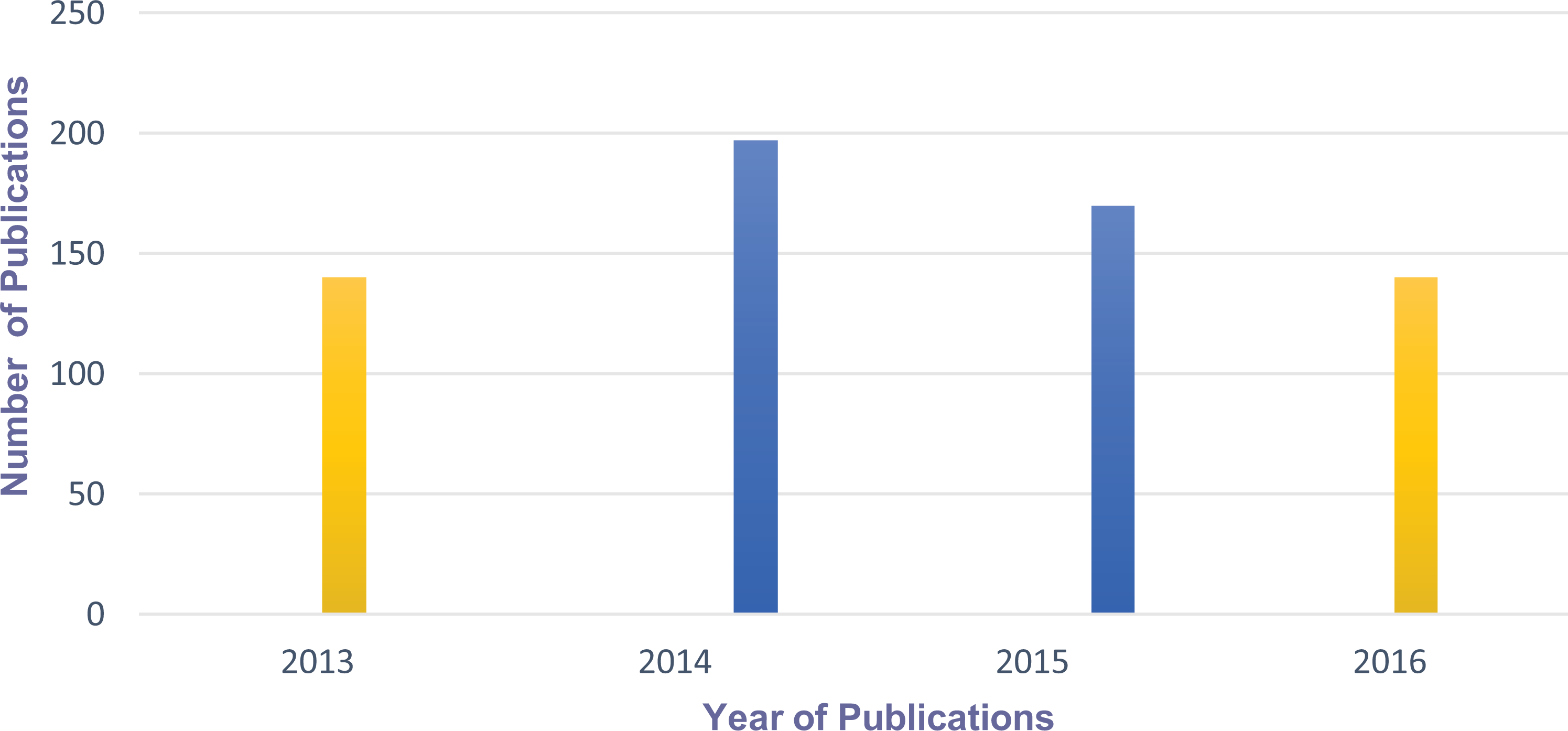
Number of publications from 2013–2016.
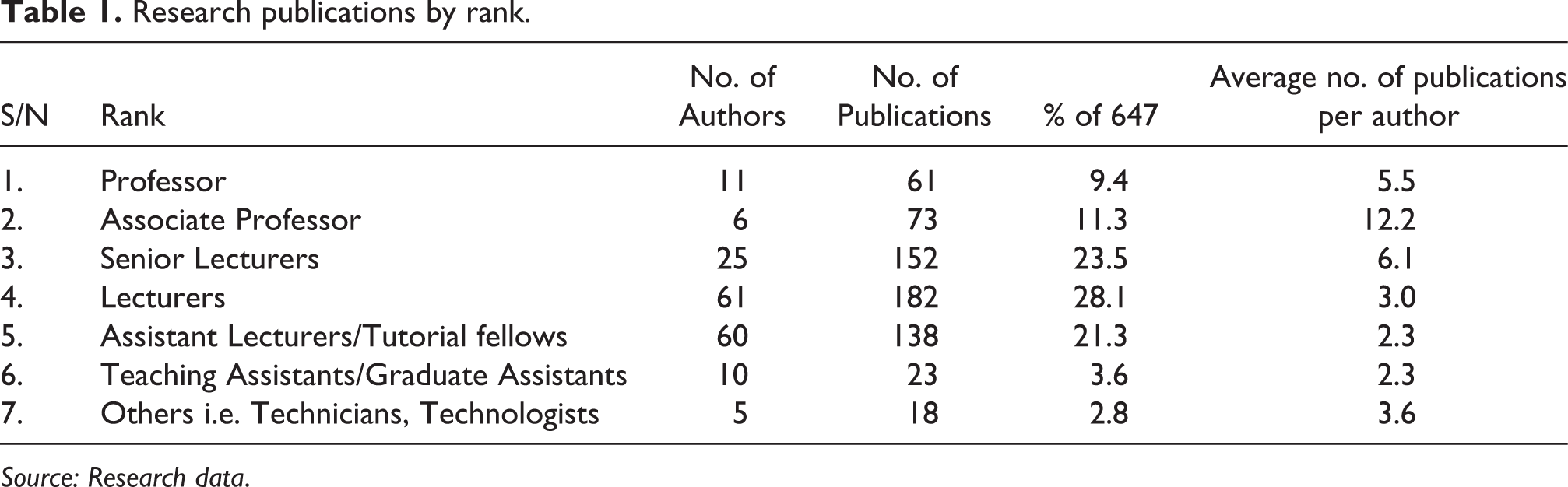
Table 1 further shows the number of research publications by rank of the academic staff at TU-K. Production of research papers was done at all academic ranks, as indicated in the table. The highest number of publications came from lecturers, who produced 182 (28.1%) papers. This was followed closely by senior lecturers, who had 152 (23.5%) publications and assistant lecturers, who had 138 (21.3%). Graduate teaching assistants were ranked last with 23 (3.6%) publications, followed by professors with 61 (9.4%) publications. However, associate professors ranked highest (12.2) in the average publications per author. This was followed by senior lecturers (6.1), professors (5.5), technicians (3.6), lecturers (3.0), assistant lecturers (2.3) and graduate assistants (2.3).
Research publications by rank.
Source: Research data.
The channels in which TU-K researchers publish their work
The study revealed that out of 647 papers published, a large number of the papers, that is 457 (70.6%), were published in journals, while 190 (29.4%) were published as conference proceedings and stored in institutional repositories. Out of the papers published in journals, 397 (87%) publications were done in international journals.
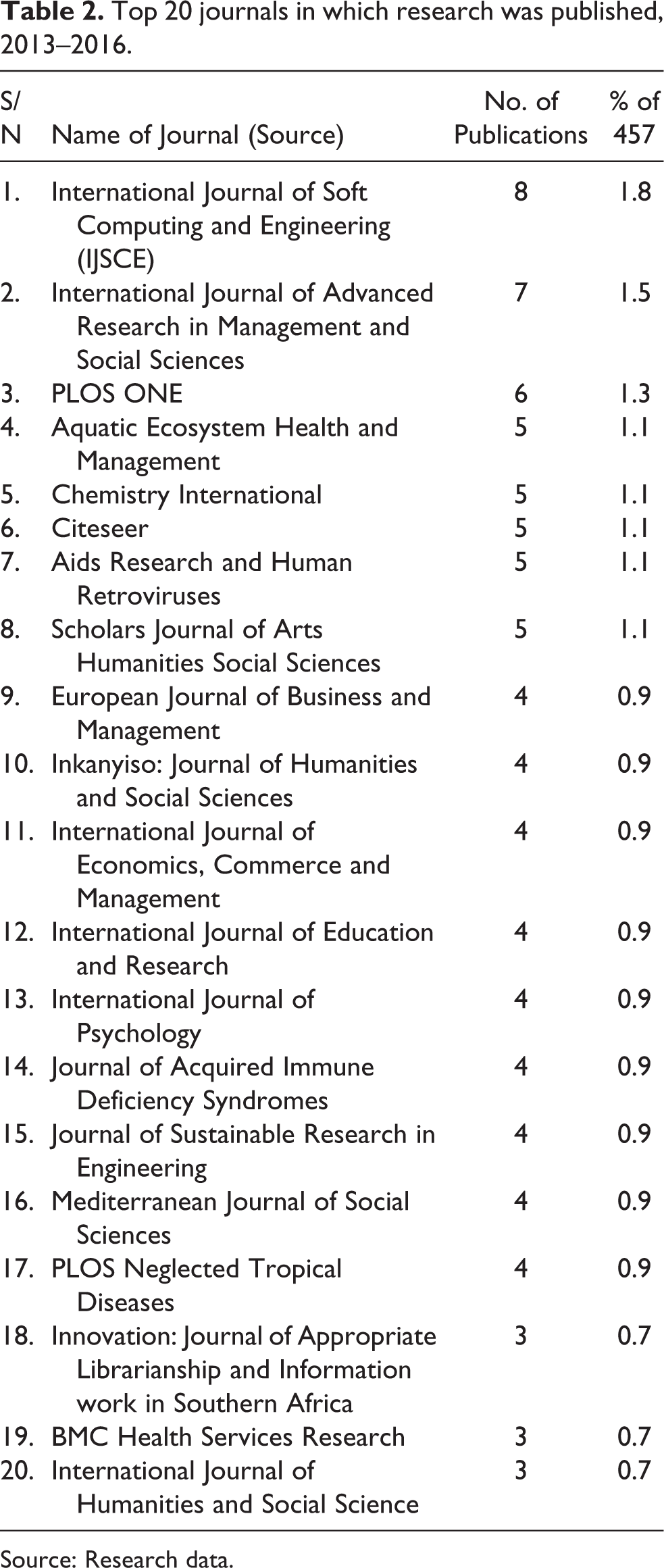
The top 20 journals, ranked by the total number of publications contributed, produced a total of 91 (19.91%) publications, while the rest, 366 (80.09%) of the publications were produced by the remaining (344) journals. At the top of the 20, was the International Journal of Soft Computing and Engineering (IJSCE) which contributed 8 (1.8%) publications, followed closely by International Journal of Advanced Research in Management and Social Sciences, and then PLOS ONE which had 7 (1.5%) and 6 (1.3%), respectively. Table 2 presents the top 20 journals as well as the number of papers published in each.
Top 20 journals in which research was published, 2013–2016.
Source: Research data.
The nature of research collaboration in TU-K
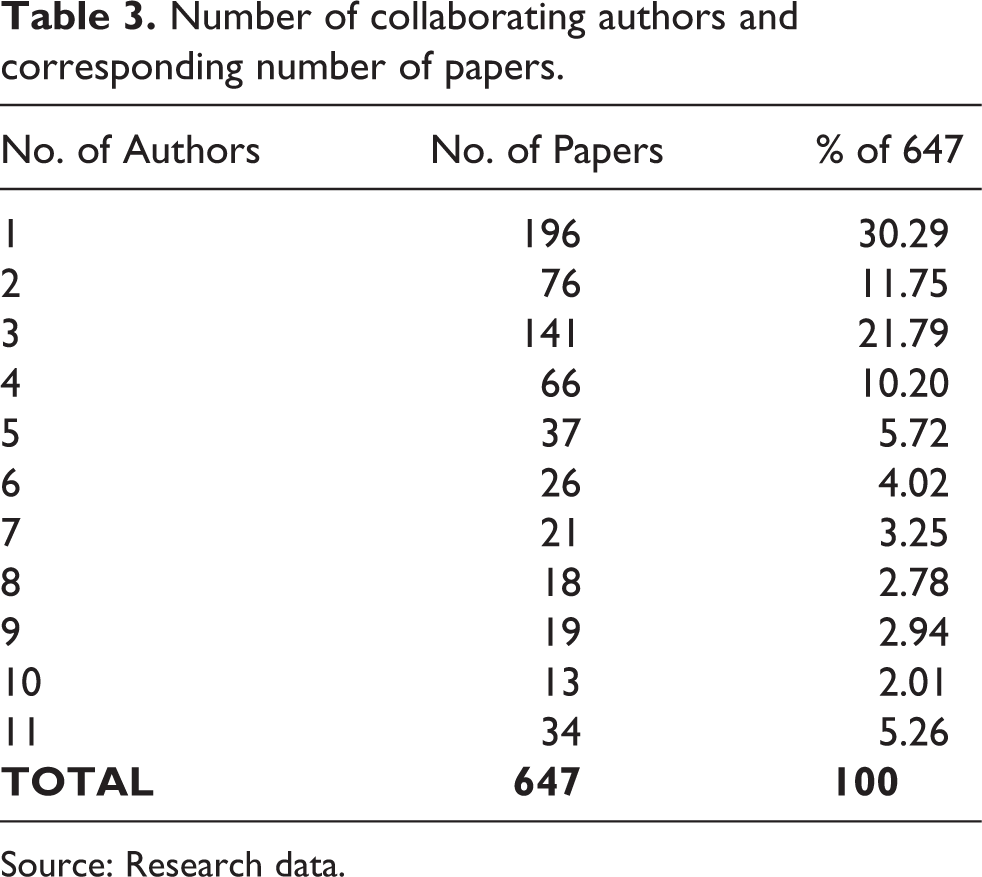
Table 3 shows that out of 647 publications analysed, only 196 (30.29%) were single authored, while 451 (69.71%) were co-authored. The study further found that most publications, 141 (21.79%), were done by three collaborating authors, while ten collaborating authors produced the least number, 13 (2.01%), of papers.
Number of collaborating authors and corresponding number of papers.
Source: Research data.
Most prolific schools and faculties at TU-K
Figure 2 shows that the Faculty of Applied Sciences and Technology (FAST) produced the highest percentage, 304 (47%), of the total number of papers produced by the university, in Google Scholar, for the period 2013–2016. It was followed by the Faculty of Social Sciences and Technology (FSST) which produced 239 (37%) of the total number of papers. The least number of papers, accounting for 104 (16%), was produced by the Faculty of Engineering Sciences and Technology (FEST).
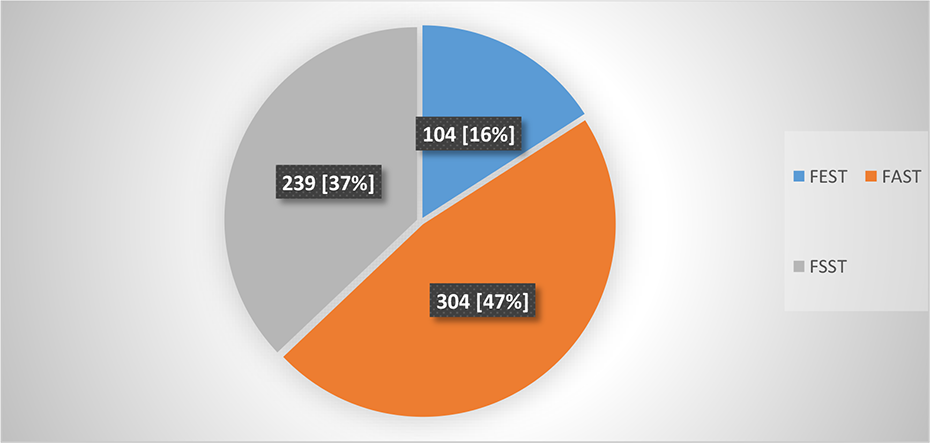
Production by Faculty (N =647).
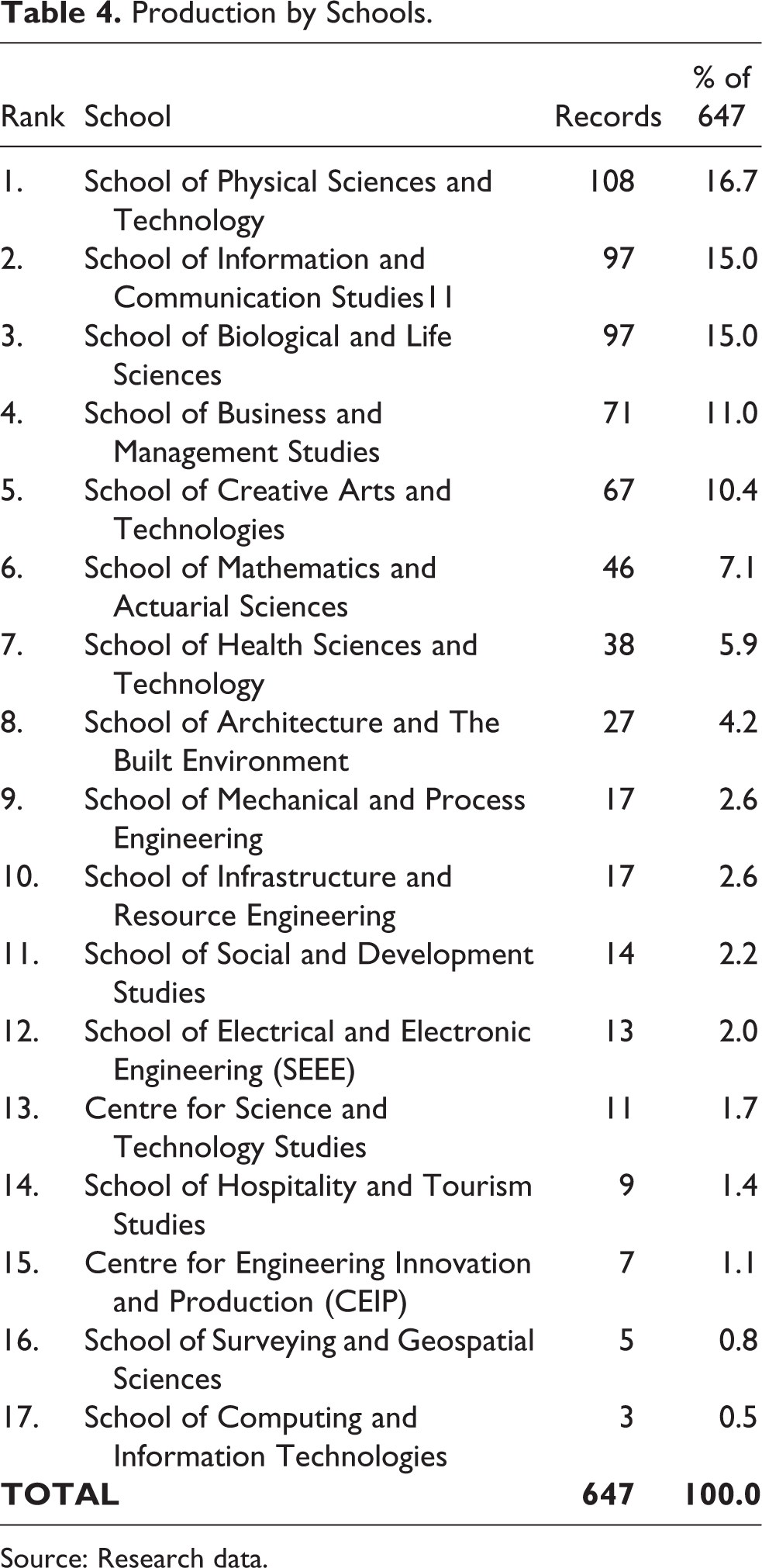
A further analysis was done on the production by schools and tabulated in Table 4. As shown by the data, the School of Physical Sciences and Technology (SPST) produced the highest number of papers, 108 (16.69%) papers out of the total produced by all the schools. It was closely followed by the School of Information and Communication Studies (SICS) and the School of Biological and Life Sciences (SBLS), both of which had 97 (14.99%) papers. The least percentage of papers was produced by the School of Surveying and Geospatial Sciences and the School of Computing and Information Technologies (SCIT), with each producing 0.77% and 0.46% respectively.
Production by Schools.
Source: Research data.
Factors affecting research productivity at TU-K
The participants identified the major factors which influence research productivity at TU-K as funding; mentorship; motivation; and equipment. Lack of time to conduct research was also a determining factor. Participant 10 stated that insufficient funding for research, from the university, hindered the publishing of research papers. It was noted by the participant that the university, in some instances, failed to promptly avail research funds awarded by sponsors through the university, to individual researchers. Participant 6 added that some researchers have failed to affiliate their research output to the university, given that they received no financial support from it. Further, Participant 5 said that, in as much as there was an increase in the number of graduate assistants in the university, research mentorship was lacking as they were not allocated to specific professors who could mentor them. Participant 2 also noted that senior researchers had a role to play in mentoring juniors and research novices into the practice, and all the tricks around research production and visibility. Participant 4 indicated that lack of motivation (monetary motivation, recognition and promotion) has made it challenging to conduct multidisciplinary research. Participant 10 noted that little time is allowed for research as staff are also involved in other duties, such as curriculum development, teaching and administration. Participant 3 indicated that research productivity was affected by lack of equipment for conducting research, especially in the engineering fields.
Strategies being considered to increase research output, visibility and impact
With regards to strategies being considered to increase research output, visibility and impact at TU-K, the participants revealed the following as the major themes: performance contracting; publication support; research merit awards; conference attendance support; research availability on the website; increase in collaboration with the industry; and the establishment of the Directorate of Research and Knowledge Exchange.
Strategies being implemented to increase research output
Performance contracts, publication support and research merit awards emerged as the major themes for the strategies being considered to increase research output. Participant 7 indicated that the full implementation of performance contracting in the university will increase research output, since it comes with research targets for academic staff, depending on their cadre. Participant 6 added that more effort was being put into supporting research and publication among staff members. In addition, Participant 10 noted that awards for researchers based on merit, for instance, in promotions, would yield more research output.
Strategies being implemented to increase research visibility and impact
Conference attendance support, research availability on the website, increase in collaboration with industry and the establishment of the Directorate of Research and Knowledge Exchange emerged, specifically, as the strategies being implemented to increase research visibility and impact at TU-K. According to Participant 15, the university was making efforts to subsidise the cost of conference attendance for lecturers, an initiative which is bound to make research products from the university more visible. Participant 5 also pointed out that the availability of research conducted in the university, on the website, is a big step towards increasing the visibility and impact of the research. Participant 11 noted that collaborations between the university and the industry have been on the increase, with more Memoranda of Understanding (MOU) underway. Participant 5 also identified the establishment of the Directorate of Research and Knowledge Exchange as a strategy to increase research visibility in the university which cannot be overlooked. This was based on the core role that the directorate is already playing in ensuring that visibility and impact of research at the university is improved. Through efforts of the directorate, this participant predicted more visibility and impact of the research produced by the university in the near future.
Discussion of results
This section discusses the findings of the study as a means of placing them in the correct context within the existing body of knowledge on the subject.
Trend of research publication and impact at the TU-K from 2013 to 2016
The first objective was to determine the trend of research publication and impact at TU-K for the period 2013–2016. The study revealed a steady increase in the research output (number of published papers) from 2013 to 2015. However, a drop in the output was experienced in 2016. From these findings, the growth of the university’s research (as indicated in Figure 1) can be confirmed since it was chartered in 2013. The findings also indicate that more staff are engaging in research and, therefore, a research culture is taking root within the university fabric (Ivey, Streete, Henry and Oliver, 2012). The drop in the number of research publications in 2016 can be related to the fact that not all the research conducted in that period has been indexed in Google Scholar.
The findings also showed that associate professors were the most productive in the ‘publication by rank’ category. They were followed by the senior lecturers, professors, lecturers, tutorial fellows and graduate assistants, in that order. The ranking of senior lecturers ahead of professors can be explained by the higher number of authors as compared to the other senior ranks. Another explanation is the promotion of senior researchers to administrative positions, which then hindered their high productivity due to the engagement of these offices. Similar arguments were held by Mishra and Smyth (2013) who noted that senior researchers may produce comparatively less than junior researchers. They allude to the administrative or leadership roles given to these senior staff, lack of the “publish or perish” pressure on the senior academics as compared to the junior academics, and the tendency of the senior lecturers to publish more in books than the high impact journals. They further add that junior researchers are driven to conduct more research for promotional and tenure related reasons, which might not be the case with senior researchers like professors.
Most of the researches conducted at TU-K are not cited. This is an indication of less impact and visibility of the research produced for the research community and society in general. Despite the low impact, the university has recorded growth over the years from 2014 to 2015. However, 2016 had a reduced number of citations which may be attributed to the fact that these researches have not been widely exposed and read by the research community. Ale Ebrahim et al. (2013) assents to this by noting that one of the ways to increase research output is through exposing it to the widest audience possible. They further add that the citations to research depend on the visibility of the output.
Channels in which TU-K researchers publish their work
The findings of this study indicated that researchers preferred publishing their work in international journals, as compared to local or regional journals. All the journals in the top 20 category, except one, were international. These findings are corroborated with Sambunjak et al. (2009) in their study on “National vs. international journals”, in which researchers attributed very high importance to publishing in international journals, adding that these journals are highly visible. The journal in which most articles were published had 8 (1.8%) papers while the least in the top 20 category had 3 (0.7%) papers. The impact factor for the top 20 journals (see Table 2) ranges from 1.033 (Aquatic Ecosystem Health and Management) to 7.296 (International Journal of Advanced Research in Management and Social Sciences). This indicates that the impact factor of the journals selected for publishing is moderate. Researchers also showed preference for publishing in journals. Matthews (2016) attributes such behaviour to the controversial journal impact factors which are greatly shaping research among academics. This is made possible through the inclusion of journals in citation and impact tracking databases like Elsevier’s Scopus.
Journal publishing preference is a strong signal of thought leadership and credibility (Brown, 2017). Articles published in journals tend to have more impact, as indicated in the comparatively higher number of citations they garner. As compared to conference proceedings, journals tend to be permanent and therefore can be retrieved any time (Ginsburgh, 2012). Readers also tend to show more preference to journals since they are published more frequently, in addition, containing more recent information as compared to books (Brown, 2017). The search-ability of journals is also based on articles, unlike that of books whose search-ability is focused on the packaging shell and not the individual chapters (Anderson, 2012). The search-ability of journal articles enhances visibility and impact of the research output of academics; no wonder more preference is given to journal publishing.
Nature and pattern of research collaboration in TU-K
The study found that research collaboration does occur among academics at TU-K. Most, 451 (69.71%), publications out of the total analysed, were co-authored. The fact that researchers collaborate is a good sign given the myriad benefits of collaboration in research. Some of which include sharing of skills and techniques, transferring of knowledge and, more especially, tacit knowledge, encouraging cross-fertilisation of ideas, enhancing of intellectual companionship and increasing the potential of visibility of the work produced by collaborating authors (Ocholla and Ocholla, 2007; Sitienei and Ocholla, 2010; Katz and Martin, 1997).
The study also noted some inter-relationship between the most collaborating authors and high research productivity. Authors who collaborated had higher output, as compared to their counterparts who had less collaborations or none. These findings are corroborated by Kyvik and Reymert (2017) in their findings on research collaboration in groups and networks. Vuong et al. (2018) also support these findings, but insist that this effect is, however, not significant in high performing authors. These findings are consistent with findings of Sooryamoorthy (2009) who found that collaborative research in South Africa, which is known to be Africa’s research leader, has been growing steadily and that researchers prefer collaborating rather than working as an individual. The findings, however, contradict the findings of Ocholla and Ocholla (2007) and Onyancha (2018) who found that collaboration was limited between researchers and universities in Africa.
Most prolific departments, schools and faculties at TU-K
The findings of the study indicated that most papers (47%) were produced by the Faculty of Applied Sciences and Technology (FAST). The Faculty of Social Sciences and Technology (FSST) followed with 37% and the least was produced by the Faculty of Engineering Sciences and Technology (FEST). The high productivity of FAST is promoted by their access to National Research Funds (NRF) files which have availed more funding for their research.
These findings are similar to the findings of White, Robbins, Khan and Freyman (2017) who established that on a global scale, applied sciences took up almost 40% of the publications while engineering sciences took up 17% of the global output. However, AbdAziz, Janor and Mahadi (2013) present contradictory findings in their study in which they found that, on average, social science-based departments performed better than science-based departments.
The findings further revealed that schools belonging to faculties that produced more output (see Figure 2), similarly, performed well. This is because the ranking of faculties is based on the cumulative output of the schools it houses. Furthermore, the performance of schools and departments also depends on the cumulative output of departments and individual researchers, respectively.
The School of Physical Sciences and Technology (SPST) topped the list followed by the School of Information and Communication Studies (SICS) which belong to the FAST and FSST, respectively. The same trend was displayed by ranking of departments in which the Department of Chemical Science and Technology, Department of Information and Knowledge Management and the Department of Biochemistry and Biotechnology ranked top three in the most prolific departments. Anninos (2014), however, dissents such rankings due to the dissimilarity of academic units, which leads to biased ranking. All in all, such rankings have the potential of spurring healthy competition and even give a strong motive for meritocratic hiring of academic staff (Lazaridis, 2010).
Factors affecting research productivity at TU-K
The findings show that insufficient funds, mentorship, motivation, research time, and inadequate equipment are the factors that affect research at TU-K. Similar findings are reiterated by Adoyo (2015) and Kumwenda, El Hadji, Orondo, William, Oyinlola, Bongo and Chiwona, (2017), who established that insufficient funding and time available for staff to conduct research, lack of motivation by peers, heavy workload, lack of mentorship and lack of research interest negatively affected research productivity of young researchers and universities in Africa. Nguyen (2015) and Law, Chan and Ozer (2017), similarly, summarised these factors into intrinsic and extrinsic factors.
Insufficient funds
Research funding, whether in the form of institutional support or from external sources, plays a big role in research. Funds aid all the stages of research including dissemination and lack of them, therefore, means research output will be affected.
There exists a positive relationship between money secured for research and the number of papers presented in international conferences. Notably, inadequate budgets is one of the reasons behind low scientific productivity in low income countries, that is, countries with a gross national income per capita below $955 (Sulo et al. 2012; Acharya and Pathak, 2019).
Additionally, Vlăsceanu and Hâncean (2015) investigated the existence of a positive association between research funding and research productivity, and concluded that there exists no significant statistical relationship between research funding and research impact, though it is proven that funding is a major incentive that boosts the number of publications.
Lack of mentorship
Mentoring is considered to be one of the most effective ways of sharing knowledge on research, especially in the demanding and competitive environment of higher education. Lack of it denies junior staff a chance to be guided by senior academic staff on the dos and don’ts of research, as well as the secrets of navigating through to becoming a ‘star’ in research. Unlike classroom learning, in mentorship, the mentee gains hands-on skills.
This study concurs with the findings of Huu (2015), Sorkness et al. (2017) and Wichian, Wongwanich and Bowarnkitiwong (2009), who established that research peer support or mentorship is a useful practice for junior and less research-experienced investigators, since it enhances their research competence, productivity and career satisfaction. On the contrary, Nundulall and Reddy (2011) note that, as much as mentorship was popular in many fields, there is not much evident data to prove it as a means to increasing research output.
Insufficient time incentive
A research process is quite intensive and requires an adequate investment of time. Unfortunately, the academics at TU-K, as is the case with most academic institutions, do not have sufficient time to conduct research, thereby affecting research productivity. Academic staff at TU-K not only engage in research, but also perform other duties such as curriculum development, teaching and administrative duties. All these activities compete for their limited time and this jeopardises research productivity.
Similar findings have been reported by Gull and Arshad (2018) and Wadesango (2014), who indicate that teaching load and administrative tasks indeed influence research productivity, and if possible, academics should be given one day per week for research in addition to more writing retreats as boosters to research productivity. Aithal (2016) is, however, of the opinion that faculty members get a lot of free time from teaching, like semester end vacations, examination time for students and study holidays, among others, which is sufficient for research.
Inadequate motivation
As revealed in the research, lack of motivation affected the research output of academics. Researchers expect motivation in various forms. These include monetary motivation and recognition. Similar to these findings are those of Zhang (2014), in which he identified promotion, performance appraisal, job tenure, recognition and financial returns as motivators to research in universities.
These findings are echoed by several researchers (Ghabban et al. (2019), Chinamasa (2012), and Vlăsceanu and Hâncean (2015)) who found a direct influence of motivation on research productivity in Saudi universities, new universities in Zimbabwe and Romanian institutions of higher education respectively. Mweru (2010) also points out negative reviews of submissions to journals, low salaries and difficulties in obtaining recent books and journal articles as some of the factors that affect the choice of journal in which to publish research.
Inadequate equipment
Lack of equipment is an impediment affecting disciplines like engineering that require laboratories or workshops equipped with sophisticated and high-tech equipment and machinery for research. The inability of academic researchers to get sufficient access to research equipment affects their output. Furthermore, in some cases, the equipment is made available at later stages when they cannot meet the demands of the study due to the now outdated technology (Nguyen, 2015).
Robust research efforts cannot take place in a state of inadequate or obsolescent infrastructure (Imhonopi and Urim, 2013) and universities should, therefore, increase budgetary allocations for equipment in order to enhance research productivity (Okendo, 2018).
Strategies being implemented to increase research output, visibility and impact
The current study found that TU-K is implementing a number of strategies in order to increase the research output, visibility and impact. These strategies include performance contracting, publication support, research merit awards, conference attendance support, research availability on the website, increased collaboration with the industry, and the establishment of the Directorate of Research and Knowledge Exchange.
Performance contracting
Performance contracting is an agreement which defines responsibilities and expectations meant to achieve mutual benefits between the contracting parties (Mburu, 2014). Academic universities engage in performance contracting with their staff in which they are expected to produce a stipulated amount of research, alongside their teaching and service activities in the university.
The full implementation of performance contracting is therefore seen to increase productivity in research, since the increase in productivity and improvement in service delivery is the aim of performance contracting (Brunn, 2017). Nganyi, Shigogodi and Owano (2014) note that performance contracts are based on targets which are Specific, Measurable, Attainable, Realistic and Timebound (SMART) in nature which, combined with their incremental nature, lead to increase in performance and productivity.
Publication support
Research writing without publishing is a futile exercise. The high cost of publishing, in some instances, impedes the research efforts of academic staff. The need to balance limited funds in this economy leaves research publication fund allocations at zero. Publication support to staff will not only encourage research, but also enhance the productivity, visibility and impact of research produced by the university.
Similar findings are reiterated by Aithal (2016) in a study on how to increase research productivity in higher institutions. In this study, he mentions journal publication support through provision of publication charges, organisation of periodic conferences and consequent creation of researcher networks as approaches to improve research productivity. Aithal further adds that providing research resources such as information technology facilities, computation and data analysis facilities, to lecturers and students, could go a long way in improving research productivity. Wadesango (2014) also confirms that generic writing workshops can provide the needed support through inspiring and empowering researchers to write quality publishable papers.
Research merit awards
Academic staff in universities are a key resource for the success of their institutions. Their performance determines the productivity and visibility that their universities experience. Consequently, their motivation is crucial in determining the quality of their output. Merits in academic institutions include promotional tiers (assistant, associate and full professor) where one rises to the next rank and its associated pay scale based on productivity (McCrea and Deyrup, 2016). Merit awards can serve to help retain valuable employees and motivate them, especially in this era of competition among universities (Bayissa and Zewdie, 2010).
These findings are consistent with the findings of Victor and Babatunde (2014) and Zhang (2014) which note that there exists a significant relationship between motivation (reward and pay, chance of promotion, etc.) and academic performance in the education enterprise. Aithal (2016) also identifies honouring the students and lecturers, on an annual basis, who considerably contribute to research as one of the strategies to increasing research productivity in universities.
Conference attendance support
Conference attendance is an important correlate to lecturer’s publication productivity. The more faculty attend conferences, the more they experience growth in their research productivity (Gregorutti, 2008; Rush and Wheeler, 2011). However, the cost of conference attendance hinders willing staff from attending conferences and, consequently, presenting research papers at conferences. This can be counteracted through partial or full conference funding to academic staff.
Masango (2015) explored the possible criteria for producing quality research outputs and asserted that funding for conferences is a great inspiration for staff to engage in more research. Bell, Hill, and Lehming (2007) further argued that the importance of conference attendance should not be overlooked, since it is believed to increase researcher visibility and also provide networking opportunities which, in some instances, results in research collaborations. Furthermore, increasing the opportunities for faculty to attend conferences can assist them in building confidence and an academic network that would encourage them to engage more in research work (Alzuman, 2015).
Research collaboration
Collaboration can occur between academic researchers or between the academic institutions and the industry. Collaboration enhances knowledge diffusion, innovation and, consequently, bolsters research activities. Academic collaboration is acknowledged to be an important transmission mechanism through which sciences can be diffused across institutions, regions and countries (Al-Sultan and Alzaharnah, 2012; Alzuman, 2015). Several studies have pointed out the importance of academic collaboration programmes to the academic research and asserted its positive impact on faculty research performance. Lee and Bozeman (2005) indicated that academic collaboration was associated with higher research productivity (number of publications) and quality of published works (citations). They also found that faculty research productivity increased as their participation in collaboration programmes increased, particularly when the collaboration is outside of one’s institution. Meo, Hassan and Usmani (2013) also found that collaboration with rich international research institutes contributed to the growth in research productivity at Saudi universities. It is also noteworthy that collaborations in webometrics receive better ratings than single-authored research in rankings (Asekun-Olarinmoye, 2015).
University-industry collaborations is a great stimulus to research productivity in academic research as it creates a source of research funding and, further, makes research more impactful, as the fruits of research are usually seen in industry products and services. This view is supported by Garcia, Araújo, Mascarini, Santos and Costa (2020) who affirm that collaborations between universities and firms have a positive effect on academic productivity, and more especially when the collaborations are long term. Konstantin, Yana and Oksana (2016) also support this by noting that universities could improve their performance by providing young scholars with wider opportunities for growth, through interaction with the industry. Furthermore, the National Research Fund (NRF) is a strong proponent of collaborations, either at multidisciplinary level or as partnerships between industry and academia (Narayanan and O’Connor, 2010).
Research availability on university websites
Availing research on university websites increases the visibility of the output, and further provides substantive references for researchers as they conduct research. This also creates availability of the same research to students to enable them to produce quality work. Mwanzu and Malesi (2015) note that there is an increasing demand for academic researchers to deposit their work in repositories, in order to increase their research visibility. A similar study by Lee, Burnett, Vandegrift, Baeg and Morris (2015) confirms the great contribution of the institutional repository in making research papers both available and accessible to readers. Persson and Svenningsson (2016) also indicated that the use of social media websites has a great potential in enhancing research visibility in Linköping University and, hence, librarians have taken upon themselves the role of advocates for the maximisation of these benefits by researchers.
Establishment of the Directorate of Research and Knowledge Exchange
The establishment of a directorate to oversee all research activities in the university and promote productivity of research is foreseen to bring great impact to the university, all its faculty and students. This unit has made progress by creating a conducive research environment. It has created blueprints like research policy (still in draft at the time of research), research strategy, code of research good practice and code of practice governing the ethical conduct of research, plus other regulations for the university, all in the interest of improving research status (TU-K, 2020). This finding is consistent with those of Kyvik and Aksnes (2015) who argued that university policies, practices and resources greatly shape the productivity of researchers. Huenneke, Stearns, Mart and Laurila (2017) also assert that the revision of institutional policies and infrastructure for research form key strategies for improving research productivity among university faculty members.
Conclusions and recommendations
Research productivity and the well-being of universities are intertwined. There exists a strong relationship between productivity-visibility-accessibility-impact in research, which university researchers need to decipher and exploit for maximum benefits in research. Based on the study findings, the study concludes that research visibility and impact at the TU-K is on the growth. However, the knowledge in journal selection and collaborations need to be harnessed by all researchers. The study also concludes that research productivity among lecturers at the TU-K is affected by factors like insufficient funds, lack of mentorship, insufficient time, inadequate motivation and equipment. Additionally, despite the challenges which affect research, many strategies have been enlisted to maintain and increase the growth of research in the university.
Research is one of the major activities of academic universities. The authors suggest that the university should increase the research funding support to academic staff, as well as the motivation needed in stimulating research. More time should also be allocated to research activities as a way of boosting productivity. The research environment should be improved by availing more equipment needed for research in all the faculties. Finally, research peer support for junior and less experienced academics should be encouraged as a way of increasing their research competence.
