






Abstract
Keywords
Patient engagement is garnering considerable attention in the context of patient-centered care, accountable care, healthcare reform, and the Institute for Healthcare Improvement (IHI) Triple Aim of improving patient care, improving population health, and reducing cost. 1 Indeed, in 2013, an entire issue of Health Affairs was devoted to the topic of patient engagement. 2 Of course, patient engagement and patient participation are not new concepts. Seminal research conducted in the 1980s by the team of Greenfield, Kaplan, and Ware links patient participation in medical care to improved health outcomes for patients with chronic illness.3–5 Similarly, work on motivational interviewing by Miller and Rollnick, which also stems from the 1980s, demonstrates that guiding patients through decisions to change behavior (e.g., alcohol use) can elicit and strengthen motivation for change. 6
This study focuses on patient participation in medical decisions, which is widely considered beneficial.7–16 Many healthcare providers, patients, ethicists, medical educators, and researchers—ourselves included—have written about the importance of shared decision making (SDM).17–21 There are clear moral and ethical grounds for patient participation in decisions about their health.21,22 However, the scope and strength of empirical support are not clear. Although the Greenfield, Kaplan, and Ware studies have frequently been cited as evidence that patient participation in decision making is beneficial, it is difficult to determine which elements of the intervention actually led to the reported benefits: The studies involved coaching patients to ask questions, negotiate medical decisions, and overcome barriers such as embarrassment and anxiety to take a more active role in their care.3–5 This is a complex intervention, the components of which are difficult to disentangle. Perhaps most important in the context of our investigation, the results reported do not clearly delineate between increased participation in the medical visit and increased participation in decision making.
There is a large body of literature on engaging patients in decision making, particularly through the use of decision aids. Although decision aids are not the only means by which one can improve patient participation in decision making, there is consensus that well-designed decision aids can increase patient knowledge, improve patient-reported involvement in decision making, and decrease decisional conflict.8,23,24 However, studies designed to evaluate decision aids are rarely set up to measure patient participation in decisions made during the medical encounter and its impact on clinically relevant outcomes.25,26 There is also increasing attention on physician training in SDM skills, although this line of inquiry has not yet been fully integrated into the larger discussion regarding outcomes of SDM. 27 Given the argument that patient participation in medical decision making is a sine qua non of patient-centered care,13,28 it is important to document the available evidence. The purpose of this systematic review is to assess the extent to which patient participation in medical decisions is associated with measured health outcomes, as reported in the peer-reviewed literature.
Methods
We conducted a systematic review of the peer-reviewed literature to evaluate empirical evidence in the context of physician–patient encounters.
Search Strategy
A primary search was run in PubMed (www.ncbi.nlm.nih.gov/pubmed) using the following strategy: Terms=(Physician-Patient Relations [MeSH] OR (Patient Participation [MeSH]) AND (decision OR decisions OR option OR options OR choice OR choices OR alternative OR alternatives); Field=Title/Abstract; Limits=English, Humans, Publication date=To 28 February 2015. The search excluded non–English language and animal studies.
PICOS Categories
The PICOS categories, put forth in the PRISMA Statement for Reporting Systematic Reviews and Meta-Analyses, are as follows:
29
Information Sources
PubMed includes MEDLINE and life sciences journals; articles indexed in PubMed date back to 1965. Because this article focuses on the context of physician–patient encounters, we did not include additional databases. Given the lag time for some articles to be indexed in PubMed, running the search through February 2015 increases the likelihood of capturing studies published by the end of 2014.
Study Selection
Our a priori inclusion criteria were that the publications must be in the context of the physician–patient relationship, involve a measure of patient participation related to a decision addressed during the medical encounter, be empirical (i.e., not hypothetical), be peer reviewed, have outcomes related to participation as part of the study, and be published in English. Citations with no abstract were excluded only if they clearly were not about the topic, if they were not in English, or if they were non-research articles (e.g., editorials). Each author and several research assistants conducted this screening process; at least one author and 2 research assistants reviewed each study. We obtained full-text articles for all citations that met the inclusion criteria; each article was evaluated by 2 trained reviewers. We conducted a secondary search of references in those articles and obtained full-text articles for all of the nonredundant citations; each article was evaluated by 2 trained reviewers.
Data Collected and Data Collection Process
For each article that was retained, we conducted an in-depth review and extracted detailed information regarding the author, publication date, clinical context, country or countries in which patients were studied, number of patients in the study, measures of patient participation, measures of decision-making processes, and outcome measures that were tested for links to the participation measures. This more thorough review added a layer of scrutiny to the measures of patient participation; articles were dropped at this stage if their measure of patient participation was based solely on physician behavior or patient assignment to a group. Outcome measures may or may not have been the primary outcomes of the study. All authors defined the data abstraction process and categories, as well as the form used for abstraction, and refined the protocol for training research assistants. At least one research assistant and at least one author independently reviewed each article and extracted relevant data. Any disagreements or questions emanating from research assistants were handled by the first author and senior author, who also double-checked all data for accuracy.
Quality Assessment of Included Studies
Each randomized controlled trial (RCT) was independently reviewed by at least one research assistant and the first author to assess risk of bias, using a protocol that addressed methods of randomization, creation of comparable groups, maintenance of comparable groups (i.e., attrition), potential investigator bias (i.e., allocation concealment, blinding), appropriateness of measures, and appropriateness of statistical methods. 30 These reviewers met to compare assessments and reconcile any differences. In the few cases of reviewer disagreement or questions about the data, the first author and senior author discussed and resolved discrepancies. Although we did not conduct a parallel assessment of the nonrandomized studies, we note the possibility of publication bias across all included studies.
Data Analysis and Reporting
Data from all retained peer-reviewed articles are reported in tables delineated by type of study (i.e., RCT, cross-sectional, longitudinal, and choice).
Results
We reviewed available abstracts of all 9757 citations found through the primary search (see Figure 1). Of these, 7973 were rejected because they were not about the topic, were not empirical, were not specific to decision making, were not in the context of physician–patient decisions, or lacked both a measure of patient participation and a measure of patient outcomes (excluding knowledge), or an attempt to relate the two to each other. We conducted full-article reviews of the remaining 1784 citations; 1670 did not meet the inclusion criteria described above and were rejected, yielding 114 articles from the primary search. Our secondary search of references in those 114 articles identified 170 nonredundant citations; corresponding full-article reviews found 16 more that met the inclusion criteria. Taken together, the primary and secondary searches yielded a total of 130 articles for in-depth review, 14 of which were excluded at that stage because no actual measure of patient participation was detected (i.e., these studies measured physician behavior or patient assignment to a group). Data abstraction on the remaining 116 articles focused on clinical context, country, sample size, measures of patient participation and health outcomes, and results.
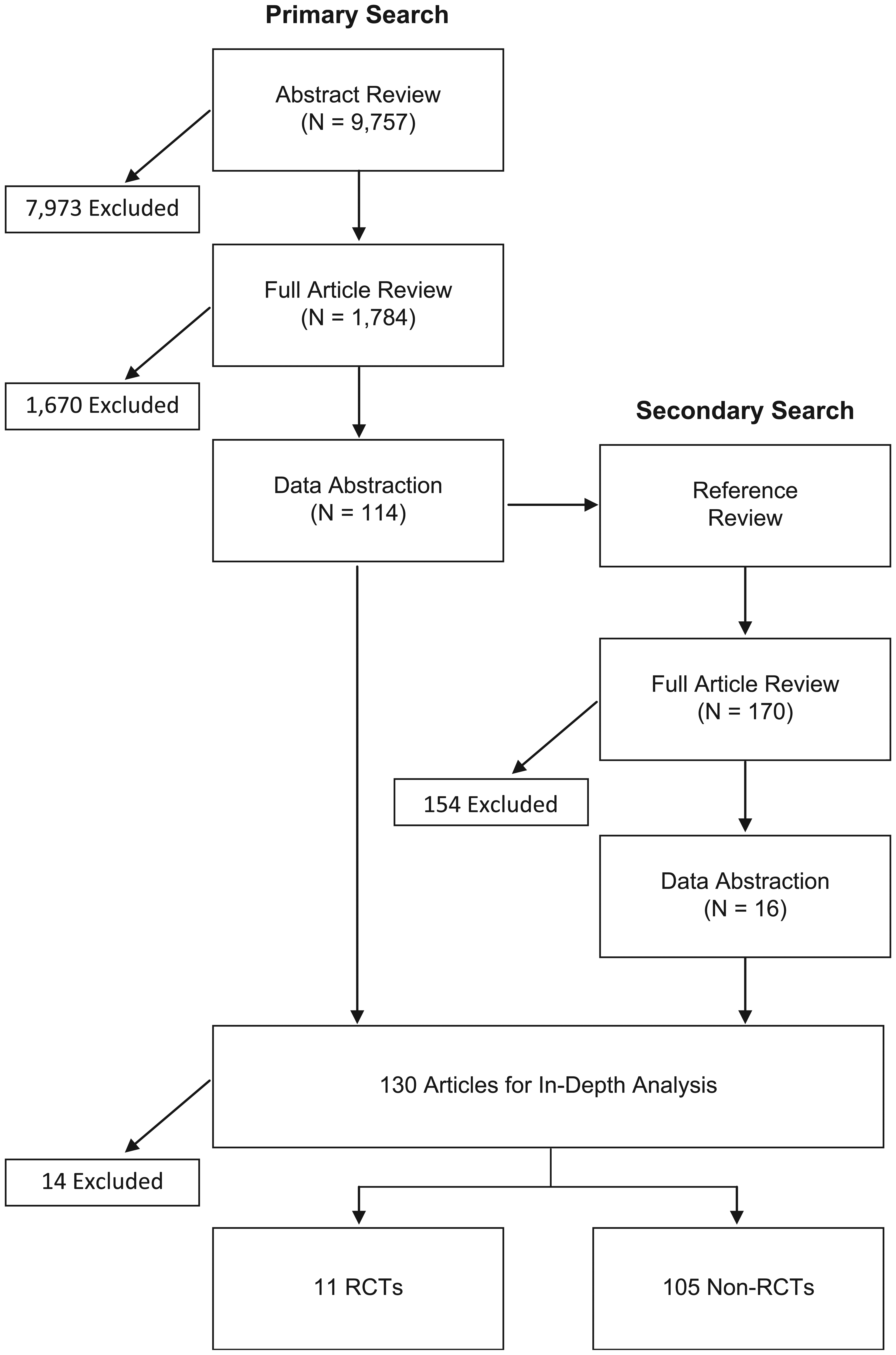
Search results.
The first study that met our inclusion criteria was published in 1979, 31 the first relevant RCT was published in 1997, 32 and the volume of publications grew markedly in the 21st century. Of the 116 articles, 11 were based on RCTs.32–42 The 105 articles representing nonrandomized studies encompassed 83 cross-sectional designs, 13 longitudinal designs, and 9 choice versus no-choice designs.
Measures
Across all studies in this review, measurement of patient participation in medical decisions varied widely, with involvement operationalized by methods ranging from audio recordings 34 to a single-item measure of patient-reported involvement in decision making32,36 or various patient decision-making scales.43–47 More specifically, as illustrated in Tables 1–4, the studies drew on 24 established measures plus a range of author-created measures of participation. A legend for the tables appears at the end of Table 4. All of the RCTs included at least one previously published participation measure, albeit different ones. In contrast, about half of the nonrandomized studies measured participation solely with measures created for those studies, often using the same moniker (e.g., “perceived involvement”) for diverse operational definitions. The established measure used most frequently was the Control Preferences Scale, 45 although it was used in only 17 of the 116 studies. Even when used, this and other established measures were often referred to by different names or analyzed with different categorical groupings.
Randomized Controlled Trials (N = 11)

A legend for the tables appears at the end of Table 4.
Cross-Sectional Studies (N = 83)

A legend for the tables appears at the end of Table 4.
Longitudinal Studies (N = 13)

A legend for the tables appears at the end of Table 4.
Nonrandomized Studies With an Opportunity for Choice (N = 9)

Authors give no value judgment to lumpectomy vs. mastectomy. ** Authors consider breast conservation surgery (BCS) is better than mastectomy.
Information and Patient Preferences (Cassileth et al., 1980). 182 b Authors created their own participation measure. c Decision Making During Illness (Degner and Sloan, 1992). 183 d Krantz Health Opinion Survey (Krantz et al., 1980). 184 e Perceived Involvement in Care Scale (Lerman et al., 1990). 46 f Control Preferences Scale (Degner et al., 1997). 45 g Patient Participation Scale (Man-Son-Hing et al., 1999). 185 h SDM-Q-9 Scale (Kriston et al., 2010). 186 i OPTION Scale (Elwyn et al., 2003). 61 j Participatory Decision-Making (Kaplan et al., 1996). 187 k Commonwealth Fund Health Care Quality Survey (2001). 188 l Hall’s Trust in Physician Scale (Hall et al., 2001). 189 m Medical Outcomes Study (Kaplan et al., 1989). 5 n Quality Improvement for Depression Survey (Rost et al., 2001). 190 o Facilitation of Patient Involvement in Care Scale (Martin et al., 2001). 191 p Adapted from Patient Perceptions of Consultation Tasks (Makoul et al., 1995). 58 q Decision-Making Preference Scale (Ende et al., 1989). 192 r Health Care Climate Scale (Williams et al., 1996). 193 s Cologne Patient Questionnaire (Pfaff et al., 2003). 194 t Picker-Commonwealth Survey of Patient-Centered Ambulatory Care. 195 u Adopted from a study by Greenfield et al. (1985). 3 v Workbook for Assessing Patients’ and Practitioners’ Decision Making Needs (Jacobsen and O’Connor, 2006). 196 w Adapted from Strull et al. (1984). 197 x COMRADE Scale (Edwards et al., 2003). 198 y MAPPIN’SDM. 79
Not reported. 1 Regression analysis. 2 t-test. 3 Mann–Whitney test. 4 MANOVA test. 5 ANOVA test. 6 Chi-square test. 7 ANCOVA test. 8 Wilcoxon rank-sum test. 9 Correlation analysis. 10 Generalized estimating equations (GEE). 11 Fischer’s exact test. 12 Wald test. 13 Confirmatory factor analysis 14 Tukey’s range test 15 Kruskall–Wallis H test. 16 Structural equation modeling.
Outcome measure increased. Ø No effect. ↓ Outcome measure decreased. Adverse effects are italicized (e.g., ↑ anxiety, ↓ satisfaction).
Similarly, outcome measures varied widely. In general, 4 types of outcomes were reported across these studies: psychosocial (e.g., satisfaction, anxiety, decision regret, decisional conflict, and quality of life), behavioral (e.g., prescription filling and adherence), practice-related (e.g., physician satisfaction and encounter length), and biomedical (e.g., clinical asthma status). As can be surmised from Tables 1–4, psychosocial constructs constitute the vast majority of the outcomes.
Randomized Controlled Trials
As shown in Table 1, most of the 11 RCTs were conducted in Germany (n = 5) or Canada (n = 3). In terms of clinical context, most of these studies focused on primary care. All of the RCTs involved an educational intervention, often physician training in SDM. Patient participation increased in 10 (91%) of the 11 RCT intervention groups, and at least one positive outcome was linked to increased participation in 5 (50%) of these 10 RCTs.32,36,39–41 At the level of individual outcome measures across all 11 RCTs, this represents only 6 (14%) of the 42 outcomes hypothesized to be positively influenced by patient participation in decisions. It is important to note that one additional positive outcome was reported, yet it was not related to a significant increase in the corresponding participation measure. 42 There was no evidence that participation was linked to improvement in the remaining 35 outcomes measured. In terms of outcome categories, 10 of the RCTs included at least one psychosocial outcome, 4 included a behavioral outcome, 3 included practice outcomes, and 3 included a biomedical outcome.
A quality assessment found that most of the studies had acceptable research designs and statistical analyses, and responsibly drawn conclusions. Although few RCTs reported on the status of patient, provider, or investigator blinding, the nature of the interventions (e.g., physician training and decision-aid use) often did not allow for complete blinding. Many of the RCTs did not achieve the expected results, but noted reasonable limitations to the study methodology and provided credible explanations. However, 2 were deemed of poor quality due to large and unaddressed potential for investigator bias 36 and/or moderate attrition.36,41 These studies are demarcated by italics and the words “quality concern” in the second column of Table 1. A supplementary summary of each RCT is available from the authors.
Nonrandomized Studies
Although nonrandomized studies do not carry the rigor of RCTs, given the relatively small number of RCTs in this review, it is instructive to summarize the cross-sectional, longitudinal, and choice versus no-choice studies (see Tables 2–4 for citations and basic information). Across all of the 105 nonrandomized studies, 78 (74%) indicated an association between patient participation and at least one positive outcome, generally a measure of satisfaction. Results were mixed in 28 (36%) of the 78 studies within this subset (i.e., patient participation was associated with both positive and null or negative effects). A negative relationship between patient participation and measured outcomes was detected in 5 (5%) of the nonrandomized studies.48–52
More specifically, among the 83 cross-sectional studies abstracted in Table 2, 66 (80%) found that patient participation in decision making was positively associated with at least one of the outcomes measured, ranging from biological measures to adherence, trust, satisfaction with physicians, satisfaction with care, and/or satisfaction with the decision itself (i.e., reduced decisional regret). At the level of individual variables, 129 (61%) of the 212 outcome variables measured in the cross-sectional studies were positively associated with participation. The proportion of positive results was lower in the other types of studies: 8 (62%) of the 13 longitudinal studies summarized in Table 3 reported at least one positive relationship between increased patient participation in decisions and improved outcomes, yet positive associations were found for only 12 (25%) of the 48 outcomes measured. Finally, 4 (44%) of the 9 choice versus no-choice studies outlined in Table 4 found at least one positive relationship; this corresponded to 8 (33%) of the 24 outcomes hypothesized to be associated with participation.
Summary
Nearly half of the RCTs and most of the nonrandomized studies reported an association between patient participation and at least one positive outcome. However, at the level of individual variables, there were slightly more null outcome tests than positive outcome tests. The pattern of null versus positive results varied by study type: Whereas approximately three-quarters of outcome tests for RCTs, longitudinal studies, and choice studies were null, the cross-sectional studies offer a different impression because more than half of the outcome tests in those investigations were positive.
Discussion
Our review of patient participation in decision making during medical encounters focused on peer-reviewed articles published in English through early 2015, covering a timespan that includes the advent of the Internet and concomitant increase in patients’ access to information. Moreover, this article offers both an update and an organizing framework for investigations in the field, complementing recent reviews of SDM training for health professionals 27 as well as SDM outcomes for patients. 53 Although our study is limited to articles published in English, the systematic approach and comprehensive nature of this work could be replicated in other languages.
Our main objective was to assess the extent to which patient participation in decision making within medical encounters is associated with measured patient outcomes. Despite widespread belief that participation in health decisions is associated with better health-related outcomes for patients, we found relatively few studies that measured both participation and outcomes, and attempted to relate the two. Indeed, only 11 RCTs assessed this connection, and they provide inconsistent evidence for improved outcomes. More specifically, only half of the RCTs with increased patient participation in decisions reported a positive impact on outcomes. All but one of the measured outcomes that improved were psychosocial in nature (i.e., satisfaction, anxiety, decision regret, and decisional conflict), yet they were outnumbered by null results for similar outcomes in the other RCTs. Interestingly, no improvement in any of the psychosocial outcomes was detected in the one RCT that found improvement in a behavioral outcome (i.e., reduced use of antibiotics for acute respiratory infections). 40
Although nonrandomized studies are considered less rigorous than RCTs, we included them to provide a more complete picture of research in this area. The nonrandomized studies—particularly cross-sectional investigations—suggest a positive effect. A close look at the tables indicates that satisfaction was a predominant outcome measure in the cross-sectional studies. The proportion of satisfaction measures to all outcomes measured was 1.6, 1.8, and 3.1 times higher in cross-sectional studies than in RCTs, choice designs, and longitudinal studies, respectively. Moreover, the proportion of positive results for satisfaction measures was higher as well: 76% for cross-sectional studies, 50% for choice studies, and 40% for longitudinal studies, compared to 25% for RCTs. Taken together, the relationship between participation and outcomes is far from clear. Our review suggests that the lack of clarity is due, in large part, to inconsistent measurement.
Measurement Considerations
Several aspects of measurement are important to address, including choice of the measures themselves. The review revealed wide variation in the conceptual and operational definition of both participation in medical decisions and related outcomes, making it difficult to make direct comparisons across studies. For example, observer ratings may differ from patient reports; different self-report scales may tap different underlying constructs. Thus, 2 studies that report effects of patient participation may actually be measuring different things.
Participation Measures
The choice and use of participation measures are fundamental and critically important to this line of research. 54 However, in terms of gauging participation, we found considerable heterogeneity of measures used across studies, amplified by a plethora of author-created measures. In addition, there was incongruity among studies using the same measure (i.e., how the measure was applied). For instance, although the Control Preferences Scale 45 was used more frequently than any other established measure, the groupings of response categories varied (e.g., shared or not-shared in some; and active, shared, or passive in others). The apparent lack of a standard measure may have prompted many authors to develop their own, nonvalidated measures of patient participation.
Outcome Measures
The diversity of measures and metrics across outcome variables makes it difficult to form a coherent picture regarding actual benefit of patient participation. Many studies included patient satisfaction as a key variable. However, measures of satisfaction were inconsistent and crossed several domains, including satisfaction with interpersonal communication, quality of care, physicians, or other facets of the interaction. Even if consistent measures were used, patient satisfaction is a highly skewed and problematic construct with questionable value as a primary outcome.55–57 Anxiety, decisional conflict, and quality of life are among the other psychosocial outcomes measured, again with variable approaches to operationalization. Measurement of behavioral, biomedical, or practice-based outcomes was relatively rare.
Types of Measurement
Although there are myriad studies of patient–provider communication in the literature, this review highlighted a dearth of studies that analyze actual communication related to decision making, which may differ markedly from self-reported communication.58,59 Several systems have been developed to measure SDM by coding audio recordings, video recordings, or transcripts,60–64 but only a few look beyond provider behavior and explicitly document patient or companion involvement in decision making.58,64–70 For example, OPTION, which is considered an efficient and sensitive coding system for research purposes, focuses primarily on physician behavior (e.g., “The clinician elicits the patient’s preferred level of involvement in decision making”). 61 There is now a dyadic version that captures both physician and patient input into decision making. 70 Measurement attuned to the co-production of decisions holds considerable promise: Because patient–provider communication is a bidirectional, interactive process, measuring the actions of only one party cannot provide an accurate assessment of decision-making quality. 58
This point takes on added importance in light of the fact that physician training was a major component of interventions designed to increase patient participation in several of the RCTs. Although there is no standard SDM curriculum, 71 clinician training combined with patient training or coaching may be a promising route for encouraging patient participation in decisions.27,72 Future studies designed to test this proposition would likely benefit from attention to the measurement and co-production issues highlighted above.
Choosing Relevant Outcomes
Popular measures such as satisfaction are unlikely to suffice as primary outcomes. If SDM is appropriate when doctors and patients consider tests, treatments, and/or procedures that may have similar health outcomes (i.e., equipoise), improved physical health is also likely to be inadequate. What, then, are the right outcomes to measure? Comparative effectiveness research provides one useful lens for this examination, given its intent to inform health care decisions on a population scale by comparing the effectiveness, harms, and benefits of each option. In the context of SDM research, such comparisons could be explicitly applied to options selected in medical encounters. Studies have shown that patients choose less invasive procedures or less aggressive care when engaged in a patient-centered process of decision making. 24 For instance, cancer patients receiving early palliative care—with attention to assessing patient preferences and evaluating goals of care—have been shown to opt for less aggressive (and less expensive) treatment, but live longer and have higher quality of life. 73 Although research into understanding the relationship between SDM and costs is in its infancy, more conservative care may mean lower costs, and may yield fewer side effects when compared to more intensive medical interventions. A recent review of studies using the Patient Activation Measure 74 found that higher levels of patient activation were associated with lower costs. 75
Moreover, studies demonstrating equivalent long-term survival have not thoroughly investigated possible differences in quality of life or other outcomes that matter to patients. Focusing on patient-centered outcomes would likely enhance patient and provider ability to choose among what may be thought of as comparable options from a traditional medical perspective. Explicitly considering outcomes that matter to patients is also consistent with current thinking regarding value in health care. Indeed, the outcomes hierarchy advocated by Porter and colleagues provides a logical approach, defining Tier 1 outcomes as health status achieved or retained, Tier 2 as the process of recovery, and Tier 3 as sustainability of health. 76 It may well be that, for most patients, recovery and sustainability are at least as important as health status. 77 Accordingly, research on SDM and, ultimately, patient-centered care will benefit from consistent application of patient-reported outcomes relevant to decision making, such as decisional regret, quality of life and functional status, 78 and behavioral outcomes, such as rates of adherence to a treatment plan. 54 The relatively recent establishment of the Patient Centered Outcomes Research Institute (PCORI) in the United States and International Consortium for Health Outcomes Measurement (ICHOM) should greatly enhance the ability of the public and researchers to examine outcomes in a more meaningful and systematic manner.
Limitations
This review may be limited in the following ways. First, like any systematic review, our search strategy may not have captured all relevant studies. Because this review focuses on the context of physician–patient encounters, our search was conducted through PubMed, which includes MEDLINE. We did not search additional databases: CINAHL focuses on allied health and would not include novel citations specific to the physician–patient relationship; other databases, such as Embase, are specific to health science rather than clinical context. Second, excluding non–English language articles and studies about patient encounters with nonphysician providers (e.g., nurses and pharmacists) may have resulted in a loss of information about patient participation across practice settings and in other cultures. Third, because our review focused on the impact of patient participation, we did not include articles that operationalized participation only in terms of physician behavior or patient assignment to a group. In other words, we required a patient-oriented measure of participation, which can also be considered a strength of the study. 79 Fourth, as we were looking specifically for the relationship between patient participation and health outcomes, studies that might have collected both types of information—but not reported on their relationship—would not have been included. We did not contact authors of studies or conduct reanalysis of data that may have existed but not been reported. Fifth, we did not conduct a quality appraisal of the nonrandomized studies and acknowledge that the greater proportion of positive results reported may be a sign of publication bias. Finally, many of the decisions that appear in this review are single-event decisions (e.g., cancer treatment choice); decisions that may be repeated or revisited have gained increasing attention and will require further study.80–82
Conclusion
There are compelling moral arguments for patient participation in medical decisions as well as many examples of excellent interventions for helping patients, families, and clinicians through the decision-making process.22,83 Yet our review of studies published in English language, peer-reviewed journals reveals uneven application of methods and mixed results in terms of empirical support for the value of patient participation in medical decisions. Given the numerous clinical contexts in which SDM is being studied, it will be difficult to derive meaning from the research unless consistent measures of participation and outcomes are used whenever possible. A more coherent evidence base—with greater attention to outcomes that matter to patients and providers—may be a rate-limiting step to thoroughly integrating patient participation in medical decisions into everyday clinical practice.
Footnotes
Acknowledgements
We thank Dr. Neeraj Arora for his encouragement and thoughtful contributions to this work; thank Christiana Kachoulas, Jonathan Lis, and Jennifer Webb for their diligent efforts and assistance with article abstraction; and thank Andrea Russell for her assistance with quality ratings. Earlier versions of this work were presented at the International Conference on Communication in Healthcare (Oslo, 2008), the Society of General Internal Medicine Annual Meeting (Phoenix, 2011), and the International Shared Decision Making Conference (Maastrict, 2011); we are grateful for helpful feedback received at these meetings as well as from the reviewers.
Presentations: Earlier versions of this work were presented at the International Conference on Communication in Healthcare (Oslo, 2008), the Society of General Internal Medicine Annual Meeting (Phoenix, 2011), and the International Shared Decision Making Conference (Maastrict, 2011). We thank our colleagues for helpful feedback.
Financial support: No external funding was used for this study.
The authors have no conflicts to report.