






Abstract
Keywords
Individual values are a critical ingredient in high-quality decision making and, indeed, in high-quality care.1–4 What is important to one person may not be the same as what is important to others. Thus, a common definition of an informed decision begins with 2 foundational elements: such a choice must be based on relevant knowledge, and it must be congruent with the individual’s values.5,6
Considerable work has been done on the first element to determine how best to ensure that people have relevant knowledge before making health decisions.7–10 Although such evidence is not always consistently implemented within decision support tools, researchers and practitioners can look to best practices for guidance on how to present health information.11,12
There is considerably less consensus on the second element. Although there is widespread agreement that supporting the process of values clarification is a key step in effective decision making,4,12–14 to the point that inclusion of such a component has been used as a metric of quality of decision support tools, 15 there are no established best practices for values clarification.16,17 This may be attributable at least partly to the fact that activities described as values clarification are extremely varied. They include tasks such as identifying pros and cons of an option, 13 rating 18 or ranking 19 the importance of these specific risks or benefits, indicating whether each piece of information pushes one toward oraway from a given choice, 20 viewing a “soap opera” whose characters are faced with a medical decision and choosing the character with whom one most identifies, 21 or having an open discussion about attributes of interest. 22
All of these activities are designed to achieve the goal of helping people clarify their values relevant to a given decision. However, they have vastly different features, which makes it difficult to compare and contrast different designs, draw conclusions about their comparative effectiveness, and thus make decisions about how we can best help people clarify their values relevant to a health decision.
To begin to build an evidence base concerning values clarification, we undertook a systematic review of explicit values clarification methods. The aim of this article is to catalog the diverse methods that have been described in the literature. The cataloguing scheme—or taxonomy—will also serve to provide structure for the development and reporting of values clarification methods, as well as for studying the effects of different design features.
Values, Values Clarification, and Preferences
The terms values, values clarification, and preferences are used in a number of ways in the literature. Values may refer to broad principles such as valuing family or to more specific concepts such as the extent to which decision attributes matter to an individual. In this review, the term values refers to the latter, narrower meaning, and we therefore refer to values clarification as it is commonly used in the medical decision-making literature, meaning the process of sorting out what matters to an individual relevant to a given health decision. Similarly, the term preferences refers to an individual’s inclination toward or away from a given decision option. According to these definitions, values clarification methods should help people sort out what matters to them, which should, in turn, help determine preferences. We note that the related terms values elicitation and preference elicitation refer to processes by which values and preferences, respectively, are drawn out.
Methods
Inclusion and Exclusion Criteria
Articles were included in this review if they sufficiently described the design of an explicit values clarification method intended to assist someone in making an individual-level health decision. We defined an explicit method as one in which the user of the method explicitly interacted with an interface, for example, by shading in boxes in a booklet or moving a slider in a web-based application. Articles were considered to have described a method sufficiently if screeners deemed that it would be possible to extract data for a minimum of 10 of the 12 design features in our taxonomy, either because the information was contained in the text of the article, in an appendix, or if the article included a URL freely linking to a copy of the values clarification method. An included values clarification method could be part of a decision aid but could also be an independent intervention or another type of intervention. In addition, an article could conceivably describe more than 1 values clarification method. We excluded articles that described a decision aid and mentioned that a values clarification method was included but did not describe the method in sufficient detail or used an implicit method.
Search Strategy
With assistance from 2 medical librarians to develop and deploy our search strategy, we conducted a systematic search to identify published accounts of values clarification methods. We searched MEDLINE, all EBM Reviews, CINAHL, and EMBASE for either value or values and clarif* within 5 words of each other in abstracts and titles. For CINAHL, we also used the major subject heading “Values Clarification.” In addition, we searched Google Scholar for values clarification exercise, the term used until recently to describe such interactive tools. 17 We also included all articles that either cited the previous version of the International Patient Decision Aid Standards (IPDAS) guidelines 12 or were included in the most recent published Cochrane review of decision aids at the time of the search. 23 Two searches were conducted: the first on 17 December 2010 and an update using the same search strings and methods on 29 January 2014. We did not use date or language restrictions. This strategy yielded a total of 2629 articles after duplicates were removed (2145 in the initial search and 484 in the update). We also searched references of included articles in which the articles referred to previous designs not included in our original set, consulted with experts to identify any articles that might have been missed, and reviewed all articles added in the update to the Cochrane systematic review of decision aids, which was in process at the time of this review. 9 These steps yielded an additional 3, 4, and 23 articles, respectively. Thus, we screened a total of 2659 articles.
Screening Process
Two authors (H.O.W. plus one of L.D.S., T.G., S.C.D.) independently screened all articles. Discrepancies were resolved by discussion until consensus was reached.
Quality Appraisal
Because we sought descriptive articles, no quality appraisal beyond our inclusion criteria was necessary.
Development of the Taxonomy
The overall structure of the taxonomy was developed collaboratively by all authors. We posed broad questions and iteratively reviewed the data to refine each data element and its categories. The broad questions posed were: 1) For what decision was this values clarification method created? 2) What theory, framework, guidelines, and previous work guided its design? 3) What were the design features of the method?
In identifying design features, we aimed to describe a taxonomy of design choices that developers of values clarification methods must make—deliberately or not—that determine how users may interact with a given values clarification method. To develop the taxonomy, we used an iterative method of constant comparison, in which we identified design features that distinguished different values clarification methods from each other, examined those features across methods, discussed the features among data extractors (H.O.W., L.D.S., T.G., A.H.P., A.F.-F., S.C.D.), consulted with other authors, revised definitions and categories, and ultimately arrived at the structure described below.
Data Extraction
One author (H.O.W.) extracted all data into evidence tables, which were subsequently reviewed in detail by 5 authors (L.D.S., T.G., A.H.P., A.F.-F., S.C.D.), each of whom examined specific columns, identified any data of concern, and resolved any issues together with H.O.W. Items for which further information was deemed necessary were referred for consultation with authors of the original articles.
Data Synthesis
Summary statistics were calculated in Microsoft Excel. 24
Analysis
We explored whether it would be possible to simplify the taxonomy of design features by examining pairwise comparisons between design features and by applying latent class analysis. Latent class analysis is similar to factor analysis but is better suited to categorical data. Analyses were performed in R, version 3.0.2, 25 using the poLCA package for latent class analysis. 26
Results
Overview of Included Studies
This review includes 110 articles describing 98 explicit values clarification methods. See Figure 1 for details of the identification, screening, and eligibility assessment of articles; Table 1 for a list of included articles; and Table 2 for full descriptive statistics of the values clarification methods.
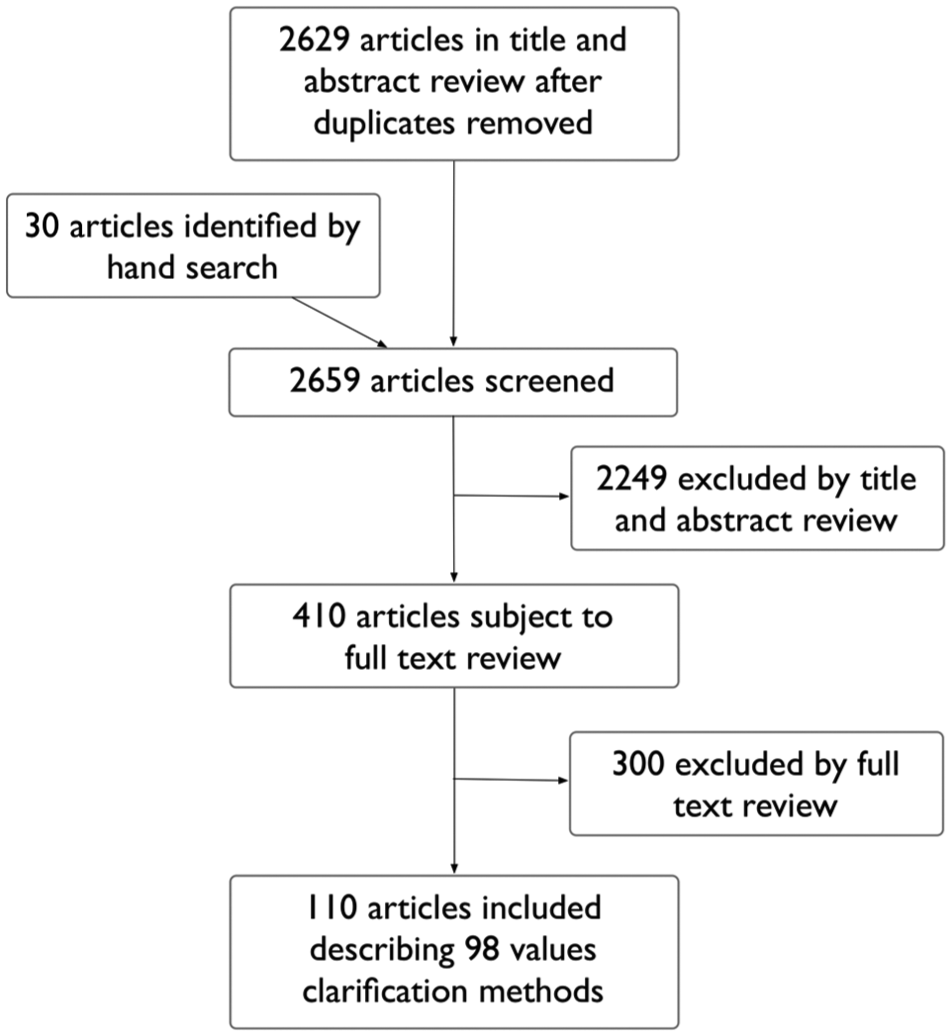
Screening process.
Included Articles

Note: Articles are presented alphabetically by the last name of the first author of the first publication in the group of articles. PSA = prostate-specific antigen; FOBT = fecal occult blood test; MMR = measles, mumps, and rubella.
Decision Contexts (n = 98 Values Clarification Methods)

Not mutually exclusive: 5 methods classified in 2 categories each, 1 method classified in all 5 categories.
Methods in this review addressed a wide range of decisions. Cancer was the most common clinical context (49%), followed by reproductive health (19%). Screening and treatment decisions dominated the types of decisions, representing 75% of contexts. Nearly half of methods (46%) were designed to support a decision of whether or not to accept an option, while others supported a decision between 2 or more options (24%) or a combination (28%) in which users would decide whether or not to pursue an option (for example, a screening test) and would then choose from among types of that option (for example, different screening tests). Among included methods, 45% were designed for use by both men and women, 36% only by women, and 19% only by men. The difference between these latter 2 statistics is attributable to differences in the clinical context of reproductive health, in which 17 methods addressed issues relevant to women’s reproductive health and 1 addressed an issue (vasectomy) relevant to men’s reproductive health.
Foundations
Using a broad, inclusive definition, only 38% of explicit values clarification methods were built on a foundation such as a theory, framework, model, or theoretically based approach applicable to values clarification. Among those that did, most (28/38, or 74%) referenced or implied theories or theoretically based approaches such as expected utility theory or conjoint analysis, which are not descriptive theories of values clarification, meaning they do not describe the details of how people engage in the process of values clarification. Few methods (21%) were based on a previous design of a values clarification method. Considering the full set of published methods, most (64%) cited no relevant guidelines. Of those that did, the IPDAS, first published in 2006, was the most frequently used overall (26%). Of the 78 methods described in articles published in 2007 or later, after these standards were published, 56% (44/78) still cited no guideline. Table 3 gives details about Foundations.
Foundations (n = 98 Values Clarification Methods)

Not mutually exclusive: 1 method used 2 theories.
Indentations represent subcategories contained within the category.
Not mutually exclusive: 1 method used both CREDIBLE and International Patient Decision Aid Standards (IPDAS).
Taxonomy of Design Features
The categories within each design feature are described and illustrated with examples in Table 4. Most categories are mutually exclusive. The distinction between mutually exclusive and non–mutually exclusive frequencies is noted for each entry in the table, and details are provided in the table. Pairwise comparisons revealed that no design feature entirely determined any of the others, and no latent factor was identified.
Design Features (n = 98 Values Clarification Methods) a

Categories are mutually exclusive unless indicated otherwise.
Not mutually exclusive: 11 methods classified as 2 types, 3 methods classified as 3 types, and 2 combine 2 subtypes under pros and cons.
Indentations represent subcategories contained within the category.
These types may have similar user experiences as decision analysis and conjoint analysis, particularly discrete choice analysis. However, types classified under “Threshold” do not involve calculating utilities in any way, nor do they involve decision analytic modeling.
Not mutually exclusive: 1 method used proportions and time visual metaphors together.
Not mutually exclusive.
Type of Values Clarification Method
Prior to data extraction, we drafted a list of possible types, based on previous typology in the literature. 129 This list was then refined through the extraction process by 2 authors (H.O.W., L.D.S.) using iterative discussions and revisions. The final list consists of 7 broad types and 17 possible subtypes in total. Values clarification methods using a multistep process may be classified under more than 1 type. Values clarification methods in this review represented a diverse range. The majority were pros and cons (36% of total), math model based (19%), or rating (18%) methods.
Position in Decision Aid
For values clarification methods that were contained within a decision aid, we extracted data about where in the decision aid the method was placed, for example, before or after an information section, between information sections, or throughout the intervention. Most methods in the review (79/98, 81%) were contained in a decision aid; of these, most (66/79, 83%) came after a complete information section.
Solo Activity
Most values clarification methods (59%) were designed to be completed independently by the patient or person making the decision. Of methods designed to be completed with others, the most common other person was a research assistant (17%) followed by a health care provider (14%). A small number (2%) were designed to be completed with a spouse, caregiver, friend, or family member.
Media
We extracted the medium used for each values clarification method, specifically, whether the method was designed to be completed on paper, a computer, or verbally. We note that although the information in a decision aid might be presented via another format such as a DVD, an explicit values clarification method requires an interactive medium. Methods in the review were roughly balanced between paper (39%), computer based (38%), and verbal (23%).
Tradeoffs
The need for values clarification methods arises out of the challenges of making preference-sensitive decisions in which tradeoffs exist. Thus, an important aspect of the decision-making process involves understanding and determining how one feels about the relevant tradeoffs. Tradeoffs were represented explicitly in less than a third of methods (32%).
Visual Metaphors
We examined whether or not each values clarification method used any sort of visual metaphor as part of the design. By visual metaphor, we mean any sort of graphical element that was part of the values clarification method itself, for example, a set of weigh scales to illustrate the concept of a tradeoff. 13 This categorization does not apply to graphics within a decision aid that were not part of the values clarification method, such as an icon array displaying risks. Most values clarification methods (59%) contained no visual metaphor.
Open- or Closed-Ended
We noted whether the sets of attributes presented to users were closed-ended, open-ended, or mixed. Closed-ended means that users could not add concerns that were not already listed, whereas open-ended and mixed allowed people to include additional items of concern. The majority of methods (61%) were closed-ended, meaning that users could not add decision attributes that were not prespecified by the designers.
Elicitation Process
We examined what process the user of the values clarification method might go through to give responses about her or his values relevant to the decision. For example, the process might involve answering questions, completing standard gamble exercises, or directly rating the importance of each attribute of a decision. The majority of methods (58%) used direct scaling.
Response Measure
The response measure refers to the type of data obtained via the elicitation process. For example, data elicited might be a categorical choice yielding nominal data or a utility (i.e., a number on the interval [0,1] that represents the value of a health state or outcome) yielding ratio data. This design feature has implications for what can be done with a user’s responses. For example, utilities can be used in decision analytic models, which might subsequently feed back a recommended option to the user, whereas verbal statements cannot be as easily integrated into a recommendation by an algorithm. Most methods generated ordinal/interval (39%) or ratio (37%) data.
Values Exploration
Values clarification is often an iterative discovery process,130,131 and it can take time for preferences to stabilize.4,16 To establish how and whether values clarification methods supported such exploration, we extracted data about whether each design explicitly encouraged an iterative process of revision, implicitly allowed such a process but did not encourage it, or did not support iteration and required users to identify and express their values in a single attempt. Very few methods explicitly encouraged all users (9%) or users who expressed decision intentions that were incongruent with their stated values (2%) to explore their values in an iterative discovery process. Most methods (65%) were designed such that iterative revision was technically possible (e.g., users could go back within a website or could complete a paper worksheet in pencil) but not explicitly encouraged.
Implications
We extracted whether or not the design of each values clarification method showed users the implications of their expressed values. For example, a method that explicitly presents implications might give a recommended option or might present scores to show how well or poorly each option fits with the user’s responses. Alternatively, a method may not explicitly show implications but may allow people to infer such information, for example, by roughly comparing the weights they have assigned to the pros versus the cons of a choice. Less than one-third of methods (29%) explicitly presented users with the implications of their stated values.
Decision Intentions
We extracted data about whether or not each method included a step in which the user is asked to indicate his or her decision intentions, whether a clear decision or a direction in which he or she is leaning. This did not include cases in which decision intentions were recorded as an outcome during a study; it refers specifically to cases in which the user was asked to express her or his decision intentions within the values clarification process itself. Slightly more than half of methods in total (54%) asked users about their decision intentions, either by asking for their decision (16%) or toward which decision they are leaning (38%).
Discussion
This review demonstrates that a diverse array of explicit values clarification methods are used across a range of health decisions. It is unknown whether a given values clarification method might be equally effective for different decisions. In other words, are designs and design features specifically suited to particular decisions, or can their use in one context be justified by empirical results in another? Such comparisons are difficult because of structural differences between different decisions. For example, choosing between 2 options is fundamentally different from choosing between 3 options, 132 and different designs are possible for 2 versus 3 options. Further research is needed regarding how best to support values clarification across different decisions.
Despite our use of an inclusive and generous description of theory, framework, model, or theoretically based approach, we found that few methods built on such a foundation. The overall low use of theories, frameworks, or models may be problematic, as such foundations can help structure hypotheses that might ultimately allow researchers to understand why and how a given values clarification method does or does not work. Similarly, few explicit values clarification methods were specifically based on previous designs. This may be a reflection of the lack of designs that have been demonstrated to be effective or simply that the field is relatively new. Further research is needed into optimal designs of explicit values clarification methods to identify and advance the use of effective design features.
The 12 design features within the taxonomy describe the heterogeneity of values clarification methods. These design features are sufficiently independent that each one should be considered when designing values clarification methods, and they should be included in reports.
Limitations
While we endeavored to capture all published accounts of explicit values clarification methods, it is possible that some were missed. Similarly, for reasons of scope, we did not search gray literature, nor did we contact authors to request copies of values clarification methods that were insufficiently described in the literature. Second, although our data extraction process was such that each element was examined by at least 2 authors and we contacted authors in cases in which a description was unclear, it is possible that we misunderstood some descriptions. Finally, although we developed our taxonomy using rigorous methods, our choices of design features in the taxonomy were based on the authors’ judgment and may not represent the entirety of important design features.
Conclusions
This systematic review formally demonstrates that there is a diverse array of explicit values clarification methods in use, most with neither theoretical nor empirical basis for their design. Given the growing social, legislative, and policy imperatives to help people make health-related decisions that reflect what is important to them, more research is needed into optimal designs of values clarification methods.
To build an evidence base and help move this emerging field forward, we encourage developers of values clarification methods to design with awareness of relevant theory 14 and previous designs, publish adequate descriptions of the design of their values clarification method using the taxonomy described in this review, and provide clear rationales for their design choices. There is a need for empirical evidence about the different choices for design features in this taxonomy. We advocate for more research to isolate the effects of different design features in order to better equip researchers and practitioners in medical decision making to help people clarify their values and make their best possible health decisions.
Footnotes
Acknowledgements
The authors would like to thank Whitney Townsend, MLIS, and William Witteman, MIS, for their work in developing and executing the search strategy for this review, as well as Peter Ubel, MD, for his comments on early draft versions of this article.
This work was partly supported by Robert Derzon postdoctoral grants awarded by the Informed Medical Decisions Foundation (now Healthwise) to Holly Witteman and Laura Scherer. During most of the time of this research, Arwen Pieterse was supported by a postdoctoral research fellowship from the Dutch Cancer Society. Holly Witteman is supported by a Research Scholar Junior 1 career development award from the Fonds de recherche du Québec–Santé. The funders had no role in study design, collection, analysis and interpretation of data, writing of the report, or the decision to submit the article for publication.