







Abstract
The widespread adoption of minimum parking requirements in American zoning codes has resulted in off-street parking provision as a compulsory part of the land development process. A robust academic literature on the effects of minimum parking requirements has identified that parking prioritization induces more driving and results in harmful consequences such as traffic congestion, air pollution, and sprawl. On the adoption of its 2017 Unified Development Ordinance (Green Code), Buffalo (NY) became the first major city in the United States to implement the complete removal of minimum parking requirements. The new zoning code sans parking minimums offers real estate developers greater flexibility on new real estate development projects because off-street parking lots can be reduced in size or removed altogether from developments, and land previously reserved for required off-street parking can now be used in other ways on development sites. To better understand the development responses to parking deregulation in Buffalo, we conducted a series of in-depth interviews with 10 real estate development and lending professionals that have been involved in new development projects since 2017. Three takeaway messages emerged. First, when minimum parking requirements are removed, parcels amid high-walkability and multimodal travel opportunities are more desirable for development. Second, lower parking ratios are useful for infill development projects and contribute to filling existing gaps in the urban fabric. Third, the removal of parking requirements enables developers to benefit from increased feasibility on projects, both in relation to financial viability and the ability to configure developments on smaller urban parcels.
Keywords
During the previous century, the widespread adoption of off-street parking requirements became institutionalized in the United States’ municipal planning system. In municipal zoning codes, this requirement—commonly referred to as minimum parking requirements (MPRs)—has been widely accepted and enforced by local planning authorities. Despite the intent of MPRs to provide convenient on-site parking for new developments and limit the nuisance effects of parking spillover, their implementation and proliferation resulted in harmful externalities for urban communities: MPRs have produced an oversupply of parking in cities like Buffalo, NY and have broadly contributed to greater automobile dependency—among other externalities—in cities everywhere ( 1 , 2 ). Importantly, much of the off-street parking supply is free, thereby incentivizing driving as an irresistible travel mode in lieu of other choices such as walking, biking, and riding public transit ( 2 – 5 ).
This research project provides an extension of a previous study of parking provision change after the adoption of Buffalo’s Unified Development Ordinance (known as the Green Code) ( 6 ). The previous article examined data from the City of Buffalo Office of Strategic Planning (via developer- or property owner-submitted project proposals) to quantify the response to MPR removal. It compared the number of parking spaces provided for new developments with the number of parking spaces that would have been required for those same developments according to the previous zoning code that the Green Code replaced. Findings suggested that the deregulation of parking requirements facilitated greater choice for developers: some chose to provide more parking spaces than previously required, whereas others offered fewer parking spaces. Parking supply reductions were most commonly observed in mixed-use developments following the Green Code’s parking reform. The study revealed that 47% of major developments provide less parking than previously mandated and that these developments generally include 21% fewer spaces than was formerly permitted ( 6 ).
To further investigate the effects of MPR removal in Buffalo, in this article we report on a series of in-depth interviews with real estate developers and lending professionals who were involved in recent development projects in Buffalo following the adoption of the Green Code in 2017. The purpose of the expert interviews was to discuss how the zoning reform has affected development practices related to parking provision in residential and mixed-use development projects. We sought to obtain a broad perspective on the effect of the Green Code on development possibilities and planning practice. Our findings about parking-development interactions draw on the perspectives of real estate development and lending professionals; we also offer takeaway messages related to parking reform.
The remainder of this article is structured as follows. We review scholarly literature about the rise of MPRs in the United States and the effects of parking mandates on the development industry. We explain how we employed an expert interview process to elucidate the effect on the property development process in Buffalo resulting from MPR removal. In the subsequent section, we explore various dimensions of the land development process by synthesizing the responses from the expert interviews. To clarify our contributions to both scholarly research and planning processes, we consolidate our findings into three key takeaway messages, stressing the practical extensions of parking reform. In so doing, we clarify how the land development process has changed—from a real estate development perspective—after the removal of MPRs from local zoning codes.
The Role of Parking and the Transport–Land Use Connection
Incentivizing driving by offering ample underpriced parking produces additional challenges for cities: more automobiles on the road and more driving result in traffic congestion, pollution, and poor air quality ( 2 , 7 ). An oversupply of off-street parking encouraged by municipal zoning policies generates higher vehicle ownership among urban residents ( 3 ), resulting in limited utilization of nonautomobile travel modes. In turn, greater automobile usage has produced negative externalities in urban centers such as increasing automobile-induced carbon emissions. Although a municipality’s zoning may indirectly affect individual driving choices, the externalities produced by car usage are felt broadly by everyone ( 8 ).
Given the widespread provision of employer-, retailer-, and municipally-subsidized parking in the United States ( 3 ), it is conceivable that alternative approaches to parking provision may lessen the propensity for driving ( 4 ). In fact, subsidized parking by employers accounts for roughly two-thirds of daily commuter trips during peak hours in the United States ( 4 ). Although off-street parking requirements have increased automobile ownership broadly, the supply of residential parking also increases the likelihood of residents commuting to work by car ( 9 ). This is readily observed in locales that are well served by public transit in large metropolitan regions ( 9 ). Initiatives to challenge existing and historical approaches to parking provision are long overdue and remain critical considerations for effective economic development, environmentally conscious urban spaces, and well-planned communities ( 5 ).
For people who choose not to drive or are unable to drive, the provision of MPRs further contributes to inequities, given the large subsidies needed to operate the parking sector ( 10 ). In many cases, parking spaces are included in the sale or lease of residential units, reflecting the most significant form of financial encumbrance associated with parking provision ( 8 ). By requiring and/or delivering parking spaces for each residential unit at no additional cost, developers and property owners incentivize driving and increase development costs in advance of observable market demand for a given project. Undoubtedly, as development costs increase for developers as a result of minimum parking provision, costs will be passed on to residents, thereby accelerating housing unaffordability ( 8 ).
The physical requirements of MPRs may impose limitations on residential densities by prioritizing parking on developable land ( 8 ). Consequently, the availability of developable land for new site uses—such as housing, commercial space, community uses, and greenspace—is constrained. Moreover, the removal of MPRs limits development costs, resulting in lower unit prices in expensive real estate markets ( 11 ). An ample supply of surface parking has resulted in reduced density, worsened urban vitality, and has created more space between buildings and urban activities. In doing so, these effects have generated unappealing walking distances and pedestrian environments ( 12 ). Further, parking oversupply has intensified the privatization of urban space and has contributed to the weakening of public spaces in urban centers ( 13 ).
Minimum Parking Requirements and the Development Process
In light of the externalities resulting from MPRs, recent interventions have sought to challenge the existing relationship between off-street parking and development in cities. Perhaps the most significant of these interventions is the elimination of MPRs from municipal zoning codes. On the adoption of its Green Code in 2017, Buffalo became the first major city in the United States to implement the removal of MPRs citywide ( 1 , 6 ).
Since the adoption of the Green Code by Buffalo City Council, the removal of MPRs has offered real estate developers greater flexibility in development projects, increasing the creation of new housing and producing greater financial returns ( 13 ). Before Buffalo’s MPR intervention, other municipalities had implemented incremental reforms to parking policies at a lesser scale ( 1 ).
Rather than regulating parking requirements for new development, the removal of MPRs allows the market to determine how much parking is needed. The role of parking provision as a reflection of market demand should not be underestimated. On- and off-street parking provision remains a critical component of municipal and regional land use–transportation planning, despite the disadvantages associated with oversupplying parking ( 2 ). Developers, urban planners, and local government employees have become familiar with parking ratios; however, these industry standards often contribute to an oversupply of parking, especially when applied on larger development projects ( 5 ). Although parking oversupply resulting from MPRs is not the sole cause of the associated urban consequences, Shoup notes that they contribute, in part, to road congestion, worsened air quality, carcentric built-form, and possibly climate change ( 2 ). Consequently, the prevalence of parking ratios in municipal zoning codes have, in some capacity, mandated policy initiatives that negatively affect urban space. Rather than providing widespread off-street parking at no cost to consumers, municipalities can limit automobile usage by raising the price of on-street curbside parking ( 2 ). Importantly, the burden for parking provision can thus be absorbed by those choosing to drive, and increases in municipal parking revenue can be generated from the appropriate allocation of market-priced curb parking spaces ( 4 ).
Despite the emergence of policy interventions aimed at lowering car usage, there remains a lack of study of their potential for improving urban life. Municipalities across the United States have subjected developers to standardized parking requirements but have failed to substantiate the actual parking demand of sites and locales ( 14 ). In turn, MPRs for residential developments have increased automobile ownership, resulting in lower residential densities ( 3 ) and undesirable externalities in U.S. urban centers.
Research Plan
To explore our focus of inquiry, we employed a qualitative research approach using in-depth interviews to investigate how the development process has changed vis-à-vis parking reform in Buffalo’s revised zoning code. In conducting interviews with current practitioners in Buffalo’s development industry, the qualitative approach aimed to obtain real-time insights on the influence of the Green Code on parking provision throughout the city. In addition to better understanding developers’ current practices and approaches with respect to parking delivery, the qualitative perspectives clarified the overall acceptance of this policy initiative among those whom it most affects. During our in-depth interviews, we explored the following questions:
How was the policy initiative to remove minimum parking requirements received by developers and lending professionals in Buffalo?
Did the removal of minimum parking requirements result in meaningful shifts in strategy for parking provision for developers and lenders?
Have alternative locations near public transit or amid high-walkability neighborhoods become more desirable for investment owing to lower parking justifications?
Has the removal of minimum parking requirements meaningfully improved project feasibility on sites that were previously unfinanceable?
A representative from each company affiliated with a real estate development project identified in the previous research study ( 6 ) was invited to interview. All of the 26 developers represented in the Hess and Rehler article were initially invited (constituting the universe of invited participants) ( 6 ). Of those, six (23%) developers responded and consented to be interviewed for this research study. The developers interviewed represent 25% of the 32 properties studied in Hess and Rehler ( 6 ). The interviewees ranged from project managers to company presidents and spanned a broad range of development companies including small family-run development companies, national affordable housing developers, and large corporate developers headquartered in Buffalo.
In addition to developers, we sought participation from lending professionals by leveraging the network of the interviewed developers. In doing so, several developers provided us with recommendations on lending professionals who were involved in project financing and had experience with the evaluation of parking provision on development projects. The inclusion of four lending professionals expanded the perspectives of our research and offered a more rounded study of the specific research questions with respect to the relationship between parking provision and development financing. The lenders interviewed have professional lending experience in the Buffalo market and were involved with some of the projects included in the previous quantitative study.
The methodology for expert interviews for this research study was approved by the Institutional Review Board at the University at Buffalo; certification was obtained in advance of interview correspondence and facilitation. Whereas our research subjects remain anonymous, we provide profiles of the developers in Table 1 to clarify their respective expertise and experience on this subject matter.
Profiles of Interview Participants
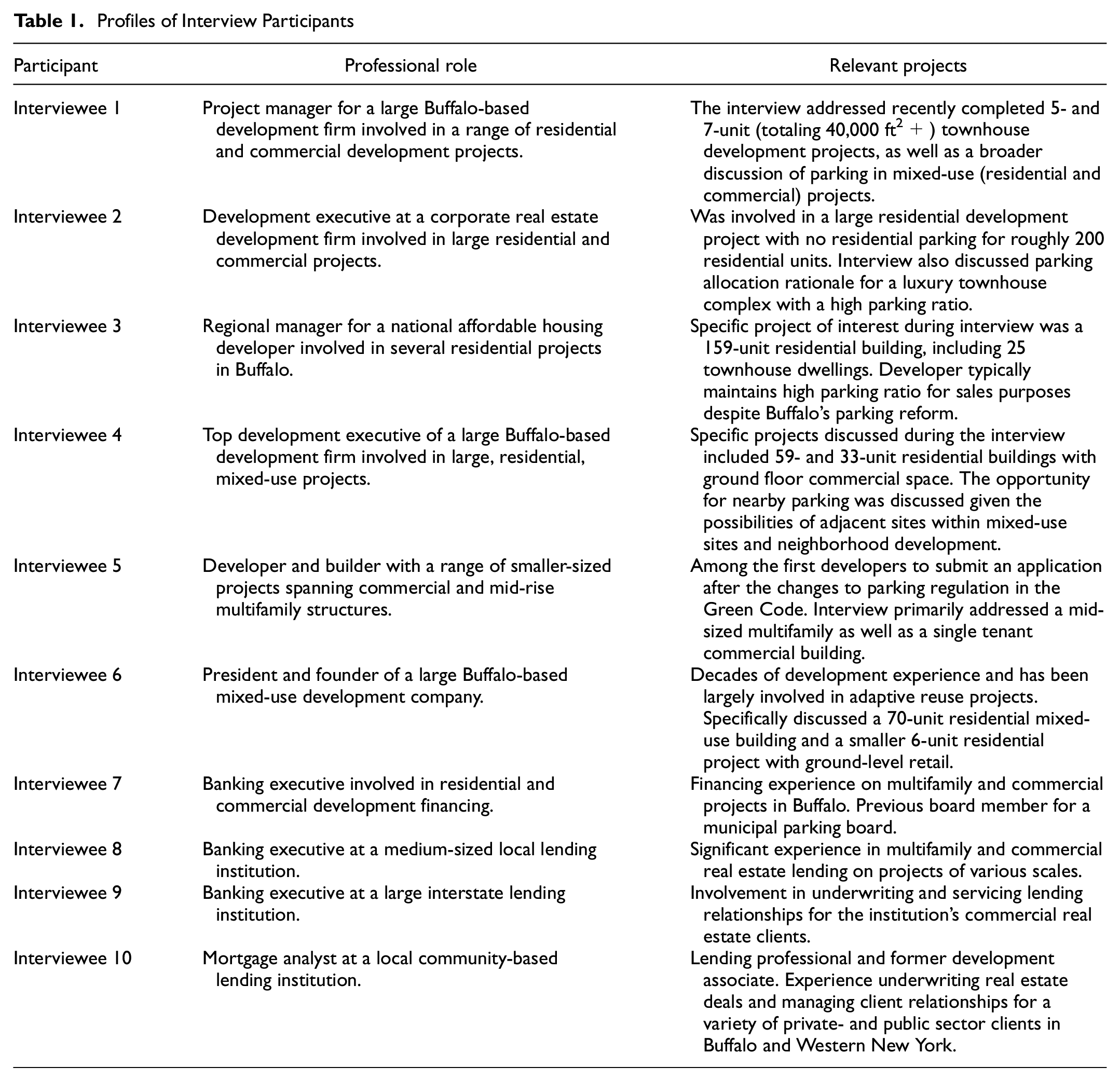
Interviews were conducted virtually by the research team via Zoom meetings. Interviews ranged in duration between 30 and 60 minutes. The decision to undertake meetings virtually enabled greater flexibility in scheduling with respondents, thereby contributing to obtaining the best interviewees possible and supported safety for researchers and participants given the ongoing COVID-19 pandemic.
Study Site Context
Much of Buffalo’s parking oversupply observed today can be attributed to automobile-centric planning during the mid-twentieth century that was typical in U.S. cities ( 1 , 6 ). Parking mandates were implemented in the late 1950s to satisfy the demands of suburban commuters ( 6 ) and remained largely unchallenged in the following half century, as was common in other cities ( 15 ). Larger cities were more likely to introduce parking requirements in municipal zoning policy ( 15 ). As such, following several decades of considerable population growth in Buffalo, it is unsurprising that parking regulation was introduced to accommodate increasing private vehicle ownership.
Like other Rust Belt cities, Buffalo was heavily affected by postindustrial population decline ( 6 , 16 ). Importantly, parking regulation introduced during Buffalo’s peak population was not adapted or revisited in subsequent decades, thereby propagating a continued oversupply of parking. Moreover, decades of economic and population decline in Buffalo had dampened urban density and reduced the willingness of developers to undertake development risks, especially on physically distressed sites ( 17 ). With a sluggish real estate development market because of a prolonged period of decline, Buffalo has been unable to offset parking oversupply with walkable built-form.
Despite the implications of historical parking regulation, Buffalo became the first municipality of its size to introduce (in 2017) sweeping citywide parking deregulation ( 6 , 18 ). In doing so, Buffalo reimaged its ineffective parking practices from the 1950s in favor of an experimental policy approach that will serve to redefine municipal parking regulation in the city and across the United States.
Findings and Synthesis of Responses
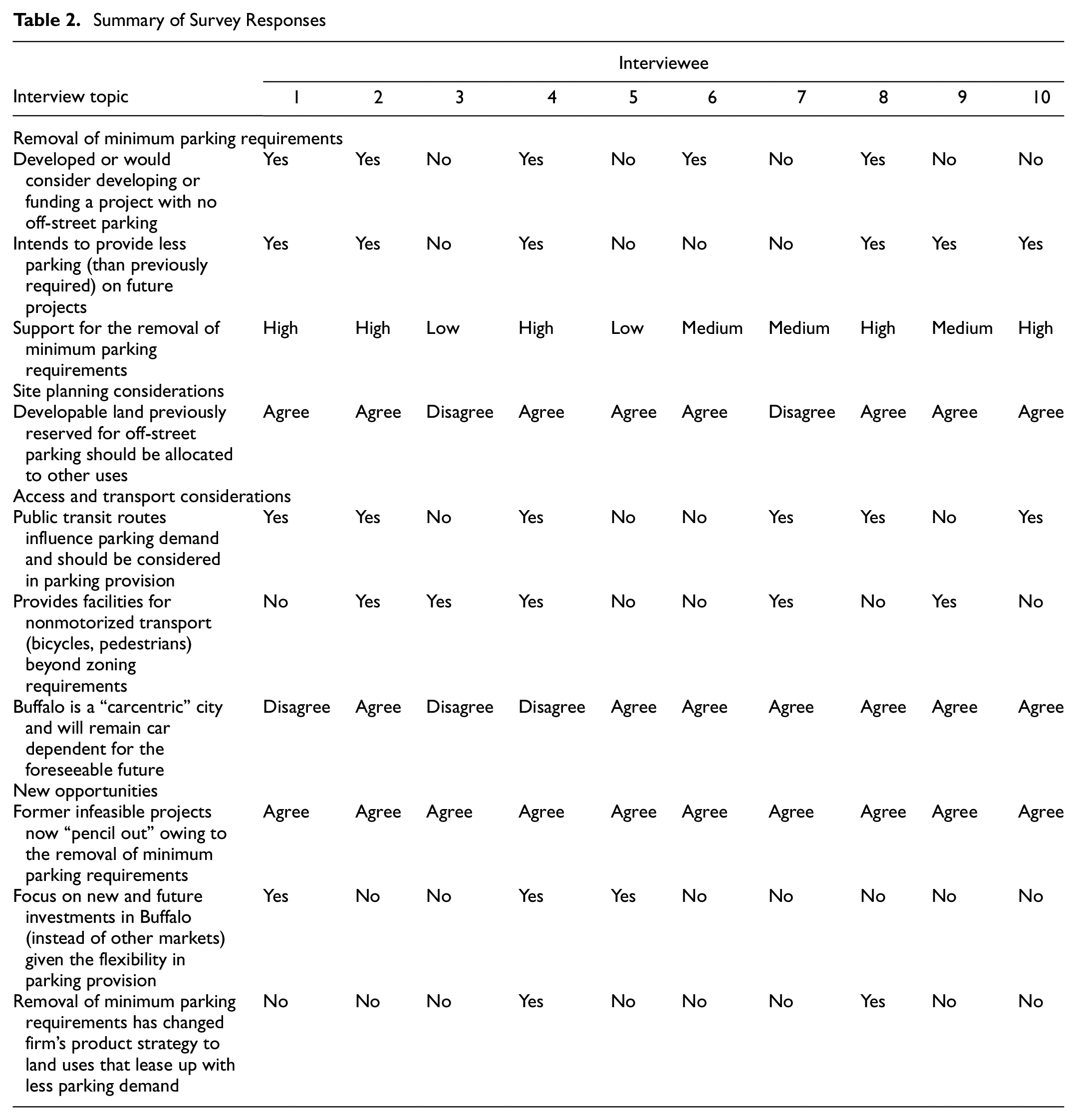
Table 2 provides a summary of responses to our survey questions. The results presented in the table can be used to compare perspectives of interviewees about ways the development process in Buffalo has been affected by the repeal of MPRs. In the following paragraphs, we synthesize key findings. First, we summarize developer perspectives about the revision of parking ratios afforded by the Green Code, and delve into the realities for developers and property owners of revising parking ratios and estimating the demand for off-street parking (given the lack of MPRs). Next, we offer highlights of a particular development project that has fully embraced parking removal in Buffalo to identify optimistic development possibilities of parking reform. Finally, we present a discussion about the influence of parking reform on bicycle infrastructure.
Summary of Survey Responses
Perspectives About the Lack of Minimum Parking Requirements
Generally, developers and lenders interviewed for this article shared an optimistic attitude toward the removal of MPRs in Buffalo. Several participants were particularly enthusiastic about the additional flexibility afforded to developers with the removal of parking regulation on sites that could accommodate more limited parking provision (those near public transit or in more walkable neighborhoods) (Interviewees 1, 2, and 4). Some developers and lenders expressed that MPR removal was a positive policy initiative but that reducing car dependency would be a slow and incremental process given (a) a lack of current infrastructure to support nonmotorized transport, and (b) distances between origins and destinations (Interviewees 6 and 10).
During the interviews, two of the 10 interviewees were less enthusiastic than the others about development projects with lower parking ratios. Both said that their development firms were unlikely to pursue a project with no off-street parking because they could not envision such a development model. These two developers expressed that a new development that does not include off-street parking has appeal to only a limited profile of tenants, and the tenants’ businesses would have only limited appeal for customers, the end-users of the parking lots. These developers further explained that the risk involved in a development without parking—that they would not be able to find tenants—did not outweigh the benefits. The benefits of not providing a parking lot, or providing a smaller parking lot, include more developable space, or offering more on-site green space or open space (Interviewee 5). Although these two developers felt that projects with lower parking ratios or no off-street parking were “not for them,” both recognized the flexibility of the zoning change and agreed that this could be useful to developers who feel they can finance and lease a project with a lesser than typical supply of off-street parking.
Revising Parking Ratios and Estimating the Number of Off-Street Parking Spaces
Developers clarified that their goals in the development process are (a) to finish construction (or renovation), (b) to lease rentable space and stabilize, and (c) to earn enough revenue to maintain debt service. Ensuring that customers can access the property (especially those who arrive by automobile) is critical during the second and third steps. During the interviews, developers shared with us the principles used by their development companies to calculate the number of parking spaces needed for their developments, even though off-street parking is no longer required. One of the lending professionals interviewed for this study referred to developers as “optimists”; we found some support for this characterization in the interviews among some developers that expressed their willingness to experiment and re-envision the development landscape in Buffalo following the removal of MPRs in the Green Code (Interviewees 1, 2, and 6). For market-rate apartments, a minimum of one parking space is planned per residential unit, but more than one parking space per residential unit is probably provided. For luxury housing, the developer estimates parking demand (by projecting automobile ownership) for prospective tenants and then plans a parking lot with a sufficient number of parking spaces to meet the anticipated demand (Interviewee 1). For senior housing or housing for low-income residents in receipt of tax credits, the developer provides 0.5 to 0.7 off-street parking spaces for each residential unit, whereas for multifamily housing, the same developer provides 1.0 or 1.2 off-street parking space for each residential unit (Interviewee 3).
For commercial projects, the removal of MPRs did not change the calculation of parking ratios, since developers have to provide enough parking space to meet market demand. The reason is that a developer assumes a high level of risk if not enough parking is provided for a given development. In Buffalo, the development process for commercial projects is highly tenant-driven and commercial or mixed-use projects rarely move forward without primary commercial tenants. A developer of chain dollar stores pointed out that the national chain retailers have their own parking minimums that, in their minds, guarantee automobile access to their stores. With a loading dock on site for chain dollar stores, off-street parking lots must be able to accommodate a semitrailer truck for deliveries, which requires a parking lot with specific sizing requirements (Interviewee 5).
An interviewee explained that lenders carefully consider the parking supply for new development proposals (especially mixed-use developments) to ensure that projects are leasable (Interviewee 7). If tenants and customers do not find on-site parking satisfactory, they may go to other sites where it is. Tenants may pay lower rent for sites with less convenient parking.
For mixed-use projects, a developer considers each component (residential, commercial, office, etc.) separately. For an office component of a mixed-use development, a developer consults with a preleased tenant (if there is one) about how much parking demand the tenant envisions. Another interviewee confirmed that parking provision can be largely dependent on a given tenant, but suggested that leasing is most successful when parking is offered directly on-site/adjacent to its associated tenant (Interviewee 6).
Before the Green Code was adopted (with no MPRs), it was possible for developers and property owners to acquire a variance allowing fewer parking spaces (than the number of parking spaces required by law), however, developers request many variances, and they might not want to “waste” a petition on parking (Interviewee 1). For development parcels in the central business district, Metro Rail corridor, Larkinville, and other sites with a high rate of absorption, it is possible to make minor decreases in parking ratios (fewer parking spaces than required by the previous zoning code), however there is not a scientific method for doing so (Interviewee 1). Although mixed-use and higher density environments better enable the removal of parking requirements, a shift to other travel modalities is generally an incremental change that may rely on the development of new technologies.
Developments for faith-based and not-for-profits organizations are amenable to reduced parking ratios. For example, local nonprofit organizations serving low-income families and people with disabilities have never had a requirement for 1:1 parking spaces for residential units, and, therefore, the removal of MPRs in the Green Code makes a great deal of sense. The previous MPRs in Buffalo thus produced an excess of off-street parking compared with needs ( 1 ) and the removal of MPRs allowed a better match between parking demand and supply (Interviewee 5).
In considering the reduction of parking supply for new development projects, interviewees expressed the importance of assessing the existing parking supply in closeness to a given site. Since approximately 2017, following an uptick in downtown development, public parking structures were largely at capacity, with little space available to take on more parked cars (Interviewee 7). Until the start of the COVID-19 pandemic in 2020, it was difficult for Interviewee 7 to envision new developments—apartment/condominium buildings or mixed-use buildings—with no off-street parking, as allowed by the Green Code. Without capacity in parking structures, all new developments, to be viable, needed to provide on-site parking. Since the COVID-19 pandemic, however, as people changed jobs, shifted worksites, began working at home (some or all the time), there is now capacity in the parking structures, so it is easier to imagine new developments downtown with lower parking ratios, taking advantage of the removal of MPRs by utilizing the existing supply (Interviewee 7).
Development Without Off-Street Parking
Despite these reservations about developing property with no off-street parking, one development in particular is worth further consideration. The largest development with no off-street parking built since MPRs were removed in Buffalo is a 201-unit affordable housing development (see Figure 1). It is a mixed-use site that also includes a small grocery market (the market includes a small off-street parking lot with 22 parking spaces). The building is developed to the property line on this large city-block parcel and it replaces a former 300-space municipally owned surface parking lot. The City of Buffalo initially released a request for proposals for site development that was originally to include below-ground parking, office space, and luxury housing. The residential component of the project was ultimately developed entirely as affordable housing units without parking.
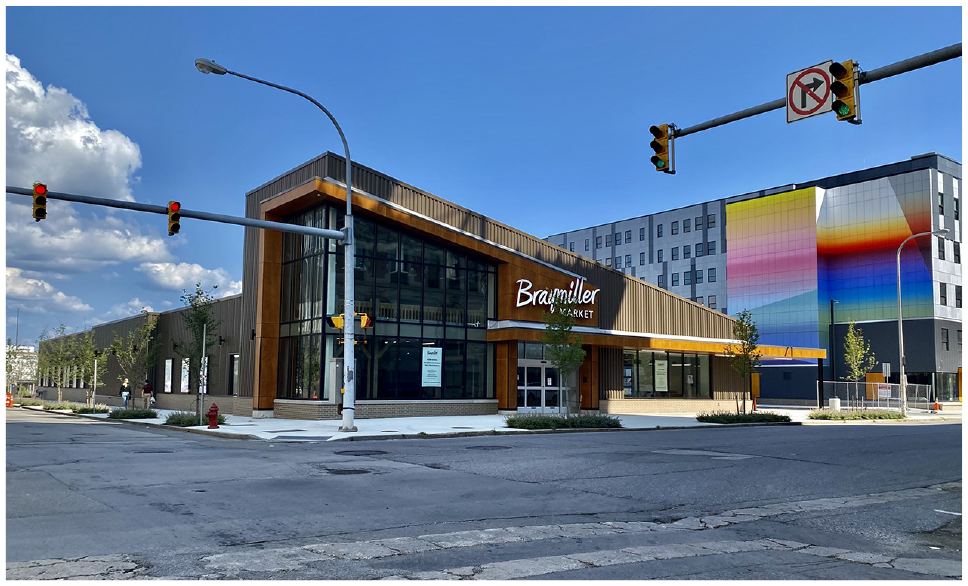
A completed project featuring a grocery market and adjacent 201-unit affordable multifamily apartment building with zero on-site residential parking spaces. It is located at Clinton and Ellicott Streets and constructed on the site of a former city-owned surface parking lot.
The developer suspected that there would be no trouble finding households without cars to rent in this affordable housing development, and these would likely be households unable to afford automobiles or households making the decision that the approximately $8,000 annually necessary for owning and operating an automobile is better spent elsewhere than automobile ownership. Despite the controversial decision not to provide residential parking, with nonsupport in the media juxtaposed by support at planning board meetings and zoning board meetings, this developer viewed their firm’s approach as cutting edge for the city. By contrast, another interviewee suggested that their firm would never have developed a project without parking given the leasing risks involved (Interviewee 3).
The transportation demand management (TDM) study supported the development with no off-street parking, since there were eight bus stops within a two-block radius and two Metro Rail stops nearby, and a grocery store would be developed on site. One developer stressed the importance of approaching the TDM study in a thoughtful and considerate way, and by doing so, the TDM study will lead to appropriate parking ratios for on-site off-street parking, based on proximity to public transit and other factors (Interviewee 2). This developer had confidence in the TDM study process to adequately assess parking needs after the adoption of the Green Code. Stemming from the TDM study, a transportation management association (TMA) was formed, and this is the first such association in a private development. It will be administered by Go Buffalo Niagara (a program within Go Bike Buffalo). The developer will pay an annual fee to administer the TMA. All employees (of the supermarket) and residents (of the apartment complex) are automatically members of the TMA (paid for by the developer-owner), and each will receive (1) personal mobility planning, (2) a guaranteed ride-home program, (3) discounts to the local bikeshare program, and (4) app-based transport tracking with an option to enter events like lotteries. The site is now branded as a mobility hub with indoor and outdoor bicycle parking and an enhanced bus shelter. Given its success, the developer of the project with no residential parking expressed interest in pursuing more affordable housing projects in future. As of Spring 2022, the project is still in its lease-up phase.
Bicycle Access and Parking
The Green Code provides requirements for bicycle facilities with developments (meeting certain prerequisites), whereas the previous zoning code did not require such facilities. Bicycle facilities do not add appreciably to development costs, but bicycle amenities can be attractive to tenants (even for tenants who do not ride bicycles). The municipality makes investment decisions about streetscape improvements and bicycle facilities in public street rights-of-way. One developer (Interviewee 4) pointed out that the attractiveness of a particular development site was enhanced by its adjacency to on-street bicycle routes, however the same developer pointed out that bicycle use does not have a meaningful impact on automobile ownership or automobile usage. Although bicycle facilities are present in large, new developments (meeting certain criteria) since the Green Code was enacted ( 1 ), bicycle use has little effect on automobile ownership or automobile usage according to developers interviewed. Most interviewees agreed that multimodal travel environments with bicycle lanes—particularly the newly designed complete streets corridor along Niagara Street—are ideal settings for lowering parking ratios. One developer (Interviewee 2) said that bicycle storage in loft buildings is very much utilized by tenants (and kayaks can be found in bicycle storage rooms) whereas another developer (Interviewee 1) said that bicycle parking at a coworking space is not completely occupied. However, this interviewee explained that developers are now aiming to provide bicycle parking at any development with (rental) residential and multifamily development projects.
Takeaway Messages
We synthesized our findings and offer three messages for research and practice. Our interviews revealed three primary advantages of MPR removal in Buffalo relating to transportation, urban vitality, and project feasibility.
Takeaway Message #1: When there are no MPRs, parcels possessing high levels of walkability and multimodal travel opportunities —attractive characteristics for development—become even more desirable.
With the removal of MPRs, sites in or near transit-oriented developments (TODs) are now ripe for development or redevelopment with fewer parking spaces. In neighborhoods or along corridors with high-quality transport infrastructure, developers will readily take advantage of an ability to provide fewer parking spaces. This is the case in Buffalo along the Main Street corridor, which is served by the city’s Metro Rail (light rail) system, and along Niagara Street, a newly reconstructed (and first of-its-kind in Buffalo) arterial corridor with protected bicycle lanes, green infrastructure, and prioritized bus service. Several developers argued that properties near Buffalo’s Metro Rail line are more attractive development sites (where lower parking ratios are more feasible) than sites along bus routes.
One developer explained that all of their firm’s projects in Buffalo could be considered TODs (Interviewee 2). These include lofts (retrofitted in historic buildings) and newly built commercial buildings. Importantly, this development company has now advanced its approach from TOD to mobility management. Although walking access is necessary for project development, people with disabilities (short- or long-term) may be unable to use pedestrian environments. Universal design principles can guide access considerations. However, walkability is a necessary ingredient for any consideration of lower parking ratios (Interviewees 4 and 10).
Neighborhoods with high walkability (or infrastructure improvements suggesting walkability is trending in a positive direction) are key for developments—especially residential developments or mixed-use developments containing a residential component) with lower parking ratios. In Buffalo, it is possible to find renters that make projects feasible with lower parking ratios (Interviewee 4); these renters would have lower-than-average automobile ownership rates.
Takeaway Message #2: Planners can remove MPRs or establish lower parking ratios to help further infill development and fill gaps in the urban fabric.
In a neighborhood or corridor with “gaps” in development (vacant lots or undeveloped parcels, usually created from building demolition), developers may readily take advantage of an ability to provide fewer parking spaces. This is the case in neighborhoods where industrial buildings are renovated for commercial or residential space, but those industrial buildings have several adjacent or nearby vacant lots where buildings were demolished. The remaining older industrial buildings are generally worthy of redevelopment. In Buffalo, this condition applies to certain parts of the central business district and the Niagara Street corridor in addition to up-and-coming districts with former industrial buildings including Larkinville and Chandlerville (see Figure 2).
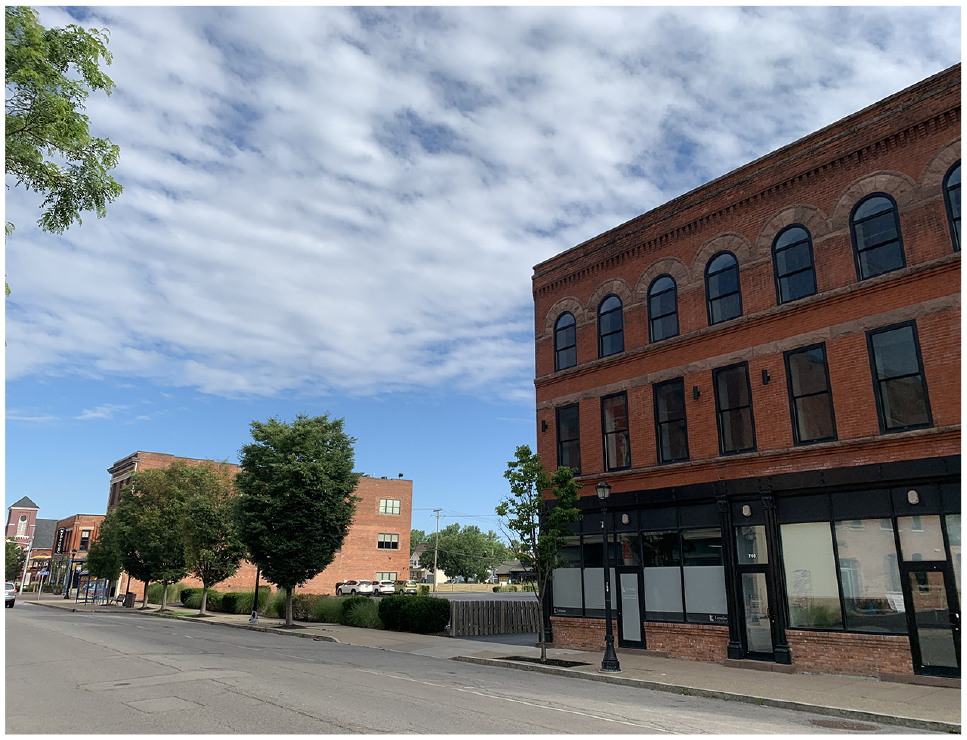
Seneca street in Buffalo’s Larkinville neighborhood. Gaps in urban form from surface parking lots remain common among Buffalo’s disinvested and revitalized neighborhoods, creating discontinuity at ground level and unappealing walking environments.
Development on infill sites can add to building density, and projects will be viable with fewer off-street parking spaces than were required by the city’s previous zoning code (before the Green Code was adopted in 2017). Urban vitality can be enhanced through infill development, and a density of origins/destinations and amenities can reduce automobile dependence. One developer stressed that the entire City of Buffalo benefits from the removal of MPRs, because it can facilitate more development and create infill on surface parking lots. All development types (residential, commercial, mixed use) benefit, and all neighborhoods benefit. The removal of MPRs can help achieve density more appropriate to an urban setting and erase some of the suburban-style development that occurred in Buffalo after WWII that was compliant with MPRs in zoning mandates. Although interviewees favored the parking flexibility afforded by the Green Code, some developers suggested that it is unlikely there will be many buildings with no off-street parking (Interviewees 3 and 6).
Takeaway Message #3: The removal of MPRs can enhance the feasibility of development projects both in relation to financial viability and new possibilities for configuring developments on parcels.
All interviewees agreed that the removal of MPRs from Buffalo’s zoning code provides developers with a great deal of flexibility. This flexibility is manifested in two ways. First, the removal of MPRs allows developers to apply lower parking ratios and therefore make project financing work for projects that may have otherwise been financially unfeasible. One interviewee, reflecting on the Green Code, said, “Projects actually work, financially. Now we can get more projects off the ground” (Interviewee 1). Reducing the number of off-street parking spaces on a given site does not necessarily correspond to reduced development expenses in a specific way (there is little structured parking in Buffalo) because at-grade parking lots are relatively cheap, but forgoing parking allows a developer to exercise the opportunity to seize more buildable space on the parking lot (Interviewee 4). For banking officials, predictability about project lease-up is important, as is the schedule for expaning supply to meet demand (Interviewee 9). Generally, lenders were not overly concerned with reductions in parking provision and supported developments with varying degrees of parking spaces so long as the parking supply appeared reasonable (Interviewees 7 and 10). Naturally, some developers and bankers expressed hesitation about “zero parking” buildings (Interviewees 8 and 10). One lender stated that parking provision did not heavily influence financing decisions but suggested that a zero-parking proposal would be examined with greater scrutiny before making financing decisions. Before the removal of MPRs, however, certain development projects required developers to purchase an adjacent property simply to increase the available land area for providing off-street parking (Interviewee 8). Now, this would seldom occur following the end of parking mandates.
Second, with the removal of MPRs, developers can situate an envisioned project on a smaller site than was previously possible. With site constraints as a concern for financing development projects on downtown Buffalo’s small parcels, the removal of MPRs makes projects more feasible, since projects can now be built on smaller sites and site configurations with less off-street parking space and more space for buildings. It will then be easier to “sell the lower parking ratio” to investors and lenders and everyone involved in a project (Interviewee 1). Developers concurred that the removal of MPRs streamlines the development process. The provision of parking is no longer an impediment to development. All development sites are treated equally, since the removal of MPRs in Buffalo’s zoning code occurred citywide and is applicable to all parcels and all development types ( 1 ). Developers also do not have to expend time or resources in seeking variances for projects that do not meet parking mandates.
For a newly constructed building on a given parcel, the requirement to provide an on-site off-street parking lot consumes a share of the parcel’s acreage because the space must be reserved for parking. But with the removal of MPRs, the bottom-line numbers—size of building footprint and size of parking lot footprint—work because the scale works (Interviewees 2 and 4). The possibility to develop smaller new apartment buildings—new construction or rehabilitation—can help address the “missing middle” ( 19 ), or small buildings that can provider a cheaper alternative to large developments and avoid the challenge of large lot assembly. Such smaller buildings—which can help densify corridors and enliven neighborhoods—are made more feasible with lower parking ratios than are typically required by municipal ordinances.
We hope that future research efforts will include additional interviews or surveys—of citizens (residents, tenants, clients) of residential and commercial buildings for which parking ratios have been lowered or MPRs removed—to gain insights about perceptions and realities of reaching sites with fewer parking spaces. We also suggest research projects that engage developers and property owners in cities beyond Buffalo to ascertain their response to lower parking ratios and the removal of MPRs. We expect these and other research efforts to generate a greater understanding of development possibilities with lower parking ratios and eliminated MPRs.
Footnotes
Author Contributions
The authors confirm contribution to the paper as follows: study conception and design: D. B. Hess, B. Flowers; data collection: D. B. Hess, B. Flowers; analysis and interpretation of results: D. B. Hess, B. Flowers; draft manuscript preparation: D. B. Hess, B. Flowers. All authors reviewed the results and approved the final version of the manuscript.
Declaration of Conflicting Interests
The authors declared no potential conflicts of interest with respect to the research, authorship, and/or publication of this article.
Funding
The authors received no financial support for the research, authorship, and/or publication of this article.
