







Abstract
The present study provides a discourse analysis of judicial attributions about battered women in Canadian sentencing decisions involving women convicted of killing their abusive intimate partners. For cases in which the accused received a jail sentence, judges downgraded acts of previous partner violence by using minimizing descriptions and by emphasizing the mutuality of the violence and of substance abuse. These discourses mobilized doubt about the relationship as abusive and limited sympathy for the accused as a battered woman. Judges’ descriptions formulated domestic abuse as discrete episodes of violence, attributed in many cases to alcohol rather than to an ongoing pattern of serious domestic abuse. These descriptions reinforced the accused’s capabilities and strength, which served to diminish the opposing claim that she was trapped in a seriously abusive relationship. Recommendations include incorporating information about battered women’s resistance efforts into traditional battered woman syndrome testimony and examining police decision making in cases of dual arrest.
Keywords
Intimate partner violence in North America continues to be a widespread social problem. It has been studied extensively and has been the focus of recent legal and policy developments, such as mandatory charging policies and the implementation of specialized domestic violence courts in some jurisdictions in Canada. These developments stem in part from inquest recommendations and represent a growing recognition that domestic violence situations can quickly escalate into lethal encounters. The death of one partner at the hands of the other represents the apex of violence between intimate partners. Of all the homicides in Canada between 2000 and 2009, 16% were spousal homicides (Statistics Canada, 2011). Women are much more likely than men to be killed by their partner. For example, a recent analysis demonstrates that between 1975 and 2005 the rate of spousal homicides against women was 3 to 5 times higher than against men. On average, approximately 15 men a year are killed by their intimate partners (Statistics Canada, 2007).
Despite or perhaps because of these small numbers, women who kill capture the attention of scholars and the public alike. When a woman kills, she pushes the boundaries of traditional gender norms and the limits of explanation. Women who kill their intimate partners are especially perplexing. The present research explores how battered women are depicted in legal discourse. Discourse analysis is used to examine sentencing decisions in cases of female defendants who have killed their abusive intimate partners. The present research focuses on judicial attributions for sentences and judges’ descriptions of the intimate relationship between the accused and the deceased.
Discourse analysis is defined both as a theoretical perspective and as an approach to analysis in which instances of discourse (such as textual legal decisions) are treated as data (Wood & Kroger, 2000). Because there are multiple definitions of discourse analysis, I adopted the approach developed within social psychology (discursive psychology; Edwards & Potter, 1992; Potter & Wetherell, 1987). As a theoretical perspective, discursive psychology involves three basic assumptions. First, language is action. Language is not only about things, it is used to do things, such as complain, blame, or explain. Second, discourse is viewed as the focus or topic of analysis, not as a resource to explain behavior or as a route toward understanding underlying cognition or events in the world. Third, variability is a feature of discourse and reflects that discourse is used to construct different versions of the world (Wood & Kroger, 2000). Discursive psychology is a social constructionist perspective in that it emphasizes the way in which human meaning and experience of the world are socially, culturally, and historically created (Potter, 1996).
Discourse analysis emphasizes the deconstruction of traditional concepts and categories within social psychology (Edwards, 2005). Discursive psychology involves a respecification of psychological concepts, that is, “reworking psychological topics as discourse practices” (Edwards, 2005, p. 260). Especially relevant to my paper is the treatment of attribution theory, and the respecification of attribution concepts such as consensus, consistency, and distinctiveness to demonstrate how participants do attributions (Edwards, 2005). For example, a judge may recount that “everyone described the accused as a loving and caring mother,” which is an example of consensus because it depicts the information about the accused’s character as agreed upon across independent witnesses and suggests that the portrayal is an accurate and truthful one.
Discourse analysis is an approach that emphasizes a situated, or context driven, analysis of psychological topics and categories, such as battered woman syndrome (BWS). Situated analysis means that the analysis demonstrates how participants use the concepts under study, unlike, for example, a content analysis that might isolate codes or themes of interest and then extract them from the text and count frequencies. As an approach to analysis, discourse analysis focuses on the way in which participants’ accounts are managed within their talk and how versions of accounts are created and accomplished in their talk. This form of analysis involves an examination of how accounts are formulated to construct particular versions of events in which blameworthiness, leniency, and sympathy, for example, are managed and constructed.
Gender and Intimate Partner Violence
In response to reports of dual arrests and arrests of women for domestic violence, some have argued that women’s rates of interpersonal violence are equal or comparable to men’s (e.g., Archer, 2000). Others have argued that reports of women’s use of force in intimate relationships have failed to adequately consider the context of the violence, have relied overly on measurement tools that similarly decontextualize the problem (Dobash & Dobash, 2004; Saunders, 2002), and do not distinguish between defensive and initiated violence (Miller & Meloy, 2006). This debate has serious implications for intimate partner violence treatment and the operation of the justice system.
Gender-neutral approaches to the understanding and treatment of domestic violence suggest a standardized application of treatment and programming that may be harmful for women. Although battered women are generally presented as deserving sympathy and support, women who fight back or resist violence are depicted as mutual aggressors and combatants (Swan & Snow, 2006). Dual arrests and restraining orders against women who report domestic violence may be necessary in some cases, but may sometimes penalize women for participating in the justice process and may prevent them from seeking help in the future. Findings from a relatively recent study showed that victims’ level of fear contributed most to police officers’ assessments of risk in domestic violence situations, followed by incident progression, previous domestic violence incidents involving the same couple, and the presence of substance abuse (Perez Trujillo & Ross, 2008). Taken in the context of such findings, if legal professionals view a woman as a mutual combatant, then she may not be perceived as a fearful victim, and they may appraise the situation to be more severe and potentially lethal. As a result, she may not receive the assistance required to protect her safety.
A theoretical or conceptual model is needed to guide research findings, prevention and treatment, and general perceptions of intimate partner violence (Swan & Snow, 2006). Initially, and particularly in legal settings, women’s lethal use of force within an abusive relationship was confined within the narrow framework of BWS. During the 1970s, feminist activists brought attention to the issue of intimate partner violence. Government officials within Canada, Britain, and the United States began to acknowledge that intimate partner violence was a serious issue and, in 1975, changes began to occur in legislation and the criminal justice system (Barata & Senn, 2003). It was during this time that psychologist Lenore Walker emerged as an advocate for battered women. Walker’s book, The Battered Woman (1979) and her conception of BWS (Walker, 1984) have informed legal understandings of domestic violence and battered women since that time and continue to shape social and legal conceptions. Walker’s book (1979, 1984) was likely the most cited work in the domestic violence literature during the 1990s (Rothenberg, 2003). There are numerous criticisms of this approach to understanding battered women’s experiences, but the most salient is that the syndrome reinforces a battered woman stereotype that fails to challenge traditional stereotypes of femininity and victimization (Schneider, 2000).
BWS in the Legal Context
Walker’s (1979, 1984, 2000) theory demonstrates why it is sometimes difficult for many women to leave abusive relationships. Her Cycle Theory of Violence was important in that it brought recognition to abuse as a continuous and escalating event, rather than a series of discreet events or a single violent episode. Walker’s (1984) research suggested that a battered woman may become trapped in the abusive relationship due to the cycle of violence. Walker reasoned that the cycle contributes to a form of learned helplessness in which the battered woman demonstrates pessimistic beliefs about the efficacy of her actions and ability to leave the abusive relationship.
Following Walker’s research (1984), BWS quickly became part of legal justification at trial for a battered woman facing murder charges in the death of her abusive intimate partner. BWS testimony provides a context for understanding an abused woman’s experiences and behavior. The content of the testimony generally describes the battering cycle and the woman’s learned helplessness as a means for comprehending her sense of perpetual fear and her inability to leave the relationship (Schuller & Hastings, 1996). It has been a complex and long legal road for BWS since it first appeared in courts in the United States in the case of Ibn-Tamas v. United States in 1979. The admission of BWS testimony is currently generally set in legal precedent and is accepted in most states in the United States (Biggers, 2005), as well as in Australia, New Zealand, and England (Bradfield, 2002). In Canada, women were granted the opportunity to introduce BWS testimony as part of a self-defense claim through the watershed case of R. v. Lavallee (1990). In the Lavallee case, the issue at trial was whether or not Angelique Lavallee’s actions could be understood as self-defense, given that she shot and killed her abusive common-law partner outside a direct, physical assault. After a lengthy appeal process, the defendant successfully used expert BWS testimony as part of her claim of self-defense. Lavallee’s acquittal and the admission of BWS testimony in her case were commended for bringing justice to battered women and for dispelling misconceptions about why battered women remain in abusive relationships.
However, the testimony was not without controversy. Critics argued that BWS testimony may reinforce a battered woman stereotype that fails to challenge traditional stereotypes of femininity and victimization (Schneider, 2000). Due to the syndrome’s inclusion of learned helplessness, the testimony has been criticized for depicting battered women as helpless victims instead of conveying the complexity of the situation and the reasonableness of women’s actions (Schuller & Hastings, 1996). BWS is thought both to perpetuate and to create stereotypes about women as passive, meek, and helpless—traditional feminine traits. Despite the Lavallee case, BWS has typically been used in the courts to justify the defendant’s failure to leave the abusive relationship (Shaffer, 1997). This treatment focuses on the woman’s individual inadequacies in her intimate relationship and personal life rather than considering the broader social context of the violence and systemic inequalities faced by women (Stubbs & Tolmie, 2008). It is argued that BWS is too narrow a conceptual framework; it is a mold that only fits one type of woman and it is especially harmful for battered women at trial whose cases and circumstances do not fit this mold. Women who fight back, who are assertive, who drink, or who possess other traditionally unfeminine traits would not benefit from the testimony. The argument is that BWS and its resultant stereotype create a dichotomy between genuine or deserving victims and those who are undeserving of leniency and sympathy (Ferraro, 2003). This criticism suggests that the use of BWS leads to the construction of “real” victims of domestic abuse (Ferraro, 2003; Russell & Melillo, 2006). As a result, the syndrome has created a narrative or discourse of what genuine victims of domestic violence should look like and, by implication, what they should not look like.
Surveys and interviews of legal officials and the public suggest that stereotypes of battered women do exist (e.g., Thapar-Björket & Morgan, 2010) and may be especially problematic for women who resist, who fight back, or who are described as engaging in mutual combat (Ferraro, 2003; Russell & Melillo, 2006). The Lavallee case itself dealt specifically with the issue of aggressive behavior on the part of the woman, and the judge determined that such behavior should not preclude the jury from finding that the woman was a victim of serious systemic abuse. Walker (2000) also addresses these concerns and notes that abused women, in attempting to control the violence against them, will express anger or aggression in safe or public situations to lower or prevent the risk of abuse. Typically, women’s use of violence within their relationships has been found to be another aspect of their ongoing victimization (McCloskey & Sitaker, 2008; Miller & Meloy, 2006).
Discursive Approaches to Legal Research
The discursive approach I adopted in the present article stands in contrast to the majority of legal decision-making research, as well as most research pertaining to BWS that is frequently located in a mainstream, positivist epistemology. Positivism is a deterministic philosophy about scientific knowledge that classically values one objective truth and uses causal explanations of nature and human behavior. Psychological knowledge about partner violence and understandings of abused women have thus been shaped by research that has overrelied on traditional methodologies. Traditional approaches, such as simulated jury studies or content analyses of news accounts, may fail to consider the important social aspects of human beings relating to the world around them. Traditional approaches do not fully consider the broader social context within which violence and attributions about blame and violence operate. In contrast, discursive perspectives of violence and attribution focus on their interactional and social contexts.
Fortunately across the last few years a body of research has been developing that examines judicial attributions in context. Such research makes important contributions because it studies naturally occurring attributions. For example, discursive analyses of trial judgments have shown that language constructs versions of reality that can have important justice consequences. MacMartin and Wood’s (2005) analysis of judicial discourse in cases of child sexual abuse shows how judges construct seriousness and the impact of analyzing situated discourse (i.e., context-based) rather than isolated codes or categories. Their analysis sought to explore criticisms that judges’ references to sexual motives in cases of sexual assault minimize seriousness and remove blame from offenders. In contrast to previous analytic approaches that use codes and count frequencies, their discourse analysis examined the entire context of the decision and specifically demonstrated how judges orient to and use sexual information in their accounts. Their discursive analysis is a detailed approach that demonstrated how judges used sex-based explanations to construct the offense as serious and to attribute blame to the offender.
Discursive examinations of violence and intimate partner violence specifically have shown that different levels of violence can be constructed through various discursive practices. In their analysis of interviews with perpetrators and victims of domestic assault, Hydén and McCarthy (1994) demonstrated that explanations for violence have important consequences for warranting or contesting abuse. Perpetrators’ accounts about abusive episodes contained language that emphasized mutual participation and descriptions that minimized the physicality or seriousness of the assault. Similarly, victims’ accounts oriented to the “degree of reciprocity” (Hydén & McCarthy, 1994, p. 554) of the physical assault in that seriousness was determined by the perpetrator’s amount of dominance over the victim. For example, the authors suggest that the perpetrator’s claim that “I pushed her around a bit” does not deny the violence but attempts to soften or “neutralize” (p. 554) the level of violence that took place. When perpetrators in their interviews recounted instances of violence, they described the events as fights or arguments to bolster the claim that the violence was mutual and not very serious (e.g., screaming back and forth, throwing items) rather than constructing the event using more serious terms such as assault.
Concepts of mutuality and participation may be equally important for downplaying the seriousness of abuse in legal settings. Coates and Wade (2004) demonstrated that judges also orient to mutuality in their explanations for sentences in cases of sexual assault. Their analysis of Canadian judgments identified the main categories of judicial attributions for sentencing (e.g., alcohol and drug abuse attributions) and concluded that judges mitigate responsibility for sexualized violence through discursive practices that minimized violence, concealed victims’ resistance, and blamed victims. Portrayals that focus on victim participation and the degree of reciprocity between victim and abuser limit fuller contextual understandings of the dynamics of violence and instead reaffirm traditional, gendered conceptions of abuse and victim identity that ignore women’s strength and efforts to control or escape the abuse.
An examination of how attributions are made in the Canadian legal system about battered women will provide information about the court’s treatment of evidence of abuse and extend the BWS literature beyond traditional decision simulation paradigms. Numerous authors have argued that negative stereotypes about battered women exist and that legal use of BWS reinforces harmful attributions about battered women in which they are constructed as pathological, passive, or helpless (Bradfield, 2002; Schuller & Hastings, 1996; Stubbs & Tolmie, 2008). The body of research in this area has made important contributions that have shown the impact of these stereotypes on verdicts and jurors’ perspectives. However, mock jury studies are the overwhelming methodology used in this area of study. These studies typically use vignettes that oversimplify the characters and battered women’s experiences. Second, such studies use an artificial methodology that does not adequately represent the context of the legal system itself. A third concern is that past research has focused exclusively on verdict decisions. Despite optimism that battered women would be acquitted with the help of BWS testimony, research indicates that acquittals do not usually seem to be the case (Shaffer, 1997). However, BWS is being used at sentencing as a mitigating factor, even where the defense has failed at trial to reduce sentences or to justify a nonjail sentence (Shaffer, 1997; Stubbs & Tolmie, 2008).
The role of BWS at sentencing has thus far received little attention in research, and I sought to address this gap. My study examines actual judicial discourse and allows for an exploration of criticisms of BWS as a conceptual framework. Specifically, the objectives of the present study include examinations of how battered women are portrayed in sentencing, of the sentence outcomes, and of the role, if any, that BWS and evidence of abuse has in sentencing decisions.
Method
Database
The present research is based on 26 sentencing decisions found using LexisNexis QuickLaw, an electronic legal database containing written Canadian legal judgments. Similar methodologies have been used in other qualitative research examining legal decision making (e.g., McDonald, Graham, & Martin, 2010). A search was conducted of decisions from all Canadian courts, excluding tribunals, covering the period from 1974 to 2006. This time frame was used in order to obtain a range of cases that reflected both the period of time during which BWS testimony may have first begun to appear in the courts in Canada and the developing social and legal changes around the issue of intimate partner violence.
Canadian sentencing decisions involving female defendants convicted of killing their abusive intimate partner were selected from the database. The focus was on legal discourse concerning battered women convicted of homicide. Accordingly, the author used all possible search terms related to domestic homicides (e.g., murder, homicide, and manslaughter) in combination with relationship terms (e.g., domestic, husband, wife, girlfriend, and common law). Cases selected for inclusion met the following criteria: (a) the accused was convicted of murder or manslaughter, (b) the deceased was her intimate partner, (c) the relationship was described as abusive, and (d) the judgment was a sentencing decision. Search results that yielded verdict decisions, successful verdict appeals, admissibility hearings, and bail hearings were excluded from further analysis. French language decisions were excluded due to language barriers, which also had the effect of excluding the province of Quebec from representation within the data. Conversely, Ontario is overrepresented. The court databases included provincial courts, courts of appeal, and supreme courts from each province. 1 For appeal cases, the sentencing decisions that were attached to cases in which the finding of guilt was appealed and overturned were excluded from the analysis because they were no longer applicable; such cases resulted in new trials, not sentencing decisions.
Each sentencing decision contained a summary of the facts of the case (e.g., offense and key evidence), a précis of pertinent legal issues (e.g., manslaughter, BWS), a short biography of the offender’s life story, the disposition of the case (e.g., suspended sentence), and the judge’s reasons for the decision. Convictions include both guilty pleas (n = 20) and findings of guilt by jury (n = 6). In total, 26 sentencing decisions were analyzed (see Table 1). A majority of cases (n = 24) were manslaughter convictions, 2 and the remaining two were second degree murder convictions. Sentences included suspended sentences, conditional sentences, terms of imprisonment, and life imprisonment with various periods of parole ineligibility.
Case Characteristics of Sentencing Decisions
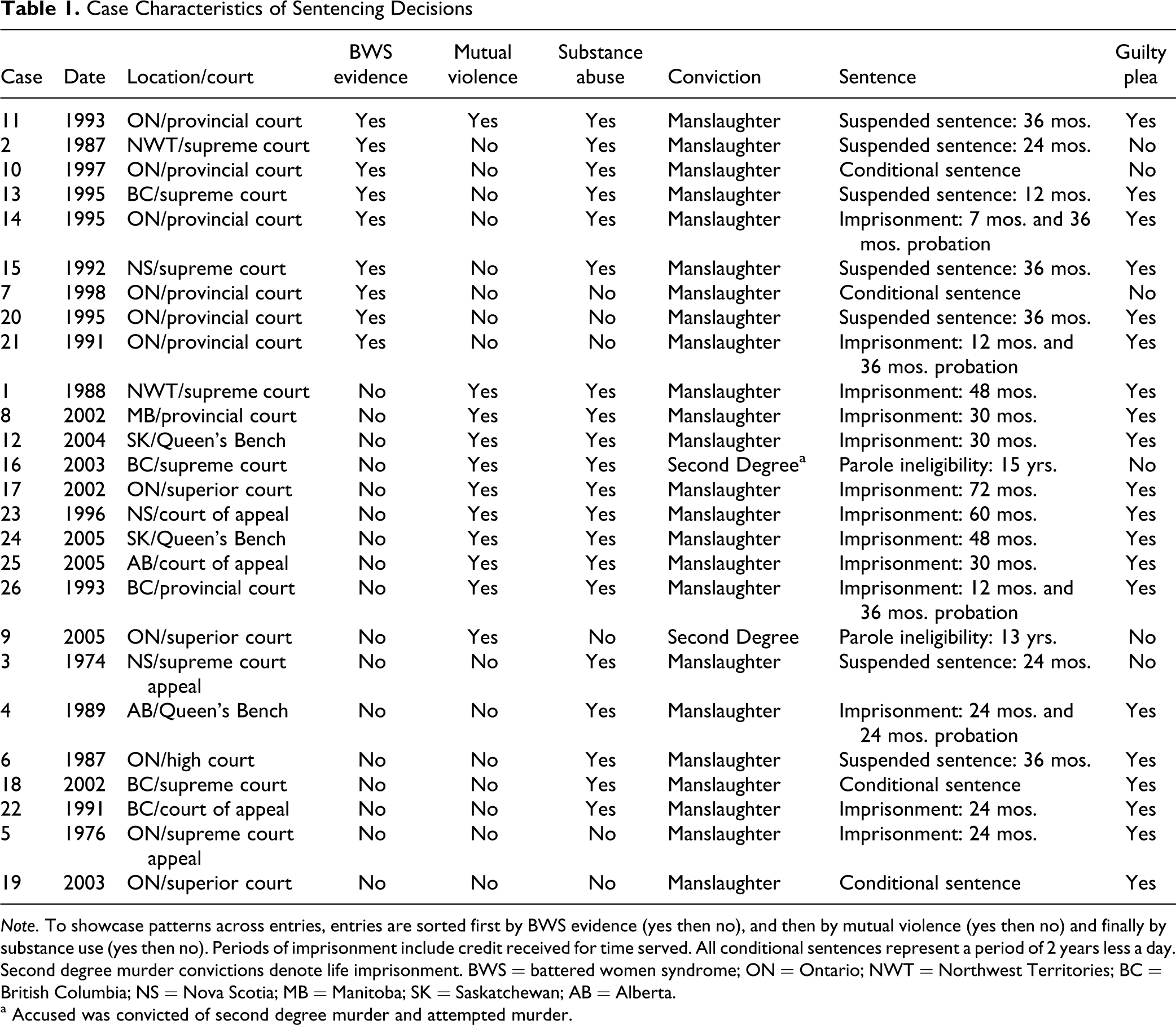
Note. To showcase patterns across entries, entries are sorted first by BWS evidence (yes then no), and then by mutual violence (yes then no) and finally by substance use (yes then no). Periods of imprisonment include credit received for time served. All conditional sentences represent a period of 2 years less a day. Second degree murder convictions denote life imprisonment. BWS = battered women syndrome; ON = Ontario; NWT = Northwest Territories; BC = British Columbia; NS = Nova Scotia; MB = Manitoba; SK = Saskatchewan; AB = Alberta.
a Accused was convicted of second degree murder and attempted murder.
Analysis of Decisions
An analysis in discursive psychology involves the identification of the actions, such as blaming, that are accomplished through the use of various discursive devices (Wood & Kroger, 2000). Discursive devices are analytical concepts or resources that have been established through work in social psychology, linguistics, rhetorical analyses, and conversation analysis. For example, lists and contrasts are discursive devices that can be identified in an account and have been shown to enhance the completeness of a claim and support its factualness. The devices aid in analysis and contribute to a wider interpretation of content, form, structure, and function (Wood & Kroger, 2000). The specific devices do not necessarily occur in isolation and may overlap. The analyses draw from several sources including work on fact construction (e.g., Edwards & Potter, 1992), accounts (e.g., Wooffitt, 1993), and linguistic devices (e.g., Potter, 1996).
One analyst (the author) read the sentencing decisions thoroughly and repeatedly to identify patterns in the similarities and differences of the sentencing decisions (e.g., conditional sentences did not include descriptions of mutual violence). Guided by the research questions, the main discourses judges used were identified from the material itself, with particular attention paid to how evidence of abuse was used by judges in sentencing. Specific analytic strategies as briefly demonstrated above (i.e., consensus) adopted from Wood and Kroger (2000) and other discourse analysts (e.g., Edwards & Potter, 1992) were used to conduct the analyses and identify the overarching discourses and warrant claims. The analyses proceeded inductively in that discourses were identified in specific cases and then located and confirmed/disconfirmed across the other cases. The analyses were confirmed through repeated meetings with a working group of independent analysts comprising graduate students trained in qualitative methods who assessed the claims for analytical soundness and bias. A final independent reviewer assessed the overall analysis and provided feedback and suggestions for improving the clarity and reliability of analytic claims.
Results
To organize the analysis process, the cases were initially examined according to harsher and lenient sentence outcomes (imprisonment vs. no imprisonment). During the analysis of the imprisonment cases, it became apparent that judges’ accounts about the intimate relationship acknowledged that relationship violence had occurred but denied that the violence represented seriously escalating domestic abuse. Because imprisonment represents the most serious or harshest sentencing outcome and, arguably, a key decision for judges is whether or not to imprison the accused and for how long, a question evolved as to how judges justified harsher sentences. To document how attributions were made for harsher sentences, the analysis presented here focused on cases in which the accused received a jail sentence but also included two nonjail sentences for later comparative purposes.
The analysis has two sections. The first is a discourse analysis that illustrates the discourses used by judges to discuss evidence of domestic abuse. The second is a broader discussion that describes the impact of these discourses on sentencing outcomes and demonstrates how one judge resists the dominant discourse. To aid in the manageability of the presentation of analysis, smaller excerpts from the wider sentencing decision are presented to demonstrate how the analyses were conducted. The specific excerpts were selected because they were analytically interesting and considered to be representative of the particular discourses under discussion. The presentation of the analyses of these excerpts does not denote that the excerpts were taken out of context from the broader decision. Rather, all findings are grounded and warranted in the discourse; warranting requires that they be grounded both in the immediate text of that excerpt and within the context of the broader sentencing decision.
The two main discourses used to diminish evidence of abuse involve the discourse of minimization and the discourse of mutual participation; both serve to downgrade accounts of abuse and excerpts may overlap. The results section provides excerpts from the judicial descriptions of the intimate relationship between the accused and the deceased, and it demonstrates how judges constructed accounts that diminished the claim that relationship violence represented serious domestic abuse. Specifically, this section will describe (a) the use of minimizing descriptions that downplayed any power imbalance between the deceased and accused and diminished the severity of the physical violence that occurred and (b) the use of police evidence to emphasize shared substance abuse and ongoing mutual violence throughout the history of the intimate relationship.
Discourse of Minimization
To support jail sentencing decisions, judges addressed the claims of abuse but provided accounts that minimized the frequency and seriousness of that violence. Minimization occurred in judges’ historical accounts about the intimate relationship between the accused and deceased. The following excerpt from Case 21 involves a woman who pleaded guilty to manslaughter in the stabbing death of her common-law partner. The offense occurred during a direct confrontation after she had threatened to pour hot oil on him if he did not stop insulting her. The accused received 12 months of imprisonment. Expert testimony was presented to support the depiction of a battered woman in the decision. Excerpt 1: It was the recollection of the accused that, during late 1988 and early 1989, the deceased’s verbal and physical abuse of her continued weekly. For the most part, the physical abuse comprised slaps on the face. She was only kicked twice, and punched but twice. (Case 21, para. 26)
In addressing evidence of previous abuse, judges focused on the level of the physicality of the violence to depict its seriousness. Through the use of differing descriptive terms, judges classified abuse or physical assaults in ways that diminished the severity of the violence. For example, judges sometimes described events as arguments, fights, altercations, or incidents. All of these terms imply different degrees of violence and different types of events. Consider the following excerpt in which the violence leading up to the offense is softened and cast as an argument. Case 8 involved an aboriginal woman who pleaded guilty to manslaughter for the stabbing death of her common-law husband while they were both intoxicated. She received 30 months of incarceration. Excerpt 2: Apparently the argument had something to do with being accused of sleeping with a brother and also, apparently, the deceased had smacked her twice in the bedroom previously, and she was angry. This was according to the statement of Ms. T. (Case 8, para. 11)
Judges’ historical accounts about the intimate relationship included descriptions that emphasized the chaotic relationship and the violence in the home. However, in the jail sentencing decisions, judges’ descriptions of previous relationship violence as “fights” worked to emphasize the participation of the accused in the dysfunctional relationship rather than foster sympathy for a battered woman. The following is from Case 17 in which the accused pleaded guilty to manslaughter in the stabbing death of her boyfriend during a verbal argument. She had been drinking and using drugs for 1 week. She received 6 years of imprisonment. Excerpt 3: KLF [accused] and TF [deceased] were partners in a somewhat dysfunctional relationship. From time to time, they lived together. They had a child together. But most of all, they fought together, and used drugs together, especially crack cocaine. (Case 17, para. 1)
Consider again the first excerpt in which the relationship violence is described as abuse despite the minimizing descriptions. In Excerpt 3, the violence is not cast as abuse. Instead, fighting emphasizes the participation of the accused in the violence and ignores the power imbalance seen more clearly in Excerpt 1. In the last sentence of Excerpt 3 the judge states “But most of all,” stressing that the defining aspect about their relationship was the fighting and drug use. The three-part structure of the final three sentences contributes to this interpretation through its escalating arrangement. Such lists are devices commonly seen in fact construction because they enhance completeness and rhetorical effectiveness as shown by the finding that lists containing fewer than three examples have been taken up by listeners as incomplete (Jefferson, 1990). Here the three-part structure creates a more complete picture of the nature of her intimate relationship that emphasizes their violent partnership.
Discourse of Mutual Participation
The presentation of abuse evidence was a key aspect in all of the sentencing decisions. However, judges in some cases described the violence using language that suggested mutuality of participation. Of the 26 accused, 11 were portrayed as participants in a mutually violent relationship. Despite evidence of ongoing domestic violence in the relationship, the violence was portrayed as mutual and participatory. Typically the women were portrayed as violent or aggressive and were construed as active participants in the assaults that took place in the relationship. The attributions were based on criminal records for assault (sometimes against the same victim) or other evidence (e.g., witness accounts) about their aggressive behavior (e.g., verbal arguments with the deceased, violent drunken episodes, police reports). The women, presented as capable and assertive, were constructed as the antithesis to the battered woman as described by the BWS literature.
Presentation of police evidence was used by judges to emphasize the turmoil and violence in the intimate relationship. The following excerpt is from Case 16 in which the accused was convicted by jury of second degree murder in the shooting death of her common-law husband and the attempted murder of her husband’s friend who was present at the time of the offense. Excerpt 4: It is clear that both Mr. P and Ms. Y drank alcohol to excess throughout the time they knew each other. It is also clear that their relationship was a tumultuous one. The police were called to their residence on several occasions. More particularly, on September 3, 2001, Constable L of the [city] detachment attended to find both Mr. P and Ms. Y at the residence. Both were under the influence of alcohol, and both were displaying evidence of having been involved in a physical altercation. (Case 16, para. 7)
Excerpt 4 provides a clear example of how judicial discussions of the deceased’s and accused’s home life served as narratives about the nature and history of the relationship in which both parties are portrayed as serially participating in drunken fights with each other. Metaphorical depictions of the relationship as tempestuous or tumultuous, for example, were common characterizations when documenting the frequency of police visits to the home. These characterizations suggest that the intimate relationship was filled with chaotic violence and drinking, and they emphasize a pattern or ongoing series of incidents. Presentations of evidence that both claimed to be victims of domestic violence suggest the violence was somehow mutual. For the accused, they suggest that she actively continued to participate in the violence.
Judges’ narrative accounts of the relationship history made reference to frequent police contact at home, which served to document the dysfunctional quality of the relationship, shared substance abuse, and mutual violence. Reference to police contact also highlighted the criminal record of the accused if she had one. As Excerpt 5 demonstrates, the presentation of police evidence was a persuasive fact-construction device (Edwards, 1997; Edwards & Potter, 1992; Potter, 1996) that served to first catalog the sheer number of times police were called. Excerpt 5: Next, on November 28, 2001, there was a further physical altercation between Mr. P and Ms. Y. Again, the police were called to attend, and again the police attended. Again, both parties showed signs of having been involved in an altercation, and there was evidence that the interior of the residence was in a state of disarray. The police were unable to determine who was responsible for any of the violence that had obviously occurred between Ms. Y and Mr. P, and as a result charges were not laid. (Case 16, para. 10)
Moreover, the first half of the excerpt is replete with terms that emphasize the frequency with which the police have attended the home; the judge uses “further” and then the word “again” three times. It is a construction that normalizes the violence in their relationship because of its frequency and consistency. The frequency or extent of violence, especially physical violence, was portrayed by the judge as an important aspect of the relationship. Even if evidence was presented to suggest that partner violence was extensive, how the judge constructed the validity and credibility of that information was fundamental to whether or not the abuse claim was accepted or challenged. As seen in this excerpt, the judge’s presentation of police evidence within the narrative establishes that the escalating violence was not abuse, but that the accused was a mutual combatant in the assaults (i.e., “unable to determine who was responsible” and “charges were not laid”). Thus, the judge makes attribution as the narrative enfolds.
A similar strategy is seen in this next excerpt from a different case. Case 24 involved an aboriginal woman who pleaded guilty to manslaughter in the stabbing death of her common-law husband. She received 48 months of imprisonment. Excerpt 6: They also had a long history of being physically and otherwise abusive to each other. Some 28 to 30 incidents involving one, the other or both of these individuals were reported to the RCMP in the last seven years. Of these, 10 occurrences between May of 2001 until the death of Mr. M. P., were investigated as criminal matters involving mutual assaults, threatening or harassing behaviors and public intoxication or disturbances. Some of these investigations resulted in criminal charges. Indeed, each of the accused and the deceased had an outstanding charge of assault against the other at the time of Mr. M. P.'s death. (Case 24, para. 8)
The presentation of duration markers is important for establishing the protracted (“lengthy”) quality of the mutual violence. In both Excerpts 6 and 7, the extent of the abuse is emphasized by the judges with the inclusion of duration markers (e.g., “further” and “long history”). Although they may be considered vague terms because they are not specific time frames, they still function to stress the ongoing and enduring aspects of the abuse. These terms portray the violence as stable and continuing over time. The presentation of the criminal records of deceased and accused similarly contributes to the construction of a long-standing pattern of abusive or violent behavior because it catalogs the prior violent behavior and constructs violence as a consistent pattern over time. Drawing on consistent actions from the same person works up permanent rather than situation-based dispositions. Such descriptions of regular events may comprise script formulations (Edwards, 1994) in which the physical violence becomes routine and expected. Thus, fighting becomes a consistent and normalized feature of their domestic life.
Attributions and Sentence Outcomes
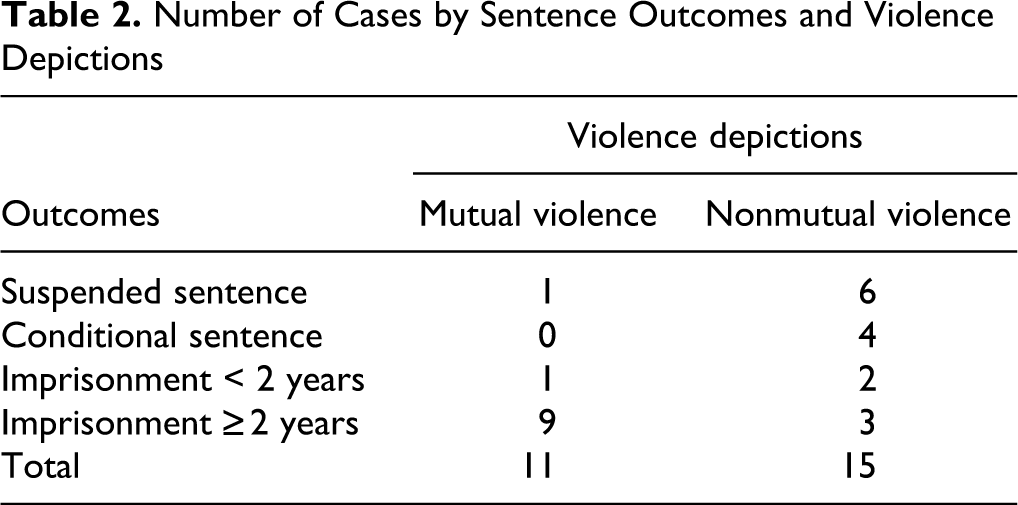
The general pattern for sentence outcomes and violence attributions is offered in Table 2. Women depicted as participants in a mutually violent relationship were significantly more likely to receive a sentence of imprisonment compared to those not depicted as participants in mutually violent relationships (90.9% vs. 33.3% respectively, χ2(1) = 8.62, p = .003, Fisher’s exact test). Instead, the latter were more likely to receive sentences such as a suspended sentence or conditional sentence.
Number of Cases by Sentence Outcomes and Violence Depictions
In the analysis presented above, the domestic abuse was downgraded in various ways, but particularly through the discourse of mutual participation. Thus, the accused were shown to present a higher risk to re-offend due to their capacity to be violent and aggressive. Accordingly, although rehabilitation and other considerations were still important, the offense was construed as more serious and requiring greater denunciation in the form of incarceration. Similarly, specific deterrence was presented as an important aspect of sentencing. These portrayals orient to the possibility that power imbalance and helplessness are important mitigating factors in sentencing battered women. It suggests that sympathy and leniency are not deserved because of the mutual nature of the violence.
For comparative purposes consider Case 20 in which the judge applied BWS evidence and portrayed the accused in a highly sympathetic victim construction. The accused pleaded guilty to manslaughter in the stabbing death of her husband and received a suspended sentence. The victim’s identity construction within the decision was replete with terms and discursive practices that emphasized passivity, servitude, isolation/vulnerability, and helplessness. The judge made extensive use of BWS stereotyping and used reported speech from the BWS expert testimony to construct both the quality of the abuse and the sympathetic victim identity. The important principles of sentencing for this decision were denunciation in minimal terms and rehabilitation. The accused was not presented as requiring incarceration because she represented no risk/threat to society. Excerpt 7: When faced with a man who, over a period of over a decade, constantly assaulted her physically, emotionally and sexually, coupled with the fact that he had a known propensity for violence, her anger and fear reached the point that Ms. D did something she had never done before but “stood up” to her husband but once again her stated intent was to scare him as opposed to kill him. She still, however, felt that he was intent on harming her during the altercation. As is typical for women who suffer from the Battered Woman’s Syndrome she still feels very guilty and remorseful for what she allegedly has done and in many respects still misses and loves the man who abused her over a period of many years. It is in Ms. D's best interest to continue with therapy in order to examine these unresolved issues and assist her in addressing the difficulty she still continues to have with her low self esteem. (Case 20, para. 17)
It is noteworthy that BWS evidence was absent from cases in which judges drew on the discourse of mutual participation. The only exception to this pattern was Case 11 in which the judge resists the discourse of mutual participation. The judge specifically attempted to account for or minimize the accused’s capacity for aggression by drawing on the expert BWS testimony as a rhetorical framework. The accused in Case 11 received a suspended sentence after pleading guilty to manslaughter in the death of her husband. Excerpt 8: Crown counsel has argued that Ms. B is not the nicest and sweetest of women. The evidence does reveal that she too was able to verbally abuse Mr. S, that she too was often drunk, profane and aggressive and that she did not hesitate to call the police or to slap Mr. S in public. Dr. S was asked to comment on this evidence and he stated that it did not change his opinion [that the accused is a battered woman]. (Case 11, para. 64)
The judge in Case 11 explicitly questions the stereotype of battered women in the next excerpt: Excerpt 9: It could also be added, in my opinion, that society, in the process of becoming more enlightened and accepting that women do find themselves in these situations, nevertheless could fall back into stereotyping these women as having to be, to be [repetition in original] credible, sweet and helpless victims who are brutalized by tyrannical men. With this, I disagree. As quoted in Lavallee at page 118, Dr. Lenore Walker, in her 1984 book, The Battered Woman Syndrome, says, "Sometimes, she precipitates the inevitable explosion so as to control where and when it occurs, allowing her to take better precautions to minimize her injuries and pain." (Case 11, para. 66)
Acts of violence are unilateral (Coates & Wade, 2004; Hydén & McCarthy, 1994) in that the attacker or abuser is in a position of dominance or power over the victim. Power imbalance is important for conventional conceptualizations of domestic abuse and corresponds well with most popular conceptions of intimate partner violence as intimate terrorism in which the violence is a tactic of control, often involves emotional abuse, and is more likely to seriously escalate over time (Johnson & Ferraro, 2000). As previously demonstrated, the portrayal of the accused as a participant in the violence commonly involved the presentation of a long or frequent record of police visits to the couple’s home. It is a strategy that constructs dual violence because it highlights the lack of available evidence to determine who the initial aggressor was or that both were charged with assault. However, it also portrays the accused as an aggressive, strong, and capable participant in the abusive relationship. These accounts do not diminish the extent or existence of violence, but rather they suggest that the accused was responsible for it—or at least an active participant. Such accounts warrant the argument that the accused is not a battered woman and limit sympathy for her as a victim of abuse. The result is a depiction that removes any power imbalance between the accused and deceased and suggests instead that they were equal combatants.
Discussion
All judges in my sample based their decisions on the principles and purposes of sentencing and relevant case law, and their discourse demonstrated careful and thoughtful application of legal rules to the specifics of each case. A key sentencing consideration for all judges involved the context of the abusive relationship. The present analysis demonstrates that depictions of mutual violence and shared substance abuse underpin negative attributions about the accused and were commonly associated with prison sentences. The finding that judges portrayed domestic violence as occurring during episodes of substance abuse suggests broader, potentially harmful attributions about the causes of and contributors to intimate partner violence. Specifically, the association supported aggressive portrayals of the accused in which she serially participated in bouts of drunken fights with her partner. In such cases, the domestic relationship was not construed as representative of serious ongoing domestic abuse.
BWS as an Explanatory Framework
Mutual violence is problematic in conceptions and treatment of intimate partner violence. In the case of R. v. Lavallee (1990), the issue was problematic enough to warrant a specific discussion around the issue of aggressive behavior on the part of the accused. It has been argued that aggression and reactive violence are typically another aspect of the battered woman’s ongoing victimization (Miller & Meloy, 2006). This analysis of judicial discourse suggests that discrepancies exist between the stereotype of the battered woman and the reality of how women attempt to cope with ongoing abuse. Walker (2000) specifically attempted to address the stereotype of the helpless victim that the term “learned helplessness” seems to evoke; she stressed that learned helplessness was not intended to describe abused women as weak and helpless but rather as unable to believe in the efficacy of their own behavior in attempting to escape the violence. However, in the present analysis, except for one sentencing decision (Case 11), decisions involving portrayals of mutual violence did not include evidence of BWS. The absence of BWS in such cases suggests mutual violence may be incompatible with the application of BWS and the construction of the accused as a victim of serious abuse. The issue is that mutually violent victims are not constructed as passive, helpless, and trapped. Stereotypical, feminine characterizations of battered women are sometimes at odds with the reality of their experiences, and regardless of what Walker intended, BWS does not appear to be taken up in a more nuanced way in the majority of legal discourse.
My study’s finding that judges drew on a discourse of mutual participation when making attributions for a jail sentence may suggest that expert testimony and particularly BWS testimony require greater emphasis on battered women’s resistance efforts. Most promising is the judge in Case 11 who demonstrates how to challenge the stereotype and apply BWS testimony to women who may not match implicit abuse victim stereotypes. The judge in Case 11 used BWS to explain the prior aggressive behavior of the accused (see Excerpts 8 and 9). Thus, BWS may still be useful as an explanatory and rhetorical framework to justify a nonjail sentence in cases of mutual violence. If this framework is to continue to be used in sentencing, it may be more effective to include descriptions of the woman’s active efforts to negotiate that violence and her many attempts to escape or control the violence against her. Because this study focused only on sentencing decisions, it is not possible to determine whether BWS was put forward by the defense at an earlier time in the proceedings unless it was explicitly taken up by the judge at sentencing. However, Case 11 demonstrates the powerful way in which BWS testimony and the Lavallee case can be used as an explanatory framework to account for women who are not stereotypically passive and, thereby, justify a nonjail sentence. The judge in Case 11 specifically challenged the stereotype that battered women have to be “credible, sweet and helpless victims who are brutalized by tyrannical men” (see Excerpt 9) and successfully used BWS and the Lavallee case to argue that women can fight back and still be victims of serious abuse. Judicial discourse of battered women needs further development and change in the areas of mutual violence and female aggression.
The judge in Case 11 may provide a unique perspective given that, in 1995, she was appointed to review similar legal cases. The Canadian federal government undertook a self-defense review of cases of women convicted for killing violent intimate partners (Sheehy, 2000). The review was stimulated by concerns put forward by feminists and particularly the Canadian Association of Elizabeth Fry Societies (CAEFS) that some women had not received the benefit of the Lavallee decision and should be afforded some degree of mercy when their cases represented a legal basis for self-defense (Sheehy, 2000). The review included 98 women and consisted of cases taking place both before and after Lavallee. The results were made public in 1997 and several legal recommendations were proposed, including some related to re-working the legal definition of self-defense. Further, seven women were recommended for some measure of relief from their convictions. Judge Ratushny’s specific recommendations for relief were reviewed by the Minister of Justice and Solicitor-General of Canada and relief was granted to five of the seven women. However, two of these five women had already completed their sentence and two others were already on parole in the community. Thus, only one woman was referred for an appeal and no women were released from prison as a result of the review. However, the law reform recommendations were a positive step forward. The recommendations recognize the problems facing battered woman in the legal system and acknowledge the high rates of guilty pleas to manslaughter. Many of the convictions analyzed in the present research involved the accused pleading guilty to manslaughter. Future research could examine differences in discourse and sentences between cases with guilty pleas versus cases without guilty pleas.
Mutual Violence Attributions
Negative attributions about mutual violence may reflect an increasing emphasis on women as capable and a shift away from traditional, feminine portrayals of battered women. This finding may suggest that battered women who do not fit traditional stereotypes are afforded less sympathy because they are instead depicted as capable participants in a mutually violent relationship. The proliferation of researchers adopting a gender-neutral approach to domestic violence has suggested that women’s use of force in intimate relationships is often comparable to that of men’s (Strauss, 2007). Although there exists a well-established literature demonstrating that battering is gender asymmetrical (e.g., Dasgupta, 2002; Dobash, Dobash, Cavanagh, & Lewis, 1998; Hamberger, 1997; Miller, 2001; Walker, 2000), judicial discourse around mutual violence in my study highlights the impact of such attributions for women in abusive relationships. A more systematic analysis of sentencing decisions over time may support the speculation that gender role portrayals are shifting and support previous findings that societal views of gender traits have changed over time (Auster & Ohm, 2000).
Practice Implications
This Canadian research can provide insights on the role that attributions and discourses of mutual participation can play in sentencing decisions in other adversarial court jurisdictions throughout the world. To my knowledge, this is the first study that has used discourse analysis to examine BWS at sentencing. The research presented here contributes to the growing body of international discourse analysis research in the area of legal attributions and sentencing (e.g., Coates & Wade, 2004; MacMartin & Wood, 2005; Wood & MacMartin, 2007). Additionally, there are few discourse analyses of domestic assault and murder (O’Connor, 1995), and my study adds to the growing body of discursive analyses of violence against women (Adams, Towns, & Gavey, 1995; Erhlich, 2004; Stokoe, 2010).
Previous research has demonstrated that different versions of the same events can be created through various discursive practices (e.g., Auburn, Willig, & Drake, 1995; Hydén & McCarthy, 1994; Ling Chan, 2009). For example, Hydén and McCarthy (1994) examined accounts given by husbands and wives in Sweden about wife battering incidents and illustrated how different discourses around denial and acknowledgment were created by participants. They demonstrated how accounts of denial consisted of the language of the mutuality of participation and the use of minimizing descriptions. The present study extends the research in this area by demonstrating how judges use similar strategies when they construct versions of domestic violence. Attributions about the mutuality of the violence in Hydén and McCarthy’s (1994) research were done, for example, through descriptions of battering incidents as “fights” rather than assaults. I have similarly demonstrated how a descriptive term such as “fight” in the judges’ discourse invokes mutuality and downplays the seriousness of the act. The finding that some judges construct battered women’s experiences in this way provides further support for the claim that such a framework is problematic not only for domestic violence interventions but also for battered women at sentencing. In an analysis of the American O. J. Simpson case, Cotterill (2001) speculates that a number of comments from the jury demonstrate a judgment of mutual responsibility between O. J. and his wife. Cotterill suggests that jurors accepted the relationship as abusive but diffused blame across both parties because the pair had been described by the defense as jointly violent. The present study confirms the importance of this trial tactic and discursive strategy in the construction of alternate attributions for domestic violence.
In the present research, when the accused was portrayed as a participant in a mutually violent relationship, her aggression was construed as a consistent internal characteristic and not as a response to her ongoing victimization. The accused’s previous aggression toward the deceased represented a serious concern that judges viewed as requiring specific deterrence measures in the form of imprisonment. In a similar vein, Nicolson (1995) described and compared two United Kingdom verdict appeal cases of battered women who killed. The findings from the present research may explain Nicolson’s (1995) assertion that a judge’s detailed description of fights preceding the offense in one case led ultimately to a conviction rather than acquittal. Nicolson suggests that the judge’s descriptions of these fights served to portray the accused as a woman who lacked traditional feminine qualities because she “could give as good as she got” (p. 196). The findings from the current study do not necessarily suggest that gender discrimination is rampant in judicial discourse, but they do serve to reinforce concerns that I previously articulated around attributions about mutual violence in abusive relationships. In the context of sentencing battered women, judges’ descriptions of mutually violent episodes seem to formulate domestic violence as discrete episodes of violence attributed in many cases to alcohol rather than an ongoing pattern of serious domestic abuse. Descriptions of mutually violent episodes additionally reinforce the accused’s capabilities and strength, which served to diminish the opposing claim that she was trapped in a seriously escalating abusive relationship.
Research Implications and Limitations
Future research should be directed toward exploring police decision making in domestic violence situations and the relation of policy decisions, such as mandatory arrest, to mutual violence attributions. Such policies were enacted because victims, for a variety of reasons, were frequently hesitant about charging their intimate partner with domestic assault, and police officers were similarly reluctant to lay charges (Goodman & Epstein, 2005). However, as indicated by research in the United States, mandatory arrest seems to have had the unanticipated consequence of a rise in dual arrests whereby both parties are charged with assault (Hirschel & Buzawa, 2002; Martin, 1997).
As with all research, there are limits to the generalizations that can be made from my findings. As discussed in the methodology section, French language cases were excluded from the analysis due to language barriers, which resulted in the exclusion of cases from Quebec. Quebec has a unique legal system (Department of Justice Canada, 2005) and arguably some differing political and social contexts than the rest of Canada. For example, by law in Quebec both spouses continue to use their birth names after marriage for all civil purposes (e.g., on contracts, credit cards, driver’s licenses; Justice Quebec, 2008) and attitudes about gender and marriage may be less conventional. It is unknown how these concepts are taken up by judges within that province’s social and legal context. In addition, cases from Ontario are overrepresented in my study. Although the cases in my study may have come from different courts, the decisions obtained from QuickLaw are the case law used to support legal arguments by lawyers and judges across the country. Consequently, my research does contribute a general Canadian perspective to the literature on sentencing and BWS. Conversely, this research can only speak to the Canadian sentencing experience for battered women and does not assume that these findings generalize to other cultures and regions where differences may be found due to cultural and ethnic factors not considered in the current study.
Conclusion
Rothenberg (2003) suggests that BWS is a cultural compromise that has provided a framework for social change; it has opened the doors for the acceptance of domestic violence as a real social problem and paved the way for policy responses that have helped women. However, she suggests that it is a compromise because it has resulted in a narrow definition of victim identity in which some women are marginalized. The present research sought to explore legal discourse around these issues in sentencing battered women. Traditional discourses of battered women persist in the legal system. My research demonstrates how such discourses are limiting and offers directions for change. The dominant discourses can constrain identity attributions in harmful ways; they may also limit our understanding of intimate partner violence and the creation of new policy and legal responses. As seen through the discursive practices of one judge in the present analysis, resistance to these dominant discourses is possible.
Footnotes
Author's Note
Elisabeth Wells is now at the Centre for the Study of Social and Legal Responses to Violence, University of Guelph.
Acknowledgment
I gratefully acknowledge and wish to thank Linda A. Wood, PhD, for comments on an earlier version of this article.
Declaration of Conflicting Interests
The author(s) declared no potential conflicts of interest with respect to the research, authorship, and/or publication of this article.
Funding
The author(s) received the following financial support for the research, authorship, and/or publication of this article. This research was supported by a Social Sciences and Humanities Research Council of Canada Doctoral Fellowship.