






Abstract
Landfill mining (LFM) has gained momentum worldwide as a strategy to remediate legacy landfills (LeLas). Despite growing global interest, a systematic understanding of the factors guiding LFM suitability and composition of landfill mined residues (LMRs) has been meagre. Whether a LeLa is considered suitable for LFM depends on factors, including motivations for LFM, environmental impacts, economic impacts, the usability of LMRs, and the availability of alternative remediation strategies. Our review shows that LFM projects and studies worldwide are primarily driven by environmental remediation and resource recovery, with these motivations accounting for 34% and 25%, respectively. Key motivations in developing countries are less diverse than in developed countries, largely due to the severe environmental impacts caused by dumpsites in former setups. The availability of alternative remediation strategies could act in favour of or opposition to mining a landfill and is discussed for case studies in India and Estonia. The composition of LMRs, which is relevant to evaluating environmental and economic impacts, varies from one project to another. Based on data from 73 LeLas, age and depth of LMRs, geographical location, and income levels are identified as major factors influencing the composition of LMRs. Regardless of these factor dependencies, landfill-mined-soil-like-fraction is the major fraction (accounting for 35% and 75%) of LMRs. These findings support estimating material stocks in LeLas and prospective material flows from field-scale projects as a basis for developing effective LFM strategies. The novelty of this review includes (i) the first systematic distinction between major LFM motivations in developed and developing countries, and (ii) the first global quantification of LMRs’ composition dependencies on-site-specific factors (age and depth) and system-specific factors (geographical settings and income level). Overall, these insights establish a strong empirical basis for assessing LFM feasibility and supporting informed decision-making.
Introduction
Although landfills have been used as final waste storage facilities for over 5000 years (O’Hare, 2021), their adverse impacts were not a major concern until the mid-20th century, primarily due to low waste volumes and relatively fewer toxic substances. During this time, the incessant growth in population and urbanisation has led to a multifold increase in municipal solid waste (MSW) disposed of in landfills, which have become a part of modern cities and/or eco-sensitive zones (Goli et al., 2020). In this context, landfill mining (LFM) has been considered as a strategy to remediate the environment contaminated by waste disposed of in legacy (old/historic/dumps) landfills (LeLas) (Krook et al., 2012). LeLas are landfills that were built and operated either before the establishment of current environmental guidelines or without adherence to those guidelines. As a result, they often lack essential environmental protection systems such as liner, cover, leachate, and gas collection and treatment facilities (Chandana et al., 2021; Goli et al., 2021, 2022b). In developed countries, most LeLas are considered historic or old landfills, whereas in developing countries, they typically are dumpsites. Although the first officially reported LFM study was conducted back in 1953 in Israel (Savage et al., 1993), it was only in the late 20th century that the concept gained impetus in the United States and Europe (Vollprecht et al., 2021). However, it soon lost momentum, owing to the (i) potential economic burden associated with the LFM process, as the prime objective was environmental remediation, and (ii) reduced demand for landfill space because of introducing sophisticated waste treatment systems and introducing policy targets aimed at reduction in landfilling in Europe (cf. European Union directive 1999/31/EC; Krook et al., 2012; Saner et al., 2011). In the late 2000s in Europe, the enhanced landfill mining (ELFM) concept, aimed at a shift in focus of LFM from a remediation strategy to an integrated resource recovery approach that facilitates safe conditioning and valorisation of excavated waste streams, was introduced and subsequently applied to REMO LeLa in Houthalen-Helchteren, Belgium, as a part of the Closing the Circle project (Jones et al., 2013). An environmental and economic assessment of the ELFM project at REMO LeLa revealed: (i) a 15% reduction in greenhouse gas (GHG) emissions from ELFM compared to the reference scenario (i.e. landfill with heat and electricity recovery from landfill gas (LFG) for 15 years), and (ii) the possibility of substantial monetary benefits from land reclamation (van Passel et al., 2013). This led to the start of the European Enhanced Landfill Mining Consortium (EURELCO) in 2014, with 38 organisations representing 13 member states to examine the economic, environmental, technological, legal, and social challenges in the implementation of ELFM in Europe (ANTS, 2024). About the same time, the successful demonstration of landfill biomining, a type of LFM customised to recover valuables from LeLas containing actively biodegradable waste, at Kumbakonam, India (Bandela and Sambyal, 2020), has led to its promotion as a preferred method of LeLas remediation and has been included in the Solid Waste Management Rules, 2016 of the Government of India (MoEFCC, 2016b). Recently, LFM has garnered increased attention in China as a means to recover MSW for use in incineration plants (Fei et al., 2026; Ma et al., 2025). As a result, a renewed interest in LFM has arrived (as evident from a rapid rise in the number of publications post 2010, see Figure 1(a)), wherein field projects and research are focused on integrated valorisation of landfill mined residues (LMRs) while achieving environmental remediation.
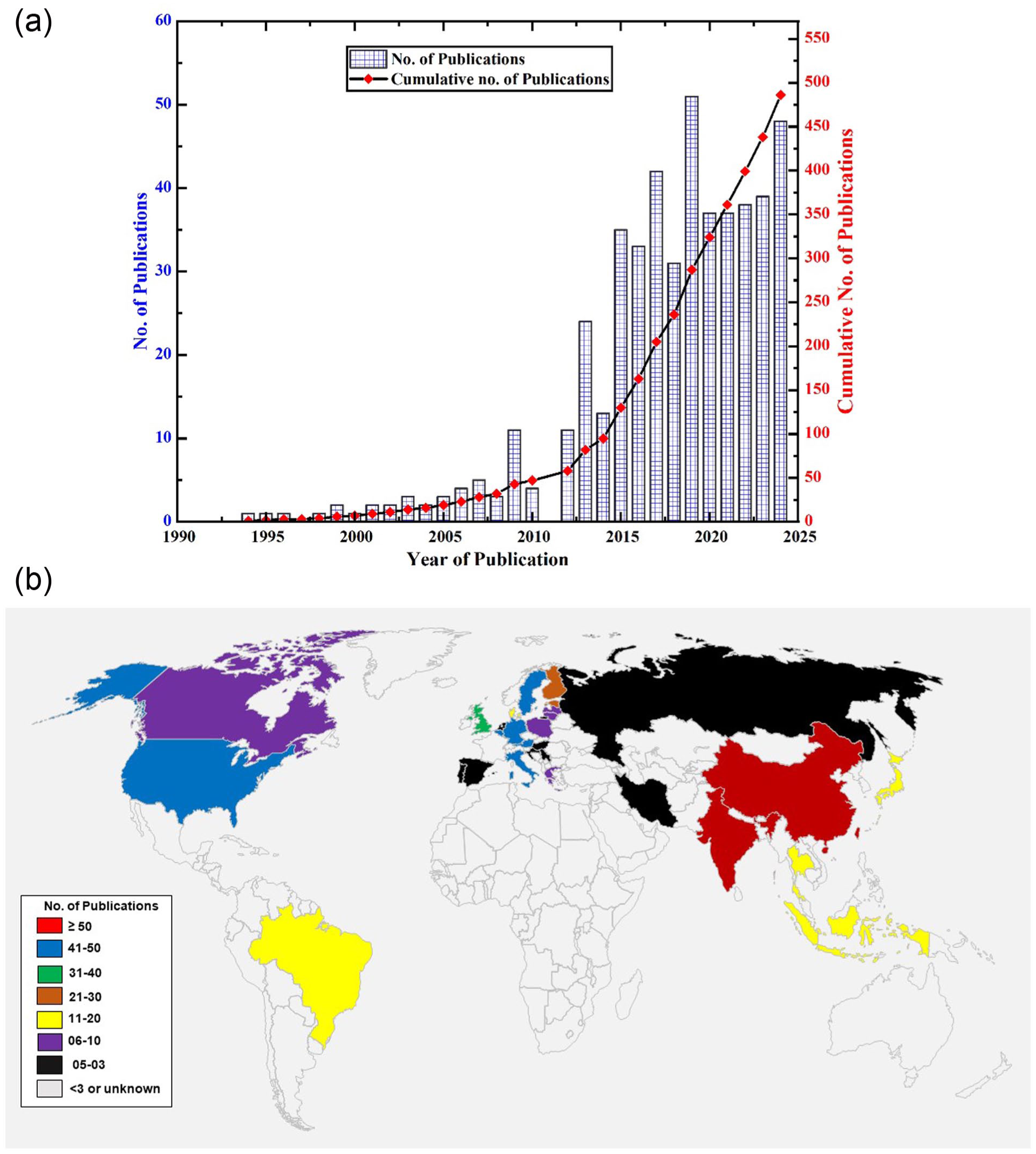
(a) Cumulative and year-wise, and (b) geographic distribution of the publications on landfill mining.
The decision on ‘whether a LeLa should be mined or not’ or ‘whether LFM is a suitable remediation strategy or not’ will be influenced by several factors. Among them, the motivations/objectives (hereafter referred to as motivations) of an LFM project is a factor that determines the process methodology and major outputs (Ortner et al., 2014). In addition, assessing environmental and economic aspects provides important information on the attainability of climatic targets and long-term financial viability of LFM projects, which interests key stakeholders such as policymakers and operators. Hence, the environmental and economic impacts of LFM projects are investigated in regional setups like Europe (Esguerra et al., 2021; Laner et al., 2016, 2019), the United States (Jain et al., 2014), China (Zhou et al., 2015a), Iran (Sabour et al., 2020), and India (Cheela et al., 2023). Specifically for Europe, the key factors influencing the economic and environmental performance are identified as waste composition, aftercare and LFG management of reference case, sorting process, background energy systems, waste-to-energy (WtE) treatment parameters, primary material production systems, transport distances of recovered materials to recycling and disposal sites, and value for recovered land (Laner et al., 2016, 2019). These studies further introduced the sub-classification of factors at site-, project-, and system- levels. Currently, a critical review of environmental and economic performance studies is lacking. In contrast to LFM, alternative approaches have been implemented for the containment and reclamation – either intermediate or final – of LeLas. These include: (i) repurposing sites for recreational use (Baser et al., 2023), (ii) using landfill surfaces for solar panel installation (Jacob and Ayers, 2018), and (iii) transforming landfills into bioreactors to recover the landfill gas (Abichou et al., 2013; Mohammad et al., 2021; Reinhart and Townsend, 2018). Notably, the bioreactor approach is also employed in combination with the first two strategies, as well as with LFM, to enhance landfill reclamation efforts. So, ‘availability of alternative remediation strategies’ influences the decision-making, which is yet to be discussed in the context of LFM with relevant real-life case studies.
The valorisation of LMRs is an integral part of ELFM that has several benefits, including avoided re-landfilling, long-term aftercare costs, and revenue generation that can contribute to the sustainability of LFM in multiple ways (Winterstetter et al., 2018). In this context, attempts have been made to understand the valorisation potential of various fractions of LMRs (Mandpe et al., 2019) as a feedstock for thermal treatment techniques such as incineration (Bosmans et al., 2013), pyrolysis (Jagodzińska et al., 2021) and gasification (Chiemchaisri et al., 2010) or for other routes such as composting (Goli et al., 2022b), landfill bio-cover (Pehme et al., 2020), pH buffer material (Goli et al., 2022a), the source of metal recovery (Wagner and Raymond, 2015), raw materials for manufacturing of building materials (Goli and Singh, 2023c, 2023d, 2024; Singh and Chandel, 2022), and geotechnical fill material (Datta et al., 2021). However, obtaining a proper composition of LMRs is crucial for evaluating their contribution towards the environmental and economic impacts of LFM. So far, no study has been conducted to investigate the major factors influencing the composition of LMRs.
Earlier reviews on LFM primarily addressed descriptions of LFM initiatives (Krook et al., 2012), the characterisation, recovery, and utilisation of LMRs (Chandana et al., 2021; Jain et al., 2023; Parrodi et al., 2018; Rawat and Mohanty, 2025; Somani, 2025), and underlying motivations guiding decision-making (Calderón Márquez et al., 2019). However, as evidenced by the extensive body of research discussed in subsequent sections, the field has evolved considerably, necessitating a comprehensive reassessment of the various dimensions of LFM. Hence, the present study aims to critically and quantitatively review the factors influencing the (i) decision-making on LFM of LeLas from an international perspective across different regions, and (ii) composition of LMRs based on the data collected from 73 LeLas (of 116 samples) spanning 20 countries worldwide. The discussion on decision-making factors is limited to motivation, environmental impacts, economic impacts, usability of LMRs, and availability of alternative remediation strategies. Similarly, the factors influencing the LMRs composition are limited to age and depth of LMRs, geographical location, and economic level, which are classified into site-specific and system-specific factors, and impacts are assessed. Based on the review of worldwide LFM studies, this work presents (i) a systematic distinction between major LFM motivations in developed (high-income countries of the World Bank classification, Metreau et al. (2024)) and developing countries (all except high-income countries), and (ii) a global quantification of LMRs’ composition dependencies on-site-specific factors (age and depth) and system-specific factors (geographical settings and income level), advances not offered by previous reviews.
Research overview
The present review employed the SALSA framework (Search, Appraisal, Synthesis, and Analysis) as outlined by Mengist et al. (2020) to systematically identify, evaluate, and select relevant research articles and reports for inclusion in the final list. Firstly, a bibliometric analysis of research publications related to LFM through 2024 was conducted using the Web of Science (WoS) database. The search employed a combination of keywords, including ‘landfill mining’, ‘excavated plastic’, ‘soil-like material’, ‘landfill-mined-soil-like-material’, ‘landfill mined residue’, ‘excavated waste’, ‘landfill reclamation’, ‘landfill remediation’, and ‘enhanced landfill mining’, along with various permutations of these terms. Additionally, the International Waste Working Group (IWWG) conference proceedings database was searched for articles related to LFM. The procedure to identify publications and subsequently select articles for data analysis is detailed in Figure 2. After screening the articles available in WoS and IWWG databases, 486 publications were identified on this topic, with the first one published in 1994 (see Figure 1(a) and Supplemental Table S1). Since then, a steady increase in the number of publications has been observed till 2010, after which the research outcome has grown exponentially up to 2019.
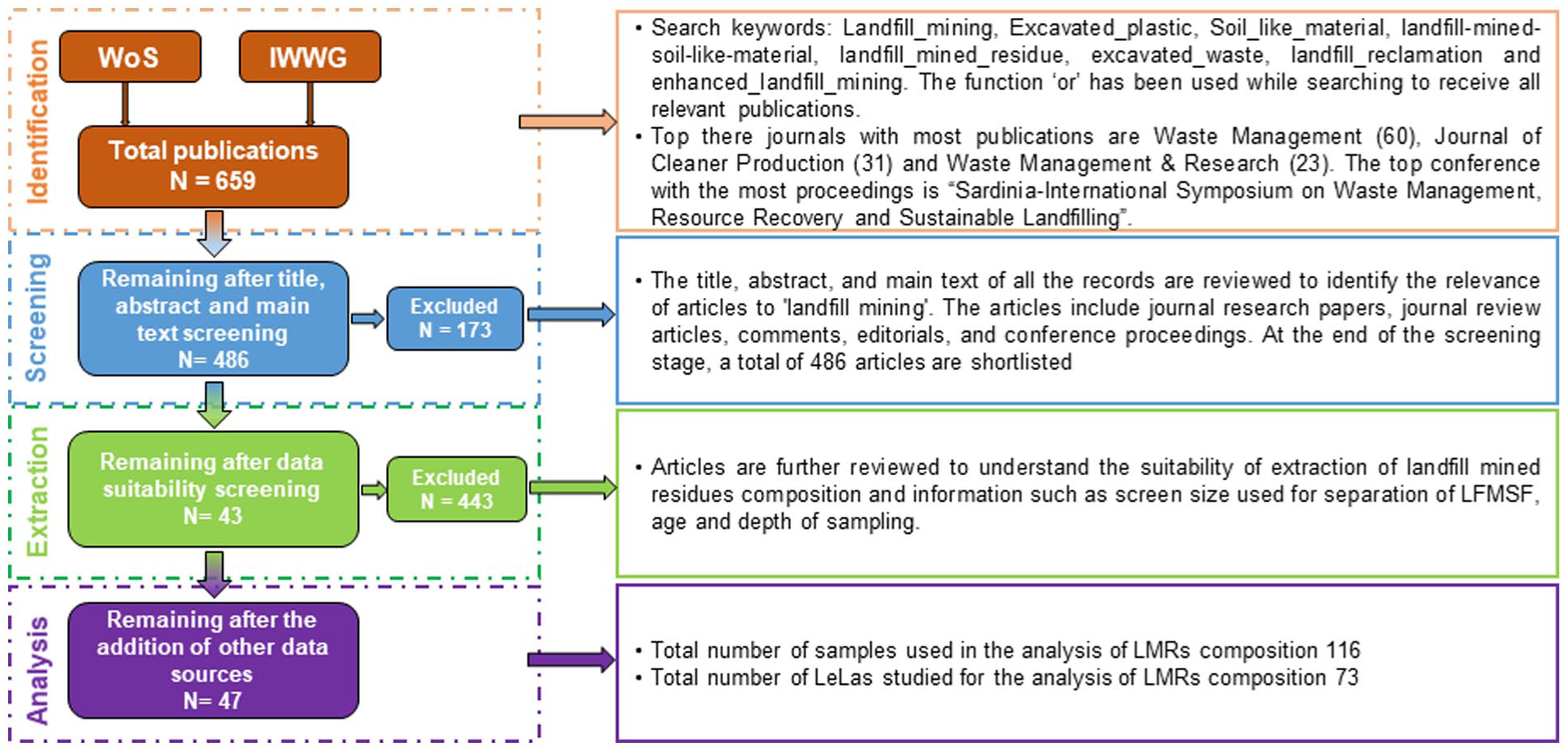
Procedure adopted for the identification of publications and the selection of literature for composition analysis.
Till the first decade of the 21st century, most research on LFM was restricted to developed countries of the European Union (EU) and North America (NA) and was mostly focused on the remediation of partially engineered landfills (i.e. closed landfills without complete environmental protection systems). When it comes to developing countries in Asia and South America (SA), the scope of LFM shifts to mining dumpsites because dumping is still the most widely adopted waste management strategy in many of these countries (UNEP, 2024). Because of their apparent impacts, the LFM of dumpsites will be associated with a larger direct environmental relief compared to the LFM of partially engineered landfills. As a result of increased awareness of environmental threats from dumpsites and pathways for the beneficial reuse of LMRs, research on LFM in developing countries picked up post-2010. In addition, the introduction of ELFM by Jones et al. (2013) and the EURELCO consortium-led projects contributed to the research output on LFM in Europe during this period. Post-2019, the number of publications on LFM research is stable (until 2023). At the moment, in terms of authors’ affiliation with research articles on LFM, India and China are leading, which are closely followed by countries like Sweden, Italy, the United States, Belgium, Austria, and Germany (see Figure 1(b)). Research in other middle income developing countries such as Thailand, Brazil, and Indonesia has gained momentum in the past 15 years.
The total number of articles published is much smaller than the cumulative number published by all authors representing different countries (see Supplemental Tables S1 and S3). This implies that a considerable number of articles are authored by researchers (i) affiliated to organisations in more than one country, and/or (ii) having affiliation to multiple universities/institutes from different countries. This methodological limitation consequently overestimates the country-wise articles, particularly for those countries that are a part of projects funded by international consortia such as EURELCO (NEW-MINE, 2020), compared to actual research output. Despite having multiple authors, if all authors are affiliated with organisations within the same country, such articles are counted as a single publication. As a result, a higher number of publications from a specific country need not coincide with same level of LFM explorations in that country. This is evident from Supplemental Table S2, which indicates that more LFM explorations have been carried out in Thailand despite publishing a smaller number of research articles (on 5 LeLas, 16 publications) in comparison with Belgium (on 2 LeLas and 46 publications; see Supplemental Table S3). Simultaneously, this could have also resulted from (i) publishing more research articles from fewer site explorations and/or (ii) participation in collaborative research carried out in other parts of the world.
Critical factors for decision-making on LFM
Similar to any other environmental remediation project, the decision on ‘whether to mine the LeLa or not’ will be influenced by several factors, which are discussed in ‘Motivations for LFM’, ‘Environmental impacts’, ‘Economic impacts’, ‘Usability of landfill mined residues’, and ‘Availability of alternative remediation strategies’ sections.
Motivations for LFM
Although the cardinal motivation for LFM is to remediate LeLas, several other motivations can play a role with regard to decision-making. In addition, these motivations change with the region, socio-economic fabric, past waste management practices, and time of actual mining/research. For instance, in land-scarce countries like Singapore, the dominant motivations include extending landfill lifespan through the creation of airspace (CA) and recovering resources such as incineration bottom ash for land reclamation, thereby reducing reliance on imported aggregates (Hu et al., 2025; Zhang et al., 2024). Similarly, in Europe, before the existence of the EU landfill directive, 23% of the studies did not mention any specific motivation, whereas another 30% of LFM studies were motivated by CA for operational benefits and landfill rehabilitation (Ortner et al., 2014). This also coincides with the primary motivations, such as CA and landfill rehabilitation of German-specific LFM projects carried out in the 1980s and 1990s (Kruger et al., 2016). However, post-1999, due to the imposition of the EU landfill directive, the focus has shifted towards addressing the concerns about environmental pollution as a result of LeLas (Ortner et al., 2014).
The above discussion emphasises that ‘time of research and/or time of policy’ is a key factor that decides the motivation for research and decision-making on LFM. As many research and field-scale studies are carried out after previous reviews (Calderón Márquez et al., 2019; Krook et al., 2012; Ortner et al., 2014), the key motivations could have differed from the past ones. In addition, we conducted a review of studies that reported motivations only concerning decision-making. For this purpose, we ignored studies that did not report any motivation or reported motivations (such as conducting a field-scale study, motivations for conducting narrow studies, such as the characterisation of LMRs) that do not impact decision-making. The remaining studies reported diverse motivations that have similar effects on the decision-making process and are grouped into a few categories (see Supplemental Table S4): environmental remediation (ER), resource recovery (RR), CA, recovery of land (RL), relocation of waste (RW), to carry out standard landfill operations (SLOs), and miscellaneous (Rest). Motivations of 102 distinct LFM projects/studies (see Supplemental Table S5) are collected using the screening procedure depicted in Supplemental Figure S1.
LFM is often an endeavour with multiple motivations. To reflect this in terms of the relevance of each motivation in decision-making, the relative percentage for occurrence of each motivation is calculated in view of total number of motivations. Accordingly, the relative occurrence of each motivation is determined using motivation-level counts rather than project-level counts. To identify the key motivations, the percentage occurrence of each motivation was first calculated and then ranked from highest to lowest. Motivations were cumulatively added until they account for at least 80% of all reported motivations. The minimum individual contribution required for a motivation to appear within this cumulative 80% was then taken as the threshold for defining a ‘key motivation’. Using this approach, the least percentage contribution needed for a motivation to be included within the 80% cumulative share was found to be 10%. This value emerged consistently across all three scenarios (i.e. worldwide, developed countries, developing countries), indicating that 10% is the data-driven cut-off. This is the case for ER, RR, CA, and RL in the present analysis, when worldwide LFM studies are considered (see Figure 3). Together, these four motivations accounted for 83% of total motivations, with ER and RR contributing to ≈60% of total occurrences. To understand the nature (i.e. specific/general) of these motivations, ER and RR are sub-classified into general environmental remediation (ER-General), protection of water bodies (ER-W), and reduction in gaseous emissions (ER-G), and general resource recovery (RR-General), utilisation of landfill-mined-soil-like-fractions (RR-L), and utilisation of combustibles (RR-C), respectively. The categories ER-General and RR-General may encompass ER-W and ER-G, and RR-L and RR-C, respectively, along with other motivations. Within ER and RR, nearly 60% and 45%, respectively, of occurrences are related to general aspects (see Figure 3(d) and 3(e)). The occurrence of specific motivations is dominated by ER-W (35%) and RR-C (32%) within ER and RR, respectively. The occurrence of ER-W is widely popular with LFM projects in Europe, as the EU landfill directive (1999/31/EC) requires protecting ground and surface water bodies from contamination by LeLas. As it is practically impossible to completely avoid LeLas leachate from entering the subsurface and water bodies, such cases are motivated to go for LFM. The RR-C acted as motivation for LMRs, such as plastics, textiles, wood, and rubber, which contain high calorific values and are capable of replacing conventional fuels, such as coal, in cement kilns and feedstock in WtE plants. In addition, utilisation of combustibles, due to their low density, provides an opportunity to create a huge airspace to extend the landfill operating life span.
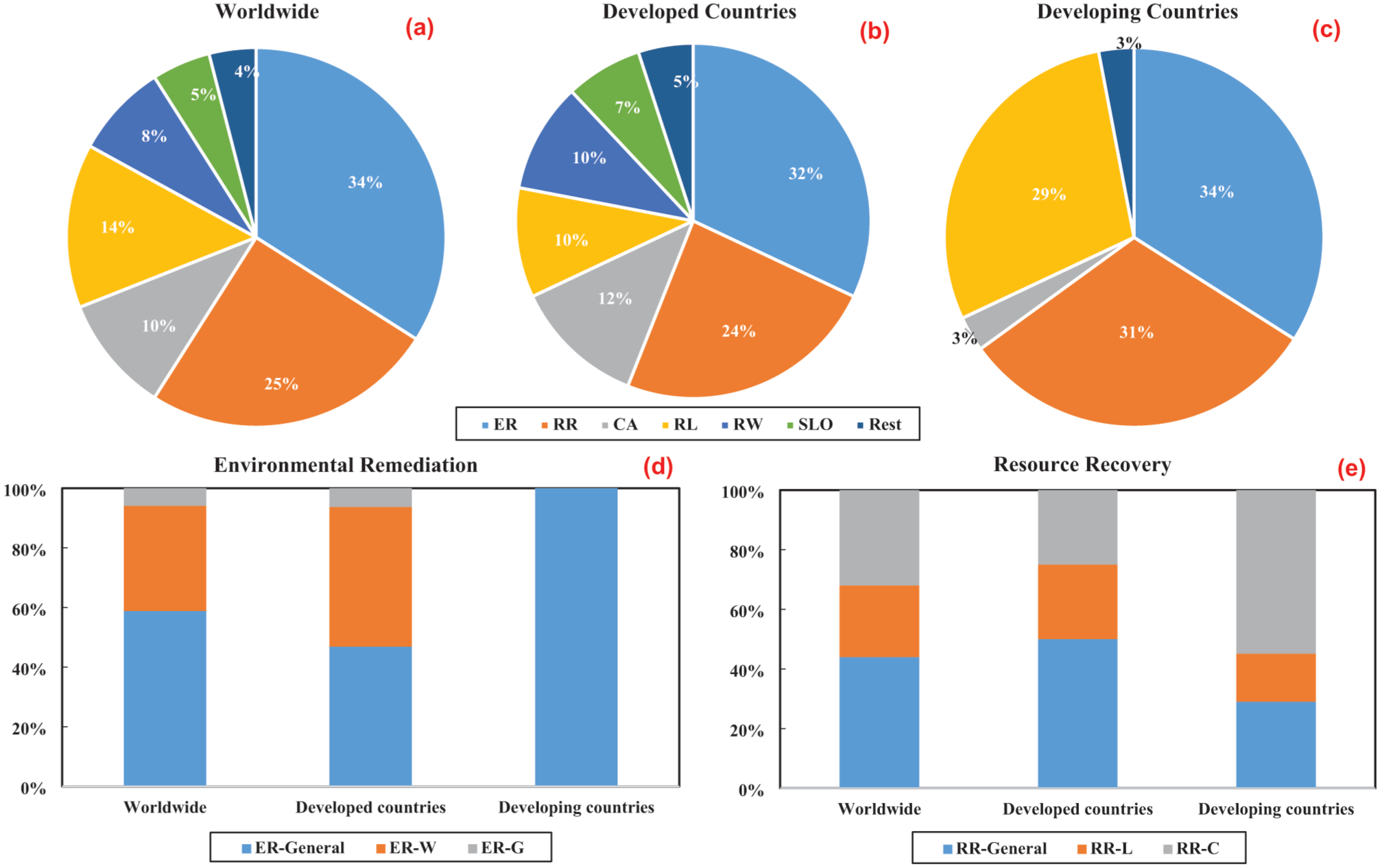
Percentage share of occurrence –for motivations reported by LFM project/studies conducted (a) worldwide, (b) in developed countries, (c) in developing countries, –for sub-classification motivations related to (d) environmental remediation, a€(e) resource recovery.
The underlying motivations differ based on the socio-economic conditions. Per capita income, GDP growth, and population growth are a reflection of socio-economic conditions, as evident from previous studies on MSW generation and management (Nguyen et al., 2020). Hence, an effort has been made to differentiate the key motivations for LFM in developed and developing countries. The key motivations for LFM in developed countries are ER, RR, CA, RL, and RW (see Figure 3(b)). In developing countries, the key motivations are identified as ER, RR, and RL (see Figure 3(c)). Overall, the environmental protection aspects (i.e. ER) are driving LFM in developed and developing countries, with a relative occurrence of 32% and 34%, respectively. Within ER, ER-General occurrence as motivation for LFM in developed countries (≈47%) is much lower compared to developing countries (i.e. 100%; see Figure 3(d)). Higher occurrence of ER-General in developing countries is a result of adverse impacts from existing dumpsites on all abiotic systems (i.e. soil, water, and air), which justifies not having any specific system as a target for ER. In other words, the overarching motivation is the remediation of all of the environmental media – soil, water, and air. RR-related motivations have occurred 24% and 31%, respectively, in developed and developing countries. Despite having more adverse landfilling conditions, decision-making on LFM in developing countries is relatively highly motivated by RR aspects and might be due to the high demand for alternative secondary resources in energy and infrastructure development sectors. For instance, in a country like India, using combustible waste as refuse-derived fuel (RDF) and converting landfill-mined-soil-like-fractions (LFMSFs) into compost, provided they comply with regulatory standards, can significantly reduce reliance on imported fossil fuels and chemical fertilisers (TET, 2024; USEIA, 2014). A relatively lower occurrence of RR for developed countries is due to less or negative environmental benefits from the substitution of combustibles as a result of less fossil-dependent background heat and electricity systems (Laner et al., 2016). Within RR, the relative occurrence of RR-L in developed countries is high due to the case-specific nature of those studies (see Figure 3(e)). For instance, LFM at Shawano County and Clovis LeLas in the United States was motivated by RW and RR-L, wherein the recovered LFMSF has been used in berm and road construction, and daily and intermediate cover construction in lined cells (Dhar, 2015). Similarly, LeLas in Hauge of New York State (the United States) and Tel-Aviv (Israel) were mined for RR-L as compost in 1994 and 1953, respectively (McCaffrey, 2010; Ortner et al., 2014). Later studies in developed countries did not report the occurrence of RR-L for compost as motivation, due to the stringent compost quality standards for microplastics and persistent organic pollutants, wherein most LFMSF samples might not qualify. When RR is not possible due to the inferior quality of recovered materials, even if LFM is compelled by policy (such as shifting of waste from unlined to lined cells), then RW becomes a motivation, as is the case for developed countries (see Figure 3(b)). The occurrence of RW and SLO as motivations is limited to developed countries due to the strict policy implementation and well-developed waste management and landfill monitoring systems (RAWFILL, 2021). LFM studies in developing countries are highly motivated (≈29%) by RL compared with developed countries (≈12%) as most LeLas in developing countries (i) occupy limited land available with urban local bodies for waste processing, treatment, and disposal (Pushkara, 2021), and (ii) are near densely populated areas wherein infrastructure development is key for accommodating more citizens (Pinto, 2025). Based on the relative occurrence of motivations, the priority-wise key motivations, including sub-classes, for LFM in developed and developing countries are proposed (see Supplemental Table S6). This differentiation underscores the distinct motivations guiding LFM practices in developed versus developing countries.
Environmental impacts
LFM should focus on assessing its environmental impacts. Several indicators are used to assess the environmental impacts as part of life cycle assessment (LCA) studies. Among these, the global warming potential (GWP) is a key consideration. During LFM, activities such as levelling, excavation, transportation, drying, sorting, composting, recycling, and incineration will have positive CO2 emissions (Frändegård et al., 2013). The key benefits are from avoided emissions due to (i) replacement of fossil fuels, raw materials, and metals, which are otherwise mined and processed, (ii) recovered heat and electricity, and (iii) future emissions, which are associated with LeLa in case it is not mined. The complete valorisation of each tonne of LMRs through composting, WtE, and metal and glass recycling would provide ≈50 kg CO2e of benefits to GWP as compared to composting and sanitary landfilling of LFMSF and remaining fractions, respectively (Cheela et al., 2023). In addition, up to 40% of future GHG emissions can be mitigated by WtE of combustibles, with a higher fraction of textile and paper, due to their ability to produce methane in the long term when placed in landfills (Liu et al., 2024). The savings from fossil fuel replacements and avoided emissions could potentially turn the entire LFM activity into a net saving of CO2e compared to not mining the landfill (Cheela et al., 2023; Laner et al., 2016).
Trends associated with other impact categories of LCA can widely vary and are often guided by scope, background, and foreground processes considered during the study. For instance, the impacts associated with photochemical oxidation are higher for LFM scenarios compared to the reference scenario (Cheela et al., 2023). The post-mining sorting operations, such as profiling, windrow pile formation, and excavation, release non-methane volatile organic compounds, carbon monoxide, and nitrogen oxides (Balaban et al., 2023; Nordahl et al., 2023), which are ozone precursors and negatively impact (i.e. positive emissions) photochemical oxidation. The emissions from these operations were typically not taken into consideration by LCA-LFM studies in the past.
The contribution of each operation or process to different impact categories of LCA will depend on its range of parameters. The transportation distance of waste from (i) the LFM site to the sorting facility, and (ii) sorting facility to respective LFMSF and RDF valorisation facilities, or metal and glass recycling facilities, is one such parameter. In literature, these distances are considered between 1 and 500 km based on case-specific information and the distance anticipated between different operating and final utilisation facilities (Cappucci et al., 2020; Frändegård et al., 2013; Jain et al., 2014). An LFM study conducted in Sri Lanka showed that transportation processes (with an average distance of 150 km) could relatively contribute to >50% of total impacts towards ozone depletion, human toxicity, terrestrial ecotoxicity, and marine ecotoxicity (Maheshi et al., 2015). Given the importance of reducing environmental impacts, it would be better to develop a relationship between transportation distance and different impact categories to establish environmentally favourable distances. Other parameters that would impact the environmental benefits of LFM are the heating value of RDF and the composition of LMRs, especially recyclables such as metals and glass (Laner et al., 2016). The higher the heating value of RDF and the content of recyclables, the greater the replacement of conventional fuels and virgin raw materials, respectively, which otherwise need to be acquired through mining and processing. Mining and processing of natural resources are highly energy-intensive and have a high impact on acidification, GWP, and ecotoxicity (Jain et al., 2014). Hence, the effective valorisation of LMRs will enhance environmental performance and increase the tendency for LFM.
The management strategy of LFMSF, often the largest fraction of LMRs by mass, is key to the environmental impacts of LFM, which is guided by regional waste management policies. For instance, an LCA-LFM study of India considered the utilisation of LFMSF as compost (Cheela et al., 2023), unlike the European case study, which considered their re-landfilling with the recovery of heat and electricity from LFG (Laner et al., 2016) in accordance with respective policy frameworks. However, the impacts associated with these two management pathways are guided by different characteristics of LFMSF. For instance, benefits from LFMSF use as compost can be enhanced when macronutrients (Nitrogen, Phosphorous, Potassium) are available in substantial quantities. Similarly, re-landfilling with heat and electricity substitution from LFG yields higher benefits for LFMSF with a considerable amount of biodegradable organic carbon. Moreover, with recent policy changes in Germany regarding restrictions on landfilling of untreated waste, LFMSF management would become case-specific. When the methane generation potential or calorific value of LFMSF is above 20 L/kg in 21 days or 6000 kJ/kg, respectively, an additional stage of biological or thermal treatment is needed before landfilling (DepV, 2009). Therefore, the impact of LFMSF characteristics should be considered for optimising environmental benefits to make informed decisions on LFM and LFMSF utilisation strategy.
Overall, LFM will have more environmental benefits when applied to dumpsites, as fugitive emissions, such as methane, that are directly emitted to the atmosphere can be avoided. The LFM of dumpsites and subsequent utilisation of combustibles in WtE with heat and electricity substitution or in cement kilns as a substitute for coal are beneficial to GWP compared to the reference scenario. Fugitive emissions from a dumpsite account for 500–1600 kg CO2e per tonne of LMRs, whereas the utilisation of combustibles alone could result in net negative GWP, despite releasing considerable fossil CO2 during incineration in cement kilns and WtE plants (Maheshi et al., 2015). During composting and subsequent land application of LFMSF, the GWP of fugitive emissions is negligible compared to emissions from the dumpsite (Cheela et al., 2023) as a result of aerobic decomposition. Nevertheless, the impact of organic matter content in LFMSF on fugitive emissions during its utilisation in compost and land applications must be established separately through detailed investigations. The environmental benefits from land recovery and its utilisation for future waste processing activities, such as material recovery and landfilling, are yet to be understood. Particularly, in large cities where it is hard, if not impossible, to acquire land for new waste processing and disposal facilities at environmentally and economically feasible distances, LFM would be beneficial. Adding avoided emissions from future transportation to the environmental benefits of recovered land would make decision-making on LFM more rewarding. However, a thorough understanding of future utilisation pathways for recovered land is required to propose a reliable emission savings estimate.
Most LFM studies conducted in developed countries, particularly in Europe, have not demonstrated clear environmental benefits largely due to relatively lower gains from (i) avoided future emissions and (ii) substitution of heat, energy, and raw materials. In other words, the presence of scientific landfills (i.e. gas and leachate management systems), along with a less fossil-intensive heat and electricity mixes and material production technologies, reduces the potential environmental advantages of LFM in these regions. On the contrary, developing countries often have inadequately managed landfill sites and rely more heavily on fossil-based heat, electricity, and material production systems. These conditions increase the potential environmental benefits of LFM. Importantly, developing countries can learn from the European experience, as LFM tends to be more beneficial when it is adopted early, before the transition to scientifically engineered landfills and cleaner material production and renewable energy systems. This insight is crucial for shaping a strategic LFM policy framework for developing countries, ensuring that the process remains environmentally sustainable. Moreover, the experience gained from European studies can also support other developing countries in Asia, such as Singapore, in planning their LFM strategies more effectively.
Economic impacts
Economic impact studies involve the estimation of monetary benefits and burdens from LFM by considering the different processes involved in it. Similar to LCA, the scope and boundary conditions of the study and processes considered would influence outcomes to a great extent. Most studies (Frändegård et al., 2013; Kieckhäfer et al., 2017; Zhou et al., 2015a) on the economic performance of LFM considered a holistic view, which includes both excavation, sorting and utilisation aspects under different scenarios to compare the net present value. One of the general conclusions is that the integration of LMRs valorisation with excavation and sorting will improve the economic performance of LFM. A comprehensive investigation carried out by Laner et al. (2019) on the influence of 12 different factors belonging to site-, project-, and system- levels revealed that only ≈19% (99,821 out of 531,441) scenarios are profitable in the European context. These findings are also supported by conclusions from most case studies (Danthurebandara et al., 2015; Kieckhäfer et al., 2017; Wolfsberger et al., 2016) carried out in Europe, which revealed that LFM is hardly profitable.
Contrary to this, a case study on LFM of 0.5 million metric tonnes of waste present in Yingchun landfill, China, revealed that the entire project costs (6.36 million USD) were ≈45% (of 13.99 million USD) of monetary benefits from valorisation of LMRs (Zhou et al., 2015a). Higher benefits are due to the (i) lower operational costs for incineration (24.2 USD/tonne) compared to studies (Danthurebandara et al., 2015; Laner et al., 2019) conducted in Europe, which considered incineration gate fees or investment and operation costs between 70 and 140 USD/tonne, and (ii) ≈10 fold higher revenues from recovered electricity (0.54 USD/kWh) compared to studies (Danthurebandara et al., 2015; Laner et al., 2019) conducted in Europe, wherein the average benefit from recovered electricity was between 0.05 and 0.08 USD/kWh. Apart from these benefits, the avoided landfill management (aftercare) costs and revenues from recovered land utilisation will make LFM economically attractive to the operators and help in making decisions in favour of LFM. Another study conducted in Sri Lanka suggested that LFM is not economically beneficial (Maheshi et al., 2015), which is due to consideration of high investment and operation costs (together 117 USD/tonne) for RDF incineration and low net electricity efficiency (22%). In this study, investment and operation costs are bound to be overestimated, as the data is taken from Ducharme (2010), which was carried out for the United States. Hence, relevant data considerations are necessary to understand the economic impacts of LFM to help with decision-making.
Major processes contributing to the costs are waste treatment, re-landfilling, excavation, and sorting. Activities such as avoiding landfill aftercare costs, material sales, and airspace recovery are major drivers of revenue generation (Winterstetter et al., 2015). Considering multiple revenue pathways beyond traditional sources, such as material sales and land recovery, is key to turning LFM economically profitable. Extending existing sources of revenues to avoided costs from (i) damage to the climate and soil from LeLas, (ii) transportation of future fresh waste to another landfill site, and (iii) avoided soil and groundwater remediation costs due to LFM is worth considering. It would be practically relevant to compute the monetary values of avoided costs from damages to climate change using per unit cost of carbon credits. Most economic performance studies are limited to the EU, which represents the context of developed countries. Though a few studies have been carried out in the context of developing countries (Maheshi et al., 2015; Sabour et al., 2020; Zhou et al., 2015a), the factors considered were limited due to the case-specific nature of these studies, unlike EU cases, which are more generic and considered a broader range of parameters (Esguerra et al., 2021; Laner et al., 2019). Extending these frameworks to developing countries is necessary to establish a comprehensive understanding of the factors guiding the economy of LFM to help with decision-making.
Usability of LMRs
The usability of LMRs is crucial for environmental (see ‘Environmental impacts’ section) and economic sustainability (see ‘Economic impacts’ section), for decision-making on LFM. The schemes of LMRs utilisation are guided by existing legislation and guidelines. In the EU, the valorisation of LFMSF as construction aggregates would be possible only when they meet the criteria laid out by local governments. For instance, in Portugal, waste compliant with NP EN 13242:2002+A1:2010 can be used as aggregates for civil engineering work and road construction (Blasenbauer et al., 2020). Though this would protect the environment, the operators will be compelled to make favourable decisions to LFM on LeLas with LFMSF that pass regulatory norms for heavy metals, salts, and organics. In addition, practitioners may select the locations where the local governments impose less stringent selection and testing criteria (Esguerra et al., 2021). The Central Pollution Control Board (CPCB) of India suggests cleaning of lightweight fractions before handing over to incineration units or cement kilns for valorisation as RDF (CPCB, 2019). This would incur additional capital and maintenance costs, which are not lucrative for the operators. Thus, interest in marketing RDF can recede quickly.
The valorisation of LMRs without adhering to environmental norms can have short-term economic benefits but create long-term burdens if LMRs become a secondary source of contamination. Particularly, LFMSF, due to its inherent high sorption and cation exchange capacity (Goli et al., 2022a), has become a sink for pollutants such as heavy metals, polychlorinated biphenyls, benzocynides, per- and polyfluoroalkyl substances, polybrominated diphenyl ethers, and microplastics (Goli and Singh, 2023a, 2023b; Goli et al., 2024; Hölzle, 2019; O’Kelly et al., 2021, 2024; Somani et al., 2020; Tolaymat et al., 2023; Zhang et al., 2021). Hence, its ex-situ utilisation in compost and geotechnical fill applications, unless proven safe against long-term leaching and against causing adverse impacts by microplastics and persistent pollutants, is not recommended. Such investigations should be carried out even on stabilised LFMSF matrices, which are established as safe against the leaching of contaminants in the short-term, as per existing guidelines (Qin et al., 2023). The leaching of toxic additives and the release of microplastics is a proven threat to the aquatic environment and soil biota (Ding et al., 2022; Yu et al., 2024). Prima facie, LFMSF should not be an exception to having such harmful impacts on the ecosystems.
Additionally, it is essential to emphasise the importance of studying the engineering properties of LMRs, as such research directly impacts their potential reuse applications and economic value. In particular, long-term studies on organic-rich LMRs such as LFMSF are essential, given their susceptibility to further biodegradation under varying environmental conditions. Extending the reuse scenarios of LMRs through engineering evaluation not only enhances their economic viability but also reduces the need for natural resources, promoting sustainable waste management practices. Such studies should be conducted systematically to ensure the safe and effective reuse of LMRs in diverse geotechnical and engineering applications. For instance, testing properties like the California Bearing Ratio and unconfined compressive strength can evaluate LMRs’ suitability for road construction, whereas simple shear tests, triaxial tests, and permeability measurements can validate their performance and value for land reclamation or embankment construction (Zhang et al., 2023). However, most LFMSF samples are rich in organic matter (Bokade and Singh, 2025), which undergoes significant compression and degradation during testing, making it necessary to modify conventional testing tools before their geotechnical properties can be reliably evaluated.
Availability of alternative remediation strategies
Apart from LFM, LeLas can be remediated using techniques such as landfill closure and containment, pump-and-treat of contaminated leachate plumes, microbial methane oxidation, among others (Ezyske and Deng, 2012; Somani, 2025). Although each technique has its pros and cons, in practical situations, the decision-making on the adoption of a particular technique will be based on environmental and economic benefits, coupled with policy intervention. Though in an ideal situation, LFM will act as a final remedy and have the most environmental benefits, not all LeLa conditions are suitable for LFM. So, alternatives available for the remediation of a particular LeLa can support or oppose the decision-making on LFM. This section illustrates these aspects with the help of two field case studies conducted in India and Estonia. The selected case studies are based on the availability of data from field-scale implementations and the presence of distinct waste management setups.
Gorai dumpsite is located in the western Suburbs of Mumbai in India, where mixed solid waste was disposed of on marshy land between 1972 and 2008 (Bhardwaj and Inocentes, 2011). The dumpsite was spread over an area of 19.6 ha with an average height of ≈15.5 m (Rodic and Gupta, 2012). The leachate from dumpsite is released into Gorai Creek, which drains into the Arabian Sea. The LFG is emitted into the surrounding atmosphere, contributing to global warming. Although the first research study on LFM in India was conducted back in 2003 (Kurian et al., 2003), the city of Mumbai did not have sufficient infrastructure for waste processing by then, which is essential for LMRs management, and the LFM technology was not sufficiently mature (until the demonstration at the Kumbakonam site in 2016). In addition, promotion of dumpsite closure projects under the Clean Development Mechanism (CDM), a programme that aims to fund emissions reduction projects in developing countries to earn Certified Emission Reduction (CER) credits under the Kyoto Protocol (UNFCCC, 2006), has benefited the decision-making for Gorai dumpsite closure and the capture of LFG for electricity generation. At the time of project planning, it was estimated that between 2009 and 2019, the Gorai dumpsite closure could reduce 1,240,289 tonnes of CO2e emission (CDM-PDD, 2009). The tradability of CERs to developed countries to meet their emission reduction targets made the closure project economically viable with an internal rate of return of 19.5%, which is higher compared to the benchmark return of 11.5% set by the Reserve Bank of India (CDM-PDD, 2009). As LeLas closure projects were common in Europe and the United States by then, technology readiness was not in question. International project partner (Vander Weil, Strotgas BV, The Netherlands) agreed to share and transfer technology (Rajeev, 2010), which helped in attracting funds from the Asian Development Bank (CDM-PDD, 2009). In this case, apart from the promotion of dumpsite closure projects under CDM, the lack of sufficient infrastructure for LMRs processing acted as a barrier for decision-making in favour of LFM.
Kudjape dumpsite is located on the island of Saaremaa in Estonia, which was dumped with mixed waste between 1970 and 2009 (Bhatnagar et al., 2017). The dumpsite is spread over an area of 4.2 ha with an average height of 12 m. In 2009, as per the National policy to close non-EU-compliant landfills (European Parliament, 2017), the Kudjape dumpsite was proposed as a closure project. The dumpsite closure needs application of a 1.5 m thick final cover composed of clay or any other low-permeable material, which was not available locally (Pehme and Kriipsalu, 2018). As the dumpsite poses low risk, an alternative methane oxidation cover in place of a conventional cover has been proposed. The material required for the methane oxidation cover is extracted from the partially decomposed fine fraction (i.e. LFMSF) obtained through LFM (Pehme et al., 2020). Lack of clay or fine soil required for dumpsite remediation through closure (i.e. alternative strategy) benefited decision-making in favour of LFM at Kudjape dumpsite.
Factors influencing the composition of LMRs
The literature selection procedure adopted for composition analysis is included in Supplemental Section S3. During this selection procedure, LMRs’ data corresponding to 73 LeLas and 116 samples are obtained (see Supplemental Table S2). Studies have reported the LMRs composition either on a dry basis (17 samples) or on a wet basis (83 samples), and others did not specify the exact calculation basis (16 samples). Welch’s analysis of variance (ANOVA) is used to compute p-values for each LMR fraction to understand if this anomaly, in data reporting, caused any statistically significant difference in LMRs’ composition, which can bias the subsequent analyses. Welch’s ANOVA, instead of classic ANOVA, is used to deal with groups of data with unequal variances, as is the case for LMRs (see Supplemental Table S7; Delacre et al., 2019). p-values for dry, wet, and not specified groups of composition data (see Supplemental Table S8) indicate that the measurement basis has no significant effect on 89% of LMRs (except for composition of paper and cardboard (P&C) and textiles). These fractions, when analysed as a part of combustibles, the latter (i.e. combustibles) have shown no significant effect from data reporting. As the method of data reporting does not influence the validity of compositional data, all samples are analysed together to obtain the average global composition and standard deviations (see Figure 4 and Table 1) and study the impact of various factors on LMRs composition (see ‘Site-specific factors’ and ‘System-specific factors’ sections).
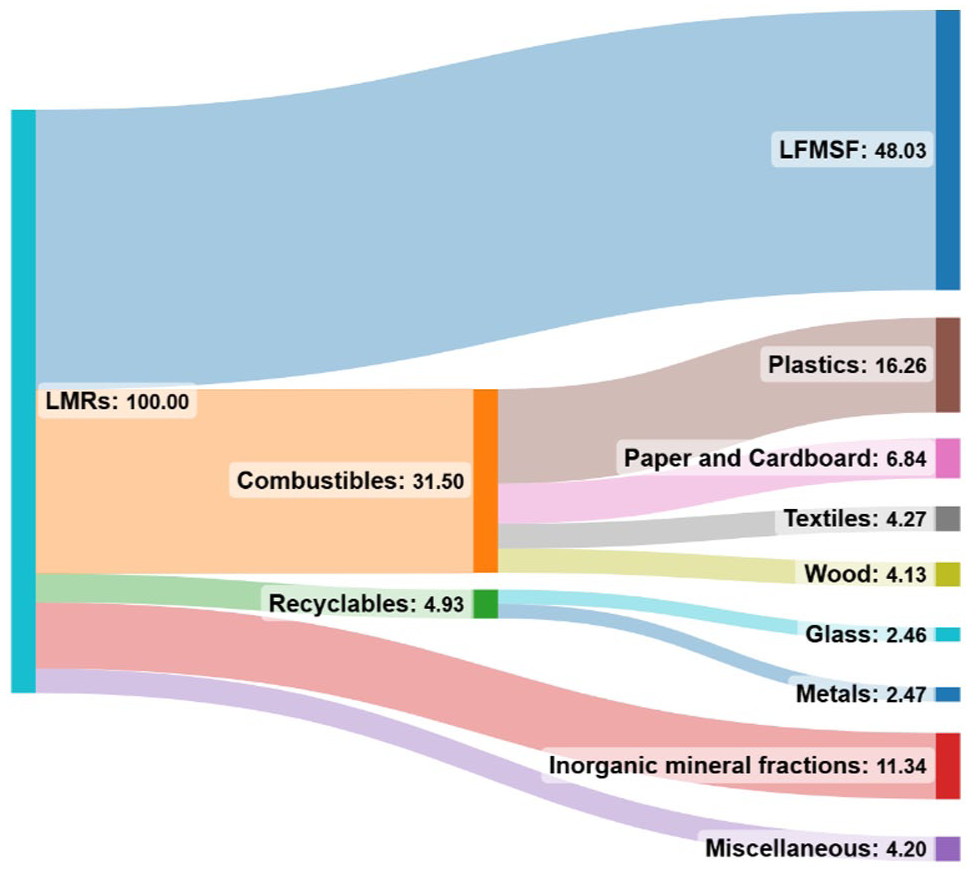
Average global composition of LMRs (N = 116).
Influence of various factors on average composition of landfill mined residues.
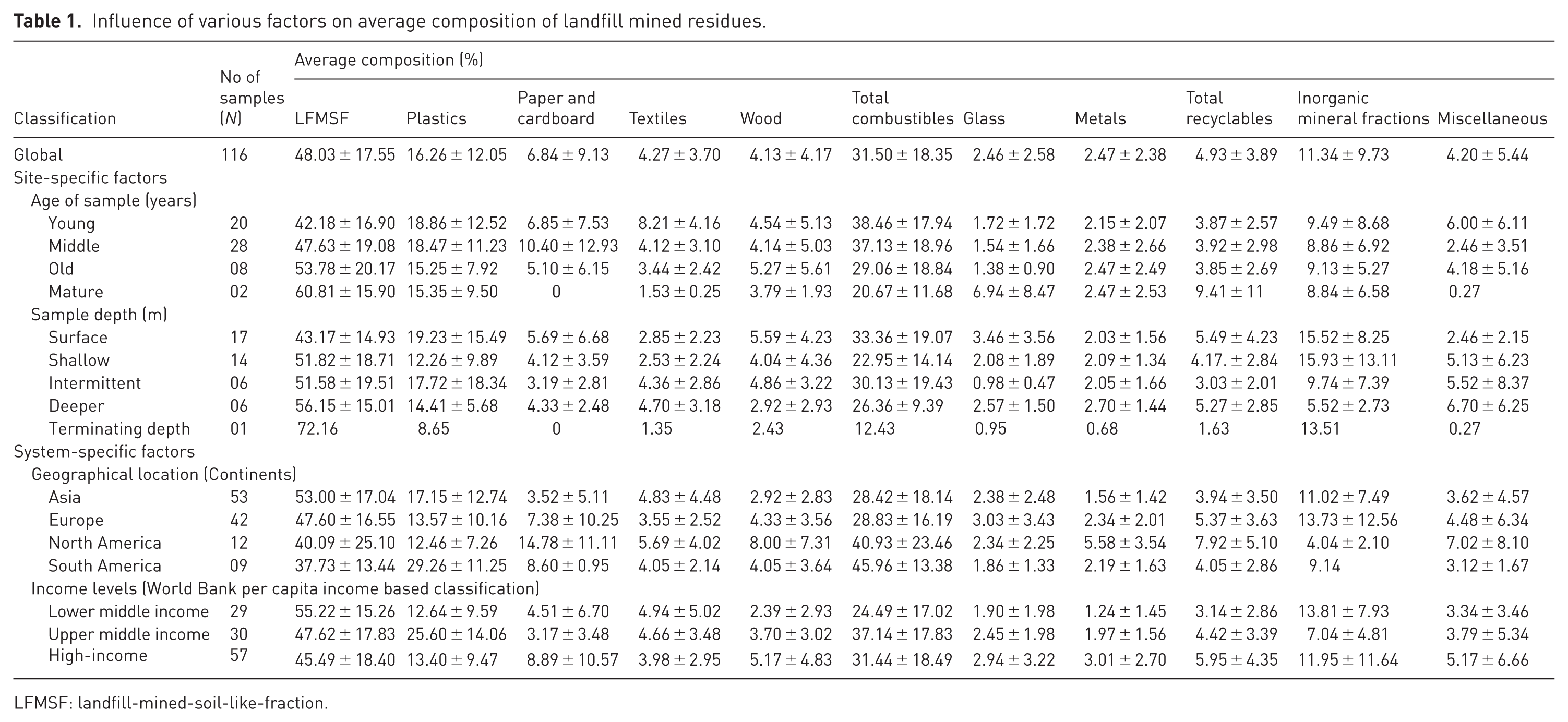
LFMSF: landfill-mined-soil-like-fraction.
The global average percentage of non- or hardly-biodegradable organic matter-based wastes such as plastics, textiles, and wood is ≈16%, ≈4%, and ≈4%, respectively (see Figure 4). The average composition of glass and metals is ≈2.5% each. Among all fractions, LFMSF is the dominant with an average value of ≈48%. LFMSF is a mix of various constituents of LeLas, such as decomposed organic matter (humus), fine contaminated soil used as soil intermediate and final covers and liner, dirt, and crushed construction and demolition waste (C&DW), microbially precipitated calcite, small pieces of other MSW constituents, which are practically inseparable (Goli et al., 2022b; Somani et al., 2018). The large variation in the composition of LMRs can be attributed to a wider range of landfill age, sampling depth, and geographic distribution of LeLas. The LMR constituents are grouped based on their intended utilisation categories, that is, combustibles and recyclables, which are ≈31.5% and ≈5%, respectively. Though most studies (Garcia Lopez et al., 2019; Hernández Parrodi et al., 2019; Singh and Chandel, 2020) have highlighted the presence of LFMSF, plastics, textiles, P&C, rubber, metals, glass, wood, and inorganic mineral fractions such as soil and C&DW, their composition varies based on age (Pecorini and Iannelli, 2020; Quaghebeur et al., 2013) and depth (Pecorini and Iannelli, 2020; Somani et al., 2022). In addition, economic conditions and geographical locations impact the composition of MSW (Karak et al., 2012; Sharma and Jain, 2020) and thus influence the LMRs’ composition. These factors are grouped at the site (age and depth) and system-specific (economic and geographical locations) levels as per the classification introduced by Laner et al. (2016, 2019), and then their influence on LMRs’ composition has been investigated.
Site-specific factors
Age
The age of LMRs, which indicates the time provided for their degradation, collected from LeLas varied between a few months and as long as 40 years. The weight percentage distribution of individual LMR fractions with change in age is depicted in Figure 5. The percentage of LFMSF varied over a wide range (between 9% and 91%) and increased exponentially up to 15 years (see Figure 5(a)). A similar but opposing trend can be observed for weight percentages of plastics, textiles, P&C, glass, and miscellaneous fractions of LMRs (see trendlines of Figure 5(b)–(d) and (i)). No significant difference in weight percentage of metals, wood, and inorganic mineral fractions with age can be noticed (see Figure 5(e)–(h)) as they neither undergo recognisable degradation nor their concentrations in LeLas are high enough to measure accurately during sorting operations. The lack of significant differences in percentage of these fractions is also established through p-values (<0.05 for all fractions) measurement (see Supplemental Table S8).
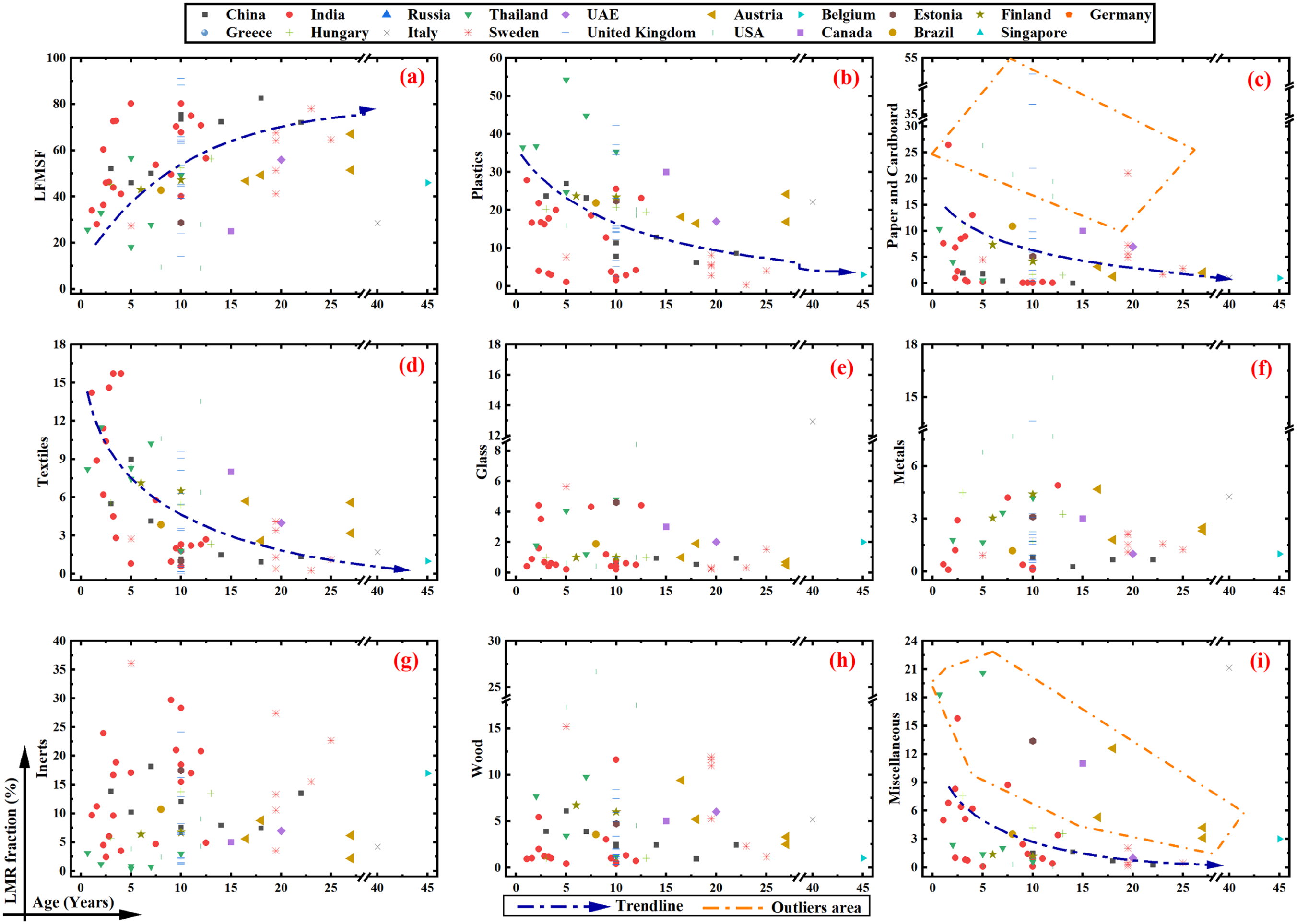
Weight percentage distribution of LMRs with age.
To understand the quantitative variation in the composition of LMRs with age (in years), the LeLas are grouped under four different categories: young (0 < age ⩽ 5), medium (5 < age ⩽ 10), old (10 < age ⩽ 20), and mature (20 < age ⩽ 40; see Figure 6). This classification is based on the general understanding of MSW degradation in landfills (Eleazer et al., 1997). Although the degradation rate depends on the operation type and climatic conditions of LeLas, older LMRs are generally more degraded. In line with this hypothesis, the percentage of LFMSF in LMRs increased from ≈42 in young LeLas to ≈61 in mature LeLas (see Table 1). An increase in the percentage of LFMSF in mature LeLas is due to the (i) downsizing of organic matter during biodegradation (Hossain et al., 2009), and (ii) degradation of medium and hardly biodegradable fractions such as P&C, wood, and textiles (Reddy et al., 2009). Although to a lesser extent, the LFMSF content may also be enhanced by (i) the disintegration of C&DW, stones and glass into smaller particles due to mechanical loads and chemical reactions with leachate (Miller and Maher, 1972), and (ii) the precipitation of calcite from microbial activities (Fleming et al., 1999). Studies on the percentage contribution of each of these factors to LFMSF will provide a better idea of dominant factors and the extent of influence on their physicochemical and engineering characteristics. For instance, calcite originating from C&DW (non-biogenic) and microbial precipitation (biogenic) will have a different microstructure, which can influence their engineering properties (Manning, 2001). So, their relative percentages in LFMSF will, in turn, influence the engineering properties during geotechnical fill application. The contribution of microbial calcite precipitation, which indicates waste degradation and stabilisation, to LFMSF will depend on the age of the LeLa (Stolarski and Mazur, 2005). The reduction in individual percentages of textiles, wood, and P&C, which can degrade up to 24%, 10%, and 60%, respectively (Eleazer et al., 1997; Moazzem et al., 2021; Ximenes et al., 2018), with time (see Figure 5(c), (d), and (h)) is an evidence of their biodegradation in landfills. The rate of increase in LFMSF percentage is higher between young and medium age LeLa groups, which is in line with the peak biogas production (Mebarki et al., 2015) and indicates the dependency of LFMSF’s abundance on waste biodegradation.
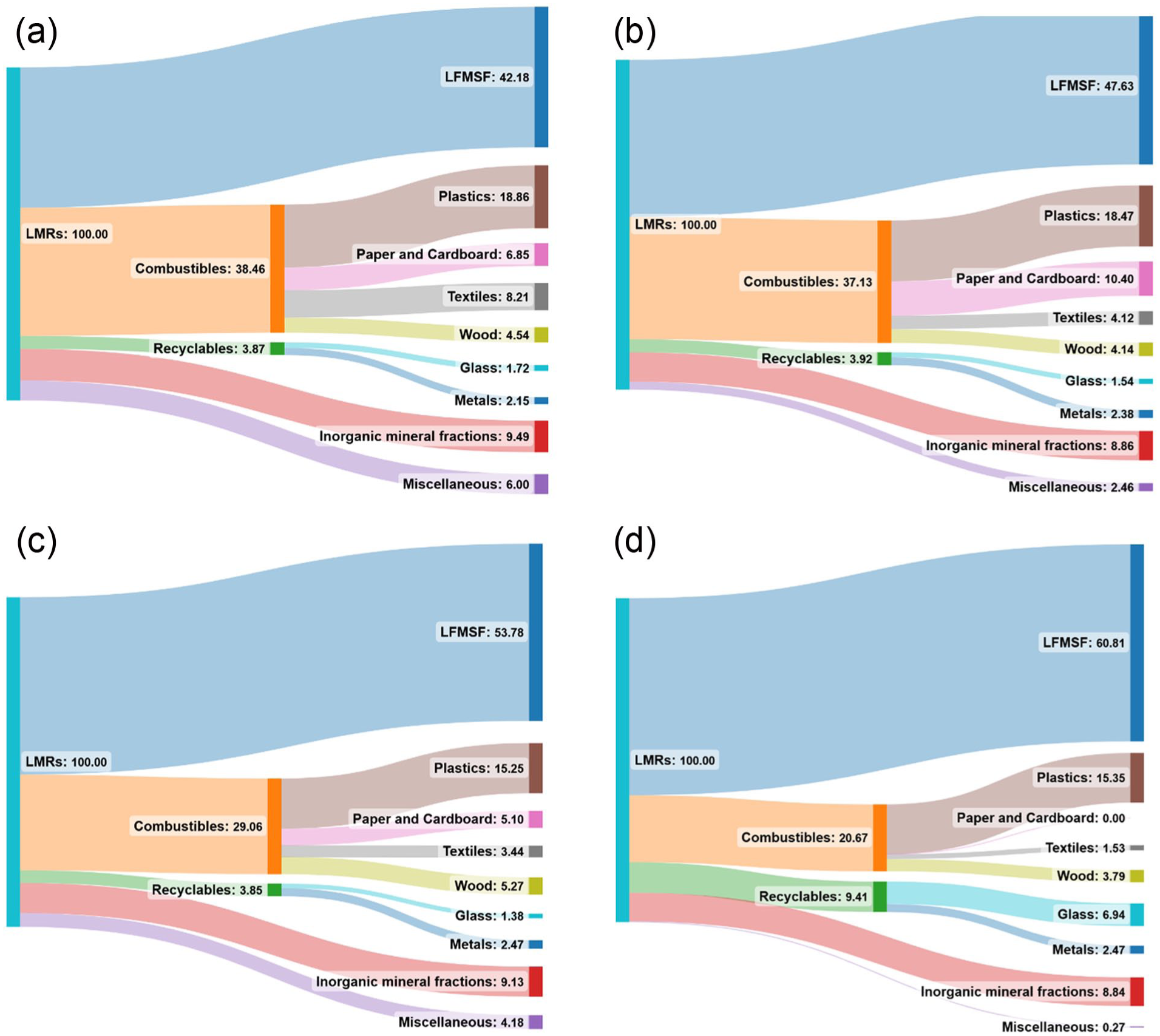
Average composition of LMRs in (a) young, (b) medium, (c) old, and (d) mature LeLas.
The percentage of plastic waste which is supposed to be non-biodegradable reduced with an increase in age (see Figure 5(b)). This can be attributed to lesser consumption of plastic in past decades and hence, less contribution to MSW (Geyer et al., 2017). Another factor contributing to a lower percentage of plastic waste in older LeLas is their fragmentation under mechanical and hydrolytic stresses to form microplastics, which will either exit with leachate or mix with LFMSF (Fei et al., 2022; Goli and Singh, 2023b; Kabir et al., 2023). In this context, the simulated landfill experiments conducted by Lu et al. (2023) and Wang et al. (2021) revealed that mass loss in low-density polyethylene (LDPE) and expanded polystyrene (EPS) plastics can be up to 45
Depth
Most LMRs, except for glass, showed no clear trend in their weight percentages with a continuous change in the depth of sampling (see Supplemental Figure S2). The lesser glass consumption in the past resulted in less glass in MSW (Gallucci et al., 2021; Westbroek et al., 2021) at greater depths, as older waste is disposed of first in LeLas or a particular cell (Singh and Chandel, 2020). However, studies conducted in Brazil (Guimaraes et al., 2023), Thailand (Chiemchaisri et al., 2010; Prechthai et al., 2008), India (Kurian et al., 2003), and China (Zhou et al., 2015b) do not follow this trend due to lower glass waste in MSW of these countries compared to their counterparts in Europe and NA (UNEP, 2024). To further understand the quantitative variation in the LMRs, the samples are grouped into five different categories: (i) 0 < depth ⩽ 3 m (surface samples which can be collected by excavators through open pits), (ii) 3 < depth ⩽ 6 m (shallow depth samples which can be collected by long boom excavators through open pits), (iii) 6 < depth ⩽ 10 m (intermittent samples which manual augers can collect through borehole digging), (iv) 10 < depth ⩽ 15 m (deeper samples which can be collected by machine augers through borehole digging), and (v) 15 < depth ⩽ 25 m (terminating depth samples which can be collected by machine augers through borehole digging with protection against borehole collapse). The groups are chosen based on the instrument in use, which is an operational factor that often decides the sampling depth during feasibility studies.
When analysing the average composition of LMRs, the mean depth was used as a proxy for the overall sampling depth range, which is then grouped into depth-based groups mentioned earlier. Studies that reported very broad sampling depth ranges (greater than 5 m) were excluded from the depth-wise composition analysis to avoid introducing excessive variability (see Figure 7). In the depth-wise assessment of LMR composition, several fractions including LFMSF, inorganic mineral fractions, and miscellaneous materials, have shown a clear trend with increasing depth. The average percentage of LFMSF in LMRs increased from ≈43 to ≈72 with a change in sampling depth from the surface to the termination level (see Figure 7). In LeLas, wherein the waste has been placed in horizontal layers, this trend can be primarily attributed to the longer degradation time provided for deeper samples. Apart from longer degradation time, factors such as (i) the formation of fine particles due to fragmentation or disintegration of waste by increased overburden mechanical stresses at greater depths (Zekkos et al., 2006), (ii) mixing of inorganic clay liner and dense soil daily cover minerals with LMRs during excavation (Qin et al., 2023), and (iii) disposal of soil and C&DW in deeper layers of LeLas due to changes in waste management regulations and practices (mixed disposal vs separate compartments) also plays a role. In India, C&DW was disposed of in the same LeLas as MSW (Rodic and Gupta, 2012), which was later changed due to the introduction of C&DW management rules in 2016 (MoEFCC, 2016a). Nevertheless, the latter reasoning is contrary to the observation concerning the concentration of inorganic mineral fractions (including C&DW), which decreased with an increase in the sampling depth (see Supplemental Figure S2(g)). Higher concentration (between 15% and 30%) of inorganic mineral fractions in top layers (between 0 and 2 m) is due to their use as a final closure cover for LeLas, as implemented at Gericino landfill in Brazil (Nunes and Mahler, 2024).
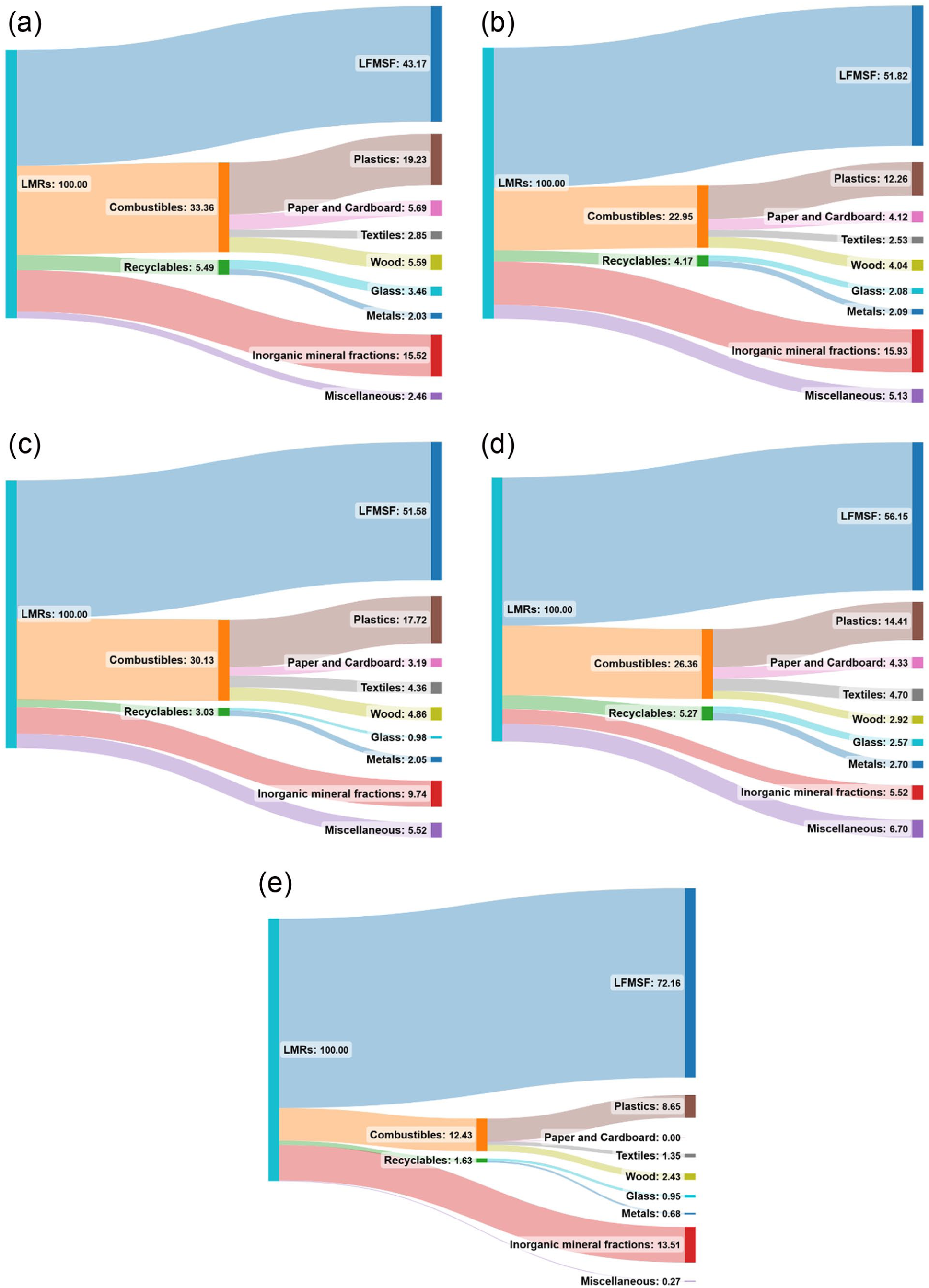
Average composition of LMRs collected from (a) surface, (b) shallow, (c) intermittent, (d) deeper, and (e) terminating depths.
With regard to the percentage of combustibles, except for samples obtained from shallow depths, the rest have shown a decreasing trend with an increase in depth. However, the change in combustibles is very negligible in surface samples in comparison with intermittent samples (see Figure 7(a) and (c)). No clear trend can be observed in percentages of other constituents of combustibles and recyclables with respect to sampling depth as established by a significance test (see Supplemental Table S8). The p-values for all combustible and recyclable fractions are >0.05, implying no significant difference in the weight percentage between groups (i.e. change in depth). Such unclear trends reinforce that knowing the history of waste placement and rearrangement, if any, in LeLas is a must for obtaining reliable depth-wise data.
System-specific factors
Geographical setups
The impact of geographical setups was analysed with continent-specific average LMRs’ composition (cf. Table 1). An intercontinental comparison of the data revealed that Asian LeLas possess a higher percentage of LFMSF, followed by those in Europe, NA, and SA (see Supplemental Figure S3). A higher LFMSF in Asian LeLas is caused by the (i) higher biodegradable organic fractions in MSW (between 45% and 55%), which decompose quickly and result in fine stabilised humus (Quaghebeur et al., 2013; Visvanathan and Trankler, 2003), and (ii) disposal of C&DW and street sweepings with soil and dirt in MSW landfills (Rodic and Gupta, 2012). The presence of stabilised humus and inorganic minerals, such as calcium carbonates and quartz, in LFMSF obtained from Asian LeLas (Goli et al., 2022b; Gurusamy and Thangam, 2023) is another piece of evidence. The SA countries, despite having a biodegradable organic fraction (54%) in fresh MSW (Alfaia et al., 2017; Kaza et al., 2018), contain a lower percentage of LFMSF (≈40) in comparison with Asian countries. Here, it is worth noting that the studies in the SA context are limited to Brazil and retrieved LMRs up to a depth of 3 m only. These limitations can lead to less representative data in terms of geographical spread of studies, depth of sampling, and the number of samples collected.
The average percentage of combustibles in Asian, European, NA, and SA. LeLas are ≈28, ≈29, ≈41, and ≈46, respectively (see Supplemental Figure S3). As expected, combustibles in Asian LeLas are less due to (i) lesser relative consumption of plastics, P&C, and textiles (both in past and present-day scenarios; UNEP, 2024). In addition, in low-income countries like India and Sri Lanka, the lower proportion of combustibles can be attributed to several factors: (i) less disposal of combustibles in landfills due to their diversion to use as cooking fuel (Stoner et al., 2021), (ii) burning of combustibles in LeLas during fire accidents (Cottom et al., 2024), (iii) loss of plastics and P&C during extreme floods and wind blowing activities at open dumps (Cottom et al., 2024; Yadav et al., 2022), and (iv) consumption by stray animals living on dumpsites (Yadav et al., 2020). Among the sub-fractions of combustibles, plastics are dominant in LeLas of all setups, except for NA. The latter has P&C as a dominant component with ≈15%, whose degradation depends on age and moisture content. The percentage of plastics in LMRs of Europe (see Supplemental Figure S3(b)) is lower when compared with their presence in LeLas of Asia and SA (see Supplemental Figure S3(a) and (d)), which is against the trend of per capita plastic waste generation in these continents. On one hand, this anomaly can be attributed to older age and older studies on LFM in Europe, which means lesser plastics consumption and hence lower disposal in LeLas (see Supplemental Table S2). On the other hand, traditionally, Europe treats a higher percentage of plastics through mechanical and thermal recycling pathways as compared to Asia and SA, which avoids their disposal in landfills (Geyer et al., 2017).
Similar trends are followed by the percentage of recyclables, which include metals and glass. The recyclables percentage in LMRs of NA is ≈8, which is almost double their quantity in LeLas of other setups (see Supplemental Figure S3). A higher percentage of P&C, wood, and recyclables in LMRs can be attributed to higher relative consumption, which is largely disposed of in landfills without any recovery at the end of their life (Joshi et al., 2015; Milbrandt et al., 2024; Mukherjee et al., 2020; Wagner and Raymond, 2015). The percentage of textiles varied minimally (between 3.55 and 5.69) across different geographical setups. Inorganic mineral fractions such as C&DW and stones are higher in LMRs from Asia, Europe, and SA (between 9% and 14%) as compared to NA LeLas (<5%). The higher presence of inorganic mineral fractions in LMRs from European LeLas is in contradiction with the current EU guidelines, which prohibit the disposal of inorganic mineral fractions such as soil and C&D waste in MSW landfills. This can be attributed to the fact that most studies are conducted on LeLas, which received MSW before the existence of the current EU landfill directive (Frändegård et al., 2013). For instance, |inorganic mineral fractions from an MSW landfill located in the Pohlsche Heide of Germany are composed mainly of concrete (≈24%), natural and industrial aggregates (42%), and bricks and stoneware (≈16%; Wanka et al., 2017), which shows that also in Europe LeLas contain C&DW and other inorganic mineral fractions as observed elsewhere.
Income levels
The LMRs’ data are grouped under high-income (HI), upper middle income (UMI), and lower middle income (LMI) countries according to World Bank data Metreau et al. (2024) to study the impact of income levels on the average composition. The percentage of LFMSF in LMRs increased consistently from ≈46 to ≈55 with a decrease in the per capita income of the country (i.e. change in status from HI to LMI; see Supplemental Figure S4). The increase in LFMSF, which implies an increase in humus, with a decrease in income level, is in line with trends of fresh MSW (i.e. HI countries generate less organic waste; Agamuthu and Babel, 2023). The accidental and/or intentional landfill fires, which often occur in open dumps of LMI and UMI countries, turn combustibles in LeLas into ash (Mohammad et al., 2023) and contribute to a higher percentage of LFMSF. Higher rates of growth in per capita GDP and population positively influence the C&DW generation rate (Ray et al., 2024), which justifies a higher percentage of inorganic mineral fractions in Indian LeLas (cf. LMI data of Table 1). In addition, the fine fraction of C&DW will end up in LFMSF, which increases the latter’s quantity in LMRs (Datta et al., 2021; Zhou et al., 2015b).
In HI countries, residents have higher purchasing power and consume more store-bought items such as groceries, home appliances, and so on (Kaza et al., 2018). Hence, the amount of packaging waste, such as plastics, P&C, and wood and cloth waste, generated at the end of their life cycle is higher. This trend is followed by sub-fractions such as textiles, P&C, and wood of the combustibles, except for plastics (see Supplemental Figures S4(a) and S4(b)). The higher percentage of plastics in LMRs of UMI countries, such as China, Brazil, and Thailand, is due to the recent disposal of waste in these LeLas compared to their counterparts in HI countries. For instance, the Dahanzhuang landfill in Tianjin, China, and the Namdaeng disposal site in Thailand have been operating since 2005 and 2011, respectively (Chungam et al., 2021; Tao et al., 2024). In Brazil, most LeLas, where LFM studies were carried out, were operated as recently as 2009 (Guimaraes et al., 2023). On one hand, global plastic consumption has quadrupled between 1990 and 2020, mainly driven by emerging economies like China and Brazil, and thus resulting in higher plastic waste in these countries (Geyer et al., 2017; OECD, 2022). On the other hand, many studies in HI countries (Garcia Lopez et al., 2019; Hogland et al., 2004; Jain et al., 2005; Masi et al., 2014; Quaghebeur et al., 2013; Tan et al., 2023; Wolfsberger et al., 2015) have been conducted in the late 2000s and early 2010s, and also on LeLas aged between 20 and 50 years by then, which contain lesser plastics due to lower consumption in the past (Geyer et al., 2017). The recyclables in LMRs decreased with a decrease in income levels. The lower recyclable percentage in LMRs of LMI countries is a result of lower consumption and necessity-driven reuse of recyclables because of low purchasing power (Korsunova et al., 2022). Apart from this, effective collection of recyclables by waste pickers (Kumari and Kiran, 2022) ensures that these fractions either do not reach landfills or do not remain in LeLas till the time of their mining (Ghosh, 2017; Juárez Pastor et al., 2024).
Conclusions and recommendations
LFM has been adopted over the last four decades as a strategy for the remediation of LeLas. In this study, factors influencing the decision-making on LFM are recognised as motivations, environmental and economic impacts, utilisation of LMRs, and availability of alternative remediation strategies. The motivations for LFM in developed countries are more diverse compared to those in developing countries. However, the common key motivations for both developed and developing countries are environmental remediation, resource recovery, and land recovery. Net environmental- and economic-savings of LFM compared to not mining the landfill act in favour of LFM, but depend on a range of different specific factors/parameters, which are also guided by regional and national policies. In addition, the utilisation of LMRs positively influences the environmental and economic performance of LFM. Such utilisation, if allowed as per the local regulations, should not come at the cost of a compromise with long-term environmental safety.
The impact of factors such as age and depth of LMRs, geographical location, and income levels on the composition of LMRs is studied. Irrespective of the effect of these factors, LFMSF is the largest fraction (with its value varying between 35% and 75%) of LMRs. Among the factors studied, age, geographical setup, and per capita income have shown a clear influence on LMRs’ composition. North American and European LeLas have higher recyclables (glass and metals) and combustibles (plastics, textiles, paper and cardboard, and wood) compared to Asian LeLas. A similar trend could not be observed with SA LeLas, due to data availability from relatively young LeLas. The information on LMRs’ composition can be used as secondary data to estimate the stocks of various LMRs in a LeLa based on its geographical location, age, and depth. Depth-wise data are useful in estimating the LMRs composition when on-site investigations are not possible due to constraints and financial limitations. When site-specific (primary) data is not available, the average data reported in this current study can serve as a proxy for establishing the material flows from LFM projects, which can be integrated into regional waste management strategies.
Supplemental Material
sj-pdf-1-wmr-10.1177_0734242X261456531 – Supplemental material for A global review of factors influencing decision-making on landfill mining and composition of mined residues
Supplemental material, sj-pdf-1-wmr-10.1177_0734242X261456531 for A global review of factors influencing decision-making on landfill mining and composition of mined residues by Venkata Siva Naga Sai Goli, Zhibo Zhang and Xunchang Fei in Waste Management & Research
Footnotes
Acknowledgements
The first author gratefully acknowledges the insightful comments and constructive suggestions provided by Prof. David Laner, Head of the Research Centre for Resource Management and Solid Waste Engineering at the University of Kassel, Germany, which significantly contributed to the development of this work.

Ethical considerations
This article does not contain any studies with human or animal participants. There are no human participants in this article, and informed consent is not required.
Author contributions
Venkata Siva Naga Sai Goli: Conceptualisation, Data acquisition, Visualisation, Formal analysis, Data curation, Writing – original draft, review and editing. Zhibo Zhang: Writing – original draft. Xunchang Fei: Writing – review and editing.
Funding
The authors received no financial support for the research, authorship, and/or publication of this article.
Declaration of conflicting interests
The authors declared no potential conflicts of interest with respect to the research, authorship, and/or publication of this article.
Data availability statement
All data generated or analysed during this study are included in this published article and its supplementary information files.
Supplemental material
Supplemental material for this article is available online.
References
Supplementary Material
Please find the following supplemental material available below.
For Open Access articles published under a Creative Commons License, all supplemental material carries the same license as the article it is associated with.
For non-Open Access articles published, all supplemental material carries a non-exclusive license, and permission requests for re-use of supplemental material or any part of supplemental material shall be sent directly to the copyright owner as specified in the copyright notice associated with the article.
