







Abstract
Liminal spaces occur separately from everyday life and are important to human development. Due to increased technological connectivity, young people are rarely separated from their home lives. Understanding young adulthood is a transitional time and summer camps can be settings for development, the purpose of this study was to understand the nature of summer camp employment as a liminal space. Individuals from a national (USA) study of summer camp employment (n = 77, Mage = 21.3) participated in in-depth interviews. Participants were 77.9% White (n = 60), 9.1% Black or African American, 9.1% Multi-Racial, 2.6% Asian, and 1.3% Latinx. About 64.9% identified as female (n = 50), 33.8% identified as male, and 1.3% identified as gender non-conforming. Interview transcripts were inductively analyzed using thematic coding. Participants described camp as a liminal space with four dimensions of separation: physical, psychological, social, and technological. They also described experiencing a liminal time of life. In combination, the separation and time-of-life dimensions created an experience of liminal intensity manifested through a closed social system, blurred boundaries between work and non-work life, and increased autonomy. A revised conceptualization of liminal space is suggested and considerations regarding liminal intensity for young people are discussed.
Liminal spaces occur when individuals are separated from their previous way of life and experience suspended reality (Turner, 1994). Engaging in a liminal space promotes new and deeper understanding of oneself (Turner, 1974). Original ideas of liminal spaces were rooted in rites of passage (Van Gennep, 1909/1960) and centered on a separation from one’s previous way of life. The introduction of technology, such as smartphones, may have implications for young people to experience liminal spaces. It is now rare for young people to engage in settings that are separate from their home lives as they almost always have the opportunity to remain connected through a smartphone. Constant smartphone use has been associated with negative outcomes including loneliness (Twenge et al., 2019) and anxiety (Skierkowski & Wood, 2012), and opportunities to be separated from smartphones may be beneficial for young people. One setting that has previously been described as a liminal space, is often free from technology, and has been linked with development is summer camp (Baker, 2018). The purpose of this paper was to consider summer camp employment as a liminal space and to understand how staff may perceive this setting as a liminal space.
Liminality
Ideas of liminality originated from Van Gennep (1909/1960) concept of rites of passage during which individuals are separated from their previous life, engage in an identity transition phase, and re-emerge to incorporate their new sense of self into their previous way of life. Turner “rediscovered” this concept in the 1960s (see Thomassen, 2009 for a review) and explained that liminality is any situation or object that is “betwixt or between” (Thomassen, 2009). According to Thomassen (2009), liminality can relate to different subjects (e.g., individuals or social groups) and includes temporal (moments, periods, or epochs) and spatial (places, areas, or regions) elements. “Pure liminality” (Thomassen, 2009, p. 18) occurs when both temporal and spatial elements are at play. Further, individuals may experience various degrees of liminality as multiple dimensions converge (Thomassen, 2009).
Scholars have described liminality in many ways, including liminal times/periods (e.g., transitions to motherhood during pregnancy; Côté-Arsenault et al., 2009), liminal entities or beings (e.g., individuals with changing identity statuses; Turner, 1974), liminal experiences (e.g., temporary employment contracts; Tempest & Starkey, 2004), and liminal spaces (e.g., the beach; Preston-Whyte, 2004). Regardless of the term used, the concept of being “betwixt and between” is essential (Turner, 1967) and the experience of liminality intensifies as personal and group dimensions coincide with temporal dimensions (Thomassen, 2009).
Liminal Space
For the purposes of this paper, we focus on liminal spaces. Liminal spaces are “intangible, elusive, and obscure. . . a limbo-like space often beyond normal social and cultural constraints” (Preston-Whyte, 2004, p. 350) and are important because they allow for “direct, immediate, and total confrontations of human identities” (Turner, 1974, p. 77). Liminal spaces provide freedom and escape from normal responsibilities or obligations and offer individuals a period of being “betwixt and between” an old familiar world and a new unknown reality (Turner, 1994). There are special or “magical” qualities of the space, to which individuals are highly sensitive and aware (Preston-Whyte, 2004). For example, within these spaces, intense social bonds transcend previous social structures and are formed without consideration of age, rank, or kinship. As a result, a new community forms based on a feeling of communitas, which encapsulates “feelings of equality, linkage, belonging, and group devotion to a transcendent goal” (Arnould & Price, 1993, p. 34) and is described as a collective group experience.
A range of liminal spaces have been discussed in the literature. Some scholars describe these spaces as being only physically separate from the outside or “real world” (e.g., prison visiting rooms, Moran, 2013; and airports, Huang et al., 2018), while others also include a physical separation that is more psychological and social in nature (e.g., vacation behaviors, Thomas, 2005). Simply stated, liminal spaces offer experiences of suspended reality when individuals feel in-between who they once were and who they are becoming (Turner, 1994). Liminal spaces are physically, psychologically, and socially separate from one’s daily life norms and structures. Figure 1 offers a visual representation of a liminal space.
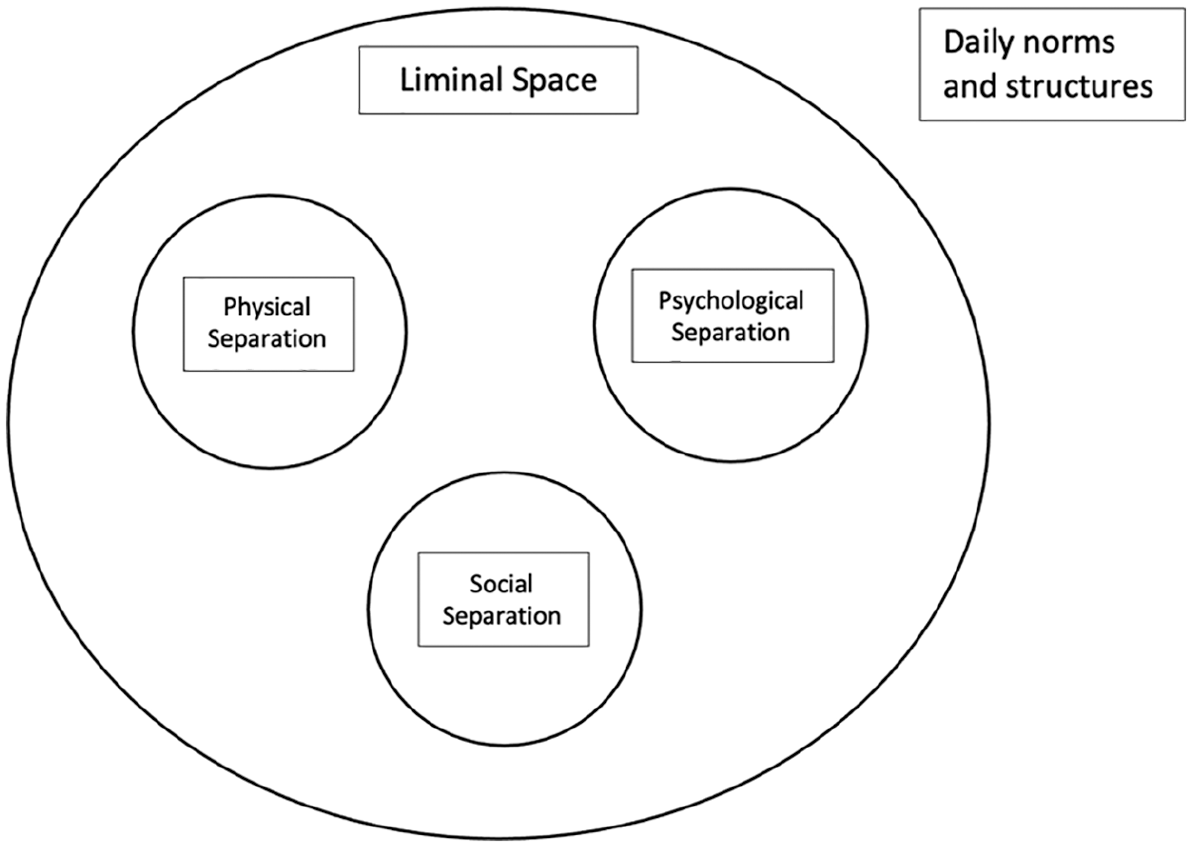
Visual representation of liminal space.
Technological Connectivity and Liminal Space
Smartphones have changed how aspects of liminal spaces operate. Technology use is steadily on the rise, and in particular, smartphones have become ubiquitous elements of daily life through texting, social media, and consumption of news and current events (Tossell et al., 2015). In fact, Pew Research Center (2021a) reports that 100% of young people age 18 to 29 own a cellphone, 96% of whom own a smartphone. Similarly, 90% of people 18 to 29 use social media (Pew Research Center, 2021b), with 48% reporting that they are online “almost constantly” (Pew Research Center, 2018). Researchers have proposed that significant amounts of online social connections have replaced in-person socializing for young people leading to increased feelings of loneliness (Twenge et al., 2019, 2021) and that high amounts of smartphone use have also been associated with anxiety (Skierkowski & Wood, 2012), depression (Pantic et al., 2012), stress (Farahani et al., 2011), and a pressure to be constantly available and accessible (Thomée et al., 2010). Opportunities for young people to be disconnected are uncommon.
Constant online connectivity may have implications for liminal spaces. Traditional ideas of liminal space require a spatial and cultural separation from one’s former or home life (Turner, 1982). As young people have replaced in-person social time with online, smartphone social interactions (Twenge et al., 2019) and are rarely, if ever, apart from their smartphones, true separation (i.e., separation that is physical, psychological, and social) from one’s home life is now increasingly rare. One setting in which young people are often separated from their smartphones and home life is summer camp (Povilaitis, 2019).
Summer Camp and Liminal Space
Summer camp is a common experience for young people in Western society, with over 14 million youth attending camp and 1.5 million young people working at camp annually (American Camp Association [ACA], 2016). Camp remains an important summertime setting as it offers participants and staff opportunities for development (e.g., Povilaitis et al., 2021; Sibthorp et al., 2020). Central to this paper, authors have posited that summer camp may serve as a liminal space for campers and staff (Baker, 2018; Foote, 2014; Harold, 2015). Specifically, researchers have identified many qualities of the camp setting that may create liminal spaces for both campers and staff: separation from one’s typical world (Garst et al., 2011; Johnson et al., 2011; Sibthorp et al., 2020; Waskul, 1998; Wilson et al., 2019), opposition of the camp space to “real life” (Foote, 2014; Waskul, 1998), the camp “bubble” (Baker, 2018; Johnson et al., 2011), independence from individuals at home (Wilson et al., 2019), communal living (Garst et al., 2011), lack of external influence on camp culture (Johnson et al., 2011; Wilson et al., 2019), and separation from technology (Foster & McCabe, 2015; Garst et al., 2009; Wilson et al., 2019). Researchers comment that many of these qualities allow for learning (Sibthorp et al., 2020; Wilson et al., 2019), personal exploration (Foote, 2014), reflection (Waskul, 1998), growth (Baker, 2018), and identity development (Johnson et al., 2011). Baker (2018) illustrated that the liminality occurring at camp can be both positive and negative, suggesting that although the experience can be transformational, it can also be mentally, emotionally, and socially taxing for staff.
Many summer camp employees are young adults and are in a liminal time of life. Young adults who are no longer children but have not yet assumed roles and responsibilities of adulthood, are exploring who they are in love, work, and worldviews (Arnett, 2004). A number of authors have argued that the transition from childhood to adulthood represents a liminal space or a liminal time of life (e.g., Blatterer, 2007; Lipska & Zagórska, 2021; Raby, 2010) as some characteristics of this transitional time are relevant to liminality. This includes a feeling of in-between and identity explorations (Arnett, 2004). The liminal space of camp and the liminal time of life that many camp staff are in may function collaboratively to create a powerful experience for young adults.
Summary of Liminal Spaces
Liminal spaces involve physical, psychological, and social separation from one’s daily life. Often, liminal spaces are discussed in opposition to the “real world” as spaces that are betwixt and between. With the prevalence of technology in today’s society, the concept of liminal spaces may need to be revised as opportunities for young people to physically, psychologically, and socially distance themselves from their home lives may also require a separation from technology.
The Current Study
Given the often liminal time of life of many summer camp employees (i.e., transition to adulthood) and the previously established liminal characteristics of summer camp, there is great potential for staff to experience a high degree of liminality through their seasonal camp employment. Although literature has identified several characteristics of camp employment that align with the dimensions of liminal spaces, the emergence of smartphones and technology has radically shaped how young people experience the world, making it important to understand the experience of camp employment as a liminal space in the 21st century. Therefore, the purpose of this study was to understand the liminal space of summer camp employment, in today’s constant connectivity. The research question guiding this study was: how do staff perceptions of camp characteristics reflect liminality?
Methodology
During the fall of 2019 a sample of summer camp staff participated in interviews about their camp employment experiences. During interviews, participants responded to questions about the camp setting. Interview transcripts were analyzed using thematic analysis methods (Nowell et al., 2017) and a codebook created from theoretically-driven inductive coding (Syed & Nelson, 2015) of interview notes. Inductive codes were developed based on themes within existing literature on liminality and liminal spaces (Syed & Nelson, 2015). We detail each step of our data collection and analysis procedure in the following sections.
Participants and Data
Participants in this study were part of a larger study of summer camp staff. After institutional IRB approval, participants were recruited through a stratified sample of summer camps representative of the American Camp Association (ACA) accredited camps. These camps included day and overnight camps, for-profit and not-for-profit camps, single-gender and mixed-gender camps, and those with specialty foci (e.g., medically-based or arts-based). We first contacted camp directors, who then forwarded information about the study to first-year staff members in the summer of 2018. The data included in this paper are from individuals recruited from 60 different camps, all of whom were camp staff members in the summer of 2018. After completing a survey for the larger project, 77 individuals volunteered to participate in interviews in the fall of 2019. Of the interview participants, 54.5% (n = 42) returned for a second summer of camp work in summer 2019 (including those who worked only a few weeks at camp or worked at a different camp in the second summer), while 45.5% (n = 35) worked only one season in summer 2018. As participants were recruited from a stratified sample of 60 camps across the USA, their experiences varied widely. Of our participants, 74.03% (n = 57) worked at overnight camps (including two individuals who worked day shifts), 18.18% (n = 14) worked at day camps, and 7.79% (n = 6) worked one summer at a day camp and another summer at an overnight camp.
Participants were 77.9% White (n = 60), 9.1% Black or African American (n = 7), 9.1% Multi-Racial (n = 7), 2.6% Asian (n = 2), and 1.3% Latinx (n = 1). Of the sample, 64.9% were female identifying (n = 50), 33.8% identified as male (n = 26), and 1.3% identified as gender non-conforming (n = 1). All participants were between 19 and 26 years old at the time of the interview (m = 21.3 years; SD = 1.77). These demographics are reflective of summer camp staff broadly (ACA, 2019). Interviewers obtained permission from participants to audio record the interviews during which they followed a semi-structured interview guide. Interviewers asked participants to reflect on their experience working at camp in the summer of 2018, their experience in summer of 2019 (whether participants worked at camp or not), and of primary interest to this paper, to describe the camp setting, and how this setting was created (e.g., “Please describe the camp setting or environment”; “how do you think this occurred?”; “what contributes to this?”). Interviewers allowed follow-up questions to flow from the interviewee’s responses, and thus each interview included slightly different probing questions, aligned with the overarching goal of the interviews (e.g., “You mentioned the ‘bubble’ concept, can you explain that more?”). To ensure a full understanding of both positive and negative experiences, interviewers intentionally devoted a portion of each interview to pursuing negative experiences and descriptions of the camp setting if they arose (e.g., “You said it wasn’t an overly positive experience for you, if you’re comfortable, can you share more?”).
Analysis
Established and reliable qualitative coding methods (i.e., selecting a unit of analysis, creating a codebook/manual, and training coders; Syed & Nelson, 2015) and thematic analysis strategies (Nowell et al., 2017) were used to identify important themes relevant to liminal spaces (e.g., types of separation). Two of the authors conducted all of the interviews, took extensive notes, and collaborated on the theoretically-driven inductive coding (Syed & Nelson, 2015) to develop a codebook with themes relevant to the camp setting, liminality, and liminal spaces. Through this iterative process, the first coder refined the codebook into first and second-level themes, based on dimensions of liminal spaces, and then met with the second coder to discuss the codebook and modify it as needed. Responses to the interview question describing the camp setting, as well as any others in which participants discussed the setting, including how it was created, were transcribed verbatim. Both coders then coded a subset of the interview transcripts (20%) using the refined codebook. From this discussion we further refined the codebook, which the first coder then used to complete coding of all the transcript sections. Themes that were relevant to liminal spaces in a camp setting were then extracted and interpreted in light of the research questions. This process is represented in Figure 2.
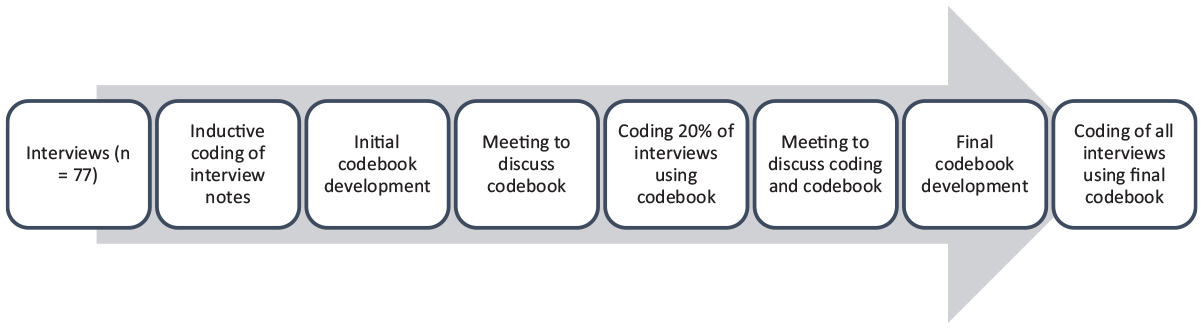
Visual representation of coding process.
Positionality
The current study focuses only on interviews from the fall of 2019; however, as this study is part of a larger longitudinal project, interviewers had been speaking with participants multiple times over the course of 2 years. As such, the interviewers developed rapport with the participants and the interviewers (first and third authors) often could make connections between comments from participants’ previous interviews and ask individuals to address new insights in light of these connections. This process of repeated meaning-making created relationships between the interviewers and the participants, and through these relationships data was co-constructed.
In addition, our identities as White individuals with extensive summer camp and outdoor education experience, shaped the ways in which we understood and viewed the data. We have worked as camp counselors, program directors, hiring directors, camp directors, and wilderness trip leaders. This emic perspective of the industry (Creswell & Poth, 2017) meant that we could identify and interpret themes in ways that others with an etic, or outsider’s, view may not have been able to.
Rigor and Trustworthiness
To address questions of rigor within the qualitative analysis, we followed an established qualitative coding process described by Syed and Nelson (2015) that included deciding on a unit of analysis, developing a codebook, training coders, independently coding, reconciling differences, and selecting a reliability index (percent agreement). Following these steps, a subset of relevant transcribed sections of interviews were independently coded by two of the authors using an agreed upon codebook. After coding, we met to discuss our coding process and establish percent agreement (99.21%). When disagreements arose, we discussed our perspectives until a consensus was reached. In addition, during interviews we continually checked for understanding with participants. At the end of a section of questions, we would summarize what the participants said, provide our own interpretation of their comments, and ask for confirmation or further clarification if there was a misunderstanding. We also engaged in steps to ensure trustworthiness during thematic analysis as proposed by Nowell et al. (2017), including peer debriefing, creation of an audit trail, personal reflexivity, and identification of positionality.
Findings
Participants in this study described the characteristics of the camp employment setting as a relevant liminal space during a liminal time of life; these resulted in a heightened degree of liminal intensity. Key themes and their relationship are represented in Figure 3. We found that the participants in this study described camp as a liminal space through four main characteristics: physical, social, psychological, and technological separation. Participants also commented on two themes that indicated that they, and others employed at camp, were in a liminal time of life. Collectively, the liminal space and liminal time of life, led to an experience of liminal intensity, which manifested in three primary ways: a closed social system, blurred boundaries between work and life, and increased autonomy. These manifestations of liminal intensity were shaped by perceptions of liminal intensity, indicated by the bidirectional arrows in Figure 3. Liminal intensity was experienced both positively and negatively, indicated by the “(+/−)” symbols. Results will be presented first by the dimensions of a liminal space, followed by those of a liminal time of life, and finally, by the manifestations of liminal intensity.
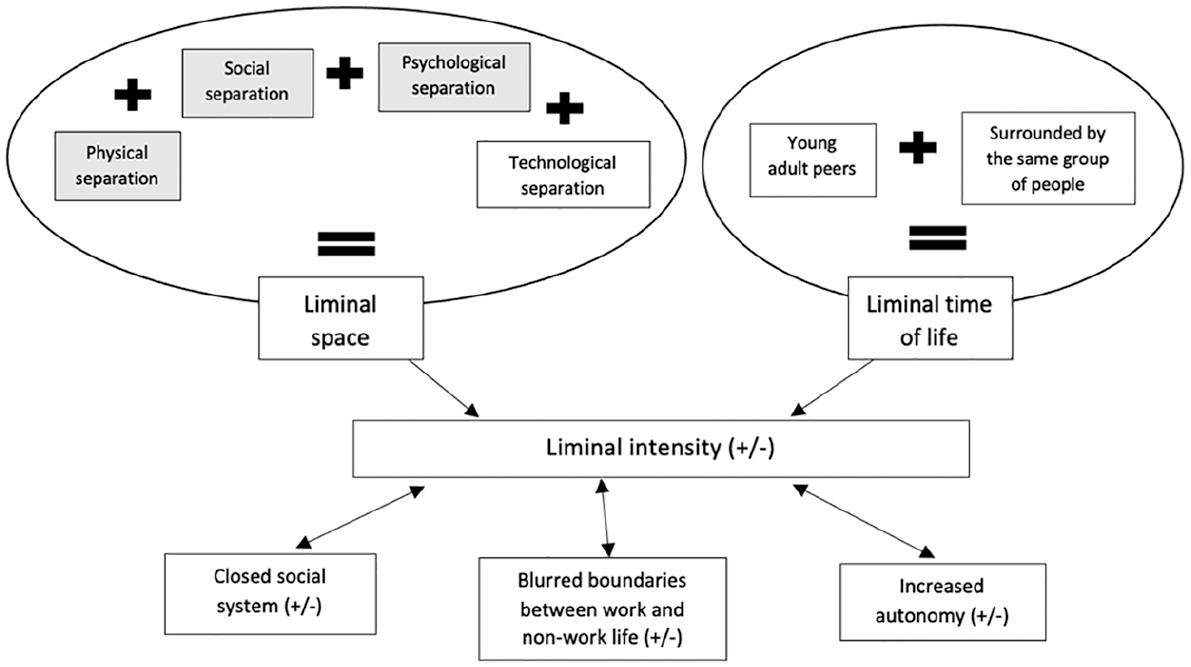
Visual representation of study themes and their relationship.
Liminal Space
Participants described the camp setting as a liminal space in four dimensions of separation: physical, social, psychological, and technological. These types of separation were mostly discussed by participants who worked at overnight camp and were generally viewed positively; contrasting negative manifestations are discussed as part of liminal intensity.
Physical
Participants commented on how being physically isolated meant they felt separated from the outside world. For example, one staff member said, “we had no connection to civilization,” and another commented “you work where you live. You’re kind of isolated and you can’t really get out much.” Another participant described the physical separation of camp. She said, You don’t leave. Even when you get a break, you’re still on the property and [your break’s] only an hour, versus at a full-time job, you work 8 hours and then you go home and you’re home for 16 hours. . . it’s just different, in that you’re always there.
This theme is mostly relevant to individuals who worked at overnight camp, as day camp employees were not as physically isolated and were able to return home at the end of the day.
Social
While at camp, many staff were not interacting with their common social circles and instead, they were interacting with an entirely new social group. For example, one participant said that staff are “put into a completely new environment where there aren’t familiar people. You can’t just latch on to your best friend. . . it gives you a lot more opportunities to get out there and try new things, meet new people.” One staff member commented that this was part of the allure of working at camp. He said, “when people go to summer camp, one of the biggest things for counselors is just to meet new people.” Another mentioned, “everyone shows up to camp at the beginning of the summer and there’s a bunch of new staff, there are international staff and they don’t know anyone.” The new group of people gathered together allows for many new social relationships to form. While this was true for both day and overnight camp staff, day camp staff were able to return home after work and could engage with their normal social group if those choose. These staff did not experience the social separation to the same degree.
Psychological
Participants described a psychological separation from their previous or “home” life while employed at camp. This theme was evident primarily for overnight camp staff. Overnight camp staff often contrasted the camp experience with “real life” or the “real world.” For example, one participant said camp was “very different from real life.” Another staff member explained this saying, “at camp, you’re away from the rest of the world. It’s on its own little land and. . . I feel like that’s pretty separated in that sense.” Another participant commented, “when I think of camp. . . there’s the camp world, and then the real world. . . camp is sort of its entirely own space.” Some staff looked forward to entering this space where they experienced a psychological separation. Multiple participants referred to it as a “bubble” and explained that it is not penetrated by people, events, or experiences from the real world, and in some cases, vice versa. One staff member said, “it’s sometimes nice to go to camp because you escape from the real world where problems come from every which way.” Another commented, “it’s definitely nice to have three months where you’re fully able to commit and not be distracted by other pressures.” One staff member said, “it’s just a bubble of happiness, where the outside world and outside problems can’t touch you.” Similarly, participants described how camp can be stressful, saying, “it can get really stressful and problems just seem like a very big deal, because they are still problems. But all of it just applies to the realm of camp. . . it’s all contained in the camp bubble.” Even still, a few participants recognized that there were magical qualities present at camp, with one participant commenting, “everything seems perfect. It’s almost like Disneyland,” whereas another commented “it’s not real life. It’s not realistic.”
Technological
Many participants described a technological separation while employed at camp (e.g., “at camp, we don’t have technology or our phones”). One participant explained, “[camp] collects everyone’s cell phone because we’re disconnecting from technology.” He explained that this practice meant staff would “live in the moment and be present.” Overnight camp staff described how this lack of access to technology helped foster the sense that camp was a separate space from their home life. One participant commented that “being disconnected from technology and things that we see, face, and deal with everyday makes [camp] into its own space in a way.” Another participant said, “in the real world you’re so connected. So [camp] feels like it’s such a fantasy.” Others described how this technological separation also impacted social and psychological separation. One participant explained that without her smartphone, she was not checking email, or social media sites. She said, “it is kind of like a nice break, forcing me away from that. Instead of all the time being like ‘oh let’s check Instagram, let’s check Facebook’ and see what’s going on.” The sentiment of enjoying the technological separation was echoed by other participants. For example, one participant commented, “one of the things I really do miss a lot that I don’t see outside of camp is the detachment from technology. That was so cool” and another said, We can’t be on our phones at camp, and it was just such an incredible feeling of just being so involved and focused on where you are—not focused on what else is going on in the world during your life outside of camp.
Liminal Time of Life
The camp staff participants in our study were in a liminal time of life. One participant commented that “most of the staff were between 18 and 25 so they’re like, freshly adults. Freshly independent.” Another commented that the camp industry generally employs many young people during a similar time of life—college years. He described how this is a common summer employment experience because, “you don’t really know what to do your first year out of college—or even before you’re even out of college. A lot of people, well, you become a camp counselor for a summer.” Similarly, another participant referred to being surrounded by others at camp who were “in similar situations” and how this “escalated the relationships.” One participant explained how during his first summer he was “going through a lot of transition.” Another participant explained that while staff are typically a similar age, they also have common mindsets and are open to new experiences. She said, “I am working at this camp with other people who are my similar age cohort, these are all people in their 20s. . . it’s a lot about life attitudes they have, that I can personally relate to.”
For camp staff, most of the summer is spent surrounded by peers of a similar age and life stage. This was especially true for staff who worked at overnight camp. One participant said, “you’re spending 24/7 with the same group of people for an entire summer.” Similarly, another explained how staff were constantly together. She said, “it was not like anyone would go off and go somewhere else after work at the end of the day. . . we spent a lot of time together.” Another said, “at camp, you wake up in the morning and you go to bed and you see the same people. I think that’s something unique to the camp experience that you don’t get anywhere else.”
Liminal Intensity
The liminal space of camp and the liminal time of life collectively created a degree of liminal intensity for participants. This intensity was perceived both positively and negatively, depending on the individual. Liminal intensity manifested through a closed social system, blurred boundaries between work and non-work life, and increased autonomy for camp staff.
Closed social system
Within the closed social system of camp, some participants experienced a sense of communitas. Participants commented, “[camp is] hugely based around community,” “there’s a super strong sense of community,” “it automatically becomes a second family” and “camp provides a very quick experience of a family.” Another described an “innate sense of safety” he felt at camp, saying “It’s safe. . . it’s because of the camp family and the camp culture.” For many, the family of camp included very close bonds. One staff member explained “you have this immense bond with people. . . [the camp experience] led me to have such a strong friendship and kinship with a lot of the people I worked with.” Communitas was evident as everyone has “the same kind of motivation. . . everyone is there to show kids a good time.”
Within the closed community, staff were able to identify peers that they were able to look up to and learn from. Near peer role modeling was described as staff comments that more-experienced staff members displayed social norms and modeled behaviors. Reflecting on their first year employed at camp, participants identified peers they were able to learn from, either from a distance or through more explicit discussions. One participant commented, “I watched these other people and what kind of counselors they were. . . I was able to take those observations and become the kind of counselor that I wanted to be.” As returning staff, some participants reflected on becoming a role model for new staff. One participant said, “people who were first-years. . . they were asking me questions. And they asked me because I know, I’ve been there, I’ve had those experiences.”
Although comments about the closed social system of camp were generally positive, some participants described instances when they did not feel they fit in or were accepted, due to social exclusion, experiences of racism, and lack of inclusive practices. Participants referenced “cliquey” or “exclusive” social atmospheres and the negative impact the atmosphere had on their experiences. One participant described the camp she worked at as “a toxic workplace” and detailed experiences of social exclusion saying, “the rules are not the same for everybody.” She described how people who were friends with leadership or were returning staff members were given more lenience in adhering to the rules.
Discrimination was described by some participants. One participant, a person of color, described an experience when another staff member sang along to a rap song, verbalizing a racial slur. She said, “it shook me to my core, because I was in this environment where I was one of really few people of color. And hearing that made it difficult for me to exist as a person of color.” Similarly, another person of color explained that at the camp where she worked, staff orientation included training about including and supporting staff members who are part of the LGBTQ+ community. This staff member appreciated this and thought, “you’re looking into a more diverse way of thinking and we’re talking about protecting people that may need protecting. And then it just stopped.” She continued, I started to realize as events started popping up and people just didn’t know how to deal with it, that nobody had ever sat down and thought like hey, maybe we should put as much effort into protecting our people of color that come to the camp, as much as we do our LGBTQ community that come here - especially if you happen to get someone who is a person of color and LGBTQ.
Within the closed community of camp, it seemed that experiencing exclusion or discrimination was intense as the participants were typically unable to access their home support system and community.
Blurred boundaries between work and non-work life
The nature of the liminal intensity of the camp employment setting led participants to experience blurred boundaries between work and non-work life. While working at camp, some participants came to view their peers as both coworkers and friends. One participant said, “I had a lot of close friends at camp that I had met there.” The friendship often developed when working closely with another staff member as one participant explained, “I was a co-program head with this girl, who is one of my best friends to this day.” One participant explained how camp allowed her to meet new friends saying, “with so many of the people there, this was a best friend that I never would have met any other way.” Participants explained that because they are living and working with a group of people, they immediately become close friends, and how this is not common in other work settings. For example, one staff member commented, “at camp, having the best friends who are also coworkers and people that I learn and live with—that is a much more close-knit family than the professional environment where I work now.” Another person explained the nature of time at camp and the impact on relationships: “Just the strength and depth of the relationships and the friendships you make at camp in 7 or 8 weeks. . . it takes years of real-world time.” For some, these new relationships were dependent on being disconnected from technology. One participant said, “you disconnect and you get into this new environment with new people. It gives you a lot more opportunities to get out there, you try new things, and you meet new people.”
Additionally, many participants commented on how all-consuming the work was, and in particular the blurring of distinctions between “normal life” and employment. Most who were working at overnight camps described being “24/7 on the clock” and having infrequent and short breaks. For example, participants said, “at camp, what you’re doing is your life, all the time” and “at camp, work and life are just the same thing.” Although some staff enjoyed this type of all-consuming work, for some it was difficult, tiring, and stressful. Comparing her summer of working at camp and in another type of employment, one participant explained how she preferred her non-camp work when she said, “what I liked about [non-camp work] was that it was part of my life, but not my entire life.” Discussing camp work, others said, “you’re so high stressed there, you’re drained emotionally,” “I’d be lying if I didn’t say I was stressed at camp sometimes. It’s a stressful place,” and “it’s stressful. You’re tired and you’re overworked.” Another participant said, “it’s not a job for the weak of heart. . . it’s physically hard and it’s emotionally hard. . . it’s draining. . . and there’s really no word for it, other than intense.” Another participant reflected, I remember sometimes being exhausted when I was working at [camp] or just feeling kind of drained because when you’re around the kids you have to be so happy and super energized all of the time.
Increased autonomy
As participants were in this liminal time of life, for many it was their first experience away from home. This led to an ability to be independent, make decisions, and take ownership for themselves. One participant mentioned, “there’s the freedom to be yourself.” For some, this independent experience was daunting. One participant commented, “when I went [to camp] for the first time. . . it was my first time ever being alone. And I will be honest. . . I was a little bit hesitant, a little bit worried.” For others, it was an opportunity to learn more about themselves independent from their families. One participant reflected on his time working at camp and said, “my first summer, I learned who I wanted to be” He continued, “I’ve had these experiences and they’ve shaped me, and they change how I interact with people on a daily experience.” Another participant commented on how while working at camp, he “had a lot of growth as a person.” He continued, “I have generally been more introspective . . .I’m more conscious . . . of what I’m doing and how it impacts others.”
With the experience of increased autonomy some participants felt they needed support from others to be successful. Participants generally described the camp environment as “very positive and supportive,” and explained that “there was good support among the staff.” Multiple participants recounted specific stories of support they received from peers and supervisors. Alternatively, however, some participants described moments when they did not feel supported by their supervisors. Participants described these experiences as challenging, which were exacerbated by being in the liminal space of camp. Once participant said, “everyone that is a source of comfort that you usually have back home is not near or contactable.”
Discussion
Findings in this study contribute to the existing literature in two main ways. First, given the rise of technology use in the 21st century, ideas of liminal space should be revised to include a technological separation. Young people are almost constantly connected to their smartphones, which prevent social and psychological separation, and therefore, liminal spaces in which young people are truly separated from their home lives are increasingly rare and important. All four types of separation (i.e., physical, psychological, social, and technological) must be present in order for a liminal space to exist. Second, we build on the concept of liminal intensity. This term describes the degree of liminality individuals perceive when in a liminal space with other individuals who are experiencing a liminal time of life. Liminal intensity manifested in our study through a closed social system, blurred boundaries between work and non-work life, and increased autonomy. Third, we illustrate the importance of engaging in a liminal space, such as a summer camp, during a liminal time of life. Camp employment is a common experience for many young people and may create opportunities for personal development.
A Revised Conceptualization of Liminal Space
A key component of liminal spaces is the separation from one’s previous way of life (Van Gennep, 1909/1960). The notion of separate time and space is a well-established concept in the summer camp literature for campers (e.g., Garst et al., 2011; Sibthorp et al., 2020; Wilson et al., 2019) and staff (e.g., Baker, 2018; Johnson et al., 2011; Waskul, 1998); however, discussions of separation from technology and smartphones for staff within this setting is a recent addition to summer camp staff scholarship. The introduction of smartphones, constant psychological and social connection to one’s social network and the world, broadly, and increased negative feelings associated with smartphone use (e.g., Pantic et al., 2012; Skierkowski & Wood, 2012; Twenge et al., 2021) present an even greater need for young people to engage in liminal spaces. Camp is a common way for young people to separate from society, form a temporary social community, earn some money, experience developmental outcomes, reflect on one’s life, and assess and explore who one is in relation to others, and within work and life (Warner et al., 2021). In the current study, most staff participants described this separation from smartphones and technology positively, supporting previous research that has found youth participants appreciate the opportunity to be separated from their devices while at summer camp (Povilaitis, 2019).
Original ideas of liminal spaces were based on tribal cultures (Van Gennep, 1909/1960), and thus physical separation also facilitated psychological and social separation from previous social networks and ways of life. In the 21st century, technology has radically changed the way young people are connected with others and the world (Twenge et al., 2019). Smartphone use has been associated with increased loneliness (Twenge et al., 2021), anxiety (Skierkowski & Wood, 2012), and depression (Pantic et al., 2012), and researchers have acknowledged the importance of tech-free periods of time for young people (Haidt & Twenge, 2021). The almost constant online connection prevents psychological and social separation for individuals who are physically separated from their previous way of life. Thus, the concept of liminal spaces should be adapted. We found that a liminal space is unlikely unless there is physical, psychological, social, and technological separation from one’s previous way of life. For example, if a young person is physically separated and experiences technological and social separation from their home life while at camp, but is still thinking about family, friends, and schooling, they are not psychologically separated and may not fully perceive camp as a liminal space. Similarly, if an individual is separated physically at camp, but still has access to their smartphone and is able to connect with friends and family, they are not socially and psychologically separated, and are unlikely to experience camp as a liminal space.
Our findings indicate that the power of the liminal space of camp relies on the presence of four types of separation. As such, we propose a revised conceptualization of liminal space in Figure 4.
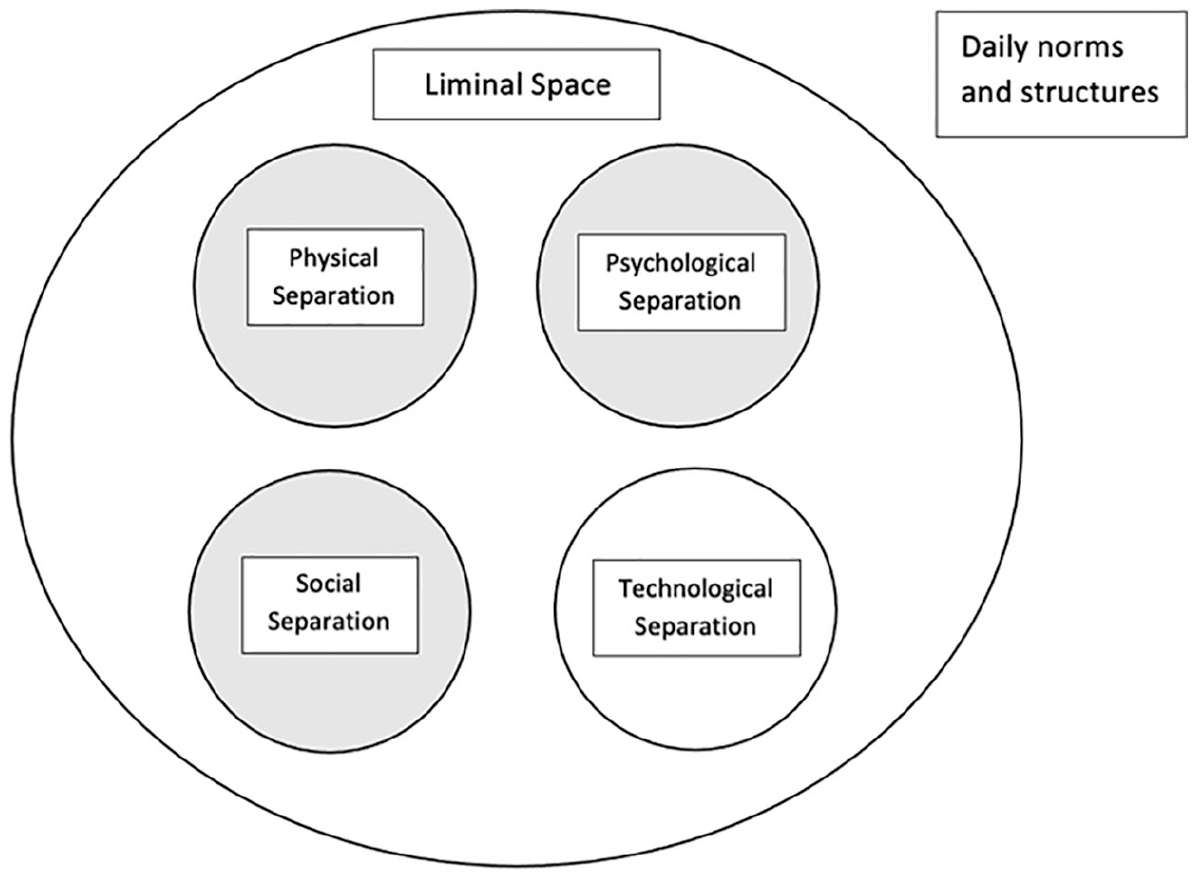
A revised conceptualization of liminal space.
Liminal Intensity
Thomassen (2009) explained that experiences of liminality may involve three dimensions: subjects, temporal, and spatial, which interact to create an intensity of liminality. Liminal intensity increases when multiple dimensions of liminality converge. For example, young people who are in a liminal time of their lives and are engaging in a gap-year of solo travel to remote destinations may experience heightened liminal intensity.
Our findings illustrate that individuals who are in a liminal time of their life and are engaged in a liminal space together, experience greater liminal intensity. Not all individuals in our study experienced the camp employment setting in the same way. This indicates that people experience liminal intensity differently, depending on their identities, needs, expectations, and perceptions of events, and thus, may view heightened liminality intensity positively or negatively. These findings are not surprising given what we know about the importance of person-environment interactions and the potential resulting fit and experience (Lerner & Overton, 2008). Specifically, while day camp staff reported being in a liminal time of their lives, the lack of separation in day camps largely eliminated reports of day camp as a liminal space. Thus, liminal intensity was largely not present for day camp staff.
In this study, some individuals experienced social exclusion or racial discrimination. These experiences contributed toward negative experiences within the closed social system of camp, and thus, negative appraisals of heightened liminal intensity. Further, individuals who faced opportunities for increased autonomy but did not experience support during this time perceived the liminal intensity of camp negatively. Others who did not enjoy the blurred boundaries of work and non-work life at camp, such as the nature of the all-consuming work that is required of overnight camp staff, also perceived the liminal intensity of camp negatively. These findings may have implications for other liminal spaces and experiences that afford more intense liminal experiences. For example, a person of color may feel, that because of the color of their skin and the associated implicit biases others have, they may not be fully accepted and included in the social group of a liminal space (cf. race-based rejection sensitivity; Mendoza-Denton et al., 2002). Although, for some participants, the experiences were not entirely positive, they may have still engaged in confrontations of identity that are described in various literatures as “crossroads” (Baxter Magolda, 2001) or “turning points” (McLean & Breen, 2009; Waskul, 1998). Others may have disengaged from the liminal space and experience of liminal intensity (e.g., ended their camp contract early) and not had the opportunity for confrontations of identity and reflection. This indicates that some young people may not experience a productive person-environment fit, and may not benefit from heightened liminal intensity.
Opportunities for Young People
The time of transition from adolescence to adulthood is fertile for development and may be considered a liminal time. As liminal intensity can be increased by converging dimensions of liminality (Thomassen, 2009), young peoples’ engagement in a liminal space may contribute to personal growth and transformation that is essential for successful adulthood. Findings from our study support Waskul’s (1998) notion that camp employment offers young people opportunities to reflect on their lives while separated from direct influences of their home lives, including peer group and other familial or societal pressures. This separation provides camp staff with authentic opportunities for distance and reflection on their lives and identities beyond camp (Waskul, 1998). These types of authentic liminal spaces in which young people are physically, psychologically, socially, and technologically separated from their home lives are infrequent, foreign, and fairly novel in current society. In addition, experiences of heightened liminal intensity (e.g., engaging in a liminal space during a liminal time of life), whether positive or negative, may afford increasingly uncommon opportunities for young people to reexamine assumptions and perspectives, which provides the foundation for personal growth and transformation.
Implications for Practice
Findings in our study indicated that not all participants perceived the liminal intensity of camp positively. In particular, some participants of color reported negative experiences. This is not surprising as, although many camps have campers and staff from diverse backgrounds, historically camp participants have been White (Browne et al., 2019) and approximately 92% of overnight camp directors identify as White (ACA, 2018). As a predominantly White space, the summer camp industry is increasingly working to increase inclusive and equitable practices. The American Camp Association offers various resources (e.g., blogs, podcasts, workshops) to help camp practitioners recognize oppressive policies and practices, engage in culturally responsive programing, and create more equitable opportunities for campers and staff. While these efforts are specifically oriented to the camp industry, they are applicable for most youth-serving organizations and young adult practitioners.
Liminal spaces offer opportunities for self-reflection and personal growth. In our study we found that the nature of liminal spaces must be reconsidered in light of the 21st century and young people’s constant online connectivity. Although engagement in a liminal space may be important to development, it is not generally expected for young people to be disconnected and separated from their home lives, including from their smartphones, unless for an employment opportunity, such as summer camp. Liminal spaces during which young people are physically, psychologically, socially, and technologically separated from their home lives should be encouraged, promoted, and normalized by young adult practitioners and parents. For example, practitioners could provide information about the benefits of being separated from one’s home life during an outdoor wilderness trip, gap year, or employment experience. They may consider recruiting former camp employees to speak during career fairs to highlight their positive experiences in liminal spaces. Similarly, parents may encourage tech-free vacations or periods of the day or week to create a liminal space for their child(ren). These opportunities may allow young adults to value times of disconnection.
Future Research
The nature and perception of liminal spaces and liminal intensity are important to understand, including how this perception may differ across the world. In most cultures and societies globally, it is critical for young people to distance themselves from their everyday lives to reflect on their lives, including who they are, who they want to be, and how they wish to engage with others and the world. These experiences and spaces foster exploration that is essential to a successful transition into adulthood (Dunham et al., 1986; Scott, 1998). These types of transitional experiences and opportunities for self-reflection look different depending on traditions and societal expectations. Currently, in U.S. cultures, experiences in which young people are physically, psychologically, socially, and technologically separate from previous ways of life—although critical for development—are undervalued, non-normative, and not prioritized. It is important for U.S. societies to value, prioritize, and create space for these experiences for young people so they are able to enter adulthood with a greater sense of self. Researchers should identify the role of liminal spaces, such as summer camp, in young people’s development and identify other spaces that afford similar characteristics and developmental opportunities. Such research would be beneficial for those working with young populations across the world and those who wish to best support individuals in their development and path to successful adulthood.
In addition, future research in this area should identify ways for individuals to determine what liminal spaces and experiences of liminal intensity may be appropriate and best suited for them. Researchers may work to address the question: what liminal spaces may offer a good fit for young adults based on personal and cultural needs? In addition, future research should seek to understand liminal intensity, including why experiences may be perceived as more intense. It is important to understand potential positive and negative effects of liminal intensity, as some participants in our study reported social exclusion, racism, and a discomfort of being separated and disconnected from familiar supports during challenging times. Our study begs several questions that may build upon previous work. How do individuals make meaning of negative perceptions of liminal intensity? How do positive and negative perceptions of experiences of liminal intensity contribute to identity development? Does the meaning-making and perceived value of these types of experiences change over time? How do young people in different developmental times experience the same liminal space differently? These questions warrant additional research.
Finally, future studies should continue to explore the changing nature of liminality, given the continuous presence of technology. What other spaces allow for a physical, psychological, social, and technological separation in today’s society? Engagement in this type of liminal space may be particularly important for young people who are constantly connected in online social worlds during a key developmental time of their lives. To what extent can liminal spaces be created or constructed by young adult practitioners? Research of this type will help inform how liminal spaces contribute to development for young adults.
Limitations
Participants in this study were recruited as part of ACA accredited camps representing overnight and day camps, agency (e.g., YMCA, Girl Scouts) and independent camps, and for-profit and not-for-profit camps. As the sample is comprised of only accredited camps, we do not have data from staff who worked at camps not accredited by the ACA. Further, data were collected through in-depth interviews, which present a few challenges. As most participants spoke with an interviewer at multiple times throughout the longitudinal project, there is a chance that social desirability bias impacted their responses during this interview in the fall of 2019. That is, they may have responded to questions in ways they felt were expected of them and that would satisfy the interviewers. In addition, as two researchers completed interviews using a guide, at times the interviews differed based on the interviewer’s style and positionality. Further, as we each have experience in the outdoor and summer camp industry, we have emic perspectives. Although this allowed us to connect with participants and their experiences, this may be considered a limitation of the study as it may have impacted the prompting questions we asked during interviews and the ways in which we analyzed the data.
Conclusion
In this study we considered summer camp employment as a liminal space. Camp staff participated in interviews and described the camp employment setting and how it was created. The staff described camp as a liminal space, including physical, psychological, social, and technological separation from their home lives. They also described being in a liminal time of life. These two dimensions of liminality converged to create experiences of liminal intensity, which manifested through a closed social system, blurred boundaries between work and non-work life, and opportunities for autonomy. Liminal intensity was perceived positively and negatively, depending on the individual’s unique experience. Based on the findings in this study, a revised conceptualization of liminal spaces was suggested. The presence of four types of separation (physical, psychological, social, and technological) increases the likelihood that an individual would experience a liminal space. Further, when multiple dimensions of liminality are present (in this case, a liminal space and liminal time of life), individuals may experience increased liminal intensity. Given the rise of technology use, liminal spaces where young people are physically, psychologically, socially, and technologically separated from their typical lives are increasingly rare yet remain essential for personal reflection, perspective, and growth.
Footnotes
Declaration of Conflicting Interests
The author(s) declared no potential conflicts of interest with respect to the research, authorship, and/or publication of this article.
Funding
The author(s) disclosed receipt of the following financial support for the research, authorship, and/or publication of this article: The study was funded by the American Camp Association (grant no. ACA 2017-01) and The Spencer Foundation (Research-Practice Partnership grant no. 201700088).
