






Abstract
Especially for women with high prevalence and incidence of victimization and trauma, taking part in a life story interview has potential for positive benefits, but it also may leave the study participants seeing their lives and themselves in a negative light. Study participants were 116 women with repeated criminal convictions and a history of substance misuse. They were from a population known to have high prevalence of victimization of multiple types and exposure to violence. To investigate the effects of telling their life stories and to identify strategies interviewers use to maximize positive and minimize negative effects of the interviews, study participants were asked to reflect on the experience and the effects of telling their stories during an interview. Most participants identified benefits from the experience. Specifically, they felt relief from talking about negative events, they saw growth over stages in their life, they realized how negative past events led to preset positive outcomes, they clarified future steps based on their stories, and they saw how their stories could help other people. Alternatively, more than has been shown in prior research, some interview participants saw themselves as permanently contaminated, and they expressed despair about how their lives turned out. Examination of the dialogue between participants and interviewers revealed how interviewers maximized positive benefits by providing esteem and emotional support, emphasizing the value of the story to other people, and directing attention to the present and the future rather than the past. Findings are relevant to training and application for the widely used method of gathering life stories to understand both victimization and breaking the law. Findings also show the need for future research on positive strategies to use in interviewing other groups with very adverse life experiences, such as combat veterans, transgender individuals, and targets of racial/ethnic discrimination.
Introduction
For women with high levels of victimization, violence exposure and substance misuse, this article presents research strategies for maximizing the benefits and minimizing the risks that may occur during life story interviews. Life story interviews are widely used by social scientists to collect data on identity development and the individual and contextual influences on identity and related behavior (Josselson & Hopkins, 2015; Riessman, 1993). More specifically, life stories have been used to study the effects of criminal victimization and the link between identity and criminal behavior (Cook & Walklate, 2019; Sandberg, 2022; van de Ven, 2020). In the present research, analysis was carried out to understand the effect of interviewing strategies with data from a larger study designed to understand study participants’ identity and the connection of identity to desistance from breaking the law.
The life story interview protocol that participants who provided data for the present paper had completed was designed by narrative identity theory scholars to study how people construct stories about their lives to communicate how they see themselves when the story is told (Study of Lives Research Group, n.d.). Following the life story interview protocol, interviewers began by asking participants to think about their lives as a book or novel, and to identify the main chapters. With multiple chapters of their lives in mind, participants responded to interviewers’ requests for descriptions of high points, low points, turning points, positive and negative childhood memories, a vivid adult memory, a wisdom event, a religious or spiritual experience, a health crisis, their greatest challenge, and plans for the future. The questions were designed to elicit a mix of positive and negative life experiences.
Because they have considerable impact on either promoting or stifling identity growth, adverse events are especially important in theories that explain the relevance of life stories to identity and behavior (Eriksson & Frisén, 2024; McAdams & McLean, 2013). Individuals telling their life stories can construct negative past events to reflect positive identity development that shows increased strength, connections to other people, and spirituality, leaving the storyteller with a sense of purpose and strength (Hoskins & Morash, 2021; Tedeschi & Calhoun, 2004). Alternatively, the life story can reflect stigmatized identity that results in a lack of identity development (i.e., stagnation), and a negative or fragmented sense of self (Fivush & Marin, 2018; McAdams, 2013). When people see past events as stigmatizing or contaminating their identity and stymieing their development, life stories are often incoherent and implausible, and the storyteller may be left in a state of despair. Thus, the life story interview has the potential to either leave study participants with a new or renewed sense of coherence in their lives and current feelings of well-being, or it can show how past events compromised the present and led to stagnation and a negative view of oneself (Fivush & Marin, 2018; McAdams, 2013; Pals, 2006).
Characteristics of Convicted Women
Prior research has revealed that women in the criminal-legal system have high prevalence of victimization as children and adults. Research on a sample of 406 Kentucky women on probation and parole showed lifetime prevalence of 72.25% for psychological abuse, 64.11% for physical abuse, and 38.36% for sexual abuse (Golder et al., 2015). For victimization by an intimate partner, the percentages were 72.25% for emotional abuse, 89.6% for physical abuse, and 53.60% for sexual abuse. Additionally, slightly more than half of the sampled women had experienced physical and sexual violence that was not perpetrated by an intimate partner. In a study of 115 women in 5 jail locations, DeHart et al. (2014) showed a link between intimate partner violence and property crimes, drug offending, and commercial sex work; and a connection between witnessing violence and property crimes, fighting, and use of weapons. The research on incarcerated women is relevant to women who are supervised in the community, since individuals often cycle between probation, jail, and prison. Confirming findings for women supervised in the community, a comparison of 500 women in prison in Ohio with a random sample of women in the general population showed much higher proportions of victimization by rape during childhood (by the age of 17; 49.4% vs. 4.8%), and higher proportions of rape in their lifetimes (70.3% vs. 17.2%; Belknap & McDaniels Wilson, 2025).
In addition to high prevalence of victimization and exposure to violence, convicted women have high prevalence of substance misuse. Women misusing substances constitute the largest group of women on probation or parole (Fazel et al., 2017; Fearn et al., 2016). There is also evidence that in both prisons and jails, a higher proportion of women than men meet the criteria for a substance abuse disorder, and the differences are substantial (Carson, 2021; Fazel et al., 2017; Maruschak et al., 2021). Childhood and adult victimization may explain why women in the criminal legal system have high prevalence of substance misuse. Women who misuse substances are especially likely to have experienced victimization and exposure to violence in childhood and adulthood (Green et al., 2016). In the general population, women more than men have a strong association between substance misuse and childhood adversities that include abuse, neglect, and abandonment (Grummitt et al., 2022). A qualitative study showed how victimization in childhood promoted the misuse of substances to cope by self-medicating, to escape troubling home circumstances such as abuse or divorce, or because family members misused substances (Boppre & Boyer, 2021; also see Belknap, 2021). As a result of the co-occurrence of women’s criminal convictions, experience of violence, and substance misuse, convicted women’s life stories often include disturbing, harmful, and traumatic events (Brennan et al., 2012; Hoskins & Morash, 2021). Thus, it is important to focus research on interview strategies that can make the interview process as positive as possible.
The present analysis focuses on the understudied group, drug-involved women in the criminal legal system who are on probation (community supervision instead of incarceration) or parole (community supervision after release from prison). In general, there is a dearth of research on women in the criminal legal system (Belknap, 2021). Women on probation and parole have been most neglected, particularly when one considers their sizable numbers in comparison to the more often studied women who are incarcerated. Women with criminal convictions are more likely than men to be under community supervision rather than incarcerated (Nowacki, 2020). As a result, women on probation or parole numbered 808,700 in 2024, which constitutes 82% of all women under correctional control (Kajstura & Sawyer, 2024). Considerable evidence confirms that women in the criminal legal system have typically lived through many experiences that are adverse, traumatic, and emotionally challenging (Belknap, 2021).
Prior studies have examined the effects of participation in interviews that contain questions about one type of negative event, for example, sexual assault or domestic violence (Campbell et al., 2010; Cook et al., 2014; Hebenstreit & DePrince, 2012; Shorey et al., 2011). Given the potential for women in the criminal legal system to have experienced numerous instances and types of past victimization, it is especially important to examine their interaction with interviewers to identify the effects of telling their life stories and interviewer strategies that can enhance benefits and mitigate risks.
Potential Effects of Life Story Interviews
Prior research has identified positive and negative reactions of victimization survivors who participated in research on traumatic events that include sexual assault, domestic violence, and dating violence. Campbell et al. (2010) found that nearly all sexual assault survivors in their sample found the interview supportive, helpful, and insightful. The participants noticed and appreciated the feminist research principles that guided the research, specifically the reduced hierarchy between interviewer and interviewee, provision of information and resources, and a research setting marked by support and compassion. Griffin et al. (2003) asked survivors in separate studies of domestic violence, rape, and physical assault how assessments of these experiences affected them. They found that most were not distressed, and many viewed the interview as interesting and valuable. Participants in a study of abused women provided examples of how interviews that applied feminist principals empowered women and gave them a way to be heard (Burgess-Proctor, 2015). Across other studies, women interviewed about traumatic experiences more often reported positive than negative effects, with the most documented negative effect being feeling more upset and more negative emotions than expected (Cromer et al., 2006; Hebenstreit & DePrince, 2012; Shorey et al., 2011).
None of the cited studies examined the effects of a life story interview in a sample of women who were likely to have repeated and multiple types of victimization and trauma in their backgrounds. A life story interview with substance-involved women on probation and parole could evoke recollections back to early childhood and an accumulation of different types of victimization experience that promote and result from struggles with substance disorders and distress associated with arrest, court appearances, and incarceration.
Alternatively, distinct from studies of the effects of research interviews, studies of narrative exposure therapy show that for individuals who have suffered traumatic events, telling one’s story to a therapist can have benefits. Specifically, it can promote post traumatic growth by increasing feelings of power, making a person aware of new possibilities, and stimulating identification as a survivor rather than a victim (Tedeschi et al., 2018). Consistent with theories of post traumatic growth, narrative exposure therapy is a treatment that helps individuals who have had a traumatic experience create a coherent life story narrative (Schauer et al., 2011). A meta-analysis showed that for 16 randomized controlled trials, narrative exposure therapy had sustained positive results (Lely et al., 2019). Similarly, a meta-analysis to compare narrative exposure therapy to alternative therapies found the narrative approach to be highly effective (Crech & Crech, 2020).
Therapists’ methods of using the life story interview to help clients would be outside of the skill set and research role of interviewers. However, several narrative therapy approaches are embedded in the life story interview protocol used for the present research. These include questions about high points, wisdom events, and the context of negative events. Such questions can encourage people to recall positive aspects of their identities and recognize external forces that led to substance misuse, illegal behavior, and mental illness (Mahoney & Daniel, 2006). Similarly, questions about the future can lead to women’s breaking with past negative views of themselves and thinking about the possibility of a changed identity and circumstances. Asking women what key events in their lives say about them gives them a chance to identify qualities such as strength to survive, steps taken to improve life, or capability to change. Additionally, taking the opportunity to share one’s story to help other women or improve probation and parole could have positive therapeutic effects (Gardner-Elahi & Samiri, 2015). Thus, although the life-story interview may have negative effects, it also may positively affect women with high prevalence of past adverse and traumatic experiences.
Based on the material reviewed thus far, the research described below addressed the following questions for a sample of women with repeated convictions and thus a high prevalence of violence exposure and substance misuse:
RQ1: What effects from telling their stories did women describe?
RQ2: How did interviewers maximize positive effects of the life story interview?
RQ3: How did interviewers minimize negative effects of the life story interview?
RQ4: How do interviewers shape women’s accounts of telling their life stories?
Materials and Methods
Data Within Two Broader Studies
Analysis focused on transcripts of the dialogue with interviewers after women answered questions about the experience of just having told their life stories. These data came from one part of an interview conducted during two sequential longitudinal studies of the same women. To explain the purpose of the series of six interviews during the two studies, as part of the consent process, interviewers provided the following written information and reviewed it verbally: “The researchers hope to learn about how some women are able to stay out of further difficulty with the law, and also what barriers they face and how they change as they mature.” Most of the six interviews conducted for the sequential studies focused on women’s needs and correctional interventions to meet those needs, but the fifth elicited women’s life stories to examine identity development as a possible explanation of desistance. Data collection took place between 2011 and 2017, with women starting participation in 2011 and 2012. The life story interviews, which ended with questions about the experience of telling one’s life story, were conducted between January 2015 and April 2017.
Interviewer and Analyst Positionality
Five women conducted the life story interviews. Three were PhD graduate students in criminology/criminal justice, one was in a Master of Social Work program, and one was an early-career criminologist and co-PI for the larger studies. All had academic or employment interests with a focus on justice for women who had broken the law. Consistent with narrative interview approaches (Murray, 2021), interviewers were selected and trained to be non-judgmental, supportive, and self-presenting in a way that minimized inequality, with study participants being experts on their lives and the interviewers learning from them. The larger research that contained the life story interview used a method compatible with narrative inquiry, specifically the methods of feminist inquiry that endorses non-hierarchical, collaborative relationships between research staff and participants and care and compassion on the part of research staff (Burgess-Proctor, 2015; Campbell et al., 2010; Griffin et al., 2003). Interviewers had been selected and trained to maximize the probability that they would accept participants’ statements without judgment and communicate the importance of participants’ viewpoint and knowledge of their needs and experiences.
As the Principal Investigator for the two studies and analyst for the data on the experience of telling one’s life story, the sole author of this paper brought a critical feminist criminology theoretical orientation, and a knowledge of narrative identity theory to the task of analyzing the data. The author was also well-versed in communication theories that focus on social support, so previously documented types of support acted as sensitizing concepts in the analysis phase (Blumer, 1954). These background factors heightened concern for the well-being of study participants and provided sensitization to look for evidence of women’s belief that they had grown or, instead, evidence of a stigmatized life and identity in their retrospective looks back at telling their stories.
Participants
The full sample for the two studies included 402 women on probation or parole for a felony offense and with a history of substance misuse. The women were on probation or parole in a midwestern state that had a state-level department responsible for community supervision in all cases involving a felony. This state correctional department had shifted toward supervision that emphasized coaching and assisting people under supervision (Morash, 2024). To achieve the broader research purpose of understanding desistance after multiple convictions, the life story subsample was restricted to 118 women with more than 5 convictions before the first interview.
Demographics and descriptive information for study participants are included in Table 1. The sample was racially diverse and included women with a range of ages. Affirming the expectation of high prevalence of victimization, substantial proportions experienced either childhood or adult physical or sexual abuse. A very high proportion of women indicated a prior traumatic event in their lives they considered to be “extremely frightening, horrible, or upsetting.”
Demographic Statistics and Indicators of Abuse and Trauma for 118 Women who Completed the Life Story Interview.
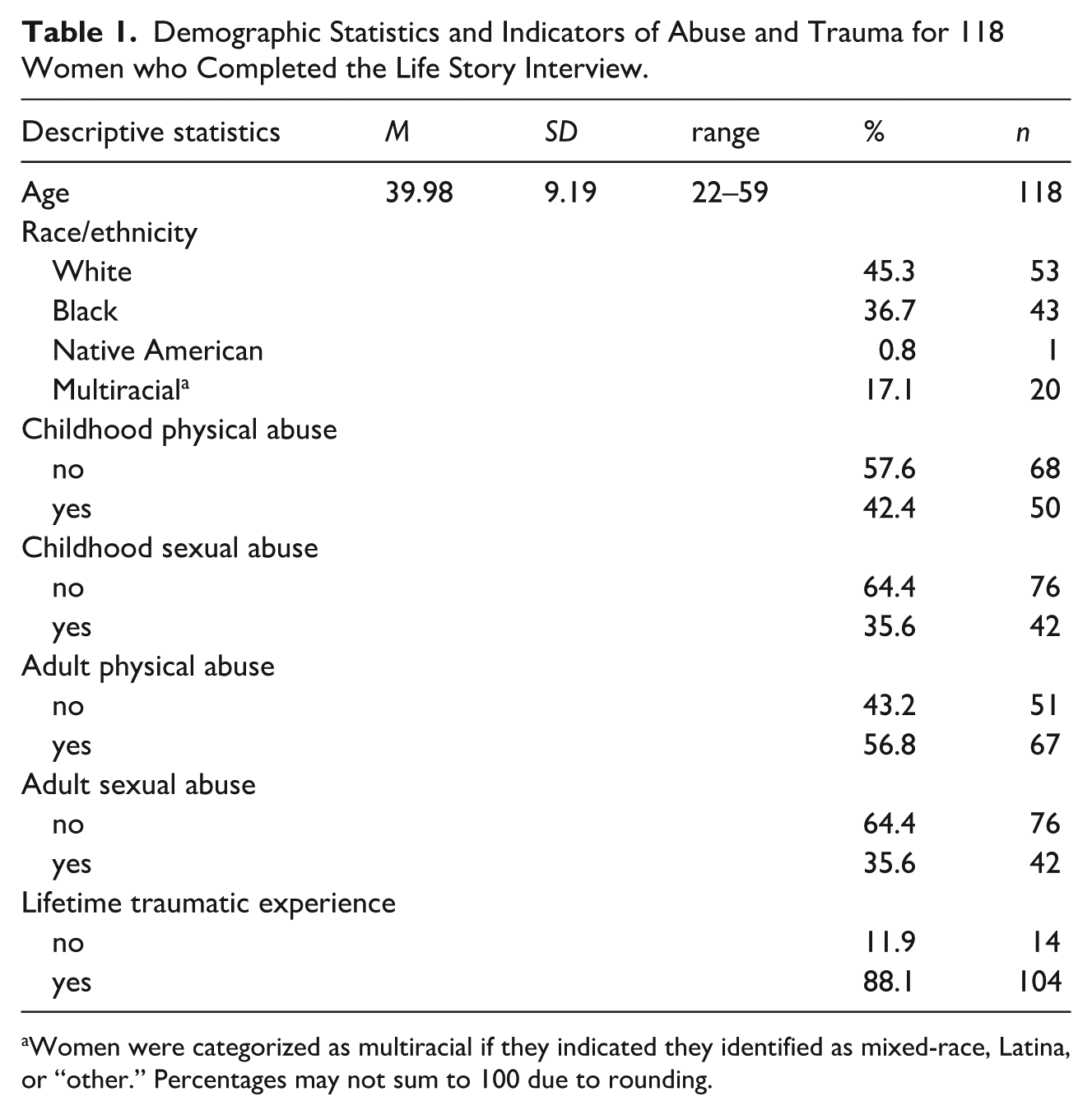
Women were categorized as multiracial if they indicated they identified as mixed-race, Latina, or “other.” Percentages may not sum to 100 due to rounding.
At the time of the life story interview, the women in the subsample ranged from age 22 to 59 years old (M = 39.98, SD = 9.19). For the 117 who answered questions about race and ethnicity, most identified as White (44.9%) or Black (36.4%), with the remainder (17.8%) identifying as multiracial, Latina, or “other.” Affirming the expectation of high prevalence of victimization in their lives before the start of the research, at the first interview, 57.3% (n = 67) said that they were physically abused as adults, 42.7% (n = 50) said they were physically abused as children, 35.9% (n = 42) said they experienced sexual abuse as adults, and 35.9% (n = 42) said they experienced sexual abuse as children. During the final interview, approximately a year after women told their life stories, a high proportion (88.1%, or n = 104) answered this question affirmatively: “In your life have you had any experience that was extremely frightening, horrible, or upsetting.”
Participant Recruitment
During recruitment into the subsample, interviewers told women that this would be a very different type of interview than past interviews since they would be deciding how to tell their life stories rather than answering a series of specific questions that asked for short answers or a choice such as “yes” or “no.” In essence, interviewers were trained to communicate that study participants would have quite a bit of control over the interview (Murray, 2017). Consistent with the narrative life story method (Atkinson, 2012), the life story interview did not include questions about illegal behavior, drug use, trauma, or any other specific topics. Instead, interviewers encouraged study participants to describe the parts of their lives that they saw as important and that they wanted to share.
Questions About Telling the Life Story
After women completed their life stories, interviewers presented ideas from the following statement:
Thank you for this interview. I have just one more question for you. Many of the stories you have told me are about experiences that stand out from the day-to-day. For example, we talked about a high point, a turning point, a scene about your health, etc. Given that most people don’t share their life stories in this way on a regular basis, I’m wondering if you might reflect for one last moment about what this interview, here today, has been like for you. What were your thoughts and feelings during the interview?
Interviewers adapted this script to flow naturally from the preceding elicitation of the life story, and they followed up with statements or prompts to encourage elaboration and, as shown by the analysis, to contribute to participants’ explanations.
Data Collection Procedure
The study protocol and instruments were approved by the Michigan State University IRB. Study participants received an incentive of $75 for taking part in the life story interview. All life story interviews were conducted in private settings. All participants were on probation or on parole when they began the main study, however, by the time of the life story interview, which took place during the 5th interview session, 7 out of 118 interviews were conducted in prison with women who had been newly incarcerated. The same interviewers who conducted interviews in the community went to the prison to carry out those interviews. The life stories were completed in one interview session and on average took an hour-and-a-half. Approximately 10 minutes of this time were devoted to women’s reflections on how the life story interview had affected them. To maintain confidentiality, pseudonyms are used in the “Results” section.
As introduction to the life story interview, interviewers told participants that the hope was that the research would help other women and that it would improve probation and parole supervision. This protocol opened the door for study participants to see their life stories as helpful to others and to understand that the interviewer thought women’s stories were valuable. Interviewers suggested that the audience for the story included not only the interviewer, but also other women entangled in the criminal legal system and personnel who designed and delivered probation and parole oversight. This suggestion of an expanded audience is important, since people direct life stories at a particular audience (Josselson & Hopkins, 2015).
Interviewers audio-recorded the in-person life stories unless they were conducted in a prison that prohibited audio-recording. For the interviews in prison, one interviewer asked the questions, and she and a second interviewer took notes that they jointly transformed into a written record of the interview as soon after completion as possible.
Transcription and Analysis
Trained project staff transcribed audio-recorded and, for incarcerated women entered, the scripted questions and the verbatim dialogue between participants and interviewers into Microsoft Word files. A second staff member checked all transcripts against the audiotapes and made necessary corrections. The life story transcripts were imported into software for qualitative analysis (NVIVO). The author of this paper used an inductive approach to identify passages that reflected benefits of the research that participants described as well as their sense that instead of having some benefit, the interview left them with negative feelings. Then a constant comparison method was used to repeatedly compare data with initial codes reflecting different types of benefits or an overall negative effect of the interview, and through repeated comparison, to refine the codes (Charmaz, 2014; Glaser & Strauss,1967). More specifically, the data were reviewed three times and all text indicating a benefit of the interview was marked. Then, marked text was inductively coded into similar types of benefits, for example relief at having talked about negative events or recognition of positive change over time. With the different types of benefit in mind, each passage was reexamined for fit with the coded themes, and final codes for each mention of each type of benefit were marked in the text and entered into a spreadsheet noting each coded theme for each study participant.
Some women described their experiences of being interviewed without any additional dialogue with the interviewer. In this paper, these descriptions are referred to as spontaneous responses, which means that they were not responses to interviewers’ follow-up probes. However, other individuals and their interviewers engaged in follow-up dialogue during which they co-constructed a description of the effects of the interview. Data were examined to identify examples of dialogue that showed how participants and interviewers co-constructed benefits, how interviewers provided support to participants, and how interviewers made comments to minimize negative outcomes of the interview during discussions of the effects of the life story interview.
The results section first presents spontaneous participant statements that were not responses to a follow-up comment or question by the interviewer and then presents examples of dialogue through which participants and interviewers co-constructed the experience of telling the life stories. Analysis identified various types of benefits, a relatively small group of women who expressed considerable distress after telling their stories, and interviewer efforts to promote positive and minimize negative effects through their comments. Specifically, interviewers provided social support, pointed out the value of participants’ life stories, and made comments to minimize participants’ distress.
Results
Due to audio-recording malfunctions, the qualitative data for dialogue about the interview experience were available for 116 of 118 women. Most women (94, 81.0%), including those who told stories riddled with negative events and circumstances, identified some benefit from participating in the interview. Of the women who indicated a positive effect of the interview, 6 did not specify how they benefited, so themes reflecting the type of benefit could not be coded. The 22 women who did not indicate any benefit of taking part in the interview said the interview had no effect on them or indicated there were no benefits resulting from telling their life stories. Some of this last group expressed feelings of defeat and despair when they looked back at the experience of telling their stories.
Benefits
Of the 116 women, 88 (75.86%) with coded themes indicated a positive effect of telling their life stories. Seventy-six of them noted one positive effect, 11 noted two positive effects, and 1 noted three positive effects. The examples presented in Table 2 illustrate the different types of women’s statements about benefits from taking part in the life story interview. Below, percentages of women noting each type of benefit are calculated using the number of women with transcripts coded for each theme divided by 116 women as the denominator and converting the result to a percentage.
Participants’ Spontaneous Descriptions of Positive Effects of Telling their Life Stories.
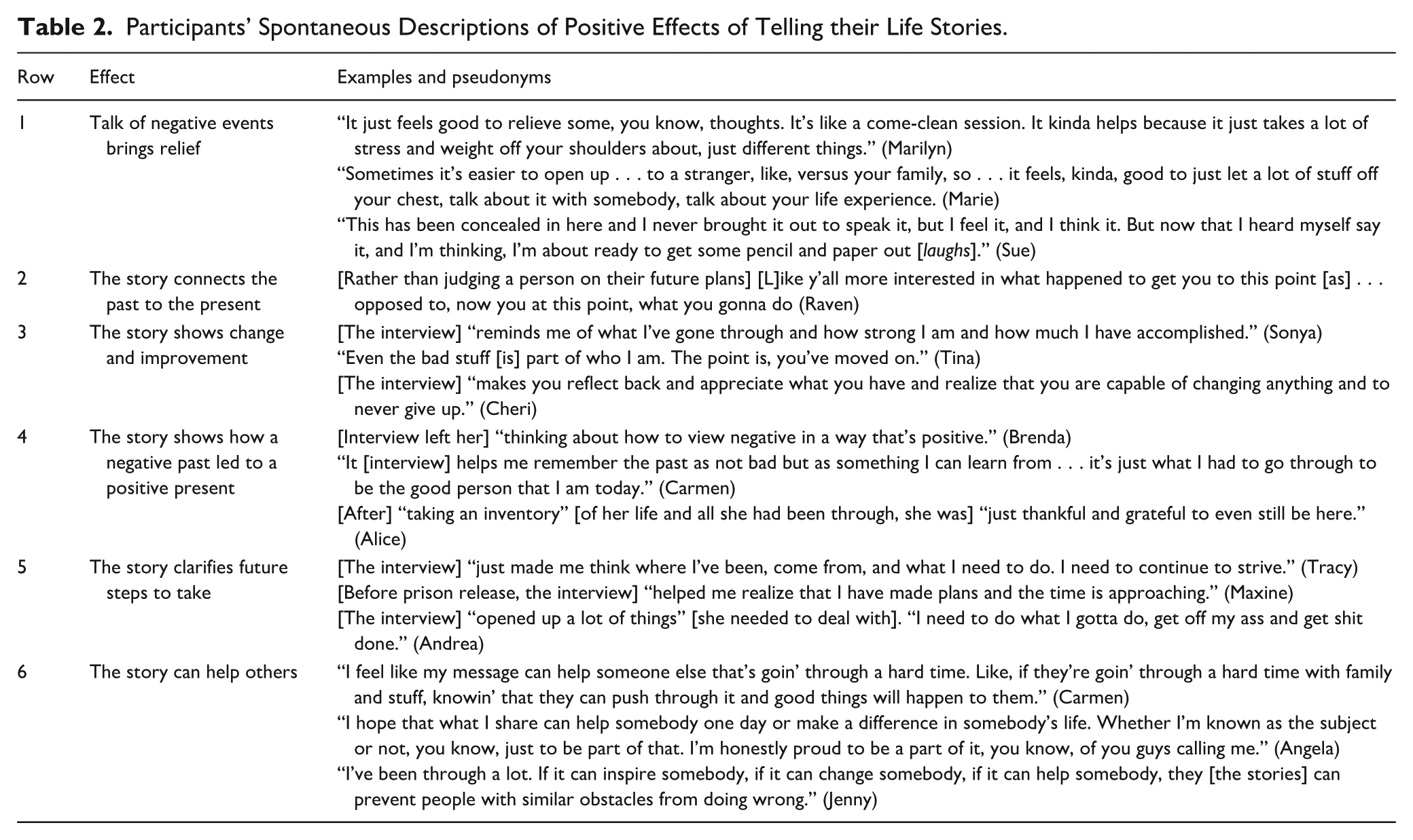
Examples in Row 1 show that recounting disturbing and traumatizing events, in some cases for the first time, could bring emotional relief. Twenty-nine women (25.00%) described emotional relief. Seven women talked about the relief of getting things off their chest, and three used the term “bottled-up” to describe experiences and feelings they previously did not share with other people, but that they shared with interviewers. Eleven women (9.48%) found benefit from looking back at their entire lives and connecting past events to their current identities (Row 2). Women also saw value in linking their past and present to their future. For instance, Patricia (pseudonym used throughout the “Results” section) said “[The interview] refreshed me again [so I] remember where I came from and where I’m at and where I am today.” Twelve (10.34%) women describe a positive effect of looking at the span of their lives, seeing change and improvement in their life stories, and recognizing their capacity to change themselves for the better (Row 3). For example, women could put negative events into perspective, so they did not overshadow positive events, as shown by Avery’s comment, “I said there’s been some rocky points but, you know, overall it makes you think, well, my life has been pretty good.” Telling their stories also showed 11 (9.48%) study participants how they had constructed positive identities from past negative events (Row 4). For instance, they emerged from trauma and periods of drug use and illegal activity as stronger as or more capable than they had been before. In addition to connecting past to present, 14 women (12.07%) said that recounting life stories increased their awareness of the future steps they needed or planned to take (Row 5). An example here is Cierra’s comment, “It hasn’t affected me badly. It just made me think where I’ve been, come from, and what I need to do.” Finally, 22 women (18.97%) viewed telling their life stories as a way to draw on their histories to help others (Row 6). The examples in Table 2 illustrate how the interview assisted women in seeing how they could use their negative experiences for a good purpose and they provide additional illustrations of the other themes.
Negative Effects
Eight of the women (6.90%) described an overall negative experience of the interview. Gwen said she felt “sad” because “nothing really good stands out” in her life story. Lynette indicated that telling her story showed her that any sense that “life is wonderful” was a façade and that the interview left her “emotionally drained.” Francesca, who worked as a street prostitute and lived with an abusive man, felt it was “just too late now” to make life better. As a final example, Eve noted the negative effect of the interview, “I fell vulnerable now that my emotions are up.” Although relatively few women described the interview as having negative effects, the depth of the negative emotions they expressed shows the need for interviewer strategies to minimize such effects.
Interviewers’ Part in the Conversation
With few exceptions (Alessi & Kahn, 2022; Murray, 2003), the literature provides limited detail about how to communicate support during interviews that elicit accounts of past harms or struggles. To fill this gap, the data were examined for ways that interviewers maximized benefits and minimized risks of taking part in the interview. This examination showed several interviewer strategies to provide social support, highlight the contribution women made by sharing their stories, and minimize or divert attention from negative endings to both the story and the discussion of the interview.
Social Support
Interviewers offered social support by pointing out the positive qualities and changes included in women’s stories. More specifically, they provided esteem support that pointed out or led women to recognize their skill, ability, and intrinsic value (Cutrona & Suhr, 1992). Without prompting, Sonya said,
When I come back and I do something like this [complete the interview], it’s like, “Wow, look how far I’ve come. Look what I’ve done.” I am doing something. I’m doing a lot right now . . . I just don’t feel like that sometimes, but doing this, I mean, it reminds me of what I’ve gone through and how strong I am and how much I have accomplished.
Building on this idea, the interviewer affirmed and added detail to Sonya’s statement, “You’re in a great space. I’m excited! I’m excited about this new job. It’s a lot going on.” In another example of esteem support, May said, “So it feels good to share all my bad stuff, all my dirt with you. You know, I’m okay with it. It’s positive. Like, I can actually talk to somebody about it and not be, like, ashamed.” The interviewer provided support by pointing out, “You’re a strong person. It sounds like you are.”
Interviewers also directed women’s attention to women’s capacity to cope with adverse events. Laine noted that it was amazing what different people had been through in life, to which the interviewer replied, “And how they handle it.” This comment led Lainie to conclude, “I think the more you go through, the stronger you get.” In addition to showing how interviewers provided esteem support, the interchange in these examples shows that participants were not the sole authors of the conclusion that the life stories showed their strengths, progress, and coping abilities, but instead they agreed with and often added on to these introjections that interviewer contributed. In several steps Carla and her interviewer co-constructed benefits of Carla’s telling her life story. Carla started out her reflection on how the interview affected her, “And also, it’s like something nice because I reflect back on stuff and I feel accomplished to where I’m at now, you know, so. Yeah, cause’ all the people in my life is new and I don’t want them to know about that stuff.” The interview gave Carla an opportunity she lacked with the new people in her life, to tie her past and present circumstances together. The interviewer provided esteem support for doing so by saying, “Yeah, and it takes a lot of energy to hold that [past] back because that’s such a strong part about who you are and what you want to do with your life.” Next, Carla explained how she would continue her story into the future, “[Telling the story] helped me look forward to my next step, what I’m about to start doing when I get my license back, you know, cause’ I gotta get used to talking about it too.” The interviewer responded by explaining why she thought Carla’s life story was “cool,” depicting it as “that whole process, the journey, the story, how you tell your story, and what you picked out as certain things that are so vivid and meaningful and have impacted your life. Like many of the different things all flow together.” Carla added to this depiction in her next comments, “Mhmm [yes], and they do. And it’s almost like you said, chapters of your life. When you were saying that I could literally go from one stage to the next stage to the next stage to the next stage to where I am now.” Through their interaction, Carla and the interviewer portrayed Carla’s life story as a coherent connection of the past, present, and future.
Pointing Out the Story’s Worth
As women reflected on having told their life stories, interviewers reinforced their initial explanation during the consent process that a purpose of the research was to improve the criminal legal system for other convicted women. Gabriela said “I really hope that this study that you guys are doing is gunna help somebody.” The interviewer offered affirmation “It will. I have no doubt.” The interviewer’s affirmation prompted Gabriela to elaborate,
I’ve shared my story probably more than the average person ever will in their life, unless they’re a recovering addict that’s truly in recovery. And that’s . . . I have the same feeling then, as if what I am telling somebody can help them, then that’s all that matters. And sometimes it doesn’t even help them today. They might remember something I said 10 years from now and it finally clicks and makes sense in their head. So, I guess I’m feeling hopeful.
Interviewers and participants sometimes jointly constructed the worth of a woman’s story. For instance, in response to questions about telling her life story, Louisa started out communicating that she wondered what would come of telling her story and completing the prior interviews, whether there would be a book, and whether she would recognize herself in it. She questioned, “What is the motivation and the meaning of it?” and she wondered “Is it gonna help other people get better?” During the interview she mused, “This lady [the interviewer] just knows my whole life in a whole ball.” She described the benefit to herself, “It’s really therapy for me, you know, whether you know or not it really is. This is somewhere to really vent, and it takes me back to where I used to be and where I am now.” The interviewer responded,
Like what you’re sharing with me, you’re not sharing with them [loved ones] in the same aspect, you know. Like it’s for research purposes. It’s also like for this relationship-building process, and volunteering to be a part of something. I mean, even as me in this interviewer role, I’m part of something bigger than myself.
The interviewer acknowledged that she and Louisa had built a relationship, and she placed them together as partners in an important endeavor, contributing to the research. Louisa agreed, “It goes bigger, and I get it.”
Like several other women, telling her story gave Raven a chance to say things she could not share with other people, “It’s always a pleasure, I swear, I be waitin’ on these interviews. I do. That’s when I can get the stuff that I’ve been goin’ through, you know? I can get it out.” The interviewer responded by describing how much she valued hearing the life stories, “I love being able to hear, like, people’s stories, like make something good come of it.” This comment led to Raven’s noting that, looking back at “the stuff these people went through” would make interviewers appreciate their own lives more. Raven elaborated, “Or, look at some of the things that they haven’t been through that makes you appreciate yours more, because you have this one way, and they were forced into this other way.” Raven agreed with the interviewer’s response that most people were unaware of and silent about issues people who were formerly incarcerated struggled with, “Yeah, like nobody cares about the people who get out of prison or get out of jail and are tryin’ to figure out what’s their next step.” Like Gabriela and Louisa, in a discussion of the effect of telling her life story, Raven and her interviewer constructed a picture of the story as affecting not just themselves, but other women who were in trouble with the law, and for Raven, as enlightening the interviewer.
In contrast with these examples, some participants doubted that telling their stories would help anyone else. Congruent with research showing that
Minimizing Distress
Stories moving toward or culminating in lives contaminated by the past challenged the interviewer to simultaneously hear the story and minimize women’s distress and despair. As Diana’s interview shows, shifting attention away from past events and toward something positive in the present and future before ending the interview was one way to accomplish this. Diana had described several traumatic events from early childhood up to the time of the interview. Her uncle molested her for 2 years starting when she was 6, her alcoholic mother beat her with hangers when she climbed onto a bureau to escape from her uncle, and her brother and his friends molested her when she was 16. Diana summed up her life, “But when you don’t have anyone there to help you to grow, you just get stuck, and you try to figure out which you’re supposed to do to literally, even survive. I mean, it’s a mess.” Adding to her current burden, Diana’s, daughter had recently died, and Diana was raising three grandchildren. Despite the series of traumatic episodes, Diana said she felt “kind of relief” after telling her story,
I can say that I’m grateful for what I do have. I pull positive out of negative and just try to smile. I wake up and I watch “I Love Lucy” [the original series ran from 1951 to 1957] and “Golden Girls” [1985 to 1992, both comic television series starring women]. I mean, you’re younger than I am, but anything to make my day and to crack me up. And those girls are off the wall, they are.
Diana continued,
I’m smiling. I mean, although as bad as it is, I choked up a couple times. It’s sad. I just, I don’t know. I’m not sad, I’m more, I feel kind of relief. I don’t know why I’m even gettin’ some of this stuff off me, and then, but other than that I don’t know what to say really because I don’t like to think about bad things like that. And it’s a shame. It’s a shame. And just, I can say this makes me want to better my, make me, how do I say this? I’m losing my mind. I’m getting tongue-tied. I’m reckless. More of a positive than a negative could I say? It makes me open up your eyes to a bunch of a bad thing, and just, you know, it’s, I’m gettin’ lost for words. I don’t know what to say, honey.
The interviewer accepted Diana’s emotions by saying, “That’s alright. That’s OK,” and Diana refocused on the ongoing interview, “I know, but it was a pleasure meeting you.” After the interviewer reciprocated, “It was a pleasure meeting you too,” Diana found words to express her feelings, saying the interview left her thinking she should “not take life so much for granted. You’re makin’ me really open up my eyes more. There’s a brain refresher course about my whole life. It was good.” The interviewer ended, “I do appreciate your talking with me. Thank you for sharing some of your life with me,” to which Diana responded, “Yea, you’re welcome honey.” Unrelated to the events in her life, Diana found a way to pull positive out of negative by watching comedy television shows daily, but reviewing her past during the interview left her at a loss for words. After the interviewer acknowledged and accepted Diana’s difficulty expressing herself, the interviewer shifted the focus to the present and Diana described some beneficial results of the interview. The transcript as a whole, however, provides a valid picture of the relatively limited benefits of telling her story in comparison to past and present challenges and Diana’s current feelings about herself.
Francesca’s life story also led to negative current circumstances, including continued drug use. At the end of the interview, she reflected on her relative disadvantages in comparison to the interviewer’s situation and then described her own present disturbing thoughts. She explained, “It’s really just too late now. You’re young, beautiful, and you got your head on straight.” Comparing herself to the interviewer, she recalled seeing her mom and dad smoke crack in the house during her childhood, and she said “A lot of times I want to give up. I don’t want to kill myself, but it’s just like, damn, life is, it’s not fair.” She described a persistent sense of dread that she would be shot at the cash register in grocery stores, and she would be decapitated and killed at work, where she operated heavy machinery. She regularly contended with prior “dates” coming into her house or recognizing her in public places. After listening to Francesca for several minutes, the interviewer asked, “Is there anything that you’re looking forward to?” This question focused Francesca on the near future, leading her to answer, “Well, actually I’ll probably go to school tomorrow. I gotta finish up these practice tests. I can’t keep putting it off and putting it off. And then after these tests it’s all hands on so I won’t be feeling much frustrated.” The interviewer reinforced this positive thought, “Alright, thank you. And I encourage you to just, you know, keep on moving forward.” Like Diana’s interviewer, at the end of their encounter, Francesca’s interviewer steered her to focus on positive future steps. She then encouraged her to take those steps.
The quality of the relationship with the interviewer and empathic listening could ameliorate women’s distress from thinking about what they depicted as ruined lives. Lynette said telling her story left her “emotionally drained.” She had revealed numerous negative events in her life, including being repeatedly raped as a child and losing custody of her two oldest children. She went on at length about ongoing abuse by her youngest child’s father. In one instance, he crashed his car into hers while she and her toddler son were in the car. She also gave examples of her son’s repeated aggression toward her. He threw a toy truck at her with so much force that it knocked her out, and more than once he shot her in the eye with a toy gun that projected foam bullets. Providing emotional support, the interviewer responded with empathetic acknowledgment of her plight, for instance “No, he didn’t” and “Oh, Lynette.” Lynette made the final comment, “I just love the interviewer! She is the most wonderful person in the world.” She then left the room to fetch a gift, a small potted plant she had set aside in advance. The interviewer’s expressions of concern and repeated interviews with the same interviewer before the life story created a relationship that Lynette saw as supportive and that she reciprocated by giving the interviewer a gift. This provided some relief from her feelings of being emotionally drained by bringing her attention to the present moment when she had been heard and supported by the interviewer. In the above examples of women reflecting on spoiled lives and stigmatized identities, interviewers combined support with relationship styles that signaled their respect for women’s taking considerable control over the specific content of the life stories they shared.
Discussion
Even though study participants included multiple negative events and circumstances in their life stories, most of them described how telling their stories during a research interview brought them benefits. This result is consistent with multiple prior studies that have shown that women interviewed about a specific type of harm to them most often reported effects of the interview that they described as beneficial to them (Campbell et al., 2010; Cook et al., 2014; Hebenstreit & DePrince, 2012). Specific to interviews that gather life stories, Rossetto (2014) similarly found that in prior studies and in her own research, participants’ experience of telling stories about their lives can serve a meaning-making function, be cathartic, and raise study participants’ understanding of themselves and their situations. More specifically, relevant to RQ1, women identified the following positive effects: emotional relief after talking about negative events, awareness of how past and present were connected in their lives, recognition of change and improvement in their lives, recognition of how a negative past can lead to a positive present, clarification of future steps to take, and belief that their life stories can help others. The women in the present study included these sorts of positive effects in their retrospective accounts of what it was like to tell their life stories.
Different from the prior research that found only minimal negative effects of talking about adverse experiences during a research interview (Campbell et al., 2010; Cook et al., 2014; Hebenstreit & DePrince, 2012), some women in the present study expressed considerable distress about their pasts and their present inability to pull positive results out of the experience of telling their stories; and they presented themselves as distraught that their lives were spoiled. This finding may occur because of the study participants’ exceptionally high prevalence of multiple distressing events during their lives. It also may occur because of the focus of the interview not on one type of traumatic event, but on telling a story that considers events across the lifespan and that reveals the meaning and the identity that women construct in their stories. Individuals’ revelations and feelings about their identity are at the core of research in the narrative tradition. The challenge of a life story interview and the potential for the interview experience to leave women reflecting on a spoiled life and self underscore the importance of anticipating this ending to the interview and preparing interviewers to use strategies that leave study participants focused on positive current and future aspects of their lives, their contributions to the research, or the positive relationship with the interviewer.
Effective Interview Strategies
Relevant to RQ2 and RQ3, a number of interviewer strategies took advantage of the nature of the life story interview protocol to maximize the benefits and minimize negative effects. Interviewers provided support, for example by pointing out that participants’ stories showed characteristics such as strength or a capacity to cope with difficult situations. Interviewers also provided emotional support by empathizing with women’s distress at being victimized. Based on a literature review and their research on trauma survivors, Alessi and Kahn (2022, p. 24) also recommended the use of emotional support such as “I can see this is very painful to talk about” and esteem support such as “It takes a lot of courage to speak about this.” These types of interviewer comments provide support, but they leave women’s depictions of the life story interview, and more broadly the life story, available for analysis and interpretation. Esteem and emotional support are especially useful when stressful events are severe and neither the interviewer nor the participant has much control over them (Cutrona & Suhr, 1992; Thoits, 2011). These conditions characterized several of the participants’ past and current lives.
Given that interview responses are co-constructed (Stephens & Breheny, 2013), it is necessary to ensure that study participants’ thoughts and perceptions rather than those of the interviewer are captured by the analysis and interpretation. Sections of transcripts presented above show the necessity of transcribing not only the words in the interview protocol, but also the interviewers’ actual verbatim statements and questions, so the data analyst can separate out spontaneous, suggested, and co-constructed participant responses, thereby enabling judgments about the authorship of accounts. Additionally, study participants’ corrections or challenges to interviewers’ ideas help to clarify their accounts. This type of challenge came up when Gwen expressed skepticism about whether her story would have good effects on other women or on community supervision practices. The most trustworthy presentations of findings consider and present these types of occurrences in the data so the reader can draw informed conclusions about the validity of study results. Following the recommendation of Philipps and Mrowczynski (2021), analysis should examine the process of content generation in the interview setting.
Pertinent to RQ4, the present examination of interviewer strategies confirmed that interviewers can shape study participants’ responses to open ended questions. This finding would generalize beyond life story research interviews to all types of research. Especially for vulnerable populations, ways to provide social support by enabling study participants to see the value of the information they provide should be incorporated into study design and interviewer training. Similarly, strategies for minimizing distress should be included in study design and interviewer training. Finally, findings about interviewers’ part in co-constructing not only participants’ assessment of the interview experience, but more generally of study participants’ responses to open ended questions and follow-up probes, requires the data analyst to closely examine the dialogue between interviewer and study participant to fully understand the participant’s perspective.
Limitations
A major limitation of the present research is the lack of generalizability of findings to groups other than women with substantial involvement with the criminal legal system. There is evidence that boys and men entangled with the criminal legal system and in the general population have especially high prevalence of victimization by physical violence in multiple settings and sexual assault in prisons (Miller & Najavits, 2012; Pettus-Davis, 2014; Tedeschi et al., 2018). Men in carceral institutions and trans women have histories of sexual abuse and continue to experience abuse during incarceration (Jenness et al., 2019; Johnson et al., 2006). As another example of a group at high risk for prior victimization, women and men who are military veterans compared to their non-veteran counterparts have especially high rates of trauma (Lehavot et al., 2018). Groups differing in gender and racial/ethnic identification as well as life experiences such as being a veteran may react differently to participation in research on adverse experiences in their life histories, and this possibility should be the focus of future study.
Conclusion
For the understudied group, women with repeated convictions that resulted in their being on probation or parole, analysis of the data showed similar positive effects of talking about past harms and struggles that other studies have identified. However, there were some unique findings specific to the life story interview and the participant-interviewer conversation about telling the life story. The life story interview provided relief from talking about negative events, revealed growth over time, showed how negative past events led to preset positive outcomes, clarified future actions, and provided stories that could help other people. Different from studies of interviews about one type of distressing event, the life story interview left some women articulating dismay about how badly their lives had been and their sense that they were not living the lives they wanted to live or being the people they wanted to be. Especially relevant to this group of women, the data illustrated interviewer tactics to maximize positive effects of the life story interview and minimize negative effects of the interview. These tactics include providing esteem and emotional support, emphasizing the value of the story, and minimizing distress by focusing on the present and future.
Footnotes

Funding
The author disclosed receipt of the following financial support for the research and/or authorship of this article: The data for this paper were generated with funding from the Michigan State University Foundation and the National Science Foundation (Grant No. 1126162 and Grant No. 1430372).
Declaration of Conflicting Interests
The author declared no potential conflicts of interest with respect to the authorship and/or publication of this article.