






Abstract
Violence against women (VaW) is a pervasive global problem affecting both developed and developing countries, regardless of culture, socioeconomic status, education, or race. Designing effective policies to prevent and reduce VaW requires a clear understanding of the mechanisms underlying different forms of violence, particularly physical and sexual violence. This study provides a comparative macro-level analysis of the determinants of these forms of violence using an unbalanced panel of 38 OECD (Organization for Economic Co-operation and Development) countries from 2000 to 2018. We estimate panel regressions with country-specific effects and conduct robustness analyses using alternative operationalizations of sociocultural factors. We also test alternative model specifications incorporating different control variables and approaches to address endogeneity. Our findings provide robust evidence that economic conditions, substance abuse, societal violence levels, and potentially cultural factors emerge as significant predictors of physical violence in OECD countries, whereas sexual violence is more strongly associated with substance abuse and, to some extent, lower levels of educational attainment and is highly sensitive to institutional and reporting environments. By distinguishing between objective and reporting-dependent forms of violence, this study highlights the importance of differentiated and context-sensitive policy interventions to more effectively prevent and reduce VaW.
Introduction
Nearly three decades ago, violence against women (hereafter VaW) was formally recognized as a severe human rights violation with profound consequences not only for women but for entire societies (Beijing Declaration, 1995). Today, VaW remains a far-reaching problem worldwide. It is currently so widespread that one in every three women globally experiences physical or sexual violence (UN Women, 2025; World Health Organization [WHO], 2021b). VaW is present in every country, regardless of its economic status, whether poor, developing, or developed. As a major public health concern (WHO, 2021a) with significant societal costs, VaW has drawn considerable attention from policymakers aiming to better understand its prevalence and diverse manifestations. While there is broad agreement in the literature that different forms of VaW share common underlying drivers—particularly gender-based power imbalances—it remains important to examine whether these forms of violence are associated with distinct socioeconomic and contextual factors across countries. Clarifying this issue is crucial for the design of effective and targeted policy interventions aimed at preventing and reducing VaW (Tekkas & Betrus, 2018).
Since the Beijing Declaration (1995, p. 55) highlighted the need to investigate the causes of VaW, numerous studies have examined its determinants (Abramsky et al., 2011; Alesina et al., 2021; Mojahed et al., 2022; Tekkas & Betrus, 2018). However, this literature is largely dominated by micro-level studies, often focused exclusively on physical violence and conducted in specific country contexts, mainly in poor and developing nations. 1 As a result, cross-country comparability remains limited, and the external validity of many findings for developed countries is uncertain. Although the WHO has provided pioneering evidence on the global and regional prevalence of VaW through its multi-country studies (WHO, 2021b, 2025), macro-level empirical analyses examining the determinants of VaW remain scarce. To our knowledge, only a small number of empirical studies have examined VaW using a macro-level, cross-country approach (Arthur & Clark, 2009; McDougal et al., 2019), and neither offers a comparative analysis of the determinants of physical and sexual violence in developed-country contexts. This gap is particularly striking given the persistently high levels of VaW reported in high-income countries. This study addresses this gap by providing a novel macro-level, cross-country analysis of the determinants of physical and sexual VaW in OECD (Organization for Economic Co-operation and Development) countries, regardless of the perpetrator. Our outcomes do not allow separating intimate partner from non-partner violence; therefore, we interpret our estimates as capturing the broader violent environment affecting women rather than IPV-specific mechanisms. Using an unbalanced panel of 38 OECD countries over the period 2000 to 2018, we estimate panel regressions with (random) country-specific effects and exploit the most comprehensive annual country-level data currently available on VaW (United Nations Office on Drugs and Crime [UNODC], 2022; World Bank, 2023a). By explicitly distinguishing between different forms of violence, this study contributes to new empirical evidence on whether—and how—their underlying determinants differ across developed countries.
The rest of the article is organized as follows. Section “Theoretical Background: VaW and Its Determinants” presents the theoretical framework on the variety and types of VaW and their potential determinants. Section “Empirical Analysis” details the data and methodology used. Section “Results” presents the results obtained. Section “Discussion” discusses the results. Section “Conclusions and Practical Implications” explains the conclusions, potential limitations of the study, and practical implications for public policy.
Theoretical Background: VaW and Its Determinants
VaW is described as “any act of gender-based violence that results in, or is likely to result in, physical, sexual, or mental harm or suffering to women, including threats of such acts, coercion or arbitrary deprivation of liberty, whether occurring in public or in private life” (UN. General Assembly, 1993). It is a violation of human rights, including the right to equality and non-discrimination and women’s right to life, liberty, autonomy, and security (Tekkas & Betrus, 2018). VaW occurs everywhere in the world without exception, independently of culture, class, education, income, or race. Current data confirm a very high prevalence of all types of VaW globally. Globally, an estimated 736 million women—almost one in three—have been subjected to physical and/or sexual violence at least once in their life (30% of women ages 15 and older), and this number has remained largely unchanged over the past decade (UN Women, 2025).
Four types of VaW can be differentiated: physical, sexual, psychological, and economic (Cepeda et al., 2022). Physical VaW includes all physical aggression suffered by women, such as beating, slapping, burning, or choking. Sexual violence is defined as all types of sexual abuse, such as forced sex or coercion of women to commit unwanted sexual acts or to have sex with others. Psychological violence includes not only coercive control but also threats, humiliation, verbal aggression, and/or scorn. Economic violence, any act or behavior that causes economic harm to an individual, occurs when a woman’s access to financial resources, education, or the labor market is restricted, decreasing her economic independence.
From an economic perspective, the cost of violence is very high. The literature usually differentiates between direct costs (the value of resources that could be allocated to other uses in the absence of violence) and indirect costs (the value of lost output because of cessation or reduction of productivity caused by violence) (Vyas et al., 2023). Some researchers also consider induced costs, understood as reductions in GDP resulting from income losses experienced by women and their families (Organization for Economic Co-operation and Development [OECD], 2023) and intangible costs of violence, which include suffering, pain, and reduced quality of life (Vyas et al., 2023). The global cost of VaW has been estimated to be at least 1.5 trillion dollars (UN Women, 2023), while the annual cost across the European Union amounts to approximately 366 billion euros, reflecting lost economic output, public services expenditures, and physical and psychological consequences for victims and survivors (OECD, 2023). Given this substantial societal cost, identifying effective interventions to prevent and reduce VaW is a critical policy priority. Doing so requires a clear understanding of its underlying determinants. Importantly, analyses of VaW should consider not only overall prevalence but also the distinct patterns and mechanisms through which different forms of violence emerge and persist. As emphasized by the WHO (2021a), risk factors are unevenly distributed across social and cultural contexts; moreover, specific determinants may play different roles depending on the type of violence considered, implying that physical and sexual violence may not be driven by the same structural factors.
According to the ecological model, VaW results from the interaction of multiple causes at different levels, such as individual, family, community, and wider societal levels (Mojahed et al., 2022; Tekkas & Betrus, 2018). Most prior research, largely conducted at the micro-level from specific contexts, identifies the following main determinants of VaW: income level, age, woman’s age at first marriage, alcohol consumption, access to education, unemployment and economic dependence, urban/rural residence, access to financial services, conflict and/or violent family context, legal protections against domestic violence and gender inequality and/or discrimination, social norms of acceptance of VaW, and diversity/ethnic minority (Abramsky et al., 2011; Alesina et al., 2021; Anderberg et al., 2016; Drazanova, 2019; Heise & Kotsadam, 2015; Kadir et al., 2020; Mannell et al., 2022; McLachlan, 2024; Mojahed et al., 2022; Owusu & Agbemafle, 2016; Tekkas & Betrus, 2018). Following previous micro-level research, our empirical analysis relies on variables for which consistent country-level data are available. Our objective is to examine the risk factors of VaW at macro level, moving beyond specific micro-level contexts, and focusing on the broader environment of developed countries within the OECD. The following sections address this objective from an empirical perspective.
Empirical Analysis
Data
The dataset used in this article was obtained by combining several data sources and matching the various records by country and year. After excluding some records that could not be matched, we obtained a final dataset composed of an unbalanced panel of 38 OECD countries for the period 2000 to 2018. Availability of data on violence in developed countries limits the analysis to this period and these countries.
The dependent variable, VaW, is measured by two proxies: (a) rate of female intentional homicides per 100,000 women, drawn from the WDI (World Bank, 2023a); and (b) police-recorded rape rate per 100,000 women, taken from the UNODC (2022). Using a female-specific denominator avoids scaling distortions; in OECD countries the female share of the population varies only between 49% to 54%, and the correlation between the series computed with total population and with female population is 0.99, indicating that results are unaffected by denominator choice. Male victims constitute only a very small proportion of reported rapes in these datasets (NSVRC, 2018), so excluding them introduces at most a negligible downward bias in the estimated prevalence of VaW in the OECD context of our data. We rely on these two proxies rather than on those provided, for example, by the WHO (2021b, 2025)—which offers valuable global and regional prevalence estimates of women’s reported experiences of violence—because WHO estimates are only available for specific years and lack the continuous annual coverage required for our panel analysis.
As explanatory variables in our empirical model, we include risk factors that have been identified as significant in previous literature. Most of these factors originate from individual-level (micro-level) analysis. Given the macro-level focus of our study, we adapt these factors by employing country-level proxies for which comparable data are available across OECD nations. Specifically, macroeconomic development is measured using GDPpc rather than individual income (Arthur & Clark, 2009; Mannell et al., 2022; Mojahed et al., 2022; Tekkas & Betrus, 2018). Alcohol Consumption is captured by liters of alcohol consumed per capita (Abramsky et al., 2011; Mannell et al., 2022; Mojahed et al., 2022; Owusu & Agbemafle, 2016; Tekkas & Betrus, 2018); Age at First Marriage is measured as the mean age of women at first marriage in each country (Mannell et al., 2022; Tekkas & Betrus, 2018); Access to Education is proxied by the mean years of female schooling at the country-level (Alesina et al., 2021; Kadir et al., 2020; Mannell et al., 2022; Mojahed et al., 2022; Owusu & Agbemafle, 2016; Tekkas & Betrus, 2018; WHO, 2019); Unemployment and Women’s Economic Dependence are measured through the male unemployment rate and female share of the total labor force (Alesina et al., 2021; Anderberg et al., 2016); Place of Residence is proxied by the share of the population living in urban areas (Alesina et al., 2021; Arthur & Clark, 2009; Mannell et al., 2022; McLachlan, 2024; Mojahed et al., 2022; Owusu & Agbemafle, 2016); Violent Context is captured using the male intentional homicide rate (per 100,000 males), deaths by war or terrorism (per 100,000 population), and political stability and absence of violence/terrorism (PS&AV) in each country (Abramsky et al., 2011; Kadir et al., 2020; Mannell et al., 2022; Owusu & Agbemafle, 2016; Tekkas & Betrus, 2018); Legal Protections against domestic violence is measured using a dummy variable registering if a law on domestic violence exists or not in each country (1 = yes; 0 = no) (Mojahed et al., 2022; Tekkas & Betrus, 2018); Family structure and relationship dynamics are captured through the divorce rate per 1,000 inhabitants. We do not interpret this variable as a direct proxy for social norms of acceptance of VaW, but rather as an indicator of broader transformations in family formation, women’s autonomy, and exit options from violent relationships. Extensive criminological evidence shows that the separation process is the period of highest lethality risk (UNODC, 2023). In OECD contexts, where women have greater institutional and economic capacity to initiate separation, higher divorce rates may correlate with higher recorded female homicides because lethal violence tends to concentrate around relationship dissolution, rather than because of more permissive social norms toward violence. Finally, we included Diversity/Ethnic Minority through ethnic fractionalization, that is, the degree of ethnic diversity within a country, reflecting the extent to which the population is composed of multiple distinct ethnic groups rather than being socially homogeneous (Alesina et al., 2021; Anderberg et al., 2016; Arthur & Clark, 2009; Drazanova, 2019). In addition to the variables commonly used in prior empirical studies, we also include income inequality, measured by the Gini index, given its role as a structural risk factor underlying different forms of VaW (WHO, 2010, p. 12). Data sources for all variables are reported in Table 1.
Variable List.
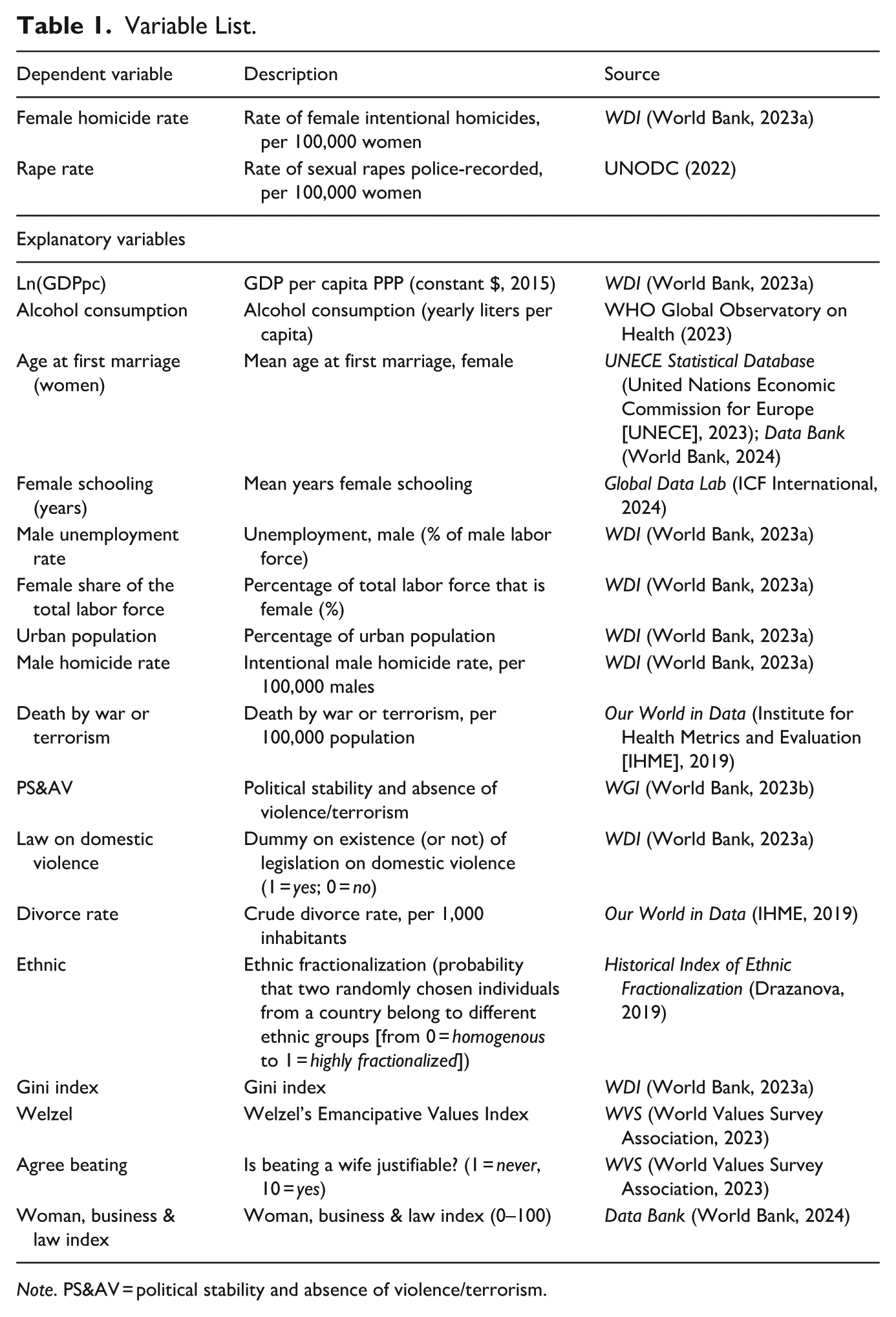
Note. PS&AV = political stability and absence of violence/terrorism.
Consistent with the criteria outlined above for selecting macro-level proxies with sufficient cross-country and temporal variation, we initially considered including a binary indicator capturing legal protections against gender inequality or discrimination from an external source. However, this measure collapses highly heterogeneous legal frameworks into a single dichotomous variable and exhibits very limited temporal variation across OECD countries. As a result, it proved unsuitable for our panel-data design and was therefore excluded from the final empirical analysis.
Methodology and Estimation Procedure
We specify our econometric model in the following terms:

where
The chosen estimation strategy used a random-effects model. The Hausman test provided no significant evidence against the null hypothesis, suggesting the appropriateness of the random-effects estimator over the fixed-effects estimator (χ2 = 20.77); p = .7971). Furthermore, the Lagrange multiplier test strongly rejected the null hypothesis, favoring the random-effects model over a pooled model (χ2 = 341.67; p < .0001).
We addressed concerns regarding potential biases stemming from endogeneity, where the dependent variable might influence contemporary values of the explanatory variables. To mitigate these effects, Equation 1 was estimated with all explanatory variables lagged by 1 year. The outcomes of this approach were very consistent with the initial results. Fixed effects models can also help control endogeneity due to time-invariant omitted variables within each entity (country, in this case). By differentiating within entities, these models eliminate time-invariant influences that could be causing endogeneity. We thus also included fixed effects estimations as sensitivity checks.
Results
Descriptive Patterns of VaW in OECD Countries
Figure 1 illustrates the evolution of female intentional homicide rates across OECD countries between 2000 and 2018. The average rate across the sample was 1.142 per 100,000 women, although substantial variation exists across countries and over time. Overall, female homicide rates declined during the period. Colombia recorded the highest rate at the beginning of the period (9.52 per 100,000 women), decreasing to 4.19 by 2018, while Ireland consistently exhibited the lowest rates, remaining relatively stable (from 0.40 to 0.41). These countries represent exceptions to the general downward trend. In contrast, Mexico, experience a marked increase in female homicide rates, rising from 2.55 to 5.85, in parallel with a sharp increase in male homicides (173.6%). Costa Rica also showed a modest rise (from 2.04 to 2.34) over the period.
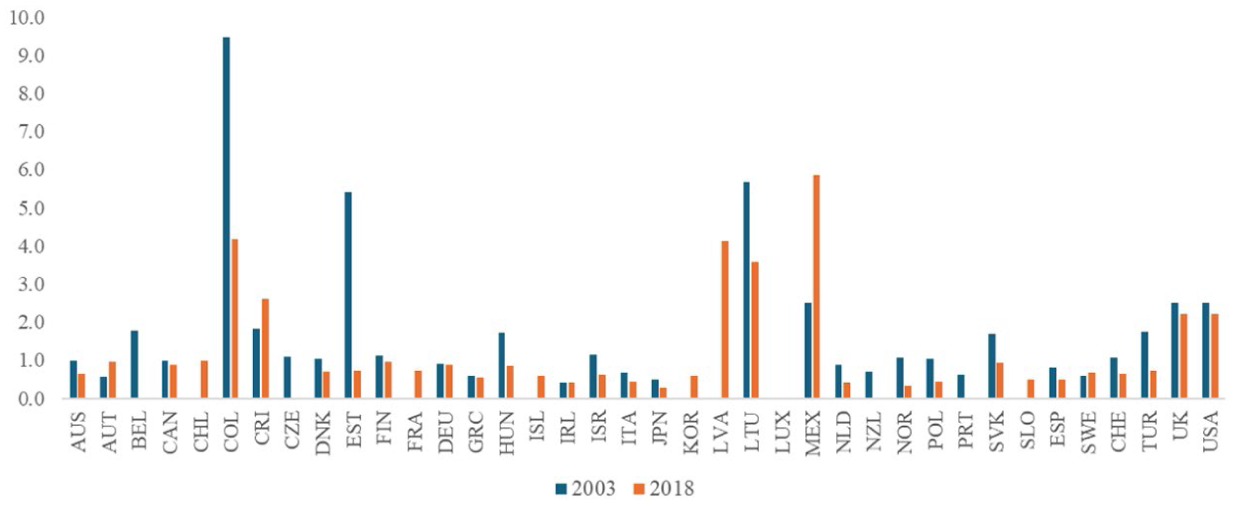
Female intentional homicides per 100,000 females.
It is important to note that the particularly high female homicide rates observed in some Latin American countries, such as Colombia and Mexico, occur within broader context of generalized violence and organized crime. In such settings, female homicides are often intertwined with criminal dynamics, drug trafficking, and weak judicial enforcement, which contribute to elevated levels of gender-related killings (UNODC, 2023).
Data on rape rates are more limited. Several OECD countries lack complete time series, while others only began consistent recording in the early 2000s. Figure 2 displays rape rates at the beginning and end of the study period (or the nearest available years). Costa Rica reported the highest initial rate (60.3 per 100,000 women), increasing to 83.3 by 2018, while Canada, Japan, and Greece recorded the lowest rates (3.3, 3.8, and 4.1 respectively).
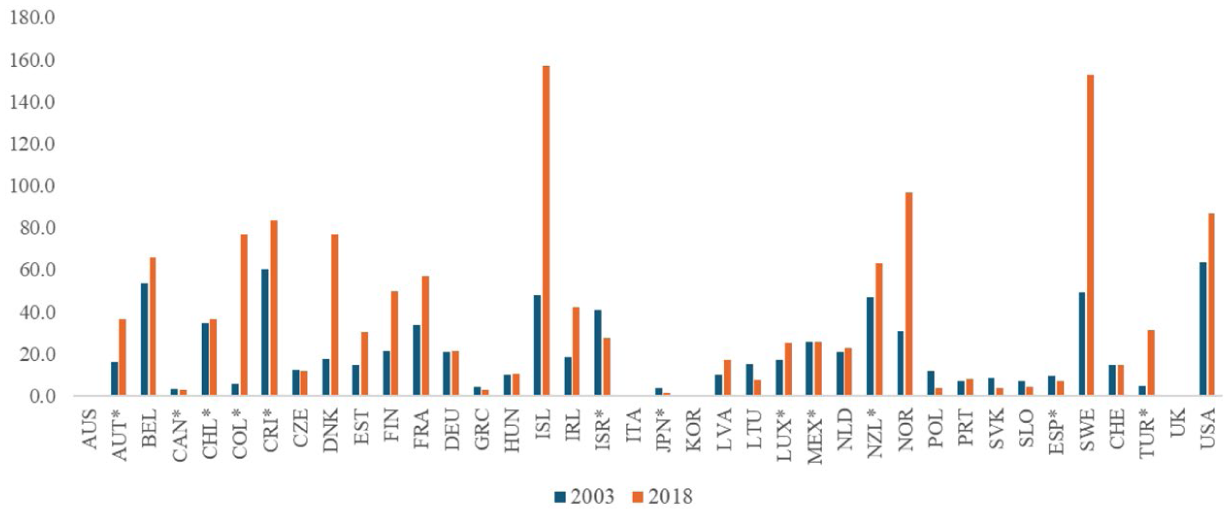
Rapes per 100,000 women.
Unlike homicide trends, reported rape rates increased in most countries. Colombia experienced the sharpest rise, with an increase of 1,294.5%, followed by the Nordic countries: Denmark 342.6%, Iceland 227.7%, Norway 216.6%, Sweden 208.6%, and Finland 132.1%. The trend was negative in 10 countries, with Poland seeing a decrease of 67.0%, Japan 60.2%, and Slovakia 57.7%. However, these figures should be interpreted with caution, as police-recorded rape rates are highly sensitive to changes in reporting behavior, legal definitions, and recording systems. As repeatedly noted by UNODC, increases in recorded rape do not necessarily reflect changes in underlying incidence but often mirror improvements in reporting and classification practices. Table 2 presents some descriptive statistics for all variables used in the estimations.
Descriptive Statistics (Estimation Sample N = 320).
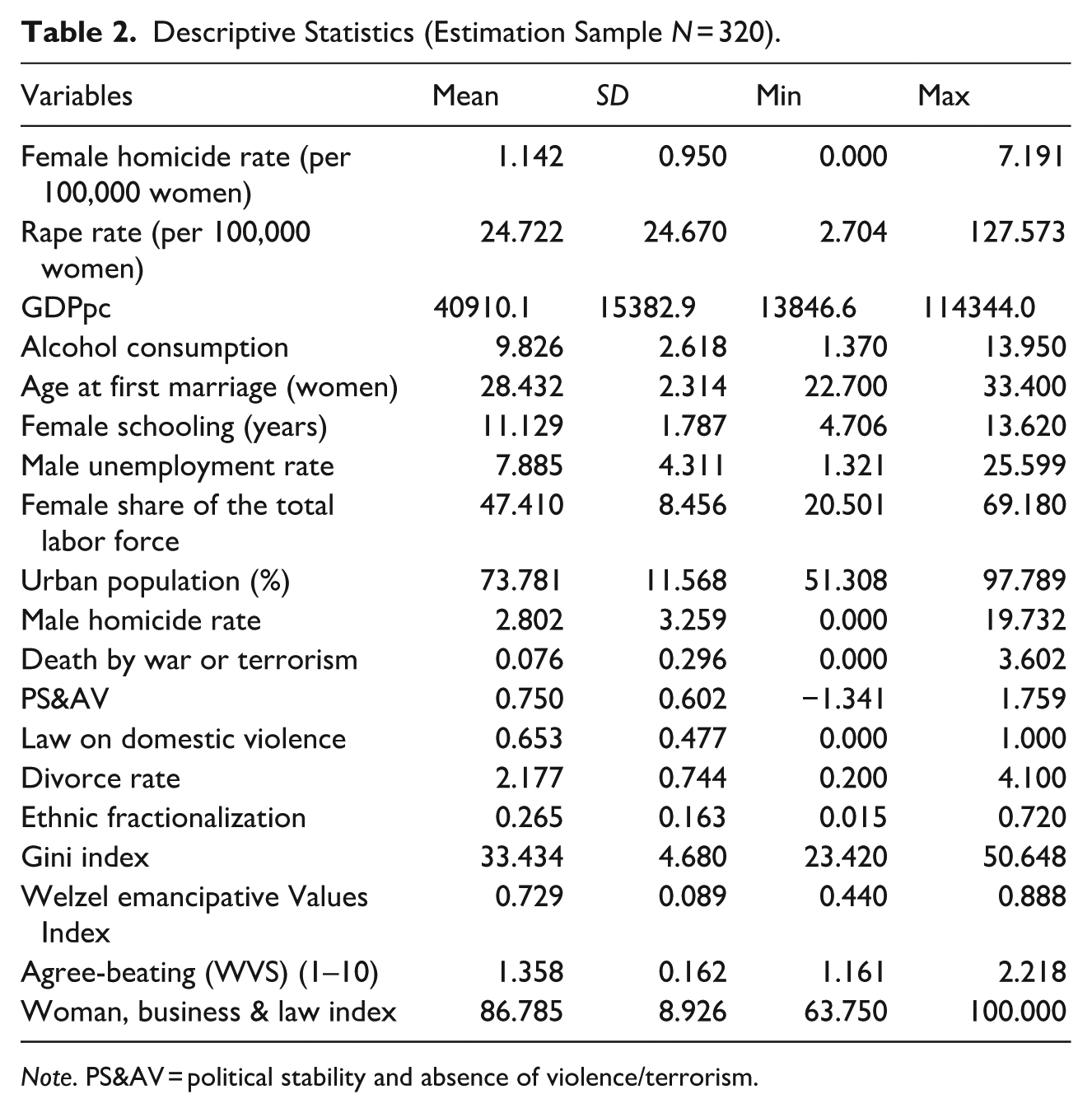
Note. PS&AV = political stability and absence of violence/terrorism.
Model Estimation Results
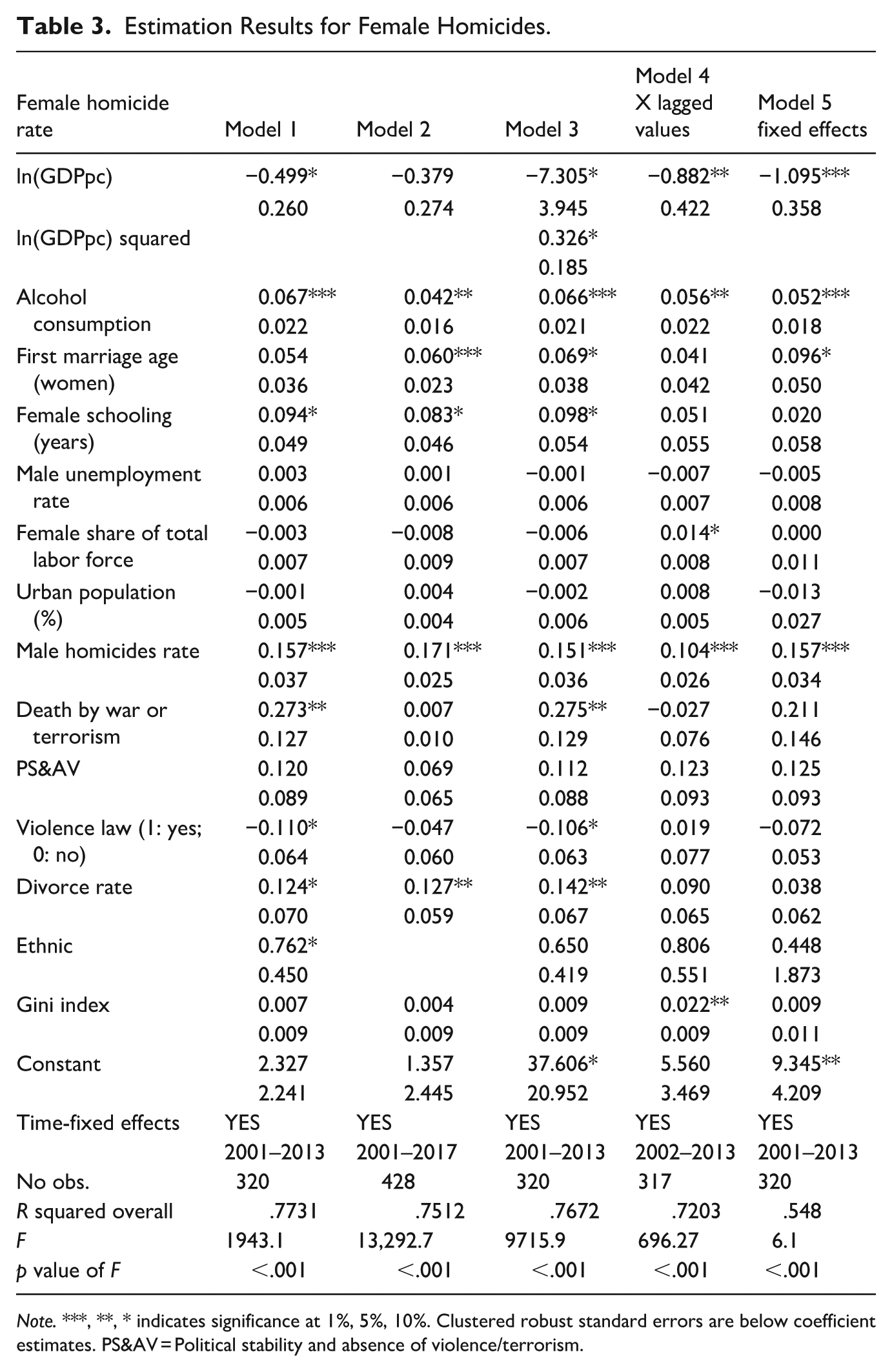
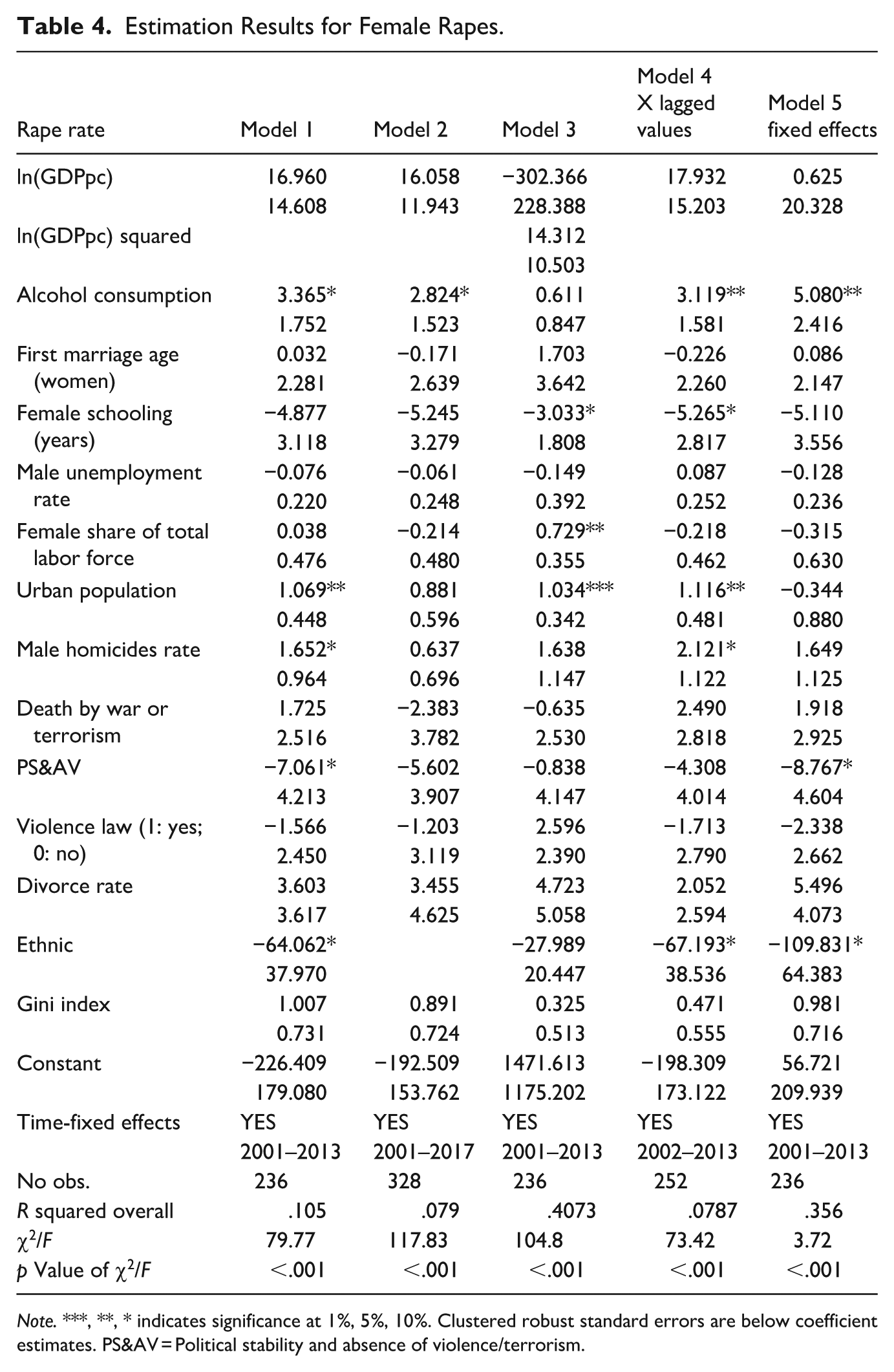
Tables 3 and 4 present the estimation results for female intentional homicides and rape rates, respectively. These tables report the coefficients and robust standard errors for five distinct model specifications (columns 2–6). Model 1 incorporates the variable ethnic diversity, limiting the sample period to 2000 to 2013 due to data availability for this variable. Model 2, in contrast, excludes ethnic diversity, thereby extending the sample period to 2000 to 2018. Model 3 introduces a quadratic term for the logarithm of GDP per capita to explore potential nonlinear effects of GDP per capita on the VaW indicators. As a robustness check, Model 4 includes the specification of Model 1, but with all explanatory variables lagged one period. Finally, Model 5 presents fixed-effects estimations. In all models, inference was based on clustered (by country) robust standard errors. A collinearity diagnostic based on Variance Inflation Factors (VIF) shows no evidence of problematic multicollinearity among regressors (all VIF <5), indicating that the estimated coefficients are not driven by correlation between covariates (see Table S.1). We assessed cross-sectional dependence in the panel using the Pesaran CD test (Pesaran, 2021). Specifically, we applied the CD test to the residuals from our random-effects specification using the xtcdf routine in Stata 17. The test statistic was CD = 0.51 (p = .61), so we cannot reject the null hypothesis of cross-sectional independence. These results suggest that common shocks across OECD countries are not a major source of bias in our baseline estimates. As an additional robustness check, we re-estimated the models using Driscoll–Kraay standard errors (Driscoll & Kraay, 1998), which are robust to cross-sectional dependence. The results are virtually identical to those of the main specifications. For brevity, we report the Driscoll–Kraay estimates for Model 1 of female homicides in Table S.2. Other models show the same pattern.
Estimation Results for Female Homicides.
Note. ***, **, * indicates significance at 1%, 5%, 10%. Clustered robust standard errors are below coefficient estimates. PS&AV = Political stability and absence of violence/terrorism.
Estimation Results for Female Rapes.
Note. ***, **, * indicates significance at 1%, 5%, 10%. Clustered robust standard errors are below coefficient estimates. PS&AV = Political stability and absence of violence/terrorism.
As shown in Table 3, certain variables remain consistently significant across the five model specifications. The coefficient for GDPpc is negative and statistically significant in several specifications, suggesting a consistent association between higher income level and lower female homicide rates. When a quadratic term for GDPpc is included (Model 3), the squared coefficient is positive and significant, indicating a potential nonlinear relationship. In the quadratic specification, the implied turning point occurs at ln(GDPpc) = 11.21, which corresponds to approximately USD 73,700 per capita (95% CI: USD 30,700–176,900). A marginal-effects plot in Figure S.3 illustrates how the marginal effect of income varies smoothly across the observed distribution of ln(GDPpc). Alcohol consumption also shows positive and statistically significant effects in most specifications. This indicates that countries with higher levels of alcohol consumption tend to exhibit higher recorded female homicide rates. The male homicide rate is consistently positive and highly significant across all models, indicating that countries with higher overall levels of violence tend to have higher rates of female homicides. Divorce rate and female years of schooling are positively associated with female homicide rates in the first three models. These associations are descriptive and do not imply causation. Interestingly, the coefficient for the female share of the total labor force is negative but not significant, suggesting that higher female participation relative to men is not systematically associated with lower rates of female homicides once other factors are held constant. Whereas the male unemployment rate, the share of the urban population and the Gini index show no systematic pattern of significance. The dummy variable for domestic-violence legislation yields a negative coefficient in some specifications, although the estimate is not consistently significant across models. Age of first marriage for women and the variable “ethnic” are significant in some models. Given the heterogeneity of these indicators, these associations should be interpreted with caution.
Overall, the models indicate that GDP per capita, alcohol consumption, and male homicide rate are the most consistent correlates of female homicide rates across specifications. Other variables display fewer stable patterns.
Concerning the estimation results for rape rates, Table 4 reveals notable differences relative to homicide models.
As shown in Table 4, neither the coefficient of GDP per capita nor its quadratic term is significant across the five models. This contrasts with the results obtained for female homicide rates in Table 3, where both terms were statistically significant, indicating that GDP per capita plays a weaker role in explaining variation in rape rates than in explaining variation in female homicide rates. Similarly, male homicide rate appears as a marginal significant predictor only in Models 1 and 4.
Alcohol consumption emerges as the most consistent predictor. The coefficient is positive in most specifications, suggesting that higher alcohol consumption may correlate with increased incidence of rape. Also, the share of urban population shows a positive and significant association with reported rape rates in several specifications. The magnitude and significance vary across models. Model 3 stands out for its significant negative coefficient for years of female schooling. The sign remains negative across specifications, although significance varies.
The coefficient for the female share of the total labor force varies across models, showing a positive association only in Model 3 and remaining non-significant in others. The male unemployment rate does not display consistent significance across specifications. Finally, the domestic-violence law indicator, the male unemployment rate, and the age at first marriage exhibit inconsistent signs and low statistical significance across models.
Overall, the models in Table 4 reveal important differences compared to those in Table 3, indicating that the determinants of sexual and physical violence are not the same. Beyond alcohol consumption—which appears to be a consistent predictor of sexual violence—Table 4 shows that several factors are associated with rape rates, although these relationships are not consistent across different specifications. This finding underscores the multifaceted nature of sexual violence, which arises from a complex interplay of socioeconomic risk factors and calls for nuanced policy interventions.
Robustness Checks
As a robustness exercise to assess whether broader sociocultural dimensions are better captured through attitudinal data, we constructed a composite indicator of gender-related social norms using Principal Component Analysis (PCA). The index combines three conceptually related variables: the divorce rate discussed above; Welzel’s Emancipative Values Index, constructed from World Values Survey items (Welzel, 2013; World Values Survey Association, 2023); and the acceptance of wife beating, obtained from the World Values Survey item “Justifiable: beating wife,” widely used in comparative cross-national research (Heise & Kotsadam, 2015; World Values Survey Association, 2023). These indicators capture different dimensions of family transformation, gender role expectations, and normative constraints. The first principal component explains approximately 54% of the total variance, indicating the presence of a strong underlying cultural factor. Because WVS waves provide data only for specific years, we interpolated values between survey rounds and carried forward/backward the closest available value outside these intervals; as a result, the derived annual series necessarily introduce a degree of measurement error. Moreover, the limited temporal and country coverage of some indicators—particularly the wife-beating item—further restricts computability and reduces the usable sample size. For these reasons, the PCA-based models are estimated on a reduced sample and are therefore presented as complementary to our main results (see Table S.4). These models allow us to test whether the cultural and normative dimensions potentially correlated with GDP per capita are better captured through a synthetic indicator rather than through single proxies such as divorce rate. The results for female homicides do not change meaningfully. However, it does produce a positive and significant coefficient for rape rates. This finding is discussed in the next section.
The next robustness check is related to rapes models. Because rape data are missing for several OECD countries and years, the rape models rely on a smaller sample (N = 236) than the homicide models (N = 320). Table S.5 reports the number of available observations per country for both outcomes, making the source of this difference transparent. We also re-estimated the female homicide model using only the restricted sample for which rape data exist. The results (Table S.6) remain highly consistent with those of the full sample, confirming that sample composition does not affect our findings. Some explanatory variables also present occasional missing values; however, because the same set of covariates is used in all specifications, these missing observations reduce the sample size uniformly across models and do not generate differential sample composition between the homicide and rape analyses. Overall, these checks confirm that the differences in “N” across tables are driven exclusively by outcome availability rather than by modeling choices.
As additional robustness checks, we first re-estimated Model 1 for rapes excluding Sweden and Colombia, the two countries where changes in legal definitions and major shifts in reporting practices generate the largest discontinuities in the rape series. The results remained highly consistent with those of the baseline model, confirming that our findings are not driven by these outliers. Second, to address concerns regarding temporal comparability, we estimated Model 1 separately for the periods 2000 to 2008 and 2009 to 2018. The sign and approximate magnitude of the key coefficients—particularly urbanization, alcohol consumption, and female employment—remained stable across the two periods, indicating that our main results are robust to changes in reporting systems, legal reforms, and classification practices over time. All these estimates are presented in Table S.7.
As the last robustness check, we re-estimated Model 1 for both outcomes replacing the domestic-violence law dummy with the Women, Business and the Law (WBL) Index Score (1–100) from the World Bank (2024), a continuous measure of gender-equality legislation. As shown in Table S.8, the main coefficients remain stable in sign and magnitude. For sexual violence, the WBL score displays the expected negative association, whereas for female homicides the effect is small and statistically insignificant. These results confirm that our conclusions do not depend on the specific legal-framework proxy used.
Discussion
The results reported above provide empirical evidence supporting several theoretical propositions regarding the structural determinants of VaW. Overall, the findings confirm that VaW is not driven by a single factor but results from the interaction of multiple economic, social, and cultural conditions operating at the macro level. A central insight of our analysis is that the determinants of lethal and sexual forms of VaW differ systematically, reflecting the degree to which each outcome is influenced by underlying incidence versus reporting dynamics. In this section, we integrate these findings and situate them within the broader comparative literature on gender norms, reporting behavior, and crime statistics.
Structural Determinants of Female Homicide
The consistent negative association between GDP per capita and female homicide rates suggests that better economic conditions are linked to lower levels of lethal VaW. This relationship supports the view that economic stability, higher income levels, and stronger social protection systems reduce household stress and conflict (Abramsky et al., 2011; Arthur & Clark, 2009; Kadir et al., 2020; Mannell et al., 2022). Nevertheless, the nonlinear specification indicates that this effect may attenuate at higher levels of development, suggesting that structural inequality or other social factors may persist even in wealthy contexts. Alcohol consumption emerges as a robust positive predictor of female homicide. In line with previous research, our results indicate that alcohol abuse acts as a catalyst for aggressive behavior against women (Kadir et al., 2020; Owusu & Agbemafle, 2016; Tekkas & Betrus, 2018). The male homicide rate also appears as a strong positive determinant of female homicides, consistent with prior research. This result underlines that physical VaW often occurs within wider contexts of societal violence, and aligns with Kadir et al. (2020), who found that a violent family environment is a significant risk factor for VaW. This positive association, also captured by variables representing political stability and violent context, likely reflects social settings characterized by a high tolerance or normalization of violence (Mannell et al., 2022). However, this does not imply that the drivers of VaW are gender-neutral; rather, gender-specific factors operate within these broader violent environments. Other variables, such as female employment or schooling, show inconsistent patterns and should be interpreted cautiously, as they may reflect heterogeneous cultural conditions not fully captured in macro-level analyses. The coefficient for the female share of the total labor force is not statistically significant across most models. This result indicates that the relative participation of women in the labor market—although theoretically related to empowerment—does not automatically translate into a lower risk of physical violence, especially when structural inequalities and cultural norms remain unchanged.
Determinants of Rape Rates: A Reporting-Dependent Outcome
The models using rape rates as a proxy for sexual violence reveal a different pattern. GDP per capita is not significant across specifications, and male homicide rates are only marginally significant in a few models. Alcohol consumption, in contrast, remains a consistent predictor, confirming evidence that substance abuse increases the risk of sexual violence (Kadir et al., 2020; Tekkas & Betrus, 2018). These authors found that women’s risk of experiencing sexual violence increases with the use of alcohol and other illicit substances. Our results also align with those of Owusu and Agbemafle (2016), who found that alcohol abuse by women—not just aggressors—can distort judgment and increase potential victims to sexual violence. Urban population also shows a positive association with reported rape rates. However, this association likely reflects not only true incidence but also differences in reporting and institutional capacity between urban and rural contexts (Lewis and Reed, 2003). More urbanized countries often have stronger mechanisms for documenting sexual violence cases—an issue extensively documented in the literature (Alesina et al., 2021; Mannell et al., 2022; Mojahed et al., 2022; Owusu & Agbemafle, 2016). The risk of suffering some type of violence, including sexual violence, increases for women who live in urban areas, as compared to those who live in rural areas. Owusu and Agbemafle (2016) also mention residence in urban areas as a risk factor for VaW but conclude that it is because most women in urban areas reside in slums or poor urban areas, which may increase their risk of VaW. Our results partially agree with Mannell et al. (2022), who conclude that some women who live in urban areas are at greater risk of suffering sexual violence than are women in rural areas. Our results disagree, however, with those of Arthur and Clark (2009), who use a combination of urbanization level and GDP per capita to measure a society’s modernization. These authors find a positive association between larger urban populations and lower levels of all types of VaW. Finally, the association between female education and rape varies across models. In some specifications, higher education correlates with lower rape rates, consistent with theories of empowerment and resource access (Arthur & Clark, 2009; Ellsberg et al., 2015; WHO, 2010); in others, the association weakens or becomes positive (Barnawi, 2017), possibly reflecting greater reporting propensity among more educated women. Violence also increases when women have a higher level of education than men (Amir-ud-Din, 2024). These mixed findings support a key insight: rape statistics reflect both underlying victimization and reporting behavior, which varies substantially across countries and time.
How Sociocultural Factors Operate Differently For Homicide and Rape: The PCA-Based Evidence
The results presented in the previous section reveal several consistent patterns across specifications, but they also uncover important differences depending on both the type of violence examined and the operationalization of sociocultural factors. While the main models using the divorce rate as a proxy for social change produce stable and interpretable associations, the robustness checks incorporating attitudinal information through the PCA-based social norms indicator point to a more nuanced picture. These contrasts are theoretically meaningful and point to distinct mechanisms underlying lethal and sexual VaW.
A clear distinction emerges by type of violence. When female homicide rates are used as the dependent variable, replacing the divorce rate with the PCA-based gender-related social norms indicator produces no substantive changes in sign, magnitude, or significance. This stability reflects the objective nature of homicide data, which are largely unaffected by social stigma or cross-national differences in reporting. Accordingly, both indicators capture similar structural conditions associated with lethal VaW.
In contrast, results differ markedly for police-recorded rape rates. The PCA-based indicator shows a strong and statistically significant positive association with rape in pooled and lagged models, a pattern not observed when using the divorce rate alone. This divergence is consistent with established evidence from high-income countries: more gender-equal societies, with broader legal definitions, stronger institutional trust, and lower stigma surrounding reporting—such as the Nordic and Benelux countries—systematically display higher recorded rape rates. These differences largely reflect variation in reporting and recording practices rather than higher underlying incidence.
The PCA-based indicator incorporates direct attitudinal information from the World Values Survey, capturing a broader sociocultural gradient related to gender equality and intolerance of violence. Because this gradient closely aligns with reporting environments, it becomes strongly correlated with recorded rape rates once included in the models. The divorce rate, by contrast, is a narrower proxy for social change and does not fully capture cross-national variation in reporting behavior, explaining why the PCA affects rape models but leaves homicide models essentially unchanged.
Taken together, these findings highlight a fundamental distinction between objective and reporting-dependent forms of VaW. While female homicide rates exhibit stable relationships with structural factors, recorded rape rates are highly sensitive to sociocultural and institutional contexts that shape reporting. Given the substantial gaps in annual attitudinal data for OECD countries, we retain the divorce rate—reframed as a proxy for broader social and institutional transformation—as the main specification, presenting the PCA-based models as an informative and theoretically meaningful robustness exercise.
Reporting and Legal Reforms
Recorded rates of sexual violence should be interpreted with caution, as they are strongly shaped by reporting behavior and institutional frameworks. It is likely that actual rates of sexual violence exceed those captured in official statistics, given persistent barriers to disclosure. Many victims of serious sexual crimes do not report their experiences (Tekkas & Betrus, 2018, p. 1), a pattern that can be particularly pronounced in rural or socially conservative settings where anonymity and access to support services are more limited (Edwards, 2015).
Accordingly, upward trends in recorded rape rates across OECD countries should not be interpreted as evidence of increasing underlying incidence. A substantial body of research documents very low disclosure rates for sexual offences—often below 10% to 15%—due to stigma, fear of disbelief, and limited institutional trust (Ellsberg et al., 2015; WHO, 2021a). The UNODC (2024) cautions that cross-national and longitudinal variation in rape statistics largely reflects changes in reporting practices, police-recording systems, and legal definitions, rather than shifts in actual victimization. During the study period, many OECD countries adopted major legal and institutional reforms, including consent-based definitions and expanded recognition of non-physical coercion, alongside initiatives to encourage reporting. Evidence from high-reporting contexts, such as the Nordic countries, indicates that increases in recorded cases are primarily attributable to these changes rather than to higher incidence of sexual violence (Brå, 2020; Heise & Kotsadam, 2015). Consequently, the descriptive increases observed in our data most plausibly reflect enhanced reporting and broader classification of sexual offences.
Similar caution applies to the interpretation of legal variables. The fact that domestic-violence legislation appears protective for physical violence but not for sexual violence should be interpreted carefully, as our indicator captures only the formal existence of a legal framework and not its scope or enforcement. As a result, estimated effects may understate the true influence of legal protection. Future research could incorporate measures of enforcement intensity or implementation capacity.
In this sense, although higher male homicide rates and broader contexts of violence are sometimes associated with higher reported rape rates, this should not be interpreted as evidence of gender-neutral drivers of violence. Rather, gender-specific dynamics operate within broader violent environments, increasing women’s vulnerability. More generally, part of the observed variation in violence-against-women indicators likely reflects differences in reporting capacity rather than actual incidence. The results should therefore be interpreted as associative rather than causal.
Beyond the cross-national patterns discussed above, macro-level analyses cannot fully capture within-country heterogeneity. Even in OECD contexts, women’s exposure to violence varies across migrant, minority, and other subnational groups, partly due to unequal access to resources and institutional protection (Heise & Kotsadam, 2015). While ILGA World (2023) does not measure violence directly, its global mapping of legal protections reveals substantial differences in the inclusiveness of LGBTQ+ legal environments, a pattern that aligns with research linking more protective legal climates to lower levels of discrimination and violence against sexual and gender minorities. Although our dataset does not allow us to incorporate these dimensions, future macro-comparative research could integrate indicators such as migrant stock, asylum flows, minority-rights indices, or LGBTQ+ legal-equality measures to better account for intersectional inequalities within countries.
Conclusions and Practical Implications
This study contributes to the limited macro-level, cross-country evidence on VaW in developed countries by comparatively examining the determinants of physical and sexual violence. Our findings indicate that physical and sexual violence are influenced by distinct sets of risk factors. Specifically, economic conditions, substance abuse, societal violence levels, and potentially cultural and legal factors emerge as significant predictors of physical violence in OECD countries. Conversely, sexual violence is more strongly associated with substance abuse and (to some extent) lower levels of educational attainment. In addition, the robustness analysis using a PCA-based indicator of gender-related social norms provides important differences between physical and sexual violence. While this measure does not affect the results for female homicides—consistent with the reliable recording of lethal violence—it is positively and significantly associated with reported rape rates. This finding highlights the role of reporting environments, institutional trust, and legal definitions in shaping sexual violence statistics, suggesting that such indicators are informative for interpretation but less suitable as baseline measures in cross-country analyses.
These findings have clear policy implications. First, the fact that alcohol and substance use consistently emerge as risk factors across all specifications suggests that prevention strategies should explicitly incorporate substance-use reduction as a core component of violence-prevention policies. Second, the differentiated determinants of physical and sexual violence underscore the need for policy approaches tailored to specific forms of violence rather than one-size-fits-all interventions. Policies that promote women’s education and economic autonomy remain central, as they address structural vulnerabilities associated with violence risk. At the institutional level, strengthening law enforcement and judicial effectiveness is essential for reducing overall violence and enhancing deterrence. Finally, our results highlight the importance of improving the systematic recording and cross-country comparability of different forms of VaW, particularly sexual violence, which remains highly sensitive to reporting environments. Many of these policy pathways are reflected in the WHO’s RESPECT framework, which provides a coherent basis for adapting and scaling evidence-based interventions across institutional contexts.
Several limitations should be acknowledged when interpreting these findings. First, this study only covers OECD countries, which are predominantly high-income settings. Therefore, the external validity of the findings may be limited, particularly with respect to low-income countries. Second, the proxy variables used to measure physical and sexual VaW (female intentional homicide and rape rates) capture only the most severe and observable forms of violence and therefore do not reflect the full spectrum of VaW. As a result, the findings should be interpreted as pertaining to these specific manifestations rather than to VaW more broadly. While more comprehensive measures based on survey data exist, such data are not consistently available across countries and over time, which constrains their use in cross-country panel analyses such as the one employed in this study. Third, the available data used in our analysis does not allow us to distinguish between IPV and non-IPV. As a result, our estimates capture broader patterns of VaW rather than IPV-specific mechanisms. Fourth, while female homicide rates are based on court and police records and benefit from near-complete and consistent reporting, sexual violence indicators rely heavily on victims’ willingness and ability to report incidents to authorities. As a result, recorded rape rates are widely recognized as substantially underestimated, particularly in contexts where stigma, fear of disbelief, or limited institutional support discourage reporting. This reporting gap implies that observed levels of sexual violence likely understate its true prevalence, as documented in previous research (Alesina et al., 2021). Moreover, police-recorded rape statistics are not fully comparable across countries or over time. They are highly sensitive to changes in legal definitions of sexual offenses, reporting incentives, awareness campaigns, and improvements in police-recording practices. Consequently, observed cross-national differences or temporal increases in rape rates may reflect shifts in reporting and classification rather than genuine changes in underlying incidence, as emphasized by Brå (2020) and UNODC (2023). These measurement issues should be borne in mind when interpreting both the descriptive trends and the regression estimates involving sexual violence. A related implication is that underreporting may be particularly acute in rural or socially conservative settings, where barriers to disclosure are often stronger and access to victim-support services more limited. Ensuring that women in such contexts feel adequately protected and supported to report sexual violence remains a critical policy challenge, as inadequate reporting obscures the true scale of the problem and hampers effective prevention.
In addition, the study faces the challenge of ecological bias, inherent to macro-level analyses. While aggregated country-level data allow for valuable insights into broad structural patterns, relationships observed at the national level do not necessarily translate directly into individual-level behavior, raising the possibility of ecological fallacy. The use of panel regression techniques partly mitigates this concern by exploiting within-country variation over time, but findings should nevertheless be interpreted with appropriate caution, particularly when drawing individual-level policy implications. Future research should aim to broaden the scope of this study by including a larger sample of countries and extending the timeline when available. Such an approach would improve the robustness of the results and facilitate a more comprehensive understanding of trends and patterns in violence.
Finally, although our analysis focuses on cross-country differences, future research could further enrich the understanding of VaW by considering within-country heterogeneity. Future studies could develop and combine advanced quantitative approaches with qualitative evidence to better account for hidden violence and improve the measurement of sexual victimization across institutional contexts. Incorporating data on migrant populations, asylum seekers, ethnic or minority groups, and the legal climate surrounding gender and sexual diversity could provide valuable insights into how multiple forms of marginalization intersect with women’s risk of violence. Macro-level studies integrating these dimensions would align with recent advances in VaW scholarship and contribute to more inclusive prevention strategies.
Supplemental Material
sj-docx-1-jiv-10.1177_08862605261458423 – Supplemental material for Determinants of Lethal and Sexual Violence Against Women: A Cross-Country Analysis of OECD Countries
Supplemental material, sj-docx-1-jiv-10.1177_08862605261458423 for Determinants of Lethal and Sexual Violence Against Women: A Cross-Country Analysis of OECD Countries by Maricruz Lacalle-Calderon, Isabel Cepeda and Carlos Martinez-De-Ibarreta in Journal of Interpersonal Violence
Footnotes

Funding
The authors received no financial support for the research and/or authorship of this article.
Declaration of Conflicting Interests
The authors declared no potential conflicts of interests with respect to the authorship and/or publication of this article.
Supplemental Material
Supplemental material for this article is available online.
Notes
Author Biographies
References
Supplementary Material
Please find the following supplemental material available below.
For Open Access articles published under a Creative Commons License, all supplemental material carries the same license as the article it is associated with.
For non-Open Access articles published, all supplemental material carries a non-exclusive license, and permission requests for re-use of supplemental material or any part of supplemental material shall be sent directly to the copyright owner as specified in the copyright notice associated with the article.
