






Abstract
Background:
Breastfeeding is the gold standard nutrition for infants, and more than three-fourths of US mother–infant couplets initiate breastfeeding at birth. However, breastfeeding rates plummet after hospital discharge, when mother–infant couplets enter primary care. This quality improvement project examined the effect of a primary care intervention on breastfeeding rates from the newborn visit through the 4-month visit.
Objective:
The overall aim of this evidence-based quality improvement project was to increase breastfeeding rates by refining the care provided to a diverse patient population with historically low breastfeeding rates.
Methods:
Two independent groups of mother–infant couplets, a pre-implementation (N = 43) and a post-implementation (N = 45), were longitudinally evaluated on breastfeeding rates at the newborn, 1-month, 2-month, and 4-month well-child visits for exclusive, partial, and any breastfeeding rates. Relationships for the 2 groups were compared using 2-sample t tests, chi-square, and Fisher exact tests.
Results:
Post-implementation rates for any breastfeeding progressively increased at each timepoint. Exclusive breastfeeding increased 40.98% at the 1-month visit, 27.4% at the 2-month visit, and 139% at the 4-month visit.
Conclusion:
The implementation of an evidence-based breastfeeding-friendly office protocol in a rural low breastfeeding rate primary care setting was associated with increased breastfeeding rates.
Keywords
Well Established
In the United States, breastfeeding support and breastfeeding rates plummet after newborns reach primary care, decreasing the health and economic benefits of breastfeeding for the mother, infant, family, and society.
Newly Expressed
This quality improvement project supports the pivotal role of the primary care office in ameliorating low breastfeeding rates in the early infancy period with an International Board Certified Lactation Consultant, Family Nurse Practitioner-led evidence-based practice protocol designed to create a breastfeeding-friendly primary care office.
Background
Breastfeeding has been long established as the gold standard for infant nutrition. Health benefits for both mother and infant are the impetus for increasing breastfeeding rates nationally and globally.1-6 National breastfeeding initiation rates are 79.2% 7 ; however, a rapid descent occurs for healthy breastfeeding couplets post hospital discharge, in the newborn to early infant period, when medically managed by primary care providers.8,9 Nationally, exclusive-breastfeeding rates drop to 40.7% at 3 months and 18.8% at 6 months. 7 The lack of primary care-based lactation consultants and interventions to address breastfeeding problems compounds this dramatic drop in breastfeeding rates in primary care. For example, at day 3 of life, 92% of breastfeeding mothers report breastfeeding problems and 82% still report problems at days 3 to 7. 10
The state of Georgia continues to lag behind the Healthy People 2020 objectives of “ever breastfeeding” (81.9%) and “exclusively through 3 months” (46.2%). 11 Georgia ranks 48th in the United States for exclusive-breastfeeding rates through 3 months (27.2%). 7 At a rural, medically underserved, low socioeconomic primary care pediatric office in north Georgia, breastfeeding rates as of June 2014 were even lower than the state’s averages, with only 23.7% of couplets exclusively breastfeeding at 2 months of age and only 14.3% at 4 months of age.
Lower breastfeeding rates exist among rural, low-income families, and further research and interventions are necessary to increase breastfeeding continuation within this population.9,12-15 Factors associated with low breastfeeding rates in rural maternal–infant couplets include Special Supplemental Nutrition Program for Women, Infants, and Children (WIC) participation, Medicaid participation, fewer maternal years of formal education, lack of breastfeeding support, being single, younger maternal age, employment at 2 months postpartum, low income, no breastfeeding education, or no previous breastfeeding experience.9,13,15
Primary care-based breastfeeding interventions are cost effective16-19 when directed at the many factors unique to rural, low-income populations due to the positive health and wellness benefits of mother–infant couplets that result from increased breastfeeding rates.20-22 These interventions need to be proactive to effectively increase breastfeeding rates.20,23,24 Mothers reporting proactive breastfeeding support and encouragement from their pediatric providers are half as likely to experience termination of breastfeeding in the first 3 months postpartum. 24
The Academy of Breastfeeding Medicine (ABM) Clinical Protocol #14: Breastfeeding-Friendly Physician’s Office: Optimizing Care for Infants and Children is an evidence-based practice (EBP) guideline that targets increasing breastfeeding success by improving the primary care office atmosphere, community involvement, and education for providers, staff, and families. 25 The recommendations are in a template format, allowing for individualization to meet specific needs of any primary care population. Effective intervention results include improved infant and maternal health, and maternal satisfaction with the pediatric clinic. 23 Therefore, this protocol was chosen for implementation in a rural, low-income, medically underserved primary care clinic.
The overall aim of this evidence-based quality improvement (QI) project was to increase breastfeeding rates by refining the care provided to a diverse patient population with historically low breastfeeding rates. Specific goals were to increase breastfeeding initiation (as measured at the newborn visit) and continuation rates (as measured at the 1-month, 2-month, and 4-month well-child visits) of exclusive, partial (breastfeeding couplets also supplementing with formula), and any breastfeeding by at least 10% after implementation of the ABM’s comprehensive EBP breastfeeding clinical protocol.
Methods
Project Design
A before-and-after design was used, with data collected via electronic medical records (EMR) from 2 independent groups: a pre-implementation group (N = 43) and a post-implementation group (N = 45) of healthy infant–mother couplets. Each group was evaluated longitudinally on breastfeeding rates at the newborn, 1-month, 2-month, and 4-month well-child visits for exclusive or partial breastfeeding. This QI project was reviewed by the Duke University Institutional Review Board and classified as exempt.
Setting
The practice site was a rural, medically underserved pediatric primary care clinic, in a low socioeconomic area with a 61% Medicaid payer mix. Predominant languages spoken in this community were English and Spanish. The practice location was rural north Georgia, in the foothills of the Appalachian Mountains. The office had 2 full-time pediatricians, 2 part-time pediatricians, 1 full-time nurse practitioner (NP), and 1 part-time NP who was also an International Board Certified Lactation Consultant (IBCLC) and led the QI implementation. The practice had a Spanish-speaking population of 4.83% and employed 2 Spanish-speaking translators.
Participants and Recruitment of Participants
The pre- and post-implementation groups were healthy, full-term infants, newborn to 4 months of age, and their families who completed at least 2 of the 4 routine health visits at this pediatric primary care clinic. The infants’ age (newborn to 4 months) was selected because the greatest drop in breastfeeding rates for healthy breastfeeding couplets occurs during the newborn to early-infant period when managed by primary care providers.8,9
Recruitment for the pre-implementation group was a convenience sample of the first 43 healthy newborns presenting for their initial newborn visit from November 2013 through the 4-month visit of the final enrolled infant, which occurred in June 2014. Recruitment for the post-implementation group was a convenience sample of the first 45 healthy newborns presenting for their initial newborn visit from July 2014 through the 4-month visit of the final enrolled infant, which occurred in February 2015. Based on an evaluation of the clinic’s population who met criteria for this QI project and time constraints for completion, a goal of at least 40 newborns per timepoint was initially set. Healthy infant criteria included full-term (greater than or equal to 37 weeks gestation) infants discharged from the hospital with their biological mother to primary care for routine newborn care. Excluded from enrollment from both groups were infants discharged from the neonatal intensive care unit, premature infants, and infants not completing at least 2 well-child visits during the study timeframe.
Intervention
The ABM Clinical Protocol #14 was implemented fully in July 2014, refining breastfeeding care already provided in this diverse population. Implementation was led by a dually certified NP/IBCLC. Current practice already included, partially or fully, 12 of the 19 recommendations. These 12 recommendations were further clarified and/or utilization was improved, and the remaining 7 recommendations (1, 3, 10, 13, 14, 17, and 19) were implemented as part of this project (Table 1). Staff and providers received training on implementation of the updated written breastfeeding-friendly office policy (recommendation #1) and worksite policy (recommendation #13). The policies communicated clearly the expectation that the office supported a breastfeeding-friendly atmosphere (ABM Clinical Protocol #14).
ABM Clinical Protocol #14: Procedures to Implement. a

Abbreviations: AAP, American Academy of Pediatrics; ABM, Academy of Breastfeeding Medicine; EMR, electronic medical record; IBCLC, International Board Certified Lactation Consultant.
Adapted from Grawey et al. 25
Current practice did not already include these recommendations and was put into place as part of this new implementation.
Current practice already included, partially or fully, these recommendations and was further clarified and/or utilization improved with this new implementation.
The implementation process began with recommendation #17 in which all staff and providers received lactation-specific education through the American Academy of Pediatrics (AAP) Education Physician in Their Communities (EPIC) breastfeeding program, conducted by a contracted pediatrician and IBCLC within the AAP local chapter. In addition to the EPIC program, the in-office IBCLC also provided general breastfeeding skills training, triage, and follow-up telephone call protocols (recommendation #10) and specifically addressed breastfeeding complications and interventions with the providers. The in-office IBCLC also used opportunities within the clinic’s daily practice for staff and provider education and training; however, the IBCLC was part-time and available only 2 half days per week. Complimentary community breastfeeding classes were offered to improve on the office’s encouragement of antenatal breastfeeding (recommendation #3).
A purchased upgrade to the practice’s existing EMR to track breastfeeding rates (recommendation #19) was implemented and training was provided to office staff and providers for appropriate documentation. Current breastfeeding rate reports were generated periodically and presented during office meetings. Implementation of the ABM Clinical Protocol #14 included community breastfeeding class flyers and supplies, community resources (recommendation #14), breastfeeding positional support pillows, breastfeeding-friendly office signs, and custom EMR breastfeeding report upgrades; the total cost to implement was $866.94.
Data Collection
Pre-implementation data were collected November 2013 to June 2014, and post-implementation data were collected July 2014 to February 2015. Data were collected and recorded during each routine newborn, 1-month, 2-month, and 4-month well-child visit using the practice’s EMR system. Demographic data collected included high-risk factors associated with low breastfeeding rates such as maternal age,9,13,24 parity,13,24 previous breastfeeding experience, 9 type of insurance (public vs private; low income),9,13-15,24 and WIC participation.9,13,15 Additional demographic data collected for pre- and post-group comparison included type of delivery, infant gender, and birth weight.
The key outcome measures are the feeding methods: breastfeeding (any, exclusive, or partial breastfeeding) or formula. The feeding methods data were collected at the newborn, 1-month, 2-month, and 4-month well-child visits for the pre- and post-implementation groups. The Centers for Disease Control and Prevention and World Health Organization definitions for key outcome measures were used: exclusive breastfeeding as no other food or drink other than human milk, partial breastfeeding as some breastfeeding and some formula, 26 and any breastfeeding being the total of either. 7
Data Analysis
Statistical analysis was done using SPSS 22.0, with the level of significance set at P = .05. Summary statistics regarding demographics were calculated and compared for pre- and post-implementation groups using 2-sample t tests, chi-square, and Fisher exact tests based on level of outcome variable. Pre- and post-implementation breastfeeding rates (percentages of exclusive breastfeeding, partial breastfeeding, and any breastfeeding) at each time interval were compared using Fisher exact tests. To examine how previous breastfeeding experience affected any or exclusive breastfeeding rates, separate chi-square tests for the pre- and post-implementation groups were conducted for each of the 4 visit timepoints. In addition, separate chi-square tests for the pre- and post-implementation groups were conducted for each of the 4 timepoints to examine the association between insurance and any or exclusive breastfeeding.
Results
Demographic Characteristics
The demographic characteristics of maternal parity, delivery type, newborn birth weight, newborn gender, previous breastfeeding experience, insured status, and WIC participation were not statistically significantly different. The average parity for the pre-implementation and post-implementation groups was greater than 1 (1.79 and 2.02, respectively; P = .25). In both groups, more than 60% were publicly insured (P = .08) and more than 50% participated in WIC (P = .08). There was a statistically significant difference between groups for maternal age (P = .02), with mean ± SD mothers in the post-implementation groups being slightly older (28.71 ± 5.86 years) than those in the pre-implementation group (26.00 ± 4.79 years).
There were no differences between groups in the percentage of mothers with previous breastfeeding experience (P = .35). Community participation in the breastfeeding classes was low with 0 participants in the first class, 4 participants in the second class, and 3 in the third class. Those with previous breastfeeding experience had a higher percentage of infants who had any or exclusive breastfeeding (81.8%; Figure 1) compared with those who did not have previous breastfeeding experience (36.4%). At the 2-month visit for the pre-implementation group, those with previous breastfeeding had a higher percentage of infants with any/exclusive breastfeeding (60.0%) compared with those without previous breastfeeding (23.8%). Regarding post-implementation, 19 (100%) of those with previous breastfeeding experience were involved in any or exclusive breastfeeding and only 15 (62.5%) of those without breastfeeding had any or exclusive breastfeeding at the newborn visit (P < .05). All other timepoints did not have significant differences in breastfeeding rates. The insurance type was not related to any or exclusive breastfeeding at any of the visit timepoints for the pre-implementation or the post-implementation group.

Percentage of Infants with Any or Exclusive Breastfeeding.
Breastfeeding at Newborn, 1-Month, 2-Month, and 4-Month Visits
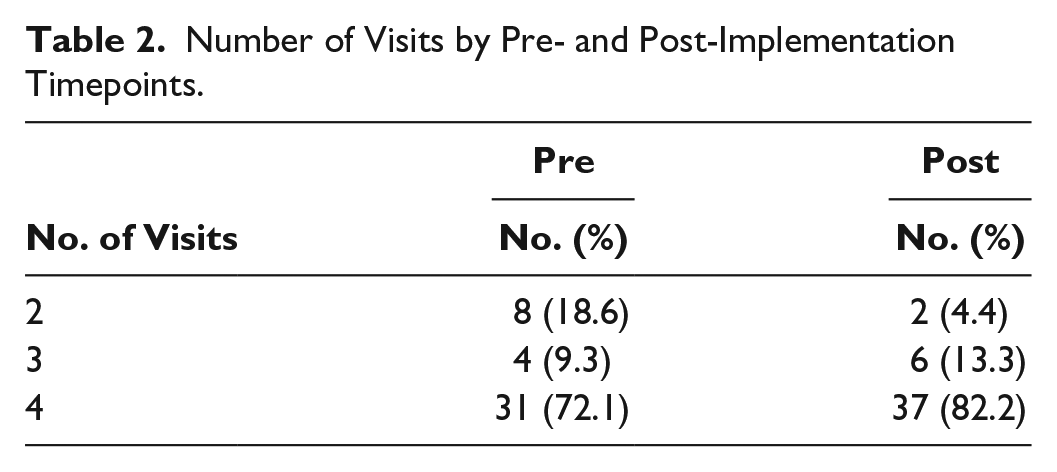
Participants completed at least 2 of 4 well-child visits at the following timepoints: newborn, 1 month, 2 months, and 4 months (Table 2). Breastfeeding rates for any breastfeeding at each of the 4 time variables increased progressively in the post-implementation group (Figure 2). In addition, post-implementation exclusive breastfeeding rates increased at the 1-month (P = .45), 2-month (P = .62), and 4-month (P = .06) visits (Figure 3). A positive relationship existed between implementing a breastfeeding-friendly office protocol and increased breastfeeding rates over time (Figure 4).
Number of Visits by Pre- and Post-Implementation Timepoints.

Any Breastfeeding Rates for Pre and Post Groups.

Exclusive Breastfeeding Rates for Pre and Post Groups.

Partial, Exclusive, and Any Breastfeeding Rates by Visit.
In our sample of 45 patients, 16 continued breastfeeding at 4 months compared with 10 in the pre-implementation group, and of these patients, 13 were exclusively breastfeeding (compared with only 5 in the pre-implementation group). This QI study supports a relationship between the implementation of a breastfeeding-friendly office protocol in a high-risk, low socioeconomic setting, following the ABM guidelines, and increased breastfeeding duration, including exclusive and any breastfeeding rates, and a decrease in partial breastfeeding rates (Figure 4).
Discussion
The breastfeeding rates of patients at the rural, medically underserved primary care clinic increased after implementation of a breastfeeding-friendly office protocol (ABM Clinical Protocol #14). The newborn visit is the couplets’ first visit to the office and the first exposure to a breastfeeding-friendly office atmosphere. Although rates for any breastfeeding increased in the newborn, 1-month, 2-month, and 4-month visits, the smallest increase was at the newborn visit. The newborn visit was also the only time interval to have a drop in exclusive breastfeeding post-implementation. The protocol included prenatal community breastfeeding classes and antenatal breastfeeding support during the inpatient stay. Providers at this office only round at 1 of several local hospitals, and attendance at the prenatal breastfeeding classes was less than predicted. The low attendance at the breastfeeding classes, combined with breastfeeding-friendly providers being affiliated with only 1 of the local hospitals, limited the ability to affect breastfeeding rates prenatally or during the antenatal period, as indicated by the smallest increase in any breastfeeding rates at the initial newborn visit. As such, the newborn visit seemed to serve as a general post-implementation baseline.
It is interesting that as partial breastfeeding rates decreased at the 1-month, 2-month, and 4-month visits, exclusive breastfeeding rates increased even more than the any breastfeeding rates at each of these time variables. Partial breastfeeding is known to decrease breastfeeding duration 27 ; however, increases in exclusive breastfeeding rates and the subsequent drop in partial breastfeeding were findings not originally predicted. Thus, whereas there was an increase in overall breastfeeding at the 1-month, 2-month, and 4-month visits, the greatest increase was among exclusive breastfeeding couplets. Breastfeeding rates increased with time exposed to the breastfeeding-friendly office. The relationship between early exclusive breastfeeding rates and exclusive breastfeeding longevity is supported in that mothers who exclusively breastfeed at discharge have greater odds of continuing to breastfeed at 6 months. 28 However, despite the fact that mothers may continue supplementing at the newborn visit, this QI project demonstrated that exclusive breastfeeding rates can still increase over time with consistent contact with a breastfeeding-friendly office in the early infancy period. Maternal intent to supplement while breastfeeding is associated with shorter breastfeeding durations. 29 Conversely, maternal perception of providers’ attitudes in preferring exclusive breastfeeding is associated with higher odds of exclusively breastfeeding. 30 Although there was a statistically significant difference between groups for maternal age, the clinical significance of the slight difference in the maternal years of age is neither supported nor refuted in the literature.
We believe that implementation of this protocol by a dually certified IBCLC/NP strengthened the effectiveness of the protocol. Staff and other providers had immediate access to support and one-on-one training by a lactation expert. Every provider was trained in addressing breastfeeding problems; however, the IBCLC was available only 2 half days per week. If the IBCLC had been more available, breastfeeding couplets would have had more access to comprehensive lactation consults versus troubleshooting by providers. Breastfeeding rates may have been further increased if the IBCLC was available more than 8 hours per week. The importance of increased maternal–infant couplets’ exposure to IBCLCs in primary care was identified through this protocol and study results. However, the Breastfeeding-Friendly Physician Office protocol supports a breastfeeding-friendly office, in part through educating the office staff and providers to address breastfeeding problems. Many local AAP chapters provide this free breastfeeding education by an IBCLC and pediatrician, allowing offices without access to an IBCLC to still effectively implement this protocol. The benefit of an IBCLC for merely 8 hours per week did not provide for all breastfeeding couplets to be seen exclusively by the IBCLC. After implementing this protocol including provider breastfeeding education, random chart audits by the IBCLC identified increased breastfeeding assessments and management being completed by the non-IBCLC providers.
The breastfeeding-friendly EBP protocol was clearly defined and allowed for ease of implementation and adaptability to this specific pediatric primary care office’s needs. Demographic variables for both groups indicated a relationship between implementation of a breastfeeding-friendly protocol and increased breastfeeding rates in this low socioeconomic, medically underserved primary care practice. The replicability of this QI project to differing socioeconomic practice settings is possible with customization of the ABM Clinical Protocol #14 template to the practice’s setting. The protocol also has a low cost to implement, which allows for replicability or transferability to many other primary care practice settings regardless of financial constraints.
The development and implementation of the 19 ABM recommendations within this protocol created a breastfeeding-friendly atmosphere and EBP process to support breastfeeding in primary care. Office champions including a pediatric nurse practitioner, practice manager, and back office supervisor facilitated acceptance of the protocol by staff and providers. The protocol was designed to achieve a breastfeeding-friendly office, and although this implementation was spearheaded by a limited part-time IBCLC, the protocol does not require employment of an IBCLC. Many local AAP chapters provide free provider and staff breastfeeding education classes conducted by IBCLCs and pediatricians to member pediatric offices. In addition, many localities have independent IBCLCs available for consultation. Settings at high risk for low breastfeeding rates include populations with a young maternal age,9,13,24 low socioeconomic status,9,13-15,24 and WIC participation.9,13,15 As demonstrated, increasing breastfeeding rates by implementing a breastfeeding-friendly physician office through the ABM Clinical Protocol #14 is achievable with limited resources even in a high-risk, low socioeconomic setting.
Limitations
Due to the sample size and design, the results of the relationship between implementation of the protocol and breastfeeding rates would not be generalizable to larger offices, multi-practice locations, or different socioeconomic settings. The sample size is small. A larger sample size and prospective design would have strengthened this QI project. Future studies should explore the use of this protocol to increase breastfeeding rates in a larger, diverse socioeconomic setting from the newborn through 12-month well-child visits.
Conclusion
To affect breastfeeding rates in the United States, health care organizations need to implement EBP protocols, confronting the weakest link to breastfeeding continuation rates: the primary care setting. This study supports primary care office implementation of the ABM Clinical Protocol #14 to ameliorate breastfeeding rates. Increasing breastfeeding rates through evidence-based primary care initiatives would be influential in achieving Healthy People 2020 national breastfeeding goals 11 and improving maternal and infant health. Just as the Baby-Friendly Hospital Initiative 31 has been influential in increasing breastfeeding initiation rates in the tertiary setting, establishing breastfeeding-friendly physician offices is feasible with the implementation of the ABM Clinical Protocol #14, and results support improved breastfeeding rates in primary care.
Footnotes
Acknowledgements
The authors thank Dr Barbara Turner, Duke University, and Dr Honorio Bulos and Debra Flax, MSN, CPNP, for their support and dedication to this quality improvement project.
Declaration of Conflicting Interests
The authors declared no potential conflicts of interest with respect to the research, authorship, and/or publication of this article.
Funding
The authors received no financial support for the research, authorship, and/or publication of this article.