






Abstract
Background
Professional organizations, including the World Health Organization, the American Academy of Pediatrics, the American College of Obstetricians and Gynecologists, the Association of Women’s Health, Obstetric and Neonatal Nurses, the Academy of Nutrition and Dietetics, and the Academy of Breastfeeding Medicine recommend exclusive breastfeeding for the first 6 months of life, with the addition of complementary foods at that time with continued breastfeeding to 12 months and beyond. The American College of Obstetricians and Gynecologists’ Committee Opinion, published in February 2016, states that all staff providing obstetric care should develop and maintain lactation knowledge and skills to support a woman’s informed decision to breastfeed (American College of Obstetricians and Gynecologists’ Committee on Obstetric Practice, 2016). A 2011 study found that although pediatric nurses are aware that breastfeeding is the optimal feeding method for both the mother and her infant, they identify knowledge deficits in the areas of physiology, positioning and latch-on, and basic breastfeeding management (McLaughlin, Fraser, Young, & Keogh, 2011). The study also found that the longer a nurse has been working, the greater her knowledge base is related to breastfeeding. Support by healthcare professionals is critical to a mother’s breastfeeding success. Healthcare professionals have been found to be more supportive of breastfeeding and more prepared to assist with breastfeeding when their knowledge deficits have been addressed through continuing education (Radzyminski & Callister, 2015).
Description
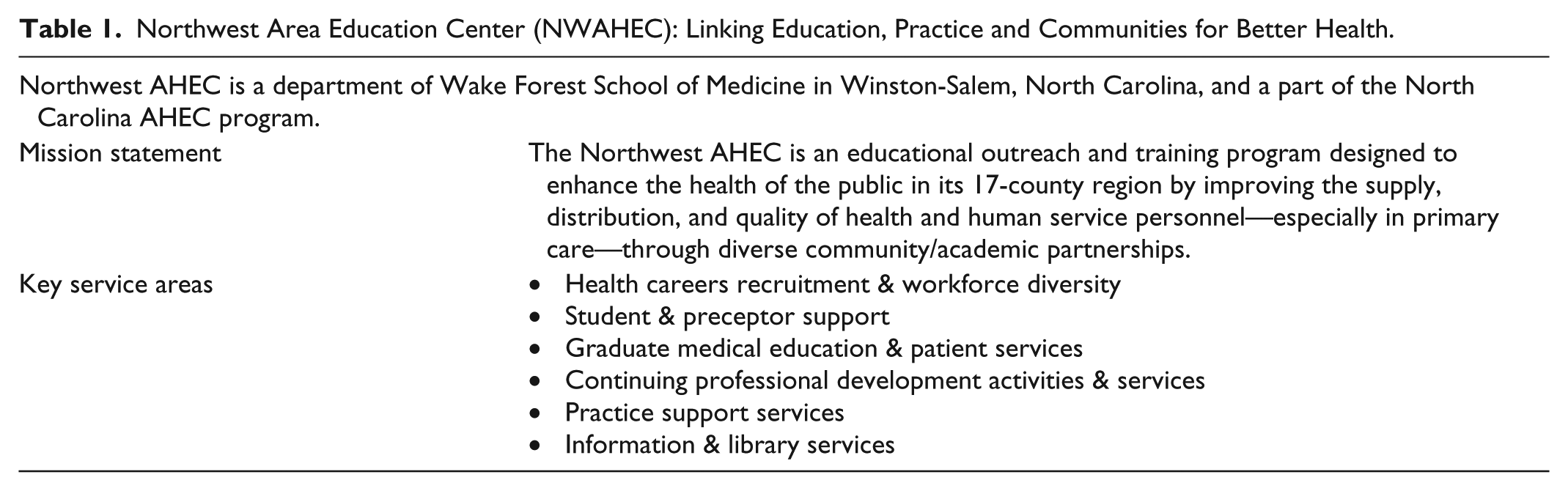
The North Carolina Lactation Educator Training Program (NCLETP) was established in 1996 through a collaborative effort of the North Carolina Department of Health and Human Services, Division of Public Health, Nutrition Services Branch–Special Supplemental Nutrition Program for Women, Infants, and Children (WIC), Northwest Area Health Education Center (AHEC), and Novant Health Forsyth Medical Center to provide lactation education for health professionals across North Carolina (see Table 1).
Northwest Area Education Center (NWAHEC): Linking Education, Practice and Communities for Better Health.
The NCLETP is not a certification course. Upon completion of the NCLETP, the learner receives a certificate of completion and can function as a lactation educator equipped to provide families with basic breastfeeding information and solve common breastfeeding problems. A North Carolina lactation educator works within the scope of practice for a specific healthcare professional license, such as registered nurse or registered dietitian. A breastfeeding concern or issue outside of the healthcare professional license scope of practice should be referred.
The initial target audiences were nutritionists working in local health department WIC programs and nurses working in hospitals. The WIC nutritionists were targeted to fulfill the requirement from the U.S. Department of Agriculture that each local WIC agency have at least one person trained in breastfeeding management to fulfill the role of breastfeeding coordinator. Over the past 20 years, the trained healthcare staff has expanded to include a diverse group: clinic and physician office nurses, social workers, peer counselors, physicians, mid-level providers, advance practice nurses, certified medical assistants, students, nursing school faculty, and community workers.
To assure that the many different facets of lactation practice are addressed, faculty has been selected from public health, hospital, provider office, and education domains. The NCLETP faculty members are diverse and include the following disciplines: physician, registered nurse, registered dietitian, International Board Certified Lactation Consultant (IBCLC), and doctor of philosophy. Eleven of the 13 faculty are IBCLCs.
Healthcare staff members who attend the entire training earn 69 hours of credit, which can be applied to the 90 hours of lactation credit required to sit for the International Board of Lactation Consultant Examiners certification exam. The curriculum follows the International Board of Lactation Consultant Examiners blueprint with the following topic areas covered: functional anatomy and physiology; breastfeeding benefits and contraindications; evidence-based practice and research; counseling skills; positioning and latch-on; concerns for infants—sleepy and fussy babies, growth spurts, and SIDS; maternal nutrition during breastfeeding; and infant nutrition. Also included are ineffective suckling; common breastfeeding problems; breastfeeding support techniques and equipment; breast pain; jaundice; milk supply issues; vitamin D and rickets; refusal to breastfeed; diabetes, hypoglycemia, and supplementation; national and state policies that support breastfeeding; and hospital policies/procedures that support breastfeeding. Additional topics included in the agenda are special maternal situations—teens, perinatal mood and anxiety disorders, domestic violence, and mothers of multiples; employment and breastfeeding; premature infants; multicultural perspectives; and ethics. The course content is covered in 5 didactic days.
Learners are also required to complete 2 clinical days, 1 in the local health department and 1 in a local hospital. During the clinical experiences, the learner observes and may assist the IBCLCs and breastfeeding peer counselors providing breastfeeding support and guidance to a variety of mothers from many different cultures. During the clinical experience, the learner applies the information learned during the didactic days to the care of patients. This application of knowledge during the clinical experience strengthens the learner’s confidence in his or her ability to apply the knowledge learned upon returning to the work setting. At the completion of the clinical day, the learner is required to complete a written assignment and identify skill areas that need to be strengthened and how the clinical experience will change practice.
To receive credit for the course, the learners are also required to complete written assignments that enhance the information learned in the classroom. The learner must respond to 15 competency questions based on the expected skills to be learned through the course and must complete a review of five breastfeeding resources. In addition, the participant is required to work with his or her agency/place of employment to complete a World Breastfeeding Week activity, a vehicle to educate other agency staff and patients. To learn more about breastfeeding resources in their respective communities, learners are required to contact hospitals, health departments, healthcare providers, and community breastfeeding support groups and complete an assessment of breastfeeding support in their communities, the Breastfeeding Community Assessment. A goal of the Breastfeeding Community Assessment assignment is to start building relationships with others in their community who support breastfeeding, with the long-range goal of strengthening breastfeeding support for the families in their community who choose to breastfeed.
Discussion
As of spring 2017, 1,500 healthcare staff members have been trained to provide breastfeeding support to families through the NCLETP, which is administered by Northwest AHEC (www.nwahec.org). During the 20-year existence of the NCLETP, learners from all 100 counties in North Carolina have completed the program. North Carolina is located in the southeastern region of the United States, which is the region with the lowest breastfeeding rates in the United States. In addition, healthcare staff from Georgia, Mississippi, South Carolina, and Virginia have also enrolled in and completed the program.
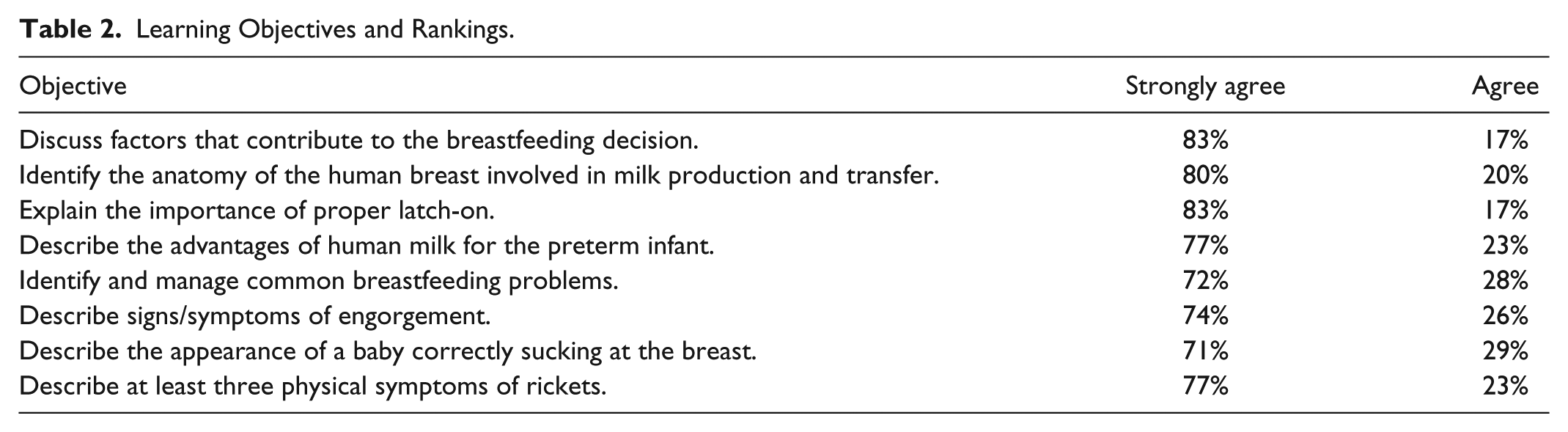
Standard Likert-type scale evaluations after each didactic section of the course reflect that learner breastfeeding deficit areas are being addressed. Table 2 shows the learner rankings for some of the breastfeeding learning objectives covered in the course.
Learning Objectives and Rankings.
As part of the initial evaluation process, the learners are asked for comments about the course content and their plans to apply the knowledge learned to the work setting. Sample comments include the following:
I am better equipped to assist moms to make a breastfeeding decision.
I have plans to further my breastfeeding knowledge.
I’m going to start a local support group for breastfeeding moms.
I’m aware of the need for earlier engagement of pregnant women.
I’m planning to proceed with becoming an IBCLC.
We are now planning to have a designated area for breastfeeding moms in our clinic.
I am teaching my coworkers how to do hand expression.
I learned how important skin-to-skin contact is within the 1st hour to help with breastfeeding.
The hands-on clinical days were very beneficial. I am very visual.
I’m so proud to be a NC lactation educator!
Follow-up evaluations are conducted 6 months after the completion of the program, per Northwest AHEC policy. Learners have indicated that they are applying the information learned and that their skills are improving. Below are some of the comments:
I am better able to reach culturally diverse populations since completing the NCLETP.
I can work with a tongue-tied baby now.
I am better able to handle questions regarding breastfeeding while counseling postpartum mothers.
I am also better able to know when to refer a new mom for breastfeeding help with a critical issue.
Learners in the NCLETP are diverse and represent many different populations. Both women and men have enrolled in the program, and they represent a variety of races: African American, Asian, Caucasian, Hispanic, and mixed. The education levels vary as well: peer counselors and medical assistants with a high school education, learners with an undergraduate degree, participants who are master’s prepared, and still others with a terminal degree such as doctor of medicine. Their places of employment are also very diverse and include private physician practice, school of medicine, school of nursing, health department, nonprofit agencies such as community support, private practice doulas, and La Leche League. In addition, learners represent ages across the lifespan, from the mid-20s to the mid-50s.
Opportunities for improvement are examined after each session of the NCLETP. One goal of the program is to assure that learners working with diverse high-risk populations are able to attend this program. Therefore, staff who work in local WIC agencies are offered a lower registration fee, since the WIC program targets families with lower socioeconomic status. One continuing challenge is learners with young breastfeeding infants missing course content due to leaving the room to breastfeed. A policy was put in place to assure that these breastfeeding participants attend at least 90% of classroom time to receive credit. Faculty members have left the program throughout the 20 years; it has been a challenge to replace them with someone who is well trained in the content area. Because of the collaboration between Northwest AHEC and other departments within Wake Forest School of Medicine, filling faculty vacancies has resulted in well-qualified new faculty members.
Conclusion
In North Carolina, the NCLETP has filled the gap to meet the breastfeeding knowledge deficits of healthcare providers working in many different locations in North Carolina from rural to urban, with a very diverse group of breastfeeding parents who might not otherwise have access to breastfeeding support. The evaluations indicated that the learners are applying the information learned to daily practice and are making an impact on breastfeeding practices in their communities. The NCLETP continues, with the 7-day sessions offered each spring and fall. The program recently received recognition through the Lactation Education Accreditation and Approval Review Committee as a breastfeeding education course whose goal is to prepare learners to be breastfeeding educators or counselors; this accreditation is approved for the next 5 years.
Footnotes
Acknowledgements
The authors wish to acknowledge the following North Carolina Lactation Educator Training Program faculty members: Sheila Britt-Smith, MEd, RD, IBCLC; Karen Horner, BSN, RN, IBCLC; Mary Showalter, IBCLC; Polly Sisk, PhD, RD, LDN, IBCLC; Jimmy Stimpson, BA, IBCLC; and Catherine Sullivan, MPH, RD, LDN, IBCLC. The authors would also like to acknowledge Novant Health Forsyth Medical Center, Forsyth County Department of Public Health, and Northwest Area Health Education Center.