





Abstract
Introduction:
Several factors influence breastfeeding, including breastfeeding self-efficacy, which can be enhanced through midwives’ or nurses’ interventions. While previous reviews have evaluated the effectiveness of programs targeting breastfeeding self-efficacy, none have specifically assessed the impact of nurse- or midwife-led interventions.
Research Aim:
To systematically review the literature and evaluate studies assessing the efficacy of nurse-led and midwife-led interventions on BSE and exclusive breastfeeding rates.
Methods:
This systematic review and meta-analysis, conducted per PRISMA guidelines, searched databases such as MEDLINE, Scopus, Web of Science, CINAHL, the Cochrane Database, and PsycINFO. We included randomized controlled trials enrolling healthy pregnant or postpartum women (P), comparing nurse‑ or midwife‑led interventions (I) with usual care (C). The primary outcome was breastfeeding self-efficacy; secondary outcomes were exclusive breastfeeding rates and exclusive breastfeeding duration (O). The Cochrane Risk of Bias Tool assessed study quality, and a random-effects meta-analysis calculated standardized mean differences for breastfeeding self-efficacy and risk ratio for exclusive breastfeeding.
Results:
A total of 21 randomized controlled trials encompassing 2,415 participants were identified, primarily conducted in Asia and the Middle East. The interventions significantly increased breastfeeding self-efficacy from 15 days (N = 1343; SMD = 1.75; 95% CI [0.94; 2.56], I2 = 97%, p < 0.01) up to 6 months (N = 246; SMD: 0.56; 95% CI [0.31; 0.82]; I2 = 0%, p = 0.48) postpartum and improved exclusive breastfeeding rates at 4 (N = 650; RR = 1.22; 95% CI [1.04; 1.41], I2 = 0%, p = 0.48), 12 (N = 718; RR = 1.61; 95% CI [1.25; 2.08], I2 = 52%, p = 0.05), and 20 weeks (N = 487; RR = 2.35; 95% CI [1.47; 3.76], I2 = 52%, p = 0.06) postpartum. Subgroup analyses highlighted that interventions were particularly effective in the Middle East, during the immediate postpartum, with durations exceeding 1 day, and through mono-component strategies. However, substantial heterogeneity was observed across studies, driven by different geographical location, timing, duration, and intervention type.
Conclusion:
Postpartum support from nurses and midwives is vital for promoting breastfeeding. Results emphasize the importance of tailored, long-term interventions to improve maternal and infant health outcomes, with further research needed to align strategies with World Health Organization recommendations. However, the high heterogeneity observed for breastfeeding self-efficacy limits the certainty of the pooled estimate, and should be carefully considered when interpreting the results.
Background
The World Health Organization (WHO, 2015a) recommends exclusive breastfeeding for the first 6 months of life, as reaffirmed in 2023, and breastfeeding up to 2 years of age or beyond (WHO, 2023a, 2023b). In 2023, the WHO reported that only 48% of infants under 6 months were exclusively breastfed, reflecting an increase of about 10 percentage points since 2011 and approaching the WHO target of 50% by 2030 (WHO, 2025).
Benefits include improved infant immunity, reduced hospital admissions (Grummer-Strawn & Rollins, 2015; Saeed et al., 2020), enhanced mother–infant bonding (Grummer-Strawn & Rollins, 2015), and lower maternal risk of ovarian and breast cancer (Babic et al., 2020; Collaborative Group on Hormonal Factors in Breast Cancer, 2002). Since breastfeeding benefits grow with duration (WHO, 2017), understanding factors influencing its continuation or interruption is crucial. There are numerous reasons why women stop breastfeeding early, including unsupportive hospital environments (Anderson et al., 2021) or the use of breast milk substitutes during postnatal stays (Colaceci, Chapin, et al., 2020; Colaceci, Corsi, et al., 2020).
Additional contributing factors include maternal attitudes and healthcare professionals’ influence (Colaceci et al., 2017; Colaceci, Zambri, et al., 2020; Titaley et al., 2021), maternal self-esteem and breastfeeding self-efficacy (BSE; Ahmadinezhad et al., 2024; Dennis, 2002; Hadisuyatmana et al., 2021), and sociodemographic factors like age, occupation (Smith et al., 2022) education (Titaley et al., 2021), income, and inequalities (Cernigliaro et al., 2019; Manhire et al., 2018). Psychosocial elements, such as family support and prior breastfeeding experiences, also significantly impact breastfeeding continuation (Cernigliaro et al., 2019; Hadisuyatmana et al., 2021).
Non-modifiable factors like age, marital status, education, income, and socioeconomic status influence breastfeeding (Kalhor et al., 2025; Scarpa et al., 2022). However, modifiable factors, such as knowledge of breastfeeding benefits and self-efficacy, can be enhanced through educational interventions (Wong et al., 2021). Bandura's social-cognitive theory (Bandura, 1977) defines self-efficacy as the belief in one's ability to control actions and outcomes, which influences both the duration and exclusivity of breastfeeding (Kehinde et al., 2023).
Key Messages
Nurse- and midwife-led interventions significantly increase women’s breastfeeding self-efficacy up to 6 months postpartum, with the strongest effects observed in the immediate postpartum period.
These professional interventions, are linked to increase breastfeeding self-efficacy and were associated with higher exclusive breastfeeding rates underscoring their impact on infant health.
Both single-component (educational) and multi- component (supportive, counseling) interventions are effective in the short term; however, sustaining these benefits over the long term remains a challenge.
The effectiveness of interventions varies by geographical region, timing, and duration, highlighting the need for culturally sensitive and tailored breastfeeding support strategies.
Building on this concept, Dennis defined BSE (Dennis, 1999) as a mother's confidence in her ability to breastfeed, emphasizing its critical role in initiating and maintaining the practice. BSE has consistently been identified as a reliable predictor of breastfeeding success (Castro-Cuervo et al., 2025; Dennis et al., 2024). To measure BSE, Dennis and Faux initially developed a reliable scale, later refined into a shorter version for practical use: the Breastfeeding Self-Efficacy Scale – Short Form (BSES-SF; Dennis, 2003).
Since BSE is a modifiable factor, health education interventions led by professionals are vital for its improvement (Maleki et al., 2021). Midwives and nurses play a pivotal role in these programs, providing essential support and information during pregnancy and postpartum (Flower et al., 2008). Prenatal breastfeeding education is particularly effective in boosting women’s confidence, knowledge, and skills for successful breastfeeding (Maleki et al., 2021). Randomized controlled trials have shown the efficacy of individualized nursing or midwifery interventions in improving BSE (McQueen et al., 2011; Nichols et al., 2009; Piro & Ahmed, 2020). However, while reviews have assessed BSE programs, they have not specifically focused on the unique impact of nurse-led or midwife-led interventions, highlighting the need for further analysis to better understand their contributions to BSE and breastfeeding outcomes.
Therefore, our aim is to systematically review the literature and evaluate studies assessing the efficacy of nurse-led and midwife-led interventions on BSE and exclusive breastfeeding rates.
Methods
Study Design
This study was conceived as a systematic review with meta‑analysis, an approach that permits a qualitative synthesis of evidence while yielding pooled quantitative estimates of intervention effects. Such dual synthesis was essential because trials evaluating BSE interventions are numerous yet methodologically diverse. The protocol was prospectively registered on PROSPERO (CRD42021255445) and the review followed both the Preferred Reporting Items for Systematic Reviews and Meta‑Analyses (PRISMA; Page et al., 2021) checklist and guidance in the Cochrane Handbook for Systematic Reviews of Interventions (Higgins et al., 2019), thereby ensuring transparency and reproducibility from question formulation through data analysis.
Sample
Eligibility criteria were formulated with the PICOS framework. Population (P) comprised low‑risk adult women during late pregnancy or the early postpartum period who had uncomplicated spontaneous or Caesarean births. Interventions (I) had to be designed and delivered by nurses or midwives since they represent the professionals most consistently present during lactation care and with advanced knowledge and skill to care for lactating women, alone or within multidisciplinary teams (McNeill et al., 2012). Comparison (C) was usual care. Outcomes (O) were maternal BSE (primary) plus exclusive breastfeeding rates and total breastfeeding duration (secondary), each measured with validated instruments. Study design (S) was restricted to randomized controlled trials (RCTs) to maximize internal validity.
Trials were excluded if they involved women at moderate or high obstetric risk, were led exclusively by lactation consultants or lay counsellors or non‑nursing or midwives professionals to maintain clinical homogeneity, or were non‑primary reports (e.g., protocols, editorials).
Data Collection
We searched MEDLINE, Scopus, Web of Science, CINAHL, the Cochrane Database of Systematic Reviews, and PsycInfo for records from January 1, 2003—the year the first BSE scale was validated (Dennis, 2003)—through March 31, 2024 (last searched March 31, 2024). A medical librarian helped craft database‑specific strategies combining MeSH and free‑text terms for breastfeeding, prenatal/postnatal education, professional support, motivational interviewing, and BSE; no geographic limits were set; however, only articles published in English were included. Search strings for every database, including applied limits, are provided in Supplementary File 1 (see the online supplemental material).
Back‑ and forward‑citation screening plus author contacts for clarifications supplemented electronic retrieval. When additional data were missing or unclear, trial authors were approached via email. The identification and selection process is summarized in Figure 1 (PRISMA flow diagram). From an initial 4,572 citations, 3,376 unique records remained after de‑duplication and were screened by two reviewers (κ = 0.82 for title/abstract, κ = 0.88 for full text). A total of 54 reports were retrieved in full; the most common reasons for exclusion were absence of BSE measurement (11 studies), non‑nurse/midwife‑led interventions (seven studies), and non‑RCT designs (15 studies). Ultimately, 21 RCTs involving 2,415 women met all criteria and were included in both qualitative and quantitative analyses. Discrepancies during screening were resolved by consensus or third‑party adjudication.

PRISMA flow diagram.
Measurements
Variables were defined a priori. Primary outcome was breastfeeding self‑efficacy, operationalized per Bandura (1977) and Dennis (1999), and measured with validated short‑ or long‑form BSE scales. Secondary outcomes were exclusive breastfeeding rate (proportion of infants receiving only breast milk) and breastfeeding duration (length of time that a child received breast milk). Descriptive variables captured journal source, publication year, country, and institutional affiliation. Two reviewers independently extracted data with piloted electronic forms adapted from Cochrane modules (The Cochrane Collaboration, 2014), capturing design details, participant demographics, theoretical underpinnings, intervention content and timing, and all outcome metrics. Data matrices were constructed to organize extracted items, and variables were grouped into analytically coherent categories (e.g., mono‑ vs. multi‑component interventions), with rationales documented. Disagreements were reconciled by discussion; unresolved items were referred to a third reviewer or clarified with original investigators. Summary statistics (means, medians, standard deviations, frequencies) were then compiled.
Data Analysis
Baseline characteristics of each trial appear in Table 1 (author, year, aim, sample, design), while methodological details of measurement instruments and of the included outcomes are presented in Table 2. For every study we assessed internal methodological congruence—the alignment between aim, design, measurement, and analysis. The risk of bias within studies was evaluated with RoB 2 (Sterne et al., 2019) across five domains; traffic‑light plots were created in Robvis. Potential cultural, institutional, or systemic biases were considered at both study and review levels. Publication bias was examined visually with Funnel plots and statistically via Egger’s test (Egger et al., 1997; Sterne & Egger, 2001).
Characteristics of the Sample and the Intervention.
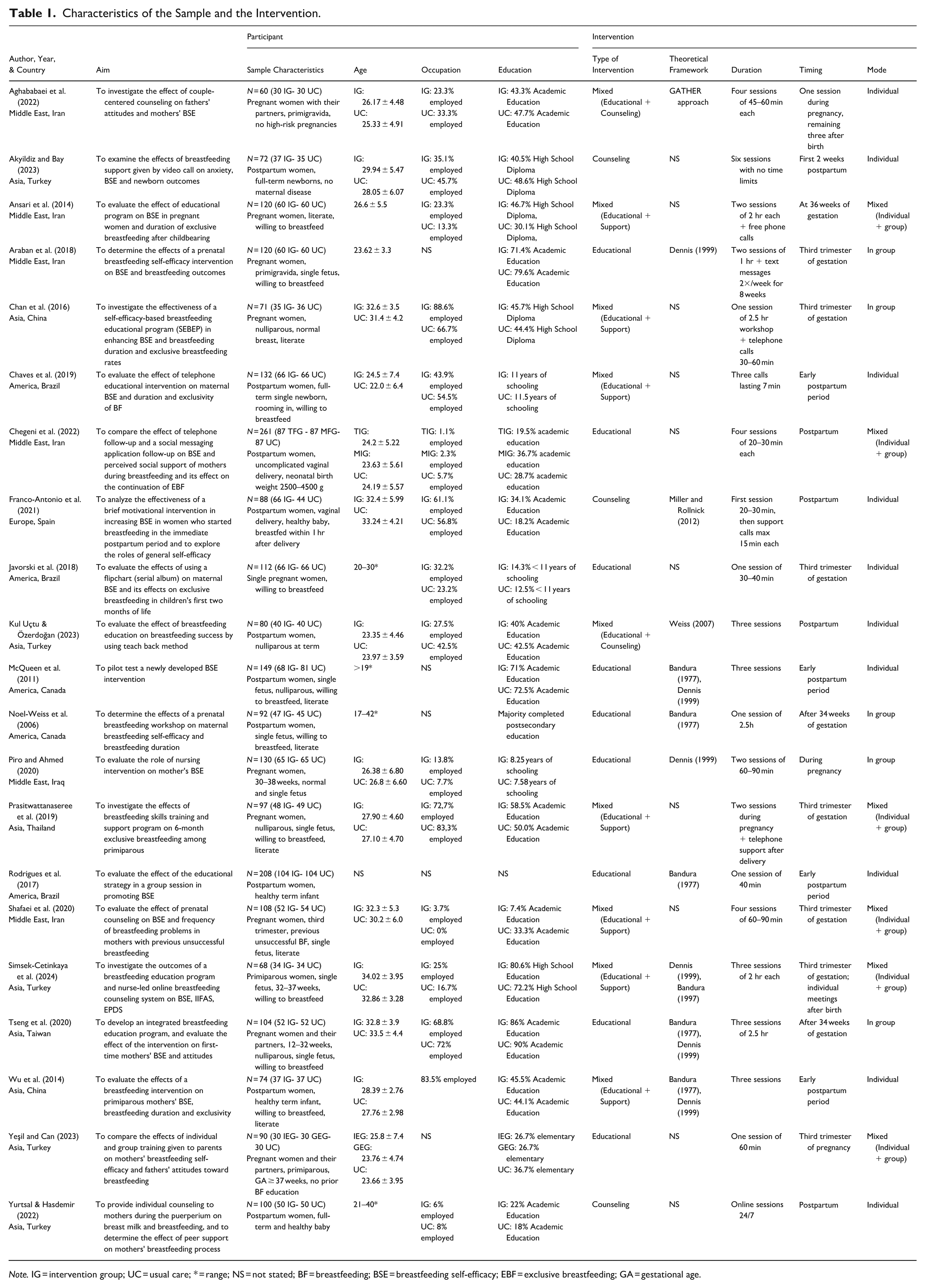
Note. IG = intervention group; UC = usual care; * = range; NS = not stated; BF = breastfeeding; BSE = breastfeeding self-efficacy; EBF = exclusive breastfeeding; GA = gestational age.
Measures and Characteristics of Outcomes.
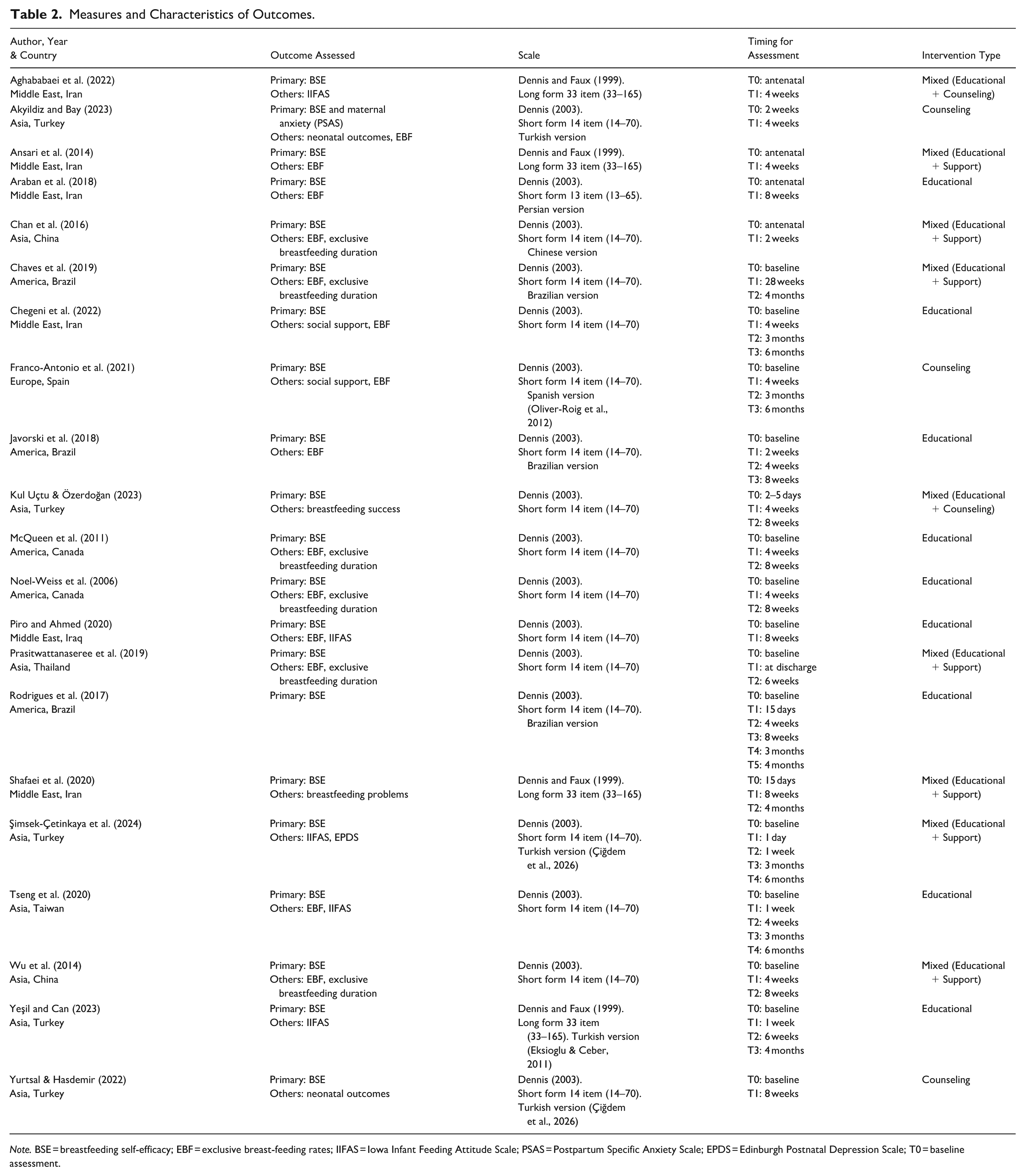
Note. BSE = breastfeeding self-efficacy; EBF = exclusive breast-feeding rates; IIFAS = Iowa Infant Feeding Attitude Scale; PSAS = Postpartum Specific Anxiety Scale; EPDS = Edinburgh Postnatal Depression Scale; T0 = baseline assessment.
Small‑study effects were explored with contour‑enhanced funnel plots and Egger’s regression Intercept (p < 0.10 was considered indicative of asymmetry). When asymmetry was present, we applied the Duval‑and‑Tweedie trim‑and‑fill procedure to estimate an adjusted pooled effect. Robustness was further assessed through (1) a leave‑one‑out influential analysis and (2) a sensitivity meta‑analysis restricted to trials with a total sample size ≥ 100. All analyses were performed with the meta package (Version 6.5‑0) in R.
A narrative synthesis was conducted to provide a conceptual summary of the findings across all included studies. Interventions were categorized into two groups based on their characteristics: mono-component or multi-component interventions (Mowatt et al., 2001). Mono-component interventions are defined as those comprising a single element, such as an educational program. In contrast, multi-component interventions include two or more elements, such as a combination of educational and counseling components. Findings were summarized with descriptive statistics, including means, medians, standard deviations (SD) and frequencies (%). A DerSimonian–Laird (DerSimonian & Laird, 1986) random-effects meta-analysis with 95% confidence intervals was performed. As moderate or high clinical and methodological heterogeneity was expected, a random effects model output was selected.
Forest plots were generated to present the results for primary (BSE) and secondary (exclusive breastfeeding rates) outcomes. For the primary outcome, as BSE was measured using various scales (short and long forms), a standardized mean difference (SMD) was computed to standardize the effect sizes (Higgins et al., 2022). All BSE instruments were first aligned so that higher scores indicated greater self‑efficacy; each trial’s intervention–control mean difference was then divided by its pooled within‑study SD and corrected for small samples to give Hedges g (R, meta:metacont sm = 'SMD', method.smd = 'Hedges'). A positive SMD indicates a difference in results favoring the intervention, with effect sizes interpreted as follows: small SMD = 0 .20, medium SMD = 0.50 medium and large SMD > 0.80 (Murad et al., 2019). Heterogeneity was assessed using Cochrane's Q chi-squared test and I2 statistic, with significance defined as p value of < 0.1 and a I2 > 75% (Higgins et al., 2003). For BSE, endpoints were calculated for the intervention group compared to the control group at common time points (e.g., 15 days, 1 month, 2 months, 4 months, and 6 months). Cluster RCTs were included as reported since intracluster correlation coefficients (ICCs) were unavailable. Sensitivity analyses were conducted by excluding studies with a high risk of bias. Subgroup analyses were performed to explore variability in intervention effects based on the following factors: (i) country, (ii) type of intervention (mono or multi-component), (iii) length of the intervention (less or more than a day), and (iv) timing of the intervention (pregnancy vs. postnatal). Sensitivity and subgroup analyses were conducted on a complete dataset, using the appropriate endpoint-point data of each study. Following Fu et al. (2011), subgroup analyses with at least four studies per subgroup were considered adequately powered, whereas subgroups with fewer than four studies were still pooled but their findings were treated as exploratory and interpreted with caution.
For exclusive breastfeeding, as risk ratios (RR) with 95% confidence intervals, computed with the inverse‑variance method under a random‑effects model (DerSimonian–Laird estimator for τ2). Heterogeneity was evaluated with Cochran’s Q and I2 (p < 0.10, I2 < 75% substantial; Higgins et al., 2003).
Results
Characteristics of the Sample
Most of the included studies were parallel RCTs, except for two cluster RCT (Javorski et al., 2018; Tseng et al., 2020), as shown in Table 1. Most of the articles were published within the last decade (2014–2024), with nearly half (42.8%) conducted in the past 5 years. Two studies were published earlier, in 2011 and 2006 (McQueen et al., 2011; Noel-Weiss et al., 2006).
The trials were conducted across various geographical regions, with Asia being the most represented (42.8%). Of these, five were conducted in Turkey, two in China, one in Thailand, and one in Taiwan (Table 1). Similarly, the Middle East accounted for 31.8% of studies (seven studies), including five conducted in Iran and one in Iraq (Table 1). In the Americas, five studies (22.7%) were identified, with three conducted in Brazil and two in Canada (Table 1). Only one study from Europe (conducted in Spain) met the inclusion criteria. Regarding publication sources, 48% of the studies were published in obstetric-gynecological journals, 38% in nursing journals, and only three (14%) in a public health journal (Table 1).
Risk of Bias Within-Study
The risk of boas (RoB) was assessed for both the primary (e.g., breastfeeding self-efficacy) and secondary outcomes (e.g., exclusive breastfeeding rates). For BSE, all 21 included studies underwent a detailed RoB assessment (Supplementary File 2). Overall, four studies were determined to have a high RoB for BSE, while six studies were assessed as having some concerns (see Supplementary File 2). The remaining 11 studies were considered low risk for this outcome.
For the secondary outcome, exclusive breastfeeding rates, 13 studies were assessed (Supplementary File 2). Only one study (Chaves et al., 2019) exhibited an overall high RoB, while three studies (Ansari et al., 2014; Noel-Weiss et al., 2006; Yeşil & Can, 2023) showed moderate RoB across all five domains. The remaining nine studies were rated as low RoB for exclusive breastfeeding rates.
Risk of Bias Across Studies
The funnel plot showed visual asymmetry, confirmed by Egger’s test (t = 4.26, df = 11, p = 0.001; see Supplementary File 3). Trim-and-fill imputed four potentially missing studies, yielding an adjusted SMD of 0.73 (95% CI [−0.22, 1.68]; see Supplementary File 3). Although the point estimate remained positive and in favor of the intervention, the wide confidence interval crossing zero indicates uncertainty in both the magnitude and the direction of the true effect.
Leave‑one‑out analysis indicated that omitting any single study changed the pooled SMD by ≤ 0.32 points (range = 1.43 to 1.91; see Supplementary File 3) and did not alter significance. Excluding trials with < 100 participants (k = 5, N = 752) produced a larger yet still significant effect (SMD = 2.46, 95% CI [0.62, 4.29]), with heterogeneity remaining high (I2 = 98.9 %). These findings suggest a possible small‑study publication bias that may inflate the pooled estimate; however, the direction of effect consistently favored nurse‑ and midwife‑led interventions across all sensitivity checks.
Description of the Sample
In all, 2415 participants were included across 21 trials (Aghababaei et al., 2022; Akyildiz & Bay, 2023; Ansari et al., 2014; Araban et al., 2018; Chan et al., 2016; Chaves et al., 2019; Chegeni et al., 2022; Franco-Antonio et al., 2021; Javorski et al., 2018; Kul Uçtu & Özerdoğan, 2023; McQueen et al., 2011; Noel-Weiss et al., 2006; Piro & Ahmed, 2020; Prasitwattanaseree et al., 2019; Rodrigues et al., 2017; Shafaei et al., 2020; Şimsek-Çetinkaya et al., 2024; Tseng et al., 2020; Wu et al., 2014; Yeşil & Can, 2023; Yurtsal & Hasdemir, 2022), as shown in Table 1. Sample sizes ranged from 60 (Aghababaei et al., 2022) to 261 (Chegeni et al., 2022) with 42.8% of studies enrolling at least 100 women. Participants ages were reported in all studies except one (Rodrigues et al., 2017), ranging from a minimum of 17 years (Chaves et al., 2019; Noel-Weiss et al., 2006) to a maximum of 42 years (Noel-Weiss et al., 2006). Most women were not employed and held at least a diploma (Table 1). Nearly half of the studies (47.6%) provided information on the delivery method, with most women having a vaginal birth.
Additionally, two studies reported a higher prevalence of Caesarean section deliveries (Wu et al., 2014; Yeşil & Can, 2023).
Description of the Interventions
A total of 57% of the interventions targeted pregnant women, while 43% focused on the immediate postpartum period (Table 1). Three studies included partners (Aghababaei et al., 2022; Tseng et al., 2020; Yeşil & Can, 2023). All interventions for pregnant women were conducted during the third trimester. Most interventions (52%) were nurse-led, as shown in Table 2. Only 38% were midwife-led (Table 2), and 10% of the study employed a multidisciplinary approach involving midwives, nurses, and a specialized pediatrician (Chegeni et al., 2022; Tseng et al., 2020).
Over half (57%) were single-component educational interventions (Table 1), focused on educational approaches, providing information, practical demonstrations, and breastfeeding timing. The remaining (43%) of interventions were multi-component, incorporating a support element (e.g., counseling or motivational interventions) alongside the educational component through individual meetings or weekly telephone calls. Only 52% of the studies reported the theoretical framework used to design and develop the interventions, with Bandura (1977) and Dennis and Faux (1999) being the most utilized frameworks, as shown in Table 2.
Approximately 71% of the studies implemented their interventions across two or more sessions (Table 2), with some extending up to six sessions (Akyildiz & Bay, 2023). In contrast, 29%, the interventions were conducted in a single session (Table 2). Most studies report the length of each session. Overall, the duration of the educational, counseling, and support sessions ranged from 20 minutes (Chegeni et al., 2022; Franco-Antonio et al., 2021) to 2.5 hours (Noel-Weiss et al., 2006; Tseng et al., 2020), except for the study by Chaves et al. (2019), in which the calls had an average duration of 7 minutes.
In 10 studies (47.6%), interventions were delivered through individual sessions, while five studies (23.8%) utilized a small groups format. Six studies (28.6%) employed a mixed approach, conducting educational components in small groups and providing support via telephone calls or face-to-face meetings.
Synthesis of Results
BSE was the primary outcome in all the studies, with 80.9% using the Dennis (2003) scale and 19.1% the Dennis and Faux (1999) scale (Table 2). Baseline BSE data was reported in all but seven studies (Table 1). In 85.7% of the studies, BSE was measured between 4 and 8 weeks postpartum (Table 2), with short-term assessment at hospital discharge, 1 week postpartum, and 15 days postpartum. Follow-ups occurred at 6 weeks, 3 months, 4 months, and 6 months postpartum.
Exclusive breastfeeding rates were measured in nearly one third of the studies at 1 month (Table 1), with some following-up at 1 or 6 months (Table 1). Secondary outcomes included exclusive breastfeeding duration, maternal attitude towards infant feeding (IIFAS scale), breastfeeding-related issues (e.g., fissures or pain in the breast, inconsolable crying, refusal to take the breast) and women's stress levels (Table 2).
Efficacy of the Intervention on BSE
Effect sizes for the efficacy of nurse or midwife-led interventions on BSE were pooled at the following endpoints: ≤ 15 days, 1, 2, 3, and 6 months. Insufficient evidence (k < 3) was available to pool effect size at 4 months. The pooled estimates for nurse-led or midwife-led interventions on BSE are shown in Figure 2.

Forest plots of the efficacy of interventions on BSE.
Our analyses indicated a significant increase in BSE (N = 1343; SMD = 1.75; 95% CI [0.94, 2.56], I2 = 97%, p < 0.01; 95% PI −1.60 to 5.11) in the intervention group compared to the usual care at 15 days after childbirth. Even after excluding the study at RoB (Chegeni et al., 2022; Rodrigues et al., 2017; Şimsek-Çetinkaya et al., 2024; Yeşil & Can, 2023), the heterogeneity remained significant (I2 = 87%, p < 0.01).
One month postpartum, a large and significant effect size of the nurse-led or midwife-led interventions on BSE (N = 1431; SMD = 2.37; 95% CI [1.47, 2.37]) was observed, although high heterogeneity was present (I2 = 98%, p < 0.01; 95% PI −1.33 to 6.06). Even excluding the articles with RoB (Aghababaei et al., 2022; Ansari et al., 2014; Chegeni et al., 2022; Noel-Weiss et al., 2006; Rodrigues et al., 2017) heterogeneity remained significant (I2 = 78.7%, p < 0.01).
At 2 months postpartum, a significant and large effect size of the nurse-led or midwife-led interventions on BSE (N = 1174; SMD: 1.13; 95% CI [0.76, 1.50]) was maintained, accompanied by high heterogeneity (I2 = 89%, p < 0.01; 95 % PI − 0.30 to 2.56). Excluding studies (Noel-Weiss et al., 2006; Piro & Ahmed, 2020; Rodrigues et al., 2017; Yeşil & Can, 2023; Yurtsal & Hasdemir, 2022) with RoB did not reduce the heterogeneity (I2 = 91.9, p < 0.01).
At 3 months postpartum, the intervention continued to show a significant and large effect size on BSE (N = 356; SMD: 1.88; 95% CI [0.39, 3.36]; I2 = 97%, p < 0.01; 95% PI −5.28 to 9.04). However, two of the four included studies were assessed as having a high risk of bias.
At 6 months postpartum, the intervention exhibited a significant and medium effect size on BSE (N = 246; SMD: 0.56; 95% CI [0.31, 0.82]) with no heterogeneity observed (I2 = 0%, p = 0.48; 95% PI 0.00 to 1.13).
Efficacy of the Intervention on Exclusive Breastfeeding and Duration of Exclusive Breastfeeding
The efficacy of the interventions on exclusive breastfeeding rates was also evaluated through pooled effect sizes at 4, 12, and 20 weeks postpartum. Pooled estimates for impact of nurse- or midwife-led interventions on exclusive breastfeeding are presented in Figure 3.

Forest plots of the efficacy of interventions exclusive breastfeeding and duration.
At 4 weeks postpartum, women who received nurse‑ or midwife‑led interventions had a 22% higher rate of exclusive breastfeeding than controls (k = 8 trials; N = 650; RR = 1.22, 95% CI [1.04, 1.41]). Heterogeneity was negligible (I2 = 0 %, p = 0.48). The advantage persisted at 12 weeks (k = 7; N = 718; RR = 1.61, 95% CI [1.25, 2.08]; I2 = 52 %, p = 0.05) and at 20 weeks postpartum (k = 6; N = 487; RR = 2.35, 95% CI [1.47, 3.76]; I2 = 52%, p = 0.06), indicating moderate but acceptable heterogeneity at the later time‑points.
Additionally, women who received nurse-led or midwife-led interventions to enhance BSE exclusively breastfed for a significantly longer duration compared to the control group (MD: 1.24; 95% CI [0.50, 1.98]; I2 = 92.3%, p < 0.01). However, this outcome was assessed in only three studies.
Subgroup Analysis
Subgroups analyses (see Supplementary File 4) were pre‑specified to probe four potential effect‑modifiers—region, timing, intervention length, and component complexity—for BSE at 15 days, 1 month, and 2 months, and exclusive breastfeeding rates at 1 month.
Effect sizes varied markedly by geography (χ2 for interaction < 0.01). Trials from the Middle East achieved the most striking gains (e.g., SMD = 6.31, 95% CI [2.16, 10.46] at 1 month; k = 3), whereas studies from the Americas produced only modest improvements (SMD ≈ 0.55) and those from Asia lay in between (SMD ≈ 1.1–1.5). Since Middle-Eastern data derive from a very small number of trials (k ≤ 3 across time-points), these estimates should be regarded as exploratory.
Launching the intervention postpartum amplified effectiveness (χ2 for interaction p < 0.01 at 1 month). Postpartum programs nearly tripled BSE at 1 month (SMD = 3.16, 95% CI [1.63, 4.69]; k = 7) but lost significance by 2 months (SMD = 0.69, 95% CI [0.28, 1.10]; k = 3, exploratory). Antenatal‑only initiatives yielded smaller, less consistent gains (SMD ≈ 1.2 −1.4). Programs extending beyond a single day outperformed one-off sessions at 1 month (SMD = 3.24, 95% CI [1.81, 4.66] vs. SMD = 0.63, 95% CI [0.32, 0.94]; p < 0.01), although the difference was negligible at other time‑points.
At 15 days, mono‑component interventions were superior (SMD = 2.43 vs. 0.70; p = 0.01); by 1 month the advantage had switched to mixed programs (SMD = 2.72 vs. 1.66). Effects converged by 2 months (SMD ≈ 1.1), although estimates for mixed programs at this time-point were based on only three trials and should therefore be interpreted as exploratory.
For EBF at 1 month, the most favorable profile combined mono‑component content with multi‑day delivery (RR = 1.36, 95% CI [1.03, 1.39]), but all EBF subgroup results drew on small numbers of trials (k ≤ 3 in some cells) and are best viewed as exploratory, with subgroup differences not statistically significant (p ≥ 0.33).
Discussion
Main Results
This systematic review and meta-analysis suggest that midwife-led or nurse-led interventions effectively enhance women's BSE from 15 days up to 6 months postpartum. Substantial heterogeneity exists among the pooled studies at 1 month and 2 months postpartum, and this variability persisted even after excluding studies at high risk of bias; however, subgroup analyses revealed significant differences in BSE scores between intervention and control groups based on the country of implementation, timing of the intervention (i.e., during pregnancy or postpartum) and length of the intervention. Additionally, midwife-led or nurse-led interventions significantly improved women's exclusive breastfeeding rates.
Most interventions were single-component educational programs with short-term follow-up, designed to enhance women's BSE. These low-resource interventions can be independently conducted by midwives and/or nurses during antenatal classes (Piro & Ahmed, 2020) and have shown short-term effectiveness, although their impact diminishes over time (Brockway et al., 2017). Notably, we found no nurse- or midwife-led motivational interventions specifically targeting BSE, likely due to the multidisciplinary nature and higher resource demands of such approaches. As motivational interventions are generally more effective long-term in public health (Hecht et al., 2019), further research is needed to develop nurse- or midwife-led motivational or multi-component interventions with extended follow-up to determine the most effective strategies for improving BSE.
Most interventions targeted pregnant women; however, our findings highlight a significant advantage of interventions delivered during the immediate postpartum period in enhancing women's BSE compared to those provided during pregnancy. This aligns with Brockway and colleagues’ (2017) findings that postpartum interventions are more effective. Conversely, a meta-analysis by Galipeau et al. (2018) reported that interventions spanning both pregnancy and postpartum were more effective than those limited to the immediate postpartum period or labor. These mixed results underscore the complexity of determining the optimal timing for breastfeeding support (Tsai et al., 2015). While our analysis emphasizes the importance of postpartum interventions for improving BSE and exclusive breastfeeding, further research is needed to confirm these findings and refine strategies and timing for maximum effectiveness.
Most interventions involved two or more sessions. Subgroup analysis of BSE at 15 days postpartum showed a statistically significant advantage for interventions lasting more than 1 day compared to shorter ones. Longer interventions proved more effective in boosting short-term BSE, consistent with findings by Jolly et al. (2012); however, this advantage was not sustained at two months postpartum. This suggests that the duration of interventions alone is insufficient without long-term follow-up. Breastfeeding often involves challenges, some of which may exceed a woman’s ability to manage independently (Sinha et al., 2015). Nurses and midwives should account for common issues such as mastitis, breast abscesses, and engorgement when designing tailored interventions. Continuous support is crucial to address external barriers and sustain BSE improvements effectively.
BSE, as a psychosocial construct, is shaped by the surrounding social context. This meta-analysis identified significant differences in BSE levels at 1 and 2 months postpartum based on geographic location. Studies from the Middle East reported greater increases in BSE compared to those conducted in North and South America. These disparities may reflect cultural and social factors, as well as breastfeeding promotion policies. For example, in high-income countries like Canada and the United States, over 20% of newborns are never breastfed, whereas nearly all newborns in low- and middle-income countries like Iran are breastfed (UNICEF, 2018; UNICEF & WHO, 2025). Targeted nurse- or midwife-led interventions in high-income countries could enhance BSE and support longer durations of exclusive breastfeeding. Notably, this review did not identify any nurse- or midwife-led interventions in the United States, and only one in Europe, highlighting a critical gap for future research.
Although our pooled estimate for BSE was sizable, heterogeneity was extreme (I2 < 90%), reflecting diverse scales, delivery formats, timing, and cultural settings. Crucially, this dispersion in self‑perceived confidence did not extend to behavioral outcomes: the relative risk of exclusive breastfeeding at early follow‑up was consistently favorable and accompanied by negligible heterogeneity, suggesting that midwife‑and nurse‑led support can deliver reliable gains in actual feeding practice, even when the magnitude of BSE change varies across contexts. Despite these short‑term benefits, the evidence base becomes precariously thin beyond the early postpartum window. Future trials should extend follow‑up to ≥ 6 months—the period when global EBF rates decline steeply and the benchmark used for WHO’s breastfeeding promotion interventions. Consistent long‑term measurement is essential to determine whether early boosts in BSE translate into sustained EBF and downstream infant health gains.
The second gap concerns terminology. Program labels range from a single “education” session to multi‑component “counselling + digital support,” obscuring which ingredients drive success. Developing a harmonized taxonomy—education, skills training, motivational interviewing, tele‑follow‑up, partner involvement, and so forth— would enhance comparability across studies and help policymakers assemble the most cost‑effective packages. Scaling midwife‑ and nurse‑led interventions appears justified by their stable impact on EBF, yet meeting the WHO/UNICEF 2030 breastfeeding targets will require both standardizing how interventions are classified and extending outcome surveillance into the critical second half‑year of life.
Limitations
Despite rigorous search methods, Egger’s test indicated small‑study effects, and trim‑and‑fill suggested the true effect might be more modest (SMD ≈ 0.7) than the main estimate (SMD = 1.75). This adjustment indicates that while the direction of the effect remains positive, the magnitude becomes considerably smaller (SMD = 0.73; 95% CI [−0.22, 1.68], see Supplementary File 3), and the confidence interval widens to include the null value. Moreover, heterogeneity for BSE remained substantial (I2 ≈ 97 – 99%) even after excluding smaller trials, implying residual variability in intervention format, intensity, and cultural context. Consequently, our pooled estimate should be interpreted with caution and viewed as hypothesis‑generating rather than definitively conclusive. Although subgroup analyses suggested that postpartum start, multi‑day delivery, and cultural setting (Middle East) amplify effectiveness, residual heterogeneity remained substantial (> 60%), indicating that additional unmeasured moderators (e.g., facilitator skill, family support) may further influence outcomes. The absence of a conspicuous number of studies from Europe and the United States is a significant limitation of our study.
Another limitation is the lack of long-term follow up in the most included studies, as well as the restriction to English language databases only. Only a few studies included 6 months follow up for BSE and exclusive breastfeeding rates. Although our subgroup analyses suggest that postpartum, multi-day, mono-component educational interventions may produce larger short-term gains in BSE and exclusive breastfeeding rates, the available evidence is insufficient to determine which specific formats are most effective, and future trials should directly compare single- versus multi-component and motivational interventions with extended follow-up. These findings contrast with the WHO recommendations and warrant further scrutiny (WHO, 2015b). Moreover, two included studies used cluster randomization, but intracluster correlation coefficients were not reported, preventing adjustment of effective sample sizes. Their inclusion as unadjusted trials may have inflated precision, and findings should therefore be interpreted with caution.
Conclusions
This systematic review and meta-analysis show that midwife-led or nurse-led interventions can effectively enhance women's BSE up to 6 months postpartum. Additionally, these interventions significantly improve women’s exclusive breastfeeding rates. However, high heterogeneity in BSE (I2 < 90%) highlights the need to standardize intervention classification and extend outcome surveillance into the second half‑year of life to achieve WHO/UNICEF 2030 breastfeeding targets. These findings are crucial for newborn health and underscore the importance of professional advocacy in promoting effective breastfeeding practices.
Supplemental Material
sj-pdf-1-jhl-10.1177_08903344261451214 – Supplemental material for The Effectiveness of Midwife-Led and Nurse-Led Interventions on Breastfeeding Self-Efficacy and Exclusive Breastfeeding Rates: A Systematic Review and Meta-Analysis
Supplemental material, sj-pdf-1-jhl-10.1177_08903344261451214 for The Effectiveness of Midwife-Led and Nurse-Led Interventions on Breastfeeding Self-Efficacy and Exclusive Breastfeeding Rates: A Systematic Review and Meta-Analysis by Gloria Anderson, Jessica Preziosi, Giorgia Gabrielli, Simona Proia, Erika Colagiovanni, Francesca Rizzi, Silvia Salvi, Angela Durante, Maria Luisa Rega, Sofia Colaceci, Antonio Lanzone, Tullio Ghi and Michelangela Danza in Journal of Human Lactation
Supplemental Material
sj-pdf-2-jhl-10.1177_08903344261451214 – Supplemental material for The Effectiveness of Midwife-Led and Nurse-Led Interventions on Breastfeeding Self-Efficacy and Exclusive Breastfeeding Rates: A Systematic Review and Meta-Analysis
Supplemental material, sj-pdf-2-jhl-10.1177_08903344261451214 for The Effectiveness of Midwife-Led and Nurse-Led Interventions on Breastfeeding Self-Efficacy and Exclusive Breastfeeding Rates: A Systematic Review and Meta-Analysis by Gloria Anderson, Jessica Preziosi, Giorgia Gabrielli, Simona Proia, Erika Colagiovanni, Francesca Rizzi, Silvia Salvi, Angela Durante, Maria Luisa Rega, Sofia Colaceci, Antonio Lanzone, Tullio Ghi and Michelangela Danza in Journal of Human Lactation
Supplemental Material
sj-pdf-3-jhl-10.1177_08903344261451214 – Supplemental material for The Effectiveness of Midwife-Led and Nurse-Led Interventions on Breastfeeding Self-Efficacy and Exclusive Breastfeeding Rates: A Systematic Review and Meta-Analysis
Supplemental material, sj-pdf-3-jhl-10.1177_08903344261451214 for The Effectiveness of Midwife-Led and Nurse-Led Interventions on Breastfeeding Self-Efficacy and Exclusive Breastfeeding Rates: A Systematic Review and Meta-Analysis by Gloria Anderson, Jessica Preziosi, Giorgia Gabrielli, Simona Proia, Erika Colagiovanni, Francesca Rizzi, Silvia Salvi, Angela Durante, Maria Luisa Rega, Sofia Colaceci, Antonio Lanzone, Tullio Ghi and Michelangela Danza in Journal of Human Lactation
Supplemental Material
sj-pdf-4-jhl-10.1177_08903344261451214 – Supplemental material for The Effectiveness of Midwife-Led and Nurse-Led Interventions on Breastfeeding Self-Efficacy and Exclusive Breastfeeding Rates: A Systematic Review and Meta-Analysis
Supplemental material, sj-pdf-4-jhl-10.1177_08903344261451214 for The Effectiveness of Midwife-Led and Nurse-Led Interventions on Breastfeeding Self-Efficacy and Exclusive Breastfeeding Rates: A Systematic Review and Meta-Analysis by Gloria Anderson, Jessica Preziosi, Giorgia Gabrielli, Simona Proia, Erika Colagiovanni, Francesca Rizzi, Silvia Salvi, Angela Durante, Maria Luisa Rega, Sofia Colaceci, Antonio Lanzone, Tullio Ghi and Michelangela Danza in Journal of Human Lactation
Footnotes

Author Contributions
Funding
The authors received no financial support for the research, authorship, and/or publication of this article.
Declaration of Conflicting Interests
The authors declared no potential conflicts of interest with respect to the research, authorship, and/or publication of this article.
Supplemental Material
Supplementary Material may be found in the ‘‘Supplemental material’’ tab in the online version of this article.
References
Supplementary Material
Please find the following supplemental material available below.
For Open Access articles published under a Creative Commons License, all supplemental material carries the same license as the article it is associated with.
For non-Open Access articles published, all supplemental material carries a non-exclusive license, and permission requests for re-use of supplemental material or any part of supplemental material shall be sent directly to the copyright owner as specified in the copyright notice associated with the article.
