






Abstract
The antifungal activity of echinocandins is concentration dependent. Previously, we demonstrated that high-dose caspofungin (HD-CSP; 100 mg daily) was well tolerated in 34 immunosuppressed patients with cancer and may have favorably influenced outcomes. We retrospectively assessed all 91 patients in whom HD-CSP was given for the treatment of invasive fungal disease (IFD). The median number of doses was 18.5 ± 21.5, and in 8 (9%) patients more than 40 doses were given. Most (62%) of the patients had leukemia. A total of 45 (49%) patients had undergone stem cell transplantation; 80% received allogeneic grafts and 47% had graft-versus-host disease. High-dose corticosteroids were given during antifungal therapy in 26 (29%) patients. In all, 8 (9%) patients had new elevation in serum bilirubin during HD-CSP therapy; normalization occurred after voriconazole and HD-CSP were discontinued in 4 patients each. No other short-term or delayed adverse events were observed. In all, 40 (44%) patients died of IFD. High-dose corticosteroids during HD-CSP (odds ratio [OR] 8, 95% confidence interval [CI] 2.1-30.4; P < .002) and starting HD-CSP in the critical care unit (OR 67.5, 95% CI 5.25-868.9; P < .001) were associated with death from fungal disease. Prolonged HD-CSP therapy was well tolerated. Drug-induced hyperbilirubinemia may pose a potential limitation for continued HD-CSP use in highly susceptible patients with hematologic neoplasms and stem cell transplantation.
Keywords
Introduction
The antifungal agent caspofungin, along with the other echinocandins, is less hepatotoxic than the new-generation triazole compounds and has a favorable drug interaction profile. 1 Because of caspofungin’s relative safety and known concentration-dependent fungicidal activity, 2 the agent has been explored as a high-dose therapy, especially in severely immunosuppressed population with cancer and transplant population in whom the new-generation antifungal drugs often elicit a less than favorable response. 3 In nonimmunosuppressed animals, a high-plasma concentration of caspofungin is sustained with continued intravenous therapy 4 ; but in primates and healthy adults, the initially high plasma concentration drops as caspofungin therapy is continued. 5,6 The safety and efficacy of prolonged high-dose caspofungin (HD-CSP) need further evaluation.
We previously reported comparable adverse events (AEs) in 34 patients with cancer given HD-CSP (100 mg daily) and 63 patients given standard-dose caspofungin (SD-CAP). 3 However, the HD-CSP group has 3 times as many favorable responses despite also having several well-known predictors of poor outcomes such as extrapulmonary fungal disease, non-Aspergillus mold infections, and use of HD-CSP as salvage therapy. 3 Furthermore, the results of a recent randomized trial in patients with invasive candidiasis were supportive of our initial observations; a modest number of patients treated with HD-CSP (150 mg daily) showed a rise in alkaline phosphatase (6.9% vs 2%) and serum aspartate aminotransaminase (4% vs 2%) levels compared with those randomized to receive SD-CAP but otherwise had comparable AEs including AEs leading to discontinuation of caspofungin therapy. 7 The 6 percentage points higher response rate in the HD-CSP group with invasive Candida species infection failed to reach significance 7 ; however, the impact of HD-CSP therapy in severely immunosuppressed patients with invasive mold diseases remains unclear.
To help clarify this impact, we present extended follow-up data for a large cohort of immunosuppressed patients with cancer, including stem cell transplant recipients who had invasive mycoses treated with HD-CSP at a tertiary care, National Cancer Institute-designated comprehensive cancer center.
Patients and Methods
Study Setting, Patients, and Design
Ninety-one patients treated with 100 mg of caspofungin daily alone or in combination with other commercially available antifungal drugs between 2002 and 2006 were evaluated retrospectively after we obtained approval from the institutional review board at The University of Texas MD Anderson Cancer Center; the requirement for patients’ consent was waived. Patients had been assessed for up to 7 years after treatment with caspofungin had commenced. Of the 91 patients presented, 34 were in a previous report. 3 The institution’s pharmacy database was queried to identify patients, and this database and patients’ electronic medical records were reviewed for data collection. For each patient, the following information was extracted: age, sex, need for and duration of critical care and mechanical ventilation, underlying malignancy, comorbidities (diabetes, renal failure, structural lung disease including liver dysfunction, congestive heart failure, and ischemic heart disease), stem-cell transplantation, graft-versus-host disease (GVHD), immunosuppressive (including corticosteroid) and immunostimulatory therapy, site of infection, pathogens isolated, serial neutrophil counts (4 weeks prior to infection, HD-CSP, and during antifungal therapy), complications of fungal infection, antifungal drug therapy, AEs from therapy, and outcomes. Concurrent infections were also assessed.
Microbiology
All clinical samples obtained from patients in whom invasive fungal disease (IFD) was suspected were evaluated in MD Anderson Cancer Center’s microbiology laboratory; identification of fungal species was performed using established guidelines. 8
Definitions
IFD was classified as proven, probable, or possible according to criteria recommended by the Invasive Fungal Infections Cooperative Group of the European Organization for Research and Treatment of Cancer and of the Mycoses Study Group of the National Institute of Allergy and Infectious Diseases. 9 The methods used in this study were similar to methods outlined in detail for the first 34 patients treated with HD-CSP at MD Anderson. 3 Pseudofungemia was defined by the isolation of Aspergillus or Penicillium species in blood cultures alone in patients with no evidence of deep-tissue infection. 10 Isolation of Fusarium or Scedosporium species from sterile blood culture specimens obtained from separate body sites, more than 24 hours apart even in the absence of known deep-tissue infection, was considered definite or proven invasive infection. Infection involving 2 noncontiguous body sites and infection with evidence of fungemia were considered disseminated fungal disease; the presence of fungemia, however, was not required for a diagnosis of disseminated fungal disease. 6
Neutropenia was defined as an absolute neutrophil count of <500/µL. High-dose corticosteroid use was defined as >600 mg of prednisone or an equivalent total dose of another corticosteroid; use during the 7 days prior to diagnosis of IFD and use during HD-CSP were evaluated. 3 Acute Physiology and Chronic Health Evaluation (APACHE) II score was used to assess the severity of illness and presence of multiorgan dysfunction by standard methods. 11
The definitions used for clinical and radiographic response or progression of fungal infection are detailed elsewhere. 3 Briefly, complete response was defined as a major improvement in the clinical and radiographic presentation of fungal disease; furthermore, the improvement had to continue following de-escalation of antifungal therapy and/or switch to secondary antifungal prophylaxis. Partial response was defined as clinical improvement accompanied by partial radiographic resolution of lesions attributed to fungal infection. Patients with modest clinical improvement and no change in radiographic features of fungal disease were considered to have stable infection. Progressive disease was defined as clinical deterioration along with radiographic worsening in patients in whom antifungal therapy had been given for >7 days.
Serious drug toxicity was defined as grade 3 or higher AEs, graded according to criteria established by the National Cancer Institute. 3 Standard criteria were used to define deaths attributed to progressive fungal disease. 9,10,12 Sepsis, septic shock-related multiorgan failure, disseminated intravascular coagulation, respiratory failure (including adult respiratory distress syndrome), or diffuse alveolar hemorrhage in patients with known pulmonary IFD were considered sequelae of progressive fungal infection. Pulmonary embolism arising from deep venous thrombosis, intracranial hemorrhage in patients with no evidence of fungal brain disease, and myocardial infarction due to coronary artery disease were not considered to be associated with IFD.
Statistical Analysis
Descriptive statistics, including medians ± standard deviations, were calculated. Categorical variables were compared using chi-square or Fisher’s exact tests, and continuous variables were compared using Wilcoxon rank-sum and Student’s t tests. Multiple logistic regression analysis was applied to identify prognostic factors for death from IFD. 3 All tests were 2-sided tests with a significance level of .05. The statistical analyses were performed using SAS version 9.1 (SAS Institute Inc, Cary, North Carolina).
Results
Table 1 provides various diagnosis of IFD and antifungal drug therapy. Table 2 shows the characteristics of the patients, their illnesses, and their treatments and compares the 27 patients who had aspergillosis to the 64 patients with infections due to fungi other than Aspergillus species. The median (±standard deviation) dose of HD-CSP therapy given to the 91 patients was 18.5 ± 21.5. Eight (9%) patients received more than 40 daily doses, and 161 daily doses were given to a single patient. In general, patients with aspergillosis were similar to those with other fungal infections, except that they received longer treatment with HD-CSP (median of 21 vs 10 days, P = .001), more doses of granulocyte macrophage colony-stimulating factor (median of 13 vs 6 doses, P = .01), and included all 3 of the patients with chronic obstructive pulmonary disease.
The Overall Diagnosis and Treatment of 91 Patients With IFD Treated With HD-CSP.

Abbreviations: HD-CSP, high-dose caspofungin; IFD, invasive fungal disease.
aIncluded ABELCET® or AmBisome®.
Characteristics of Patients Treated With HD-CSP for Aspergillosis Versus Non-Aspergillus Species Infections.a
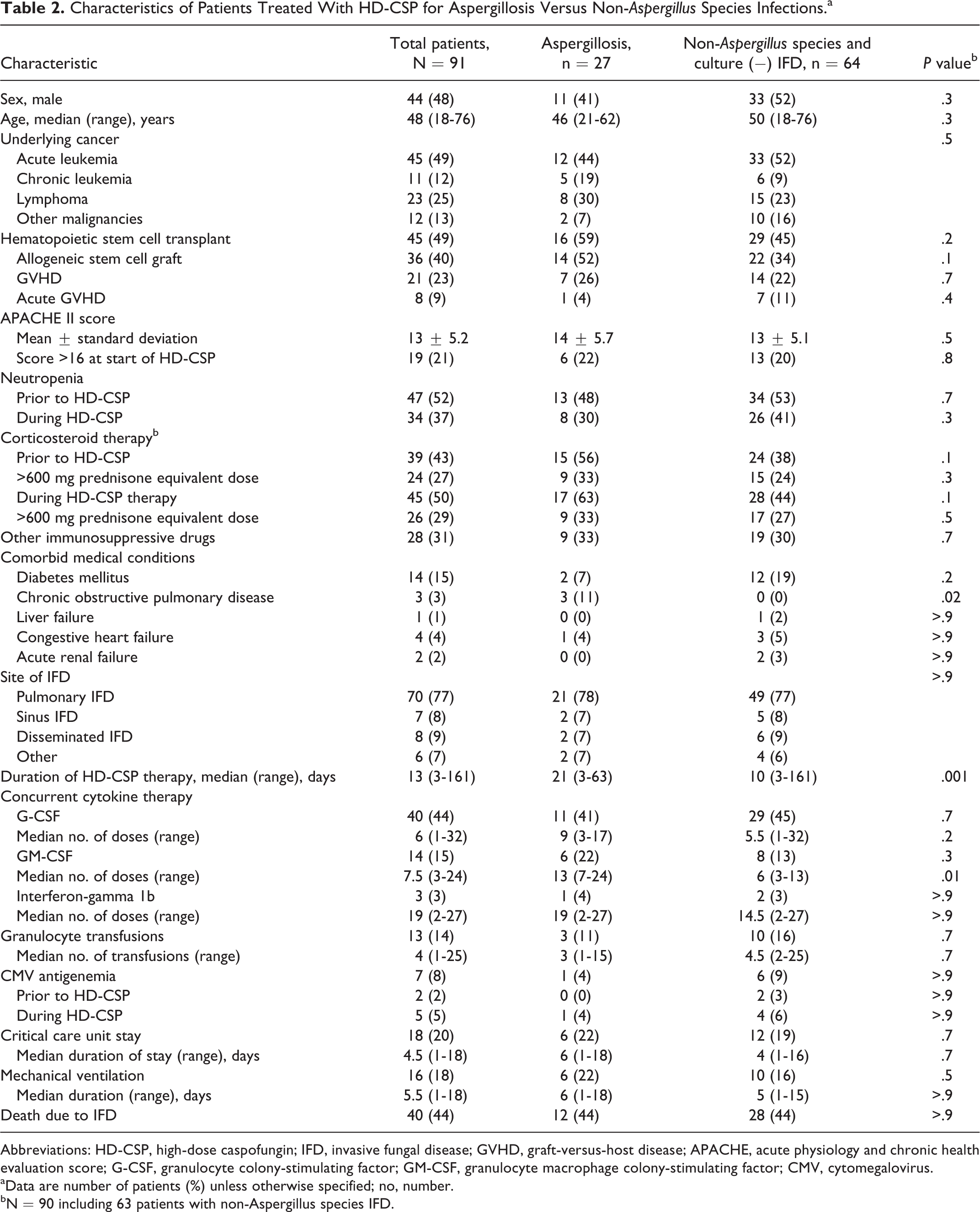
Abbreviations: HD-CSP, high-dose caspofungin; IFD, invasive fungal disease; GVHD, graft-versus-host disease; APACHE, acute physiology and chronic health evaluation score; G-CSF, granulocyte colony-stimulating factor; GM-CSF, granulocyte macrophage colony-stimulating factor; CMV, cytomegalovirus.
aData are number of patients (%) unless otherwise specified; no, number.
bN = 90 including 63 patients with non-Aspergillus species IFD.
Table 3 shows the comparison of patients with and without neutropenia. Patients with neutropenia were more likely to have acute leukemia (P = .001). High-dose corticosteroid therapy prior to and during HD-CSP was more common in patients without neutropenia (P = .03 and P = .01, respectively). As expected, granulocyte transfusions were given more often to patients with neutropenia (P = .01).
Comparison of Patients With Versus Without Neutropenia and Patients Who Received HD-CSP Alone Versus in Combination With Other Licensed Antifungal Drugs.
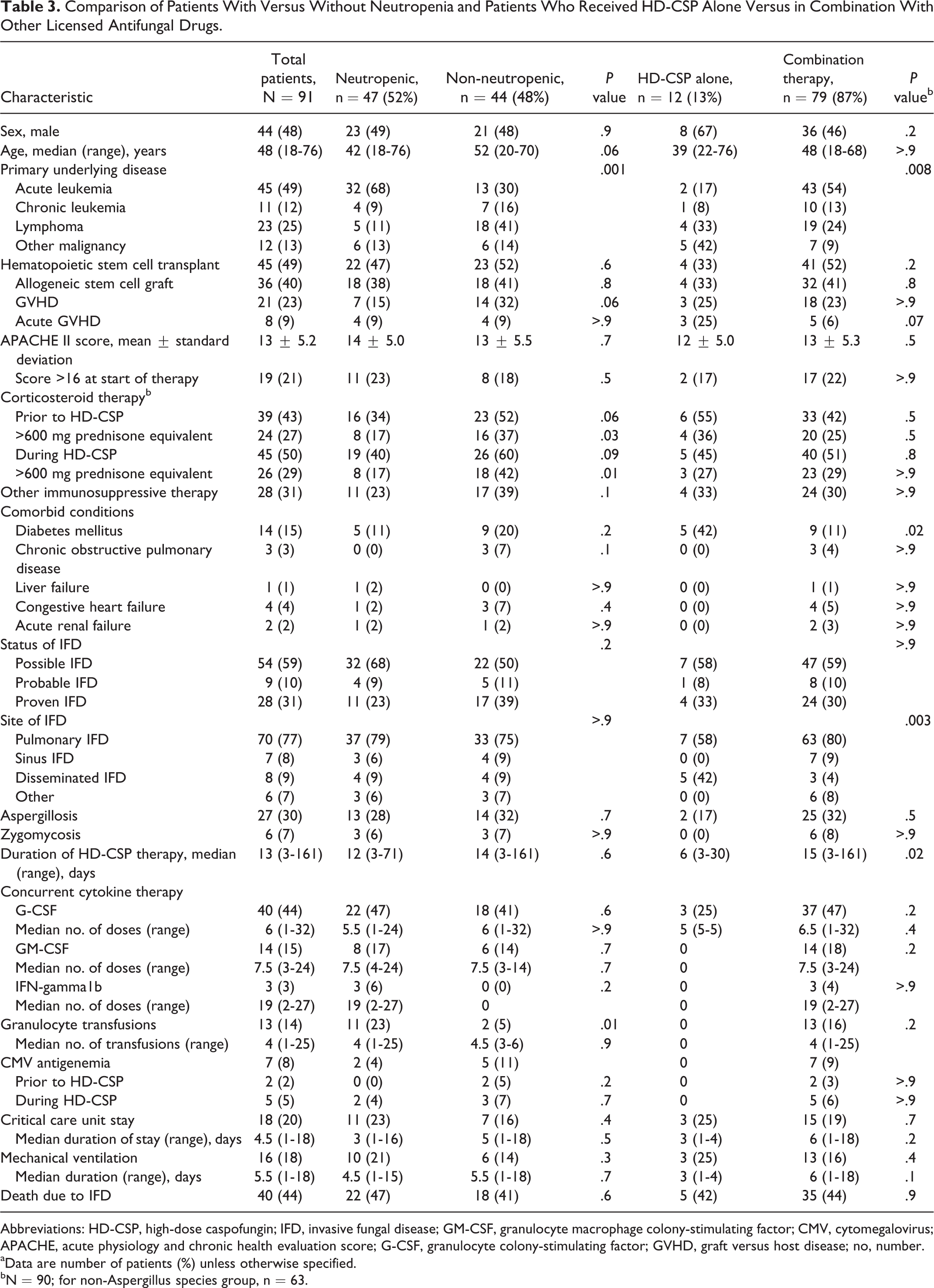
Abbreviations: HD-CSP, high-dose caspofungin; IFD, invasive fungal disease; GM-CSF, granulocyte macrophage colony-stimulating factor; CMV, cytomegalovirus; APACHE, acute physiology and chronic health evaluation score; G-CSF, granulocyte colony-stimulating factor; GVHD, graft versus host disease; no, number.
aData are number of patients (%) unless otherwise specified.
bN = 90; for non-Aspergillus species group, n = 63.
Table 3 also compares patients who received HD-CSP alone with those who received combination antifungal therapy. Patients who received combination antifungal therapy were more likely to have acute leukemia (P = .008) and fungal disease involving the lungs and paranasal sinuses (P = .003). In contrast, patients who received HD-CSP alone were more likely to have disseminated IFD (P = .003). Interestingly, patients given combination antifungal therapy received a longer median duration of HD-CSP compared to those being treated with HD-CSP alone (15 vs 6 days, respectively; P = .02). All 3 patients who received recombinant interferon-gamma were neutropenic and in the combination antifungal therapy group.
Adverse Events
Modest elevations in the following serum laboratory values were seen between at baseline and the end of HD-CSP therapy: a median increase of 0.2 mg/dL for total bilirubin (from 0.2-3.9 mg/dL at baseline to 0.2-7.1 mg/dL at end; P = .0003), 43 IU for alkaline phosphatase (from 21-1556 IU to 25-1371 IU; P = .01), and 2 IU for alanine aminotransferase (from 9-135 IU to 12-723 IU; P = .04). In all, 11 (12%) patients had elevated serum bilirubin levels (>1.3 mg/dL) prior to HD-CSP; in 2 of these patients bilirubin normalized during HD-CSP therapy, whereas in 6 patients progressive worsening was noted. Eight (9%) patients had new elevation in serum bilirubin during HD-CSP therapy; normalization occurred after voriconazole and HD-CSP were discontinued in 4 patients each. Discontinuation of concomitant voriconazole and HD-CSP in 3 patients each resulted in normalization of serum bilirubin levels. In all, 8 (9%) patients had new elevation in serum bilirubin during HD-CSP therapy; normalization occurred after voriconazole and HD-CSP were discontinued in 4 patients each. Levels of potassium, minerals such as magnesium and calcium, and creatinine remained unchanged during HD-CSP therapy (P > .4). No other short-term or delayed AEs were observed.
Outcomes
Outcomes of IFD were evaluable in 90 patients. Complete clinical and/or radiographic responses to fungal disease were seen in 40 (44%) patients. The overall IFD-attributable mortality rate was 44% in patients who had been followed for up to 7 years. The IFD-attributable mortality rates were similar in the following groups: neutropenic versus nonneutropenic (47% vs 41%; P = .6), invasive aspergillosis versus non-Aspergillus species disease (44% vs 44%; P > .9), and HD-CSP alone versus combination antifungal therapy (42% vs 44%; P = .9; Tables 1 and 2).
During up to 7 years of follow-up, other causes of deaths that overlapped included advanced/relapsed cancer (n = 54), bacterial sepsis (n = 15), diffuse alveolar hemorrhage (n = 12), and/or treatment-refractory GVHD (n = 8).
Logistic Regression Analysis
Logistic regression analysis for the 90 patients evaluable for outcomes revealed that treatment with high-dose corticosteroids during HD-CSP (odds ratio [OR] 8, 95% confidence interval [CI] 2.1-30.4; P < .002) and antifungal therapy begun in the critical care unit (OR 67.5, 95% CI 5.25-868.9; P < .001) were predictive of death from progressive fungal disease. Patients with diabetes mellitus had a reduced probability of death (OR 0.05, 95% CI 0.004-0.5; P < .01).
Discussion
In this large cohort of severely immunosuppressed patients with IFD, HD-CSP was tolerated without serious or unexpected AEs. Extended therapy with HD-CSP (40-161 daily doses) did not result in additional toxicity. As expected, the predictors of poor outcomes were therapy with high-dose corticosteroids during HD-CSP and treatment begun while patients were in the critical care unit. New and worsened hyperbilirubinemia was seen in 15% of patients during HD-CSP therapy. In half of the patients (n = 4), new-onset hyperbilirubinemia during HD-CSP resolved after concomitant mold-active triazole drug was discontinued.
In a study of hematopoietic stem cell transplant recipients with invasive aspergillosis treated with first-line SD-CAP, 42% of the patients had a favorable outcome at the end of caspofungin therapy with an ensuing survival rate drop from 79% to 50% at weeks 6 and 12, respectively. 12 In our prior study, 15 percentage points higher response rate in the HD-CSP group compared with the SD-CAP group 12 weeks after treatment commenced failed to reach significance although a 3-fold higher probability of favorable outcome at 12 weeks in patients who received HD-CSP was encouraging. 3 In the current study, all patients received HD-CSP; the 44% complete clinical/radiographic response rate was promising, particularly because a large percentage of patients had known predictors of antifungal treatment failure and death, such as failure of prior systemic broad-spectrum antifungal therapy, persistent neutropenia, or non-Aspergillus species infection. 13,14
Extended follow-up for up to 7 years showed that most patients died of advanced cancer and some due to other complications. Relapsed proven IFD was not seen; however, patients with fatal diffuse alveolar hemorrhage may have had an undiagnosed pulmonary fungal infection, although coagulopathy, refractory thrombocytopenia, and GVHD of the lungs were regarded as the probable causes of alveolar hemorrhage in these 12 patients.
Reservations about using high-dose echinocandins had been based on laboratory experiments showing that immunosuppressed animals had paradoxical increases in tissue burdens of Candida 15 and Aspergillus species 2 as the doses of caspofungin were increased. Potential mechanisms for this unexpected phenomenon include derepression or activation of unknown mechanisms for echinocandin resistance that is independent of inhibition of the echinocandin target enzyme (1,3-beta-glucan synthase). 15 In Candida species, upregulation of an important cell wall stress-response pathway dependent on protein kinase-calcineurin signaling that promotes compensatory chitin biosynthesis may accentuate the paradoxical bounce in yeast growth. 16 Similarly, for filamentous molds such as Aspergillus fumigatus, a potential mechanism for echinocandin-induced accelerated fungal growth is upregulation of the chitin synthase gene with ensuing calcineurin-dependent increased chitin synthase activity. 16 The clinical relevance of these compensatory mechanisms elicited by caspofungin-induced fungal cell wall injury is not known. 3,7 However, the experimental design and often short duration of follow-up of antifungal therapy in animal studies make clinical interpretation of paradoxical fungal growth associated with HD-CSP exposure in animal experiments speculative. 2,15,16 Additionally, recently described echinocandin-augmented fungal clearance by enhancing the host’s innate immune recognition and activation 17,18 may offset any drop in efficacy that might result from an upregulation of ancillary fungal repair mechanisms. The finding of a high survival rate in neutropenic mice with invasive aspergillosis treated with HD-CSP 19 was in concert with our observation in immunosuppressed patients with systemic mycoses treated with HD-CSP. 6,7
This was further emphasized by a recent observation. Caspofungin exerts fungicidal activity against Candida albicans by directly causing necrosis of yeast cells and in others to undergo programmed cell death or apoptosis. These targets were shown to have a drug concentration differential. At low concentrations, caspofungin-induced apoptosis among C albicans isolates and direct fungal killing occurred only after exposure to high drug concentrations. 20 No paradoxical phenomenon was associated with increased caspofungin concentration.
Combination antifungal therapy is commonly given to severely immunosuppressed patients with difficult-to-treat IFD in whom refractory neutropenia occurs in the setting of relapsed leukemia. In animals with invasive mycoses, amphotericin B followed by caspofungin therapy was shown to evoke favorable containment of fungal growth. 21 Even in the absence of demonstrable in vitro synergy, guinea pigs infected with A fumigatus displayed substantial reduction in fungal burden and prolonged survival following 7 days of caspofungin plus voriconazole combination therapy versus caspofungin given alone. 22
Such an approach seems feasible for treating IFD in allogeneic stem cell transplant recipients with GVHD, chronic graft compromise, or cancer relapse. Caspofungin plus lipid amphotericin B combination is associated with favorable pharmacokinetics in recipients of stem cell transplants. 23 And in patients with chronic GVHD, the addition of caspofungin to initial voriconazole therapy was shown to reduce deaths related to IFD. 24 In a pilot study, 30 patients with hematologic malignancies and invasive aspergillosis were randomized to receive liposomal amphotericin B plus caspofungin or high-dose liposomal amphotericin B alone. 25 The rate of favorable responses was 67% in those given combination drug therapy—significantly better than the 27% response rate observed in patients given single drug therapy. 25 Moreover, a 20 percentage points higher survival rate 12 weeks after treatment with combination therapy was encouraging 25 and warrants further investigation. In our patients, deaths due to IFD were nearly similar among patients (44%) in whom HD-CSP was given in combination with other licensed antifungal drugs compared to patients (42%) who received HD-CSP as a single agent. This was despite the presence of poor prognosticators in the group who received HD-CSP in combination with other antifungal drugs such as zygomycosis (100%), proven IFD (86%), GVHD (86%), critical care unit stay (83%), and requirement for mechanical ventilation (81%).
Besides combination of antifungal drugs, immune adjunctive treatment in the severely immunosuppressed patients with difficult-to-treat IFD has also been explored such as recombinant myeloid growth factors, Th1 cytokines, and donor granulocyte transfusions. 26 –28 Please refer to comprehensive reviews on the topic. 29,30
The limitations of this study are its retrospective study design and lack of a prospectively randomized control group. However, the safety analysis provides meaningful information for designing prospective trials in severely immunosuppressed patients with cancer and transplant patients with IFD. An improved response rate to those reported in patients with cancer treated with SD-CAP therapy occurred despite the presence of multiple predictors of poor outcome in patients presented in this report. 12,13
In summary, HD-CSP alone or in combination was safe. No unexpected or delayed toxicity such as irreversible liver damage was noted in 91 patients. The clinical response and IFD-attributed mortality rates observed were favorable compared with responses noted following treatment with SD-CAP in high-risk patients with myeloid and lymphoid neoplasm and those with complications arising from allogeneic hematopoietic stem cell transplantation. Further feasibility and efficacy studies are needed.
Footnotes
Declaration of Conflicting Interests
The author(s) declared no potential conflicts of interest with respect to the research, authorship, and/or publication of this article.
Funding
The author(s) received no financial support for the research, authorship, and/or publication of this article.