






Abstract
Objective:
The objective of this study was to assess the management of students presenting with pharyngitis to a university health clinic.
Methods:
This was a retrospective cohort study. Electronic medical records of undergraduate students presenting to a university health clinic from January 1, 2012, through December 31, 2014, with complaints of sore throat and a diagnosis code for pharyngitis, tonsillitis, or sore throat were reviewed.
Results:
Records of 241 patients were screened and 197 patients were included. A rapid antigen detection test (RADT) was obtained in 145 (73.6%) patients. The incidence of group A streptococci (GAS) and non-GAS were 15.2% (30/197) and 10.1% (21/197), respectively. All patients with a positive RADT were prescribed antibiotics, with 13 (46.4%) receiving amoxicillin. Overall, 129 (65%) patients received an antibiotic prescription.
Conclusion:
Management of pharyngitis at the clinic appears inconsistent with current guidelines. Approximately 2 of every 3 students were prescribed an antibiotic with no clear indication.
Acute pharyngitis in late adolescence and young adulthood is a common illness for which primary care providers are consulted and is in the top 3 most common diagnoses for which antibiotics are prescribed. 1 Generally, viruses are the most common causative pathogens, followed by group A streptococci (GAS), although non-GAS etiologies such as Fusobacterium necrophorum have been reported with increased frequency in college students. 2 Group A streptococci are detected in 10% to 37% of visits for acute sore throat, but antibiotics are prescribed in 56% to 72% of visits depending on age. 1,3,4 Antibiotics are not indicated for viral pharyngitis but are indicated for the treatment of GAS pharyngitis as a means of preventing acute rheumatic fever (ARF). 4 -7 Antibiotic overuse can result in increased unnecessary drug-related adverse events and increased resistance, but there is little published data regarding antibiotic overuse in the college student population. 8,9 An important component of care provision to college students is the appropriate prescription of antibiotics to patients who require them and withholding prescriptions in those who have a viral disease.
Patient satisfaction has been associated with receipt of an antibiotic prescription in college students, as well as adults, presenting with symptoms consistent with respiratory tract infection. 9,10 Withholding antibiotics in cases of GAS pharyngitis requires rapid, sensitive, and specific detection of GAS in the pharynx. Clinical symptoms are not specific enough to allow reliable diagnosis on the basis of symptoms alone, so GAS verification via either a rapid antigen detection test (RADT) and/or throat culture is required to make the diagnosis when bacteria are suspected. 4 Validated scoring methods have been utilized to predict the likelihood of a positive RADT in order to direct testing and steward resources but their ability to predict infection with GAS is imperfect. 11 The Centor score derives points based on a patient’s symptoms, and RADT is recommended when the score reaches 3 of 4 points. 11 Back-up throat cultures are recommended in the presence of a negative RADT in children and adolescents due to suboptimal sensitivity and the risks of ARF in this population, but not in adults. 4 College students straddle the pediatric and adult populations, complicating the application of guidelines in clinical practice.
Adequate antibacterial therapy is recommended in instances of confirmation of GAS through RADT or throat culture. 4 -6 Narrow-spectrum penicillin or amoxicillin are preferred, as GAS has not yet demonstrated resistance to these agents. Cephalexin is a first-line option in the presence of nonanaphylactic penicillin allergy, and clindamycin is a first-line option in the presence of anaphylactic penicillin allergy or true cephalosporin allergy. 4 Unnecessarily broad-spectrum antibiotics are often prescribed, however, penicillin G is the only antibiotic demonstrated to prevent ARF, and narrow-spectrum options are associated with fewer adverse effects and lower cost as compared to more broad-spectrum options such as macrolides. 3 Data describing the diagnostic and therapeutic management of sore throat in college students at university health clinics are limited and existing evidence suggests the etiologic causes of pharyngitis in this population might vary from a more general pediatric or older adult population. The objective of this study was to assess the management of students presenting with pharyngitis to a university health clinic.
Methods
This retrospective cohort study was performed using data extracted from medical records at a university student health services clinic and was approved as exempt through the university’s institutional review board. The university is a private liberal arts university with approximately 4500 undergraduate students and is located in the Midwest region of the United States. College students presenting to the clinic with complaints of sore throat, based on a diagnosis code of “sore throat,” “pharyngitis,” or “tonsillitis,” from January 1, 2012, through December 31, 2014, were eligible for inclusion. Patients were excluded if they had a diagnosis code of “sinusitis,” “mononucleosis,” or “otitis media” as documented by the evaluating health-care provider.
Data were extracted from medical records using a standardized data collection tool. Demographic- and visit-related data included age, condition-related signs and symptoms, duration of symptoms prior to the visit, diagnostic methodology, RADT and throat culture results if present, and prescribed antibiotic regimen. A Centor score for each subject was calculated at the time of data collection based on the symptoms documented in the medical record. 11 Specifically, subjects received 1 point for each of the predictors present upon evaluation at the clinic. Predictors included subject reported history of or measured temperature >38°C, absence of cough, tonsillar swelling or exudate, and tender anterior cervical lymphadenopathy.
The primary goal of this study was to describe the management of students presenting with complaints of sore throat. Emphasis was placed on describing what diagnostic testing was used and which patients received antibiotic prescriptions. This management was then compared to study-calculated Centor scores and guideline recommendations. 4,11 Results of diagnostic testing, including use and result of back-up throat cultures, and specific antibiotic agents prescribed were also evaluated. Guideline-concordant antibiotic prescription was defined as the use of an antibiotic listed as first-line agent by the 2012 Infectious Diseases Society of America (IDSA) Group A streptococcal pharyngitis guidelines or the use of a second-line agent in the presence of an allergy documented in the medical record. Penicillin and amoxicillin were categorized as narrow-spectrum antibiotics and everything else as broad-spectrum.
Continuous data were described using mean and standard deviation (SD) for variables considered to be normally distributed and median and interquartile range (IQR) for variables considered to be non-normally distributed. Normal versus non-normal distribution was determined by the use of the Kolmogorov–Smirnov test. Groupwise comparisons were made using chi-squared analyses. Statistical analysis was conducted using Statistical Package for Social Sciences version 23.
Results
In total, 241 patients were screened and 197 patients were included (Figure 1). The mean (SD) age of subjects were 20 (1.5) years and 126 (64.3%) subjects were female. The sample demographics were representative of the larger institution demographics. Patients experienced symptoms for a median (IQR) of 3 (2-5) days prior to seeking care. Fourteen (7.1%) patients had documentation of a penicillin allergy in their medical record.
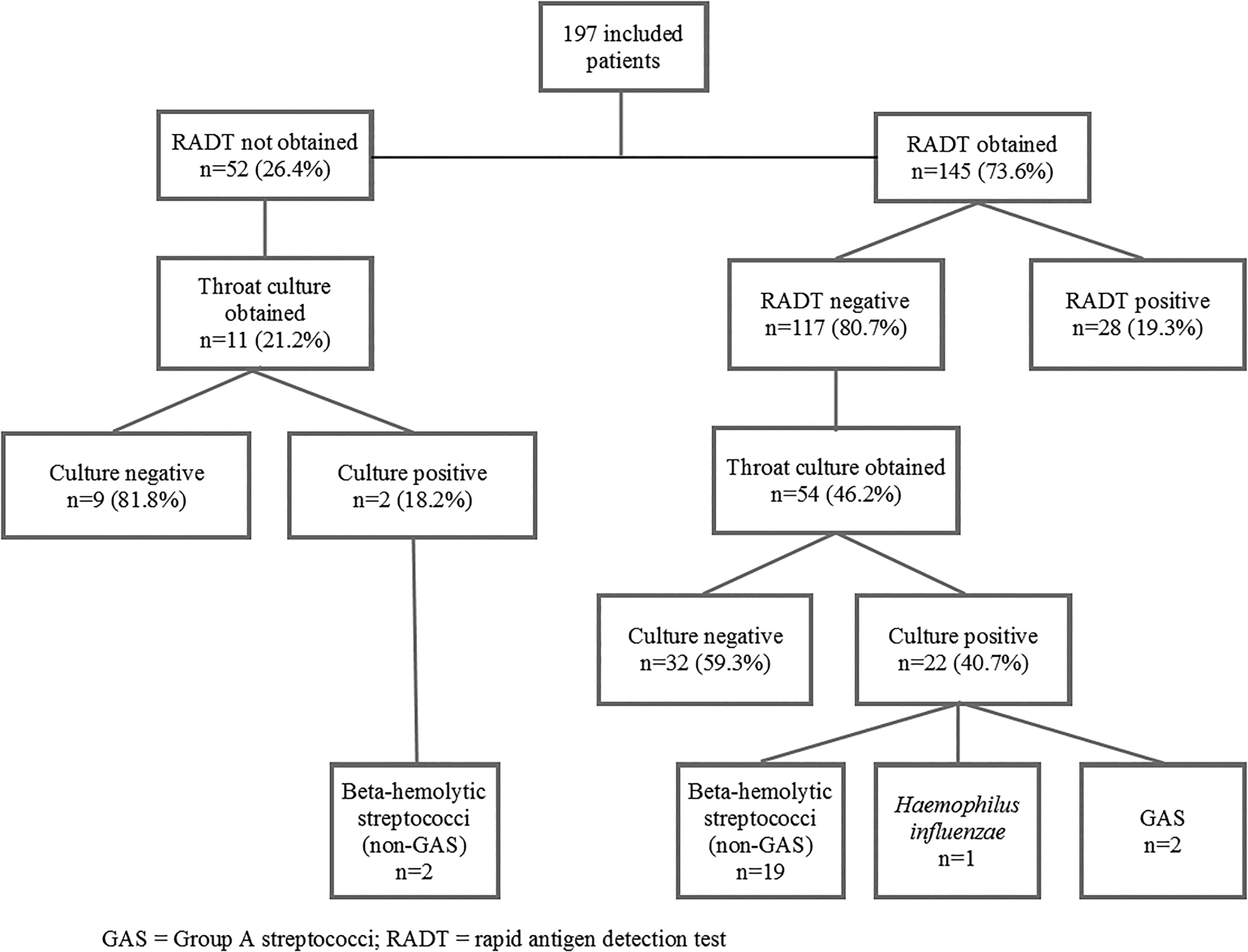
Patient flow.
A Centor score of 0 was assigned to 8 (4.1%) patients, a score of 1 was assigned to 47 (23.9%) patients, a score of 2 was assigned to 60 (30.5%) patients, a score of 3 was assigned to 50 (25.4%) patients, and a score of 4 was assigned to 32 (16.2%) patients. Table 1 includes testing and test positivity results in patients with each Centor score. Rapid antigen detection testing was performed in 145 (73.6%) patients, and of these, 28 (19.3%) patients were positive. A throat culture was obtained in 54 (46.2%) patients with negative RADT. Twenty-two of those throat cultures were positive (40.7%). In the positive throat cultures that were obtained from those with negative RADT, nongroup A beta-hemolytic streptococci were observed (19/22) most commonly. Overall, GAS was detected either by RADT or throat cultures in 30 (15.2%) patients overall (Table 1). Throat cultures were obtained in 11 (21.2%) of 52 patients in whom an RADT was not performed, and 2 of these 11 patients were positive for non-group A beta-hemolytic streptococci. The incidence of GAS and non-GAS were 15.2% (30/197) and 10.1% (21/197), respectively.
Centor Scores and GAS Test Positivity.

Abbreviation: GAS, group A streptococci.
a Percentage is of total patients in Centor score group.
b Patients with this score in whom GAS was detected via RADT or throat culture.
Overall, 129 (65%) patients received an antibiotic prescription (Table 2). All of the patients with a positive RADT received an antibiotic prescription, as did the 2 patients who had a negative RADT but positive throat culture for GAS. Of those with a negative RADT, and no throat culture obtained, 32 (50.8%) patients were prescribed an antibiotic. All but 1 of the 22 patients with a negative RADT and positive throat culture received antibiotic prescriptions. Ten (24.4%) of 41 patients who received no diagnostic testing were prescribed antibiotics. Most patients who received an antibiotic were prescribed a beta-lactam antibiotic (n = 79, 61.2%) or a macrolide (n = 41, 31.8%). Only 37 (28.7%) patients received amoxicillin and no patients received penicillin (Table 2). Amoxicillin (n = 13, 46.4%) followed by cephalexin (n = 6, 21.4%) were the most commonly prescribed antibiotics in patients with a positive RADT. When RADT was negative, but throat culture was obtained, cephalexin (n= 24, 47.1%) was most commonly prescribed.
Antibiotic Prescription Distributiona.
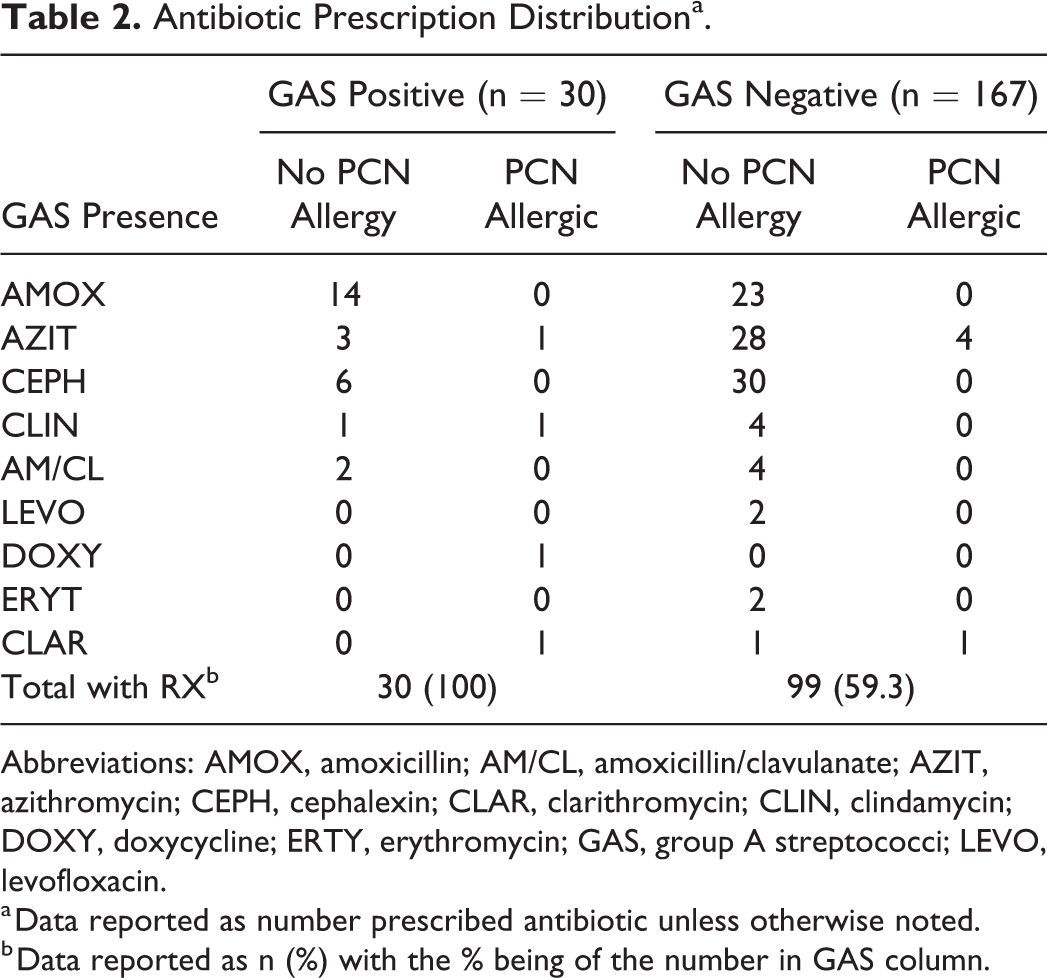
Abbreviations: AMOX, amoxicillin; AM/CL, amoxicillin/clavulanate; AZIT, azithromycin; CEPH, cephalexin; CLAR, clarithromycin; CLIN, clindamycin; DOXY, doxycycline; ERTY, erythromycin; GAS, group A streptococci; LEVO, levofloxacin.
a Data reported as number prescribed antibiotic unless otherwise noted.
b Data reported as n (%) with the % being of the number in GAS column.
Nine of the patients prescribed antibiotics had a documented penicillin allergy, and 7 of those prescriptions were for macrolides. Of the 30 patients ultimately diagnosed with GAS pharyngitis through RADT or throat culture, 4 received broad-spectrum agents due to documented penicillin allergies. Patients diagnosed with GAS pharyngitis were more likely to receive narrow-spectrum antibiotics as compared to patients without GAS (46.7% vs 23.2%, P < .05). They were also more likely to receive a beta-lactam antibiotic than patients without confirmed GAS (73.3% vs 57.6%, P = .121). Of the 10 patients who received no diagnostic testing but were prescribed antibiotics, 5 received amoxicillin or amoxicillin/clavulanate, and 5 received azithromycin.
Comment
In this cohort of college students at a single university health clinic, management of sore throat, including diagnostic and prescriptive practices, significantly varied and was not concordant with the current IDSA recommendations. Group A Streptococcus was identified as the causative pathogen of pharyngitis in 15% of patients, but antibiotics were prescribed in 65% of cases. This is an important finding given that this single institution is 1 of over 1000 higher education institutions making up the American College Health Association and that university health clinics provide health care for millions of student–patients.
The percentage of pharyngitis cases caused by GAS in our study was consistent with previous evaluations estimating that 7.5% to 18% of adults and college students with complaints of sore throat test positive for GAS. 1,12 Antibiotics are prescribed to nearly 60% to 72% of adults with pharyngitis despite the low incidence of GAS in adults versus children and the prescribing rate observed in our study is similar. 1,3,5,13 A cross-sectional analysis of 1844 adult patients demonstrated that 60% of patients presenting to a primary care practice or emergency department (ED) with sore throat received antibiotics, despite only 10% of them being diagnosed with GAS. 5 Predictive criteria evaluation, such as Centor scores, have been suggested to help guide further testing and treatment. 4 In this cohort of college students, Centor scores were not assigned prospectively, suggesting that practitioners were not utilizing the scores as part of their assessment. The retrospectively determined Centor scores were associated with increased likelihood of positive RADT. Centor scores of 3 and 4 were associated with an increased likelihood of a positive RADT (26.8% and 25%, respectively) when compared to a Centor score of 1 and 2 (17.4% and 6.7%, respectively; P = .049). A score of 4 versus 3 did not appear to differentiate well an increased likelihood of GAS positivity. It is difficult to determine this, but the performance in this cohort was lower than what has been reported in the previous studies evaluating predictive criteria. We would suggest that this may be in part to the retrospectively determined scores, as they were not prospectively assigned, and perhaps the cohort as a whole. In general, the cohort differs with respect to baseline demographics to the cohorts used in previous studies evaluating predictive criteria and that may have factored into the overall score performance.
While there is some advocacy for no testing (RADT or otherwise) for Centor scores of 1 or less, in our cohort RADT was performed in 30 (62.3%) patients with a score of 1 and 16 (53.3%) of those patients received an antibiotic prescription. There were 3 (6.4%) of 47 patients with a Centor score of 1 who tested positive for GAS via either RADT or throat cultures. While this could raise questions regarding the utility of the score in a young adult/college student, this finding may also be reflective of the limitation of retrospectively assigning a Centor score to a patient. Utilization of Centor scores prospectively may provide some benefit to the clinical work-up. Although the predictive criteria may be imperfect, the criteria do represent another source of data to which could be value-added for a clinician during their decision-making.
Back-up throat cultures are recommended in the case of negative RADT in children and adolescents with sore throats, but not in adult patients. 4 This is because of the general lower sensitivity of RADT compared to throat culture and because of the low incidence of GAS pharyngitis and decreased risk for ARF in adults. There are no clear recommendations or guidance for when back-up cultures should be obtained in the young adult/college student which can be a challenge to the management. In this cohort, only about half of the patients with negative RADT received back-up throat culture, but the 2 positive culture results from that group potentially support the use of back-up cultures in the young adult population. Dingle and colleagues suggest that in patients aged 13 years and older there is utility of using back-up throat cultures in instances of negative RADT. 13 In their study, 5% of patients with negative RADT tested positive for GAS using a back-up throat culture. Of these, nearly half had a Centor score of less than 2. Overall, there was 1 subject in this cohort who had a Centor score of 2 or less (specifically 1) with a negative RADT who had a positive back-up throat culture for GAS. Of the 54 subjects who had a back-up throat culture and a negative RADT, 24 had a Centor score of 2 or less, which, at 4% is similar to previous findings. 13 This information would not definitively support the use of a back-up culture in cases of negative RADT and low Centor but does serve as a reminder of the limitations of some predictive criteria and diagnostic tests. This finding also highlights that it is important to consider the prevalence of GAS carriers, especially in those with symptoms that may be more consistent with viral etiology. It was surprising that the 11 patients in our cohort who did not receive RADT testing did receive throat culture although none of these cultures grew GAS. This could be related to test supply availability or investigation for sexually transmitted causes of pharyngitis, but is a cause for further quality improvement investigation.
In cases of GAS pharyngitis, antibiotic treatment has been shown to prevent later development of rheumatic fever. Since rheumatic fever can be prevented for up to 9 days after onset of symptoms, waiting 2 to 3 days for the culture results to be finalized before starting an antibiotic course would not be harmful to the patient. 1 Nearly two-thirds of patients without GAS in this cohort were prescribed an antibiotic which suggest that there is significant room from improvement. It is unclear if all of these patients had the prescription filled at a pharmacy and started taking the antibiotic course. It is possible that due to the nature of young adult/college students, prescribing behavior may be driven by competing patient satisfaction interests and prescribers may take a “better safe than sorry” approach. 10,14 This could be an explanation for the apparent overprescription of antibiotics in this cohort. It is also possible, although not able to be determined through this retrospective review, that the prescriber had specific conversations with the patient regarding when to begin the antibiotic course if the prescriber was taking a conservative management approach. There are opportunities for providers in university student health services clinics to education and engage student–patients in the decision-making process as this type of collaboration may have positive impact on appropriate antibiotic utilization. 15
Non-GAS bacterial pharyngitis was encountered in 10% of this cohort and the clinical significance of this finding is unclear; non-GAS bacteria are not known to share similar risk of rheumatic fever as GAS. 3 Non-GAS pharyngitis has been reported in college students and young adults at similar rates to that observed in our cohort, and studies suggest similar clinical presentation in individuals with GAS and non-GAS. 2,13,16 There is a paucity of evidence from well-designed clinical studies to support antibiotic therapy for non-GAS pharyngitis. Zwart and colleagues report that a 7-day penicillin course in patients with high colony counts of non-GAS reduced symptom duration by a day; however, bacteria were still present in 60% of those with group C streptococci following treatment. 17 Infectious Diseases Society of America Guidelines do not support the use of antibiotic therapy for non-GAS etiologies of pharyngitis. 4 Despite this, 20 of 21 patients with non-GAS confirmation received an antibiotic prescription and of those, 19 patients were for broad spectrum antibiotics.
All patients with identified GAS were prescribed a course of antibiotics, but the guideline-concordant first-line antibiotic was prescribed in only 56.7% of patients with confirmed GAS pharyngitis, and this includes 3 patients with a penicillin allergy. Of the patients with confirmed GAS pharyngitis, 20% received prescriptions for cephalexin and none of those were guideline-concordant. Doxycycline was prescribed in 1 patient with a reported penicillin allergy. Azithromycin (n = 3) and amoxicillin/clavulanate (n = 2) were prescribed for patients without reported penicillin allergy. Macrolides were prescribed in 20% of the overall cohort, and specifically in 22% of patients without the confirmed presence of GAS suggesting an increased propensity to prescribe a macrolide (azithromycin most commonly) when the diagnosis is uncertain. The reason for this is unclear and not examined in this study, but perhaps clinicians view azithromycin as a rather innocuous antibiotic given its short course. Regardless, this finding is similar to other studies suggesting a 15% rate of azithromycin prescription for all sore throat visits.
Nearly 60% of patients without GAS were prescribed an antibiotic. Antibiotics were prescribed to 19.2% (n = 10) of patients in whom neither RADT nor throat culture were performed, 50.8% (n = 32) of patients with a negative RADT and no throat culture, and 93.8% (n = 30) of patients with a negative RADT and negative throat culture. Of these prescriptions, 76.8% were for broad spectrum antibiotics and only 57.6% were for beta-lactam antibiotics.
Our findings highlight a general trend of increased likelihood of antibiotic prescription in college students with increasing Centor scores. There are risks of antibiotic use in the absence of clear indication. Over half of the patients receiving an antibiotic prescription received 1 for either amoxicillin or cephalexin. Amoxicillin and penicillin are the drugs of choice for GAS pharyngitis and cephalexin could be a suitable alternative in instance of a nonanaphylactic penicillin allergy. 4 None of the instances of cephalexin prescription were in patients with documented penicillin allergy. Interestingly, of the 9 patients with documented penicillin allergy, azithromycin (n = 5), clindamycin (n = 1), doxycycline (n = 1), and clarithromycin (n = 2) were prescribed. In the cases of immune-mediated or anaphylactic penicillin allergies, clindamycin could be a suitable alternative, but there are considerable risks including macrolide-resistant GAS and treatment failure when considering azithromycin. It was surprising to see 83 (69%) prescriptions for antibiotics other than amoxicillin in patients without documented penicillin allergy. There was a significant proportion of broad-spectrum antibiotics prescribed, and some of the selections such as amoxicillin/clavulanate and levofloxacin were especially peculiar.
Overuse of unnecessary antibiotics is not without risk. There are an estimated 142 505 annual visits to US EDs for drug-related adverse events attributable to systemic antibiotics, representing 19.3% of all ED visits for drug-related adverse events. 8 We were unable to adequately assess potential antibiotic-related harm due to the design of our study. A significant repercussion to the overprescribing of antibiotics is the resistance associated with overuse. The impacts of antibiotic on bacterial resistance in the higher education community remain unknown at this time.
There were several limitations to this study. Our retrospective study was dependent on the documentation performed at the time of the visit, which may not have been complete. We were unable to assess adherence to antibiotics or eventual clinical outcome due to lack of follow-up documentation in the chart. Subjects in this cohort had a variety of symptom durations which may have limited the utility of the Centor score as a predictor of GAS pharyngitis given the subjects and symptom durations encountered in Centor score validation studies. Retrospectively assigning a Centor score is also limiting due to the need to interpret the documentation contained within the medical record. It is possible that some subjects who were prescribed an antibiotic may have been also been given instruction to not begin taking the antibiotic unless they received follow-up from the clinician with information about a positive culture. Personnel changes during the study period could have impacted the management of patients with a sore throat, as each provider seemed to have their own specific preferences. These findings may not be applicable to the practices of current providers in the clinic.
Conclusions
In a university health-care clinical setting, antibiotics were often prescribed in patients presenting with pharyngitis despite there being no clear indication for antibiotic therapy. Clinical appearance is important but should not be the only tool used in diagnosing a patient with bacterial pharyngitis. Developing a clinic-specific algorithm for the management of pharyngitis and involving the student–patient in a shared decision-making process could be beneficial to help decrease the use of nonindicated antibiotics.
Footnotes
Declaration of Conflicting Interests
The author(s) declared no potential conflicts of interest with respect to the research, authorship, and/or publication of this article.
Funding
The author(s) received no financial support for the research, authorship, and/or publication of this article.
