







Abstract
Individual differences in fixation duration are considered a reliable measure of attentional control in adults. However, the degree to which individual differences in fixation duration in infancy (0–12 months) relate to temperament and behavior in childhood is largely unknown. In the present study, data were examined from 120 infants (mean age = 7.69 months, SD = 1.90) who previously participated in an eye-tracking study. At follow-up, parents completed age-appropriate questionnaires about their child’s temperament and behavior (mean age of children = 41.59 months, SD = 9.83). Mean fixation duration in infancy was positively associated with effortful control (β = 0.20, R2 = .02, p = .04) and negatively with surgency (β = −0.37, R2 = .07, p = .003) and hyperactivity-inattention (β = −0.35, R2 = .06, p = .005) in childhood. These findings suggest that individual differences in mean fixation duration in infancy are linked to attentional and behavioral control in childhood.
Attention can be defined as a cognitive process that is composed of various highly associated but distinguishable processes (e.g., alerting; orienting; selective, sustained, and executive attention) that has both an endogenous component (attention is influenced by internal representations of task goals) and an exogenous component (attention is captured by events in the environment; Scerif, 2010). It has been proposed that fixation duration could be a stable measure of individual differences in attention across both short and long test-retest intervals (Colombo, Mitchell, Coldren, & Freeseman, 1991) and across different tasks (Castelhano & Henderson, 2008; Rayner, Li, Williams, Cave, & Well, 2007). Fixation duration refers to the time between saccadic eye movements when the eyes are relatively stable. During a fixation, several cognitive processes may occur: Foveal visual information can be processed and encoded in working memory, the next saccade target may be selected from peripheral visual stimuli, and the oculomotor program required to bring the target into foveal vision might be prepared (Rayner, 1998).
In infancy, fixation duration exhibits a robust developmental change (Colombo et al., 1991). For example, whereas 1- to 2-month-old infants exhibit a series of long fixations when viewing static stimuli, 3- to 4-month-old infants exhibit a greater proportion of shorter fixations (Johnson, Posner, & Rothbart, 1991). This change is thought to reflect a reduction in the early difficulty known as sticky fixation or obligatory attention, in which infants have trouble disengaging their attention. By 4 months, problems with disengaging from static stimuli have largely disappeared (Johnson et al., 1991).
There is evidence to support the continuity of attention from infancy through toddlerhood to preadolescence. Scores on attentional measures in infancy are correlated moderately with scores on attentional measures in toddlerhood and preadolescence, and infants’ attention relates to IQ at 11 years of age (Rose, Feldman, Jankowski, & Van Rossem, 2012). Moreover, a recent longitudinal study in which look duration (average duration of individual looks to targets) was assessed in infancy (5, 7, and 12 months of age) and childhood (24 and 36 months of age) revealed that infants’ average look duration was positively associated with the behavioral trait of inhibition at 11 years of age (Rose, Feldman, & Jankowski, 2012). These findings show how individual differences in infant attention may predict executive functions in later childhood.
Executive Attention and Temperament
Given that a fixation is made up of the conflict between demands for keeping the eyes stationary (in order to encode foveal information) and disengaging attention to shift to peripheral targets (Findlay & Walker, 1999), executive attention—the ability to regulate responses to conflict situations in which several responses are possible (Holmboe & Johnson, 2005)—is a crucial parameter for one’s ability to process and efficiently encode visual information.
Behavioral data indicate that the time children spend to resolve conflict (e.g., in the color-word Stroop task) is correlated with scores on parent-report measures of effortful control, the temperament trait of one’s ability to regulate his or her emotions and to inhibit a dominant response in order to activate a subdominant response (Johnson et al., 1991; Rothbart, Sheese, Rueda, & Posner, 2011). Effortful control has been found to correlate negatively with surgency (Rothbart, Ahadi, & Evans, 2000). Surgency is the trait aspect of temperament in which a person tends toward high levels of extraversion, motor activity, and impulsivity, and it has been found to correlate with aggression and externalizing behavior problems in early childhood (Berdan, Keane, & Calkins, 2008). Effortful control has also been found to correlate negatively with impulsivity (Eisenberg et al., 2005) and hyperactivity (Gusdorf, Karreman, van Aken, Deković, & van Tuijl, 2011) and to differentiate reliably, typically developing children from children with attention-deficit/hyperactivity disorder (ADHD), with the latter scoring significantly lower than the former on measures of effortful control (Samyn, Roeyers, & Bijttebier, 2011).
Executive Attention and Behavioral Traits of Hyperactivity and Inattention
ADHD is characterized by symptoms of hyperactivity and inattention; these behaviors are thought to lie on a continuum with normal variation in attention and activity level in the general population (Larsson, Anckarsater, Rastam, Chang, & Lichtenstein, 2012). Executive attention is impaired in children with ADHD (Dovis, Van der Oord, Wiers, & Prins, 2013). A meta-analysis of 83 studies revealed that individuals with ADHD showed significant deficits on all executive functioning measures, with one of the most prominent and consistent effects occurring on measures of response inhibition and planning (Willcutt, Doyle, Nigg, Faraone, & Pennington, 2005). However, other evidence suggests that executive function deficits are, to some extent, dissociable from the diagnostic symptoms observed in individuals with ADHD (Johnson, 2012).
During visual tasks, children with ADHD have difficulties inhibiting responses to salient stimuli and sustaining attention on task-relevant stimuli (Karatekin & Asarnow, 1999). In a video-based eye monitor study, children with ADHD exhibited a trend toward shorter fixations than children without ADHD did (Karatekin & Asarnow, 1999). Their reduced ability to sustain attention was demonstrated in a study that required children with and without ADHD to view two televised stories either with toys in the room or with no toys in the room and to answer causal-relations questions regarding the stories. The direction of the child’s gaze was recorded with a video camera. In the toy-presence condition, children with ADHD answered significantly fewer questions in comparison with typically developing children, which indicates that children with ADHD were less able to reduce the amount of time they spent looking in order to follow the continuity of the story (Pugzles Lorch et al., 2004). Finally, an electrooculography study revealed that, in comparison with typically developing individuals, individuals with ADHD exhibited difficulties suppressing intrusive saccades in a task that required them to maintain steady fixation (Munoz, Armstrong, Hampton, & Moore, 2003). If these findings extend to the continuous traits of hyperactivity and inattention in the general population, hyperactivity and inattention would negatively correlate with mean fixation duration.
The Current Study
The current study is the first to combine eye tracking with a longitudinal design to investigate the degree to which individual differences in infants’ attention relate to individual differences in parent-report measures of temperament (effortful control and surgency) and behavior (hyperactivity-inattention) in childhood. Eye tracking offers the opportunity to study infants’ attention; it is a noninvasive technique that has much higher spatial (~1° of visual angle) and temporal resolution (50 Hz for the eye tracker used in this study) in comparison with video coding. This opens the possibility of analyzing in detail how attention is allocated through individual fixations (Wass, Smith, & Johnson, 2013). On the basis of the evidence from the aforementioned studies, we hypothesized that mean fixation duration in infancy would be (a) positively associated with effortful control in childhood, (b) negatively associated with surgency in childhood, and (c) negatively associated with hyperactivity-inattention in childhood.
Method
Sample and procedure
The participant pool consisted of 271 children (141 males, 130 females) born between March 2008 and December 2010, who took part in an eye-tracking study when they were between 4 and 10 months of age (mean age = 7.69 months, range = 6.34). Their parents were invited to participate in the present follow-up study by e-mail, telephone, and regular mail between February 2012 and May 2012. One hundred seventy-two participants accepted the invitation (response rate = 63.5%), after which they received an information sheet, two copies of a consent form, and a questionnaire booklet. Parents mailed back the questionnaire booklet and a signed copy of the consent form using a prepaid envelope. Fifty-one participants did not return questionnaires. One participant was excluded from the analysis because of insufficient eye-tracking data. One hundred twenty participants (55 males, 65 females; mean age of children when their parents competed the questionnaire = 41.59 months, SD = 9.83) took part in this follow-up study. The majority of infants were Caucasian, of middle socioeconomic status, and residents of London. The project was approved by the ethics committee of the Department of Psychological Sciences, Birkbeck, University of London.
Eye-tracking data
In the present study, the data from a series of previously published eye-tracking experiments were combined, and a new analysis was performed to determine fixation durations. The experiments, which were part of a single overarching eye-tracking study, involved similar experimental conditions in which infants learned from different attention cues or no attention cues about multimodal objects (Wu & Kirkham, 2010; Wu, Tummeltshammer, Gliga, & Kirkham, 2014) and about statistically coherent shapes (Wu, Gopnik, Richardson, and Kirkham, 2011). The apparatus, stimuli, design, and procedure of the experimental conditions are described in detail in those reports.
Throughout the eye-tracking study, infants’ looks were monitored with a Tobii 1750 eye tracker (Danderyd, Sweden). All stimuli were presented on a 17-in. monitor attached to the eye tracker. Calibration was performed using the standard five-point Tobii infant-calibration procedure in the four corners and center of the screen. Stimuli consisted of dynamic videos of faces, red flashing squares, multimodal objects, and moving shapes.
Measures
Eye tracking
Fixation duration was extracted from the infants’ raw eye-tracking data, which included information on periods during which the infants’ eyes were stable, periods during which the velocity of the gaze was high, and periods when gaze was lost because of blinks. Fixations were analyzed using a two-stage approach. First, MATLAB (The MathWorks, Natick, MA) scripts designed by Wass et al. (2013) specifically to cope with low-quality infant data were used to detect fixations. Briefly, the scripts use a bilateral filtering algorithm written by Ed Vul (Frank, Vul, & Johnson, 2009; based on those of Durand & Dorsey, 2002) to smooth the data; these scripts interpolate the data in order to fill periods of data loss up to 150 ms and use a velocity threshold of 35°/s. Only fixations meeting the following criteria are kept as “real”: (a) Fixations must be complete (i.e., begun and ended by a saccade rather than by smooth pursuit or a blink; incomplete fixations are excluded from analysis), (b) displacement since the previous fixation must be greater than 0.25°, (c) average velocity during the previous fixation must be less than 12°/s, (d) velocity in the three samples immediately preceding the saccade must be less than 12°/s, (e) binocular disparity cannot be above 3.6°, and (f) the fixation identified must have a minimum temporal duration of 100 ms (Wass et al., 2013). Only 33% of the fixations detected by the standard-dispersal algorithms passed the stringent quality control of Wass et al.’s (2013) algorithms (mean number of fixations = 147, SD = 103).
Subsequently, to further improve the quality of the data and to correct for the limitation of the algorithms, we hand-moderated the data returned by the algorithms and corrected it for sections of smooth pursuit that were incorrectly identified as fixations (Wass et al., 2013). To do this, an in-house fixation-detection tool, GraFIX, was used (Saez de Urabain, Johnson, & Smith, 2014). GraFIX allows gaze data of variable quality to be accounted for across several stages of both automated and hand-moderated processing. In the current analysis, GraFIX was used to hand-moderate only the data derived by Wass et al.’s (2013) algorithms via inclusion, exclusion, or modification of artificial fixations. This procedure has been shown to be the most efficient and accurate method for identifying fixations in noisy gaze data, such as that encountered in infants (Saez de Urabain et al., 2014).
On average, 64 additional fixations per participant were identified in the hand-moderation analysis (mean number of fixations = 211, SD = 125). The amount of fixations per participant was used as a covariate in the regression analysis. The hand-coded data were significantly correlated with the algorithmic data (r = .57, p < .001; Wass et al., 2013) and were used in the analysis. The reliability of the algorithms has been shown on multiple infants’ data sets (see Wass et al., 2013, for details). The hand-moderated data did not deviate significantly from the data before it was hand-moderated.
Questionnaires
Eight subscales from the short version of the parent report form of the Early Childhood Behavior Questionnaire (ECBQ; Putnam, Jacobs, Gartstein, & Rothbart, 2010) that load onto two factors, namely effortful control and surgency, were employed to assess temperament in preschool-age children (19–36 months old). The scores on the ECBQ scale of effortful control represented the average score of the ECBQ subscales of attentional focusing (six items), inhibitory control (six items), low-intensity pleasure (six items), and perceptual sensitivity (five items). The scores on the ECBQ scale of surgency represented the average score of the ECBQ subscales of activity level (eight items), high-intensity pleasure (six items), impulsivity (four items), and shyness (five items; reversed scored). The rater reported the frequency of a particular behavior (example question for effortful control: “Your child can wait before entering into new activities if s/he is asked to”; example question for surgency: “Your child likes to play so wild and recklessly that he/she might get hurt”). Ratings were made on a 7-point scale (ranging from never to always), and the subscales’ scores represented the mean score of all items applicable to the child. The mean instead of the sum score of the items was used to ensure that missing data would not affect the scales’ final score. The ECBQ scales of effortful control and surgency showed excellent internal consistency (Cronbach’s αs = .86 and .85, respectively).
The equivalent eight subscales of the short form of the parent report version of the Children’s Behavior Questionnaire (CBQ; Putnam & Rothbart, 2006) were employed to assess effortful control and surgency in school-age children (36–58 months of age). The scores on the CBQ scales of effortful control and surgency represented the average score of the same subscales as for the ECBQ. The CBQ scales of effortful control and surgency showed excellent internal consistency (Cronbach’s αs = .81 and .89, respectively).
To assess hyperactivity-inattention in preschool children, we used the parent report form of the Revised Rutter Parent Scale for Preschool Children (RRPSPC; Hogg, Rutter, & Richman, 1997). The RRPSPC hyperactivity-inattention scale consisted of four items, and the rater reported on the frequency of a particular behavior (e.g., “Restless, runs about or jumps up and down, doesn’t keep still”) on a 3-point scale (not true, sometimes true, certainly true).
To assess hyperactivity-inattention in school-age children, we employed the hyperactivity-inattention scale from the parent report version of the Strengths and Difficulties Questionnaire (SDQ; Goodman, 1997). The SDQ hyperactivity-inattention scale consists of five items in an identical format to the RRPSPC, and it is a reliable and valid measure of hyperactivity-inattention in children 3 to 16 years old (Goodman, 1997). The SDQ and RRPSPC scales of hyperactivity-inattention showed good and moderate internal consistency, respectively (Cronbach’s αs = .76 and .54, respectively).
Statistical analyses
Descriptive statistics
Mean fixation duration and questionnaire data were examined using Descriptive Statistics in SPSS Version 18.0. Because of skewness in the data, Van der Waerden’s transformation (Lehmann, 1975) was used to normalize the data before further statistical analyses were undertaken. Levene’s test was used to examine the assumption of equality of variances between males and females, and an analysis of variance tested for significant mean sex differences (at p < .01). No statistically significant sex differences were observed (see Table S1 in the Supplemental Material available online).
Correlations
Partial correlations were performed to test for significant correlations (at p < .05) between the questionnaire scales of effortful control, surgency, and hyperactivity-inattention. Sex and age of the child when the parents completed the questionnaires were used as covariates. In addition, whether the preschool or school-age versions of the questionnaires were used was included as a covariate in the analysis.
Regressions
Multiple linear regression was performed to test for significant associations (at p < .05) between mean fixation duration in infancy and effortful control, surgency, and hyperactivity-inattention in childhood. The effects of age when the child took part in the eye- tracking study and age of the child when the parents completed the questionnaires, which version of the questionnaire was used (the ECBQ and the RRPSPC or the CBQ and the SDQ), the child’s sex, and total number of trials completed and fixations detected in the eye-tracking study were treated as covariates in the regression analysis in order to investigate to what degree variation in fixation duration in infancy accounted for variation in scores on effortful control, surgency, and hyperactivity-inattention in childhood. The slight stimulus differences and the location of fixations (in line with Wass et al., 2013) were disregarded in the analyses. Although the stimuli across all conditions were very similar, condition was included as a covariate in the regression analysis to address any effect of stimulus presentation. Finally, the interaction effect between fixation duration and age of the infant on explaining variation in effortful control, surgency, and hyperactivity-inattention was examined using a moderated multiple regression model (Baron & Kenny, 1986).
Results
Descriptive statistics
Descriptive statistics for mean fixation duration and for the scales of effortful control, surgency, and hyperactivity-inattention are shown in Table 1. Figure 1 presents the distribution of fixations for all participants. Table S2 in the Supplemental Material presents descriptive statistics for the ECBQ and CBQ scales of effortful control and surgency and for the RRPSPC and SDQ scales of hyperactivity-inattention.
Descriptive Statistics for Mean Fixation Duration in Infancy and Scales of Effortful Control, Surgency, and Hyperactivity-Inattention in Childhood
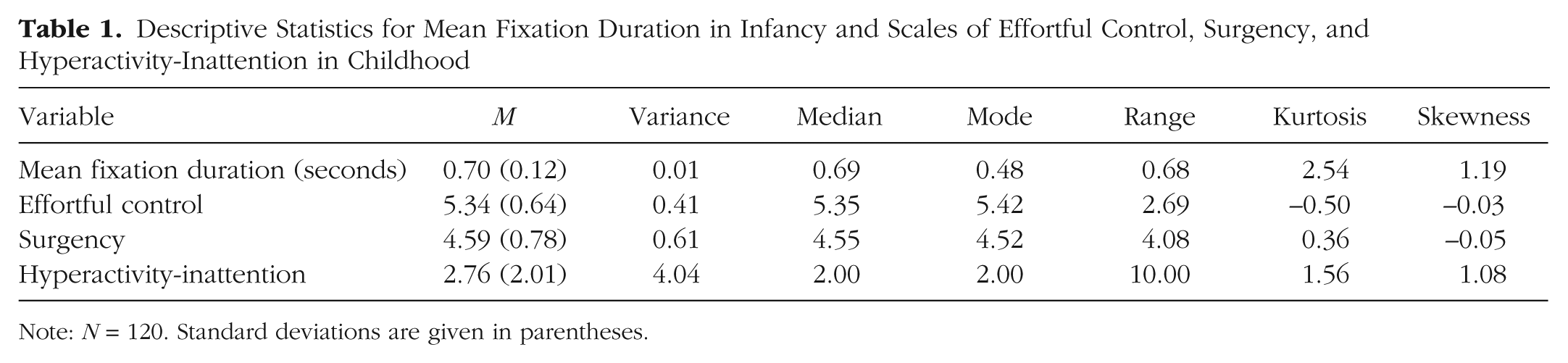
Note: N = 120. Standard deviations are given in parentheses.
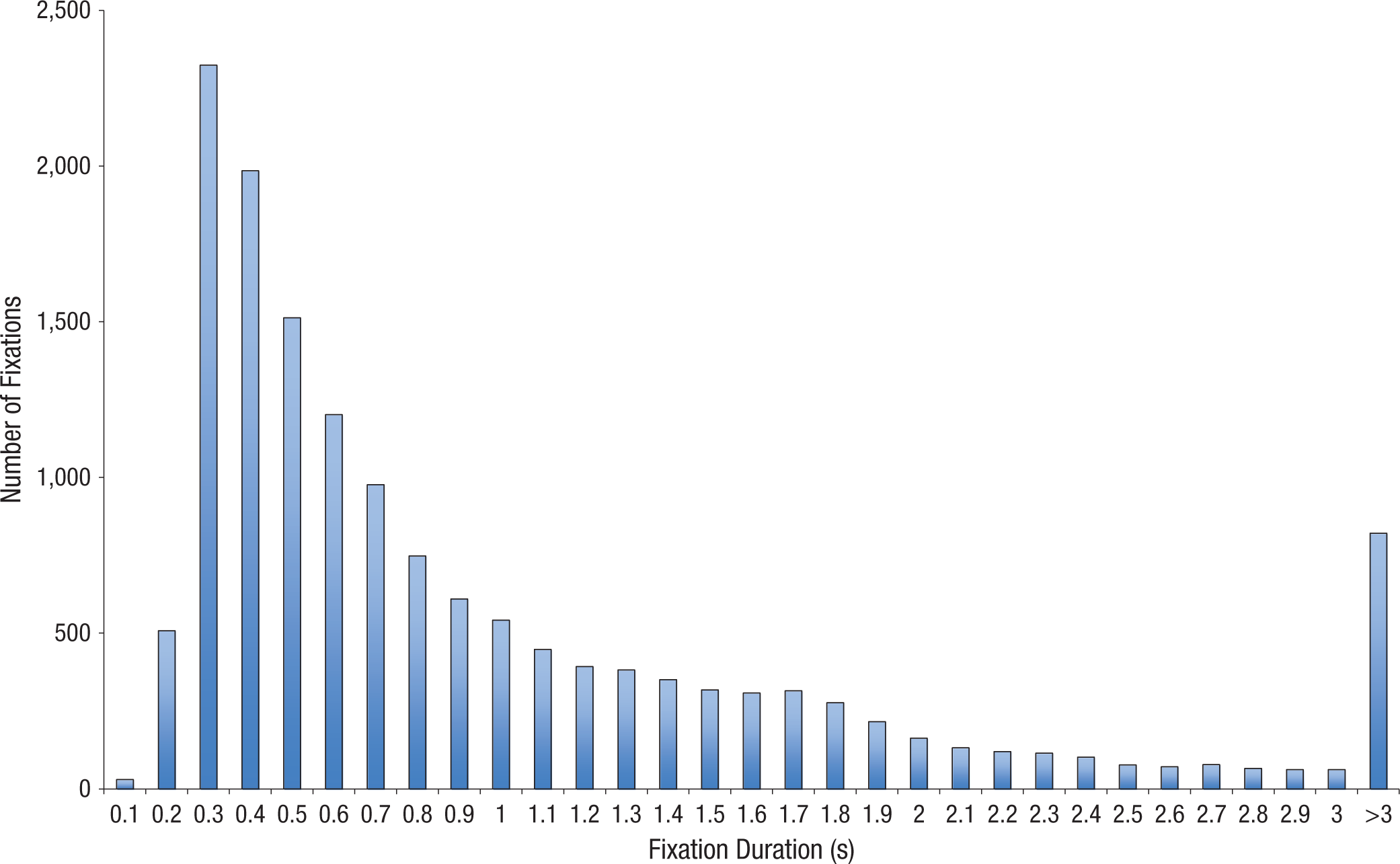
Distribution of fixation durations.
Infant age and fixation duration
To explore the effect of age on infant fixation duration, we performed a regression analysis with infants’ age (continuous variable measured in months) as an independent variable and infants’ mean fixation duration as the dependent variable. Child’s sex and the number of fixations detected and trials completed in the eye-tracking study were treated as covariates. Age of the infant was not significantly associated with mean fixation duration (β = 0.23, R2 = .01, p = .07).
Correlations between effortful control, surgency, and hyperactivity-inattention in childhood
Correlations between effortful control, surgency, and hyperactivity-inattention in childhood are shown in Table 2. Effortful control was correlated significantly with surgency (r = −.17, p = .05) and hyperactivity-inattention (r = −.52, p = .001). Surgency was correlated significantly with hyperactivity-inattention (r = .26, p = .001).
Correlations Between Effortful Control, Surgency, and Hyperactivity-Inattention in Childhood
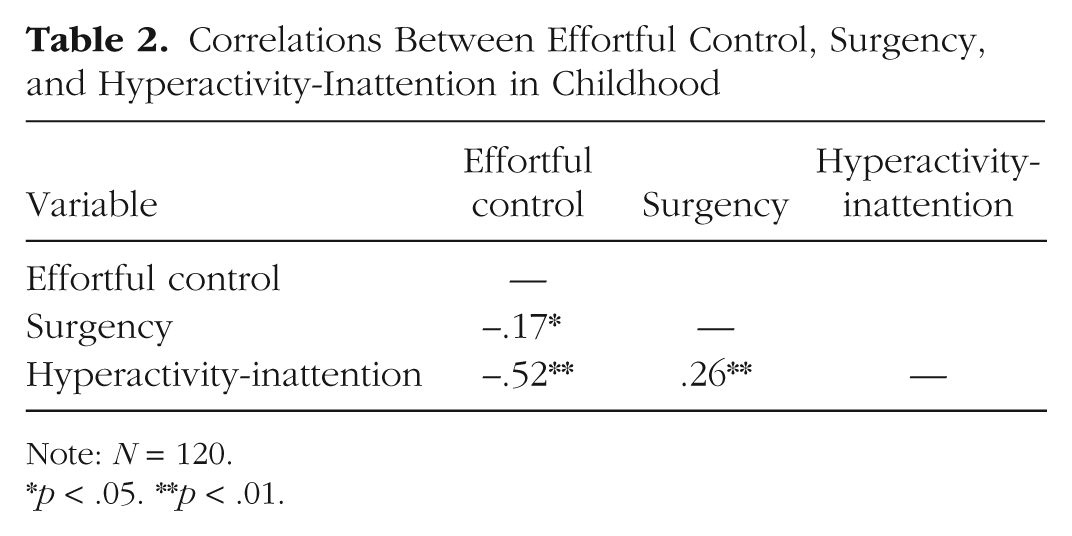
Note: N = 120.
p < .05. **p < .01.
Multiple linear regression between fixation duration in infancy and effortful control, surgency, and hyperactivity-inattention in childhood
The results of the multiple linear regression showed that mean fixation duration in infancy (independent variable) was associated significantly with the dependent variables of effortful control (β = 0.20, R2 = .02, p = .04), surgency (β = −0.37, R2 = .07, p = .003), and hyperactivity-inattention (β = −0.35, R2 = .06, p = .005) in later childhood (see Table 3). Scatter plots for these associations are shown in Figures S1, S2, and S3 in the Supplemental Material for effortful control, surgency, and hyperactivity-inattention, respectively. Table S3 in the Supplemental Material presents the results of the multiple linear regression for the overall model. The overall model represents the additive effect of the independent variable (mean fixation duration) and the effect of all the covariates on accounting for variation in the dependent variables.
Results of Linear Regressions Predicting Effortful Control, Surgency, and Hyperactivity-Inattention in Childhood From Mean Fixation Duration in Infancy
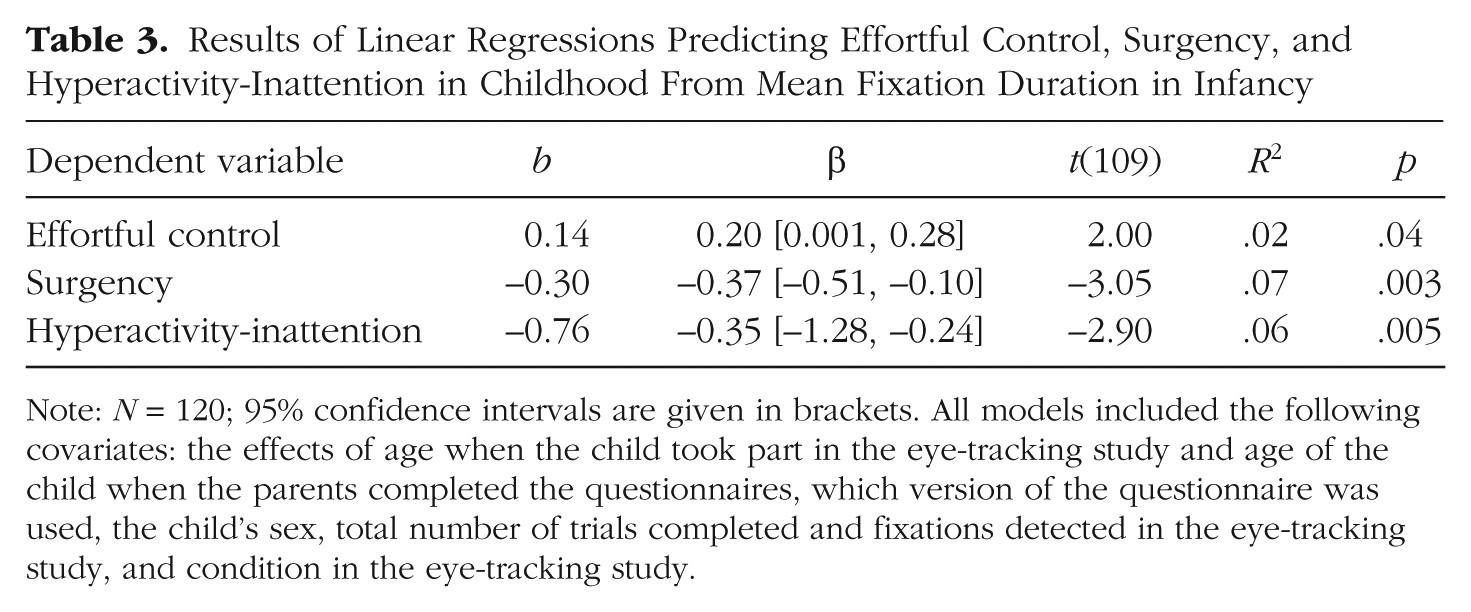
Note: N = 120; 95% confidence intervals are given in brackets. All models included the following covariates: the effects of age when the child took part in the eye-tracking study and age of the child when the parents completed the questionnaires, which version of the questionnaire was used, the child’s sex, total number of trials completed and fixations detected in the eye-tracking study, and condition in the eye-tracking study.
To shed light on the developmental mechanisms that link attention in infancy to temperament and behavior in childhood, we explored whether the interactive effect of infant fixation duration and age of the infant explained variation in effortful control, surgency, and hyperactivity-inattention. Table S4 in the Supplemental Material presents the results of the regression model. The Mean Fixation Duration × Infant Age interaction was significantly associated with surgency in childhood (β = −0.20, R2 = .03, p = .05). This result suggests that the direction of the association between mean fixation duration and surgency remains the same (negative) irrespective of the age of the infant; the fact that the association is significant suggests that the variance of childhood surgency accounted for by variation in infant fixation duration increases as the age of the infant increases.
Discussion
The present study showed, for the first time, the degree to which individual differences in fixation duration in infancy (a measure of attentional control) relate to the temperament domains of effortful control and surgency and the behavioral trait of hyperactivity-inattention in childhood. As hypothesized, longer mean fixation duration was indicative of higher levels of effortful control and lower levels of surgency and hyperactivity-inattention. The associations were of moderate magnitude, with the proportion of variance explained by mean fixation duration in infancy being 2%, 7%, and 6% for effortful control, surgency, and hyperactivity-inattention in childhood, respectively. Moderate effects are to be expected given that many factors within a dynamic developmental framework operate to produce individual variability on high-level behaviors (e.g., hyperactivity-inattention; Nigg, 2009).
These findings should be considered in light of some limitations. The Cronbach’s alpha reported for the RRPSPC hyperactivity scale was moderate. It will be important to test whether the findings replicate in other samples. There was attrition in the present sample because of the longitudinal nature of the study. Nevertheless, the final sample yielded enough power to detect moderate effects and was considerably larger than the sample size of most studies in infant eye-tracking research (typically 10–20 individuals). Furthermore, there was unavoidable attrition in usable eye-tracking data within participants. This was because infant eye-tracking data are generally of poorer quality (less precise and with more lost samples) compared with adult data (Wass et al., 2013). As a result, considerable attention was given to ensure that the observed variation per participant reflected individual variation in fixation duration and not noise produced by extraneous components (e.g., data quality). Fixation-parsing algorithms, designed specifically to detect fixations in low-quality infants’ data, were used and hand moderation was performed to improve the quality of the data used in the regression analysis. This two-stage approach has significant advantages over using fixation-detection algorithms or hand coding alone. It provides stability in the criteria used to detect fixations and the flexibility to address limitations of the automatic fixation-parsing algorithms. Finally, a limitation of the study was the reliance on parent reports of children’s behavior and temperament. Although parents are typically most familiar with their children’s behavior, all types of raters include some bias. Future research should consider collecting data from multiple raters or employing additional objective measurements of behavior.
Previous research indicates that there is continuity of attention from infancy through toddlerhood to preadolescence and that infants’ look duration relates to IQ and the behavioral trait of inhibition at 11 years of age (see Rose, Feldman, Jankowski, & Van Rossem, 2012). The present study demonstrates that mean fixation duration in infancy is linked to attentional and behavioral control in early childhood. The data also support the notion that fixation duration could constitute a measure of individual differences in the efficiency of young infants’ ability to regulate and control their attention. This is of great importance considering that, whereas the temperament trait of surgency emerges in the 1st year of life, effortful control develops in the 2nd and 3rd year of life and beyond, which makes it difficult to find appropriate measures to assess aspects of executive attention in infancy (Rothbart, Sheese, & Posner, 2007). As such, studying fixation duration in infancy could have significant implications for understanding the mechanisms through which executive control develops.
Investigating the causes of individual differences in voluntarily control of attention as early as in infancy might inform early intervention practices that will aim to improve aspects of executive attention. Executive attention is an important network for the acquisition of a wide variety of skills that draw on general intelligence (Rothbart et al., 2007). Finally, given the role of effortful control in differentiating typically developing children from children with ADHD (Samyn et al., 2011), and the association between mean fixation duration in infancy with later effortful control and hyperactivity-inattention, reported here, a tentative idea for future research would be to explore whether fixation duration in infancy could be used to identify individuals at risk for developing ADHD.
Footnotes
Acknowledgements
We are grateful to the children and their parents for their invaluable contribution and support to this research. We also thank Sam V. Wass for providing the fixation-parsing MATLAB scripts, Irati Rodriguez Saez de Urabain for providing access to GraFix, Thomas Blonievsky for entering the questionnaire data in SPSS, and Leslie Tucker and Marian Greensmith for providing guidance on data collection.
Declaration of Conflicting Interests
The authors declared that they had no conflicts of interest with respect to their authorship or the publication of this article.
Funding
This research was funded by Royal Society and Waterloo Foundation grants to A. Ronald; the infant eye-tracking study was supported by a grant to R. Wu and N. Z. Kirkham from the University of London Central Research Fund and a grant to M. H. Johnson from the United Kingdom Medical Research Council. K. A. Papageorgiou is supported by the European Commission Marie Curie Initial Training Networks.

References
Supplementary Material
Please find the following supplemental material available below.
For Open Access articles published under a Creative Commons License, all supplemental material carries the same license as the article it is associated with.
For non-Open Access articles published, all supplemental material carries a non-exclusive license, and permission requests for re-use of supplemental material or any part of supplemental material shall be sent directly to the copyright owner as specified in the copyright notice associated with the article.
