






Abstract
In the current study, we leveraged differences within twin pairs to examine whether harsh parenting is associated with children’s antisocial behavior via environmental (vs. genetic) transmission. We examined two independent samples from the Michigan State University Twin Registry. Our primary sample contained 1,030 families (2,060 twin children; 49% female; 6–10 years old) oversampled for exposure to disadvantage. Our replication sample included 240 families (480 twin children; 50% female; 6–15 years old). Co-twin control analyses were conducted using a specification-curve framework, an exhaustive modeling approach in which all reasonable analytic specifications of the data are interrogated. Results revealed that, regardless of zygosity, the twin experiencing harsher parenting exhibited more antisocial behavior. These effects were robust across multiple operationalizations and informant reports of both harsh parenting and antisocial behavior with only a few exceptions. Results indicate that the association between harsh parenting and children’s antisocial behavior is, to a large degree, environmental in origin.
Harsh parenting, and especially hitting children in anger, is increasingly recognized as a significant public health concern (Fortson, Klevens, Merrick, Gilbert, & Alexander, 2016). It has been robustly linked to deleterious mental health outcomes (Gard et al., 2017; Goulter, McMahon, Pasalich, & Dodge, 2020), including aggression and antisocial behavior, as well as poorer school performance (Gershoff & Grogan-Kaylor, 2016). Despite the consistency of these associations, definitive causal conclusions regarding the origins of the association between harsh parenting and child outcomes are elusive because experiments in which parents are randomly assigned to (for example) hit or not hit their children are unethical. It thus remains possible that some unmeasured confounding variables, such as shared genes, actually account for the association between harsh parenting and children’s antisocial behavior. In particular, should the genes that predispose parents to be harsh with and physically punish their children also increase the risk for children’s antisocial behavior, the association between harsh parenting and antisocial behavior in children could reflect their common genetic lineage (i.e., a genotype–environment correlation) rather than a causal effect of harsh parenting per se (Jaffee et al., 2004). Given the increasing interest in policy and intervention efforts to reduce harsh parenting, and especially parents’ use of physical punishment (Gershoff & Lee, 2019), it is crucial to determine the genetic and environmental origins of the association between harsh parenting and children’s antisocial behavior.
Twin-differences designs are ideal for disambiguating intertwined genetic and environmental effects. Monozygotic twins are genetically identical and thus differ only to the extent that they have been exposed to different levels of specific environmental factors (along with measurement error and random events; Plomin, DeFries, McClearn, & McGuffin, 2008). Comparisons of monozygotic twins who differ in levels of harsh parenting could thus illuminate whether or not harsh parenting is associated with children’s antisocial behavior via environmental pathways.
Prior studies have leveraged this interpretive clarity to good effect. Caspi et al. (2004) examined associations between differences in observed maternal expressed emotion at age 5 years and differences in children’s antisocial behavior at age 7 years in 565 monozygotic twin pairs, finding that differences in maternal expressed emotion predicted differences in children’s antisocial behavior 2 years later. Asbury, Dunn, Pike, and Plomin (2003) similarly examined a large sample of 4-year-old monozygotic twin pairs (n = 2,353) and found that differences in parental treatment were associated with differential sibling behavioral problems, particularly among highly discordant pairs. Finally, Burt, McGue, Iacono, and Krueger (2006) examined 486 monozygotic twin pairs over the course of adolescence using a cross-lagged twin-differences design. Results revealed that, in the most discordant twin pairs, the twin experiencing harsher parenting at age 11 years showed more externalizing symptoms 3 years later.
Although such findings support the presence of an environmental association between harsh parenting and children’s behavior problems, results are less certain than one would like, for two reasons. First, empirical studies have yet to focus on monozygotic differences in what is arguably the harshest form of parenting: hitting or spanking children. It is as yet unknown whether physical punishment per se is environmentally associated with youth behavior problems, whether it reflects genetic confounds, or whether it reflects some combination of the two. This is a notable gap in our knowledge base given that physical punishment of children by parents remains relatively common, with half of parents in a U.S. national survey reporting that they had physically punished their child by the time the child reached age 9 years (Finkelhor, Turner, Wormuth, Vanderminden, & Hamby, 2019). Moreover, this knowledge is critical for public policy; organizations such as the United Nations (Committee on the Rights of the Child, 2007), the American Academy of Pediatrics (Sege, Siegel, & Council on Child Abuse and Neglect, Committee on Psychosocial Aspects of Child and Family Health, 2018), and the American Psychological Association (2019) have called on parents to stop using physical punishment, and 60 countries have banned all physical punishment of children (Global Initiative to End All Corporal Punishment of Children, 2020). Such initiatives may not be successful if gene–environment correlation is responsible for documented associations between physical punishment and detrimental outcomes for children.
Second, all empirical research, including twin-differences research, is undergirded by a series of researcher decisions regarding the data. For example, researchers must decide which dimension of antisocial behavior to examine (e.g., aggressive or nonaggressive rule breaking), which informant reports to examine (e.g., a specific informant or a composite of several informants), whether to adjust for nonnormality, whether to control for demographic confounds, and so on. Different researchers make different choices at these various decision points, often for legitimate reasons related to their core research question. Researchers looking to establish the overall relationship between X and Y, for example, might focus on informant-report composites of X and Y given prior work indicating that informant composites outperform single informants in the prediction of external validation criteria (Achenbach, McConaughy, & Howell, 1987). Researchers evaluating the robustness of the association between X and Y, by contrast, might examine multiple individual informant reports as a sensitivity analysis. Because these various decision points can sometimes alter findings, however, they also can result in p-hacking or simply less replicable science, in that hoped-for results may be present for only a narrow band of specifications (Simonsohn, Simmons, & Nelson, 2019).
In the present study, we addressed these issues, evaluating twin-differences data in two independent samples using an analog of the idealized counterfactual model of causation, the co-twin control design (McGue, Osler, & Christensen, 2010). In this model, the co-twin experiencing harsher parenting is used to estimate what scores for the twin experiencing milder parenting would have looked like had that twin received harsher parenting, thereby illuminating the origins of the association between harsh parenting and children’s antisocial behavior. To evaluate the robustness of these findings, we conducted analyses using an exhaustive modeling approach. Analyses were specifically conducted across all reasonable decision points and data specifications (i.e., harsh parenting in general vs. hitting in anger, operationalization of children’s antisocial behavior, individual and composite informant reports, adjustments for nonnormality, and control for demographic confounds). In this way, we were able to illuminate the genetic and environmental origins of the association between harsh parenting and children’s antisocial behavior, and we did so across various specifications of the data.
Method
Primary sample
Participants
The population-based Michigan State University Twin Registry (MSUTR; Burt & Klump, 2019) includes several independent twin projects. Participants in our primary sample were drawn from the Twin Study of Behavioral and Emotional Development in Children (TBED-C). The TBED-C includes a population-based arm, recruited via birth records (N = 528 families; monozygotic n = 260, dizygotic n = 268), and an at-risk arm, also recruited via birth records but additionally identified as living in neighborhoods with higher-than-average levels of poverty (N = 502 at-risk families; monozygotic n = 166, dizygotic n = 336). Detailed information regarding the design, recruitment procedures, and participation rate of the TBED-C is available elsewhere (Burt, Klump, Gorman-Smith, & Neiderhiser, 2016; Burt, Slawinski, & Klump, 2018). All procedures were approved by the institutional review board of Michigan State University. Children provided informed assent, whereas parents provided informed consent for themselves and their children.
The twins were 6 to 10 years old (mean age = 8.2 years in the population-based sample and 7.9 years in the at-risk sample), although 30 pairs turned 11 by the time of their participation. The population-based and at-risk samples were 48% and 51% female, respectively. Collectively, the racial composition of the combined sample was 82% White, 10% Black, 1% Asian, 1% indigenous, and 6% multiracial. However, as detailed by Burt and Klump (2019), families in the at-risk sample, but not the population-based sample, were more racially diverse than the local population (e.g., 14% Black and 77% White in the at-risk sample vs. 5% Black and 87% White in the population-based sample; local population based on the area census: 5% Black and 85% White). As in recent TBED-C publications, the two arms of the study were analyzed jointly for the current analyses.
Zygosity was established using physical-similarity questionnaires administered to the twins’ primary caregiver (Peeters, Van Gestel, Vlietinck, Derom, & Derom, 1998). On average, the physical-similarity questionnaires used by the MSUTR have accuracy rates of 95% or better.
Measures
Children’s antisocial behavior
Mothers and fathers completed the Achenbach Child Behavior Checklist (CBCL; Achenbach & Rescorla, 2001) separately for each twin, while the twins’ teachers completed the corresponding Achenbach Teacher Report Form (TRF; Achenbach & Rescorla, 2001), a well-validated family of instruments for assessing antisocial behaviors prior to adulthood. For the current study, we examined both the Rule-Breaking Behavior scale (e.g., lies, breaks rules, steals, truant; 17 items on the CBCL and 12 items on the TRF; αs = .63–.71) and the Aggressive Behavior scale (e.g., destroys other people’s things, fights, threatens other people, argues, suspicious, temper; 18 items on the CBCL and 20 items on the TRF; αs = .86–.92). Despite moderate to high correlations between aggressive behavior and rule-breaking behavior, a large body of research has highlighted important distinctions between them. Aggressive behavior and rule-breaking behavior demonstrate different developmental trajectories, different demographic correlates, different levels of stability over time, and different etiologies (Burt, 2012). We thus considered both aggressive behavior and rule-breaking behavior here. Maternal reports were available on 98.7% of twins (n = 2,034), whereas paternal reports were available on 82.9% (n = 1,707). The teachers of 119 twins were not available for assessment (e.g., because the twins were home-schooled, because teacher contact information was incorrect). Our final teacher participation rate was 83%, and TRF data were available for 1,551 participants.
Nearly all twins (98.8%; n = 2,035) completed the corresponding Semistructured Clinical Interview for Children and Adolescents (SCICA; McConaughy & Achenbach, 2001), a clinical interview that was developed and validated for children between the ages of 6 and 18 years. Twins were interviewed in separate rooms by different interviewers. In the current study, we made use of the Aggressive/Rule-Breaking scale (Achenbach & Rescorla, 2001; McConaughy & Achenbach, 2001), which comprises 23 SCICA items adapted from Aggressive Behavior and Rule-Breaking Behavior items on the CBCL and TRF. Roughly 10% of SCICA interviews were videotaped to obtain interrater reliability (the average intraclass correlation across raters was .88). Per the manual, the SCICA Aggressive/Rule-Breaking scale should not be disambiguated into separable aggressive-behavior and rule-breaking-behavior dimensions prior to adolescence and was thus examined as a single measure.
As expected on the basis of prior meta-analyses (Achenbach et al., 1987), the various informant reports were moderately intercorrelated (rs among adult reports of children’s rule-breaking behavior = .26–.44, rs among adult reports of children’s aggressive behavior = .19–.57, and rs between adult informant reports and the SCICA = .23–.34; all ps < .01). Prior empirical and theoretical work examining informant effects has suggested that despite these small correlations, each informant is providing incrementally valid information regarding the child’s behavior. The attribution-bias-context model, for example, proposes that different informants are exposed to different slices of the child’s behavior and thus develop different opinions or attributions regarding the same child (De Los Reyes & Kazdin, 2005). Parents of school-age children typically observe their children in less structured home settings and are privy to only some of what happens during the school day, whereas teachers observe children in a more rigid classroom setting and have a clearer sense of developmental norms. When they can be reliably and validly assessed, the children are also very useful informants, in that they are explicitly motivated to conceal antisocial behaviors from adults and thus have unique knowledge of antisocial acts for which they were not caught.
Given these considerations, our team has adopted a combined informant approach whenever possible, which is thought to allow for a more complete assessment of child symptomatology than would the use of any one informant alone (Achenbach et al., 1987). We thus created three sets of composites, echoing the various composites used in our prior work: all available adult informants (mother, father, teacher; as in Slawinski, Klump, & Burt, 2019), all available family informants (mother, father, child; as in Burt et al., 2006), and all available informants (mother, father, teacher, child; as in Burt, Clark, Pearson, Klump, & Neiderhiser, 2020). Data were averaged across the relevant informants to create each composite. When only one informant report was available, that report was used for analyses.
Harsh parenting
We examined two indicators of harsh parenting. The Parent–Child Conflict scale on the Parental Environment Questionnaire (PEQ; Elkins, McGue, & Iacono, 1997) assesses harsh and conflictive parenting (12 items; e.g., “My parent often criticizes me”; “I often seem to anger or annoy my parent”). Mothers and fathers individually rated their parenting of each of their participating twins, whereas twins individually rated the parenting they received from mothers and fathers, respectively. Each item was rated on a 4-point scale from definitely true to definitely false. The PEQ was read to twins with reading levels under fifth grade (as assessed via a brief reading screen; Torgesen, Wagner, & Rashotte, 1999) to assure comprehension of the items. The conflict scale displayed good internal consistency reliability, with αs between .75 and .87 across all informant reports.
Maternal and twin reports of harsh parenting were each available for 2,013 twins, and paternal reports were available for 1,698 twins. Mother and father reports of parent–child conflict were correlated at .30. Because twins appeared to have difficulty discriminating mother–child conflict from father–child conflict (r = .64), twin reports of mothers and fathers were combined to index their overall perception of parent–child conflict. The twin report was only modestly correlated with parent reports (rs = .15 and .13 with mother and father, respectively). As above, we examined each informant individually and created composite scales: all adult informants (mother, father) and all informants (mother, father, child).
When considered dimensionally, most twin pairs differed in terms of harsh parenting, with only 3% to 18% of co-twins experiencing identical levels of harsh parenting according to any individual informant or informant composite. Moreover, these co-twin differences were substantial, ranging from 43% to 92% of the phenotypic standard deviation. As a representative example, the mean co-twin difference in the harsh-parenting composite of all informants was 2.63 (SD = 2.23, range = 0–15). This corresponds to a full 64% of the typical phenotypic variability in this index of harsh parenting across the sample (phenotypic SD = 4.13, M = 8.76, range = 0–24.5 after setting the scale minimum to zero). Put another way, average twin differences in harsh parenting were nearly two thirds the magnitude of average differences among unrelated individuals in the sample.
Second, one of the 12 items in the PEQ Parent–Child Conflict scale assessed a particularly problematic form of harsh parenting: hitting in anger (“I sometimes hit my child in anger,” as assessed via a single item). To directly investigate what is often considered a particularly harsh form of harsh parenting (hitting in anger), we examined each informant’s report of this item individually and created composites (all adult informants and all informants, as implemented for the Parent–Child Conflict scale). Fewer than half of informants endorsed any level of hitting in anger (24%–48%). Only a relatively small percentage of twin pairs differed in level of hitting in anger (17%–33% observed) according to any one informant or informant composite. However, the magnitudes of these co-twin differences were substantial, ranging from 43% to 72% of the phenotypic standard deviation.
Replication sample
Participants
The 240 same-sex twin pairs included in our replication sample were assessed as part of two smaller scale projects within the MSUTR: the Twin Study of Behavioral and Emotional Development in Adolescents (n = 111 pairs, 49.5% female) and the TBED-C pilot study, a sample of child twin pairs collected to demonstrate the feasibility of the TBED-C (n = 129 pairs, 49.2% female; none of these pairs participated in the actual TBED-C). Families in both studies were recruited via State of Michigan birth records in collaboration with vital records in the Michigan Department of Health and Human Services. Recruitment procedures echoed those used for the broader Michigan Twins Project within the MSUTR, as detailed at length by Burt and Klump (2019). Twins gave informed assent, and mothers gave informed consent for themselves and their children. Twins collectively ranged from 6 to 15 years old (M = 10.55 years, SD = 2.72). As in the broader MSUTR, the distribution of participating families’ ethnic-group memberships was comparable with those of other area inhabitants (e.g., 86% White, 7% Black, 3% Asian, 0.4% indigenous, 4% multiracial).
Measures
Mothers completed the CBCL (Achenbach & Rescorla, 2001) separately for each twin. We again examined the Aggressive Behavior and Rule-Breaking Behavior scales (αs = .91 and .71, respectively). Maternal informant reports were available on all twins. Mothers also completed the PEQ Parent–Child Conflict scale (α = .88), including the hitting-in-anger item, separately for each of their twins (available for 95.8%; N = 460 twins). Only maternal reports of our core measures were consistently assessed across the substudies, and thus, only this informant report was examined here. Zygosity was again established using physical-similarity questionnaires administered to the twins’ primary caregiver (Peeters et al., 1998).
Analyses in both samples
Our core analytic approach was predicated on the sources of similarities and differences across twins who were reared together. All twins fully share their overall rearing environment, but the amount of segregating genetic material they share differs by zygosity: Monozygotic twins share 100%; dizygotic twins share an average of 50%. Differences between monozygotic twins are thus due to person-specific environmental influences (e.g., unique peer groups, differential parenting) as well as measurement error and random events, making this sibling differences approach a direct estimate of nonshared environmental forces in general. Differences between dizygotic twins, by contrast, are due to these person-specific environmental influences and the approximately 50% of segregating genes they do not share (see Plomin et al., 2008).
We conducted a series of interrelated analyses leveraging this approach to examine the origins of the association between harsh parenting and children’s antisocial behavior. We first computed twin difference scores, separately by zygosity, for all measures of harsh parenting and children’s antisocial behavior. We then computed difference-score correlations for all possible combinations of parenting and antisocial behavior.
We next evaluated these associations using an analog of the idealized counterfactual model of causation, the co-twin control design (McGue et al., 2010). Our co-twin control design uses the more exposed co-twin’s scores to estimate what his or her less exposed twin sibling’s scores would have looked like had that twin experienced harsher parenting. In more specific terms, let yij be the observed outcome (in this case, antisocial behavior) for the jth twin (j = 1, 2) in the ith twin pair (i = 1, 2, . . ., N), and let xij be the corresponding exposure index (in this case, harsh parenting) for this individual. The overall, or individual-level, regression of the outcome on the exposure is given by the following regression model:
where β1 is the individual-level effect of harsh parenting on antisocial behavior (yij), β0 is the intercept term, and ε ij is the residual (correlated across the two members of a twin pair). The overall regression effect can be further represented in terms of a within-pair (β w ) and a between-pair (β b ) effect using the following regression model:
where
This model is then further conceptualized within a genetically informed design (Burt, McGue, Carter, & Iacono, 2007; McGue et al., 2010). Individual-level associations reflect potential confounding of genetic effects, shared environmental effects (those that increase twin similarity regardless of the proportion of genes shared), and nonshared or twin-specific environmental effects (as defined above). Within monozygotic twin pairs discordant for exposure, associations control for both shared environmental and genetic effects and thus directly index twin-specific environmental mediation. Accordingly, should harsh parenting be environmentally linked to children’s antisocial behavior, we would expect to observe this association at the individual level, within dizygotic twin pairs discordant for harsh parenting, and within monozygotic twin pairs discordant for harsh parenting (see Fig. 1, Scenario 1). By contrast, the failure to observe an association within discordant monozygotic twin pairs would imply that the association of harsh parenting with antisocial behavior instead reflects genetic or other family-level confounds. If harsh parenting were associated with antisocial behavior only at the individual level and in discordant dizygotic twins (Scenario 2), we would infer that the causal mechanism is genetic in origin. If harsh parenting were associated with antisocial behavior only at the individual level (Scenario 3), we would infer that the causal mechanisms are both genetic and shared environmental in origin.
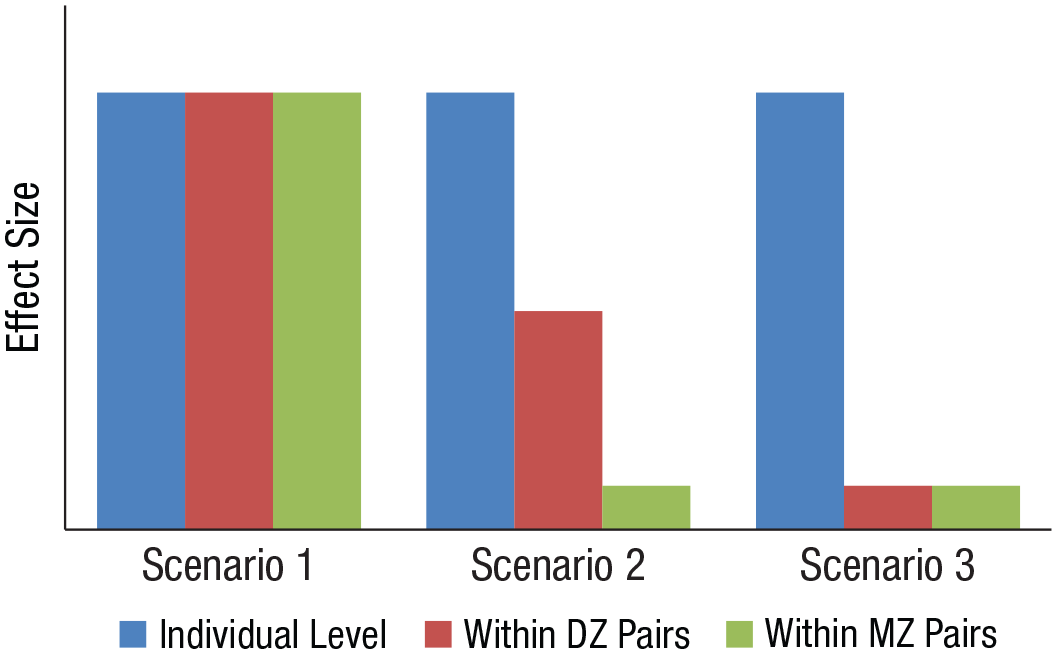
Hypothetical co-twin control results for the association between harsh parenting and children’s antisocial behavior. In Scenario 1, the association is solely environmental in origin. In Scenario 2, the association is attributable to genetic confounds. In Scenario 3, the association is both genetic and shared environmental in origin. DZ = dizygotic; MZ = monozygotic.
We ran our co-twin control analyses within a specification-curve framework (Simonsohn et al., 2019). Specification-curve analysis is an exhaustive modeling approach that avoids the noise and bias introduced by different data decision points by jointly evaluating all reasonable specifications of the data and identifying those decisions that are most consequential. The first step is to identify the set of reasonable specifications (e.g., Which informant should we examine?) and generate an exhaustive combination of those decisions. In the primary sample, we focused on the following: (a) the measurement of harsh parenting (the full Parent–Child Conflict scale or the hitting-in-anger item), (b) the measurement of antisocial behavior (Aggressive Behavior scale, Rule-Breaking Behavior scale, or Semistructured Clinical Interview of antisocial behavior in general, the latter of which was available only for twin reports), (c) the informant report used to assess antisocial behavior (mother, father, teacher, twin self-report, a composite of all family members, a composite of adult informants, or a composite of all informants), (d) the informant report used to assess harsh parenting (mother, father, twin, a composite of adult informants, or a composite of all informants), (e) the normalization of antisocial behavior (whether we examined raw data—skews ranged from 1.26 to 3.91—or data that had been log-transformed to better approximate normality—skews ranged from −0.48 to 1.72), and (f) potential demographic covariates (sex, age, ethnicity, or no covariates).
When we examined all possible combinations of each decision point, there were 1,040 possible specifications. We ran all possible combinations and then summarized the results across various specifications. We focused here on several sets of results, including median and mean effect sizes (i.e., unstandardized regression coefficients) across all specifications, their 95% confidence intervals (CIs), the percentage of p values less than .05, and the median p value. We also converted each p value to a z score (a z score of 1.96 corresponds to p = .05) and then computed the average z score. To accommodate the different sample sizes for various informants in our primary sample, we weighted all averages by sample size. To determine the statistical significance of our effect sizes, we simultaneously evaluated four indicators, reasoning that universal agreement among them would indicate that the effect size could be interpreted as statistically significant at a p value of less than .05. An effect was deemed significant if neither set of 95% CIs overlapped with zero, the median p value was less than .05, and the average z score was greater than 1.96. Alternatively, an effect was deemed nonsignificant if both sets of 95% CIs overlapped with zero, the median p value was greater than .05, and the average z score was less than 1.96. When the four indicators did not agree, we conservatively interpreted the effect as likely nonsignificant.
We then repeated our analyses in the replication sample. In this sample, we focused on the following: (a) the measurement of harsh parenting (the full Parent–Child Conflict scale or the hitting-in-anger item), (b) the measurement of antisocial behavior (Aggressive Behavior scale, Rule-Breaking Behavior scale), (c) the normalization of antisocial behavior (raw data—skews ranged from 1.70 to 1.79—or log-transformed—skews ranged from .69 to .87), and (d) potential demographic covariates (sex, age, ethnicity, or no covariates). When we examined all possible combinations of each decision point, there were 32 possible specifications. As above, we ran all possible combinations via regression models in multilevel modeling and then summarized the results across various specifications. Because the sample size did not meaningfully vary across specifications, all averages were simple averages.
All analyses were conducted using multilevel modeling in Mplus (Version 8.4; Muthén & Muthén, 2019) to accommodate the nestedness of the data. The MplusAutomation package (Hallquist & Wiley, 2018) in the R programming environment (Version 3.6.0; R Core Team, 2019) was used to facilitate the specification-curve analyses. Because multilevel-modeling coefficients are unstandardized, we standardized all depen-dent variables (i.e., the various operationalizations of children’s antisocial behavior) to have a mean of zero and a standard deviation of 1.0 to facilitate interpretation of the fixed-effects estimates. Full-information maximum-likelihood estimation with robust standard errors was used to provide unbiased estimates in the face of the small amount of missing data (Enders, 2001).
Results
Primary sample
Twin difference-score correlations in our primary sample are presented in Table 1, separately by zygosity, both overall and for each of our core specifications. Within monozygotic twins’ families, differences in parental harshness were positively associated with differences in children’s antisocial behavior in most cases (across the 1,040 analyses within monozygotic pairs, the mean and median rs were .14–.15, of which 63% were significant at p < .05). Moreover, the median p value was less than .05, the average z score was greater than 1.96, and neither the mean nor the median 95% CIs overlapped with zero. These positive findings persisted across nearly all data specifications, including all of the various operationalizations of children’s antisocial behavior and harsh parenting, the different approaches to addressing nonnormal distributions in the antisocial-behavior data, and nearly all informant reports for both antisocial behavior and parenting. However, they did not persist across teacher reports of children’s antisocial behavior or children’s reports of harsh parenting, a pattern of findings that was observed in both monozygotic and dizygotic twin pairs. Despite these two exceptions, the overall pattern of results collectively offers compelling preliminary evidence that the monozygotic twin who received harsher parenting also exhibited higher levels of antisocial behavior relative to his or her co-twin. Moreover, because monozygotic twins are genetically identical, such findings cannot reflect genetic differences between the twins.
Twin-Difference Correlations in the Primary Sample
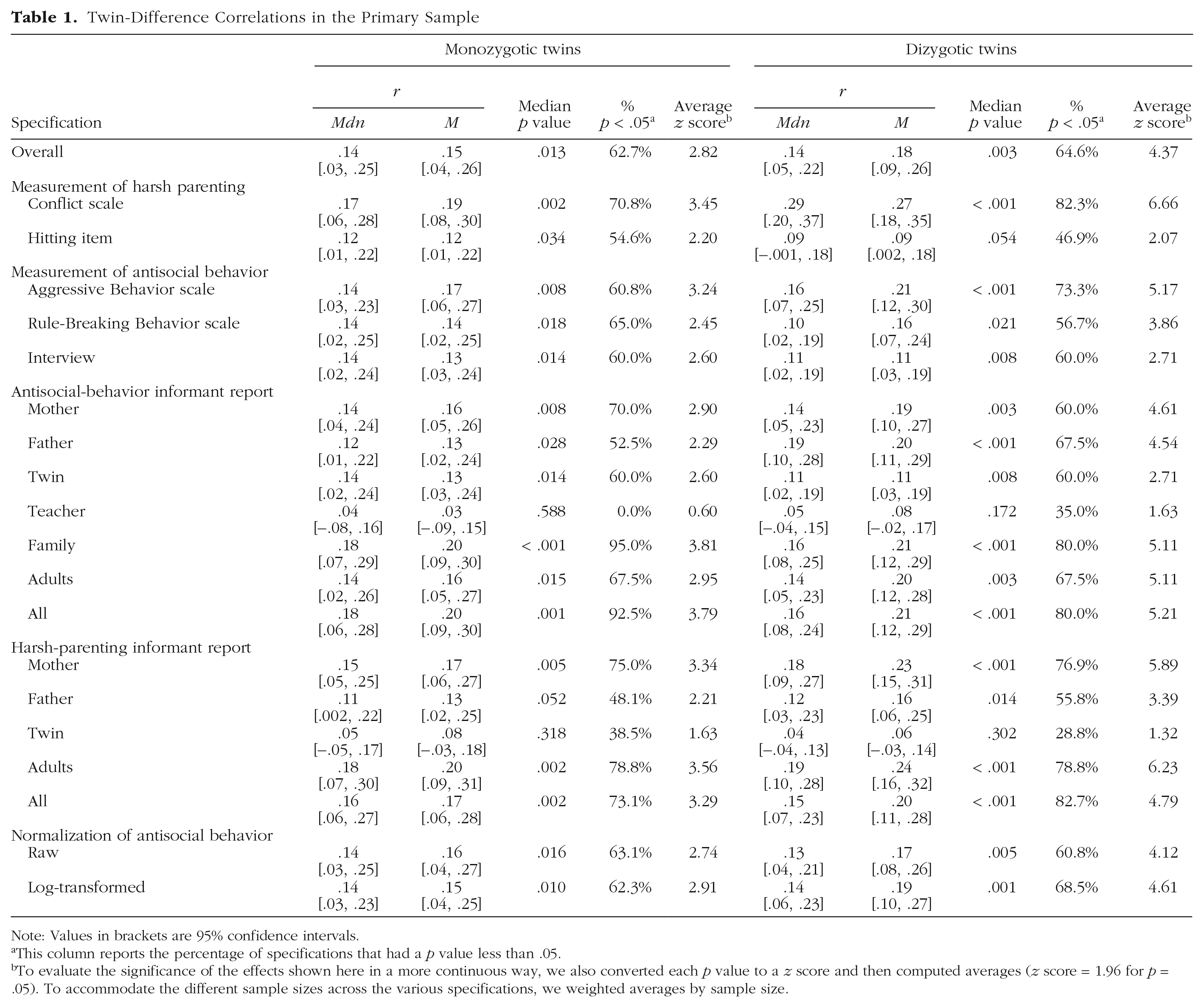
Note: Values in brackets are 95% confidence intervals.
This column reports the percentage of specifications that had a p value less than .05.
To evaluate the significance of the effects shown here in a more continuous way, we also converted each p value to a z score and then computed averages (z score = 1.96 for p = .05). To accommodate the different sample sizes across the various specifications, we weighted averages by sample size.
Co-twin control results formalized these preliminary findings via a multilevel-modeling regression framework that adjusted for mean family exposure, thereby ensuring that within-pair effects were not a function of any family-level differences. Results are reported in Tables 2 and 3 and plotted in Figure 2. Across all data specifications, we found that the median monozygotic estimate was 0.07 (median 95% CI = [0.01, 0.13]), whereas the mean monozygotic estimate was 0.16 (mean 95% CI = [0.02, 0.30]). These monozygotic within-pair beta weights were typically statistically significant, as indicated by a median p value of less than .05, an average z score greater than 1.96, and the fact that neither the mean nor the median 95% CIs overlapped with zero. As above, this pattern of results for monozygotic pairs persisted across almost all model specifications. We observed significant within-monozygotic-pair effects for both hitting in anger and parent–child conflict, for all operationalizations of children’s antisocial behavior, for both raw and log-transformed antisocial-behavior data, and for nearly all informants (i.e., mother, father, twin, and all composite reports of antisocial behavior, and mother, father, and both composite reports of harsh parenting). The overall pattern of findings in monozygotic twins thus clearly points to environmental mediation of the relationship between antisocial behavior and harsh parenting.
Co-Twin Control Analyses in the Primary Sample
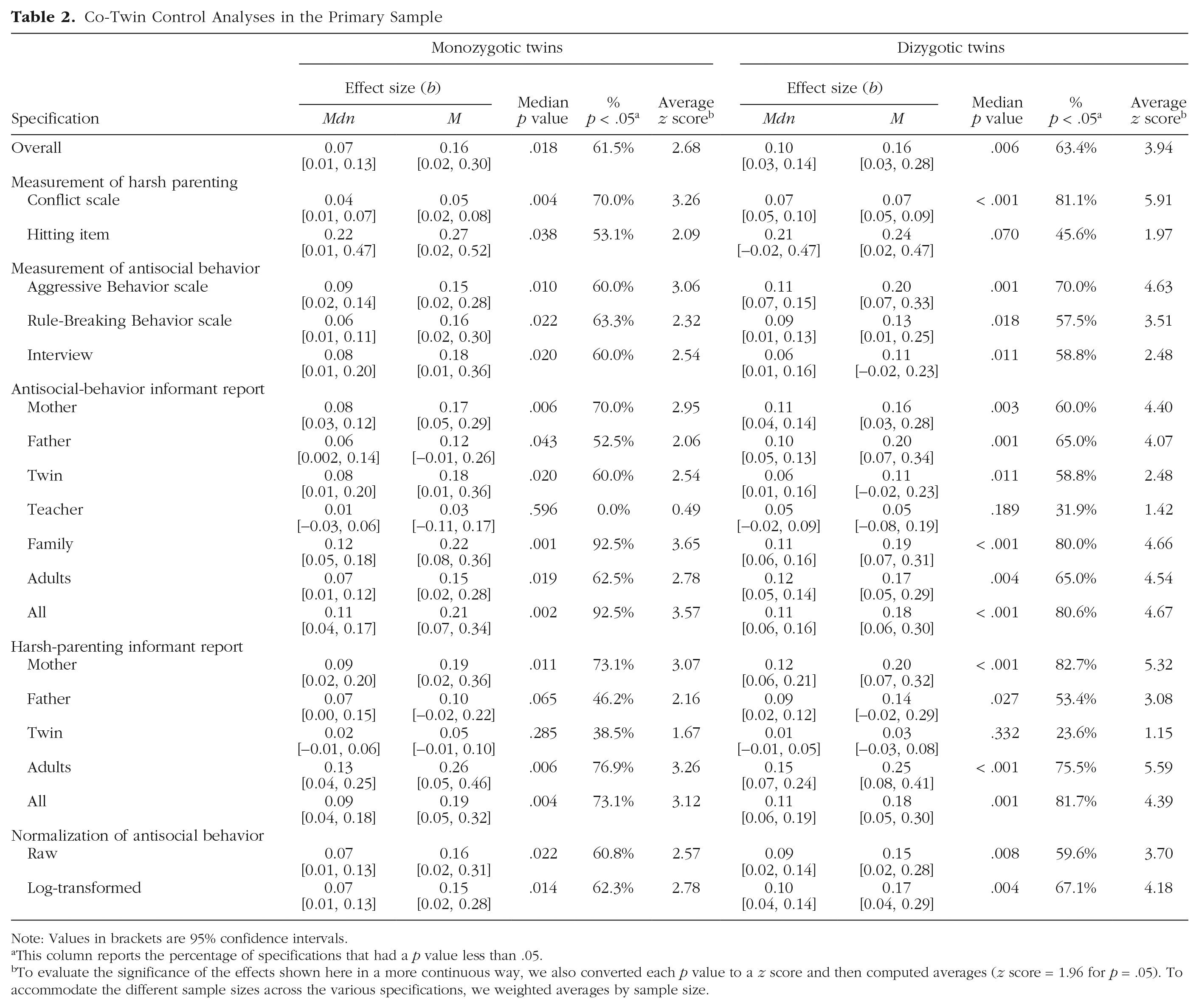
Note: Values in brackets are 95% confidence intervals.
This column reports the percentage of specifications that had a p value less than .05.
To evaluate the significance of the effects shown here in a more continuous way, we also converted each p value to a z score and then computed averages (z score = 1.96 for p = .05). To accommodate the different sample sizes across the various specifications, we weighted averages by sample size.
Co-Twin Control Zygosity by Differential-Exposure Interaction Term in the Primary Sample
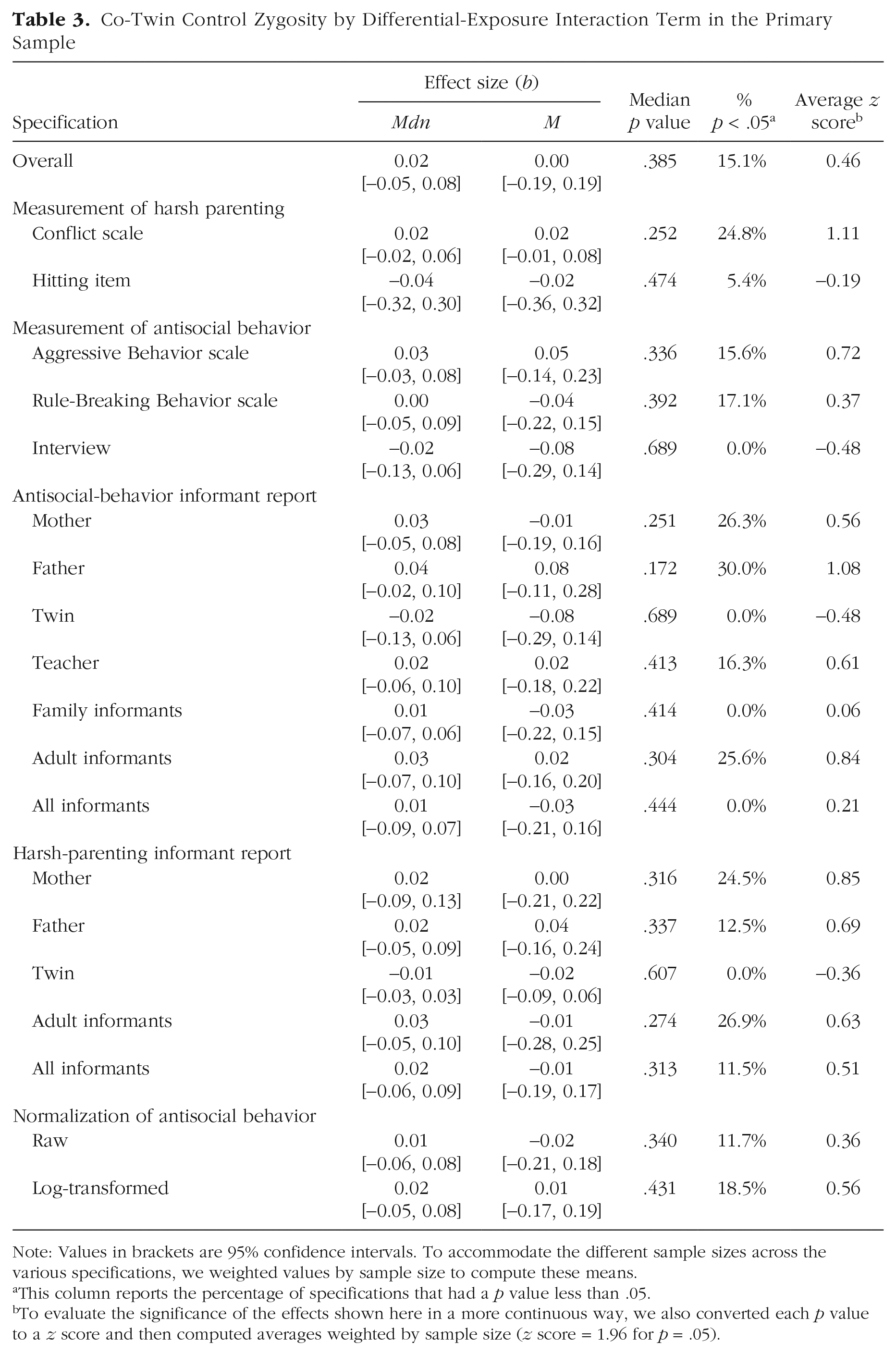
Note: Values in brackets are 95% confidence intervals. To accommodate the different sample sizes across the various specifications, we weighted values by sample size to compute these means.
This column reports the percentage of specifications that had a p value less than .05.
To evaluate the significance of the effects shown here in a more continuous way, we also converted each p value to a z score and then computed averages weighted by sample size (z score = 1.96 for p = .05).
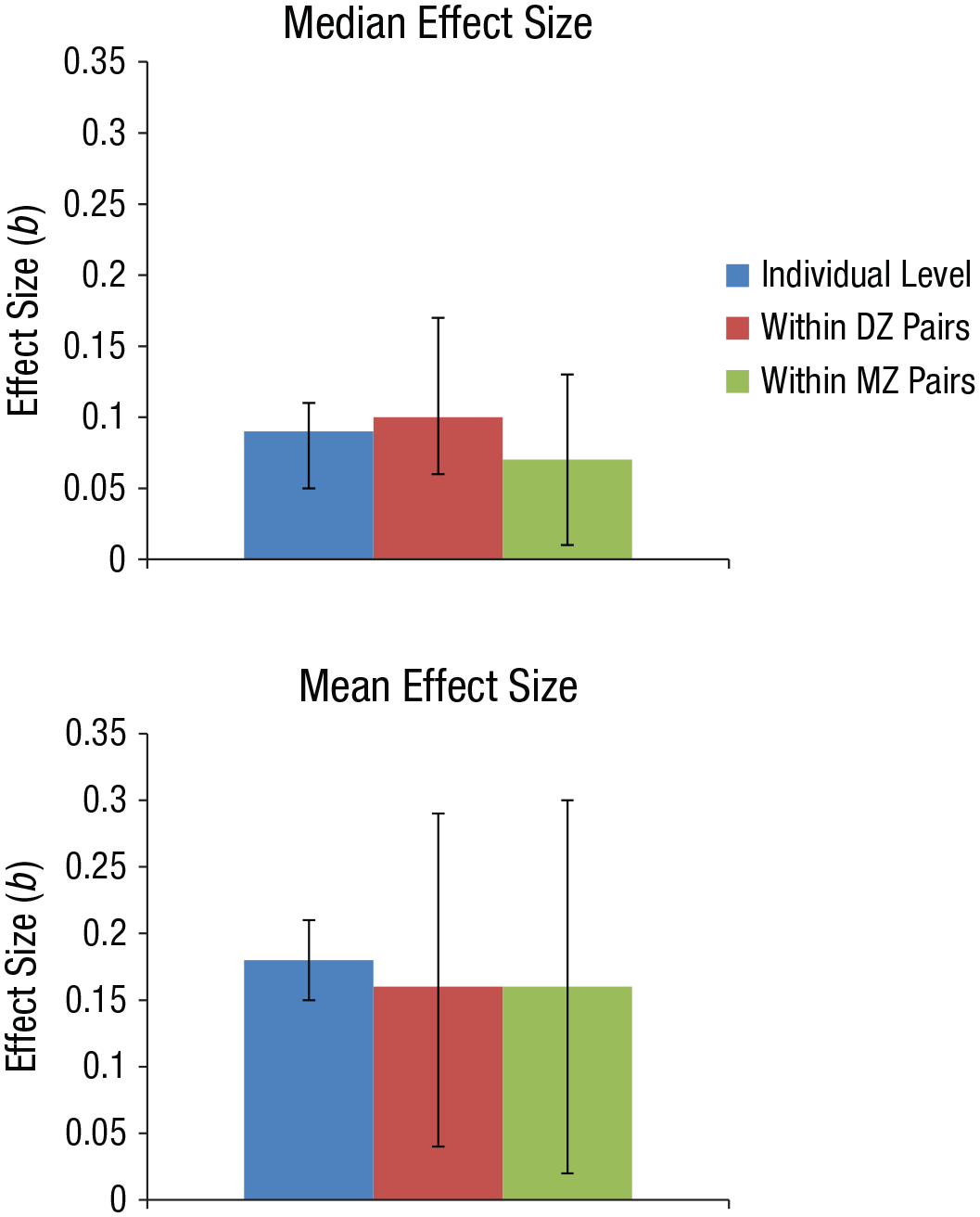
Observed co-twin control results for the association between harsh parenting and children’s antisocial behavior in our primary sample. Median and mean effect sizes are shown separately. Error bars represent 95% confidence intervals. DZ = dizygotic; MZ = monozygotic.
Support for environmental mediation was further bolstered by the findings for dizygotic twins, which were equivalent in magnitude to those for monozygotic twins (e.g., the mean b was 0.16 for both monozygotic and dizygotic pairs, whereas the median b for dizygotic pairs was 0.10 compared with 0.07 for monozygotic pairs). Indeed, as seen in Table 3, the within-pair estimates were never larger for dizygotic twins than for monozygotic twins (i.e., all differences approached zero and were clearly nonsignificant). Such nonsignificant findings contradict the additional presence of genetic influences on the association between harsh parenting and children’s antisocial behavior and further bolster support for primarily environmental mediation of their association.
There were two exceptions to this otherwise robust pattern of results. Neither differential teacher reports of children’s antisocial behavior nor differential twin reports of harsh parenting demonstrated significant within-pair associations in either monozygotic or dizygotic pairs. In making sense of these findings, it is worth noting that (a) the difference between monozygotic and dizygotic within-pair estimates remained nonsignificant in those cases as well, and (b) the estimated individual-level effect sizes (bs) for those specifications were 0.04 (median) and 0.07 to 0.08 (mean). Thus, rather than pointing to the presence of genetic or shared environmental confounding for those specifications (i.e., Scenarios 2 or 3 in Fig. 1), these results instead seem to reflect a minimal within-family and phenotypic association for those two specifications.
Replication sample
To confirm these results, we ran the above analyses again in an independent sample. Across the various specifications, monozygotic-twin-difference correlations between antisocial behavior and harsh parenting ranged from .30 to .52 for the overall conflict scale (all were significant by all four indicators) and .15 to .22 for the hitting-in-anger item (in this case, however, associations only between hitting in anger and aggressive behavior were significant across all four indicators, perhaps because of lower power given the small sample size). Similarly sized difference-score correlations were observed in dizygotic twins (twin-difference rs ranged from .16 to .40 across all specifications), pointing again to the likely presence of environmental mediation. The results from our co-twin control analyses confirmed these suspicions (see Table 4); there was again consistent evidence of a significant within-pair association between harsh parenting and children’s antisocial behavior in monozygotic pairs. This pattern of results persisted across all specifications (save one), including both hitting in anger and the Parent–Child Conflict scale and the raw and log-transformed antisocial-behavior data. However, there was evidence that associations were more robust when we examined aggressive behavior as opposed to rule-breaking behavior. Results were equivalent in magnitude in dizygotic pairs, although most of the dizygotic within-pair effects were nonsignificant. Regardless, when viewed alongside the results in our primary sample, findings in our replication sample collectively provide strong evidence in favor of environmental mediation of the relationship between harsh parenting and children’s antisocial behavior.
Co-Twin Control Results in the Replication Sample
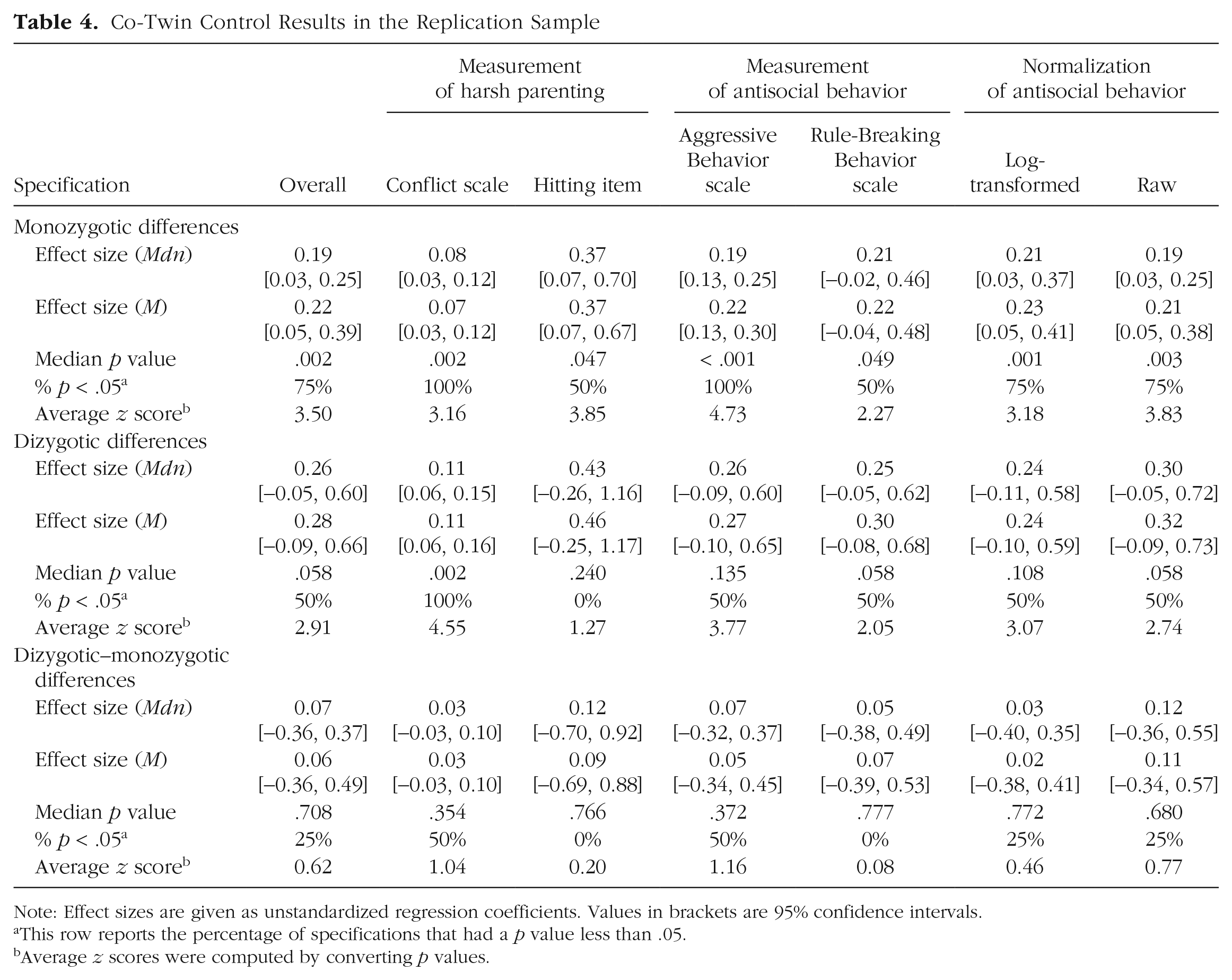
Note: Effect sizes are given as unstandardized regression coefficients. Values in brackets are 95% confidence intervals.
This row reports the percentage of specifications that had a p value less than .05.
Average z scores were computed by converting p values.
Discussion
The possibility that genetic confounds underlie the association between harsh parenting and children’s antisocial behavior has cast some doubt on whether harsh parenting broadly, and hitting children specifically, truly causes deterioration in children’s behavior (Larzelere, Gunnoe, & Ferguson, 2018). Carefully evaluating this possibility is critical, given the significant policy implications of this work (e.g., banning physical punishment). Using a genetically informed twin-differences design, we found that the link between harsh parenting and children’s antisocial behavior is, to a strong degree, environmental in origin. Results were not dependent on the conceptualization of antisocial behavior (e.g., aggression vs. rule breaking) and the type of parenting measured (e.g., a broader dimension of harshness vs. hitting in anger) and were robust, for the most part, across informants and other analytic decisions. The strength and consistency of these results are striking given the strong sampling frames (birth records), the inclusion of one sample oversampled for exposure to disadvantage and a replication sample, the use of an exhaustive modeling approach, and the use of a genetically informed counterfactual model.
Of note, this is the first study to use a co-twin control design that capitalizes on differences in physical punishment (in this case, hitting in anger) between twin siblings to isolate environmental contributions to its association with antisocial behavior. Our results build on meta-analyses of observational studies (Gershoff & Grogan-Kaylor, 2016) and several studies that used a variety of designs to approximate experiments (Beauchaine, Webster-Stratton, & Reid, 2005; Boutwell, Franklin, Barnes, & Beaver, 2011; Deater-Deckard, Ivy, & Petrill, 2006; Gershoff, Sattler, & Ansari, 2018; Lynch et al., 2006; Okuzono, Fujiwara, Kato, & Kawachi, 2017) to show that twin differences in exposure to physical punishment are associated with twin differences in levels of children’s antisocial behavior, even when genetics are held constant through monozygotic twin comparisons.
Despite these strengths, several limitations are noted. First, our measure of physical punishment did not directly assess spanking, the most common form of physical punishment by parents. However, spanking is a form of hitting (Gershoff, 2013), and thus, the use of the term hit was appropriate. Although use of the qualifier in anger could be tapping something closer to physical abuse, most parents admit that the main reason they physically punish their children is because they are angry at them (Gershoff, Miller, & Holden, 1999). Thus, our hitting-in-anger item likely tapped into parents’ everyday use of physical punishment. Second, given that both harsh parenting and children’s antisocial behavior manifest differently across development (Klahr & Burt, 2014; Burt & Neiderhiser, 2009), the current results should be considered specific to childhood and perhaps adolescence. Indeed, given that physical punishment is most common during the preschool years (Zolotor, Robinson, Runyan, Barr, & Murphy, 2011), our findings may underestimate the true effect of physical punishment on antisocial behavior. Third, we note that our study was underpowered to detect the median interaction value between zygosity and differential exposure in the co-twin control analyses with a sample of our size. A Monte Carlo simulation in Mplus estimated that we would need approximately 2,220 pairs to detect an effect of this magnitude with 80% power. However, we note that should the differential-exposure effects have been more consistent with genetic mediation as represented in Figure 1, Scenario 2 (e.g., median monozygotic within-pair b = 0.00, median dizygotic within-pair b = 0.05, median-zygosity/differential-exposure interaction term = 0.05), we would have 87.1% power to detect the interaction term in our primary sample. In short, our results do seem to be indicative of environmental mediation.
Finally, although co-twin control analyses are ideally suited for confirming environmental mediation over and above potential genetic confounds (Petersen & Lange, 2020), the design is not without its limitations. Nonshared confounders can bias effect estimates upward, whereas measurement error can bias effect estimates downward (Frisell, Öberg, Kuja-Halkola, & Sjölander, 2012). In short, although we can now be confident that the association between antisocial behavior and harsh parenting is largely environmental (nongenetic) in origin, we cannot make any causal attributions to their association from these data. We also cannot make any conclusions regarding the direction of the association (parenting to antisocial behavior or vice versa) given the cross-sectional nature of these data, although prior studies using propensity-score matching have suggested that the directionality is from harsh parenting to antisocial behavior (e.g., Gershoff et al., 2018).
Despite these limitations, the current study provided a critical test of whether various instantiations of harsh parenting are environmentally related to children’s antisocial behavior. The results convincingly show that these associations are, to a significant degree, environmental in origin; harsh parenting, including hitting in anger, is associated with increases in children’s antisocial behavior for nongenetic reasons. Our findings are consistent with recent policy initiatives, including the recent policy statements by the American Academy of Pediatrics (Sege et al., 2018) and the American Psychological Association (2019); recommendations from the Centers for Disease Control and Prevention for educational and legislative means of reducing physical punishment to prevent physical abuse (Fortson et al., 2016); and national bans on physical punishment in 60 countries (Global Initiative to End All Corporal Punishment of Children, 2020). Moreover, these results support further efforts to prevent antisocial behavior by decreasing the use of harsh parenting techniques and emphasize that physicians and public health officials should work to change attitudes and behaviors related to harsh parenting in order to promote the health and well-being of children.
Footnotes
Acknowledgements
We thank the staff of the twin projects for their hard work, and we thank the families who participated in these twin studies for sharing their lives with us.
Transparency
Action Editor: Brent W. Roberts
Editor: D. Stephen Lindsay
Author Contributions
S. A. Burt, E. T. Gershoff, and L. W. Hyde jointly developed the study concept. S. A. Burt and K. L. Klump designed the overall study and collected the data. D. A. Clark analyzed the data; S. A. Burt interpreted the results. S. A. Burt wrote the majority of the manuscript; E. T. Gershoff and L. W. Hyde wrote some sections and assisted with preparation of the manuscript. All the authors provided critical revisions and approved the final manuscript for submission.
