






Abstract
This article argues that ER systems in the care sub-sectors in both countries offer social partners opportunities to influence job quality and that the trade unions’ efforts have played important roles in limiting wage dispersion and in recent wage increases. Marketization is a challenge to job quality, especially in the Netherlands, but even in the most marketized sub-sector, the Dutch ECEC, ER actors and institutions have limited the deterioration of job quality. Nevertheless, wages are still relatively low for some groups, and the social partners have not been able to prevent job quality problems such as work intensification. This mirrors that factors other than ER and marketization in and beyond the trilemma, including budget constrain and labour shortage, also influence job quality and constrain the actions of social partners.
Keywords
Introduction
As ageing populations, budget restraints and labour shortages strain care services in the welfare state, it becomes crucial to explore how job quality, service provision, and the role of employment relations (ER) actors are interconnected. These factors impact the sustainability of care systems because they are essential to maintain adequate service coverage and the well-being of workers and care recipients alike.
This article focuses primarily on the understudied role of ER in explaining job quality (in terms of wages, employment types, and working conditions) to attract and retain employees in the care sector as deteriorating job quality might spill over to bad service quality. Moreover, this article explores how ER actors in Denmark and the Netherlands navigate the complex balancing act in the broader ‘care trilemma’ between the three poles of job quality, public budget constraints and service coverage (Mori et al., this volume; Iversen and Wren, 1998; Pavolini et al., 2013).
Although differences between the two countries exist with regard to the powers of the trade unions and the extent of marketization, both countries have labour markets with strong roles for the social partners and collective agreements (CAs), and welfare states with high levels of public spending and elements of the universalist regime. We expect that the social partners continue to be involved in welfare state reforms and collective bargaining in the care sector to protect job quality.
Research on ER in the care sector in these otherwise well-studied countries remains scarce. In accordance with the theme of the special issue, we will therefore, through a comparative analysis, provide new insights into the social partners’ responses to job quality problems, their actions, and results in collective bargaining, and the tensions that arise with other poles of the care trilemma (service coverage and public constraints).
The article has two objectives. First, to fill the descriptive gap in the literature we analyse the main characteristics of ER and job quality in two specific and less researched sub-sectors within the care sector – long-term care (LTC) and early childhood education and care (ECEC) – in the two countries. Second, to analyse the influence of ER actors and institutions on job quality in the two sub-sectors in the two countries vis-à-vis other poles in the trilemma.
The article argues that ER systems in the care sub-sectors in both countries offer social partners opportunities to influence job quality and that the trade unions’ efforts have played important roles in limiting wage dispersion and in recent wage increases. Marketization is a challenge to job quality, especially in the Netherlands, but even in the most marketized sub-sector, the Dutch ECEC, ER actors and institutions have limited the deterioration of job quality. Nevertheless, wages are still relatively low for some groups, and the social partners have not been able to prevent job quality problems such as work intensification. This mirrors that factors other than ER and marketization in and beyond the trilemma, including budget constrain and labour shortage, also influence job quality and constrain the actions of social partners.
Next, we review ER and welfare state research related to LTC and ECEC in the two countries and identify important knowledge gaps on ER systems and job quality. We then describe the methods used. The following section outlines the main ER actors and institutions in the two care sub-sectors, followed by an analysis of job quality and a discussion of the role of ER compared to other influencing factors. The final section concludes.
State of the art in Danish and Dutch care studies
Denmark
The ER literature covering the LTC, and especially ECEC, parts of the Danish care sector is limited. Some relevant ER studies cover the care sector, although they are not limited to this. Mori (2020) found in the Danish part of her comparative study of outsourced public services that whole staff group (such as cleaners or technical assistants) was transferred during outsourcing and that their conditions of employment remained almost unaltered after outsourcing. This was facilitated by the strong bargaining tradition in both the private and the public sectors combined with regulation supporting the coverage of outsourced services. The strong (local) union presence has also in other studies proven important in relation to Danish processes of public procurement, especially in mediating the effect of outsourcing, job quality and solidarity (Jaehrling et al., 2018; Mori, 2024). On similar lines, De la Porte et al. (2023) showed the importance of unions in pushing back against cutbacks in ECEC spending and lowered service quality and working conditions among ECEC staff. Mailand and Thor Larsen (2017) covered both LTC and health care (hospitals) in a study of reform and crisis impacts on ER and job quality in the Danish public sector. They found in both sub-sectors a development towards more conflictual ER, work intensification challenges and a high level of non-standard employees, but more risk of precariousness in LTC than in the hospitals. In a comparative case study of nursing homes in Denmark and Sweden, Hedenus and Rasmussen (2021) confirmed several of these LTC-related findings in their Danish case but also pointed to the (mis)use of on-call temps and constraints in the form of both skills and labour shortages. Larsen and Ilsøe (2024) analysed platform-work and found this type to be marginal in LTC so far.
The welfare state and public administration literatures describe the Danish welfare state as historically characterized by universalism. However, in eldercare universalism has to some extent come under pressure in recent decades as service coverage has declined (Rosgaard and og Matthiessen, 2019), while the coverage of childcare in Denmark in the same period increased towards 100% (Szebehely and Meagher, 2013). Indeed, De la Porte et al. (2023) have described ECEC in the Nordic countries as a ‘flagship of the social investment state’ that emphasizes universal access and lifelong skill development through high-quality integrated care and education services. Moreover, in 1994, Denmark was the first Scandinavian country to introduce a tax credit for users of home care with the aim of enhancing job growth in the lower echelons of the labour market (Kvist, 2012).
Publications from these traditions have seldom included analyses of ER-related issues within the Danish care sector, with the exception of a number of studies from the Danish Center for Social Science Research, such as Rostgaard and og Matthiesen’s (2016) nation-wide study of the working conditions in LTC in 2005 and 2015 showing worsening of conditions in 9 out of 10 dimensions in both home care and institutional care. On the 10th dimension, workload, a small decrease was found in home care and a large increase in institutional care. A number of studies have analysed the effect of outsourcing on working conditions in the public sector. With a cross-sector focus, Vrangbæk et al. (2013) found more negative than positive effects on outsourcing for employees, whereas Petersen et al. (2021) showed that outsourcing significantly decreased employee remuneration and employment and increased public income transfers, while the effect on health service use was marginal and transitory. Focussing on LTC only, Rostgaard (2017) showed that working in (private) outsourced home care often involves a greater workload and a worsening of the psychological work environment, although private home helpers on a few parameters – such as support from the employee’s immediate manager and training – do better than their public sector colleagues. In sum, the publications provide indicators that outsourcing – which in most parts of the Danish welfare services are partial and limited – on most parameters leads to worse pay and conditions. Moreover, the mix of government policy and alliances among social partners (Jaehrling et al., 2018) and the agency of unions and public employers are crucial for understanding the outcomes of marketization on working conditions (Mori, 2024).
The Netherlands
The literature on ER in the care sector in the Netherlands is very limited. Leisink and Bach (2014) discuss the cuts in municipal budgets, while municipalities have been given additional tasks in care provision since 2008. Marino and Keizer (2022) argue, that contrary to the situation in the UK social dialogue and collective bargaining structures in the Netherlands maintain the discussion on the interrelations between quality of care and employment, including the need for satisfying terms and conditions of employment after earlier cutbacks in funding and the introduction of staffing norms (Marino and Keizer, 2022: 171).
More publications covering the care sectors can be found in the literatures on welfare states and public administration. Welfare states like the Dutch and the German have undergone more path-shifting experiences compared to their Nordic, Anglo-Irish, and Mediterranean counterparts during the post-war era (Di Carlo et al., 2025). Female labour market participation and childcare provision were for a long time at an extremely low level in the Netherlands because of the dominant male-breadwinner model. In the article ‘One welfare state, two care regimes’, Van Hooren and Becker (2012) analysed the different developments of childcare and elderly care in the Netherlands, reflecting the hybrid character of the Dutch welfare system, which, until the 1980s, featured both conservative elements (childcare) and social democratic elements (elderly care). Since 2005, the childcare sector has been reformed into a more liberal model. Bokhorst and Hemerijck (2023) argue that the combination of marketization in the service provision with public subsidies for the parents’ costs has made the Dutch childcare system one of the most expensive in Europe and that it reinforces the part-time preferences among women in many working families because of financial considerations.
Regarding LTC, several studies suggest that the public procurement model introduced in home care since 2007 has had negative effects on job quality, especially in the form of work intensification (Inspectie, 2019; Tros et al., 2025). During the COVID-19 pandemic, Van Hooren and Ledoux (2023) found that the resilience of homecare was undermined by fragmentation and marketization, limiting the government’s ability to respond adequately to new working conditions and labour shortages.
Knowledge gaps
Overall, the (limited) literature focussing on ER issues in LTC and ECEC has provided important knowledge. It is evident that the Dutch ECEC has never been universalistic. In Denmark, both sub-sectors are universalistic, although service coverage has declined in LTC. Moreover, studies indicate the importance of trade unions, collective bargaining and other forms of regulation for job quality. The job quality issue, however, has mostly been analysed in relation to outsourcing and marketization processes, where mostly negative effects have been found in both countries, although the Danish studies include more nuances. However, the literature leaves substantial knowledge gaps about the article’s aims of describing ER systems and job quality in LTC and ECEC and analysing the role of ER institutions vis-à-vis the other poles in the trilemma.
Methodology
For the empirical analyses, we adopted a multi-comparative case study approach (Eisenhard, 1989). We compare across countries and sub-sectors and across the factors identified in the care trilemma while maintaining priority to analysing how ER shape job quality within the sectors relative to the other factors.
Case selection
The Danish and Dutch labour market models show significant similarities, including relatively high coverage of collective agreements, also in LTC and ECEC. However, trade union membership is far lower in the Netherlands than in Denmark, and the Danish labour market model of ‘organized corporatism’ has shown more resilience than the similar Dutch ‘social partnership’ model. The organizational density of unions in the Dutch care sector declined from 24% to 20% in the period 2011–2022 and is estimated to be 15% in ECEC and LTC. Furthermore, legislative interventions play a more prominent role in shaping the Dutch labour market than the Danish (Mailand, 2020; ICTWSS Database; Visser, 2009) 1 .
Main characteristics of the models in countries and sub-sectors.

In sum, although we cannot treat the two countries as most similar cases, they share sufficient similarities to create expectations of similar outcomes concerning the influence of ER actors on job quality. However, the differences in the welfare state models in ECEC might disturb the effect and cause less similarities in outcomes than what otherwise could be expected.
Data and analysis
Data collection for this study involved 72 semi-structured qualitative interviews with key decision-makers from employers’ associations, trade unions, companies, and national/local governments (see Appendix A for an overview). The interviews were approximately 1 hour long and were conducted either face-to-face or online. For the Danish case, 32 interviews were conducted, comprising 13 interviews at the sector level and 19 at the local government/enterprise level. In the Dutch case, 40 interviews were conducted, of which 15 were with representatives at the national/sectoral level and 25 at the local government/enterprise level. Complementing the interviews, data were collected from legislation, collective agreements (CAs), national statistics, policy reports, and secondary literature.
Data were first analysed with a specific focus on the role and strategies of unions and employers on ER outcomes (Mori, 2024) in the two care sub-sectors in the two countries. Second, we used the analytical framework of the care trilemma to set the findings on ER outcomes into a broader analytical frame (Mori et al., this volume).
ER actors and job quality outcomes
Actors and institutions in the two countries
Denmark
The main actors on the employers’ side include in both sub-sectors on the local level the municipalities and on the national level the Local Government Denmark (LGDK), the interest-organization of the municipalities. LGDK acts as a public employer, public authority, and service provider. Although an independent organization, the strategies of LGDK are strongly influenced by the state employer (Ministry of Finance). Private providers are organized in organizations such as the Confederation of Danish Industries (DI) and the Danish Chamber of Commerce (DE).
Although more than one union organizes employees in the two sub-sectors, the unions focus on different occupations. Hence, competition is limited. In LTC, the core trade union is FOA, organizing the care workers with an organizational density of around 85% – higher in the public sector and around 50% in the private sector. The Danish Nurses Organization organizes nurses with an estimated density of approximately 85%. In ECEC, the Association of Child and Youth Educators (BUPL) is the main trade union representing pedagogies. BUPL organizational density is estimated to be 80% in the public sector and 70% in the private sector. The trade union FOA organizes the groups of pedagogical assistants and day care workers with a density of around 73% (Hansen and Mailand, 2022: 32–34).
The labour market institutions grant the social partners a decisive influence on job quality. The total coverage of CAs in LTC is unknown but is estimated to be 100% in the public sector, high among the larger private suppliers and much lower among the smaller private suppliers. In ECEC, 100% of the employees working in the public sector are covered, whereas the estimate in the private sector part stands at 73%. Hence, limited uncovered pockets exist, in ECEC, for example, in the form of self-employed day cares, in LTC, for example, in the form of smaller private providers (Hansen and Mailand, 2022: 37–79). Social clauses aim to limit the job quality problem of the latter (e.g. Refslund et al., 2023). The regulation mechanism (tying wage development in the public sector to wage development in the private sector) implies difficulties for occupations to change their positions in the wage hierarchy. Partly due to this, wage compression is relatively high in the public sector and only around 10% of wages are decentralized. In sum, wage flexibility is limited, but a tripartite agreement from 2023 aims to improve it. Although working conditions are also mainly regulated by CAs, some of them (work environment, holidays, terms of notice, etc.) are regulated by legislation. Importantly, the elderly/care worker ratio, which is important for potential work intensification, is de facto mainly determined by budget constraints and municipal priorities.
Netherlands
Six organizations are involved in collective bargaining in LTC in the Netherlands. On the employers’ side, ActiZ is by far the largest, as it organizes almost all residential care providers. HomeCarenl represents (mostly commercial) SMEs in homecare and is a much smaller employer association than ActiZ. There are two cross-sectoral unions: FNV, which is the largest, and CNV. NU ’91 is the professional union for nurses and FBZ organizes higher-level professionals. The CAs in LTC are made generally binding for the whole sector by the government, including the unorganized companies. In 2022, around 5% of all workers in the sector were not covered because they are self-employed.
In the ECEC, four associations are involved in collective bargaining. The side of the employers include Branch-organization Childcare (BK) and Branch Association for Social Childcare (BMK). BK is the largest association, and it covers both for-profit and non-profit ECEC providers. BMK is only organizing non-profit organizations. It is estimated that both associations together organize around 75% of the employment in the sub-sector. Employers’ associations in the Dutch ECEC sector cover a wide variety of service providers with differences in ideology and financial strategy (business versus public oriented) and a mix of (many) small employers and (some) very large providers. On the workers’ side, only the cross-sectoral unions FNV and CNV are involved. In 2021, another business organization, the Branch Association for Entrepreneurs in Childcare (BVOK), signed an alternative low-cost CA with a ‘yellow’ union. This organization only represents for-profit SMEs, but their CA was overruled by the larger regular CA in ECEC because of the public extension mechanism. 2 Around 8% (2022) of the workers in ECEC are not covered by the CA because they are self-employed.
Both the CAs in the LTC and ECECs regulate standardized wage levels by profession and by years of job tenure, with no flexibility given at the decentralized level.
Job quality in the two care sub-sectors
Denmark
In LTC, the main occupations are nurses, highest qualified care workers, lower qualified care workers, and the unskilled care workers (Indenrigs-og Boligministeriets Benchmarkingenhed, 2022). Nurses and the large majority of care workers have completed formal education of at least 3 years duration. However, the proportion of unskilled care workers is rising due to severe recruitment problems. Part-time work (most often with 32 hours per week or more) is very widespread (Vinge og Tophold, 2021: 26) and 9 out of 10 employees in eldercare are women (KL, 2021).
As the literature review showed, there are indications that job quality has worsened among the LTC workers, partly due to work intensification. The reduction in job quality and work intensification was confirmed by the trade union interviewees, whereas it was questioned by employer interviewees. Sickness absence is high and increasing (especially among public sector providers) (KL, 2021; DI, 2018) and the feeling among care workers of being unable to deliver a quality service within the time allocated – reported in previous studies – was confirmed by the trade union interviewees, that furthermore pointed to the working conditions as one of the explanations for the widespread use of part-time employment among care workers.
The trade union interviewees reported less variation between public and private providers’ CAs and working conditions than the above-mentioned study by Rostgaard (2017) and pointed to the social clauses as one of the factors counteracting such differences. However, national statistics show substantially higher wages (including all benefits) among public sector providers compared to the private sector (Danmarks Statistik, 2018). This difference might be caused by the existence of a section of small private providers not covered by the CAs and not ‘lifted’ by the social clauses.
With regards to wages, LTC employees’ wage level was in 2018 at 84 % of the national average, which is a bit above the EU-average at 80% (Mori et al., this volume). A detailed study from the so-called Wage-structure Committee, which focused on management responsibility, job experience, and education of the various occupations, found the elder care workers’ wages to be around the expected level according to these three dimensions (Lønstrukturkomitéen, 2023). Moreover, the elder care workers were one of four occupations that via a tripartite agreement in 2023 received a substantial extra wage bonus at the public sector bargaining round in 2024. The bonus was justified by the extensive recruitment problems. What the bonus implies for the exact position of the care workers in the wage hierarchy has not yet been calculated.
In ECEC, the key groups are pedagogues, pedagogical assistants, day care assistants and family day carers. To become a pedagogue, akin to a ‘pre-school teacher’, and pedagogical assistants require 3–3 ½ year of education. Day care assistants have no formal training in childcare. Family day carers, employed municipally or privately, must be formally approved, but require no formal training. Part-time work (most often with 28 hours per week or more) is very widespread (KL, 2019b).
In day care centres, noise, psychosocial strain and lifting are specific challenges. For years, initiatives have focused on the physical and mental work environment, addressing factors such as indoor climate, noise, working postures, and lifting. The family day carer’s working environment challenges similarly include psychosocial aspects and strain from lifting and routine tasks. There is no clear documentation of the worsening of these conditions within the sub-sector, but local austerity post-2009 affected job quality, slightly reduced the staff-to-child ratio and increased reliance on less-trained staff. After strong lobbying from BUPL together with other associations in ECEC, the government introduced minimum staffing requirements in 2020, but their impact on job quality remains uncertain.
ECEC employees’ (pre-primary schoolteachers) wage level was in 2022 63% of the national average, which is below the EU-average at 75% (Mori et al., this volume). Female-dominated ECEC groups have argued for the existence of a historical gender wage gap. The above-mentioned report by the Wage-structure Committee placed most childcare providers below the expected level according to the three dimensions (Lønstrukturkomitéen, 2023). Like the LTC workers, the pedagogues received an extra wage bonus at the public sector bargaining round 2024 related to a tripartite agreement from 2023, which might change their position in the wage hierarchy.
The Netherlands
Summary of key figures and job quality outcomes.
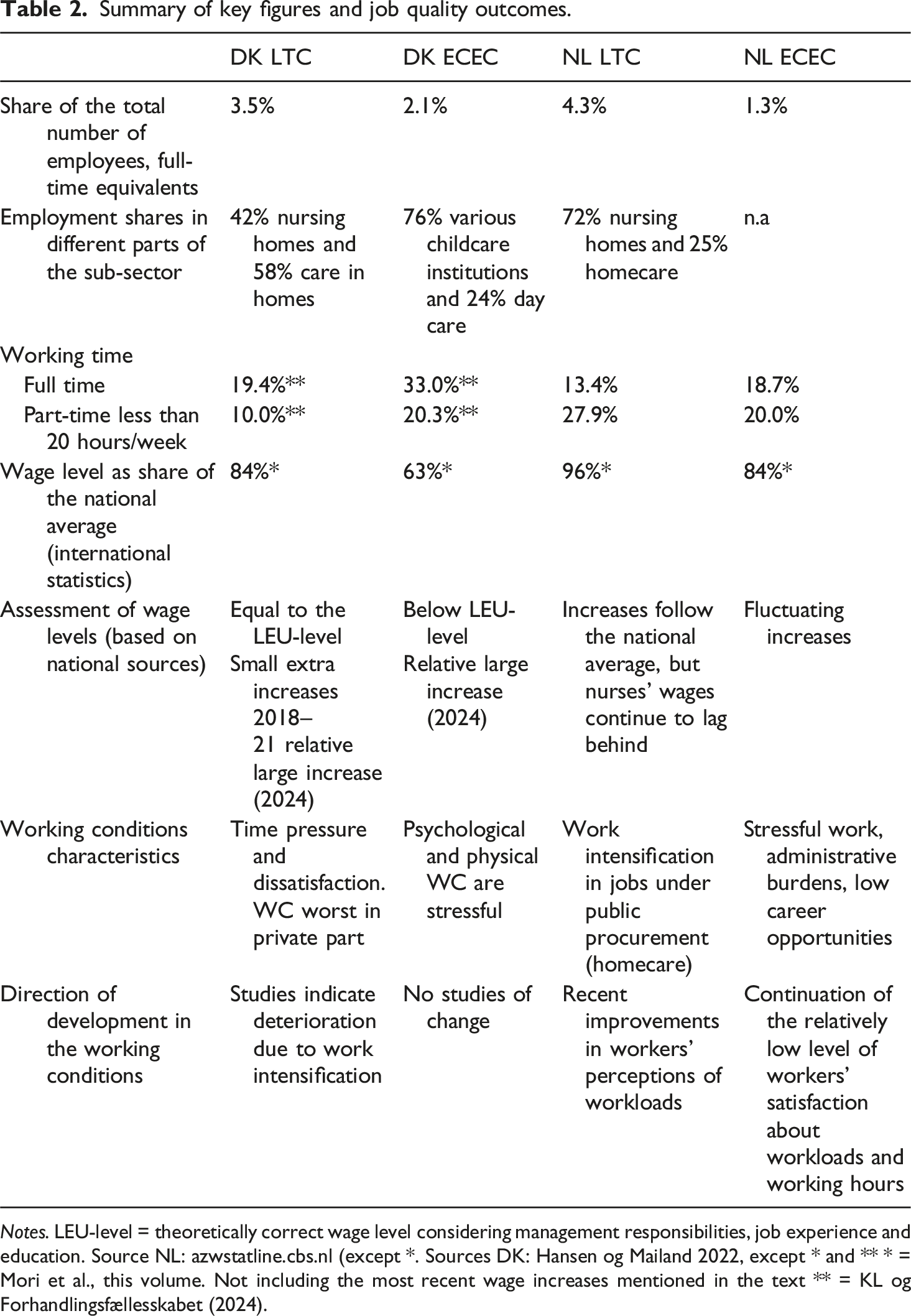
Notes. LEU-level = theoretically correct wage level considering management responsibilities, job experience and education. Source NL: azwstatline.cbs.nl (except *. Sources DK: Hansen og Mailand 2022, except * and ** * = Mori et al., this volume. Not including the most recent wage increases mentioned in the text ** = KL og Forhandlingsfællesskabet (2024).
The share of part-time work is extremely high and is one of the main reasons why many LTC workers have a low income and experience problems in paying regular bills (FNV, 2023). The Netherlands still has a strong part-time culture among women, and the Dutch tax system requires a large increase in the number of hours in marginal part-time contracts before income really improves. According to unions, inconvenient working hours and high workloads in the sector are also reasons why many workers choose part-time contracts with few hours.
All interviewed employers’ organizations and unions agreed on the problems of low wages in general and the low income of part-time workers in LTC. The salary levels of nurses in LTC continued to be structurally 6–9% lower than similar functions in other parts of the public and private sector (SER, 2021). The governmental policy to follow the average wage development in the private sector and the social partners’ tradition to agree on one uniform percentage of wage increase do not level out these gaps, but reproduces them.
Furthermore, social partners in LTC mentioned persistent problems of too high workloads, work-related stress, and time pressure (interviews ActiZ, FNV1, Homecarenl, Nu ’91). FNV sees a direct correlation between procurement practices and the high workload in home care. ‘Employers’ focus on value for money places unreasonable demands on staff, and employees feel like they have to check their phones 24/7, deciding when and where to work’ (interview FNV1). Other problems, especially those raised by FNV, are the inconvenient and unpredictable working hours for employees in LTC. Recent statistics show improvements in workers’ satisfaction on job quality indicators in LTC, such as sufficient payments, workloads, and working hours, which align with home situations in the last 5 years (Statistics Netherlands, 2025).
The Dutch ECEC accounted in 2023 for only 1.3% of the total number of employees in the Netherlands in full-time equivalents, illustrating the less universalistic character of the ECEC model (see Table 2). Since 2010, the sub-sector has suffered from high fluctuations in the number of workers, reflecting the marketized nature of the sub-sector with lower demands in ECEC facilities in times of economic downturn and cuts in the tax bonus for parents (Van Hooren, 2021). The high staff turnover in the sub-sector is also related to dissatisfaction among child educators with terms and conditions of employment, in particular the lack of career opportunities and education and training facilities (Van Den Tooren et al., 2019) and stressful work. The job structure in Dutch ECEC is not very differentiated and includes a relatively low share of assistants. Because of the high number of marginal part-time employees, several employees experience income problems in Dutch ECEC.
Both the unions find that work-related stress has increased in the last years and that the unpredictability of working hours leads to work-life balances among part-time workers. CNV sees low resistance of workers in ECEC workplaces when they are confronted with specific demands by the employer and do relate this to the opacity of the CA regulations. ECEC workers have many administrative tasks, such as reporting the cognitive and emotional developments of children, but experience low professional autonomy. However, the social partners cannot influence these legal requirements. Collective bargaining partners have only made small steps in improving the CA in the sector, but the sector continue to be covered by the CA. Contrary to LTC, the workers’ perceptions in ECEC on payments, workloads and working hours that align with the home situation did not improve in 2019–2024 (Statistics Netherlands, 2025). The stagnation in improving job quality through collective bargaining can partly be explained by the pressure of the marketized model in ECEC provision and the related fragmentation between employers’ associations having different ideas about labour costs and service quality.
The role of ER and other factors in explaining job quality
The explanatory power of ER
Institutions
In both countries, the social partners have a decisive influence on job quality. Regular collective bargaining rounds are a platform for social partners to address specific job quality problems. Furthermore, the high coverage of collective bargaining has benefited the job quality, including in outsourced services, as most large suppliers are covered. However, especially in Denmark, limited uncovered pockets exist, in ECEC, for example, in the form of self-employed day cares, in LTC, for example, in the form of smaller private providers. Social clauses in Denmark aim to limit the job quality problem of the latter. In the Netherlands, the impact of the legal extension mechanism leads to CA-coverage of all employees 3 in both sub-sectors, including those working in contracts of public procurement, those employed in for-profit organizations and those employed by unorganized employers. All employees enjoy minimum wages, holidays/leave, regularities in working hours, pension, and other social security rights. Although unions in the Netherlands have clearly lower organizational density than in Denmark, they and the employers’ associations have more institutional power by this support from labour law. In none of the countries, however, are self-employed workers covered by CAs.
CAs have contributed to the high wage compression in the two sub-sectors in both countries. In the Danish public sector, only around 10% of wages are decentralized, while wages in the two care sub-sectors in the Netherlands are even less decentralized. Wage compression is good for equality but might, under budget restraint, bring working conditions under pressure, because employers then seek alternative ways to increase productivity rather than wage reductions.
Actors and strategies
The social partners and their strategies clearly matter in both countries. However, actor differences contribute to the differences in outcomes. In Denmark, the unions show high organizational density, and one large and influential employers’ association covers and dominates both sub-sectors. LGDK acts as a public employer, public authority (responsible for implementation of relevant legislation) and service provider (of care services). This concentrates public employer power and limits marketization and its potential impact on job quality. In the Netherlands, the union density is far lower, and employers’ associations are, especially in ECEC, more fragmented in terms of ownership and size and therefore need to use other kinds of lobby activities towards public authorities than LGDK in Denmark.
Concerning actor strategies, trade unions organizing care employees in Denmark experienced for a period from 2011 to 2018 meagre collective bargaining rounds combined with employers following a strategy to strengthen the management prerogative. Since 2018, however, after a - for the unions - successful collective bargaining round, more cooperative approaches from the public employers have been seen, also in the care sector.
Both BUPL and FOA were parts of a coalition for (gender) equal pay in place from 2008 to 2018, but this had little direct effect. However, since 2018, LTC workers and their trade unions have benefitted from LGDK’s special attention due to extraordinary labour shortages in LTC (interviews FOA; LGDK LTC).
When FOA together with other public sector unions during the 2018 collective bargaining round in the public sector again pushed for equal pay and wage increases for low-paid groups, they faced the usual barrier from the above-mentioned regulation mechanism, which makes it very difficult for specific groups to get support for extra wage increases for special groups, because other public sector groups normally have to pay for this. In 2018, however, such a support was reached as part of a broader ‘musketeer oat’ (binding demands together) between the different public sector unions. Since the employers in LGDK also had an interest in making care work more attractive to tackle labour shortages and, furthermore, hoped it would split the unions, they offered a substantial extra pay rise that benefitted especially FOA’s groups of LTC employees (Hansen and Mailand 2022). Also in the following years, LGDK has aimed for above-average wage increases for LTC workers.
In relation to this, and after a nurses’ strike in 2021 related to the equal pay issue, a partly government-driven process focussing on public sector wage structures combined with recruitment difficulties led in 2023 to the above-mentioned tripartite agreement on a special wage-lift for some public employees, including those in the two care sub-sectors.
Moreover, in ECEC, a successful trade union effort to improve staffing should be mentioned, as it might also have positive workload-related side-effects. Local budget cuts in the previous decade had in many municipalities caused a higher ratio of children per staff member, fewer skilled employees, earlier transition of children from nursery to kindergarten, and more closing days. Therefore, the issue of minimum standards was prioritized by the trade unions BUPL and FOA and the parents’ organizations (FOLA) as a safeguard against budget cuts and a means to secure quality in service provision across municipalities (interviews FOLA and BUPL). Their lobbying effort resulted in the passing of legislation on minimum staffing requirements in Parliament in 2020 (interview FOA ECEC), but the legislation's impact on job quality remains uncertain.
The improvement of the social partner relations since 2018 has also created better opportunities for cooperation beyond CAs. In 2020, LGDK and the relevant trade unions initiated a nation-wide and still ongoing project to increase working time in the municipal part-time dominated areas of LTC, ECEC, care for children and adults with special needs, and cleaning. The project has a broad approach covering working time culture, life course needs, employee involvement and work environment perspectives and have – where it has been most successful – via employee involvement and tailored measurements increased working hours and job satisfaction simultaneously (interview FOA LTC).
In the Netherlands, we see in both sub-sectors conflictual experiences in ER since the Great Recession. In the LTC, the employers and unions were in conflictual relationships in 2014–2018. FNV was seen by the employers as ‘overly activist… in a time of agitation and propaganda’ (interview ActiZ). During this period, FNV followed an ‘organizing model’ to attract more (active) members and to show their associational and mobilizing strength. In these years, employers’ associations and FNV did not cooperate, and the co-creation of collective agreements got stuck. However, the interviews taught us that since 2018, employers and unions in the LTC have developed a more common understanding of job quality problems. This led to a joint manifesto and lobbying of the government for an extra 10% compensation for inflation in 2023. Where in 2019, just 26% of the LTC workers agreed with the statement that they were sufficiently paid for their job, this percentage increased to 39 in 2024, which can be related to the improvements in the CA in that period (Statistics Netherlands, 2025). Another innovation in LTC was the introduction of a new chapter in the CA in 2022 about the promotion of worker participation in companies, including discussions of organizational and occupational change and sustainable employability. Moreover, in 2025, the social partners agreed on new regulations in LTC, in which workers were given a say in the number of working days in a week. Every employee makes a written agreement with the manager once a year, and if the employee has to work more days in a week than agreed, a substantial bonus will be added to the salary. ‘This is another example of how constructive social dialogue can lead to worker participation and innovation of terms and conditions of employment’ (interview FNV1).
In ECEC, FNV organized in 2021 for the first time in 20 years public campaign-actions and strikes in the sector, asking for higher wages, reduced workload and more respect for childcare professionals. Employers blame FNV for its ‘activist’ approach in the sector and its ‘unrealistic demands in reducing workloads considering current staff shortages’ (BK interview). FNV did not sign the CA of 2021–2022, but it did not hinder the continuation of the CA in the sub-sector, and it did not increase union memberships. Furthermore, in contrast to the experiences in LTC, the interviews did not show that the employers’ associations in ECEC developed a more cooperative attitude. Again in 2025, members of the FNV did not accept the final wage offer of the employers.
Interviews with social partners in the ECEC show that the seocial partners in this sub-sector have less of a common view about job quality problems than in the LTC. In 2021 and 2025, FNV did not sign the CA because of the too low wage increases. FNV sees the marketized model on service provision as an overall reason for job quality problems and the related staff shortage in ECEC (interview FNV2). CNV points to the bigger problems in ECEC compared to LTC in the form of limited employee voice at the workplace, legal ambiguities in the CA, and slower decision-making processes (interview CNV). Fragmentation and competition between the employers’ associations are visible in their different positions on ECEC-reforms.
In sum, ER institutions and actors play a key role in shaping CAs and their coverage, with direct implications for working time and wages. We also find examples of strong union lobbying influencing care coverage. However, the consequences for work intensification, the working environment, and other aspects of job quality remain uncertain, highlighting the persistent tensions within the care trilemma between job quality, service coverage, and cost containment.
Explanatory power of other poles in the trilemma
The other poles in the care trilemma, budget constraints and service coverage, also influence job quality. The social partners have less control in these areas, as budgets and access to care are mainly controlled by the state, although the government might consult the social partners. Employers, particularly public employers, tend to have a stronger influence than trade unions.
Budget constraints have an important impact on job quality in both countries. In both countries, the budget per see has increased in both sub-sectors, but budget pressure seems to be strongest in LTC, where the budget per user has decreased substantially and thereby contributed to work intensification. Budget constraints are dominant in discussions about the (financial) robustness or sustainability of LTC in the Netherlands. In Denmark, budget constraints related to, inter alia, LTC and ECEC are also very much debated, although labour shortage is the issue of most concern recently.
As wages are relatively inflexible in both countries, the impact of decreased budgets on job quality is mainly found in relation to working conditions. In both countries, budget constraints are likely the most important explanation for the increased sickness absence and the experienced job intensification found especially in LTC. In the Dutch case, this is most evident in the sub-sector of homecare, where the introduction of public procurement at the municipality level in 2007, in combination with public cuts, has led to price competition between homecare providers and work intensification for homecare workers. In Denmark, the impact of budget constraints on working conditions is evident in both sectors, although it is most evident and debated in LTC. In ECEC, there has been more focus on service quality than on the working conditions. A measure that partly bypassed the effect of the budget constraint was introduced in ECEC in the form of a legally guaranteed employee/children ratio quality (Hansen and Mailand, 2022).
We found several links between service coverage, service quality, and job quality. The increased demand for care might increase work intensification and reduce service quality. In both countries, a feeling of not having enough time to ‘do your job properly’ was, according to interviewees, among the most important reasons for a reduced job satisfaction in LTC. In ECEC, both countries have introduced minimum standards (the employee/children ratio), which might benefit both job quality and service quality, but could put pressure on service coverage.
An additional explanatory factor is marketization, including outsourcing to private providers. Marketization has been much deeper in the Netherlands than in Denmark and might very well be one of the factors explaining the stronger negative impacts on job quality in the Dutch sub-sectors, especially in ECEC. Finally, labour shortages have developed into an issue of equal importance to the other poles in the trilemma. As in the case of tighter budgets, labour shortages are likely to lead to downward pressure on service coverage, but they have also contributed to upward pressure on wages.
In sum, although ER actors and institutions are important explanatory variables for at least some job quality indicators, other factors also clearly have an influence, especially on working conditions.
Conclusions
The first aim of the article was to describe the main characteristics of ER and job quality in LTC and ECEC in the two countries to fill a descriptive gap in the literature.
We found persisting challenges regarding wages as well as working conditions in both countries and in both sub-sectors, but also some improvements. Wage dispersion is limited to the benefit of the lower-paid, and wages have recently increased substantially for several of the occupations studied, but wages for some groups of workers remain below the national average. Moreover, work intensification and low job satisfaction were widepsread, although job satisfaction has increased in Dutch LTC.
In sum, although several job quality problems persist, the limited wage dispersion and recent wage increases are noteworthy. Moreover, even in the most marketized sub-sector, Dutch ECEC, there has not been a job quality race to the bottom.
The ER system in both countries provides the social partners with a strong opportunity to influence job quality, especially through collective bargaining. However, the actors and their powers differ. Trade unions are much stronger in Denmark than in the Netherlands, and the FNVs’ rejections of signing CAs in LTC are just one illustration of this. To the benefit of the Dutch care workers, the Dutch state acts as a power-substitute by making CAs generally binding for all employment in the sub-sectors. Additional differences include the Danish employers predominantly public nature and the presence of an all-dominant employer (the municipalities), whereas employers in the Netherlands are predominantly private and in ECEC more fragmented due to the deeper marketization.
The second aim of the article was to analyse the explanatory power of the industrial relations’ actors and institutions for the job quality in the two sub-sectors in the two countries vis-à-vis other poles in the trilemma.
There is strong evidence that the social partners in both countries have used their collective bargaining opportunities to influence job quality, especially in relation to wages. The low wage dispersion and recent examples of wage increases show the impact on job quality. It is also important that the social partners in both sub-sectors with few exeptions have been able to agree on renewals of CAs, sustain the high collective bargaining coverage, and jointly formulate policies to combat labour shortages. In other words, ER have continued to protect working conditions for large groups of workers.
ER has not been the only driver though. The other poles in the trilemma have also influenced the job quality. Especially budget restraints have led to work intensification and less attractive jobs, thereby increasing labour shortages, which in turn have had mixed effects on job quality: positive on wages and negative on working conditions. Beyond the trilemma, marketization is an explanatory factor for job quality. Marketization comes with a risk of lower job quality and creates difficulties for collective bargaining, as seen in the Dutch ECEC. The market-based nature of ECEC services in the Netherlands is not seen to the same extent in Denmark and is the most important explanation for the country and sub-sector differences.
Marketization is on the agenda in many European countries, including Denmark, and constitutes – together with labour migration, new technology and improved job quality – the main political suggestions to overcome labour shortages in the two sub-sectors. As budget restraint can be expected to prevail or even increase in the near future, and the same is the case for the ageing of the populations, the challenges are likely here to stay. Strong social partners are needed to ensure that improved job quality remains on the agenda for future solutions.
Supplemental Material
Supplemental Material - Social partners’ influence on job quality in care in Denmark and the Netherlands
Supplemental Material for Social partners’ influence on job quality in care in Denmark and the Netherlands by Mikkel Mailand, Frank Tros, and Nana Wesley Hansen in European Journal of Industrial Relations.
Footnotes

Funding
The authors disclosed receipt of the following financial support for the research, authorship, and/or publication of this article: This study is supported by Directorate-General for Employment, Social Affairs and Inclusion; VP/2019/004. This article is based on the project ‘Social dialogue in welfare services - Employment relations, labour market and social actors in the care services’ (Sowell), funded by the European Commission (Agreement no. VS/2020/0242).
Declaration of conflicting interests
The authors declared no potential conflicts of interest with respect to the research, authorship, and/or publication of this article.
Supplemental material
Supplemental material for this article is available online.
Notes
Author biographies
References
Supplementary Material
Please find the following supplemental material available below.
For Open Access articles published under a Creative Commons License, all supplemental material carries the same license as the article it is associated with.
For non-Open Access articles published, all supplemental material carries a non-exclusive license, and permission requests for re-use of supplemental material or any part of supplemental material shall be sent directly to the copyright owner as specified in the copyright notice associated with the article.
