







Abstract
Objective
The aim of this study is to evaluate the quality and readability of the Arabic web-based information about cleft lip and/or palate (CL/P).
Materials and Method: Searching in three engines and checking eligibility for the first 300 websites. The quality of the included websites (72) was assessed using the DISCERN questionnaire, JAMA benchmarks, and HON code. The readability of the websites was assessed using three readability tests: FKGL, SMOG, and FRE. Then, data analysis was done.
Results
All checked websites were partly related to CL/P and contained medical facts. The affiliation of most of the websites was commercial 33 (45.8%). The mean overall DISCERN score was 2.87 (± 1.61). The maximum score was not achieved by any website, and only one (1.4%) website had the minimum score. For JAMA benchmarks, the currency was the most achieved item in 39 (54.2%) websites, and none of the websites achieved the four items. Only one website had the HON code. Based on the FRE scale, the level was very easy for most of the websites 57 (79.2%).
Conclusion
The available content about CL/P is readable but with moderate to poor quality and trustfulness. Undoubtedly, there is a serious need to increase and improve the quality of the web-based Arabic population's knowledge about CL/P, especially by governmental institutions and universities. Establishing specialized websites for CL/P is also needed.
Introduction
Cleft lip and/or palate (CL/P) are common congenital anomalies that affect the facial structures of newborns. They result from incomplete fusion of the lip and/or palate-forming processes during early development. The condition can have significant implications on affected individuals, including difficulties with feeding, speech, dental health, and psychosocial well-being. CL/P occurs as separate entities or together as cleft lip and palate. The cleft lip refers to a gap or split in the upper lip, while the cleft palate involves an opening in the roof of the mouth. These conditions may vary in severity, ranging from a small notch to a complete separation of the lip and/or palate. CL/P are among the most common birth defects worldwide, with a birth prevalence of 1.57 per a thousand live births.1,2
In Arabic-speaking countries, the prevalence of orofacial cleft ranged from 0.3 to 2.4 per 1000 live births. In Saudi Arabia, the prevalence of CL/P has been reported to be approximately 1.19 per 1000 live births, based on a study conducted in the Eastern Province.3,4 In Jordan, a study found a prevalence rate of CL/P of approximately 1.65 per 1000 live births. 5 A study conducted in Kuwait reported a prevalence rate of 2.26 per 1000 live births for CL/P. 6
The etiology of CL/P is multifactorial, involving a complex interplay of genetic and environmental factors. Genetic predisposition, maternal smoking, alcohol consumption during pregnancy, consanguinity, certain medications, and nutritional deficiencies are among the known risk factors. Understanding the underlying causes and risk factors associated with CL/P is crucial for prevention, early detection, and appropriate management strategies.7–10
Comprehensive management of CL/P involves a multidisciplinary approach spanning from pre-birth to adulthood. Parental education plays a vital role, providing parents with knowledge and guidance to ensure optimal care for their children. This includes information on feeding techniques, such as using specialized nipples and addressing potential challenges in feeding. Surgical interventions are often required to repair the CL/P. The timing of these surgeries depends on the specific needs of the child and is carefully planned to maximize functional and aesthetic outcomes. Primary lip repair is typically performed within the first few months of life, followed by palate repair around 12 to 18 months of age. In addition to surgical interventions, other aspects of management include speech assessment and therapy to address potential speech difficulties associated with CL/P. Dental care, orthodontic treatment, and psychological support are also important components of the overall management plan.11–17
The widespread use of the Internet is revolutionizing the way we access information. Nowadays, many patients turn to online resources to learn more about their health concerns before seeing a doctor. The internet has become an essential tool for health information seekers. In fact, most patients now consult online resources before visiting a healthcare provider. The internet has made it easier than ever for patients to find health information. Studies done to evaluate the patient's use of online resources in preparation for physician visits ranged from 58 to 85%.18–20
In the era of digital information and the long period of management of CL/P, parents and caregivers may increasingly rely on web-based resources to seek knowledge and support. In this regard, multiple studies were conducted to evaluate the truthfulness of the web-based information about CL/P and concluded the need for more informative content.21–25
However, it is noteworthy that most of the available studies examining web-based knowledge are conducted in English, leaving a significant gap in understanding the quality and accessibility of Arabic-language resources. This study aims to bridge this gap by assessing the web-based knowledge available in Arabic regarding CL/P.
Materials and Methods
Searching and Selecting Websites:
The process of identifying websites involved searching and selecting from various Arabic search engines, including Google (http://www.google.com), Yahoo (http://www.yahoo.com), and Bing (http://www.bing.com). To ensure unbiased results, the searches were conducted using incognito mode, and the cookie data and browser were cleared prior to browsing. The search queries utilized translated Arabic keywords “cleft lip and palate.” Despite the fact that only a small percentage of people click on results beyond the first page of Google, we included the first 100 websites from each search engine in the study to be as comprehensive as possible. 26 The default search settings were retained, and advanced search options were not utilized.
Exclusion criteria were applied to filter out irrelevant websites. Firstly, duplicate websites were removed, and then the following criteria were applied: websites that did not provide content in Arabic, websites that only mentioned CL/P briefly, pure auditory or visual content, complete scientific publications or books, websites containing banner ads, sponsored links, or discussion forums, websites that prevented immediate access, and websites that did not contain any information on CL/P.
All other websites were included and categorized according to Ni Riordain and McCreary (2009), 27 based on their affiliation as (commercial, non-profit organization, university/medical Center, or governmental), specialization of the website categorized as partly or exclusively related to CL/P, content type as (medical facts, clinical trials, question and answers, and human interest stories) lastly, content presentation (image, audio, and video).
Quality Assessment
The assessment of the website's quality was carried out using a combination of established evaluation tools, namely the Journal of the American Medical Association (JAMA) benchmarks for website analysis 28 HON's evaluation 29 and the DISCERN evaluation instrument. 30
DISCERN questionnaire provides a reliable method for evaluating the quality of written information pertaining to various therapies for a specific health condition. The questionnaire consists of a total of 16 questions, which are divided into three distinct sections. The first section comprises questions 1 to 8 and focuses on assessing the credibility of the publication, aiming to determine whether it can be considered a dependable source of information regarding a particular therapy. Questions 9 to 15 form the second section and specifically address therapy options. Finally, question 16 corresponds to the overall quality score of the evaluation. To assign scores to each question, a five-point Likert scale is utilized, with a rating of 1 indicating poor quality and a rating of 5 denoting good quality. 30 In order to ensure consistency in website evaluation using the DISCERN questionnaire, a dentist who possesses expertise in the field examined the uniformity of website rankings. The lowest possible score is 16, and the highest possible score is 80. The scores were categorized as follows: low scores (16–32), moderate scores (33–64), and high scores (≥65).
The Journal of the American Association has published the JAMA benchmarks, which encompass four criteria: authorship (The website clearly states the authors of the medical content, as well as their affiliations and relevant credentials), attribution (sources of its information, including any references or studies), currency (clearly indicating when the medical content was posted or updated), and disclosure (ownership and disclosure of any conflicts of interest).
The websites were also evaluated for the transparency and quality of web-based health data by the HON (Health On the Net) Foundation. It is important to note that while HON focuses on assessing transparency and quality, it does not evaluate the precision of web-based health information. HON incorporates eight criteria, namely attribution, authority, complementarity, confidentiality, justifiability, financial disclosure, openness, and advertising policy. HON code evaluation was done using a browser extension for their official website.
Readability Assessment
For readability assessment, three tools were used: Flesch-Kincaid Grade Level (FKGL), the Simplified Measure of Gobbledygook (SMOG), and the Flesch Reading Ease (FRE) scale. With the presence of other readability tests, these are the applicable tests for the Arabic language. FKGL can be 0 to 18, with 18 representing the most difficult text to read. For SMOG, the higher the score, the harder the text is to comprehend. However, the FRE score can range from 0 to 100; the higher the score, the easier the text to read. All readability tests were conducted using the automated formula through the website (www.readabilityformulas.com). Based on multiple studies done in the Arabic language, it was recommended to set the acceptable level as less than 7 for FKGL and SMOG and 80 or above for FRE.31–33
Examination and Calibration
All websites were evaluated by two investigators, and the average of the quantitative variables was considered, while the qualitative data, like JAMA and affiliations, etc., were ensured to be consistent, and any inconsistencies were checked by a third investigator to resolve them. Examining investigators were licensed dentists. To ensure consistency and reliability in the evaluation process, calibration sessions were conducted before the formal evaluation began. During these sessions, the evaluators reviewed a sample set of ten websites to identify any discrepancies and refined the evaluation criteria as needed. The calibration was done for DISCERN, JAMA, HON code, and the readability tests.
Data Analysis
The statistical data was analyzed using the statistical software SPSS version 25. The results of the analysis were all descriptive and presented in tables, with each mean value accompanied by its standard deviation.
Ethical Considerations
As this is a study that contains only public data, ethical approval and consent were not required.
Results
Available Websites
Searching in the engines with the Arabic term for CL/P resulted in 122,000 websites from Google, 26,700 from Bing, and Yahoo it was 26,200 websites. The first 100 results from each engine were evaluated for eligibility criteria. Among the 300 websites, 72 websites were included. The excluded websites were 228. The selection strategy is shown in Figure 1.
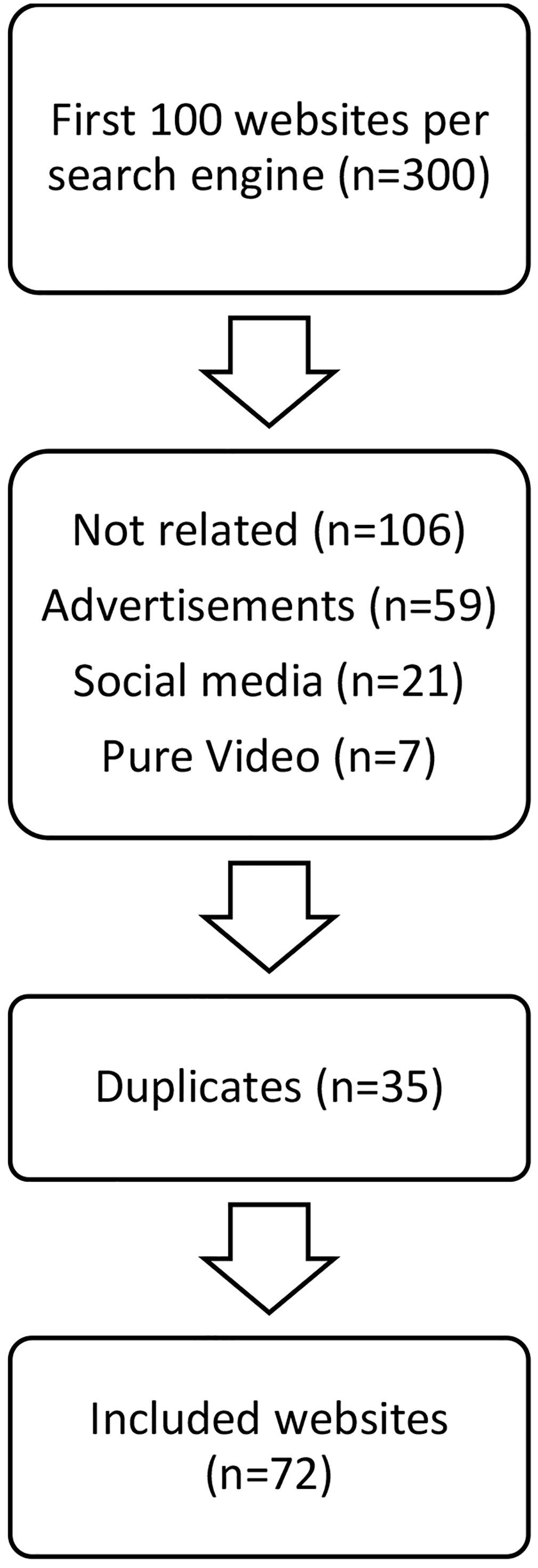
Flow chart of the searching strategy.
For website categorization, all checked websites were partly related to CL/P. Regarding affiliation, most of the websites were commercial 33 (45.8%), followed by Non-profit organizations accounting for 28 (38.8%), then University/Medical centers 10 (13.8%), and none of the websites were governmental. The content type was mainly medical on all websites; 72 (100%) but 30 (41.7%) contained questions and answers, and only 7 (9.7%) had clinical trials. The presented content included images in 52 (72.7%) websites, videos in 4 (5.6%) websites, and only one website contained audio (1.4%).
Quality Assessment
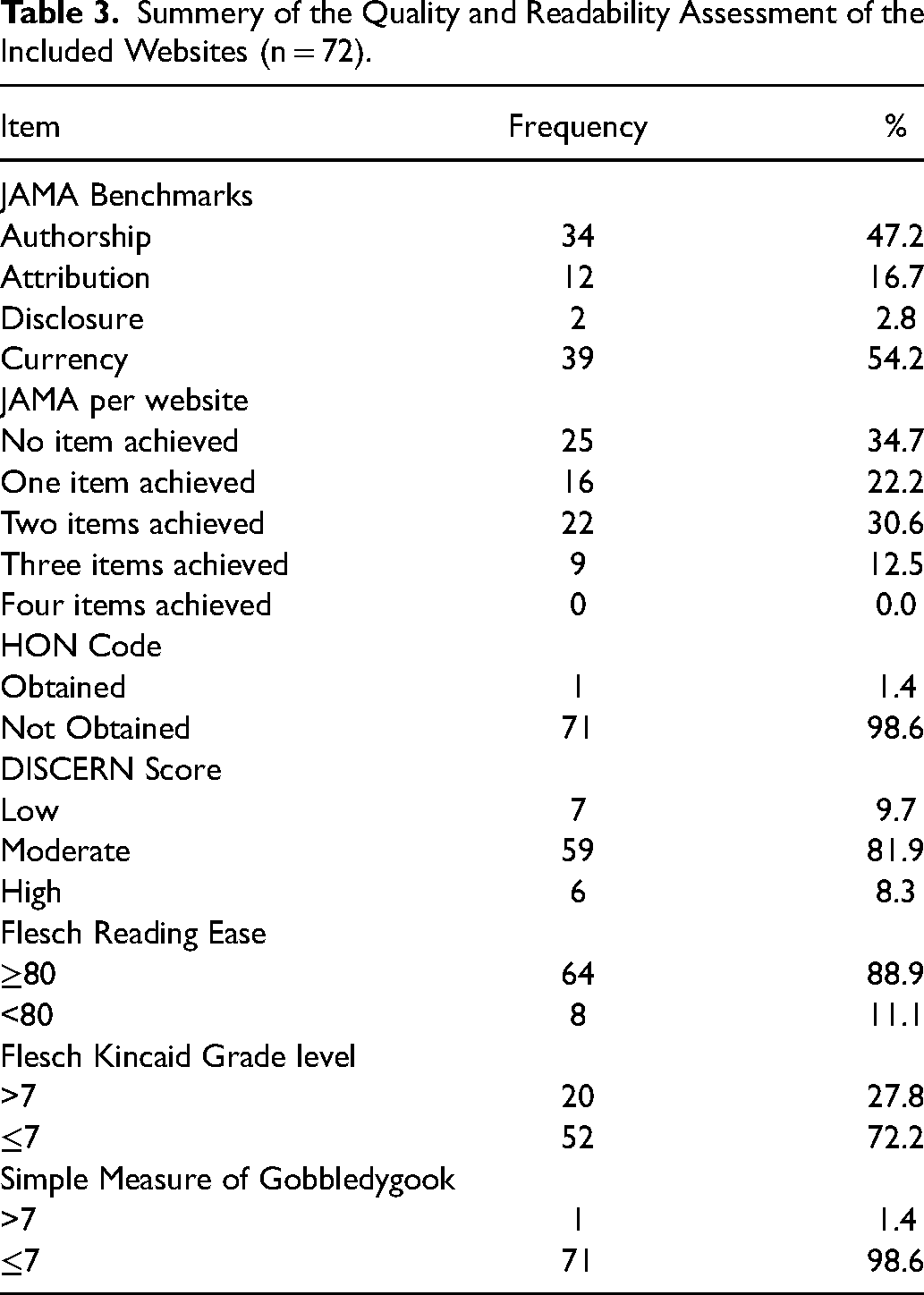
For the included 72 websites, the mean overall DISCERN score was 2.87 (±1.61). The maximum score was not achieved by any website, and only one (1.4%) website had the minimum score. Poorest scores were related to the fourth question, “Is it clear what sources of information were used to compile the publication (other than the author or producer)?” and the seventh, “Does it provide details of additional sources of support and information?” with number of websites achieved one score 57 (79.2%) and 48 (66.7) respectively. Based on the total score, most of the websites had moderate scores, 59 (81.9%), 7 (9.7%) websites had low scores, and only 6 (8.3%) had high scores. Table 1 presents the summary of the DISCERN analysis for each item, and Table 2 shows the distribution of DISCERN scores based on website affiliation. Only one website (www.mayoclinic.org) was certified with the HON code (Table 3).
Means and Standard Deviation Scores for DISCERN Instrument.
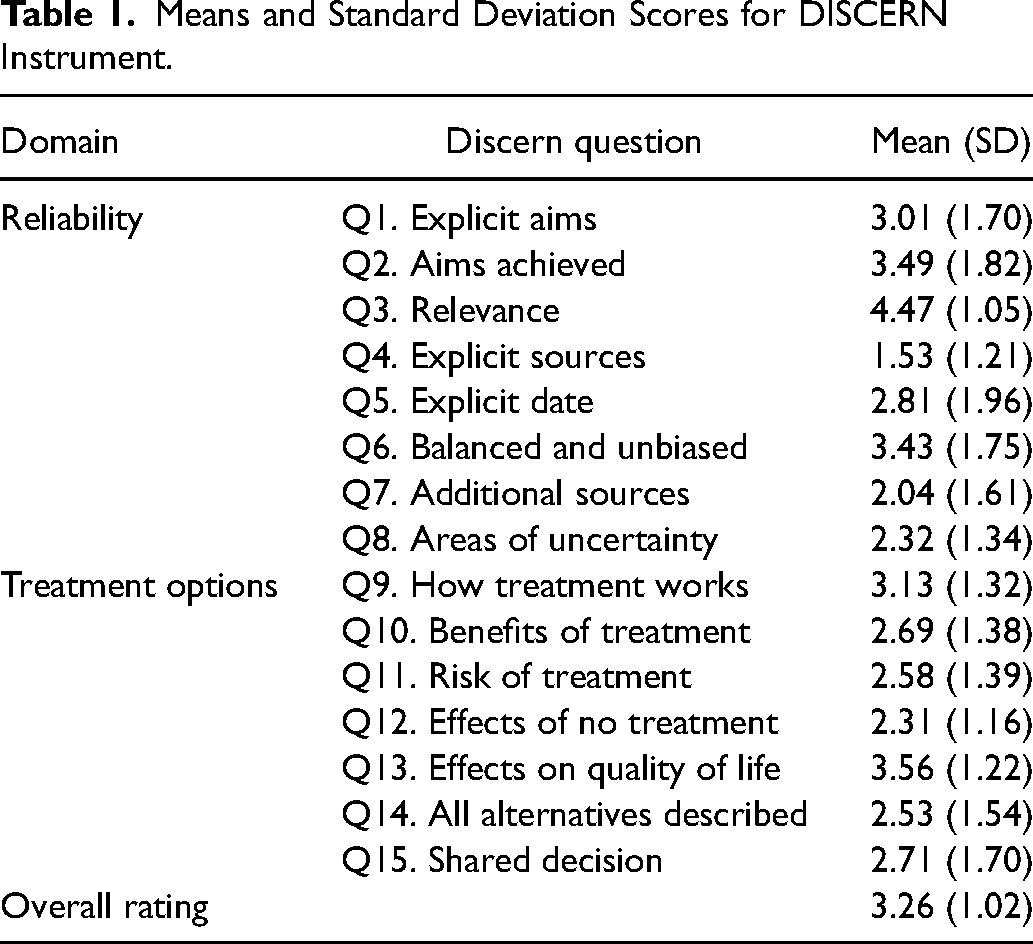
Distribution of DISCERN Scores Based on Website Affiliation (n = 72).
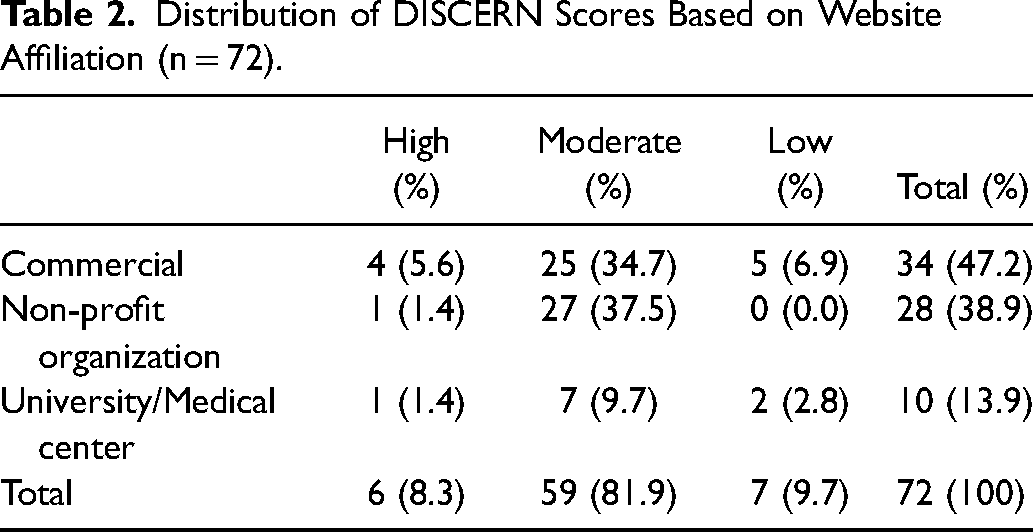
Summery of the Quality and Readability Assessment of the Included Websites (n = 72).
Interpreting JAMA benchmarks, the currency was the most achieved item in 39 (54.2%) websites, followed by authorship in 34 (47.2%) websites, then attributions in 12 (16.7%) websites, and the least was the disclosure in only 2 (2.8%) of the websites. None of the websites had a full score in JAMA benchmarks, and only 9 (12.5%) websites had three items, then 22 (30.6%) websites had two items, one item was achieved in 16 (22.2%) websites, and most of the websites 25 (34.7%) did not achieve any item. As shown in Table 2 shows the number of achieved items per website based on JAMA benchmarks. Table 4 shows the distribution of JAMA scores based on website affiliation.
Distribution of JAMA Scores Based on Website Affiliation (n = 72).

Readability Assessment
FRE scale rating ranged from 65 to 99.7 with a mean of 93.43 (±8.91). FKGL varied from 0.3 to 18 with a mean of total is 6.82 (±4.2). For SMOG, it had a range of 1.8 to 7 with a mean of 2.08 (±0.68). As shown in Table 2, on the FRE scale, 64 (88.9%) websites scored 80 or above, while 20 (27.8%) websites scored it in the FKGL test, and all websites scored seven or above in SMOG.
Discussion
Nowadays, the internet is an easily available and accessible source of information in most languages, and the quality of the online content is not trustworthy for most of the available data, especially health-related information. For health-related questions, it is not surprising that patients usually check for online information about the condition or even the symptoms they have.
Despite the benefits of the available online information, for medical advice, it is always better to consult a doctor rather than rely on online information.
CL/P is a long period of treatment with many related complications and difficulties. Families of patients with CL/P, like any family, may seek the Internet for medical information. A study by Khouri et al. in 2018 reported that 92% of families with cleft children seek information about CL/P through the Internet. 34 This is a very high percentage that raises concern about family education and the importance of the quality of posted knowledge. The internet contains a vast amount of information, some of which may be misleading or inaccurate. This is true for English websites, and it is even more true for Arabic websites, which have been less rigorously evaluated for health information. To address this issue, several tools have been developed to assess the quality of information on medical websites, such as JAMA benchmarks, DISCERN, and the HON code tools. The results of this study show that most of the websites had moderate to poor quality and readable content.
It is important to ensure that good quality and scientifically correct knowledge is available to the population. Of 72 included websites, only one website had the HON code. The HON code is a set of standards that websites can follow to ensure that the health information they provide is accurate, reliable, and unbiased. Websites that meet the HON code standards are certified with the HON code, which can help users identify trustworthy sources of health information.35,36 In English-based studies about the web-based knowledge about systemic sclerosis, the number of websites with HON code was available in one-fifth of the websites. This refers to the need for Arabic websites to raise the quality of the content to meet the criteria to get the HON code.
Unfortunately, none of the websites had a full JAMA score; this means that no single website had mentioned the author, including sources of information and disclosure with date of posted information together. Missing such main information should decrease the trustworthiness of the website, even if the quality of the posted information is acceptable. In the present study, the least achieved item was “Disclosure,” which was available on two websites only. Then, “Attribution” was available for less than one-fifth of the websites. Not mentioning such essential items badly affects the reliability of the website. Furthermore, one-fourth of the websites scored zero in JAMA benchmarks. In other Arabic assessment studies, the zero score in JAMA was 7 (10%), 14 (15%), and 2 (5.6%). This indicates that in the future development of CL/P-related public knowledge, the items of JAMA benchmarks should be ensured.31–33
The websites were categorized into (university/medical Center, Non-profit organization, Commercial, or Governmental), and about half of them were commercial, and one-third were from non-profit organizations. Compared to other English and Arabic studies, about half of the websites were commercial. Despite the fact that the Food Drug Association stated that Governmental, non-profit, and academic institutions are often the most reliable sources of online information, this study shows that most of the web-based knowledge was provided by commercial institutions with acceptable levels of reliability and quality. This might be due to the high percentage of commercial websites included in the study. On the other hand, it is worth noting that most of the commercial websites had zero JAMA scores, and none of them have reached more than two items. The nine websites that achieved three items in JAMA benchmarks all belong to universities, medical centers, or non-profit organizations. So, these institutions should contribute more to the body of public knowledge about CL/P, and commercial websites should focus more on increasing the quality of the content.
DISCERN instruments assess the quality of the provided information using 16 questions evaluating multiple aspects with a score from 1 to 5. It is disappointing that high scores were achieved in 6 (8.3%) websites only. However, low scores were also low in occurrence in only 7 (9.7%) websites. The remaining were moderate in quality; this is better than the findings in some other studies in which low scores presented about half of the websites 32 and more than one-third of the included websites. 33 Although the overall quality is mostly moderate, most of the pitfalls were in the items related to the sources of the information and its currency, which are hugely important for the trustfulness of the posted knowledge. Noteworthy, moderate quality should not be the acceptable level of public health-related information. One concerning finding is that half of the websites had poor scores (1 or 2) in describing the risks or complications of treatments. Conversely, 55% of the websites had high scores (4 or 5) in the item related to the effect of treatment on the quality of life. This might be explained by the domination of commercial websites, but mentioning both benefits and risks is important to have the reader's expectations in a reasonable range.
Managing CL/P is a complex issue that requires the expertise of multiple medical specialties, including plastic surgery, otolaryngology, orthodontics, speech-language pathology, and others. This can be challenging for medical practitioners, so imagine how difficult it can be for the general population to understand. Unless the information is simplified and well-written, it is very difficult for such a topic to be understood by the general population.
The readability assessment of the websites revealed that most websites are easily readable. The websites with FRE scores less than 80 were mostly categorized as non-profit organizations and with moderate DISCERN scores. The FKGL had the most variability, with about one-third of the websites scored above seven. Not surprisingly, most of them were categorized as non-profit organizations and university/medical centers. Although the Arabic content is considered readable, the quality of the content is poor, and the issue is that there is a growing concern that patients may not be able to accurately interpret medical information. 37
Due to the limited number of available studies in Arabic for quality and readability assessment for similar content, it is challenging to compare the results of this study with other studies.
Comparing the results to an English similar study by (Antonarakis, Gregory Stylianos, Kiliaridis, and Stavros) (2009) 25 assessing CL/P web-based knowledge, about half of the websites belonged to universities or hospitals, unlike the domination of commercial websites in our study. Both studies had about one-fifth of the websites had mentioned the sources of information. Visual presentation by means of images was higher in this study, as half of the included sites had images compared to one-fourth in the other study. The shocking fact is that no website was exclusively related to CL/P in Arabic, but in English, 20% of the websites were specialized in CL/P. This study did not evaluate the quality of the content with similar tools, but the study by Karamitros et al. described the quality of the CL/P content in English as “borderline satisfactory,” which is more or less like the quality of contents assessed in this study. 24
This study is limited to a few aspects that may be avoided in future studies. It did not include the evaluation of video content nor the social media websites, which may be considered as a source of information to families of patients with CL/P. It also used readability tests that are not established to be used for the Arabic language, but it was considered as it was used before to assess the Arabic text and the lack of a validated tool for that.
Lastly, it is the moral responsibility of website administrators to provide patients with accurate, relevant, and unbiased information. Plus, healthcare professionals also have a responsibility to help patients find the right health information. There is an earnest need to help practitioners and health educators identify the most useful websites to help direct their patients. In Arabic content, there is a clear and urgent need to improve the quality of the online information about CL/P, especially by the universities and governmental sectors. To enhance CL/P information for Arabic-speaking communities, it is recommended to encourage collaboration among universities, governmental institutions, and non-governmental organizations, enabling resource pooling and knowledge sharing. Establishing online platforms can improve accessibility while investing in capacity building for healthcare professionals and content creators is essential. Governments and organizations can contribute through public awareness campaigns focused on prevention, early intervention, and destigmatization. These comprehensive measures can collectively improve the availability and quality of CL/P information for Arabic speakers.
Limitations of the Study
It is important to acknowledge the limitations of our study. We only searched three search engines using one term. Additionally, we only used six assessment tools for quality and readability. Although they are commonly used, we encourage further research that addresses these limitations. In addition, our study evaluated the content in the Arabic language only. In future research, it may be wise to include more than one language to allow for comparison and better specify the areas of weaknesses.
Conclusion
The assessment of available Arabic content on CL/P indicates that it generally maintains satisfactory readability. However, the critical areas of concern lie in the quality and trustworthiness of the information provided. There exists a clear and pressing need to enhance the depth and reliability of online knowledge resources concerning CL/P for the Arabic-speaking population.
This responsibility may fall more on governmental institutions and universities. These entities can significantly contribute to raising the standards of web-based information by dedicating efforts to develop and disseminate accurate and comprehensive CL/P-related content. Establishing specialized websites specifically dedicated to CL/P can serve as a vital step in this direction, ensuring that individuals and families seeking information have access to a focused and reliable source.
By addressing these shortcomings and elevating the quality of online information, we can better equip individuals and families affected by CL/P in the Arabic-speaking community with the knowledge and resources they need to make informed decisions and navigate the challenges associated with this condition.
Footnotes
Declaration of Conflicting Interests
The author(s) declared no potential conflicts of interest with respect to the research, authorship, and/or publication of this article.
Funding
The author(s) received no financial support for the research, authorship, and/or publication of this article.
