






Abstract
Keywords
Venous thromboembolism (VTE) is a disease state consisting of deep-vein thrombosis (DVT) and pulmonary embolism. Approximately 2 million patients in the United States are affected by VTE annually, and 59% to 75% of these DVT events have been reported to be hospital acquired. 1 VTE is associated with 100 000 to 300 000 deaths annually, with two-thirds of these deaths occurring in hospitalized patients. Of VTE-associated mortality, 18% to 65% of cases have been reported as being preventable. 1 Mahan et al 2 estimated the annual cost of VTE diagnosis and treatment in the United States to be between 5.1 and 19.1 billion dollars.
Without prophylaxis, DVT incidence in medical and surgical patients ranges from 10% to 80% depending on underlying risk factors. 3 Thromboprophylaxis with medications such as heparin and enoxaparin have been associated with a reduction in the incidence of VTE, but despite this, poor rates of thromboprophylaxis have been reported. In an international study assessing compliance with the American College of Chest Physician’s (ACCP) guidelines, Cohen et al 4 found adherence to be low and variable. VTE risk was evident in 36% to 73% of the population in this study, and 2% to 84% of patients were initiated on ACCP-recommended thromboprophylaxis.
In critically ill patients, medications for prevention of VTE are often withheld for a variety of reasons such as fear of bleeding and a scheduled or anticipated invasive surgical procedure. However, the impact of missed doses of VTE prophylaxis medications on the development of acute DVT is unclear. The purpose of this study is to determine the association between missed doses of pharmacological VTE prophylaxis medications and development of acute, in-hospital DVT.
Materials and Methods
This is a case-control study involving hospitalized patients who spent at least 24 hours in any intensive care unit (ICU) at Virginia Commonwealth University Health System, an 865-bed academic medical center, between January 2009 and September 2011. The study was approved by the institutional review board with a waiver of informed consent. Patients were required to be at least 18 years old at the time of hospitalization and have an active electronic order for subcutaneous heparin, enoxaparin, or fondaparinux for study inclusion. Prophylactic dosing was defined as heparin ≤15 000 units daily, enoxaparin ≤60 mg daily, and fondaparinux ≤2.5 mg daily. Using a randomly generated number list, an approximate 15% sample of the total population who met the inclusion criteria was collected. Patients with incomplete information necessary to calculate body mass index were excluded.
Demographic data and baseline characteristics were collected from the electronic medical record and included age, sex, height, weight, history of malignancy, hospital and ICU length of stay (LOS), and use of mechanical prophylaxis. Cases were identified as patients who experienced an acute DVT event at any time during hospitalization, and controls were those patients from the same population with no documented DVT event. Patients were considered to have a DVT if the results of lower- or upper-extremity Doppler ultrasound studies were positive for acute thrombus. Missed doses of VTE prophylaxis medications were assessed from review of the electronic medication administration record and defined as any dose of medication that was ordered but not administered for any reason. The primary outcome was to assess the relationship between any missed dose of VTE prophylaxis medication and DVT events.
Statistical Methods
Baseline continuous characteristics are presented as mean (SD) for normally distributed data and median (interquartile range) for skewed data, and categorical data are presented as frequencies (percentages). Differences in baseline demographic data between cases and controls were analyzed using χ2 tests of homogeneity for categorical variables and 2-sample t tests for continuous variables.
Multivariate logistic regression modeling was used to determine the odds of acute DVT in patients with any missed dose of pharmacological VTE prophylaxis medications compared with those with no missed doses. In addition to missed doses, baseline variables associated with DVT at a significance level of P < 0.25 in the univariate analysis were included as covariates in the multivariate model. All statistical analyses were performed with a P value of <0.05 representing statistical significance, using SAS v9.3 (SAS Institute, Cary, NC).
Results
Of the 15% sample from the total population, 59 of 920 patients (6.4%) experienced an acute, in-hospital DVT. Baseline demographic data are shown in Table 1. Patients with an acute, in-hospital DVT were older and had a significantly longer ICU and hospital LOS. In-hospital mortality was 8% in both groups.Overall, 64% of patients missed at least 1 dose of VTE prophylaxis medication; 30% (n = 277) of patients missed 1 to 2 doses, 22% (n = 203) missed 3 to 6 doses, 6% (n = 56) missed 7 to 10 doses, and 5% (n = 50) missed more than 10 doses.
Baseline Demographic Data in DVT Cases Versus Controls.
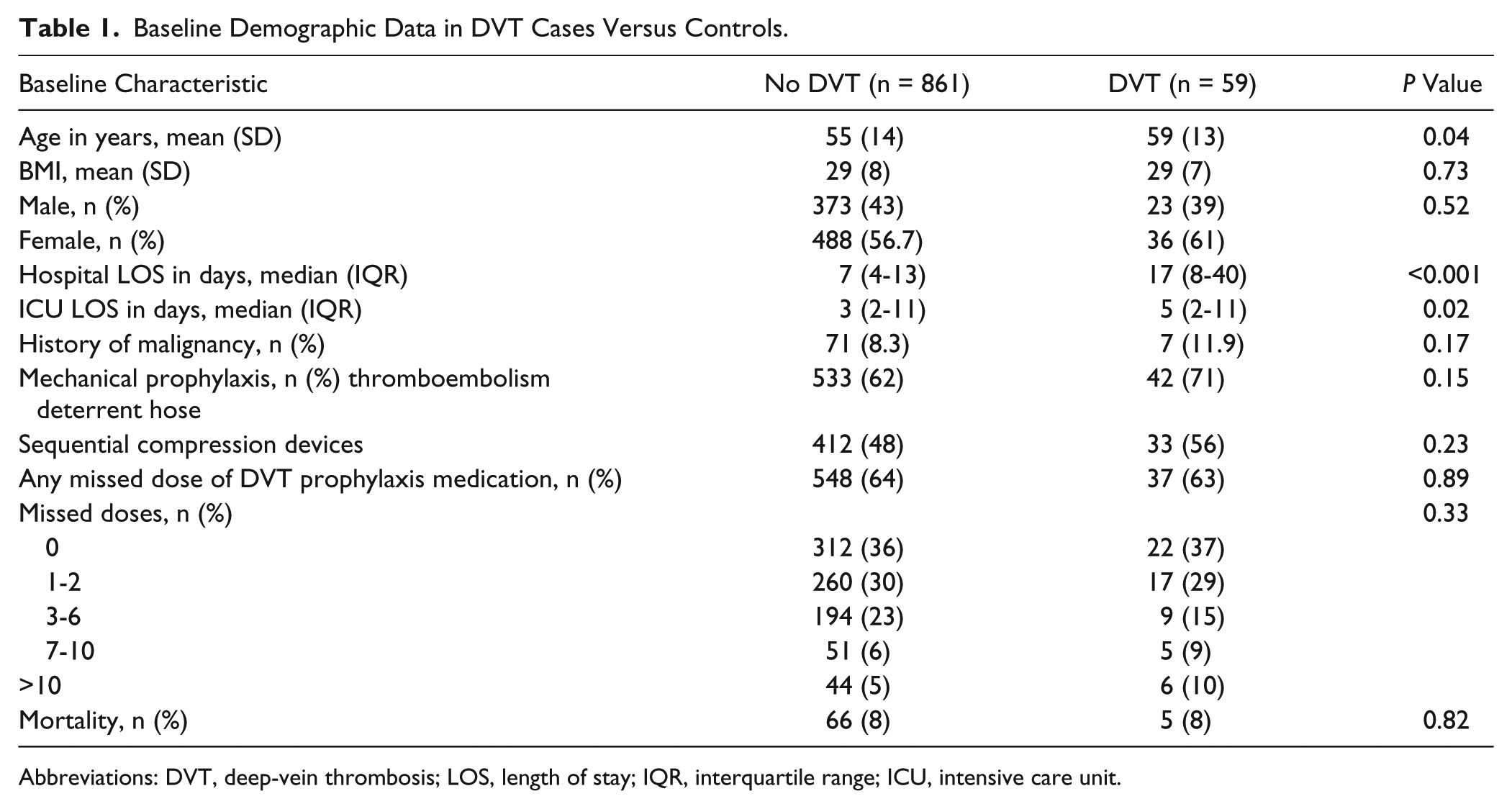
Abbreviations: DVT, deep-vein thrombosis; LOS, length of stay; IQR, interquartile range; ICU, intensive care unit.
In the univariate analysis, there was no significant association between any missed dose of VTE prophylaxis medication and acute DVT; odds ratio (OR) = 0.96 (CI = 0.56-1.7). Age, hospital LOS, history of malignancy, and use of mechanical compression devices were associated with DVT (P < 0.25) and included in the multivariate model. Intensive care unit LOS was also significant in the univariate analysis but not included in the multivariate model because of collinearity.
In the multivariate logistic regression model, there was no association between missed doses of pharmacological VTE medications and development of acute, in-hospital DVT (OR = 0.69 [0.39-1.2]; P = 0.21). For the multivariate analysis, hospital LOS was categorized into quartiles. Prolonged hospital LOS was associated with increasing odds of acute DVT (Table 2).
Multivariate Logistic Regression Model for Odds of DVT.
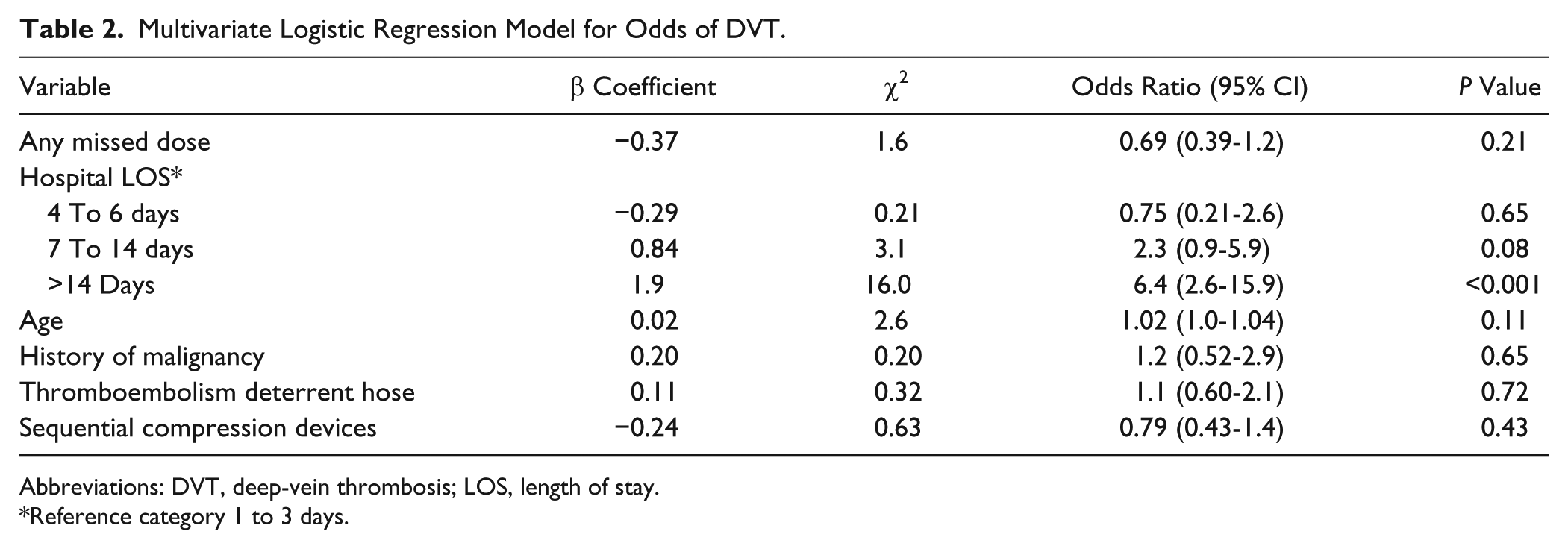
Abbreviations: DVT, deep-vein thrombosis; LOS, length of stay.
Reference category 1 to 3 days.
Discussion
Missed doses occurred in more than 60% of patients in our study compared with other studies, which reported rates of 26% to 59%.5,6 Of the patients who missed any dose, approximately one-third missed more than 2 doses. Although we did not assess the rationale for missed doses of VTE prophylaxis medications, it is our experience that common reasons include scheduled or anticipated minor surgical procedures, patient refusal, and minor bleeding. Other authors have reported invasive procedures as the most common reason for withholding pharmacological prophylaxis, but often, the reason for omission is not documented. 5
Despite a high incidence of missed doses, we found no relationship between missed doses of pharmacological VTE prophylaxis and the development of in-hospital, acute DVT events in a mixed, critically ill population. Consistent with previous work, hospital LOS was associated with acute DVT. In a validation study of a VTE risk score in 8216 surgical patients from the National Surgical Quality Improvement Program, an inpatient LOS 2 days or longer was the strongest predictor of VTE, with an odds of more than 10 times that of patients with shorter LOSs. 7
Louis et al 5 recently reported an increased incidence of DVT in trauma and general surgery patients who missed at least 1 dose of enoxaparin. The incidence of DVT was 23.5% in patients with any missed dose compared with 4.8% in patients with uninterrupted therapy. However, multivariate analysis in this study did not control for a much longer hospital LOS in patients with DVT when compared with those without (median of 33 days vs 20 days), which may explain the contrast in findings. Other limitations of this study include no reference to use of mechanical prophylaxis devices and average day of enoxaparin initiation, potentially biasing the results. Delay in initiation of pharmacological prophylaxis has been associated with VTE and is a Joint Commission core measure endorsed by the National Quality Forum. 8 Salottolo et al 6 also reported an increase in VTE in patients with traumatic brain injury with interruptions in pharmacological prophylaxis. Again, LOS was not included in multivariate analyses, and the event rate was small (15 VTEs), leading to wide confidence intervals around the point estimate.
In contrast to Louis et al, 5 we chose to study missed doses of any medication indicated for pharmacological VTE prophylaxis. Hypothetically, a single missed dose of enoxaparin that has a once-daily dosing schedule could lead to a prolonged period between administration of doses (approximately 48 hours). Based on an estimated duration of enoxaparin of approximately 12 hours for a 40-mg dose, anti-Xa activity may potentially be subtherapeutic for approximately 36 hours. It is unclear if this scenario is associated with more clinical events than a single missed dose of a prophylaxis medication that is administered more frequently (eg, unfractionated heparin every 8 hours).
The strengths of our study include large sample size and statistical analysis using multivariate modeling that controlled for LOS and use of mechanical prophylaxis—factors not addressed in previous studies.5,6 The limitations of our study include those inherent to case-control studies and the potential omission of factors that may increase the risk of VTE, such as undiagnosed hypercoagulable syndrome (eg, factor V Leiden). There was no standard protocol for ordering Doppler ultrasound studies, so clinically silent DVT events may not have been investigated; however, this likely reflects clinical practice, and more sensitive methods for detecting DVT (eg, contrast venography) are invasive and performed infrequently outside of clinical trial settings. Hospital day of initiation of pharmacological prophylaxis was not recorded, and the effect of missed doses on the development of DVT could potentially depend on the time of initiation. We did not record the hospital day of DVT diagnosis, and a new diagnosis of DVT may have led to a longer hospital LOS, which could partly explain the discrepancy in LOS between groups. Finally, the baseline risk of DVT in our study population is unclear because we included a mixed sample of ICU patients and only required a brief ICU stay for study inclusion. However, the median ICU LOS was 3 to 5 days, with an overall DVT rate of 6.4%, suggesting a moderate- to high-risk population. 8
Conclusion
Missed doses of VTE prophylaxis medications were common, and one-third of patients missed more than 2 doses. However, after controlling for other risk factors for DVT, we found no evidence of a relationship between any missed dose of prophylactic antithrombotic medication and development of acute, in-hospital DVT. Prolonged hospital LOS was associated with increasing odds of acute DVT.
Footnotes
Declaration of Conflicting Interests
The author(s) declared no potential conflicts of interest with respect to the research, authorship, and/or publication of this article.
Funding
The author(s) received no financial support for the research, authorship, and/or publication of this article.