






Abstract
In this paper, a robust backstepping controller is presented for position tracking of a class of servomotors. It has been shown by mathematical proof that the closed-loop system with the proposed controller has global asymptotic stability in the presence of structured and unstructured uncertainties, and external disturbances. In the following sections of this paper, to remove the undesirable phenomenon of chattering in the proposed control input, using a Takagi-Sugeno-Kang fuzzy system a robust fuzzy backstepping controller is designed that does not suffer from the undesirable phenomenon of chattering. To investigate the performance of the proposed controller, an induction motor and a DC motor with uncertainties are used as case studies. In the simulation phase, to provide essential challenges for the proposed controllers, simulations have been implemented in two steps. The results of these simulations show that the proposed approaches are very robust in the presence of parametric uncertainties, especially in the presence of external disturbances. In the design of a robust fuzzy controller, practical implementation considerations are taken into account in a way where the control input has a low computational burden.
1. Introduction
A wide variety of automatic processes involve controlling the position of electrical servodrives. However, the performance of these servodrives is affected by uncertainties, e.g. external disturbances, unmodeled dynamics, unstructured uncertainties caused by non-ideal field orientation in the transient state, mechanical-parameter variation, and so on. In practice, it is very difficult to obtain complete information about these uncertainties in advance. So far, in order to deal with these uncertainties, much research has been carried out to apply various methods in the field of control.
Variable structure control and especially sliding mode control are among the approaches that are commonly used in the field of electrical machine drives (Slotine and Li, 1991; Khalil, 2002; Tadjine et al., 2003).
Sliding mode control has a very good performance in overcoming the structured and unstructured uncertainties and external disturbances that exist in the dynamics of servomotors. However, this desirable performance encounters the undesirable chattering phenomenon in control input. To overcome this phenomenon, researchers have proposed various approaches, one of which is to create a boundary layer around the zero sliding surface (Kim and Jeon, 2004). Although the chattering problem is solved by this, the servomotor encounters steady-state errors.
In recent years, various approaches have been presented to solve this problem (Byungkook and Woonchol, 1998; Huang and Huang, 2001; Tao et al., 2003; Agamy et al., 2004; Lin and Hsu, 2004; Hsu et al., 2005; Shahnazi et al., 2008). Combinations of sliding mode control, adaptive control, and fuzzy theory have been used in these methods. Simulation results show the desirable performance of the proposed controllers in overcoming structured and unstructured uncertainties, and external disturbances. However, these approaches have the following problems:
In the rule base of fuzzy inference of these controllers, multiple input-multiple output (MIMO) fuzzy rules have been used. On the other hand, various adaptive laws have been used for online updating of membership functions that exist in these rule bases. Therefore, the computational burden of the proposed controllers is extremely high. Consequently, high speed processors have to be used to implement these controllers in practice, and as a result, their implementation costs greatly increase. The design stages of these controllers are very complicated. Therefore, learning these methods is difficult for students of control engineering and the researchers who work in this field. Similar to approaches presented by Byungkook and Woonchol (1998), Huang and Huang (2001), Tao et al. (2003), Agamy et al. (2004), Lin and Hsu (2004), Hsu et al. (2005), and Shahnazi et al. (2008), the proposed approaches could only be applied on single input-single output (SISO) systems.
When the capability of fuzzy theory to overcome the chattering phenomenon was revealed, researchers presented simpler approaches (Khooban and Soltanpour, 2013; Niknam and Khooban, 2013; Niknam et al., 2014). As a result, the proposed approaches did not suffer from the aforementioned drawbacks. In other words, implementation of these controllers is simple and the computational burden control input is very low. However these methods have the following disadvantage:
In recent years, a backstepping control method was presented to control a particular group of MIMO industrial systems. As the backstepping method can be designed step by step, learning this control approach is very simple. Over time, researchers used this method to overcome the problems that they encountered in controlling industrial systems. Soon it became clear that it is only if an accurate dynamic model of the system under control is available that the backstepping method performs well and can guarantee the stability of a closed-loop system, while because of the existence of structured and unstructured uncertainties and external disturbances in many industrial systems, it is very difficult and often even impossible to present a highly accurate dynamic model for the system under control (Khalil, 2002). When the problems of the backstepping technique became known, researchers tried to combine this method with other control techniques in order to overcome the problems existing in controlling the position of electrical servomotors.
1.1. Neural network-based backstepping control
Along with the backstepping approach, sliding mode control techniques and neural networks (NN) have recently been used to control the DC servomotors that are the actuators of industrial robot manipulators (Shafiei and Soltanpour, 2009; Soltanpour et al., 2012). A controller which is presented by combining these methods has a desirable performance and successfully controls the DC servomotor in the presence of structured and unstructured uncertainties, and external disturbances. Despite these advantages, the proposed controllers have the following drawbacks:
Because sliding mode control is used, the control input has severe chattering. The occurrence of this undesirable phenomenon could excite the natural frequencies existing in the dynamics of the DC motor. If this happens, the stability of the closed-loop system is lost. The design stages of the proposed controller are complicated and the control input has a high computational burden.
1.2. Neural network-based adaptive-backstepping control
To control induction servomotors, researchers have used combinations of backstepping, neural networks and adaptive control methods (Lin et al., 2002; Lin and Hsu, 2005). Finally, the proposed controllers have the properties of all these three control approaches and the induction servomotor system has global asymptotic stability. In spite of these outstanding results, the proposed controllers have the following drawbacks:
Using a hidden-layer NN, an adaptive-backstepping control system has been proposed. In this system, the gradient-descent technique is used for deriving the NN parameter-training algorithms. However, the global convergence of these parameters could not be guaranteed by the gradient-descent method. The proposed controllers make the closed-loop system asymptotically stable in the presence of parametric uncertainties. However, where there are external disturbances and unmodeled dynamics, it is impossible to guarantee the stability of the closed-loop system. As there is an adaptive rule that updates the coefficients of the controller online, the proposed controllers have a high computational burden. Therefore, if a delay occurs in control input calculations, guaranteeing the stability of the closed-loop system encounters some difficulties.
1.3. Adaptive backstepping controller
In the past, combinations of the backstepping approach and adaptive control have been used to control induction motors with uncertainties (Lin and Lee, 2000). The proposed controller shows good performance in overcoming the parametric uncertainties and makes the closed-loop system asymptotically stable. In Shieh and Shyu (1999) , to overcome the structured and unstructured uncertainties, and external disturbances, sliding mode control has been used along with an adaptive backstepping technique. However, when researchers wish to use these approaches, they have to consider the following:
The proposed approaches can only be used for controlling a particular type of induction motors The occurrence of the undesirable chattering phenomenon in the control input To design the control system, it is necessary to have prior knowledge of the system
1.4. Backstepping wavelet neural network control
Using combinations of backstepping, wavelet, and neural network methods is one of the approaches proposed for decreasing the problems of the backstepping technique in controlling induction motors (Wai and Chang, 2004). The proposed control outperforms all the approaches mentioned above in overcoming all the uncertainties that exist in the dynamics of the induction motor. However, the proposed control encounters the following drawbacks:
The performance of a control input for tracking the desirable non-smooth path is accompanied with the occurrence of chattering phenomenon The design stages of the controller are extremely complicated Because various adaptive laws exist in the control input, the computational burden of this controller is very high
In this paper, using a combination of backstepping approach and Lyapunov redesign approach, a robust backstepping controller is presented for controlling the position of a class of servomotors. In the design process of the proposed control, the authors have tried to consider the simplicity of designing stages, the computational burden of the control input and, generally, to take into account the practical considerations of implementation. The proposed control successfully overcomes all the uncertainties existing in the dynamics of servomotors. However, as with most of the controllers investigated in this section, it encounters the chattering phenomenon. Next, to solve this problem, the TSK fuzzy system is used in designing this controller. Finally, combining the backstepping method, the Lyapunov redesign approach, and the TSK fuzzy system results in the presentation of a robust fuzzy controller that does not encounter the undesirable chattering phenomenon. The proposed controller has the design simplicity of the backstepping approach, the robustness of the Lyapunov redesign approach, and a high capacity of fuzzy theory against uncertainties.
2. Problem formula
Consider the following MIMO system:
In equation (1), it is assumed that the function Assumption 1:

2.1. Stabilizing MIMO systems using robust backstepping method
In this section, it is attempted to design the control input, u, in such a way that it makes the origin of system (1) i.e.
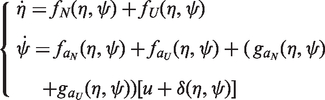
In equation (2), Although Although Although Although Assumption 2:
Assumption 3:
Assumption 4:
Assumption 5:
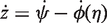
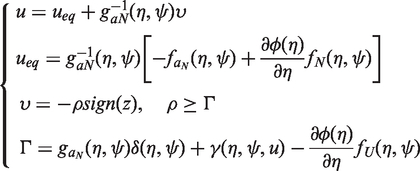
In the mentioned assumptions, In order to stabilize equation (3) by using the backstepping approach, as a virtual input, Next, in this paper, in the section on designing a controller for systems used as case studies, it is explained how From equation (5) it can be concluded that if z = 0 then, the system of equation (7), with the following control input and in the presence of all structured and unstructured uncertainties, makes the state variable z converge to zero. Therefore, the closed-loop system becomes global asymptotically stable:
The control input is called ueq. This control input is selected in such a way that it removes the known dynamics of the right side of equation (7). In other words, if equation (7) does not have unknown dynamics and uncertainties, ueq could result in Next, the control input obtained as
In equation (10), By defining Next, the new control input, To design the control input Equation (14) is differentiated with respect to the time and equation (13) is substituted into the result:
In order to satisfy From equation (16), it can be concluded that by selecting control input (8), the energy of co-energy function of It can be concluded from equation (16) that Remark 1:
Theory 1:
Proof:
Remark 2:
Remark 3:












2.2. Implementing robust backstepping method
The implementation steps of the proposed method in the previous section are as follows:
First, the dynamic equations of the system must be expressed in the form of equation (1): Collecting the system information and determining its known dynamics Determining the virtual input Determining Estimating the value of Designing the control input by using equation (8)
3. Position tracking control of the system using the robust backstepping method
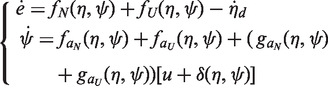
In many industrial works, researchers do not seek to stabilize industrial systems, but position tracking control of these systems is considered vital (Khalil, 2002). Therefore, in this section, the proposed approach in Section 2 is attempted for position tracking control of a system that has the dynamic equation of (1). To do so, first the tracking error is introduced:


According to Section 2, the dynamic equations of (18) are divided into the following known and unknown parts:
By defining

By comparing equations (20) and (3) it can be concluded that the problem of designing a position tracking controller has been converted into a stabilization problem. Therefore, using the proposed approach in Section 2, a position tracking controller could be designed in such a way that it makes the tracking error, e, converge to zero in the presence of all uncertainties. Since the details of the proposed design approach are fully described in Section 2, they are not described again in this section.
3.1. The Advantages of robust backstepping control
In the design of the proposed controller some points are considered to make it possible to implement this control approach in practice. The advantages of the proposed control are listed below:
Using known dynamics in the design of the proposed controller limits the boundaries of structured and unstructured uncertainties. Therefore, the amplitude of control input becomes small and saturation of actuator is prevented The design steps of the proposed controller are such that when it is attempted to prove the stability of a closed-loop system, Lyapunov candidate functions are simply given to the designers. In most of the control approaches, however, finding Lyapunov functions is a very complicated task In the proposed control, the converging speed of z to zero could be increased by properly selecting the coefficients of controllers In contrast to most of the existing techniques, the proposed control could be implemented on MIMO systems The design process of the proposed controller is carried out step by step, and therefore learning this approach is very easy for designers.
3.2. The drawback of robust backstepping control
Despite the advantages mentioned in the previous section, the proposed approach has some disadvantages. Considering the proposed control (8), the occurrence of an undesirable chattering phenomenon in the control input is inevitable. The natural frequencies of the system are excited with the occurrence of chattering. Therefore, guaranteeing the stability of the closed-loop system is no longer possible (Khalil, 2002). To solve the problem of chattering in the control input, the proposed control (8) is modified as follows (Kim and Jeon, 2004):
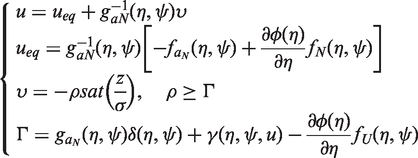
Where, sat(*) is the saturation function. In equation (21), the chattering phenomenon could be removed from the control input by properly selecting σ (the thickness of boundary layer). However, in this case we have no control over the position tracking error of the system under control. In fact, by selecting Selecting a large value for σ removes the chattering in the control input and increases the error in tracking the position of the system under control Selecting a small value for σ increases the accuracy in tracking the position of the system under control but unfortunately it brings about vibration phenomenon in the control input.
While in most industrial applications of servomotors, removing chattering of the control input and accuracy in position tracking are especially important. This is the reason why in the next section the first order TSK fuzzy system is used for controlling the position tracking error and overcoming the undesirable chattering phenomenon.
4. Position tracking control using fuzzy robust backstepping method
A first-order fuzzy TSK system is defined by fuzzy if-then rules which show the relationship between inputs and outputs. Generally, the fuzzy rules of the first-order TSK fuzzy control system are defined as follows (Wang, 1997):
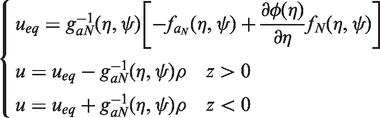
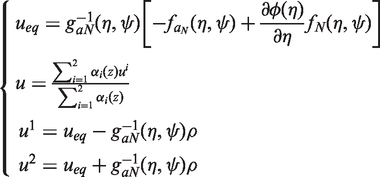
It is known that if the control input of the fuzzy robust backstepping controller is similar to the control input of equation (23) then To achieve this goal, the fuzzy rules of the proposed controllers can be expressed as follows:
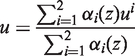
If we consider ‘z’ as the input of the TSK fuzzy system, using center average defuzzifier, its output could be obtained as follows:
In fact, equation (26) is the membership degree of input z in membership function Remark 4:




4.1. Implementing fuzzy robust backstepping position tracking control
In order to implement the proposed controller the following steps are carried out:
First, the dynamic equations of the system must be expressed in the form of equation (1) System information is collected and the known dynamics of the system are determined The virtual input The value of u1 and u2 and membership functions A1 and A2 are determined Build fuzzy inference system Select the center average defuzzifier
4.2. Advantages of fuzzy robust backstepping position tracking control
In addition to the advantages mentioned in Section 3.1., the fuzzy robust backstepping position tracking control also has the following advantages:
The rule base of proposed control has only two rules. Therefore, practical implementation of this proposed controller is possible because of its low computational burden Due to the existence of stability proof mentioned in Section 2, determining the membership functions of the rule base of the proposed TSK fuzzy system is very easy The undesirable chattering phenomenon is removed from control input The fuzzy part of the proposed control can be easily optimized by using heuristic algorithms such as genetic algorithms, ant colony optimization and so on
Next, to investigate the performance of the proposed controller, a case study is carried out on an induction motor and a DC servomotor. Overcoming the structured and unstructured uncertainties existing in the dynamic equations of these servomotors could be a great challenge for the proposed controllers.
5. Case studies
In this section, to investigate the performance of the proposed controllers, two different types of servomotors with uncertainties are used as case studies. These servomotors are selected in such a way that they encounter the proposed controllers with the greatest challenges (Lin et al., 2002; Shahnazi et al., 2008; Shafiei and Soltanpour, 2009; Rodriguez-Donate et al., 2011; Ganesh and Patnaik, 2012; Soltanpour et al., 2012; Guoguang et al., 2013; Khooban and Soltanpour, 2013; Niknam and Khooban, 2013; Niknam, et al., 2014). Consider a three-phase Y-connected, two-pole 800 W and 60 Hz 120 V/5.4 A induction servomotor that has the following model:
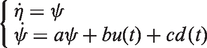
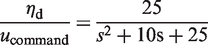
To design the proposed controllers, first by defining In equation (29), A second-order transfer function is selected as the reference model for a periodic step command. In the equation above, Robust backstepping method, which was discussed in Section 2. Fuzzy robust backstepping method, which was discussed in Section 4.Example 1:
Step 1:
Case1:
Case2:

5.1. Case 1
Step 2:
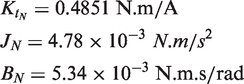
in this step, to design the RBM, it is assumed that the known parameters of the induction motor are as follows:
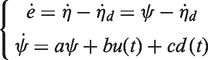
To design the RBM, the tracking error, e
Step 3:
in equation (32), as a virtual input, ψ is defined in such a way that it makes e converge to zero:


Step 4:
The variable z is selected as follows:

It is clear that if the variable z becomes zero, then equation (33) is satisfied and as a result e converges to zero. Using equation (32) it can be concluded that






In equation (41),


Step 5:
Considering equation (43), it can be concluded that
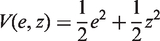
Equation (44) is differentiated with respect to the time and, considering equation (34), the following equation is obtained:

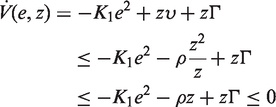
Substituting (43) into (45) gives

The control input
Step 6:
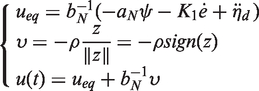
It can be concluded from equation (47) that with the proposed control, the closed-loop system has overall asymptotic stability in the presence of uncertainties. Therefore, control input of the proposed RBM is as follows:
In this section of paper, to show the performance of the RBM controller, two simulation stages are presented. The simulation stages are chosen in such a way that step by step they encounter the proposed controller with more challenges.
Simulation 1:
In this stage of simulation, it is supposed that the dynamic equations of the induction motor have only structured uncertainties. In other words,

In this stage of simulation, the coefficients of the RBM controller were adjusted to The desirable path and the actual path caused by applying robust backstepping method controller in the presence of structured uncertainties existing in the dynamics of induction motor. The control input caused by applying robust backstepping method controller in the presence of structured uncertainties existing in the dynamics of induction motor. Tracking error caused by applying robust backstepping method controller in the presence of structured uncertainties existing in the dynamics of induction motor.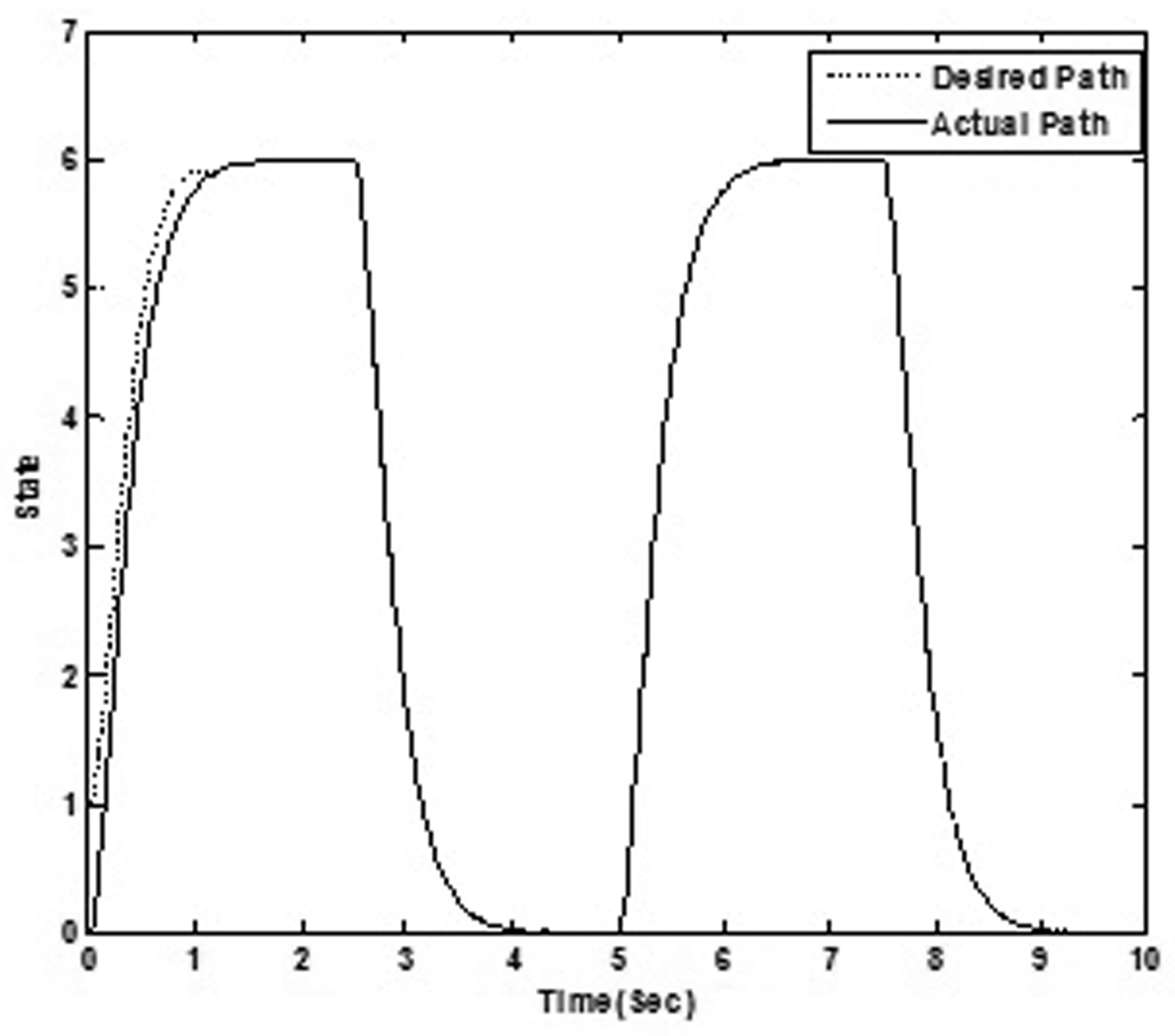
Simulation 2:
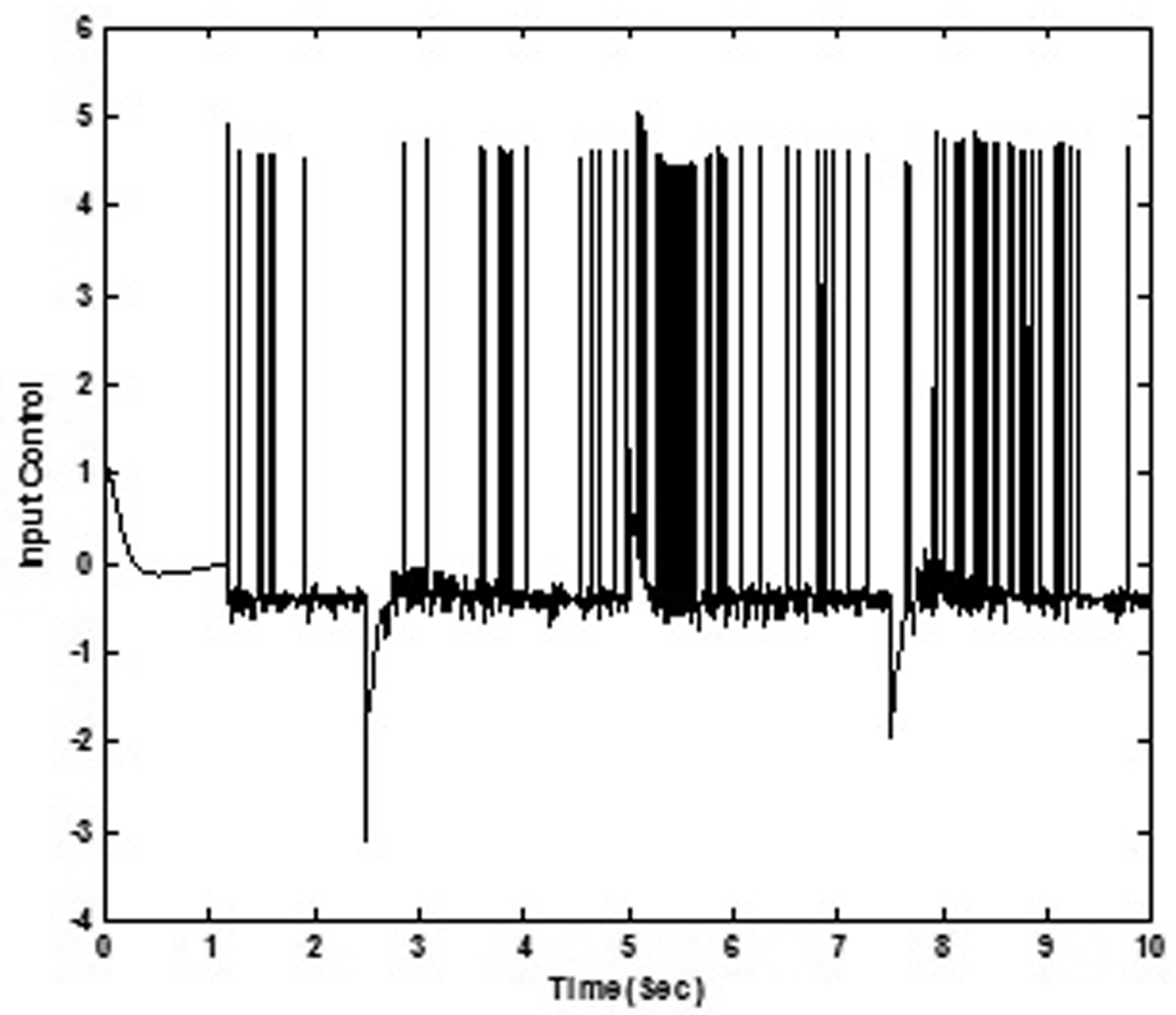
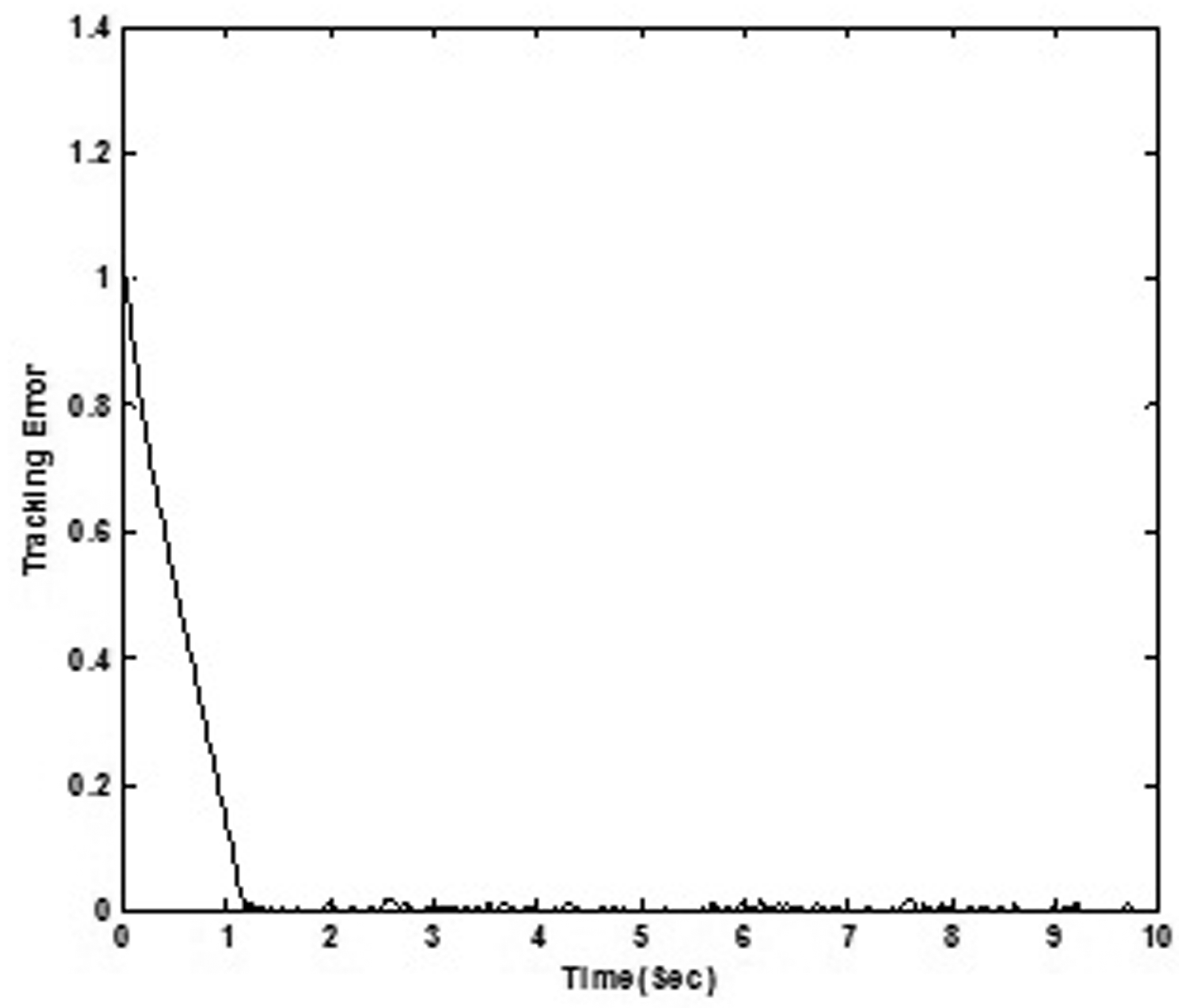
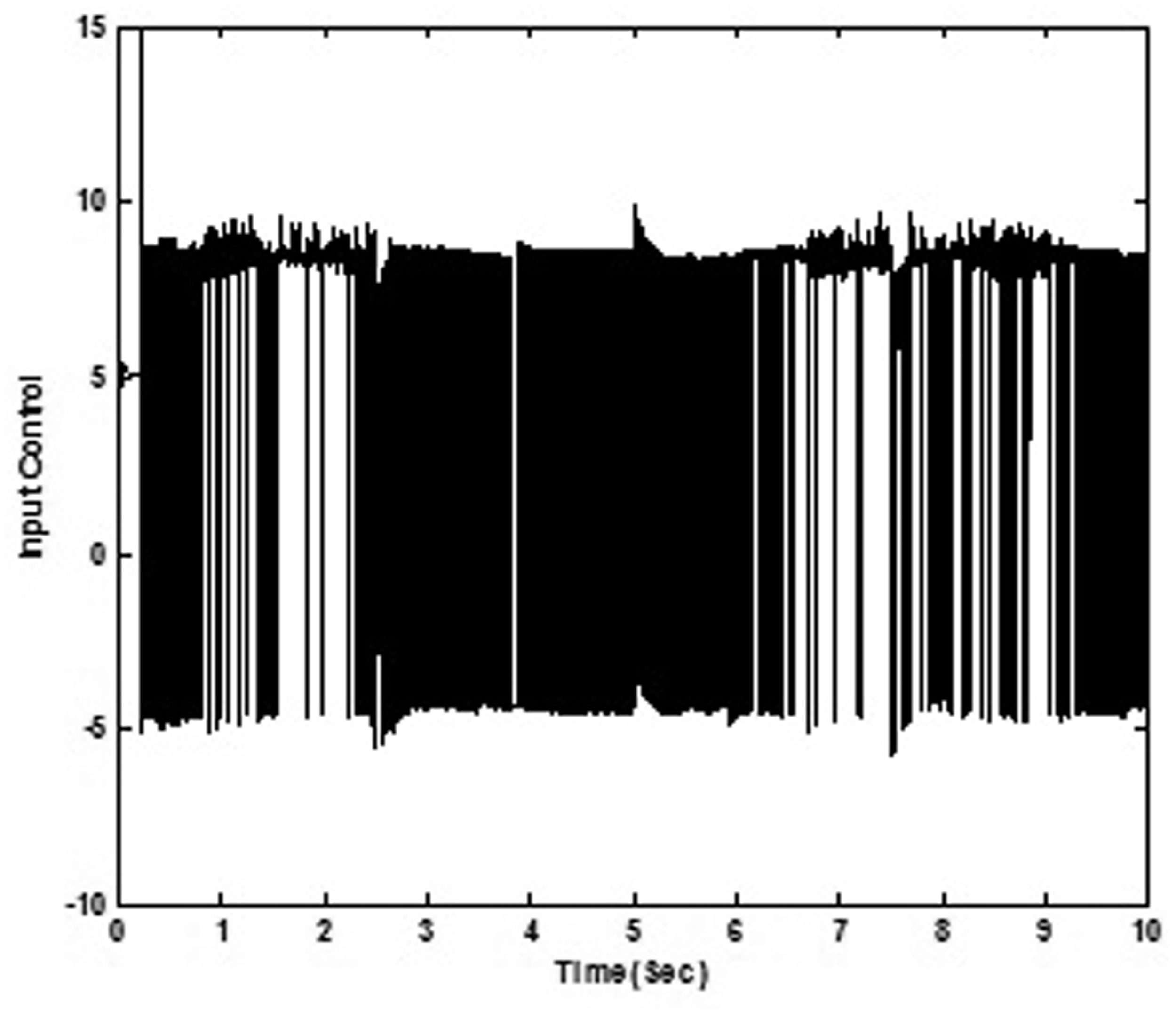
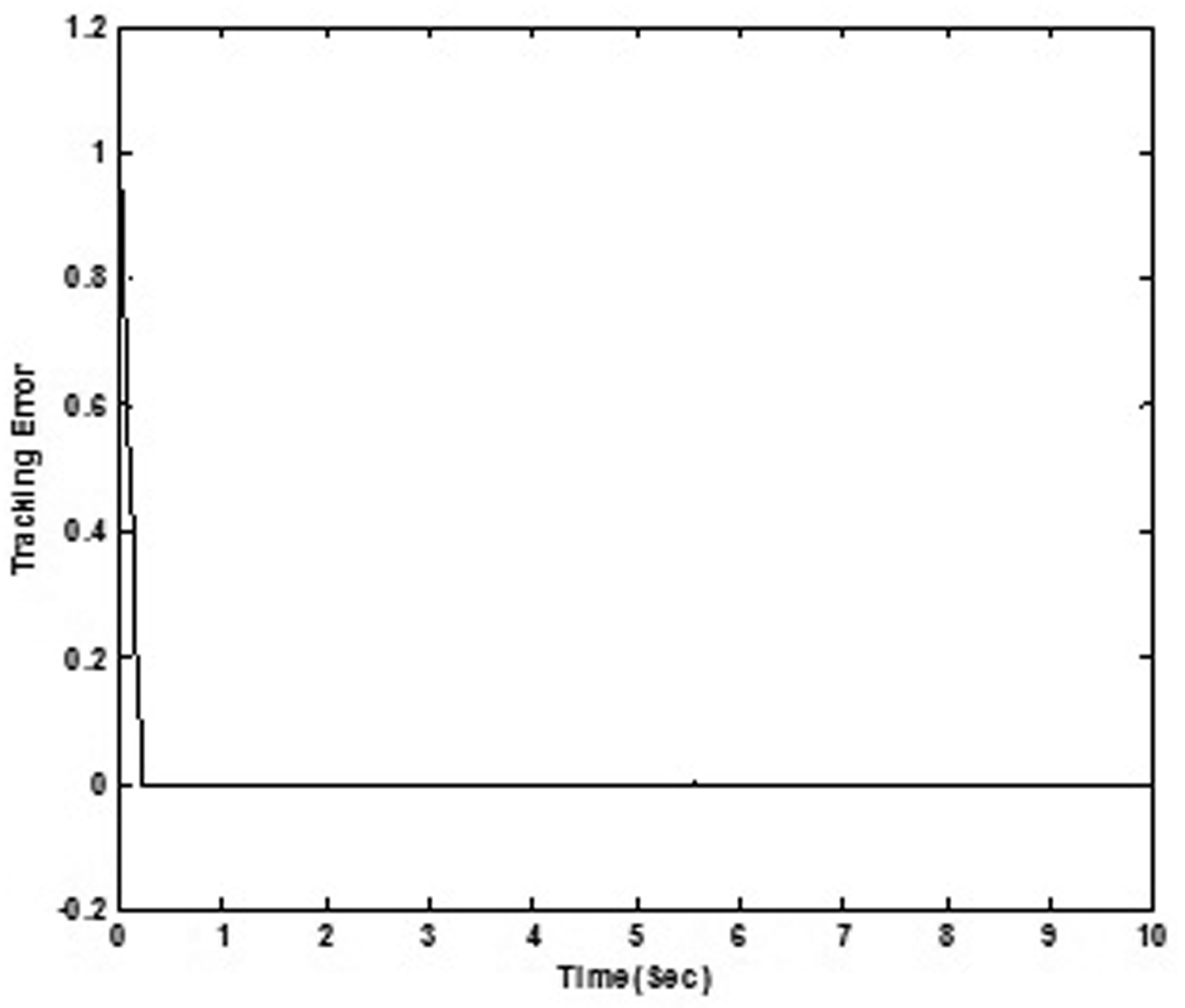
In this stage of simulation, in addition to the severe uncertainties of the previous simulation, the unstructured uncertainty of The desirable path and the actual path caused by applying robust backstepping method controller in the presence of structured and unstructured uncertainties existing in the dynamics of induction motor. The control input caused by applying robust backstepping method controller in the presence of structured and unstructured uncertainties existing in the dynamics of induction motor. Tracking error caused by applying robust backstepping method controller in the presence of structured and unstructured uncertainties existing in the dynamics of induction motor.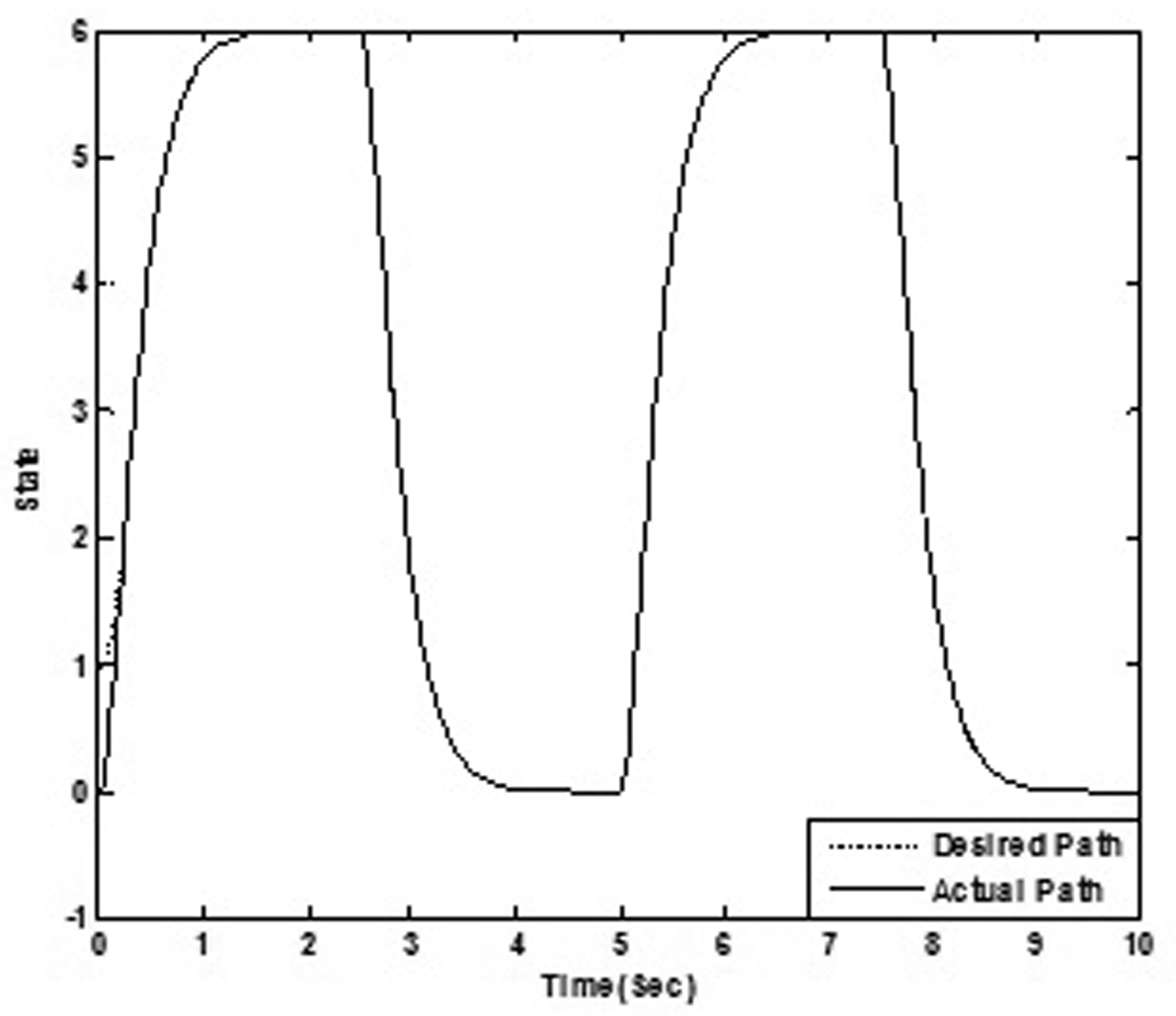
5.2. Case 2
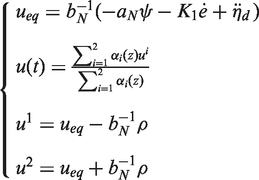
In this section, the performance of the fuzzy robust backstepping method (FRBM) controller on the induction motor is investigated. Based on the design of the RBM controller which was described in detail in the previous section, the input of the FRBM controller of induction motor (29) is as follows:
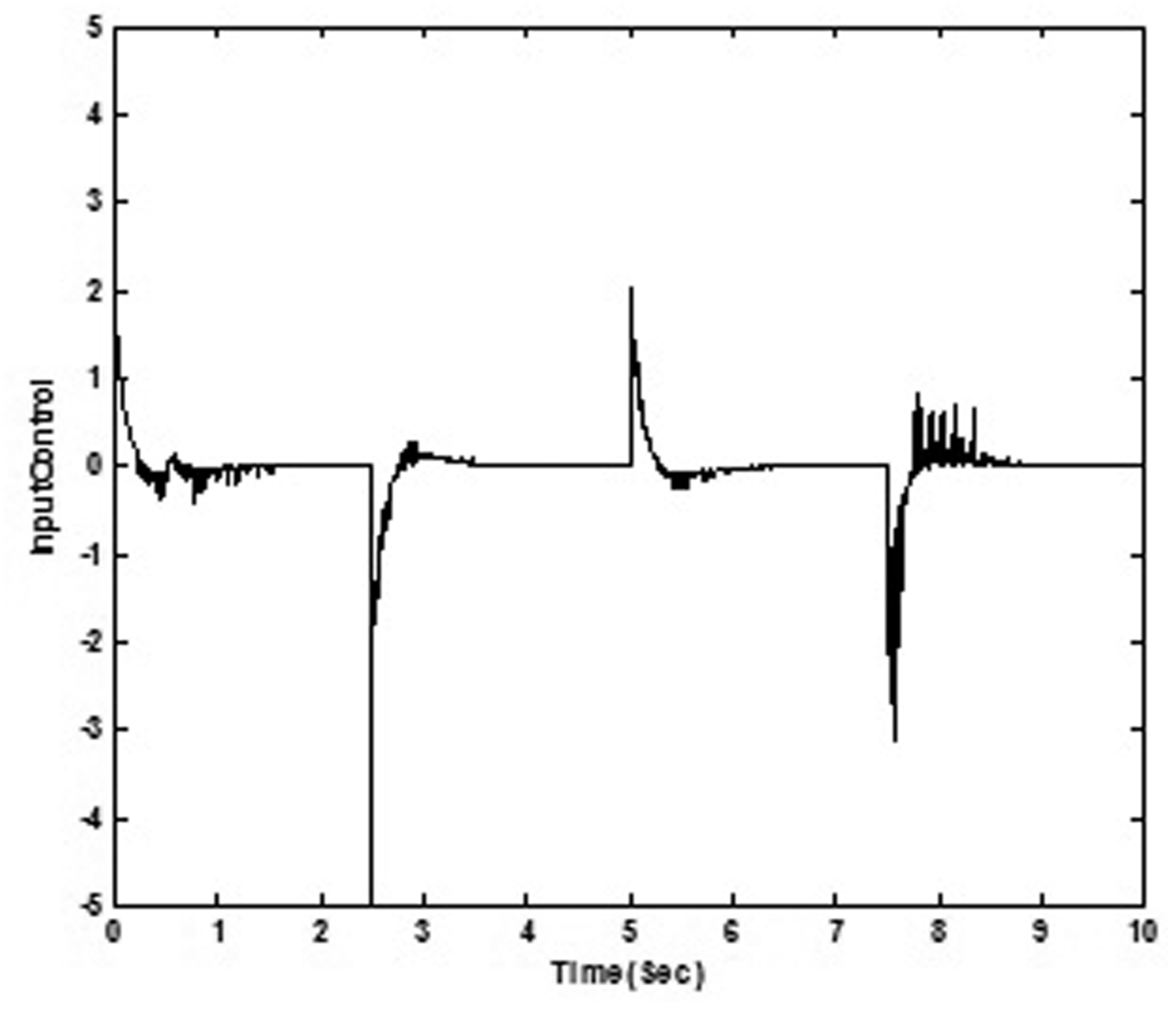
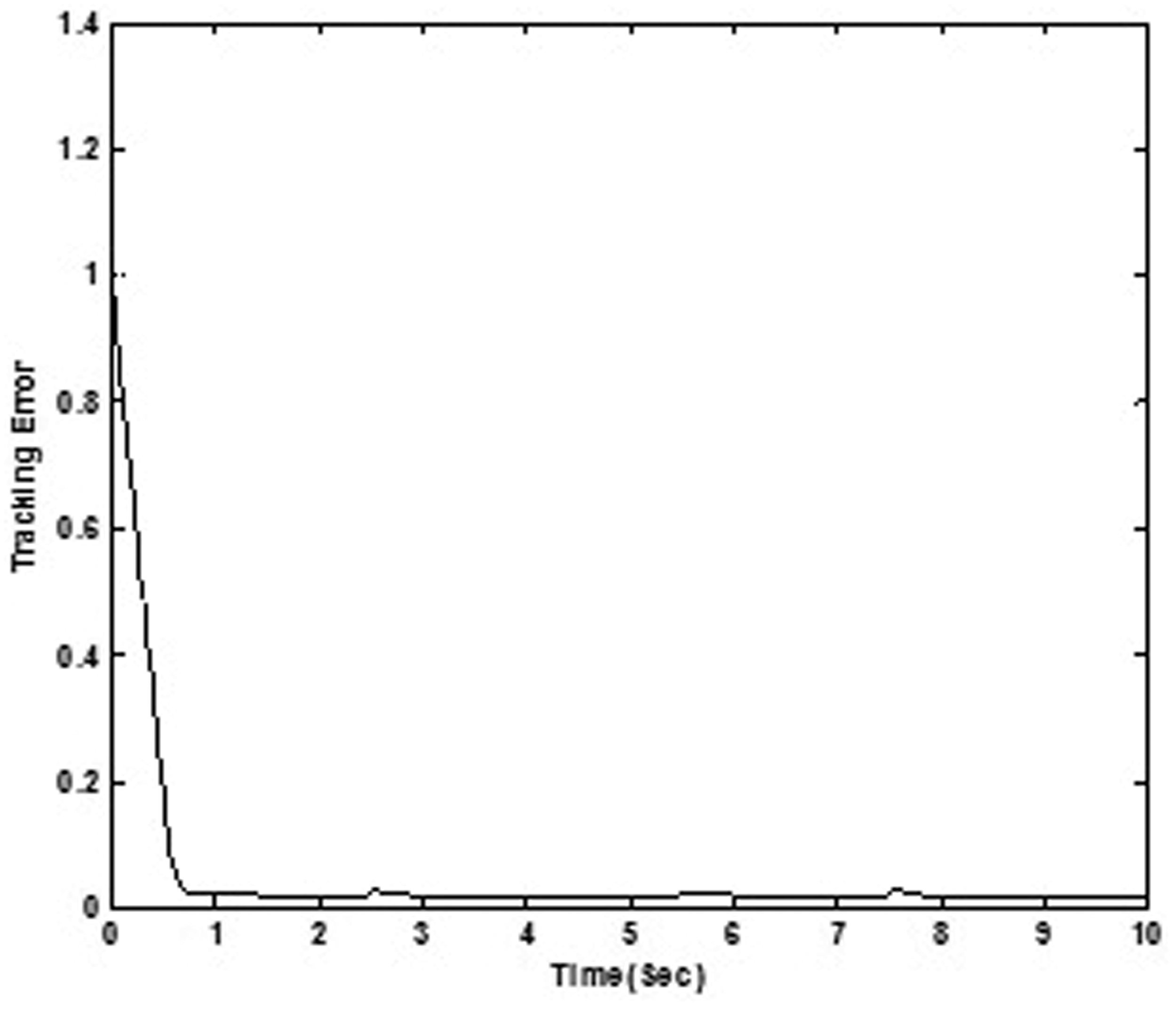
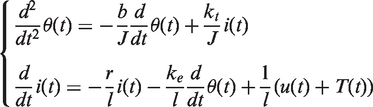
The conditions governing this stage of simulation are similar to those of the previous section. In this section, The desirable path and the actual path caused by applying fuzzy robust backstepping method controller in the presence of structured uncertainties existing in the dynamics of induction motor. The control input caused by applying fuzzy robust backstepping method controller in the presence of structured uncertainties existing in the dynamics of induction motor. Tracking error caused by applying fuzzy robust backstepping method controller in the presence of structured uncertainties existing in the dynamics of induction motor. This section of simulation is exactly the same as Section 2 of the previous simulation. In this section, The desirable path and the actual path caused by applying fuzzy robust backstepping method controller in the presence of structured and unstructured uncertainties existing in the dynamics of induction motor. The control input caused by applying fuzzy robust backstepping method controller in the presence of structured and unstructured uncertainties existing in the dynamics of induction motor. Tracking error caused by applying fuzzy robust backstepping method controller in the presence of structured and unstructured uncertainties existing in the dynamics of induction motor. It was observed in the previous section that the FRBM controller performed very well in the presence of all uncertainties in the dynamics of the induction motor. In this section, to create more challenges for the proposed controller, a system where the dynamic equations are more complicated than those of an induction motor was selected. Considering the following DC motor (Shahnazi et al., 2008):
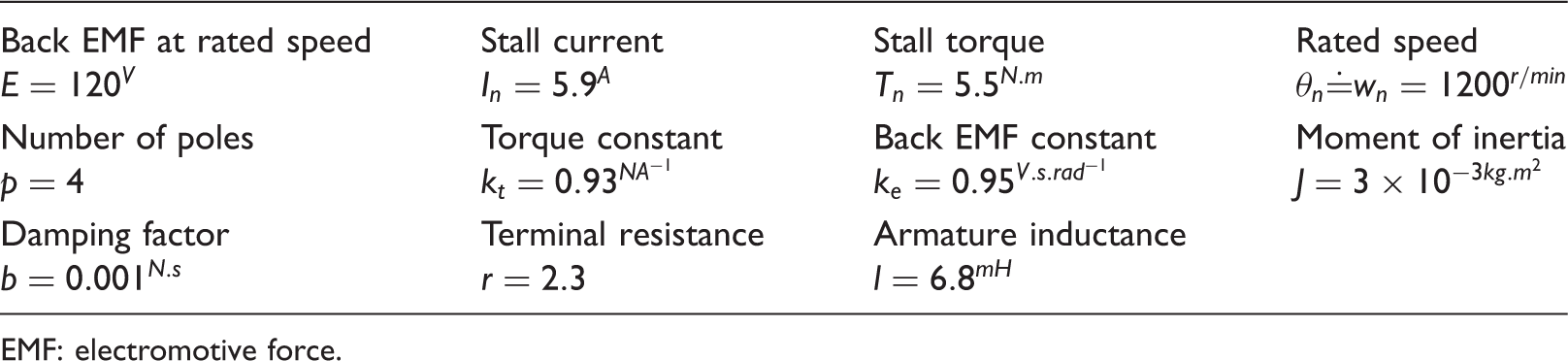
DC motor parameters. EMF: electromotive force.Simulation 1:
Simulation 2:
Example 2:
First, by selecting 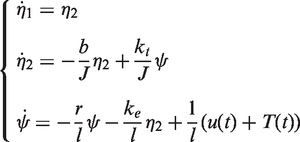
In this stage of simulation, initial conditions are
Two cases are considered to show the effectiveness of the proposed approaches:
Case 1:
Robust backstepping method, which was discussed in Section 2.
Case 2:
Fuzzy robust backstepping method, which was discussed in Section 4.
5.3. Case 2
In this stage, in order to design the RBM controller, the tracking error is defined as 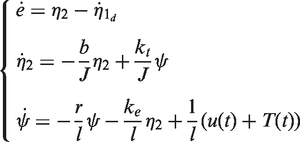
The design steps of the RBM controller were discussed in detail in the first example. Therefore, only the designed control input is presented in this section:
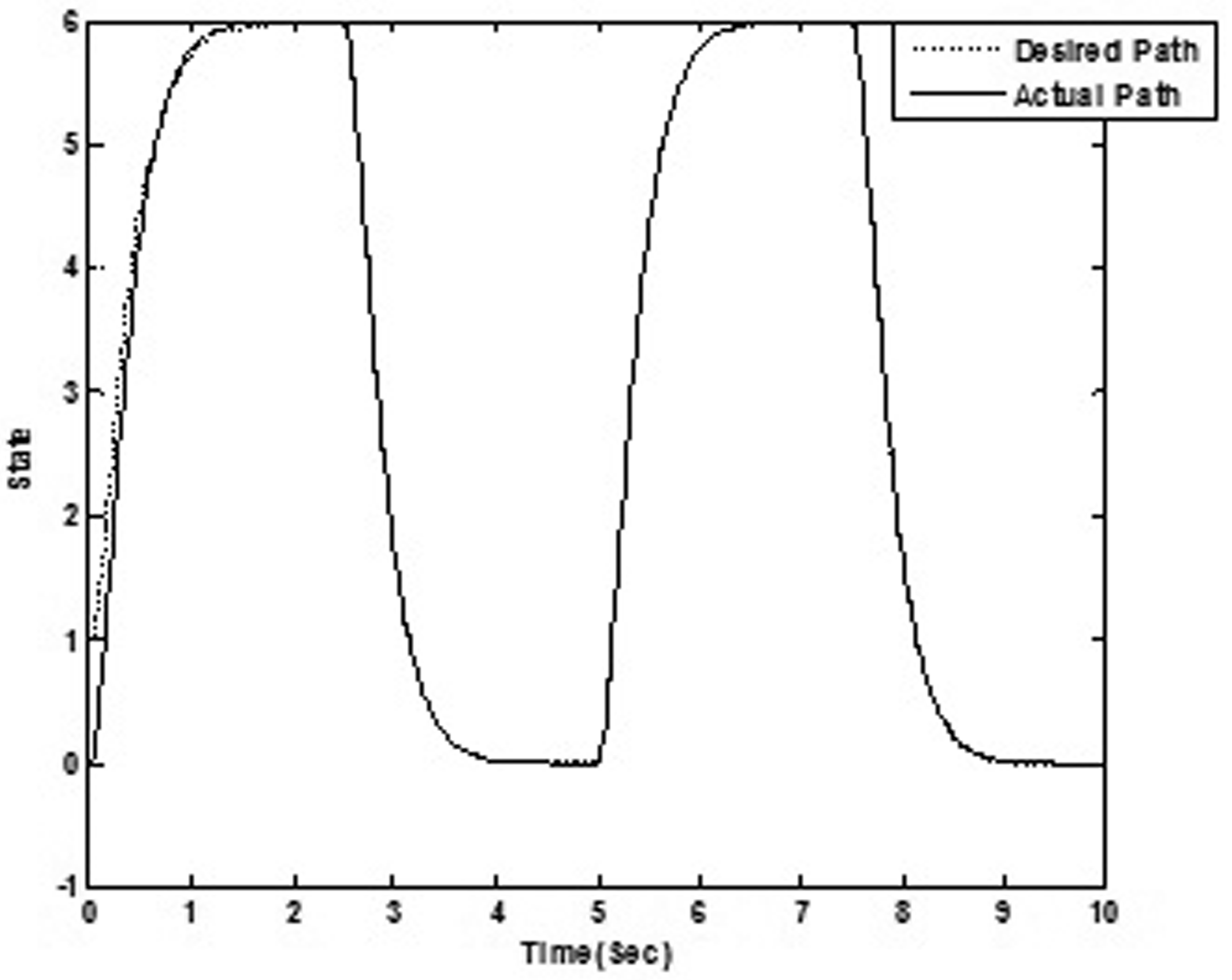
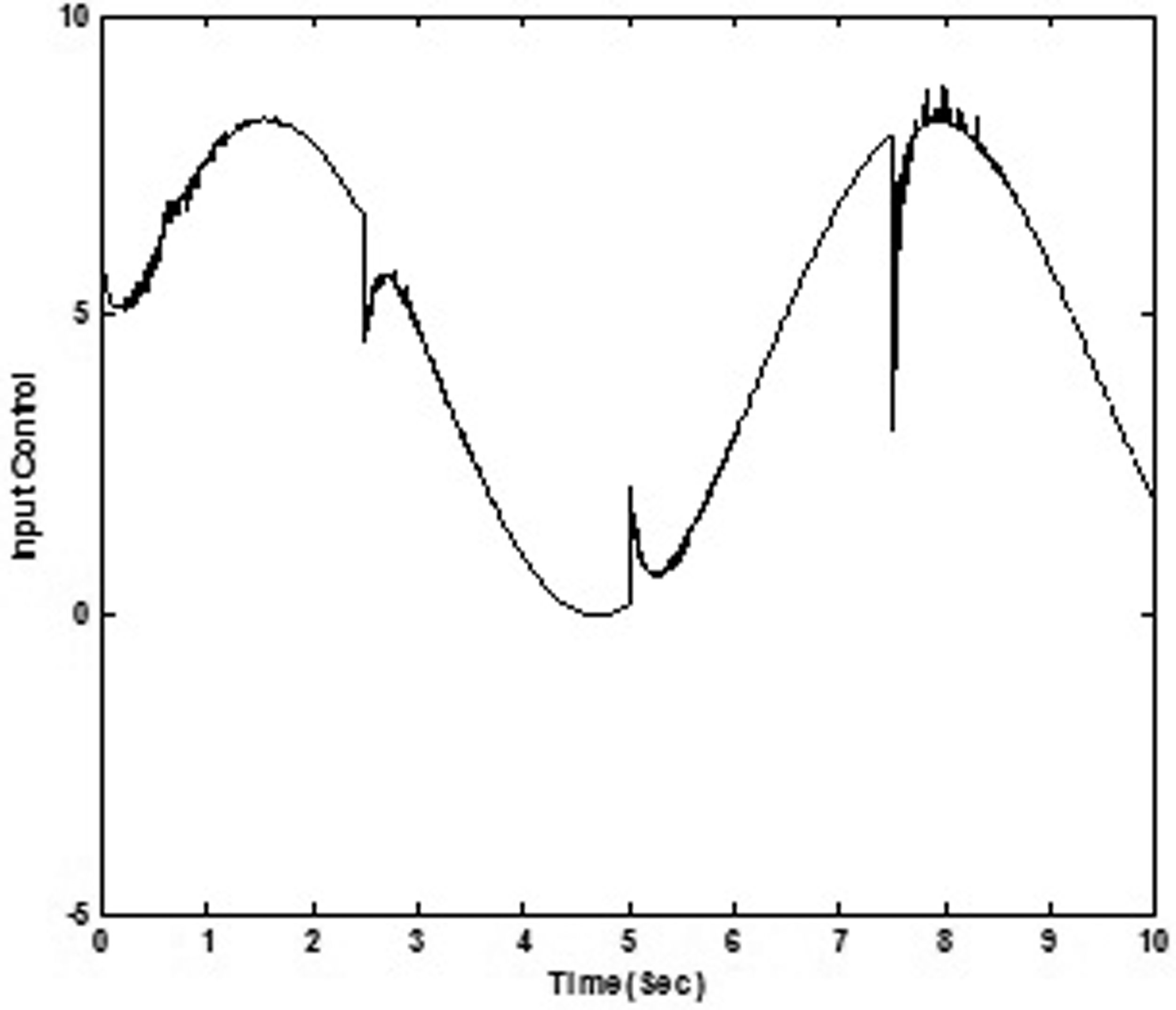
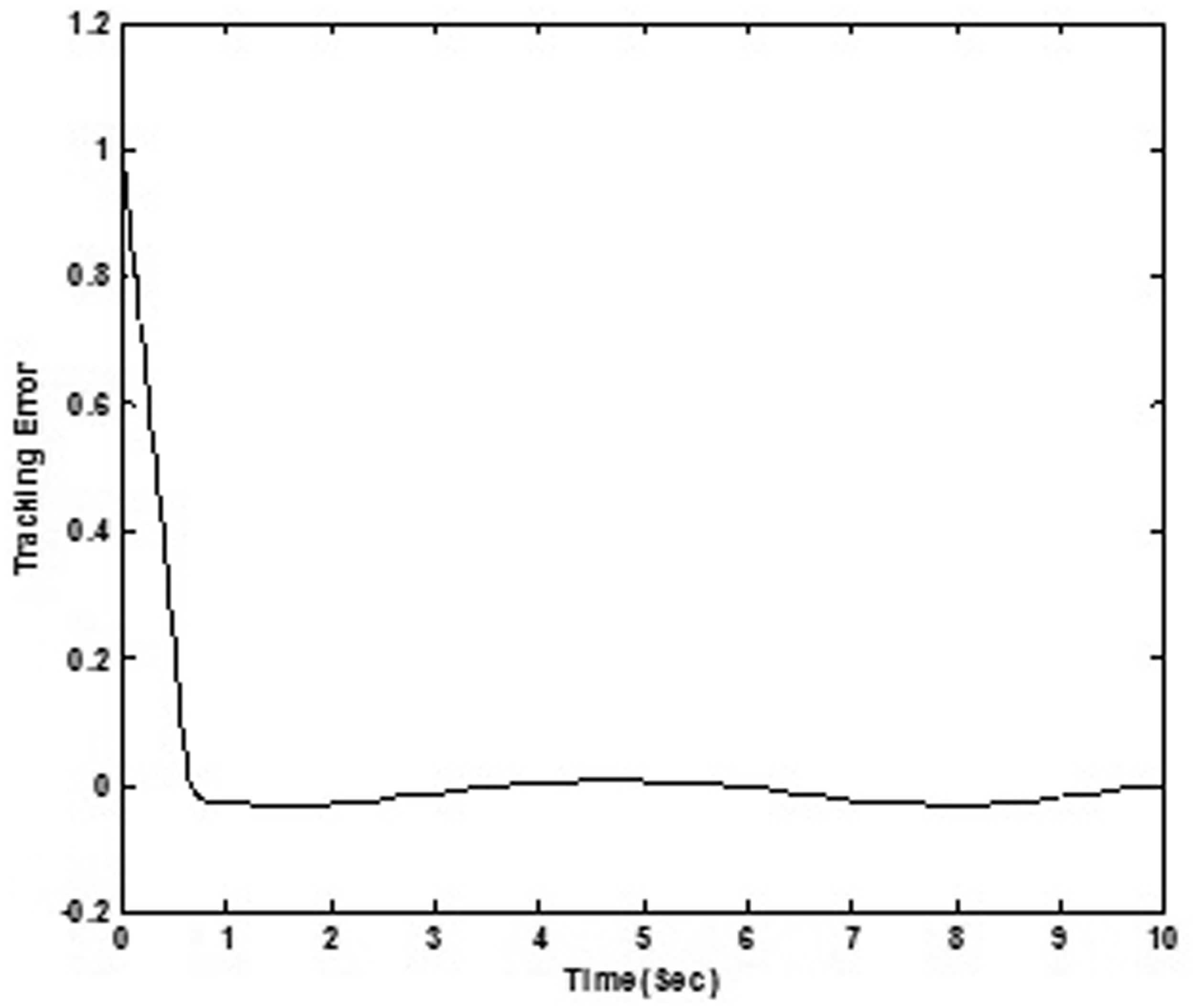
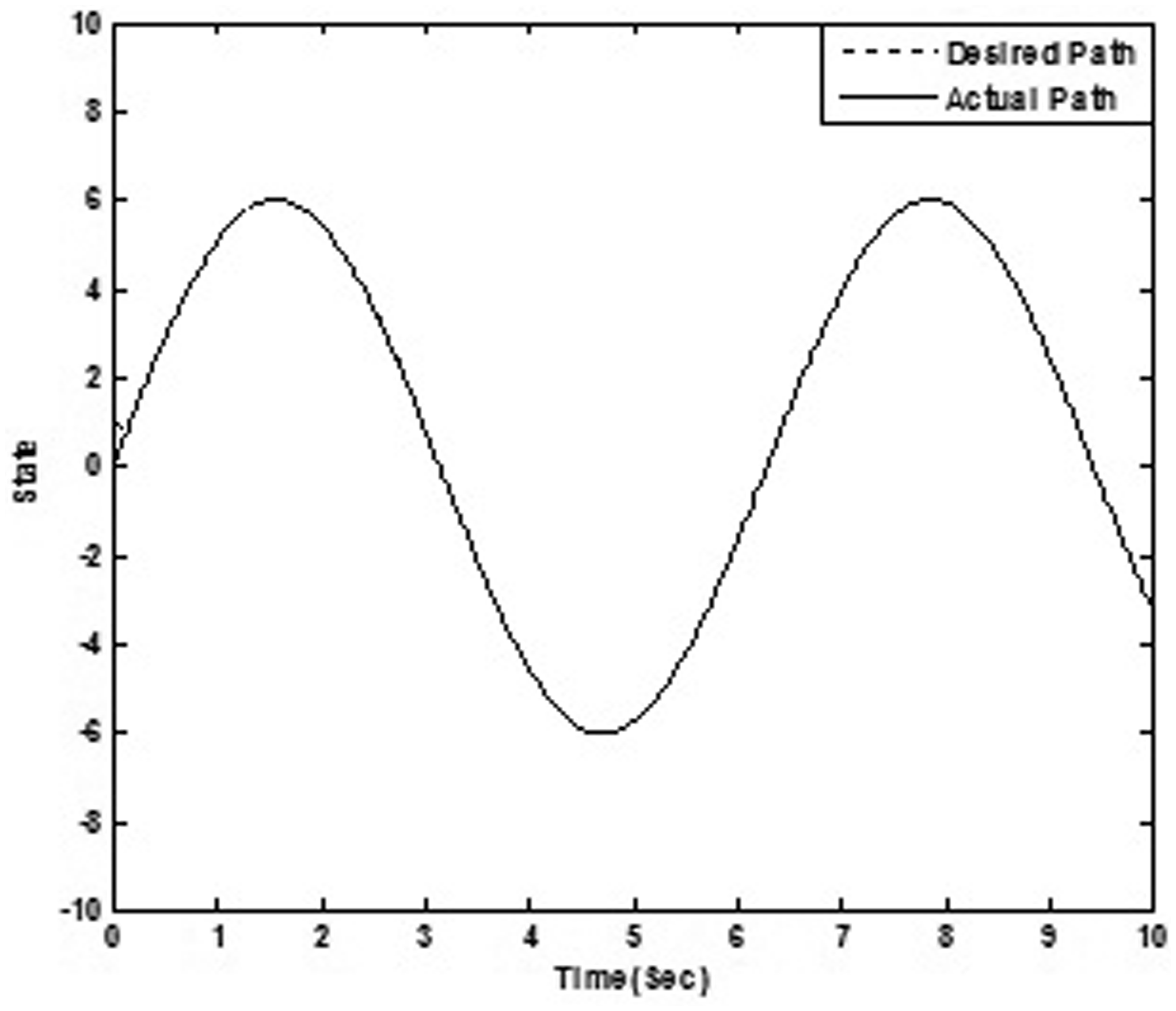
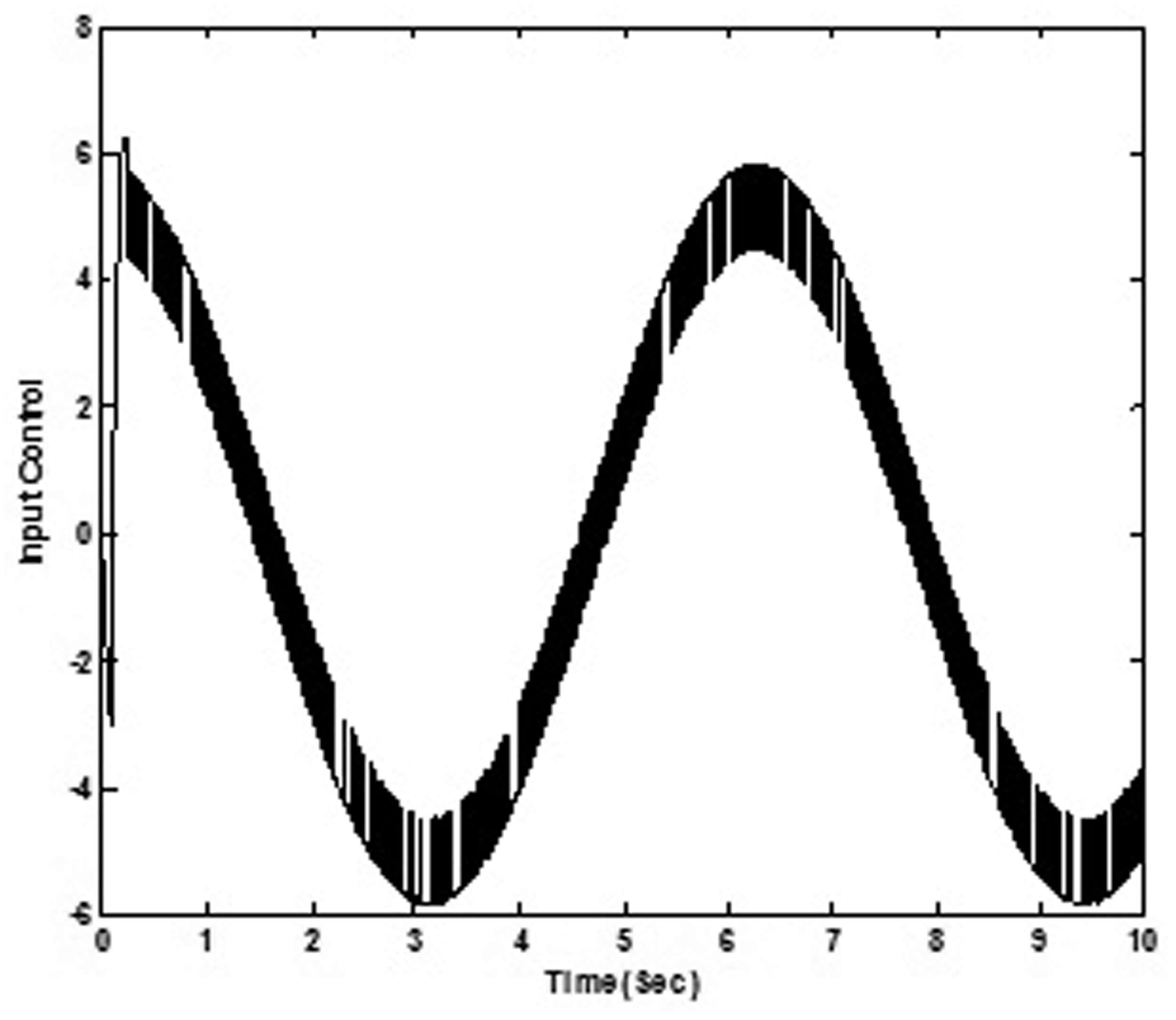
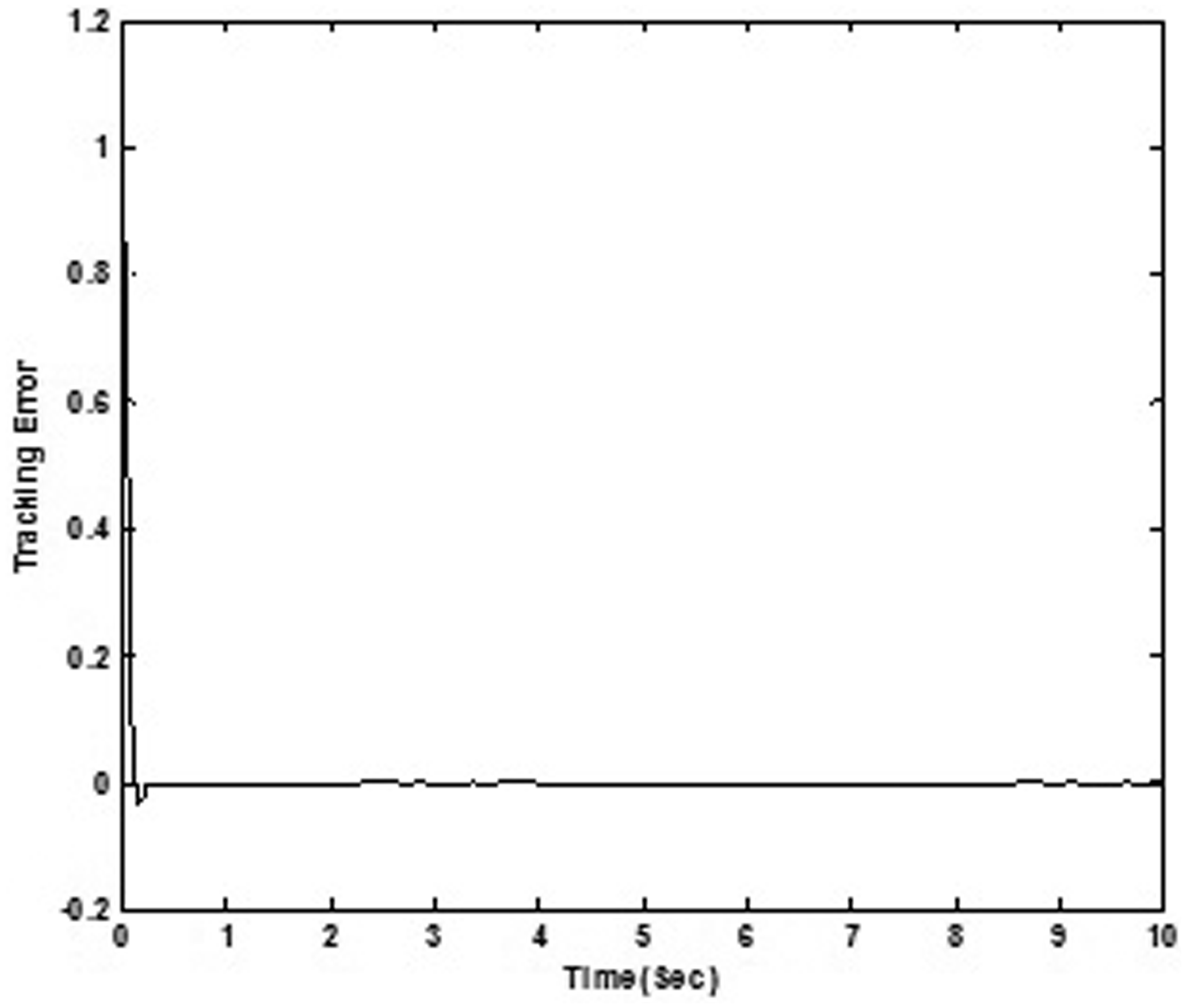
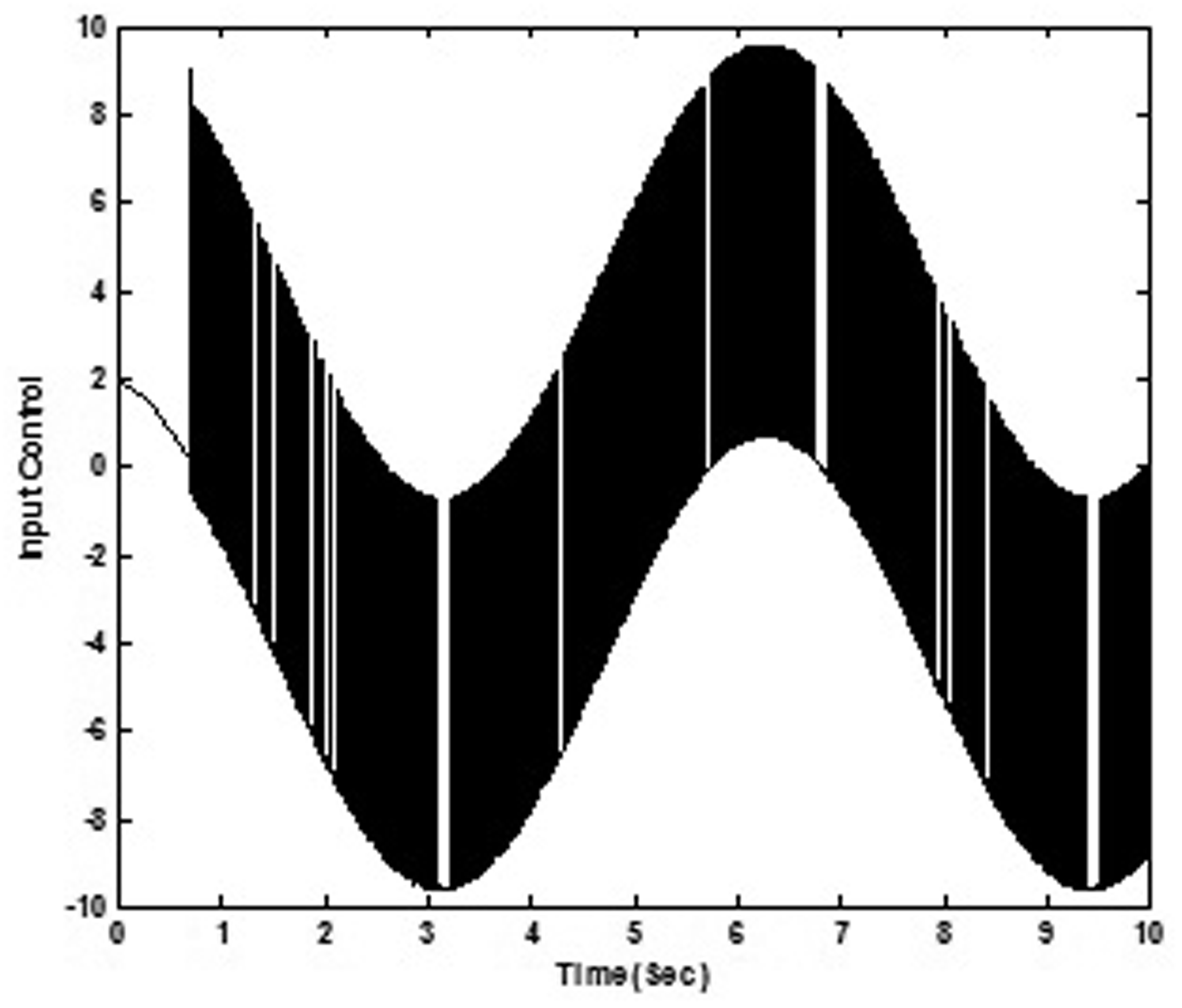
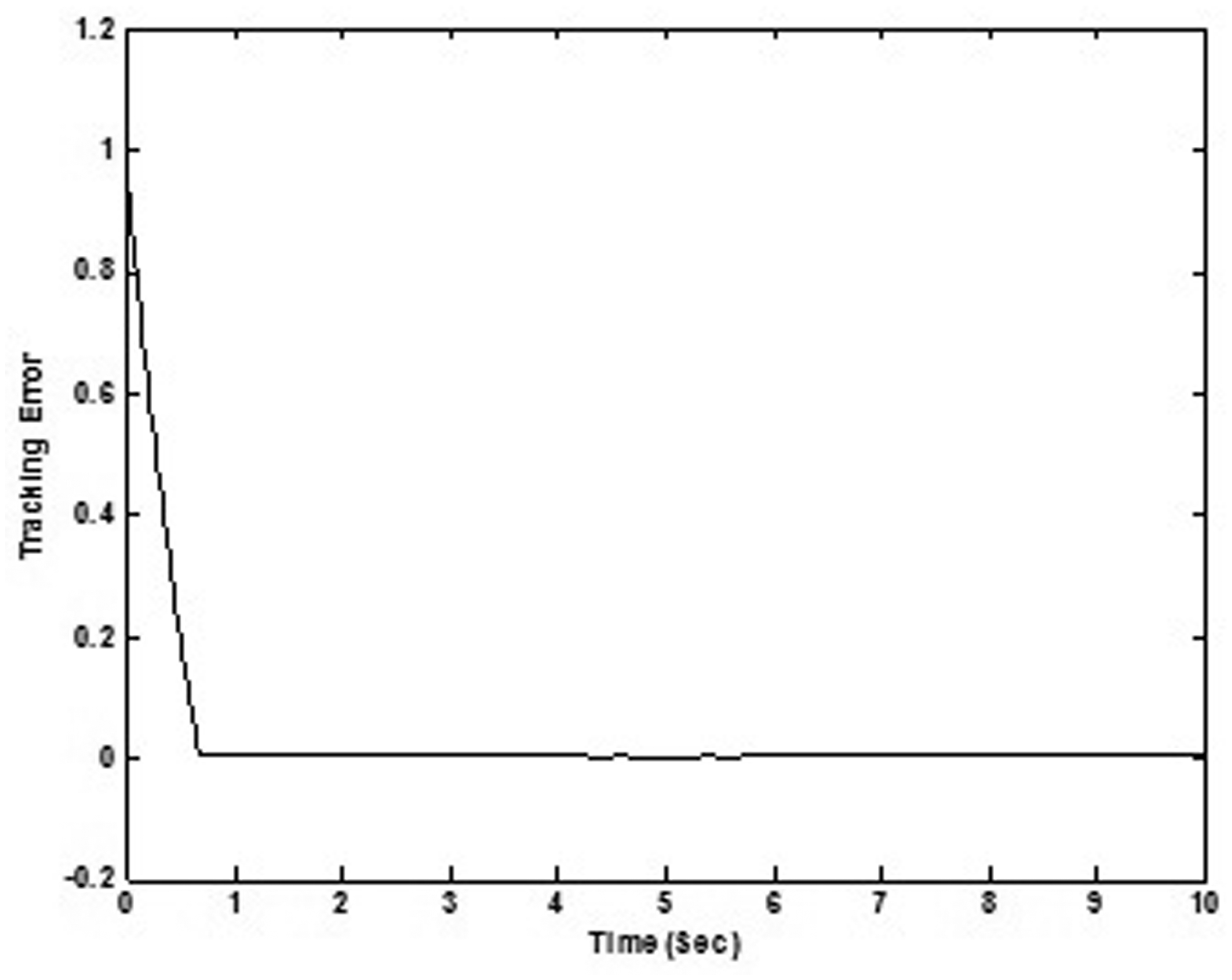
In this stage of simulation, the known parameters are considered to be equal to half the actual values of the DC motor parameters shown in Table 1, and the external disturbance d(t) is considered to be equal to zero. Therefore, in this stage, the DC motor has only structured uncertainties or severe parametric uncertainties. Both the coefficients K1 and K2 are considered to be equal to 80, and ρ is considered to be equal to 200. After simulations are carried out, it can be concluded from Figures 13 and 15 that the proposed control shows a good performance in the presence of all uncertainties, and it makes the tracking error converge to zero in less than 0.5 seconds. Despite high tracking accuracy, it can be seen in Figure 14 that the control input is accompanied by chattering.
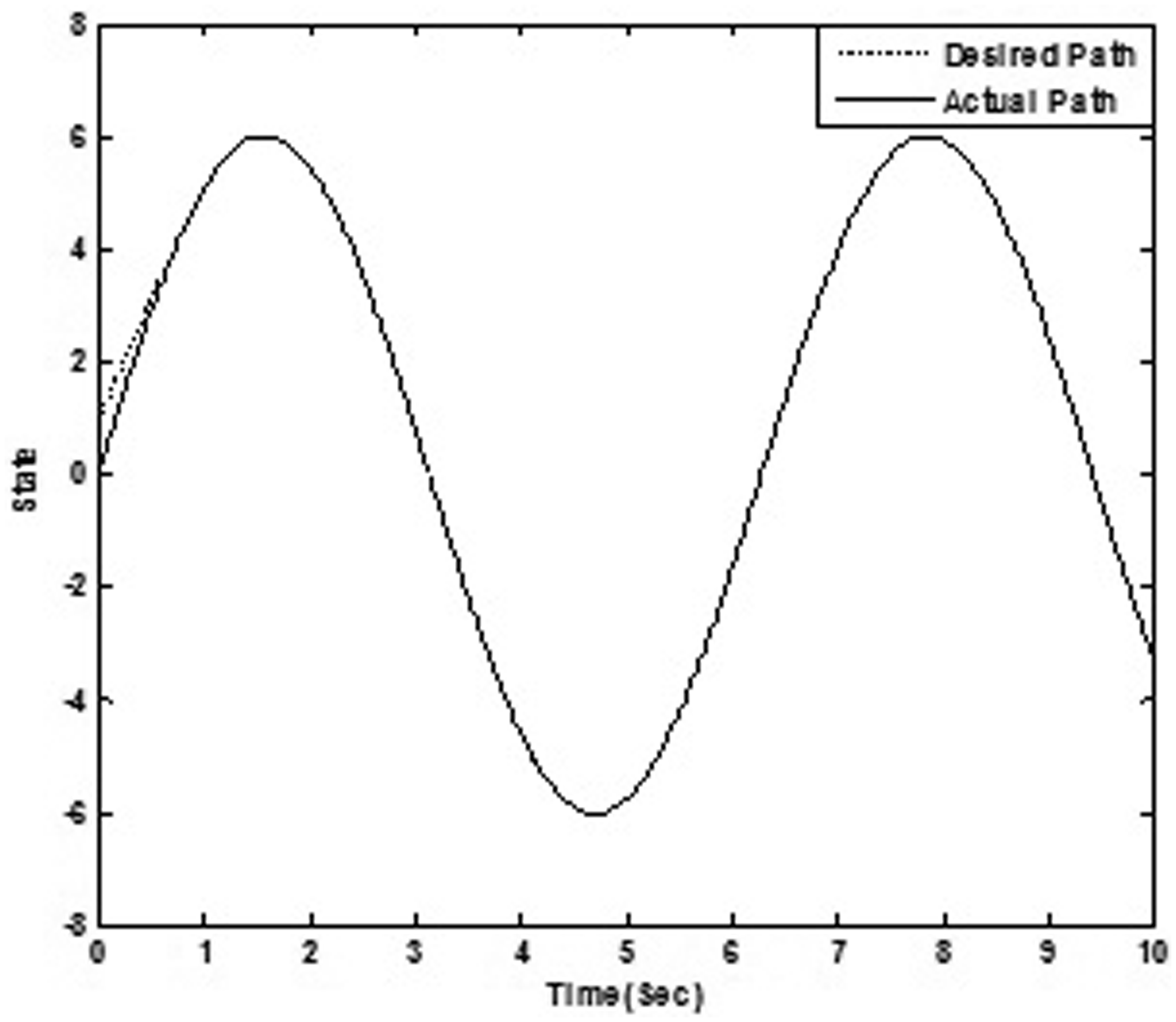
The desirable path and the actual path caused by applying robust backstepping method controller in the presence of structured uncertainties existing in the dynamics of DC motor. The control input caused by applying robust backstepping method controller in the presence of structured and existing uncertainties in the dynamics of DC motor. Tracking error caused by applying robust backstepping method controller in the presence of structured uncertainties existing in the dynamics of DC motors. In addition to the parametric uncertainty of simulation 1, the external disturbance The desirable path and the actual path caused by applying robust backstepping method controller in the presence of structured and unstructured uncertainties existing in the dynamics of DC motor. The control input caused by applying robust backstepping method controller in the presence of structured and unstructured uncertainties existing in the dynamics of DC motor. Tracking error caused by applying robust backstepping method controller in the presence of structured and unstructured uncertainties existing in the dynamics of DC motor.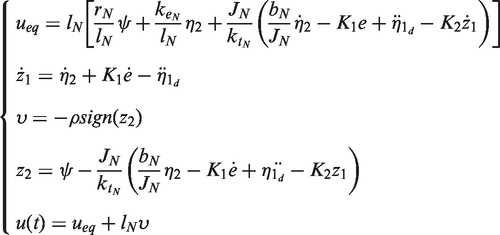
Simulation 1:
Simulation 2:
5.4. Case 2
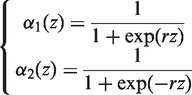
In this section, the performance of the FRBM controller on the DC motor is investigated. The control input of the designed FRBM is as follows:
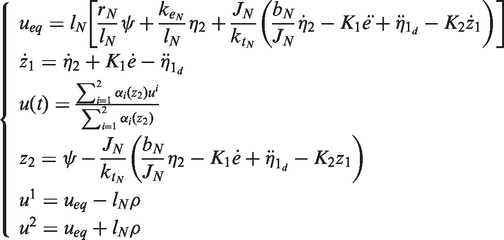
In equation (56), the premise variable is represented by The conditions governing this stage of simulation are considered to be similar to those of the previous section. In this stage, both the coefficients of K1 and K2 are considered to be equal to 80, and ρ is considered to be equal to 200. After simulation, according to Figures 19 and 21, the proposed controller performs well in the presence of structured uncertainties, and it makes the tracking error converge to zero in about 0.5 seconds. Figure 20 shows that the control input does not suffer from chattering, and it is within an allowable range from an amplitude point of view.
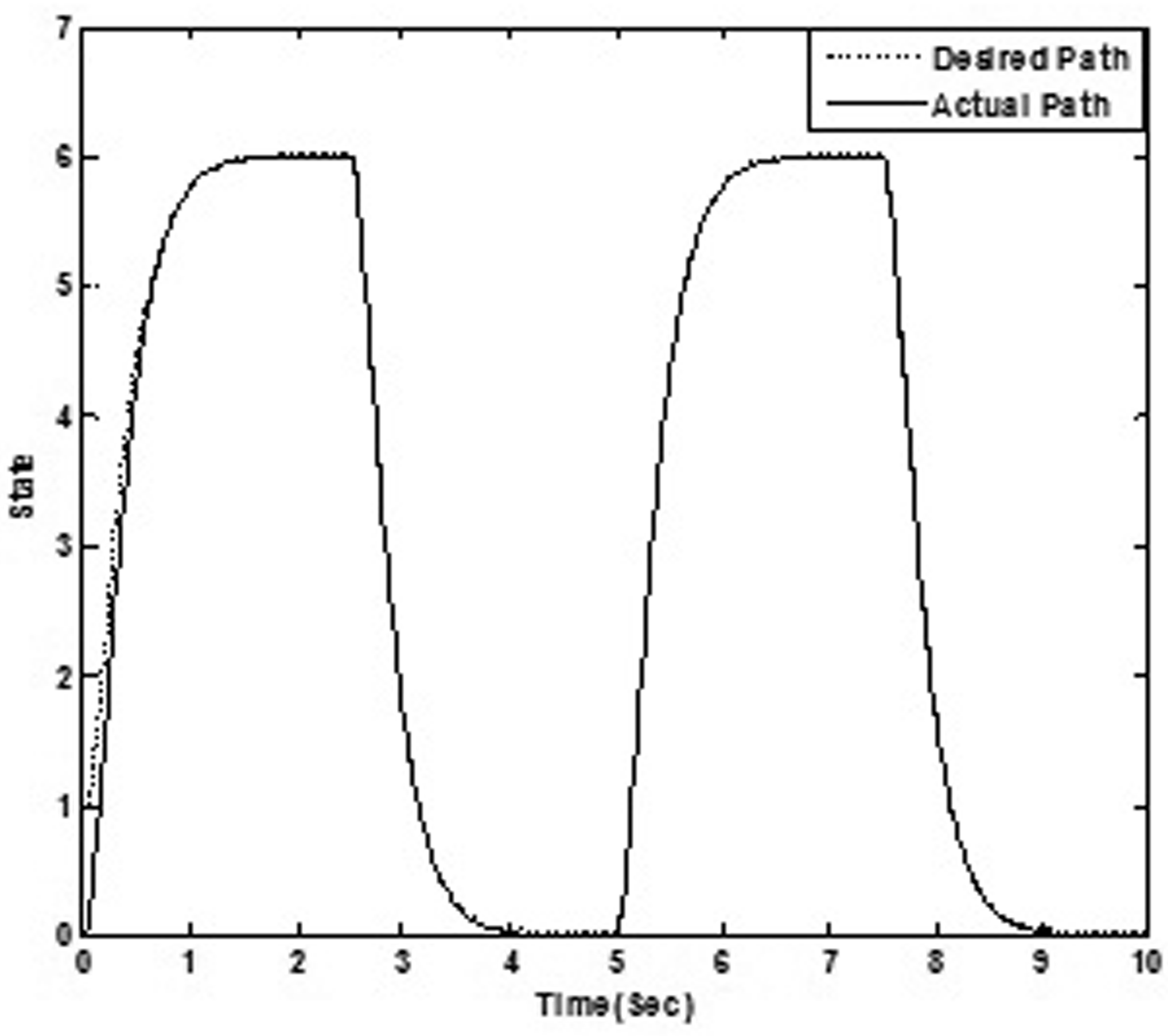
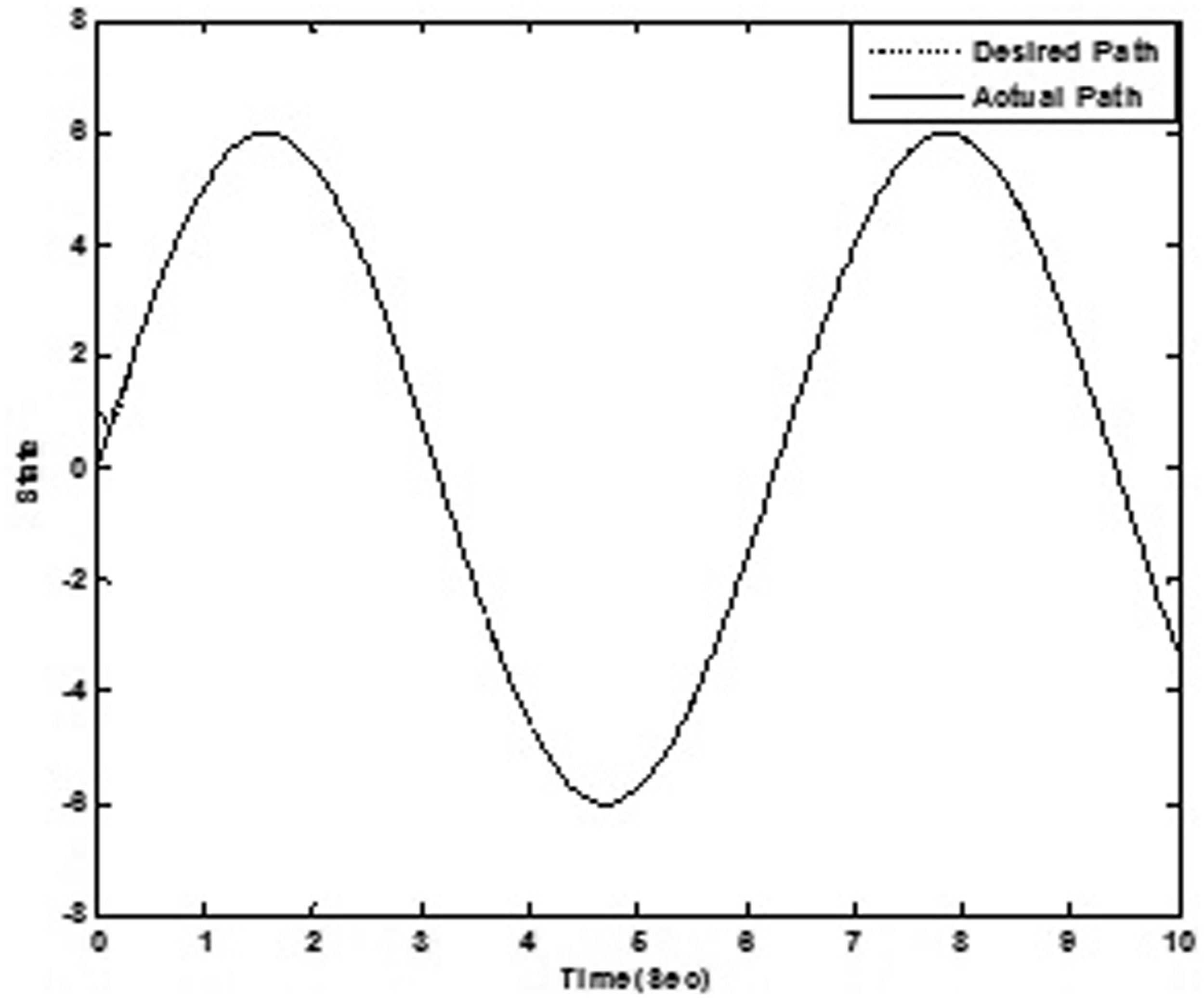
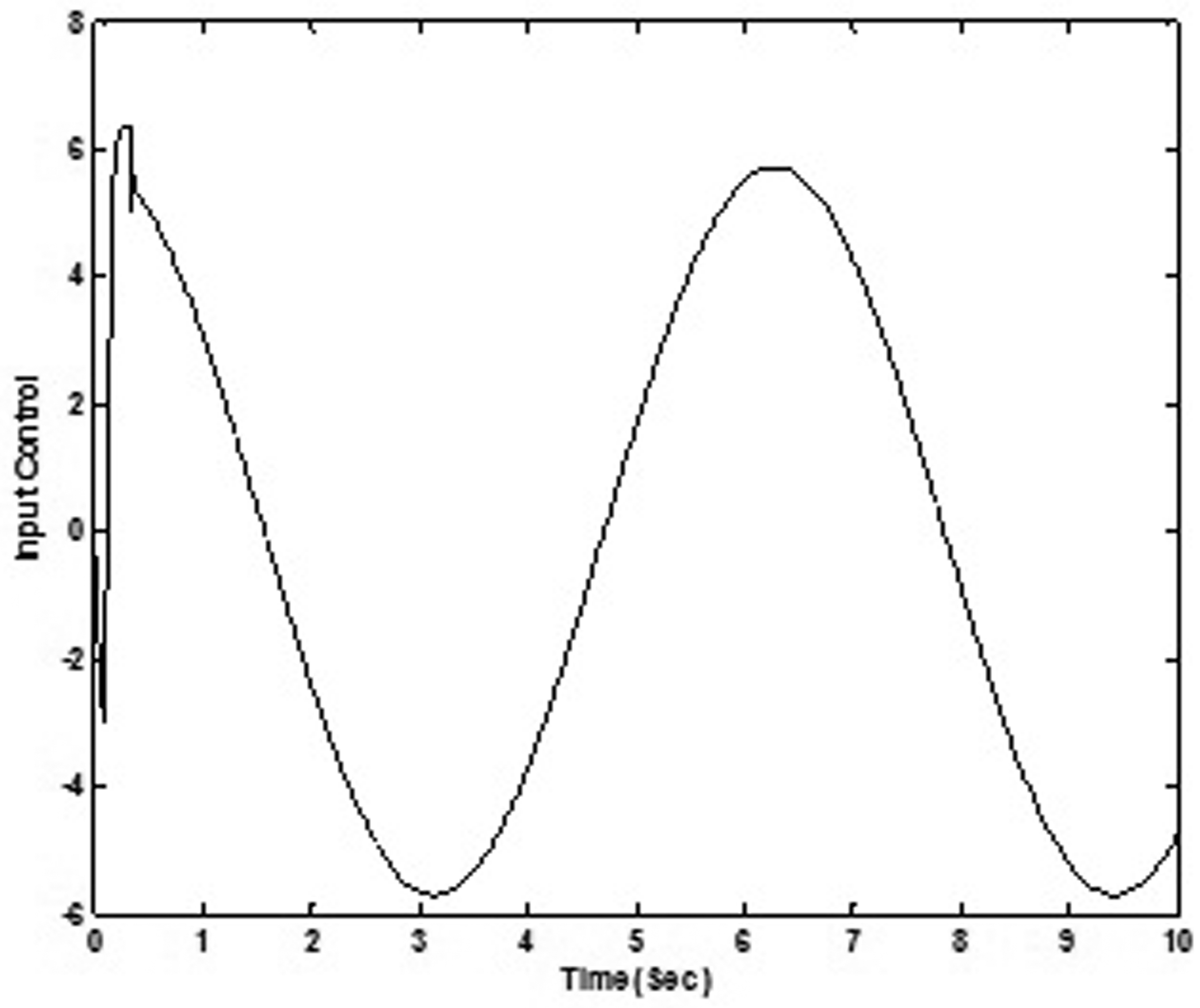
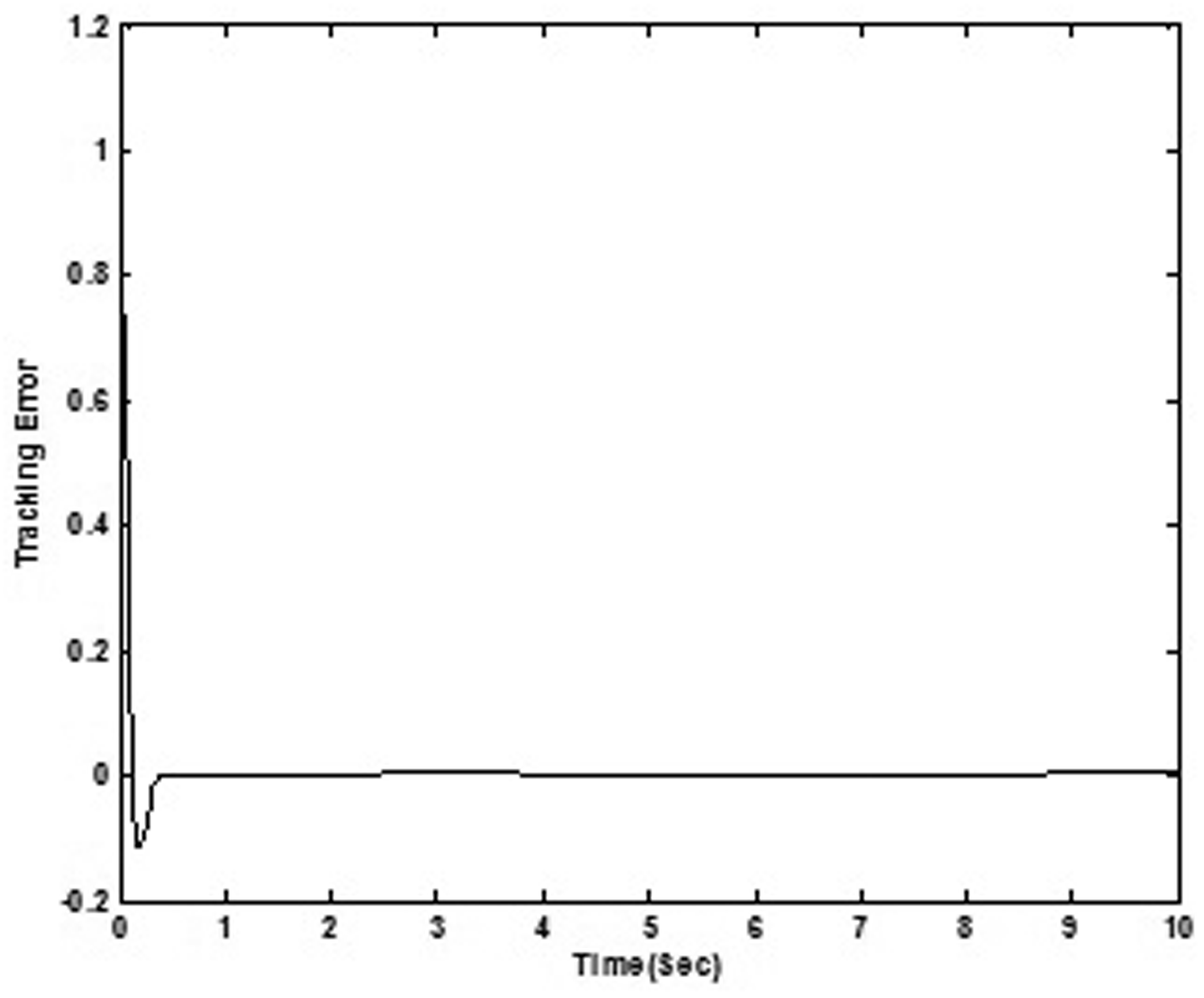
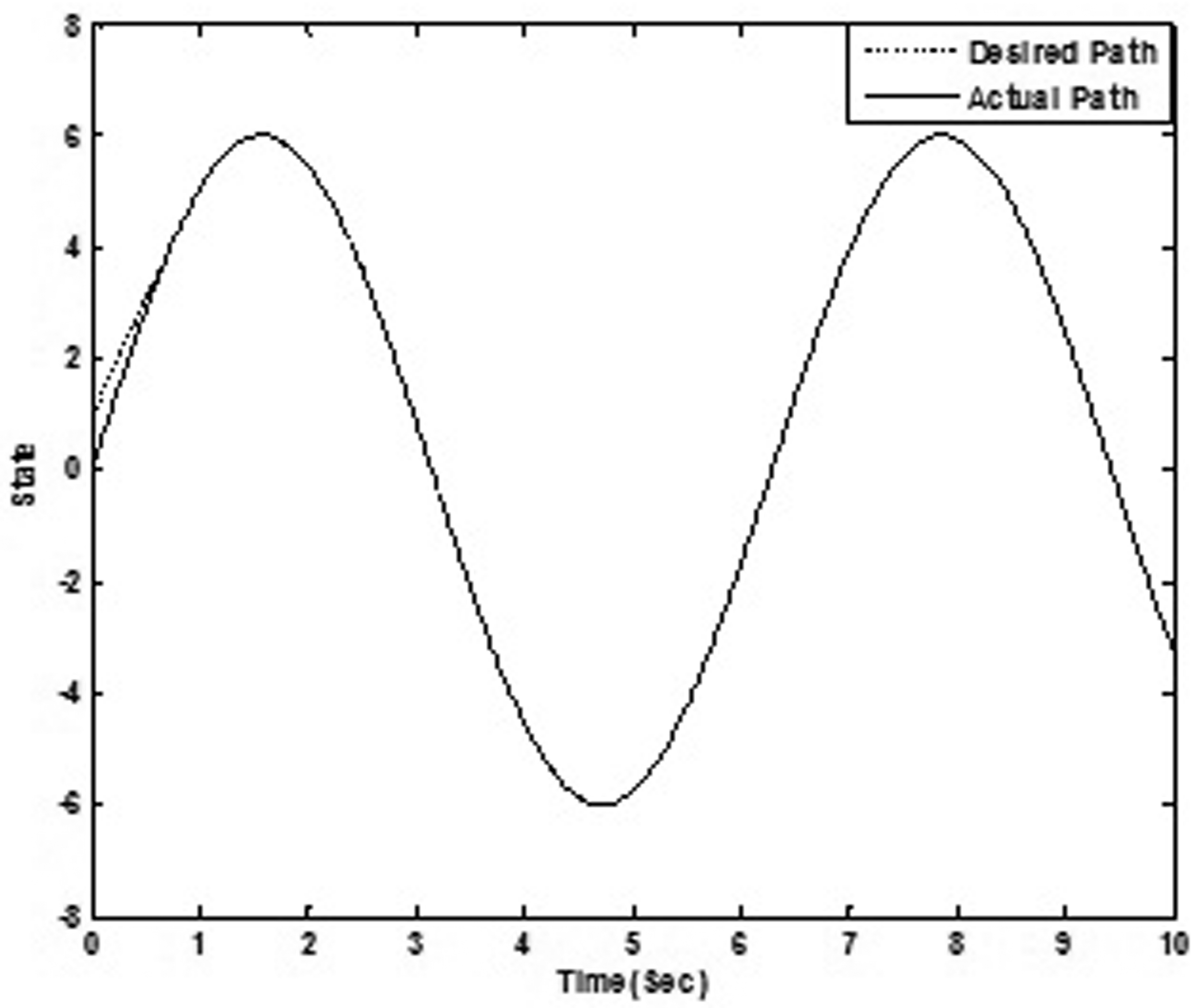
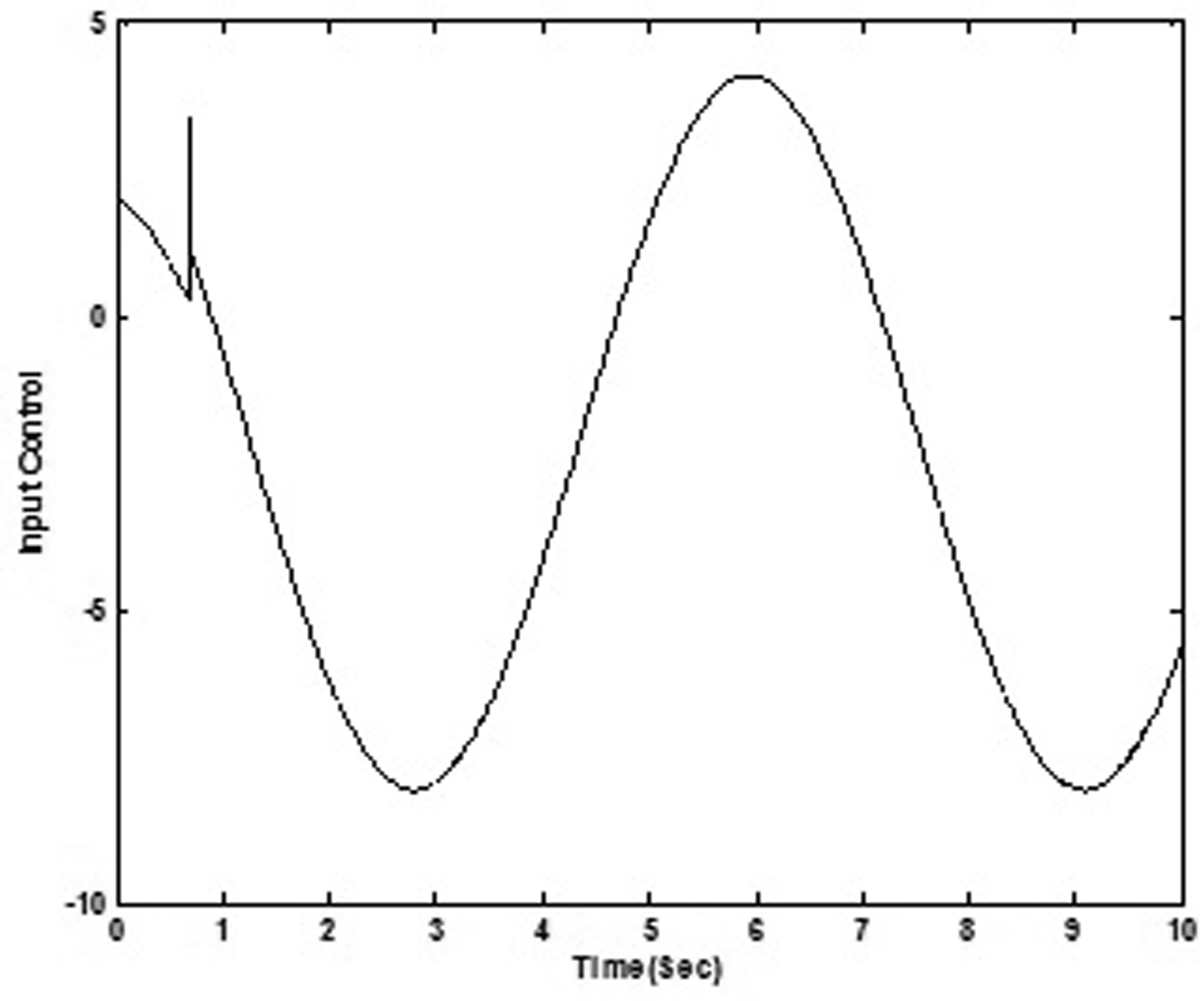
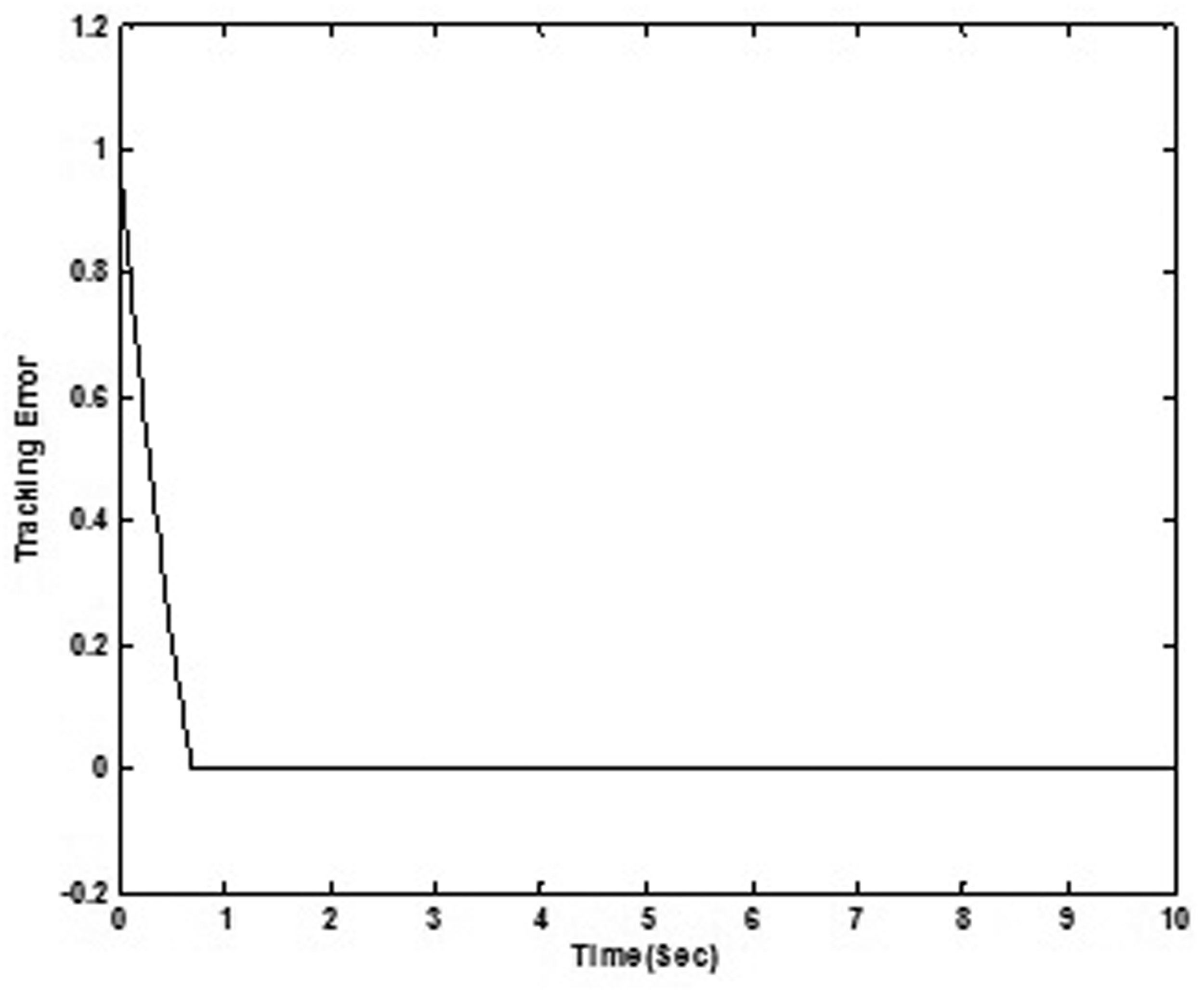
The desirable path and the actual path caused by applying fuzzy robust backstepping method controller in the presence of structured uncertainties existing in the dynamics of DC motor. The control input caused by applying fuzzy robust backstepping method controller in the presence of structured uncertainties existing in the dynamics of DC motor. Tracking error caused by applying fuzzy robust backstepping method controller in the presence of structured uncertainties existing in the dynamics of DC motor. This stage of simulation is exactly the same as simulation 2 in the previous section. In this stage, The desirable path and the actual path caused by applying fuzzy robust backstepping method controller in the presence of structured and unstructured uncertainties existing in the dynamics of DC motor. The control input caused by applying fuzzy robust backstepping method controller in the presence of structured and unstructured uncertainties existing in the dynamics of DC motor. Tracking error caused by applying fuzzy robust backstepping method controller in the presence of structured and unstructured uncertainties existing in the dynamics of DC motor. By investigating Figures 8, 11, 20, and 23, it can be concluded that the performance of the FRBM controller in controlling the DC motor is better than its performance in controlling the induction motor. This is because no chattering is observed in Figures 20 and 23 while some signs indicating the occurrence of chattering are seen in Figures 8 and 11. The reason for this is related to selecting the desirable paths in these motors. As in Figure 7, the desirable path selected for the induction motor is not so smooth, and the derivate of this non-smooth path causes some signs of chattering to be seen in the control input of the FRBM. Investigating Figure 19 reveals that the desirable path for the DC motor is very smooth. Consequently, there is no sign of chattering in the control input of the FRBM. In this paper, the desirable paths are selected in such a way that they show the performance of the proposed controller in the best way.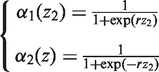
Simulation 1:
Simulation 2:
Remark 5:
6. Conclusion
In this paper, a robust backstepping controller was presented for position tracking of a class of electrical motors. Despite its advantages, the proposed controller encountered the problem of chattering in the control input. This problem increases the probability of exciting natural frequencies. Under these conditions, it will be impossible to guarantee the stability of the closed-loop system. To solve this problem by using the TSK fuzzy system, the robust backstepping controller was designed in such a way that it would not suffer from the problem of the occurrence of chattering. To investigate the performance of the proposed controllers, two different types of motors, namely induction and DC motors, were used as case studies. The results of multistage simulations show that the fuzzy robust backstepping controller has a desirable performance in the presence of structured and unstructured uncertainties that exist in the dynamics of these motors, and it can make the tracking error converge to zero in a very short time. In this paper, the way in which the proposed controllers are implemented, and their advantages, disadvantages, and practical implementing considerations were discussed in detail.
Footnotes
Funding
This research received no specific grant from any funding agency in the public, commercial, or not-for-profit sectors.