






Abstract
Background
Cyclin-dependent kinase 4 and 6 (CDK4/6) inhibitors, such as ribociclib, are the cornerstone of treatment for estrogen receptor-positive (ER+), human epidermal growth factor receptor 2-negative (HER2-) metastatic breast cancer. However, ribociclib is known to cause hepatotoxicity, and the role of other dietary supplements in this process is not well understood.
Case Presentation
A 47-year-old woman with metastatic breast cancer experienced grade III hepatotoxicity shortly after starting ribociclib. Despite discontinuing the drug, transaminase levels remained elevated. Using the the Roussel Uclaf Causality Assessment Method (RUCAM), a probable drug-induced liver injury was identified (score: 6). Upon disclosure of concurrent use of a fenugreek-based supplement, the revised RUCAM score dropped to 4. Further anamnesis revealed concurrent intake of a fenugreek-based supplement, prompting a revised RUCAM score of 4. The Naranjo Adverse Drug Reaction Probability Scale also indicated a possible association (score: 4). In contrast, the Drug Interaction Probability Scale (DIPS) scored 5, suggesting a probable herb-drug interaction between ribociclib and fenugreek.
Management and Outcome
Transaminase levels gradually returned to normal within eight weeks of stopping ribociclib and four weeks after discontinuing the fenugreek supplement. The patient was counseled to avoid herbal supplements and initiated on palbociclib as an alternative CDK4/6 inhibitor. Liver function remained stable with no recurrent hepatotoxicity.
Discussion
Fenugreek modulates CYP3A4, which metabolizes ribociclib. This case highlights underrecognized herb-drug interactions in oncology.
Introduction
Cyclin-dependent kinase 4 and 6 (CDK4/6) inhibitors in combination with endocrine therapy (ET) represent the standard of care for ER-positive, HER2-negative metastatic breast cancer (MBC). 1 Among the three agents; palbociclib, ribociclib, and abemaciclib, all have demonstrated significant improvements in progression-free survival with the addition of ET to ET alone. Although they are equally efficacious, these agents differ in terms of side effect profiles. 2 The most common grade 3/4 side effects reported with CDK4/6 inhibitors are neutropenia (more commonly with palbociclib and ribociclib) and gastrointestinal toxicity, such as diarrhea (Abemaciclib more commonly). However, liver toxicity, which is marked by increased hepatic enzyme levels, is also a frequent and important adverse effect to CDK4/6 inhibitors, with different rates of occurrence for these drugs. This adverse effect is particularly prominent with ribociclib. 3
Drug-induced liver injury (DILI) is an established side effect of many chemotherapeutic agents and presents a diagnostic problem. 4 Additionally, the use of complementary and alternative medicines, including dietary supplements, is common among cancer patients. These supplements are often underreported and their potential interactions with chemotherapeutic agents are frequently overlooked. 5 Fenugreek-based dietary supplements, widely consumed for their purported health benefits, contain bioactive compounds that could impact liver function and drug metabolism. However, their specific effects, particularly in patients undergoing cancer treatment, remain insufficiently studied.
We describe an extremely rare case of hepatotoxicity in a 47-year-old female patient with advanced breast cancer treated with ribociclib. While the clinical presentation and elevated liver enzymes suggested DILI, detailed anamnesis revealed the concurrent use of a fenugreek-based dietary supplement, raising the possibility of a previously unreported interaction.
This case draws attention to the need to evaluate all therapeutic agents i.e., dietary supplements when assessing hepatotoxicity of patients with cancer and emphasizes the crucial need for greater awareness and monitoring of potential drug-supplement interactions.
Cas clinique
A 47-year-old female with a history of breast cancer (ER+, HER2-) diagnosed in 2012 underwent a lumpectomy followed by chemotherapy, radiotherapy, and a 5-year course of tamoxifen, achieving effective disease control.
In 2024, the patient presented with persistent, diffuse headaches. A brain CT scan revealed a single brain metastasis measuring 3 cm × 2 cm. Subsequent brain MRI confirmed a large extra-axial meningeal tumor predominantly located in the left paramedian parietal region, accompanied by a midline shift to the left. A full metastatic workup was conducted to assess extracranial disease. PET scan findings included: A metabolically active lesion in the left interpectoral region, highly suspicious for malignancy with multiple secondary bone lesions.
A bone biopsy confirmed metastases of mammary origin: ER+, HER2-. The patient received palliative radiotherapy to the brain metastasis and was initiated on a first-line treatment regimen for advanced luminal breast cancer, including: gosereline (GnRH analogue) every 4 weeks, letrozole (2.5 mg daily) and ribociclib (600 mg oral daily for days 1–21 of a 28-day cycle) and zoledronic acid each 28 days. Baseline liver function tests were normal prior to ribociclib initiation, and imaging showed no evidence of liver metastases. The patient had no history of liver disease, alcohol use, or drug abuse.
After completing one cycle of ribociclib, the patient exhibited an isolated elevation in alanine aminotransferase (ALAT) to 117 U/L, while aspartate aminotransferase (ASAT), alkaline phosphatase (ALP), and bilirubin levels remained within normal ranges. Ribociclib was discontinued at this point. A physical examination revealed no abnormalities, and tests for acute viral hepatitis were negative. A liver ultrasound showed no structural abnormalities.
Despite discontinuation of ribociclib, liver enzymes continued to rise (Figure 1), and the Roussel Uclaf Causality Assessment Method (RUCAM) score was calculated as 6 points, indicating a probable causal association with Ribociclib therapy. Three weeks after ribociclib withdrawal, prednisone was initiated at a dose of 60 mg daily. However, ALAT and ASAT levels rose sharply, peaking at 776 U/L and 697 U/L, respectively, in early November.
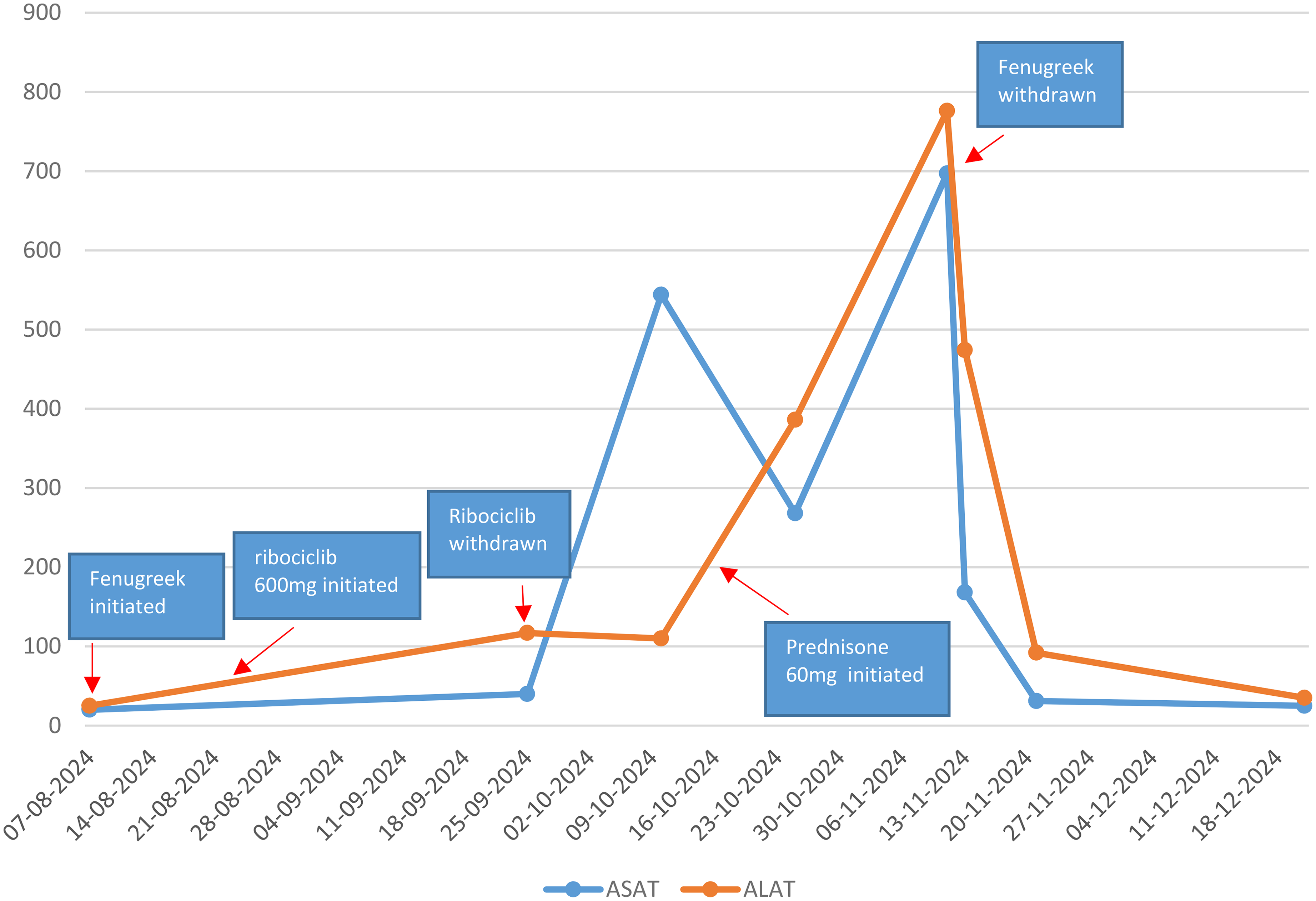
Timeline of liver enzyme levels (ASAT and ALAT).
During a detailed medical history review, the patient disclosed concurrent use of a fenugreek-based dietary supplement, which she began at the same time as her cancer therapy. Due to fatigue and a decline in her overall condition, she had increased the supplement dosage during treatment.
In light of this new information, the RUCAM score for ribociclib alone was recalculated to 4, indicating a possible rather than probable causal association. To further assess the contribution of ribociclib to the hepatotoxicity observed, the Naranjo Adverse Drug Reaction Probability Scale was applied, yielding a score of 4 (indicating a possible association) (Table 1). In addition, the Drug Interaction Probability Scale (DIPS) was used to evaluate the likelihood of a herb-drug interaction between ribociclib and fenugreek. The patient's clinical course, timing of supplement initiation, and the resolution of symptoms upon withdrawal were all considered. The DIPS score was calculated at 5, suggesting a “probable interaction"(Table 2). This reinforces the hypothesis of a synergistic effect between ribociclib and the fenugreek supplement as a potential trigger of hepatotoxicity. The concurrent use of fenugreek, combined with the timing of liver enzyme elevation, highlights the potential for herb-drug interactions to contribute to the observed hepatotoxicity.
Naranjo adverse drug reaction probability scale.

Drug interaction probability scale (DIPS).

The patient was closely monitored, and prednisone was tapered once liver enzyme levels peaked. Transaminase levels gradually returned to normal within eight weeks of stopping ribociclib and four weeks after discontinuing the fenugreek supplement. She was counseled to permanently avoid herbal supplements. Therapy with Palbociclib (125 mg daily) was introduced as an alternative CDK4/6 inhibitor two weeks after normalization of liver function, with close laboratory monitoring. Remarkably, liver enzyme levels remained within the normal range one month after palbociclib initiation.
This case was reported to the pharamcovigilance unit of the National Institute of Oncology in Rabat and written informed consent was obtained from the patient for the publication of this case report.
Discussion
The cyclin D-cyclin dependent kinase (CDK) 4/6-inhibitor of CDK4 (INK4)-retinoblastoma (Rb) pathway plays a key role in regulating cell cycle progression, particularly at the critical G1-S checkpoint. When this pathway is disrupted, it often leads to unchecked cell proliferation, a hallmark of many cancers. Such disruptions can occur through various mechanisms, including gene amplifications, loss of regulatory proteins, or mutations. 6 Ribociclib, which targets the CDK4/6 pathway, is metabolized in the liver primarily by the enzyme CYP3A4 and is eliminated through bile, making its pharmacokinetics highly dependent on liver function. 7
The liver's cytochrome P450 (CYP450) enzymes are responsible for metabolizing the majority of drugs. These enzymes, part of a large family of hemoproteins, are involved in breaking down a wide range of substances, from natural compounds like steroids and fatty acids to medications. However, when CYP450 enzymes are inhibited, drug levels in the bloodstream can rise, potentially leading to toxicity. Among the key CYP450 enzymes, CYP3A4 and CYP2D6 together metabolize over 80% of drugs. 8
Clinical trials for ribociclib have shown elevated alanine aminotransferase (ALT) and aspartate aminotransferase (AST) levels. In the MONALEESA-2 trial, grade 3 or 4 ALT elevations occurred in 9.3% of ribociclib-treated versus 1.2% of placebo patients. 2 This led to the recommendation of monitoring liver function both prior to and during treatment. A meta-analysis revealed a higher risk of hepatic toxicity with ribociclib compared to palbociclib and abemaciclib, with the absolute risk of grade 3–4 ALT elevation being 0.097 for ribociclib, 0.034 for palbociclib, and 0.046 for abemaciclib. 9
In our case, the hepatocellular injury during ribociclib therapy, initially classified as probable according to the Roussel Uclaf Causality Assessment Method (RUCAM) with a score of 6. This aligns with prior reports of ribociclib-induced liver injury, which often exhibit hepatocellular patterns and prolonged transaminase elevation even after discontinuation of the drug as shown in Table 3.3,10–15 However, the concurrent use of a fenugreek-based dietary supplement, which was taken and dose-escalated during cancer therapy, introduced a significant confounding factor.
Fenugreek (Trigonella foenum-graecum) is a popular herbal remedy, grown in different countries and regions, including China, North and East Africa, Ukraine, and Greece. It is known for its many purported health benefits, including its hypocholesterolemic, antidiabetic, anticancer, and antioxidant properties.16,17 Fenugreek is a plant rich in a wide variety of bioactive compounds, including flavonoids, alkaloids, amino acids, coumarins, vitamins, saponins, and other antioxidants. Although there is evidence that the effect of fenugreek on CYP3A4 metabolism is generally weak, some caution is needed, especially when fenugreek is taken in combination with CYP3A4 substrates drugs. 18 Additionally, coumarin, a component of fenugreek, has been associated with hepatotoxicity in some scenarios (Abraham et al., 2010). 17
Given the temporal relationship between the supplement use, and liver enzyme elevations, we recalculated the RUCAM score to 4, suggesting a possible rather than probable causal association with ribociclib alone. To further assess the contribution of ribociclib to the observed hepatotoxicity, the Naranjo Adverse Drug Reaction Probability Scale was applied, yielding a score of 4 (indicating a possible association). This adjustment underlines the potential for herb-drug interactions, which continue to remain underreported and unpredictable.
In order to strengthen the evaluation of a causal relationship between ribociclib and the fenugreek-based supplement, we also applied the Drug Interaction Probability Scale (DIPS). This tool considers factors such as the known interactive properties of the involved agents, the timing of onset, the dechallenge-rechallenge response, alternative causes, and objective evidence. In this case, a total DIPS score of 5 was obtained, corresponding to a probable interaction. This assessment was supported by 1) the pharmacological plausibility due to ribociclib's known metabolism via CYP3A4, 2) the presence of compounds in fenugreek that may influence CYP activity, and 3) the temporal correlation and aggravation of liver enzyme elevation upon increased supplement intake. These findings are particularly significant given that the liver injury improved only after discontinuation of both agents and did not recur with palbociclib, suggesting a synergistic or additive hepatotoxic effect.
The management of this case involved withdrawal of both ribociclib and the fenugreek supplement, coupled with corticosteroid treatment. The normalization of liver enzymes within eight weeks of discontinuation and without recurrent hepatotoxicity upon initiation of palbociclib as an alternative CDK4/6 inhibitor strongly supports the reversibility of the hepatotoxicity and suggest that ribociclib-fenugreek interaction likely played a central role.
This case underscores several important lessons:
The requirement for detailed patient history taking, including the collection of data about dietary supplements and herbal products, although generally neglected. Attention to close liver function monitoring for CDK4/6 inhibitors therapies. The need for educating patients about the potential risks of combining prescription drugs with herbal supplements like fenugreek. Particularly when undergoing treatments with known hepatotoxic potential. Further research is necessary to better understand the mechanisms underlying herb-drug interactions and to develop guidelines for safer co-administration of herbal supplements with targeted therapies.
Comparison of previous case reports on ribociclib-induced liver injury.

Footnotes
Authors' Contributions
Declaration of conflicting interests
The author(s) declared no potential conflicts of interest with respect to the research, authorship, and/or publication of this article.
Funding
The author(s) received no financial support for the research, authorship, and/or publication of this article.
