







Abstract
Well-being has been traditionally considered a multidimensional construct linked with different well-being capacities and the satisfaction of basic human needs. However, theories of well-being have in general rested on a dichotomous differentiation between ‘positive’ and ‘negative’ mental health, rather than seeing these as natural, dynamically occurring experiences part of a well-being process (i.e., growth). Therefore, this article suggests a growth theory of well-being, seeing well-being as a dynamic process of differentiation and integration, which were previously established as fundamental elements of various theories of change, personal growth, cognitive development and more. This article outlines the growth theory of well-being and its component processes of differentiation and integration, reviewing their roles in earlier growth theories. It then discusses the implications of adopting the growth theory of well-being.
‘‘-- The human being’s development is a continuum of differentiation from the ‘mass’ towards freedom as an individual. -- All through life a person is engaged in this continuum of differentiation of himself from the whole, followed by steps towards new integration.’’ (Rollo May, 1953, p. 85–86).
Well-being is dynamic. This is the premise of the growth theory of well-being (GT) put forward in this article. Echoing the epigraph by the existential psychologist Rollo May, this new theory suggests that well-being, like development and learning, is a process characterized by dynamic fluctuations between differentiation and integration. The GT relies on a process ontology of how complex living systems grow. Across biology, systems sciences, and education, among other fields, growth is understood as the emergence of differentiated elements that are integrated into coherent wholes. For instance, in biology, the process of embryogenesis involves cells differentiating into organs and tissues, which ultimately integrate into an individual organism (e.g. Chen et al., 2020; Czyz & Wobus, 2001). Within systems sciences, systems differentiate through boundaries while also integrating into higher-order systems (Ladyman & Wiesner, 2020). In education, learning and cognitive change happen via the accumulation of differentiated types of knowledge and their integration to solve problems and enact societal change (e.g. Siegler & Chen, 2008). Following the process ontology observed in these and other fields, the current GT posits that differentiation and integration lie also at the heart of the well-being and mental health.
This article first reviews current perspectives on well-being and argues for the need to change how psychology understands well-being. Following this, the GT is described through first outlining its underlying metatheory and then explaining the key concepts of differentiation and integration. After that, the theoretical background of the GT is described, including theories of personal growth and development. Finally, I will reflect on the suggested theory’s implications.
Well-Being Theories and a Suggestion
Well-being research is rife with theories and models of well-being, such as the subjective well-being model (Diener, 2009; Diener et al., 1985), psychological well-being (Ryff, 1989; Ryff & Singer, 2008), dual-factor models of well-being (Keyes, 2002), PERMA theory of well-being (Seligman, 2011), and the EPOCH model for adolescent well-being (Kern et al., 2016). Under these theories are a host of variables considered to be part of the well-being umbrella, such as life satisfaction, positive affect (subjective well-being: Diener et al., 1985), autonomy, personal growth, environmental mastery, self-acceptance, purpose (psychological well-being; Ryff, 1989), meaning, accomplishment, positive relationships, optimism, perseverance, and engagement (PERMA; Seligman, 2011; and EPOCH; Kern et al., 2016), harmony (Kjell et al., 2015), and transcendence (Kaufman, 2020). Indeed, well-being is a multidimensional concept.
However, this array of concepts has yet to find substantial order under the umbrella of well-being, and they are rarely considered holistically in a research context. The GT posited in this article aims to construct such an order whereby an individual develops well-being through an ongoing process of differentiation and integration. Individual well-being facets such as self-awareness and autonomy serve to distinguish and differentiate the individual while facets such as harmony, social relationships and transcendence help to integrate the person within a social reality. High well-being should not be considered the predominance of one facet or another but an integration of these facets across different domains (i.e. physical, psychological, social, spiritual, cultural). Each aspect and domain influences the others, such that an enhancement in physical well-being can positively affect psychological and social well-being, but will not determine these domains. A similar argument was recently given by Lomas et al. (2024), who suggests that well-being should be seen as the harmony and balance of various multidimensional aspects of wellness (see similar argument also in Carreno et al., 2021; Delle Fave et al., 2023; Martela, 2024). Harmony, as they discuss it, is an integrated process, meaning that integration is fundamental to their theory of well-being (Lomas et al., 2024).
Where the GT departs from other theories of well-being is its process ontology, whereby well-being is not an array of hedonic and eudaimonic constructs but a process of differentiation and integration—in other words, of growth. This suggestion allows for theorizing on well-being that is truer to real-life experiences, following Delle Fave et al.’s (2023) criticism of the dichotomous nature of well-being endorsed by traditional definitions and measures. It is time to move beyond the positive-negative dichotomy and polarization in well-being theories (see Van Tongeren, 2024), as well as the categorical view of well-being (Delle Fave et al., 2023), and incorporate a more balanced, true to real life, and dynamic view of well-being as continuous growth and change. The categorical and dichotomous approaches undermine the dynamic nature of well-being in everyday life (e.g. Delle Fave et al., 2023), whereby well-being fluctuates between lows and highs. The GT recognizes this dynamic nature of well-being.
Furthermore, the critique of positive psychology and well-being theories as individualistic (Van Zyl et al., 2024) can be tackled by the GT, which posits that the individual’s well-being growth process is fundamentally embedded in a social context. Since the GT is based on the organismic systems theory (discussed below) which holds that the individual is embedded in multiple social systems on different levels, the GT similarly suggests that the social environment plays a crucial role in well-being. The social environment can support or stifle some of the processes that the individual is going through. For instance, an environment with high levels of psychological safety can serve as a supportive environment for individual’s well-being growth process, whereas a psychologically unsafe, threatening, or hostile social environment can stifle the process (e.g., Maurer et al., 2023).
The call for a ‘third wave’ of positive psychology (Lomas et al., 2021) is a call for such integrative models. It calls to incorporate both positive and negative sides of human existence, deal with existential concerns, and the holistic experiences of being a human being with ups and downs of life. Such an integrative perspective would also incorporate dual-factor models of well-being and the associated findings that people can be simultaneously high on mental health problems and high on well-being (see Suldo & Shaffer, 2008; Moore et al., 2019; Suldo, 2016; Antaramian et al., 2010; Eklund et al., 2011; Maurer et al., 2025).
The GT suggests that the processes of differentiation from others (individuality, self-awareness, autonomy, authenticity) and integration into social reality (greater social responsibility, compassion, harmony, social relationships, transcendence) build a picture of optimal well-being and mental health for an individual. Furthermore, this process is embedded in a social context. This suggestion is based on past theories that also viewed well-being as a process of personal growth and that positioned integration, or high well-being, as the ultimate goal of such growth (Dabrowski, 1964; Kaufman, 2020; Maurer et al., 2023; Rogers, 1961, 1964, 1980; Siegel, 2007, 2018). The GT builds on this literature by better articulating this process of growth and by positioning integration not as the goal or outcome (high well-being) but as one of two component processes that make up the higher-order well-being process.
The GT consults personal growth theories of well-being, such as the personal growth process model (PGP; Maurer et al., 2023), as well as the theories by Kaufman (2020; based on Maslow, 1962), Siegel (2009, 2018), and Dabrowski (1964), which incorporate integration. It further draws on Lomas et al.’s (2024) recent theory of “sustainable well-being”, which positions well-being as a balance or harmony of various life-domains, well-being aspects and systems (Lomas et al., 2024). Integrative growth also forms the basis of some developmental theories (such as Erikson’s [1968] psychosocial theory; Piaget’s [1971] theory of cognitive development; and Loevinger’s [1966] theory of ego-development). Finally, the GT should be seen as fitting within the recently suggested metatheory for positive psychology called organismic systems theory (OST; Maurer, 2024).
The Growth Theory of Well-Being
Metatheory: Assumptions of Human Nature and The Nature of Well-Being
Any theory of well-being rests on clear definition of the basic assumptions of human nature and well-being itself—in other words, a metatheory. Basing a new theory on a metatheory improves it by outlining its assumptions, philosophy, epistemology, and ontology. This helps in avoiding componential thinking (Donaldson et al., 2022). The metatheory behind the current suggested theory of well-being is the newly suggested OST (Maurer, 2024), which incorporates systems sciences (systems-informed positive psychology: Kern et al., 2020) and the organismic theory inherent in disciplines such as psychotherapy, biology, and neurology. The OST is based on 11 assumptions aligning with the individual (view of the person) and systems (social systems) levels of inquiry. The assumptions are as follows: (1) active organisms – people actively orient towards growth and functionality, i.e., they have an actualizing tendency; (2) functional tendency – the actualizing tendency is a functional one, i.e., it serves the organism and its social environment; (3) integration – the processes of the individual, such as the personal growth process, tend towards a state of integration whereby differentiated elements come to function in unity, (4) emergence – emergent properties of a phenomenon can arise on higher levels of the system (such as the mind emerging from the brain: Siegel, 2011, 2018) and these are not reducible to their component parts; (5) dynamism – processes such as personal growth are dynamic and fluctuating rather than sequential; (6) self-organization –processes tend towards coherence in the long term, i.e., there is order in a process that may seem chaotic; (7) interconnectedness – the individual is embedded within a system of interconnections with larger systems (e.g., social and cultural); (8) holism – the systems within which the individual is embedded are holistic in nature, comprising biological, psychological, social, and cultural levels; (9) subjectivity – it is important to give voice to individuals’ subjective viewpoints and experiences; (10) boundaries – a system or phenomenon has boundaries that enable distinction between what is excluded and included within it; and (11) adaptation – organisms behave adaptively in their environments (Maurer, 2024).
Taken together, these assumptions indicate that an individual’s functional and natural growth tendency (growth towards greater well-being) is an inherently self-organized, dynamic process that results in the integration of various functions of the individual. The result of this self-organizing growth process is an integration of differentiated facets. The GT is based on these assumptions. Fundamentally important is that the GT is in fact not solely an individualistic theory of well-being, but consults the systems theory, therefore takes into account the individual’s embeddedness in various social, cultural and societal systems.
Some Definitions: Differentiation, Integration, and Their Importance for Well-Being
The concepts of differentiation and integration have their root in mathematics (Newton and Leibniz), but have been used somewhat symbolically outside of it, such as in psychology when discussing developmental processes (e.g. Siegel, 2001, 2007, 2011, 2018; Dabrowski, 1964; Erikson, 1968; Kaufman, 2020; Loevinger, 1966; Piaget, 1971). In both the OST metatheory and the proposed GT, differentiation and integration are core drivers of growth, including the growth of the biological, psychological, and personal growth. They are further considered fundamental for mental health (Siegel, 2011, 2018).
Differentiation broadly refers to the process of separating between various elements, identifying differences, and understanding these differences (Magnusson & Törestad, 1993; Siegler & Chen, 2008). At the level of the person, it refers to the process of engaging in new experiences and taking on challenges, which help individuals reach beyond their established boundaries. Differentiation promotes a higher awareness of the self as unique and helps to build one’s separate identity. Through differentiation, a person comes to understand their unique capacities and traits, which are in turn harmonized through the process of integration (May, 1953). Differentiation is foundational to the processes of cognitive growth, learning, and personal growth. As an individual differentiates, they learn to separate themselves from close others, marking a fundamental developmental milestone (e.g. Mahlet & Furer, 1968; Pine, 2004; Loevinger, 1966). They learn to differentiate their own thoughts and perspectives from those of others, become more autonomous and capable of independent or interdependent action (Mahlet & Furer, 1968; Pine, 2004; Loevinger, 1966). Similarly, when an individual is learning new knowledge or skills, they must first differentiate between various concepts and learn different pieces of information, make distinctions, and learn details. This aspect of the accumulation of knowledge is fundamental to the overall learning process (e.g. Ambrose et al., 2010; Siegler & Chen, 2008).
Integration, on the other hand, is the process by which differentiated elements come to work as a system. To integrate is to build connections and bridge gaps, creating coherence between the differing parts (Magnusson & Törestad, 1993). After the individual explores aspects of themselves through differentiation, integration is the process by which these aspects are reconciled, creating a more harmonious and stable sense of self (Siegel, 2011). This integration process fosters adaptability, coherence, and a sense of purpose by embedding new learning and experiences within a unified identity (Loevinger, 1966; Rogers, 1961; Siegel, 2009, 2011, 2018). Through integration, the person feels more coherent and connected to themselves and acts more according to their values, experiencing a sense of harmony with the self. At the same time, the individual integrates with their social environment, enjoying higher quality connections with others and better mental health (Kaufman, 2011, 2020). Indeed, as discussed by Siegel (2009, 2011, 2018), integration is the process through which well-being, mental health and personal growth are realized.
It is important to note that differentiation can also lead to mental health problems; the individual can feel isolated and lonely in their differentiation or they may not find integration and coherence in themselves, developing a fragmented self-image. This lack of coherence may lead to mental health problems, such as depression, anxiety, or psychosis (e.g. Dabrowski, 1964; Siegel, 2009). Such states are described by some authors as states of chaos, disorder (Siegel, 2018), or psychological entropy (Hirsh et al., 2012; Kaufman, 2020), whereby the individual fails to integrate themselves and their social worlds in a balanced way. In fact, moments of mental health problems may be a part of the cycles of differentiation and integration, as life naturally fluctuates between lows and highs as the individual deals with varying social environmental changes. Therefore, mental health problems—such as moments of depressive symptoms, anxieties, and stress—are natural fluctuations in life and as such do not take away from one’s capacity for well-being (see also May, 1953; Dabrowski, 1964; Suldo & Shaffer, 2008).
Integration, likewise, can relate to mental health problems, if integration is not balanced by the differentiation process. Such situations could arise if an individual fails to detach from caregivers and forms co-dependent relationships (e.g. Happ et al., 2023). Another example could be if one feels pressured to follow along a group norm or the demands of society without a sense of inner integrity, transgressing one’s own values (e.g. May, 1953; Fromm, 1941).
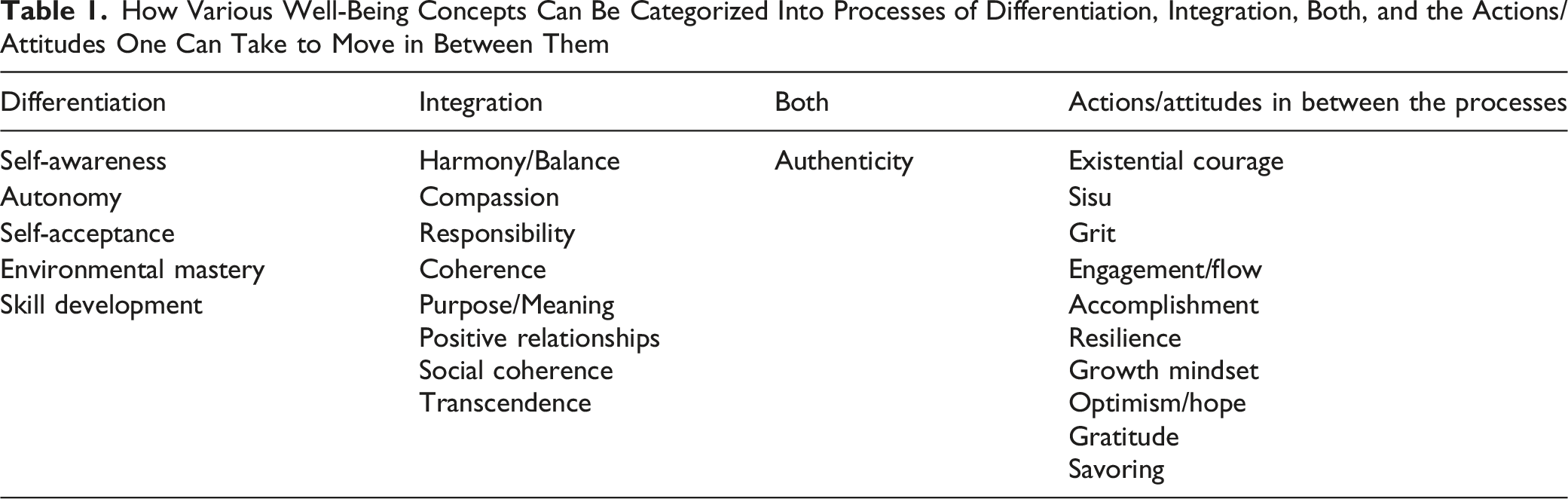
How Various Well-Being Concepts Can Be Categorized Into Processes of Differentiation, Integration, Both, and the Actions/Attitudes One Can Take to Move in Between Them
The Growth Theory of Well-Being (GT): Cycles of Differentiation and Integration
The GT suggests that well-being is a dynamic process that cycles and changes continuously through differentiation and integration, as illustrated in Figure 1. As can be seen in the figure, these processes are by no means neat and separate, but overlapping and circular. Changes in well-being may not occur quickly, but are always occurring to some degree, with cycles of differentiation and integration intertwining and sometimes occurring simultaneously (Maurer, 2024). Furthermore, the process is fundamentally influenced by an individual’s social environment. An individual is continuously embedded in multiple layers of social environments: the social, societal, cultural, global levels (see Ecological systems theory: Bronfenbrenner, 2000). In this way, the theory is not individualistic. Illustration of the suggested Growth theory of well-being, whereby processes of differentiation (D) and integration (I) are dynamically changing in a cycling process of well-being as growth. The context of these processes is the individual’s embeddedness in the social environment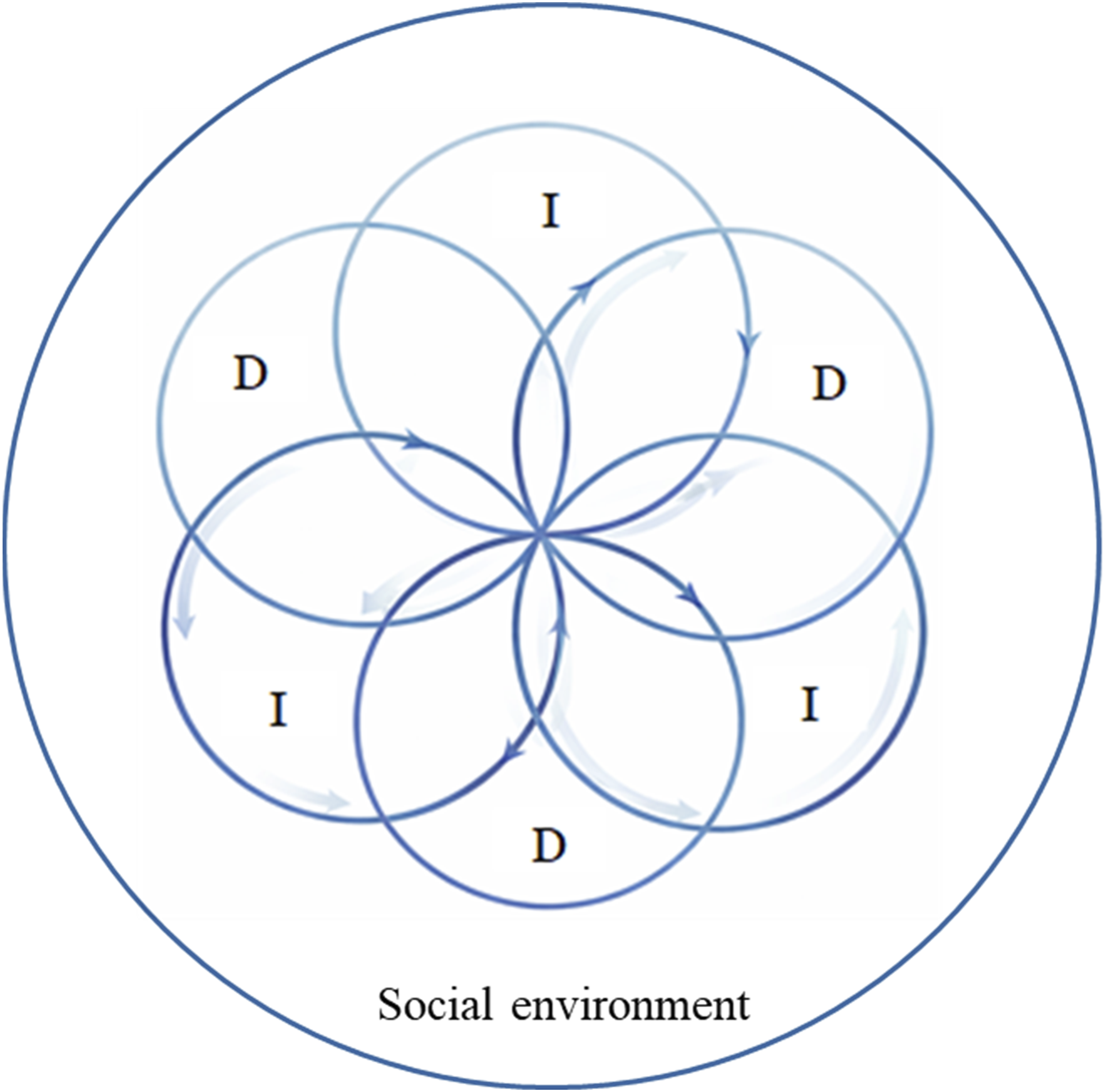
Differentiation and integration are considered overarching processes capturing concepts empirically identified in past literature on well-being, with concepts like self-awareness, autonomy, and environmental mastery reflecting differentiation, whereas harmony, compassion, responsibility, and transcendence reflect integration. Some concepts are considered to reflect both processes (e.g., authenticity, personal growth). The GT also conceptualizes actions or attitudes that a person can take to facilitate the cycle from differentiation to integration or vice versa (e.g., sisu, grit, engagement, gratitude). These actions or attitudes taken are important when differentiation or integration has resulted in negative outcomes, such as mental health symptoms, and one needs to move closer to integration (or differentiation). These concepts, which are considered “well-being capacities” to reflect their contributions to the overall well-being process, are summarized in Table 1. Note that they are not meant to be exhaustive. Moreover, it is important to understand that all these capacities described in the table are complex and experiences of them often overlap.
The following sections will focus on two examples from the table. All these aspects have been thoroughly studied by various scholars, and their work can be referenced for many further details on these concepts (see, e.g. Antonovsky, 1993; Delle Fave et al., 2016, 2023; Duckworth et al., 2007; Duckworth, 2016; Dweck, 2006; Frankl, 1946, 1966, 1970; Fredrickson, 2009; Lahti, 2019; Lomas, 2021; Kaufman, 2020; Keyes, 2002; Kjell, 2011; Kjell et al., 2015; Maddi, 2004; Maslow, 1962; Neff, 2011; Rogers, 1959, 1961, 1980; Ryff, 1989; Ryff & Singer, 2008; Seligman, 2011).
Differentiation
Differentiation is defined as including the processes of self-awareness, autonomy, self-acceptance, environmental mastery, and skill development more generally. All these things have to do with the identity of the individual as somewhat separate from others. Self-awareness and autonomy have been explored at length in philosophy and psychology, including thinkers such as Kirkegaard, Nietzsche, Sartre, Hegel, Carl Jung and Erich Fromm. Erich Fromm (1941), for instance, a humanistic thinker and social psychologist, emphasized the individual’s need to differentiate themselves from the pressures of society and external expectations, find their own values, being autonomous and authentic. He criticized society for placing so much pressure on people to conform, leaving the individual devoid of true ability to differentiate, but instead find only a ‘pseudo-self’ as identity rather than pure authenticity. A somewhat similar account was given by Carl Jung (1951) who posited that the process of individuation is a process of the person differentiating the self from outside norms and pressures, and then again integrating one’s unconscious elements into consciousness to be whole.
Self-awareness is often interpreted as having intra- and interpersonal aspects, meaning that it includes both awareness of the self (one’s own thoughts, emotions and motives) and how the self and behavior affect one’s social environment (Carden et al., 2021). As a process (of differentiation), the individual learns higher emotional awareness through differentiating and labeling their emotions, and then exploring the reasons that these emotions arise as well as the influences these emotions have on their lives in general. Differentiation reflected through self-awareness is therefore the act of becoming familiar with the self and one’s own mind.
Autonomy, another process of differentiation, refers to the capacity for autonomous volition—making autonomous decisions rather than being heteronymously influenced by other people’s demands and wishes (e.g. Deci & Ryan, 2000; Ryan & Deci, 2000, 2018). While at times listening to others is important and enhances the growth process, the ability to listen to one’s own core values when making decisions is at the heart of autonomy (Maurer et al., 2023), marking it as a process of differentiation.
Integration
Integration is considered to reflect capacities such as harmony/balance, compassion, responsibility, coherence, purpose/meaning, positive relationships, social coherence and transcendence. These all signify the individual’s ability to connect with the self, others, and the external world in a harmonious way. Thinkers such as Aristotle, Nietzsche, Heidegger, and humanistic psychologists such as Rogers and Maslow have been focusing on concepts of integration, such as authenticity, growth, harmony and general eudaimonia. For instance, Rogers (1961) considered that the ultimate goal of growth is to become congruent (i.e. integrated) as an individual with very little inner conflict and turmoil, and a sense of harmony.
Responsibility and compassion are illustrative of the integration process. As one’s autonomy increases, one learns to take more responsibility over the self and others (Maurer et al., 2023). This means that person takes more responsibility for their own self—understanding how they have shaped their own life, thoughts, and actions—and for their social world, or their capacity for engaging in moral behavior, taking others into account, considering the consequences of one’s actions and engaging in civic responsibilities (see Arslan & Wong, 2022). This is a fundamental change in the personal growth process, but as can be seen, it is reflective not only of individualistic growth but also growth in social responsibility and prosociality, signaling integration (Maurer et al., 2023).
Compassion also signals integration. Compassion is defined as an empathetic, altruistic way of responding to another with a motivation of being loving and proactively helping with small acts of kindness (Sinclair et al., 2017). This is not merely responding to another with emotional resonance, but being proactively motivated to help them. In the personal growth process, one learns to extend such a proactively prosocial attitude towards the social world, understanding that one’s capacity to care for others also benefits the self and the systems in which one is fundamentally embedded (Maurer et al., 2023). This is therefore a self-transcendent attitude of integration, extending beyond the self to the world.
Capacities Reflecting Both Differentiation and Integration
Especially one well-being capacity signals both differentiation and integration – authenticity. According to Wood et al. (2008) and Joseph (2016) authenticity includes three main facets – ability to understand the self (self-awareness), ability to reject external pressures and be true to oneself, and the ability to live life that looks like oneself by following one’s values. In other words, Joseph (2016) summarized these aspects of authenticity as (1) knowing the self, (2) owning the self, and (3) being the self. Therefore, differentiation is inherent in the first process of self-awareness – the ability to understand oneself, one’s emotions and thoughts, and in the act of autonomously rejecting external pressures. Integration, then again, comes from the ability to be and behave according to one’s values, in a socially harmonious way, as well as being in harmony with oneself, which can be considered an inherent part of authenticity (Wood et al., 2008).
Actions in Between the Processes of Differentiation and Integration
Some well-being capacities are actions or attitudes that facilitate the cycle between differentiation and integration. These are particularly important in cases where differentiation (or integration) have led to mental health problems (stress, anxiety, depression, etc.) and one needs to move closer to integration (or differentiation). Various well-being capacities have been shown to enhance well-being, including the aspects found in Table 1, such as sisu (Khan et al., 2024; Lahti, 2019), grit (Vainio & Daukantaitė, 2016), existential courage (Maddi, 2013), savoring (Smith & Bryant, 2017), and gratitude (Sansone & Sansone, 2010).
Existential courage is both an attitude and action taken to address possible adversities in life as well as facilitate stagnant differentiation (or integration). Through existential courage, individuals can transform stress and anxiety into growth opportunities, leading to higher meaning and thriving (Maddi, 2013). It is individuals’ ability to gear towards adversity with a sense of bravery and take actions that help them deal with that adversity, such as engaging with different coping mechanisms (e.g. Maddi, 2013; Maurer et al., 2023). Basically, one can use both problem-focused and emotion-focused coping when appropriate (e.g. Algorani & Gupta, 2022; Carver & Connor-Smith, 2010). Someone who has high existential courage is capable of knowing what types of coping mechanisms best help them in a given situation, and are able to engage in actively rehearsing those (see also hardiness: Maddi, 2004, 2013).
Gratitude is known to enhance well-being (Dickens, 2017) and reduce mental health symptoms (Wong et al., 2018; Wood et al., 2010). In this way, gratitude can be considered a way to shift psychological entropy into greater integration. According to Fredrickson (2009), we feel gratitude towards a benefactor when we receive an altruistic gift from them. This emotion can enhance our tendency to want to give benefits back to other people, and it can elicit in us a possibility to strengthen social bonds and loving connections. Other accounts of gratitude see it as a more general appreciation of life, not solely thankfulness towards a benefactor. For instance, Wood et al. (2010) defined gratitude as a general orientation to life consisting of grateful affect, appreciation of other people, focus on what one has, awe, behaviors to express gratitude, appreciation of the present moment, appreciating that life is short, and making positive social comparisons. As a general attitude to life, gratitude is strongly related to higher well-being (Wood et al., 2010).
As noted earlier, the above well-being capacities (Table 1) are not considered an exhaustive list of those reflective of the cycles of differentiation and integration. They represent what has been highlighted and empirically tested in various theories within the field of well-being and development. These theories are reviewed in brief in the next section, with a focus on illustrating how they reflect the broader processes of differentiation and integration in the GT.
Building the Background Story: Differentiation and Integration in Different Theories
Developmental Theories Supporting Differentiation and Integration
According to multiple theories of human psychological development (Mahlet & Furer, 1968; Pine, 2004; Loevinger, 1966; Erikson, 1968; Piaget, 1971; Pulkkinen et al., 2023; Berk, 2004), life is marked by periods of differentiation and integration. The individual separates from close others, becoming more self-aware, autonomous, and authentic, driven by their own person and capable of making their own decisions and taking responsibility for themselves (Mahlet & Furer, 1968; Pine, 2004; Loevinger, 1966; Erikson, 1968; Piaget, 1971; Pulkkinen et al., 2023; Berk, 2004). At other times, development is marked by integration, whereby the individual finds harmony with their various internal processes and better connects to their social world in an interdependent and (sometimes) healthy way, finding their place in the world, and forming meaningful connections (Berk, 2004; Dunderfelt, 1997; Pulkkinen et al., 2023). Such processes are continuous throughout life. For example, a young infant is first in a symbiotic relationship with their caregiver, after which they begin a process of differentiation, separating from the symbiosis (Mahlet & Furer, 1968; Pine, 2004; Loevinger, 1966). Gradually, the child starts to understand themselves in comparison to others, realize they are a separate individual like everyone else, and starts to form first steps of integration, forming meaningful friendships and learning important skills for better inner harmony, such as important emotional and social skills (Piaget, 1971; Erikson, 1968; Loevinger, 1966; Mahlet & Furer, 1968). During adolescence, the individual begins to separate from their home environment, becoming more individual and finding their own way in life – their identity forms strongly in this period (Berk, 2004; Harter, 2012), marking it as a period of differentiation. At the same time, they are integrating – finding their niche, forming meaningful connections, and trying to gradually approach coherence in their self-image (which is established, commonly, by late adolescence: Harter, 2012).
Piaget’s theory of cognitive development is particularly useful in showcasing differentiation and integration in human development. According to Piaget (1971), the young child develops through stages of increasing cognitive differentiation, separating their experiences from those of their close others, and developing greater cognitive skills. A core concept for Piaget is accommodation, whereby the child encounters new information that does not fit with their existing schemata of the world, requiring them to modify their old schemata or create completely new ones. This leads to greater differentiation of knowledge, schemata, and skills. When children learn about new categories, such as animals—not everything with four legs and a tail are dogs, some are also cats, rabbits, foxes, tigers, and the like—the child learns to differentiate between these categories by accommodating their schemata (Berk, 2004). Another core concept is assimilation, whereby the child integrates information into their schemata. For example, the child learns to categorize multiple different dog breeds (chihuahua, bulldog, greyhound, labrador) into the overarching category of ‘dogs’. Assimilation, or integration, is essential for developing coherent schemata and learning to understand one’s overall experience and the world.
The Piagetian stages of cognitive development also reflect increasing differentiation. Piaget’s sensimotor stage (ages 0–2), children learn to differentiate the self from the outside world. Moving into the preoperational stage (ages 2–7), they develop symbolic thinking and learn to differentiate between real and imagined events. This continues to the concrete operational stage (ages 7–11), which marks the development of logical thinking and differentiating more complex relationships between things and events, and the formal operational stage (ages 11 and above), where children learn to differentiate between abstract concepts and concrete facts and develop complex thinking skills (Berk, 2004). Importantly, however, Piaget’s theory is not a process theory. Piaget had clear stages each with defined developmental outcomes, which contrasts with a dynamic view of growth in GT.
Erikson’s (1968) psychosocial theory of development, like Piaget’s, also focuses on stages of development that illustrate differentiation and integration. For Erikson (1968), each developmental stage is marked by developmental tensions, which need to be resolved. The successful resolution of the tensions helps the individual develop without problematic inner and outer adversities. The first stage of differentiation is in early childhood (2–3 years old) when the child faces tensions between autonomy vs. shame and doubt; toddlers assert their independence strongly during this stage, marking differentiation from caregivers. Further differentiation happens in the next stage, initiative vs. guilt (3–6 years of age), when children learn to explore and create things, leading to a heightened sense of self separate from others and confidence in one’s skills build. Industry vs. inferiority is the stage between ages 6–12 years, showcasing as further development of more refined and differentiated skills in various domains at school. The major stage of differentiation and integration happens in adolescence (13–18 years), when youth enter the stage of identity formation vs. role confusion, when adolescents directly explore their identities separate from those of their family and friends, feeling of both differentiation as separate individuals with their unique identities, as well as feeling of integration and belonging to certain like-minded groups (Berk, 2004; Erikson, 1968).
In young adulthood (19–40 years) individuals may face particular challenges of integration, when they are to form meaningful and lasting interpersonal relationships. In middle adulthood (40–65 years) individuals differentiate their unique contributions to the society around them, making sure they can contribute to feel both differentiated, yet integrated to belong and contribute to a bigger whole. Finally, during integrity vs. despair (65 years onwards) individuals need to integrate their life stories into coherent narratives to feel meaningful. When successful in this integration, the individual can grow in wisdom and acceptance (Berk, 2004; Erikson, 1968).
Loevinger’s (1966) theory of ego development describes changes in ego maturation across the lifespan and closely relates to processes of differentiation and integration. Although it is a stage theory, development progresses with ego maturation rather than age, meaning individuals of different ages may occupy the same stage. Many adults never reach the highest levels of development, with full integration attained only by a minority (Loevinger, 1966).
The earliest stages involve little differentiation between self and others. In the presocial stage, the child cannot distinguish the self from non-self-objects, while in the symbiotic stage the child differentiates the caregiver from the environment but not clearly the self from the caregiver. In the impulsive stage, the child expresses personal will but lacks impulse control and clear self–environment differentiation. In the opportunistic stage, rules are understood but followed mainly to avoid punishment, and relationships are used instrumentally for personal advantage. Clearer differentiation emerges in the conformist stage, where individuals distinguish between self and others but define themselves largely through social roles and group expectations.
Greater integration appears in the conscientious stage, where moral standards become internalized, self-evaluation develops, and empathy and understanding of relationships increase. In the autonomous stage, individuals can manage inner and outer conflicts and balance personal autonomy with interdependence. Finally, in the integrated stage, conflicting demands are reconciled into a coherent identity characterized by wisdom and empathy, a level rarely attained (Loevinger, 1966).
Personal Growth Theories Supporting Differentiation and Integration
The GT is couched in both the above developmental theories as well as theories of well-being. It in fact assumes that the separation of well-being and development is arbitrary at best, given that commonly developmental theories also explicate processes that influence well-being over time (e.g., Loevinger, 1966). The theories of personal growth summarized here offer an illustration of how differentiation and integration are considered fundamental for growth.
One comprehensive theory of personal growth that strongly involves the importance of psychological entropy for change (differentiation) and integration is the positive disintegration theory by Dabrowski (1964). According to Dabrowski (1964) the individual who is personally growing towards their personality ideal (the best versions of themselves) will experience a great deal of disintegration (which can also be considered as differentiation), which refers to psychological entropy. That means that a personally growing individual will face a lot of internal and external conflicts, lack of coherence and potentially experience various forms of psychopathology along the way towards personal growth, here defined as Positive Disintegration (Schläppy, 2019).
According to Dabrowski there are five (5) main levels of personal growth, the first of which and last of which are the only ones without a sense of disintegration (i.e. psychological entropy and existential crises, differentiation). The final stage of personal growth, level V is according to Dabrowski a stage in which visionaries exist – i.e. people who are able to live according to their own internal intrinsic values rather than follow blindly the socially set values of their social environment. They do not suffer from much psychological entropy since they have been able to start to live according to their own values that are in line with their idealized higher standards. Only a small minority of people are expected to reach this level (Schläppy, 2019). They have, in other words, high levels of integration.
Another personal growth theory described here is the Personal Growth Process model (PGP: Maurer et al., 2023). Although not explicitly stated so in the original paper, this article takes this theory further in suggesting that the PGP comprises various subprocesses of well-being as personal growth, some of them representing processes of differentiation, which is the act of exploring one’s unique self within aspects of self-awareness, autonomy, and authenticity (Maurer et al., 2023). Some other aspects that occur during personal growth process are processes of integration, whereby the individual builds inner and outer coherence and harmony, such as personal and social responsibility, compassion for others and harmony (Maurer et al., 2023). Furthermore, the model includes well-being skills that the individual can utilize as active ways to move from differentiation to integration, such as openness to experience and change, existential courage as well as self-compassion. Ultimately, this process leads towards higher well-being capacities, greater integration, all along the process, but also once one is further along it, when one’s skills for authenticity, harmony and life-satisfaction enhance.
Some personal growth theories discuss integration as a commonly considered end-goal for growth. Integration is seen as a way in which well-being and better mental health are realized. For example, Kaufman (2020) redesigned Maslow’s hierarchy of needs theory, suggesting that rather than a linear process of separated needs in a hierarchy, Kaufman (2020) depicted the needs as a sailboat, suggesting that the needs are more dynamic, non-linear and integrated. Kaufman (2020) suggests that needs are interdependent and that people do not move through them in a rigid sequence. Instead, people can revisit or pursue multiple needs simultaneously. This reflects the integration of human experiences and how different aspects of well-being are interconnected. At the base of the boat are so-called safety needs, security, connection and self-esteem. At the sail of the boat are growth needs, exploration, love and purpose. Similarly, the highest need at the top of the pyramid is the need for transcendence, that of a greater connection to the world, with unity and harmony with the environment, integration. A greater sense of wisdom ensues, connection with the rest of humanity. Therefore, transcendence is being in harmony with the rest of human existence, harnessing all of the self and becoming the best versions of ourselves, an integrated individual (Kaufman, 2020).
Another personal growth theory emphasizing the importance of integration is interpersonal neurobiology (Siegel, 2001, 2018). Siegel (2018) emphasizes that at the heart of well-being is integration – i.e. the coming together of separate elements to function as a whole. Integration has the quality of harmony – an integrated system is one that has the qualities of being Flexible, Adaptive, Coherent, Energized and Stable (FACES, Siegel, 2018). An integrated brain (in which brain areas can work together) is a healthier brain (Siegel, 2018), a healthy self is an integrated one in which the inner self and inter-self (relational self) are integrated, and a healthy mind is also one in which the facets of the mind (internal and external, relational) are integrated.
Furthermore, Siegel (2011) developed the theory of Mindsight. Mindsight is an ability to look inwards, to be aware of one’s emotional reactions and inner communication, to understand the workings of the mind. Mindsight consists of three components: insight into the mind, empathy to others, and integration between your inner workings (nervous system, etc.), as well as social world. Therefore, with mindsight one can learn to find integration between various cognitive-emotional processes and find resolution. Siegel (2011) describes eight different types of ways to find integration: (1) integration of consciousness (one’s ability to focus attention, and gain awareness, with greater ability to regulate emotion and lessen reactivity); (2) horizontal integration (greater neuroplasticity and flexibility in the brain); (3) vertical integration (an ability to tune in with our bodily senses, our nervous system, listening to the ‘‘wisdom of the body’’ and intuition); (4) memory integration (bringing implicit memories, such as trauma, into explicit memory and thus make them conscious and enactable); (5) narrative integration (finding a coherent life-story); (6) state integration (finding integration between our multiple different roles and states); (7) interpersonal integration (finding better resonance with other people); and (8) temporal integration (accepting life’s uncertainty and death).
Empirical Evidence for the Theories
The point of presenting these theories and models in this article is to showcase the pattern of differentiation and integration that show up across the fields of study. While some of these theories have collected good amounts of empirical evidence (Interpersonal neurobiology, Siegel, 2001; Ego-development, Loevinger, 1966), some others have indirect evidence, and are based on findings from personality psychology and positive psychology to build their claims (Kaufman, 2020; Maurer et al., 2023), although direct empirical evidence for the whole models have not yet been fully established. Further empirical support for these models and theories is called for. Interpersonal neurobiology is a consilient integrative model of well-being and mental health incorporating findings from different fields into the same framework (Siegel, 2001, 2018). These include evidence from neural plasticity and attachment showcasing the importance of relational-neural integration for well-being, which has a good evidence base (see Klamer et al., 2024; Siegel, 2001, 2007, 2015; Volkow et al., 2011).
Developmental theories, such as Piaget (1971) have collected empirical evidence over the years. While overall support for Piaget’s developmental processes has been gained (see Berk, 2004), some scholars also criticize that the emergence of the stages are heavily influenced by cultural context and schooling (Rogoff & Chavajay, 1995), as well as argue whether development occurs in discrete stages or gradual development (Carey, 1999; Case, 1996). However, there is extensive evidence for the processes of accommodation and assimilation (see Hanfstingl et al., 2022), suggesting that the basic differentiation and integration aspects of his theory are supported. Erikson’s theory has gained variable support, with the development of identity having gained strong research base and support (Berk, 2004; Maehler & Hernández-Torrano, 2025), while the entire stage-model lacks overall support. Loevinger’s (1966) theory of Ego development has gained considerable empirical evidence, especially by using the WUSCT (Washington University Sentence Completion Test; see Murra, 1997), which presents participants with sentences to complete that can be used to rate their stage of ego-development. The test has been shown to have good reliability and validity (Holt, 1980; Weiss et al., 1989) and shown to measure ego-development beyond mere intelligence or literacy levels (Hauser, 1976; Vaillant & McCullough, 1987). This showcases that psychological growth involves increasing differentiation and integration of self-related perspectives, and provides good empirical support for the idea that well-being is a dynamic developmental process involving differentiation and integration.
Implications for Embracing the Importance of Differentiation and Integration as a Foundation for Well-Being
Embracing a growth theory of well-being whereby well-being is made up of dynamic cycles of differentiation and integration can have fundamental implications for well-being theories. The implications are suggested to be found for both theory and practice. They are discussed next.
Well-Being as a Process of Growth
As discussed also by Joseph (2021) well-being should be approached as a growth process, whereby it is dynamic and changing over the course of an individual’s lifespan. As natural parts of life, life has peaks and valleys and quite naturally the individual’s mental health can fluctuate accordingly. With the growth theory of well-being (GT) well-being is seen as a growth process, therefore dynamic, rather than categorical, static and linear. This implies that well-being is not a stable trait, rather it may change more in a state-like manner. Some stability over time is expected, given also the accounts of well-being as being rather consistent over time (Springer et al., 2011). However, changes in one’s well-being status and profiles of well-being have been reported also (Johnson et al., 2021; Rees, 2018), and it can showcase how well-being is not always stable, but also prone to change according to the person’s life circumstances and gradual personal development as an individual.
As a practical implication derived from this, the growth theory of well-being could be assessed by measuring processes of differentiation coupled with integration. A measure that gives a score separately for the individual’s levels of differentiation and their levels of integration would indicate what types of processes the individual is currently involved in. Measuring simultaneously also mental health with other measures, such as the Depression, Anxiety and Stress Scale (DASS: Lovibond & Lovibond, 1995) would help see how much differentiation or integration processes are related to mental health symptoms. Such a scale for measuring the new growth theory of well-being still needs to be developed.
Holistic and Dynamic Systems-View on Well-Being
A growth theory of well-being is holistic, taking into consideration biological, psychological, social contextual, cultural, and generally systemic perspectives. Well-being and mental health can be seen as emergent properties of a dynamic system, where individuals are continually balancing between processes of differentiation (developing unique traits, goals, skills) and integration (creating coherence and unity among these different aspects). This perspective moves away from static or outcome-based models of well-being (e.g., achieving happiness or fulfilling specific needs) and emphasizes ongoing processes of growth and adaptation. When well-being changes dynamically, it is truer to real life as experienced. A holistic view can also take greater stock of individual and cultural differences in well-being.
Avoiding Dichotomies of ‘Negative’ and ‘Positive’, Seeing Mental Health as a Process Not Category
Relatedly to the previous points, a growth theory of well-being avoids the strict categorical dichotomy of ‘positive’ vs. ‘negative’ mental health, where well-being is the categorical opposite of ill-being, or mental health problems. Rather, a dynamic growth theory sees that negatives and positives interchange and interact during the natural flow of life and dynamic process of well-being. At times, mental health problems might arise to some degree and some duration, but a person with high levels of well-being is able to integrate their well-being after differentiation dips and return to higher levels of well-being.
Integration of the Developmental Perspective With Well-Being and Mental Health
The concepts of differentiation and integration can be seen as unifying and underlying concepts at the basis of developmental theories (such as cognitive and social growth), learning theories, as well as well-being theories (well-being as growth) and mental health. All these subfields can be seen as unified under the umbrella of viewing their content matter as dynamic interchanges between differentiation and integration processes. In other words, differentiation and integration are processes that are suggested to unify (or integrate) the subfields of development, learning, well-being and mental health. All these subfields can be seen as concerned with dynamic processes of change; development as both qualitative and quantitative changes of physical characteristics, psychological skills and traits, social skills and circumstances, and other intra- and interpersonal changes; learning as the growth of various skills including motor, cognitive, social, and well-being skills; well-being as specifically the growth of well-being capacities/skills and personal growth; mental health as the integration of various intra- and interindividual processes, such as integrated brain function (Siegel, 2011, 2018). Differentiation and integration are the foundational concepts in all these processes.
Cross-Disciplinary Co-Work on Well-Being Research
Again, relatedly to the previous point, the concepts of differentiation and integration are found in mathematics, neurobiology (brain integration), biology (e.g. organ differentiation and ultimate integration in systems of organs), psychology (developmental, well-being and mental health theories, as discussed in this article), learning and cognitive change (e.g. Siegler & Chen, 2008) as well as discussions of scientific progression more in general (see Magnusson & Törestad, 1993). These different fields can more easily find unification with concepts that are similar in each enabling finding common ground and overarching overlaps between them.
Potential Reduction of Mental Health Stigma
Last, but certainly not least, because the model of well-being as growth considers that well-being consists of stages of both differentiation and integration, it also assumes that sometimes differentiation can be ‘functional’ and signify a stage of greater autonomy and individuality, but at times it may also include aspects of greater differentiation of mental health signifying psychological entropy such as stress, anxiety, depression, or even psychosis. This would imply that the growth theory of well-being naturally embraces people’s holistic growth processes whereby life fluctuates, and sometimes mental health problems might also be a part of the natural flow of life. We all face stress, worry, anxieties and moments of melancholy or depressive symptoms, which are natural responses to life’s circumstances. Therefore, a growth theory of well-being in fact considers – much like the theory of Positive Disintegration – that mental health symptoms are a normal part of the well-being growth process, and therefore not to be considered as ‘abnormal’ or stigmatized. This is a new and rather radical view of mental health within a well-being theory, whereby mental health problems are not necessarily merely the opposite pole of well-being but are at times in fact a part of a process of growth. This is not to deny the severity of enduring and severe mental health conditions, rather such situations are considered to signify enduring stages of differentiation when integration is compromised. A ‘healthy’ cycle of well-being would include both differentiation as well as integration. In any case, seeing mental health symptoms as normal may lessen the stigma often related to them.
Conclusion
This article set out to suggest a new way of looking at well-being, a growth theory (GT) of well-being, whereby well-being is a dynamic process of change. Furthermore, fundamentally well-being is characterized via processes of differentiation and integration that interchange. Differentiation processes include finding autonomy, one’s identity, developing skills, goals and traits. Differentiation includes processes such as self-awareness, autonomy, self-acceptance, environmental mastery and the learning of various skills. Integration, then again, is marked by processes of emotional and social coherence, finding meaning, building connections, finding harmony and transcendence. Integration processes include, among others, harmony/balance, compassion, responsibility, coherence, meaning/purpose, positive relationships, social coherence, and transcendence. A process that includes both differentiation and integration is suggested to be authenticity, whereas actionable processes that help an individual go from differentiation towards integration include existential courage, sisu, grit, engagement/flow, accomplishment, resilience, optimism/hope, gratitude, and savoring. The field of well-being as a multidimensional, outcome-oriented field (where well-being is seen as attainment of happiness or goals, or satisfaction of needs) can change when one looks at well-being as a holistic, dynamic growth process in which differentiation, acts to build more integration (such as via grit, sisu, existential courage, savoring, gratitude etc.), and integration interchange. This view is suggested to unify not only well-being and mental health, but also development and learning theories, among others. Well-being should be approached from an angle that is truer to real life, holistic, dynamic and avoids the dichotomies of ‘positive’ and ‘negative’ well-being.
Footnotes
Acknowledgments
I would like to thank Jason Maurer for his great help in revising and editing the manuscript.

Consent to Participate
This study has no participants, and was therefore exempt from ethical approval.
Funding
The author received no financial support for the research, authorship, and/or publication of this article.
Declaration of Conflicting Interests
The author declared no potential conflicts of interest with respect to the research, authorship, and/or publication of this article.
Data Availability Statement
This study has no data or analyses, as it is a theoretical article, therefore data is not available.