







Abstract
The purpose of this exploratory qualitative study was to identify if and how a community college provided services to meet the needs of undocumented students seeking STEM degrees during the pandemic. The study is grounded in the framework of Institutional Undocu-Competence (IU-C) and draws from interviews with 16 students at an urban community college. The findings are critical for community colleges to develop Institutional Undocu-Competence for undocumented students in STEM during the COVID-19 pandemic and beyond.
Recent data shows that undocumented students’ enrollment in colleges and universities dropped from approximately 427,000 to 408,000 students from 2019 to 2021 due to the pandemic and because of unique barriers that undocumented students face, such as employment and financial insecurities (American Immigration Council, 2023; Hubbard, 2023). Additionally, data from 2015 revealed that close to 30% of undocumented students pursued degrees in Science, Technology, Engineering, and Mathematics (STEM; Teranishi et al., 2015). Other data from 2021 revealed that “33.6% of undocumented graduate students and 37.1% of DACA-eligible graduate students had a STEM background” and “23% of undocumented and 30.5% of DACA-eligible graduate students specialized in healthcare-related fields” (Hubbard, 2023, para. 4). Studies related to undocumented students’ enrollment in healthcare fields are unsurprising because undocumented students often exhibit high civic engagement and return to help their communities, especially in health-related areas (Balderas-Medina Anaya et al., 2014; Pérez et al., 2010). In fact, numerous undocumented students served as medical personnel during the pandemic (Svajlenka, 2020).
Considering the previous data, there is scant research on undocumented students’ experiences in STEM (Aurin et al., 2021). Despite the extant research about undocumented students’ barriers in higher education, there are fewer studies that focus on the experiences and obstacles that undocumented STEM students face, including their experiences in community colleges (Aurin et al., 2021). Consequently, researchers recommend ongoing research to understand undocumented students’ needs in niche areas, such as STEM, to improve policies, organizational climates, and curriculum for them, including in community colleges (Aurin et al., 2021; Flores, 2011; Valenzuela et al., 2015). A focus on community colleges is vital because undocumented students frequently enroll in such institutions due to their accessibility and affordability (Nienhusser, 2014; Valenzuela et al., 2015).
The purpose of this exploratory qualitative study was to identify if and how a community college provided services to meet the needs of undocumented students seeking STEM degrees during the pandemic. The study is grounded in Valenzuela et al.’s (2015) framework of Institutional Undocu-Competence (IU-C) and draws from interviews with 16 students at an urban community college in Southern California. The IU-C is fitting because it helps assess if and how colleges or universities competently understand undocumented students’ needs to provide services for the students. The study will hereafter further provide a literature review of undocumented students in STEM and discuss the IU-C, the methodology, and the findings. The findings are critical for community colleges and 4-year universities to develop IU-C for undocumented students in STEM during the COVID-19 pandemic and beyond.
Literature Review: Undocumented Students in STEM
Although there is abundant research revealing numerous barriers that undocumented students face (Pérez, 2010, 2011), the primary focus of the present study is to understand undocumented students’ experiences in STEM. Hence, this section discusses existing research pertinent to the purpose.
In early studies, researchers studied enrollment and population trends in the United States, identified an underrepresentation of and low degree completion rates in Latinas/os/xs in STEM fields, and predicted that, despite the potential growth of Latina/o/x students, including undocumented students, enrolling in community colleges and universities, such students faced barriers, such as ineffective counseling or communication about degree requirements (Chapa & De La Rosa, 2006). Flores (2011) explained that financial difficulties, lack of mentorship or encouragement by faculty, “blatant or subtle racial/ethnic discrimination in school or the workplace, . . . [and] difficulty in adjusting to collegiate school culture” were barriers that undocumented students faced in STEM (p. 330). Flores (2011) also described that undocumented status, parental misinformation, language barriers, and gender-segregation, particularly excluding Latinas, were additional variables that prevented Latina/o/x students from pursuing STEM degrees.
Some studies identified the barriers that undocumented students face in specific STEM fields. For example, Lara and Nava (2022) found that undocumented graduate students in mathematics and engineering fields similarly faced high living expenses and financial difficulties. Other studies found that students in health and medical pathways faced barriers, such as a lack of federal financial aid, international student fees, no employment authorization, and denials in licenses for medical practice (Balderas-Medina Anaya et al., 2014; Kuczewski & Brubaker, 2014). Additional studies showed that pre-health programs did not offer holistic support for students, including psychosocial and administrative support for students (Leyva Bedolla et al., 2020).
Other studies revealed the inadequacy of resources for undocumented students in STEM fields. For example, Aurin et al. (2021) found that counselors and advisors misunderstood the needs of undocumented students and the STEM disciplines in university settings sufficiently to help them and promoted inaccessible opportunities, such as traveling abroad. The same authors found that professional development workshops often ignored undocumented students, as well, and internship and other STEM opportunities required social security numbers, a green card, or proof of citizenship or residency (Aurin et al., 2021). Community college transfer students also faced unique barriers, including the rigor of upper-division courses, competition over resources, and adapting to their university environments (Aurin et al., 2021). Teranishi et al. (2015) found that undocumented students in STEM fields at universities and community colleges reported a need for internships given the skills needed in those careers, but, unfortunately, as Aurin et al. (2021) attested, many of these internships excluded undocumented students.
In general, as Fernandez (2018) noted, “Undocumented students [in STEM] find it difficult to have their questions answered and there are few college retention programs that target undocumented students and address their specific needs” (p. 348). The lack of resources is dire for several reasons, including the fact that positive perceptions of resources and validation positively affect student success in STEM areas (Victorino et al., 2022). In fact, Victorino et al. (2022) found that Latinx university STEM students’ perceptions of campus climate had a positive effect on engagement in the classroom and academic GPAs. The authors stated, “students who have a greater sense of belonging in the academic environment (e.g., ‘Students of my race are respected’) are more likely to engage proactively with their peers and the academic course content” (Victorino et al., 2022, p. 43).
In sum, while some studies reveal numerous obstacles and a lack of resources for undocumented students in STEM, there is still an absence of research about their experiences at a community college during the pandemic. The present study seeks to address such limitations.
Theoretical Framework: Institutional Undocu-Competence (IU-C)
Valenzuela et al. (2015) developed the framework of IU-C. The authors established the framework to investigate if and how institutions, especially community colleges, “serve, support, and advocate” for undocumented students and it is driven by philosophies of social justice and racial equity (Tapia-Fuselier, 2019, p. 142). The framework can be understood as having theoretical and practical dimensions that are pertinent to the present study.
The IU-C framework has a theoretical dimension that aims to challenge “cultural competence” lenses in higher education (Valenzuela et al., 2015, p. 87). Cultural competence in higher education are any frameworks in institutions that promote broad and generic “diversity and equality while failing to hold institutions accountable for changes to improve equity for underserved populations with particular needs, such as undocumented students” (Valenzuela et al., 2015, p. 87). The primary problem with cultural competence frameworks, as the namesake implies, is that they guide institutions to view their respective student bodies as monolithic cultures, instead of recognizing and affirming or responding to the needs of the individually distinct student groups, especially marginalized groups. Cultural competence frameworks are the reason why the needs of undocumented students are never fully met, particularly when draconian immigration laws or other laws that limit education and healthcare intersect, target, and overwhelm undocumented students, their families, and communities. As such, Valenzuela et al. (2015) explained that challenging cultural competence frameworks and adequately, competently addressing undocumented students are an “equity issue” that needs attention to address marginalization (p. 88).
The IU-C framework has a practical dimension, as well. As Valenzuela et al. (2015) argued, researchers must assess if and how institutions have attempted to understand and developed interventions to meet the needs of the students. One way of assessing institutions is through “Various data collection methods,” such as “one-on-one interviews [that] that may provide depth and breadth of data from students who feel comfortable sharing their experience with school staff, faculty, and administration” (p. 88). Next, the researchers explained that to develop IU-C, institutions may be assessed to see what types of interventions they have created for undocumented students, including, but not limited to, “training faculty and staff, advocating for students, building appropriate college outreach and recruitment procedures, increasing financial aid, supporting undocumented student organizations on campus, providing appropriate health and psychological services, and creating a visible welcoming campus environment” (Valenzuela et al., 2015, p. 88). The latter list of interventions encompasses different types of support research and students have positively described them. However, the researchers also recognized that different community colleges may need to develop more interventions due to changing sociopolitical contexts. As such, the IU-C framework is a lens through which researchers can assess if and how institutions address the needs of undocumented students and calls for microscopic analysis of the services created for students (Valenzuela et al., 2015).
Researchers have applied the IU-C framework to assess institutions broadly or specific interventions. For example, Tapia-Fuselier (2019) described institutions, including high schools and community colleges, as often ill-equipped to serve undocumented students. To document institutional incompetence, Tapia-Fuselier (2019) showed that counselors often gave undocumented students incorrect or incomplete information about their academic options. Also, Tapia-Fuselier (2021) investigated undocumented student resource centers through an IU-C lens, and the researcher found that, although the centers provided customized and holistic care, professional development to their campuses, and found and trained allies, these centers were underfunded, understaffed, and had limited resources. Nienhusser and Espino (2017) studied what they refer to as “Undocumented/DACAmented Status Competency” of institutional agents in community colleges and found that staff and leadership had different and contrasting understandings of and approaches to undocumented students. The authors identified an insufficiency in holistic and baseline understanding of the students’ identities and needs. Another study found that students often faced microaggressions in classrooms and other areas of their campuses (Nienhusser et al., 2016; Valenzuela et al., 2015). Lastly, Castrellón (2021) found that institutional agents evaded and amalgamated the needs of undocumented students with white or other students’ needs; such an evasion was an example of a lack of undocu-competence.
Given that undocumented students face many barriers to success in higher education (Pérez, 2010, 2011), the IU-C framework then places the onus of responsibility on institutions, including leadership, faculty, and staff, to develop ways to address obstacles, while also serving and affirming undocumented students’ diverse identities and needs. Ways that universities and colleges have competently addressed undocumented students’ needs are through professional development of faculty and staff, the creation of spaces and programs, and public validation of students (Gildersleeve & Vigil, 2015; Tapia-Fuselier, 2021). Despite the growing research using the IU-C lens and assessment of institutional competence, Tapia-Fuselier (2019) argued that more research is needed that dissects the effectiveness of specific interventions, such as the creation of centers that serve undocumented students, and how institutions adapt to environmental changes, including anti-immigration policies outside of their campuses that negatively affect students. In many ways, the present study answers this call by means of its precision of focusing precisely on whether and how a community college provided support for undocumented students in STEM during the pandemic.
Methodology
Exploratory qualitative studies tend to be snapshot investigations of a small sample within a confined environment (Rendle et al., 2019). As Rendle et al. (2019) explain, researchers deploying exploratory studies may be “guided by [a] theoretical framework” and “document interview or focus group data using audio recording and transcribe data verbatim whenever possible” to present “evidence of phenomena within a specific sample” (Rendle et al., 2019, p. 4). Unlike quantitative studies with extensive data or qualitative studies that have longitudinal, extensive data, exploratory studies look at previously unexplored areas, including those that have minimal population sizes.
Researchers who conduct exploratory qualitative studies often use qualitative interviews and additional tools, such as questionnaires that include closed- and open-ended questions (Rendle et al., 2019). Closed- and open-ended questions are simply pre-devised questions that help organize interviews and fulfill the purposes of the studies; closed-ended questions give participants multiple choice options for response and open-ended questions allow them to provide in-depth and lengthy responses without limited answer options (Creswell, 2013). Education research methodologists view qualitative interviews as opportunities to gain knowledge about the complex identities, environments, and communicative practices of individuals within their communities (Marshall & Rossman, 2011).
Effective qualitative interviews must build trust and positive rapport with participants so that the interviewees can provide in-depth details about their experiences in their responses. Building trust is difficult, particularly in minoritized communities that may distrust researchers or may be aware of historically racist power differentials in scientific studies (Moree, 2018), but showing “prolonged engagement in the field,” working with gatekeepers that participants may trust, and showing full transparency prior to and during the interviews (e.g., the recruitment materials or informed consent forms), may minimize apprehension or weariness (Creswell & Miller, 2000, p. 127). In all, qualitative interviews provide rich data and participants’ descriptions that are frequently excluded from or disregarded in quantitative and post-positivist research methods.
Recruitment and Data Collection
The researcher sought to recruit students who self-identified as undocumented, majoring in STEM, and over the age of 18. Upon receipt of IRB approval, the researcher reached out to an institutional agent that oversees special programs at the community college where the study took place. The institutional agent provided one list of 85 currently enrolled undocumented students in different STEM majors and another list of 20 undocumented students who participate in a student club. The researcher proceeded to email the students at the end of the summer and the beginning of the fall seasons in 2023. While the researcher also emailed STEM faculty to share a recruitment flier with students, this yielded 0 participants for the study. Such a timeframe was significant and speaks to the importance of the study for two reasons. First, the community college was now offering on-ground courses, which meant that students were returning to the physical campus, unlike during the pivot to online teaching during the pandemic, and prospectively potentially using school resources on the campus. Second, the study fulfills the need to recurrently study institutions’ interventions beyond the first years of the pandemic to hold them accountable and to ensure they assist already marginalized populations.
In all, the researcher recruited 16 undocumented students and conducted interviews primarily through Zoom. During the recruitment process, students had the option to meet in person on campus, speak over the phone, or use Zoom for the interviews. Fifteen students selected Zoom and one student wrote and emailed responses to the interview questions; the researcher theorizes that the majority of students used those interview modalities due to busy schedules and because many students were still taking a majority of their courses online. A noteworthy observation to share is that the student who emailed responses to the interview questions did not provide lengthy or as much substantive descriptions as the students that attended the Zoom interview sessions.
For the interviews, the researcher used a questionnaire with 8 closed- and 15 open-ended questions. The closed-ended questions asked for demographic information, such as ages, ethnicities, or majors. Two examples of open-ended questions included the following: “During the pandemic, were there any things the school did to help you?” and “During the pandemic, were there any things faculty did to help you?” The Zoom interviews lasted approximately 1 hr each.
Setting and Participants
The study took place at a Hispanic-Serving Institution (HSI) community college in an urban city of Southern California. Table 1 shows the total number of participants, including pseudonyms for anonymity, genders, ages, countries of origin, ethnicities, and STEM majors. The STEM majors are alphabetized in Table 1 for organizational purposes. Importantly, because scholars have problematized the colonialist roots and imposition of ethnic categories, such as Hispanic, onto research populations (García-Louis, 2022) and raised questions about the term Latinx and how youth are often confused about the origins or definitions of the word (Salinas Jr., 2020), participants in the present study were able to select their ethnicity from a list of multiple choices, including American Indian/Native American, Asian, Black/African American, Hispanic/Latina/o/x, White, Caucasian, or Other. The researcher did not define the categories for the participants. Giving them multiple ethnicity options to select from ensured agency over their self-identification and identity formations. Due to these options, one student, for example, self-identified as Zapotec, which reveals students’ desires to self-identify beyond pre-existing identity categories.
Participants.
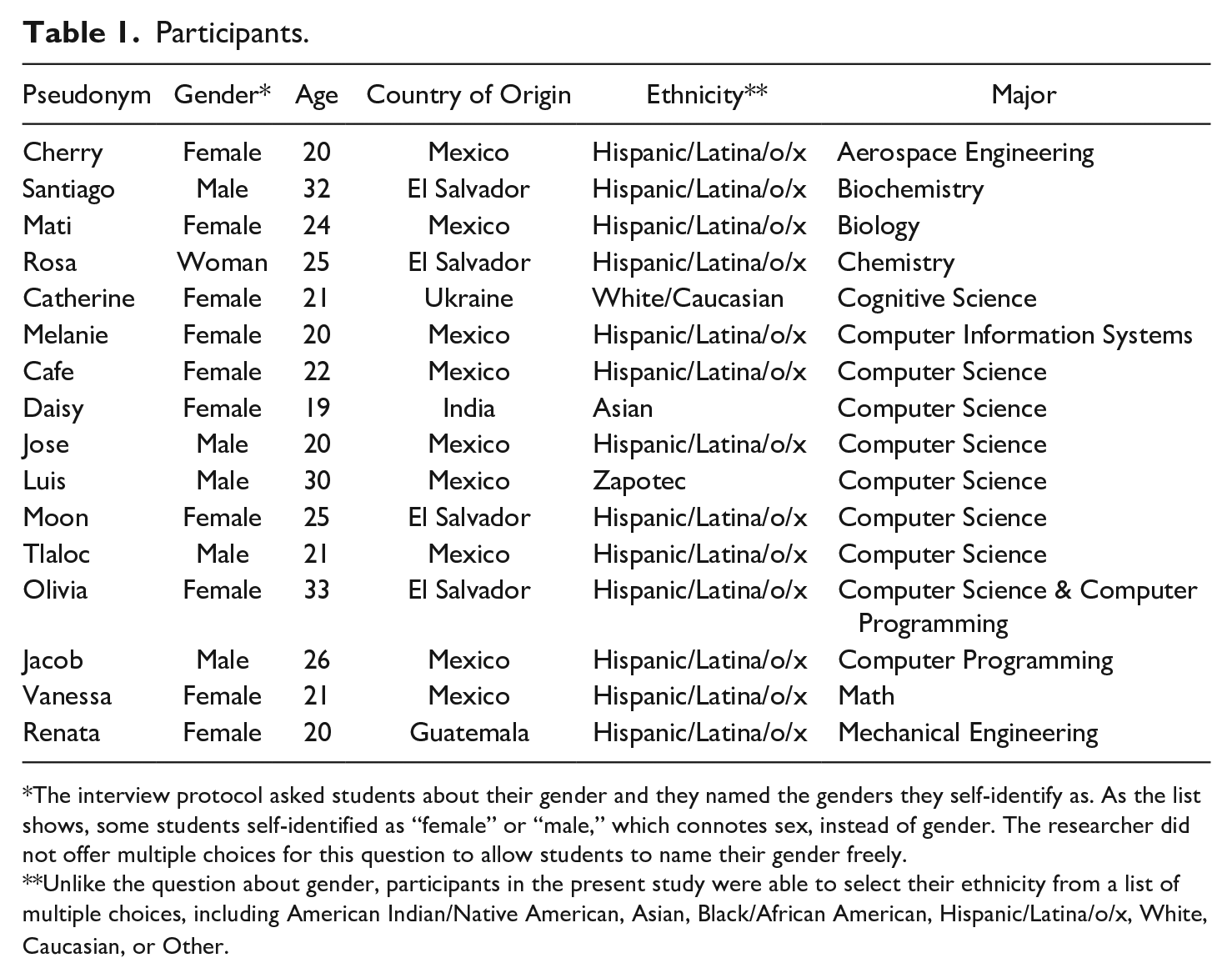
The interview protocol asked students about their gender and they named the genders they self-identify as. As the list shows, some students self-identified as “female” or “male,” which connotes sex, instead of gender. The researcher did not offer multiple choices for this question to allow students to name their gender freely.
Unlike the question about gender, participants in the present study were able to select their ethnicity from a list of multiple choices, including American Indian/Native American, Asian, Black/African American, Hispanic/Latina/o/x, White, Caucasian, or Other.
Thematic Analysis
The researcher utilized a thematic analysis approach like previous studies that studied the experiences of undocumented students (Andrade, 2019, 2021a). To conduct thematic analysis, interviews are transcribed prior to the analysis of the thick qualitative data that emerges. Thematic analysis refers to the identification of themes based on repetition, emphasis, or recurrence of words, phrases, and ideas across interviews (Owen, 1984). For example, the researcher saw the recurrence of certain words or phrases referencing financial aid, food, counselors, and other types of support during the sifting and interpretation of the transcribed responses. To reflect such thematization, the findings show a quantification of how many students referred to specific types of support they received. The quantification of responses and themes may reach “theoretical sufficiency” (Vasileiou et al., 2018, p. 8), or what other researchers refer to as saturation (Creswell & Miller, 2000), when participants keep repeating certain words, phrases, or descriptions and, hence, no further interviews may be necessary. Theoretical sufficiency or saturation are good indicators of a strong sample or credible themes.
Limitations
The major limitations in the present exploratory qualitative are related to the site, timeframe, and small sample. The HSI community college is in California and a largely urban area; such setting is vastly different than other institutional types or geographies, which may produce distinct results. In addition, the nature of exploratory qualitative studies is such that they only provide snapshots of phenomena that require ongoing and future investigation. Lastly, the sample of 16 students included persons who self-identified as woman (1), female (10), male (5), Hispanic/Latina/o/x (13), Zapotec (1), Asian (1), and White/Caucasian (1). A sample of 16 students with the aforementioned identities constitutes limitations because future studies may reveal distinct findings with a larger sample, and with additional genders and ethnicities. In all, the study is only a glimpse of students’ overall experiences—a snapshot that may be supplemented by longer longitudinal studies.
Trustworthiness
Disclosure of the researcher’s positionality is important to establish credibility and trustworthiness for the thematic analysis. One way of showing credibility in the findings is to engage in constant “researcher flexibility” to sidestep personal biases and to faithfully disclose findings via quantification and thematization that is genuinely reflected in participants’ voices (Creswell & Miller, 2000, p. 127). Another way to show credibility is to demonstrate “prolonged engagement in the field,” including participation in the communities of study and previous research (Creswell & Miller, 2000, p. 127). To satisfy such ways to build credibility, the researcher in the present study identified extensive and numerous quotations, as shown in the findings, to accurately reflect the quantification of themes as best as possible. The researcher has collaborated with the program for undocumented students on campus and gatekeepers who work with the students and has published numerous studies about undocumented students’ experiences for many years. This extensive engagement in the field shows a genuine commitment and fidelity to comprehending the lives and needs of students (Creswell & Miller, 2000). Consequently, building credibility by following the aforementioned steps warrants the trustworthiness of the findings.
Findings
This section discusses the types of support the students described and received from the HSI community college during the COVID-19 pandemic. It is important to note that some students mentioned only one type of support while others listed several. For example, Luis explained generally, “Overall, [the school] was helpful academically, financially, and counseling wise from professors and counselors.” In all, the types of support are listed in order of predominance: financial support, counseling, food distribution, support for students previously in high school, and faculty support.
Financial Support
Ten students (Vanessa, Jose, Santiago, Moon, Café, Luis, Jacob, Olivia, Renata, and Melanie) named financial aid as a type of support they received from the school. For example, Jose explained, “They . . . gave out the emergency grants, I believe every semester which would be up to like $1,600.” Luis echoed Jose’s explanation: “Financially as well, [the school] was very helpful. That stimulus packages they gave to students I think every semester was a few hundred dollars. That helped me cover food expenses and other expenses that were essential.” Vanessa also described: They sometimes . . . gave a little bit of financial aid where people or students could apply for a little help. And at first I, I remember that we weren’t allowed to participate, the undocumented community, but after talking to like some lawyers and getting some people from I believe CARECEN to investigate that, they said that we were allowed to.
As Vanessa implied, during the pandemic, some students were skeptical of financial aid because it could negatively affect their future prospects of applying for residency or citizenship due to President Trump’s 2019 Public Charge Rule, which declared that people utilizing governmental services could be denied future residency or citizenship. Moreover, Santiago illustrated, “After Biden came into [Presidential office], I started to apply to COVID-19 relief programs [at the community college], but they were first time first serve. They covered a couple of bills.” While the aforementioned descriptions refer to emergency relief funds, Moon identified financial aid from another source. She stated, “I’m also involved on the EOPS [Extended Opportunity Programs and Services] program, and they provide me like a voucher for books like $400 or something.” In all, students received financial support from the federal COVID-19 emergency relief funds, small stipends, or vouchers from special programs.
Counseling
Eight students (Luis, Jacob, Catherine, Olivia, Renata, Melanie, Mati, and Rosa) named counseling as a type of support they received from the school. In doing so, the students identified different types of counseling, such as academic counseling, career counseling, or counseling in special programs, such as the program that specifically assisted undocumented students, the undocumented student club, the STEM program, and EOPS. For example, Olivia explained: [M]y counselor just directed me into resources like I thought that I needed to go to school, to the library to use some of the programs that were available there, and then they kind of told me that a lot of the programs that I needed for my class and programs, I mean, like coding programs that are available through the school. They kind of told me, ‘No, you can find these resources online. They’re still free. Like the library database or visual studio, which is a programming.’ Then the STEM program at [the school], they have online tutoring. So usually it was like in person, but now they provided like online tutoring, where you can go and could help with classes.
Luis also described, “I think . . . my ability to access the career counseling was very helpful and so I had access to that resource before and during the pandemic” and Jacob illustrated, “I believe I talked to counselors as well, so that help cheer me up.” Rosa expressed, “the [undocumented student program] informed us that we could apply for emergency funds, or something like that.” Lastly, Mati indicated: The only ones that did help were the [undocumented student program] and EOPS. We still had our regular meetings for EOPS, like every semester. We have three contacts and we can plan out what we had with specific counselor[s] and plan classes and talk about what’s going on. I think that’s the only thing that the school did do. The [undocumented student program] is just reaching out to us.
In sum, students found utility and comfort in the different types of counseling. The different types of counseling—academic counseling, career counseling, or counseling in special programs—offered diverse and important information for students’ academic, professional, personal, and economic well-being.
Food Distribution
Six students (Vanessa, Jose, Luis, Santiago, Olivia, and Rosa) named food distribution a type of support they received from the community college. For example, Vanessa explained: Something they did to help [was] ship out food. They were meals, I believe, and like it was part of like Every Table foundation, and that really helped because sometimes my parents didn't have any money for food, and so we would look into the fridge and there . . . were like a couple of meals, so we would mainly use them as like emergency when we don't have anything.
Echoing Vanessa’s explanation, Santiago described, “They also had Every Table meals, and they were a huge help. They delivered those seven meals, it was a huge blessing because we had food issues because my wife wasn’t making enough money.” Jose illustrated, “I would say they gave out gift cards like to the grocery store like, I would say, like every month or so. And that would really help me, you know, buy groceries and get food.” The students’ descriptions identified two main types of food support: food delivery to their homes or gift card/stipends to buy food. The community college was able to deliver food to students by collaborating with specific food delivery companies, such as Every Table. Additionally, the school distributed gift cards for students to purchase food on their own. Students positively perceived the food distribution, delivery, and financing provided by the school.
Support for Students Previously in High School
Six students (Cherry, Café, Catherine, Daisy, Melanie, and Renata) reported that they were in high school when the COVID-19 pandemic started. These students recollected that they did not receive support from their high schools, but they eventually found assistance at the community college. For example, Daisy explained: Well, I wasn't at [the college] for the pandemic, but I was in high school, and they didn’t do anything, and they wouldn't do anything, I think, either, because the area in which I come from, let's just say that they’re quite conservative and I don’t think that the cards would be in my favor if I was seeking support. I felt pretty helpless.
Café was in high school when the pandemic started, but she described that she eventually received help from the community college. She stated, “I think maybe at some point I think I received the CARES Act one semester. That’s some of the help I got.” To clarify, Café referred to the financial aid that the community college dispersed based on the CARES Act emergency funding. Renata received the same financial aid as Café. Renata indicated: So my counselor, he’s the one that’s been helping me and he sends me like a link to a COVID-19 [aid] and basically I would have to fill that out and tell people what I was going through and basically they would send me checks depending on what I was going through. He even gave me his personal number and told me to share it with any other students who want to study.
Catherine also positively perceived the support she received at the community college. She explained, “The [program for undocumented students] was my first support system in the school and [the extracurricular club for undocumented students], as well. I was [also] in the STEM program that . . . I joined my first year as well.”
The six students that were in high school during the pandemic consistently stated that they did not receive support from their institutions. Fortunately, they did receive supports once they transferred to the community college. The supports came primarily in the form of financial aid, academic counseling, or from special programs, such as the undocumented student club or the STEM program. The community college, then, offered the assistance that undocumented high school students needed, but did not previously receive from their high schools during the pandemic.
Faculty Support
Four students (Luis, Jacob, Tlaloc, and Santiago) described that faculty provided useful support during the COVID-19 pandemic. Faculty support came in different forms, including availability and encouragement for students, flexible assignment deadlines, or other accommodations in classes. For example, Luis explained, “Other than being available for virtual meetings, I think that was enough, but at least for me, and I’ll say that’s where they mostly helped, professors . . . just make themselves available.” Jacob described, “It would just be like helping me in regards of encouraging me, telling me like you know, like, ‘don't give up,’ you know, ‘finish your classes.’ Pretty much like support in that way.” Moreover, Tlaloc indicated, “when the pandemic started some professors extended deadlines for homework or assignments and they honestly made me feel better because it relieved some stress.” In terms of accommodations, Santiago expressed: Big time! The mathematics professor during the pandemic, his class is, uh, filling notes–terms, terminology, and a few theorems typed. So we don't have to write those things down. He can go straight into the problems and we fill out as he goes. He printed all the packets for each lecture, delivering those to his students. That was like I found that so amazing. He literally went around town, who knows, I live in the valley and he delivered a packet.
Santiago also noted, “I was also taking biology class and, as you know, we couldn’t do in-person labs in school. So [the professor] contacted a company to get home kits to do at-home labs. So that was incredible. It was a huge box with a bunch of home biology experiments.” Santiago also shared, “[The mathematics professor] borrowed me a Chromebook. He knew the stress levels, and he recommended me to get special accommodations for tests if I needed them, which helped a lot because now I have huge stress anxiety.” The Chromebook that Santiago received was part of a school loaning program. The professors Santiago mentioned went out of their way to accommodate students’ learning.
Three students (Catherine, Olivia, and Vanessa) mentioned other ways that faculty supported them during the pandemic. For example, Catherine explained that professors were concerned about students’ well-being and, therefore, provided spaces to talk with each other. She stated: Yes, there were a couple of professors that always cared about how you’re doing in the class. Me, in particular, I didn’t disclose my status to my professors because I didn’t have the necessity to, so there wasn’t a specific help for that, but these surveys that professors had or having those breakout rooms during online and the pandemic it was very helpful to put yourself out there.
Olivia described several ways she received help from the faculty. She stated: I reached out to them when I needed recommendation letters, so they did that for me, especially during the college application process. So, they helped me with making sure that I was still on track to graduate. They helped me, okay, with like job opportunities. So my current internship, that's all through them.
Last, Vanessa expressed that the faculty also provided resources for food, just like counselors. Vanessa stated, “Well, I remember that during the pandemic one of my math teachers offered to get groceries for students who were struggling but because I was part of . . . the Every Table meal delivery, I chose not to participate in that. But yeah, a lot of them were offering to deliver students some groceries or paper towels or any other necessities they might need.” According to the aforementioned students’ descriptions, faculty provided different types of assistance in- and out-side of the classroom that comforted students.
Nine students (Jose, Moon, Café, Cherry, Daisy, Renata, Melanie, Mati, and Rosa) explicitly reported getting no support or assistance from faculty. For example, Jose explained, “Honestly, not sure. But I can’t really think of anything,” and Café stated, “Nothing comes to mind.” Moon described, “Not really. I mean, I just went to talk to counselors, and that really helped me talking to counselors. It helps me to know what I have to take or how to prepare myself to graduate.” Additionally, Mati indicated: Well, when it came to classes, I’m going to be completely honest, I do not think I got a lot of help with my classes or any student really that I did take a class with during the pandemic or after because everything was online, and they just made it so much more difficult. And also I don't blame the professors, but it wasn't really very helpful in any way because when I would reach out to a professor, you know, I would get a response back a week later or a few days later.
In all, most of the students who reported getting no support from faculty had straightforward “No” responses when asked if the faculty did anything to help them during the COVID-19 pandemic. The students’ responses are telling because they suggest that faculty kept teaching and upheld a business-as-usual approach in their classrooms, or they did not actively share or advertise resources for students to positively navigate the COVID-19 pandemic. Therefore, it is unsurprising that students, like Moon, received support from other sources, such as counselors.
Discussion and Recommendations
Utilizing Valenzuela et al.’s (2015) framework of Institutional Undocu-Competence (IU-C) and an exploratory qualitative methodology, the present study drew from student interviews to determine if and how a community college provided support for undocumented students in STEM during the pandemic. The students positively described financial aid, counseling in different forms (academic, social, and interpersonal), food distribution, support for former high school students, and faculty support that suggests a degree of IU-C for students in STEM. These findings show that the institution did provide some support to help students. However, some types of support can be made more effective and accessible for undocumented students in STEM during and beyond the pandemic. In other words, while the institution did show signs of some institutional undocu-competence, there are areas to improve and expand at the community college or other institutions that wish to respond to the needs of undocumented STEM students.
Prior to explaining the importance of each type of support for undocumented STEM students found in the participants’ descriptions and how to improve these, it is important to note that most of the resources that students named are no different from the resources already afforded to all students, including non-STEM students, regardless of their citizenship status. In other words, most of the resources, such as financial aid, different types of counseling, and food distribution, that students positively perceived were not inherently created for undocumented STEM students specifically because the campus promoted them to the entire student body. Moreover, the students’ descriptions of services at the HSI community college hardly differ from services available at 4-year universities or other institutional types. These observations are noteworthy because, as Andrade (2023) argued, institutions often provide resources for the entire student body that undocumented students may benefit from, but this “begs the question of whether institutions intentionally craft and design assistance for undocumented students to directly validate them” (p. 14). One negative consequence of such broad support is that the needs of undocumented students are lumped with the needs of other students without consideration of the risks, fears, or limitations that undocumented students face in accessing the resources practically and realistically. Hence, students’ identification of resources technically afforded and advertised for all students reveals that the institution in the present study may need refinement or establishment of support solely for and culturally responsive to undocumented students’ needs. Moreover, while some resources, such as the undocumented student club, exist to directly benefit undocumented students at the community college, more needs to be done to strengthen the institution’s undocu-competence. The following subsections describe the unique services that were important for students but need to be mimicked or improved to enhance institutions’ undocu-competence during and beyond the pandemic.
Financial Aid
Financial aid is perhaps the most important support that undocumented students need because of the increase in tuition, cost, and technological needs as they progress through STEM degrees, as well as costs of living and financial support for their families (Flores, 2011; Lara & Nava, 2022). However, several students noted that financial aid was limited in quantity or duration, they feared a Public Charge, and not all students were aware of such help. The aforementioned findings parallel other research findings. For example, Aurin et al. (2021) found that financial aid or other resources often did “not explicitly state citizenship/residency requirements, which makes eligibility unclear. In order for undocumented students to find out whether they are eligible or not, they would need to personally reach out to these departments, exposing their identities and disclosing their status” (p. 5). Therefore, as we continue to live in the pandemic and beyond, institutions must develop ways for funding streams to be extended, to advertise constantly and across many areas of the campus, especially in STEM buildings, courses, and laboratories, and students should be informed that they will not be legally at risk. As Jaimes Pérez (2014) explained, institutions should find federal, state, and local monies to disperse to students while not requiring Social Security numbers. Financial aid information should not be placed solely in financial aid counselors or offices; professional development of faculty and staff should occur for them to translate financial aid information to students in different areas and capacities on campuses (Jaimes Pérez, 2014). Moreover, there is an urgent need to demystify financial aid processes for students who are afraid or unaware of how to navigate such processes.
Counseling and Faculty Support
Counseling and faculty support were important for students in the present study. The most effective counseling and faculty support tended to include: constant availability; uplifting and supporting messaging; direction to different types of services, especially food or technology distribution, or, in some cases, actual delivery of resources by counselors or faculty; support for psychological and emotional coping; and information about extracurricular activities (e.g., EOPS, STEM labs/tutoring, or the undocumented student club), internships, or jobs. The aforementioned types of support are vital during and beyond the pandemic because previous research has shown that STEM students are often misguided in their majors, careers, or needs, or they do not come across internships and jobs for them (Aurin et al., 2021; Fernandez, 2018; Victorino et al., 2022). Also, as Aurin et al. (2021) stated, “Opportunities such as attending professional workshops, participating in networking events, and interning for different companies and organizations are important for students to develop necessary professional skills and to build their resumes, making them more attractive to potential employers” (p. 4). In addition, studies have shown that intentional, compassionate messages are needed to minimize students’ stress during the pandemic (Andrade, 2021b). Students are more likely to feel a sense of belonging and validation when services cater to their social, physical, and mental health–all these dimensions are at the core of IU-C (Valenzuela et al., 2015).
The bad news is that students in the present study revealed that some faculty misunderstood undocumented students’ needs in STEM, did not show concern, or advertised resources for them. The nine students who declared a lack of support from faculty revealed a combination of silence, unavailability, or difficulties due to the online modalities for the courses. As such, professional development to encourage faculty support, advertisement, and online course flexibility is vital and urgent during and beyond the pandemic for STEM students to feel validated and supported. Aurin et al. (2021) found that students often felt uncomfortable approaching STEM faculty who were inaccessible and did not offer flexibility or extensions on assignments when immigration process interviews came up. Faculty support is crucial because, “Instructors (both faculty and teaching assistants) who are able to leverage or mirror institutional practices promoting positive campus climates within their classroom will enhance the learning environment for students of all backgrounds” (Victorino et al., 2022, p. 43). In the absence of faculty support or professional development, as students like Moon implied, institutions should actively advertise other sources, such as counseling or special programs, that undocumented STEM students can turn to for validation and support.
Alliances and Partnerships
The findings in the present study reveal that IU-C is possible when colleges proactively form additional alliances and partnerships in communities to help STEM students. Such collaborations include, but are not limited to, partnerships with food delivery companies, such as Every Table; college-high school partnerships for undocumented students that do not receive validation or support in their high schools; partnerships with industries and workforce that can provide internships for undocumented students; and partnerships with STEM professionals that can mentor or guide students. For former high school students, community college support in STEM for undocumented students may be the first and only support system. With this in mind, community colleges can advertise support for undocumented students who may wish to transfer to said institutions. Also, given that undocumented students often face obstacles when they transfer to 4-year institutions, STEM internships are limited or exclusive, or students do not come across undocumented or other knowledgeable advisors (Aurin et al., 2021; Teranishi et al., 2015), community colleges may look for partnerships that can help students along their different educational pathways and to secure professional and academic opportunities for students. The goal is to create bridges and smooth transitions for students along their varied STEM pathways.
The present study affirms Valenzuela et al.’s (2015) theoretical and practical calls to create IU-C to affirm undocumented students proactively and positively in STEM during the pandemic and beyond. Financial aid, counseling, food distribution, support for high school students, and faculty support are ways undocumented students in STEM may feel a sense of belonging. The resounding lesson is that enhancing undocu-competence at community colleges or 4-year universities may require mimicking some of the interventions shown in the present study in localized and precise ways attendant to the relative needs of the undocumented student populations at distinct campuses during and beyond the pandemic. After all, students described supports that can technically exist at community colleges or 4-year institutions where needs arise.
While these supports are vital and urgent, institutions must be careful not to solely provide services available to all students in such a way that perpetuates cultural competency frameworks that sacrifice the unique needs of undocumented students. Cultural competency frameworks exist to overlook or disregard the unique circumstances that oppress undocumented students. IU-C offers practical ways to validate or affirm undocumented students, especially in niche areas, such as STEM fields, and ensure that campuses create localized interventions to assist them (Valenzuela et al., 2015). Consequently, support services must respond to the marginalizing conditions that undocumented STEM students face in and across community colleges or other institutional types and beyond the pandemic.
While the findings of the present study are fruitful, future studies can address its limitations by expanding the sample size, including students from more diverse backgrounds, and providing more detailed analyses of specific support systems in different STEM areas. Inherent to the IU-C framework is the need to continuously research what additional assistance may be needed for undocumented STEM students in the future, particularly as laws change and directly affect students and their communities. IU-C is an ongoing project that requires institutional flexibility, learning, growth, and cultural responsiveness if institutions want to truly help undocumented students and avoid generic platitudes of inclusion and diversity (Valenzuela et al., 2015).
Footnotes
Declaration of Conflicting Interests
The author declared no potential conflicts of interest with respect to the research, authorship, and/or publication of this article.
Funding
The author received no financial support for the research, authorship, and/or publication of this article.
