






Abstract
This article explores qualitative shadowing as an interpretivist methodology, and explains how two researchers participating simultaneously in data collection using a video recorder, contextual interviews and video-stimulated recall interviews, conducted a qualitative shadowing study at six early childhood centres in Norway. This paper emerged through the discussion of this experience with another researcher, who had shared interests in early childhood leadership, about the benefits of this research methodology in studying leadership practices in early childhood centres. We argue that qualitative shadowing methodology is a powerful resource that can enrich leadership, learning and development within the early childhood sector. By facilitating reflective engagement between practitioners and researchers through qualitative shadowing, it is possible to enhance the exploration of complex phenomenon such as early childhood leadership practice.
Introduction
The purpose of this paper is to critically examine the merits of adopting qualitative shadowing as a methodology using video footage and video-stimulated recall interviews to investigate the enactment of leadership within early childhood centres. Simply put, ‘shadowing’ as a research methodology can be described as ‘observation on the move’ (Czarniawska, 2014: 43), as the researcher follows a target participant as they go about their everyday work. In this way, shadowing can produce detailed descriptions on the nature of leadership as a stream of continuous action. As explained by McDonald (2005), Coupled with the fact that shadowing research does not rely on an individual’s account of their role in an organization, but views it directly, means that shadowing can produce the sort of first-hand, detailed data that gives the organizational researcher access to both the trivial or mundane and the difficult to articulate. (p.457)
Although there are contributions related to shadowing in different disciplines, shadowing studies focusing on leadership in educational contexts are scarce (Czarniawska, 2007, 2014; McDonald and Simpson, 2014; Meunier and Vasquez, 2008). Within educational leadership contexts there are two classical studies of particular interest (Mintzberg, 1973; Wolcott, 1973). These studies are different in terms of the design, duration of the shadowing processes, number of participants and the extent to which education is contextualised as part of the study. One of the pioneers of shadowing research, Harry F Wolcott (Wolcott, 1973) was an anthropologist who shadowed an experienced elementary school principal for two years. Using an ethnographic approach to answer his research question – What do school principals actually do? – he used different research strategies including field notes, interviews, collecting and analysing various documents and notes.
During the same period, Henry Mintzberg studied the nature of managerial work of five top managers over a period of a week. One of these chief executives was a superintendent of a large suburban school. The Nature of Managerial Work by Mintzberg (1973) received widespread attention because it gave detailed descriptions of structured observations of shadowing leaders. Codifying procedure was used to illustrate grounded theory (Arman et al., 2012; Czarniawska, 2007) whereby he developed a leadership taxonomy. Recently, in 2009, Mintzberg conducted another empirical study shadowing 29 managers for one day each. Other researchers have also conducted shadowing studies to explore school educational leadership contexts. In an Australian case study by Gronn (2009), the principal team was shadowed on 19 discontinuous days. In Norway, Anne Marie Presthus (2010) has also conducted a shadowing study with three school principals for five weeks, each using an ethnographical approach comprising contextual and in-depth interviews as primary data.
Taken together, the above studies show that shadowing is fruitful in providing thick descriptions of the dynamics of leadership work, because of its intimate and exhausting nature of data collection. However, these studies emphasise shadowing as a strategy within different methodologies. Within different methodologies, and while there are other studies in an educational context where the researchers have followed a participant closely using mobile observations and interviews, these authors did not conceptualise their methodology as shadowing. One example is the Swedish study where school principals were followed over an extended period of time by Sundin (2007). Despite a rigorous search of appropriate library databases during 2013–2015, published papers on shadowing studies of educational leadership conducted within early childhood contexts were not found.
Researchers have argued that shadowing studies can provide insights into otherwise invisible aspects of practitioners’ work and offer opportunities to explain what they are doing by sharing and reviewing the experiences with the researchers (Arman et al., 2012; Czarniawska, 2014; Gill et al., 2014; McDonald, 2005). Shadowing enables the researcher to get open access to complex leadership actions as they unfold in everyday contexts and seek an explanation of the sense making by the shadowee (Gronn, 2009). Therefore, shadowing can be fruitful when exploring and engaging with day-to-day leadership practice (Nicolini, 2009), especially since early childhood leadership is characterised as emergent and situated actions (Rodd, 2013).
In the context of early childhood centres, teachers have multiple responsibilities in performing the roles of being both a teacher and leader at the same time, and thus, the practices of teaching and leading are intertwined (Hujala et al., 2013). According to Gronn (2009), shadowing enables researchers to explore how leadership is a mix of hierarchical and heterarchical leadership styles, and how this hybrid leadership is an adaptive or emergent response to unforeseen situations that are specific to the context. In keeping with the contextual nature of early childhood centres, of necessity, this study adapted and extended upon the original shadowing method used by Mintzberg. In essence, conducting shadowing in this study means thinking about methodological and epistemological issues, and producing data by following and listening to informants. Therefore, shadowing as a methodology is about how researchers do research; it is about what crucial matters, such as theories, approaches to social science, philosophies, ontologies and epistemologies, are driving it (Redding-Jones, 2005: 67). Taking an interpretive approach to shadowing enabled the researchers to engage with the participants in conversations, and privilege understanding of these activities from their point of view (Gill et al., 2014). By including the participant’s voices in the process of shadowing, Mintzberg’s shadowing study has been expanded by Bøe and Hognestad in several ways as will be shown in this paper. The article begins with an overview of conceptualising shadowing as a research methodology. The processes of the qualitative shadowing methodology, as used by Bøe and Hognestad, in conducting research in Norway is presented next. We conclude this paper by assessing the merits of this methodology by highlighting key aspects, including double shadowing roles, the power dynamics of shadowing, ethics on the move and shadowing as reflective practice and professional development.
Conceptualising ‘shadowing’ as a research methodology
As pointed out by Gronn (2000), a shortcoming of the shadowing study of Mintzberg (1973) was that it left the dynamics and the complexity of everyday leadership implicit, tacit, unsaid or invisible. Therefore, expanding upon the shadowing method used by Mintzberg (1973) meant considering methodological issues that explained leadership in terms of practices from a wider spectrum instead of simply making a list or register of activities performed by leaders.
Although all forms of shadowing seek to obtain detailed descriptions of professional practice, it is not always clear how practice is conceptualised (Hognestad and Bøe, 2016). Within what Nicolini (2013) conceptualises as a strong methodological approach, leadership practice is more than just a register of leadership activities. According to Nicolini (2013: 13), listing and enumerating practices just by observing constitutes a weak approach to exploring professional practice and is just a point of departure in explaining leadership practice. On this basis, we argue that qualitative shadowing as explained in this article is an effective methodological approach in studying early childhood leadership practice, as it involves more than simply following the participants to map their behaviour. In addition, a strong methodological approach includes information that explains the meaning of the participants’ behaviour, what makes it possible, why it is the way it is and how it contributes to organisational life (Nicolini, 2013: 13) where leadership is being enacted.
Qualitative shadowing as a methodology adopts a subjectivist epistemology that assumes that reality is constructed intersubjectively through the meanings and understandings developed in social practice (Lincoln et al., 2011: 102) Within early childhood centres, participants continuously make sense of their socially constructed and shared meanings, which, in turn, influence how they negotiate their leadership actions. Interpretivist thinking which acknowledges the possibility of multiple perspectives and agency of both participants and researchers underpins this shadowing study as a strong research methodology in striving to explain leadership practice in the early childhood sector.
Shadowing as a reflective approach enables researchers and participants to engage in conversations whilst collecting data (Gill et al., 2014). By being close to the participant, shadowing can also enable the researcher and the participant to have a continuous conversation and reflect on the shared experiences occurring throughout the shadowing period (McDonald and Simpson, 2014). Considering shadowing as a reflexive approach points to the research question: Why is qualitative shadowing a powerful research methodology for studying leadership in early childhood centres?
Methods of qualitative shadowing
This section illustrates the processes involved in conducting a qualitative shadowing study, which included the use of a video camera and the presence of the two researchers at all times, simultaneously shadowing the same formal teacher leader or target participant, as a distant or close shadow. This shadowing study was designed to capture everyday leadership practice as an adaptive or emerging response to situational challenges that are specific to early childhood contexts. Research shows that everyday leadership in contemporary early childhood centres is hectic, fragmented and complex (Mujis et al., 2004; Colmer et al., 2015). To develop a deeper understanding of leadership practice requires methods that can capture the details and continuous actions in leadership performance and the meaning inherent in them. To gain access to both the leadership action and the intentions and motivations behind it, the shadowing approach in this study required clusters of varied and overlapping methods. Through research triangulation and developing a distant and close shadowing role, it was possible to manage the necessary methods, and thus improve the quality of the data (Arman et al., 2012).
Unlike other shadowing studies on educational leadership, Hognestad and Bøe (2016) extended the scope of shadowing with the use of video footage and video-stimulated recall interviews. This was deemed necessary because the purpose of the study was to capture and understand formal teacher leaders’ leadership practice at the middle-manager level within the early childhood centres, operationalised within Norwegian municipalities.
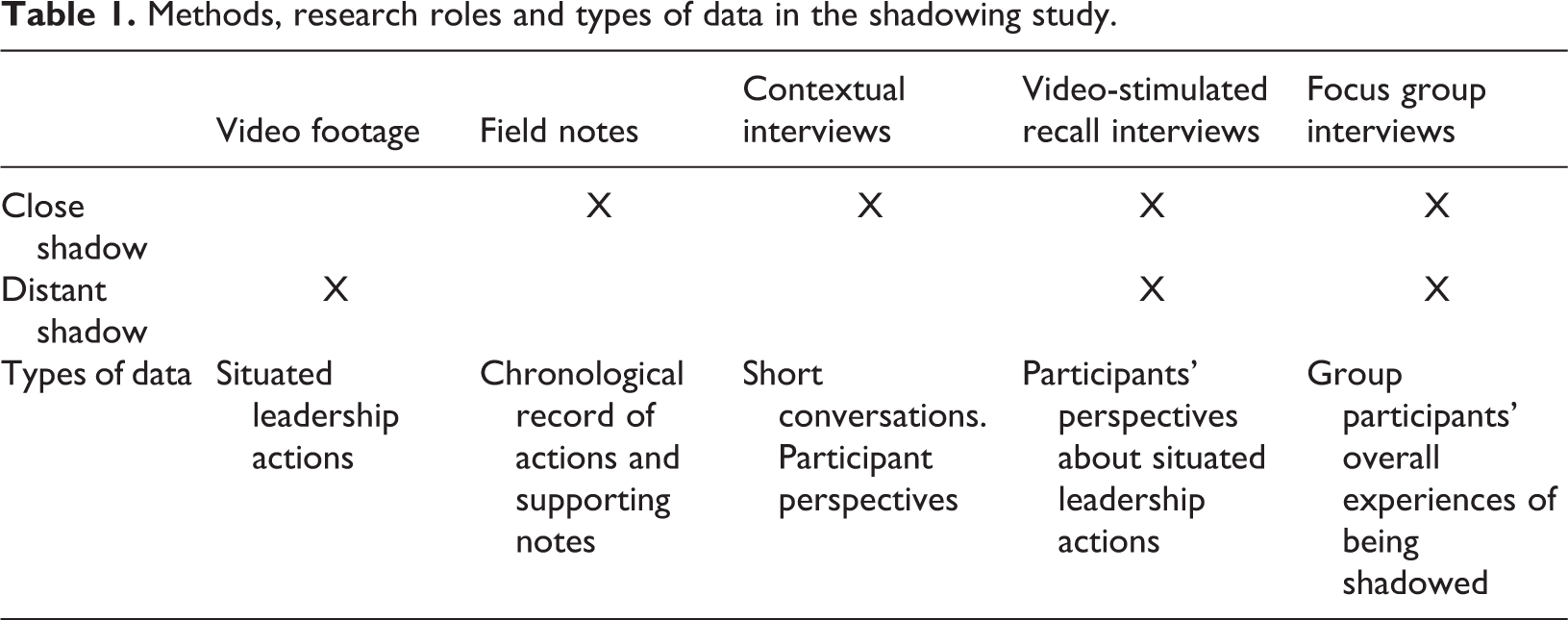
Table 1 shows the different methods used by the close and distant shadow, and the types of data collected. Considering the various methods conducted, video observation, contextual interviews, field notes and video-stimulated recall interviews, and the immense amount of empirical material that was generated, made the data analysis quite challenging. In dealing with the demands of data quantity and quality, the involvement of two researchers was fruitful when undertaking shadowing research. Likewise, the involvement of a third researcher as a critical friend to reflect on the methodology enabled the extension of this analysis in considering the merits of shadowing research for wider application, to advance the knowledge base of early childhood leadership in practice in diverse contexts.
Methods, research roles and types of data in the shadowing study.
Shadowing research design processes
In their research, Bøe and Hognestad (2015) collaborated in collecting data in five stages. Using two researchers enables an expanded scope and detailed data collection (Anleu et al., 2015). A brief description of each stage is presented next, including the aim or purpose of each stage, to explain how it contributed to the overall data collection and analysis of the research. There is sufficient detail of each stage to enable its replication, as well as for the purposes of assisting readers to fully understand the processes involved. The discussion of the research design begins with the identification of the participants of the Norwegian study.
There are no clear rules on how long one must shadow participants to obtain sufficient data for research analysis. However, it has been pointed out that shadowing over a long period of time can exacerbate the ethical challenges of conducting this type of research. This is because one can establish a close personal relationship with a participant, which can complicate the professional nature of interactions and maintaining the balance between an outsider and insider perspective (Czarniawska, 2014; Gill et al., 2014). Importantly, Bøe and Hognestad also deliberately decided to shadow the six participants for one week each only to avoid being too intimate and maintain their outsider perspective as independent researchers. At the commencement of the study, suitable participants were identified on the basis of three primary criteria. Firstly, the ontological orientation in the study acknowledges that knowledge about leadership develops through participation and leadership performance. Therefore, applying a practice perspective on leadership uses the actions of experienced and skilful leaders as the primary data for exploring leadership in everyday work (Tengblad, 2012b: 5). Secondly, given the intimate nature of the study, experienced early childhood leaders who were comfortable in their leadership roles were deemed suitable because it was possible they may not to be very intimidated by having their leadership work being captured on video recordings over five days. The selection bar was set at a minimum of five years of experience. Thirdly, given the practicalities of transportation and time, centres that were within 50 km distance from the home university of the two researchers were identified as potential study locations.
Seven early childhood centres that satisfied these three criteria were sent a letter of invitation outlining the purpose, methods and time commitments of the study, as well as the ethical protocols that will be in place to ensure anonymity for both the centres and the practitioners participating in the study. Considering that shadowing as a method meant following practitioners everywhere in their workplace and recording what they were doing, participants may perceive this research too intrusive and scary to volunteer. However, only one centre refused the initial invitation because they did not have any leaders that met the three selection criteria for the study, and the remaining six centres accepted the invitation without hesitation. Figure 1 provides a quick snapshot of the six stages of the study conducted. The processes involved in each stage are described in the following sections.
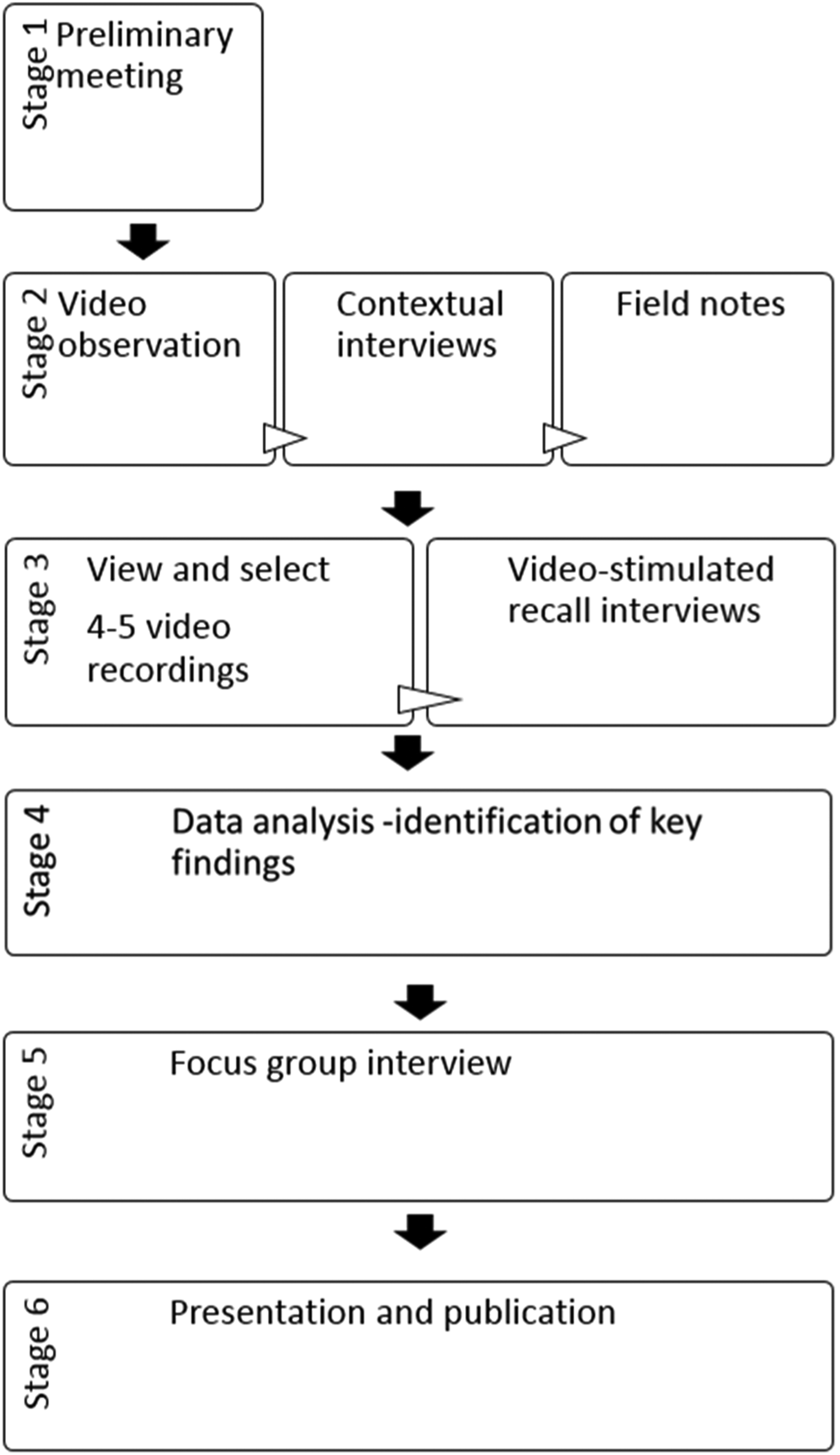
Processes of qualitative shadowing in early childhood centres.
Stage 1 – preliminary meeting
After the formal approval from the Ethics Committee of the Norwegian Social Science Data Services, to carry out the research, the two researchers contacted a sample of early childhood centres by email to arrange a preliminary meeting at each centre to introduce themselves in person and to answer any questions that the participant or ‘shadowee’ may have before the data collection began. This visit was typically informal and brief with the researchers being prepared to stay as long as it was necessary to answer any questions that participants asked. Ethical procedures of how the data were being collected, collated, analysed and shared in presentations and publications were also explained. In explaining the role of the researchers, the possibilities of co-reflecting with the shadowee during the data collection process were discussed. Importantly, it was emphasised that the research focus of the study was to theorise everyday leadership from the shadowee’s perspective and selecting experienced practitioners was a deliberate strategy.
Stage 2 – daily collection
Both researchers participated in the data collection, taking turns to be either the ‘close shadow’ or the ‘distant shadow’. The close shadow carried out the contextual interviews and note-keeping simultaneously, whilst the ‘distant shadow’ focused on taking the video observations. Every day, approximately five hours of leadership in practice were captured on video footage. This process was repeated during five days from Monday to Friday during an agreed week at each of the six centres participating in this research. Figure 2 shows one example of the locations of the close and distant shadows or the two researchers and the shadowee, who is the practitioner, during the daily data collection processes.
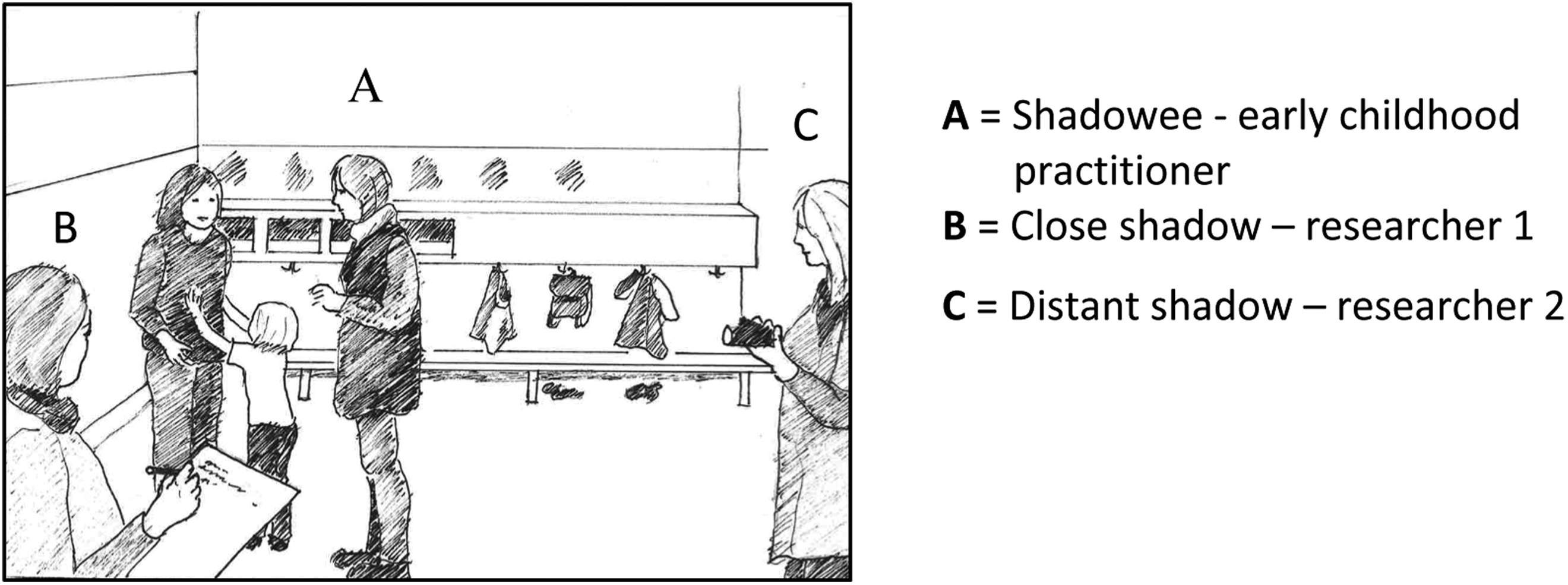
Shadowing in action.
Stage 3 – debrief visit
Once the video recordings were completed, the two researchers watched the full footage of each centre’s data collection independently, and selected 4–5 video excerpts for further investigation. These selections were made on the basis of what the researchers found interesting from their observations and field notes. These excerpts reflected informal, habitual and deliberate actions and short leadership events where the leaders had to grasp the particularities of the situation and act upon it then and there. Arrangements were made for a meeting at the end of the week when the video recording was completed to show the selected excerpts to each participant and stimulate a discussion to explore their intentions and motivations about leadership practices that had been captured on video. Each of these video-stimulated recall interviews were conducted by both the researchers using semi-structured and open questions, and were on average approximately 90 minutes in duration. These interviews were audio recorded and transcribed for analysis.
Stage 4 – data analysis and identification of key findings
After concluding the Stage 3 tasks, both researchers reviewed the data collected to date to ascertain broad themes emerging from the study. The first step in the analysis was qualitative coding in a team using the already established leadership taxonomy (Mintzberg, 1973; Vie, 2009: 30; see Table 6) of the entire data material (video data and video-stimulated recall interview). Recognising the openness and flexibility inherent in the categorisation of data in this taxonomy (Mintzberg, 1973; Tengblad, 2006; Vie, 2009) made it possible to capture important contextual and new knowledge. Further, the data were analysed by the two researchers working as a team to organise, condense and categorise contents to obtain a deeper understanding of leadership actions. At this point, different areas of distinct interest for Bøe and Hognestad emerged.
Stage 5 – focus group interviews
To retain authenticity of the participants’ perspectives in data interpretation, the researchers also invited the participants to a focus group gathering six months later to share their experiences on being shadowed. The participants’ perspectives are important in critically examining whether shadowing as a methodology was a fruitful way to explore leadership enactment. The participants’ collective reflections about being shadowed were, in turn, treated as a separate set of data for this study and comprised Stage 5 in the research processes.
Stage 6 – presentation and publication
Based on the analysis of the data collected at the six centres, both researchers commenced preparing papers for presentation and publication in a variety of ways. The preparation of this paper, focusing on shadowing methodology and emerging out of discussions with a third researcher, is another outcome of Stage 6.
Findings and discussion
This section presents the findings by highlighting the experiences from the shadowers and the shadowee in the Norwegian study. The involvement of the third researcher as a critical friend will focus on the discussion of four aspects of conducting shadowing methodology: use of the researchers as double shadows; power dynamics between researchers and participants; ethics on the move; and shadowing as reflective practice and professional development.
Researchers as double shadows
By introducing a double shadow role, the researchers experienced shadowing in two ways: as both a non-participant and as a more participant, by being either the distant or the close shadow, respectively. As a close shadow, the researcher had access to the participant’s actions immediately and made possible reflection in action. Through contextual interviews, the close shadow interacted directly with the participant. In contrast, the distant shadow focused on video observations, and remained a more non-participant observer. In this way, shadowing can be perceived as a combination of two researcher roles, where neither was completely participatory nor non-participative. The literature does not define whether shadowing is a participative or non-participative method (Meunier and Vasquez, 2008). For example, Czarniawska (2014) explains shadowing as a non-participant observation method by contrasting it to stationary observations based on the analysis of photographs. According to McDonald and Simpson (2014) shadowing has similarities with both interview and participant observation strategies in yielding a variety of data and different insights to these methods. Further, they explain shadowing as a different method to participative observation in the way that the researcher is not participating in the activities, and because there is a clear separation between the researcher and the shadowee or the person being observed.
By alternating between a close and distant shadowing role, it was possible to deal with the physically demanding process of shadowing (Arman et al., 2012; Czarniawska, 2007; McDonald, 2005; Mintzberg, 1973) and to obtain rich and good quality data. Czarniawska (2007, 2014) points out that shadowing is both emotionally and physically demanding because of the length of time spent being on the move in a close relationship with a shadowee.
Assuming the potential intrusiveness of having two researchers constantly following every action or behaviour of the leaders, one participant explained that this was a less of a challenge than anticipated: Being shadowed by two researchers was not really any challenge for me, because I am used to being a role model for both parents, children and staff. Thus, my work is transparent, and I am used to be ‘on stage’. I was so busy doing my own work that I did not even notice when you were filming or not. The day are so hectic and I have no time to let this affect me and my work.
Surprisingly, the participants also highlighted the benefits of having two researchers being on the move simultaneously. That is, this meant it was not necessary for the participants to constantly explain everything. From the participants’ perspective, the double shadowing roles seemed to safeguard what was being documented and the possibility of interacting and sharing reflections on the move with the close shadow. Further, they stated that they would have been more insecure about what the researcher was seeing if there was only a single researcher sitting in a corner observing and video recording with no conversation with the participants.
By having two researchers in shadowing roles, being a close and distant shadow also created a special relationship with the shadowee and the researchers, and required consideration of the power dynamics between the researchers and the participant, as discussed next.
Power dynamics between the researchers and participants
When conducting shadowing, the power dynamics between the researcher and the participant must be considered because there is a physical closeness between the participants during the shadowing process. This means that there is familiarity, not only as an object being observed, but also as a ‘live’ target whose behaviour may be shaped by the shadowing process itself. There can be tension during the shadowing process, as the shadowee may feel insecure about being constantly and immediately available throughout the data collection process. This discomfort is possible, even if the researcher’s aim was not to assess or monitor the practitioner’s behaviour, and instead was clearly focused on learning about the participant’s everyday experiences and practice (Blake and Stalberg, 2009).
For this reason, the preliminary meeting described in Stage 1 was especially important because of the power differences existing between the researchers and the participants. By discussing the experiences regarding the preliminary meeting together with the critical friend, it became clearer how the preliminary meeting was helpful in balancing the power dynamics between the researchers and the participants. As a result, this meeting was included as the first stage in the shadowing process. Engaging the participants and their expert knowledge in reflecting on the shadowing experience in Stage 5 also contributed to the power relationship being balanced. In the focus group interview, the participants highlighted the value of the initial meeting, before data collection commenced, as one participant declared: The preliminary short meeting with you [the researchers] was good because you were clear about the purpose of shadowing, not aiming to assess and examine my practice and highlight weaknesses. This made me feel OK about being shadowed as you were aiming to record my everyday practice as it were. After the short conversation, I was thinking that I just had to show you the everyday practice as it emerges; because that is the way it is in my centre. Things suddenly emerge and it is not possible to plan everything in detail in advance; it requires making decisions there and then.
However, shadowing the participants in practice can also reduce the hierarchical relationships between researcher(s) and practitioners, as well as the participant’s movement through time and space, and the professional role of the participant can shape the nature of data gathering. Thus, researchers cannot control exactly how or what type of data were collected and they were obligated to follow wherever the participant’s day would take them (McDonald and Simpson, 2014). Another factor that may have contributed to balancing the power in the shadowing processes was that the researchers remained open and adaptable to situations (Gill et al., 2014) that emerged during the video-recording period. The researcher’s ability to be flexible and to adapt to the participant’s daily routines was essential, as illustrated in the comments made by one practitioner: Before you came to my centre, I was a little bit tensed and nervous about being shadowed. However, when you were here I was calm because of the way you acted. I did not feel like I was put to the test.
In contrast to post-positivist and critical approaches, taking an interpretive approach shapes the relationship with participants through the methodological commitments by privileging the understanding from the participants’ point of view (Gill et al., 2014). This means that shadowing as an interpretive methodology can balance the power dynamics by highlighting the process of interaction between the researchers and the participants.
Ethics on the move
Conducting a qualitative shadowing study with a reflective approach requires methodological choices, as it presents ethical implications for both practitioners and researchers. The consideration of ethical issues in relation to how a researcher ‘blends’ into the organisational context during the shadowing process is an important part of conducting shadowing research. As Czarniawska (2014: 55) notes, the ‘choice of camouflage’ in terms of the researcher’s gender, age, clothing and ethnicity may require constant attention, as highlighted in studies conducted with those such as bikies, the homeless and the police. McDonald (2005) argues that it is important for the shadow to begin data collection with some knowledge about the research context because the researcher could otherwise spend a long time trying to obtain meaningful data. In this study, because both researchers, Bøe and Hognestad, were experienced early childhood practitioners, they had a sound understanding of the centre contexts. In turn, the participants being shadowed were accepting of the researchers as knowledgeable insiders.
Although the researchers were prepared for shadowing, it was not possible to be prepared for everything because of unexpected ethical issues that arose during the shadowing. In shadowing research, researchers must deal with ethical issues they encounter then and there, as it happens in the field (Johnson, 2014). This meant being ethically responsive ‘on the move’ (Dewilde, 2013). For the close shadow, ethics on the move focused on situations where the researcher had to be sensitive to when they could have the contextual interviews without interrupting the ongoing work too much. Field notes were used in situations where the close shadow decided not to interrupt the shadowee by asking questions. Leadership situations were marked in the notes for later discussion during the video-stimulated recall interview. Due to the hectic pace of work and variety of activities in the centres it was also not possible to record everything with pen and paper. Therefore, the video footage of the distant shadow was crucial in recording the practice of leading (Hognestad and Bøe, 2016). Another important experience was also discovered when researchers watched the video data and how the data can illuminate relationships and interactions between participants and the close shadow. Capturing both the close shadow in practice and the formal teacher leaders in practice could shed new light on using shadowing as a tool for professional development on various early childhood matters involving children, families and early childhood education and care practitioners. This point was further discussed between the three researchers, and discussion concentrated on how documenting the conversation and interaction between the researcher and the participant could strengthen shadowing research as reflective practice, as discussed next.
For the distant shadow it was also important to consider when to stop recording. These particular moments required making ethical decisions where the participants were having conversations with parents and situations involving their children. For example, it was important for the shadow to be sensitive about children’s feelings, movements and bodily expressions. Even if the desire to continue recording was present for professional reasons, it was important to stay true to the agreement of the study. Ethics on the move also included the understanding that all staff have time out from work during the day and that this is private time. Being the distant shadow who does the video recording, therefore, means handling the camera work with technical competence as well as being respectful and sensitive about the participants’ privacy and wellbeing throughout the recording period. Also, being the shadow was not like being a ‘fly on the wall’ because they were ‘constantly on the stage’ together with the shadowee who was on the move. Having two shadows was a great advantage in sensitive situations, because it enabled better decision-making through brief exchanges of ideas and opinions.
Shadowing as reflective practice and professional development
Video footage can be selected specifically to provide detailed and situated data on leadership practice at any time during a day. This involved acknowledging that professional knowledge realised in practice (Nicolini, 2013; Tengblad, 2012a) and the quality of video footage capturing actions in context could be revisited and thus could stimulate deeper reflections on leadership enactment. Therefore, an important benefit of using video footage was for the researchers to engage the participants in video-stimulated recall interviews. The purpose of these follow-up interviews was to enable the shadowee to recall their motivations and intentions about the recorded actions more explicitly (Hodgson, 2008) than what was possible to capture in the contextual interviews conducted on the spot. The potential of shadowing as a reflective practice enabled the discussion to be extended further. As such, when taking into account all stages of the research process, as explained in this paper, the study’s shadowing methodology may be considered as a process of collective professional development.
Education is a discipline where shadowing is used for both professional learning and research purposes (McDonald and Simpson, 2014). According to Schön (1983), reflection-in-action is something leaders do, but in busy early childhood centres, the leaders rarely have the opportunity to reflect-in-action (Colmer et al., 2015). This means that the leaders’ judgement and deliberations along the way are rarely talked about as they happen. The use of qualitative shadowing including video-stimulated recall interviews can open up new insights about leadership enactment. For the participants who agreed to be a shadowee, the value of being part of the study was related to shadowing as a form of professional learning (McDonald, 2005).
According to McDonald (2005: 461), shadowing within the social science literature is distinguished in three different ways, depending on the purpose of the shadower: to learn for themselves; to record behaviour with a view of discovering patterns in it; and to investigate roles and perspectives in a detailed, qualitative way. Through the shadowing study of Bøe and Hognestad, a new mode of shadowing was worked through the research process – shadowing as a means of understanding the practice of leading (Hognestad and Bøe, 2016). This new mode emphasises that actions in context take into account a conceptualisation of practice that holds the meaning and orientation performed by practices. Thus, shadowing as fieldwork is a study of practices and the moral value involved (Czarniawska, 2007). From the shadowing process, a surprising element appeared which was related to the participants’ professional development. Acknowledging that practical knowledge is realised in practice and in leadership enactment, shadowing as a mode of practice can strengthen reflective practice because it enables shared reflections based on real actions. During the focus group interview, the participants reflected upon the benefits of shadowing by watching the video recordings in the video-stimulated recall interviews. As one of the participants explained, these discussions triggered further reflections on their leadership enactment: I was ready to be video recorded, and it was OK that it was a research project. However, I have been thinking about this in relation to my role as a teacher leader and how this process has helped me to develop from where I stand. It must be the most effective way to develop staff’s competence. Being shadowed and further being able to watch my own leadership actions and comment on them, activated reflections about my leadership practice.
Accordingly, shadowing as a way of learning through experience can enhance leadership development. That is, sharing first-hand experiences during the shadowing process has the ability to stimulate reflection in action, but in a busy early childhood centre, there is little time to examine, in depth, everyday practice. Further, continuing shared reflections based on real actions in a professional forum could also facilitate targeted professional development on leadership of both novice and experienced educational leaders. ‘Importantly, the capacity to create and communicate one’s leadership approach is built through interactions with others. Put simply, it is through conversations with others that one can experiment and refine the articulation of one’s leadership philosophy’ (Waniganayake, 2013: 74). Conceptualising shadowing as a strategy for experiential learning could motivate and inspire educational leaders to reconstruct their practice in cooperation with practitioners and/or researchers. However, considering shadowing as a methodology for early childhood practitioners’ leadership development must take into account the importance of the educational researchers’ ability to combine knowledge, judgement and ethics on the move to act in an appropriate way. Because of its intimate and relational nature, conducting shadowing requires ethical consideration during the whole process.
Conclusion
In this paper, we have highlighted qualitative shadowing as an interpretivist research methodology and explored why shadowing can be fruitful in studying leadership as social practices in early childhood centres. By including the participants’ reflections in the process of shadowing, the study has expanded shadowing studies that simply register leadership activities performed by leaders. Further, qualitative shadowing contributes to illuminating the nature and functions of a professional’s work and how leadership enactment is understood or explained from the perspective of the participants. Shadowing, as a strong methodological approach developed in this study, highlights a practice-based ontology. That is, the belief that leadership practices are constructed intersubjectively through the meanings and understandings developed in the practice community. To me this means that we construct knowledge through our lived experiences and through our interactions with other members of society. As such, as researchers, we must participate in the research process with our subjects to ensure we are producing knowledge that is reflective of their reality. (Lincoln et al., 2011: 103)
Footnotes
Declaration of Conflicting Interests
The author(s) declared no potential conflicts of interest with respect to the research, authorship, and/or publication of this article.
Funding
This research received no specific grant from any funding agency in the public, commercial or not-for-profit sectors.