






Abstract
Through a prosopography study of three studios – Bratři v triku (Brothers in Trick), Gottwaldov Studio in Czechoslovakia, and Se-Ma-For in Poland – this study reconstructs the creative capacities of animated film production in Czechoslovakia and Poland, examining how artistic, institutional, and political conditions shaped entry into the position of film director. The authors argue that, while both national industries eventually achieved international recognition, Czechoslovak animation developed a structured professional field earlier due to institutional and personal continuity with the period of German occupation. In contrast, Polish animation had to start from scratch after World War II, resulting in delayed consolidation. This difference in the capacity and prestige of animated production began to even out in the 1960s, as television broadcasting rapidly expanded distribution for animated films. The comparison of personnel capacities and professional paths in three animated film studios in two countries revealed elements of exceptionalism in development within the given comparative framework, i.e., the influence of the German occupation on the above-standard accumulation of young talent in Brothers in Trick Studio, and the demand from television stations as an opportunity for the smaller studio in Gottwaldov to grow its capacity. The thesis of exceptionality is open to future refinement through an extension of the comparative perspective to other countries.
Keywords
Introduction
Since the hand-drawn animated movies were seen from the beginning as an addition or a pun, they became an experiment. And since their production required, and still demands, specialised technical knowledge and drawing skills, their producers retained independence. They were spared the invasion of incompetent and dishonest people, which has so much affected the feature film. (Kučera, 1941: 10)
1
These words were used in 1941 by the Czech filmmaker and critic Jan Kučera to characterize the cartoon’s development. Kučera identified two pivotal factors that shaped animated film in inter-war Czechoslovakia and abroad. The first was the experimentation involved in establishing a commercially viable production model of animated advertisement (Cook and Thompson, 2019). The second factor was the association of cartoon film with specific technical and artistic competencies. This elevated animation from a mere craft to an art form, transcending the reproductive nature of film and legitimizing it culturally (Bourdieu, 1998: 95–96; Moen, 2019: 11–12). 2
The adaptability of animation for both commercial and political promotion, combined with its legitimizing function through artistic qualities, helped establish animation production in post-war Czechoslovakia and Poland. In these countries, where film industries were nationalized in 1945, animation studios faced substantial infrastructural challenges (Skopal et al., 2026). Despite starting from markedly different positions regarding personnel expertise and institutional knowledge, animation in both countries eventually achieved international recognition and high productivity. For a comprehensive understanding of the process of establishing animation as a significant production segment in post-war film industries of the two countries, we need to reconstruct the development of filmmakers’ personal capacities and competencies as they entered the sector. This article analyses animation in Czechoslovakia and Poland via prosopography (a collective biography of a selected group, see, e.g. Keats-Rohan, 2007) applied to three significant studios, namely Brothers in Trick in Prague and the Zlín/Gottwaldov 3 film studio in Czechoslovakia, and Studio Małych Form Filmowych (Studio of Small Film Forms) abbreviated as “Se-Ma-For” in Poland, to allow systematic comparison of the animated production personal capacities across over four decades (to provide contextualization for the process of establishing structured field of animation, the research goes back into the pre-war and WWII period). 4
In view of the previous absence of similarly oriented research and the necessary data, it was not possible to consistently reconstruct the entire output of animated production across all production centres for cinema and television (such completeness has been achieved only for the Czechoslovak field before 1960). This is why the research focused on the three key studios named above in both countries – two studios with the highest production output in each country, and a smaller studio in Zlín with the longest production continuity and a specific peripheral position. Polish animation represents Se-Ma-For in Łódź, which existed under this name only from 1961, but as the puppet film production unit it had been running since 1946 (under various names and institutional forms). In Łódź, the focus of production was primarily on puppet films (43%), but the overall production profile was more diverse: cartoons (22%), combined (13%), cut-out (6%), and live action (15%) (Skopal et al., 2025). The total volume of production until 1989 was approximately 1,300 films and series episodes. The second most productive Polish studio, Studio Filmów Rysunkowych (Cartoon Film Studio; SFR) in Bielsko-Biała, produced approximately 1,000 cartoons and cut-out animated films. Founded in 1956, the studio succeeded a semi-professional film group (active 1947–1952) and a subsequent branch of the Łódź WFF studio (1952–1956). Two years later, the Studio Miniatur Filmowych (Film Miniatures Studio) in Warsaw was founded. Its production was closely linked to the capital’s Akademia Sztuk Pięknych (Academy of Fine Arts) and focused primarily on auteur and art films, reaching a total output of approximately 650 films. 5
On the Czechoslovakian side, the Brothers in Trick Studio maintained continuity with the pre-WWII-era company AFIT. With a portfolio of more than 700 films, it specialised in cartoon production throughout the period, with a minority of cut-out films in the 1970s and 1980s (Skopal et al., 2025). In contrast, Gottwaldov’s production portfolio of over 750 titles varied over time. Until the end of the 1960s, the studio predominantly produced puppet films, including several features combining animation and live action. However, the situation changed in the following decade when production increased, and puppet animation was replaced by cut-outs, relief, and cartoons (Večeřa and Szul, 2024: 19–20). The output of other studios did not reach such high volumes – in comparison, the Studio Jiřího Trnky (Jiří Trnka Studio) produced fewer than 400 films during the same period.
The applied prosopography research approach provides an excellent opportunity to compare the identified professional clusters and trajectories. We do not (yet) have data for all animated film studios in post-war Czechoslovakia, so we cannot perform a detailed analysis of the entire field of animated film production (Bourdieu, 1995). However, the three selected film studios allow us to use an asymmetrical comparison to understand the peculiarities of one case against the background of the others, making similarities and specificities clearly visible in these contrasting comparisons. While acknowledging the risk of overemphasizing specifics at the expense of similarities, this exceptionalist thesis remains productive. It allows for the identification of certain patterns and sets the stage for wider comparative research (Kocka and Haupt, 2012: 5–6). In our case, it allows us to convincingly explain, first, the relationship between working and living conditions during the Protektorát Čechy a Morava (Protectorate of Bohemia and Moravia; hereafter Protectorate) period and the rapid post-war success of Czechoslovak animation; and, second, the specific features of a smaller, peripheral studio’s adaptation to changing production conditions following the expansion of television broadcasting.
Before 1945: Experimental foundations and wartime consolidation
The emergence of animated cinema in Czechoslovakia during the 1920s represented a convergence of practitioners from disparate professional domains, including the arts (painter Ferdinand Fiala), crafts (surface painter Karel Dodal, photographer Antonín Frič), architecture (Bohuslav Šula), and performance (occasional theatre actress Hermína Týrlová). The earliest experimental work in cut-out animation was undertaken in the early 1920s by architect Šula, though this initial venture proved unsuccessful. The first completed animated works were produced in 1920 and 1921 by Fiala, whose heterogeneous background encompassed architecture, painting, and acting. Making three movies under the auspices of Pojafilm studio with support from film director Svatopluk Innemann, Fiala established the foundational precedent for cartoon production in the region. This was followed in 1923 by two contributions from Frič, whose expertise bridged photography and poster design (Mertová, 2012: 11–15; Strusková, 2013: 22–30). From the mid-1920s, Dodal initiated more systematic animated production for the Elekta Journal, despite lacking formal artistic training – his professional background consisted solely of an incomplete apprenticeship in lacquer work. His collaborator (and spouse from 1928 to 1932), Hermína Týrlová, similarly entered the field without specialised preparation, her sole artistic experience being theatrical performance (Strusková, 2013: 38–40, 52).
The early 1930s marked the emergence of commercial animation enterprises. In 1933, the painter and graphic artist Fritz Rühr established Technofilm, a studio dedicated to cartoon and stop-motion production. This was followed in 1934 by the founding of IRE-film by Karel Dodal and his collaborator and spouse, Irena Dodalová (née Rosnerová) (Havelka, 1970: 97). Dodalová’s professional trajectory had encompassed opera singing, clerical work, and sales management in the cosmetics industry; her most relevant preparation for animation work consisted of painting studies in Paris under Paul Peroff. Notably, IRE-film’s establishment was predicated upon Dodal’s commercial advertising license, with the studio’s activities defined as late as 1937 only in negative terms as “making films without taking photographic films” – a reflection of the fact that Czech animated production during this period consisted predominantly of advertising (Mertová, 2012: 11–15; Strusková, 2013: 76–77, 113). Hermína Týrlová’s retrospective assessment of the pre-war landscape, drawn from her direct participation in the industry during the 1930s, characterised the situation following Dodal’s emigration in stark terms: “After Dodal’s departure abroad, not only was there no entrepreneur, but also no trained followers. Except for two colourists, I was the only insider” (Benešová, 1982: 27).
Despite its roots in advertising, the Dodals’ cinematic output constituted the inaugural attempt to establish Czechoslovak animation as “pure art.” Their “cultural trick film” Všudybylovo dobrodružství (Všudybyl’s Adventure, 1936) achieved international recognition by being selected for the Venice Film Festival in 1936. The following year, the same festival featured their abstract work Fantaisie érotique (1936), which was, in essence, a re-edited version of a soap advertisement that had been transformed into an autonomous abstract artwork (Dodalová, 1937a: 252–253; Dodalová, 1937b: 274–275; Strusková, 2013: 186). The latter film was exhibited at the Museum of Modern Art in New York in 1939, accompanied by promotional materials that explicitly positioned the perspective of “pure” works of art accessible to consumers endowed with the disposition and the competence which are necessary for their appreciation, and that declared: “In order to achieve its noble aim, this film was made without any attempt at financial gain” (Strusková, 2013: 186, 233–287).
The wartime period precipitated significant transformations in animated film production within the Protectorate, as a more substantial production infrastructure developed around two companies established in the mid-1930s. The first, AFIT (abbreviation for Ateliér filmových triků /Studio for Film Tricks/), was founded in Prague in 1935 with a primary focus on creating title sequences and special effects for feature films. The studio’s transition to drawn animation production occurred only in 1940, following its administrative takeover by a German Treuhänder – a trustee invested with comprehensive authority over company operations (it was merged with the newly established Prag-Film company in 1943) (Benešová and Boček, 1979: 3). The second production centre emerged at the Zlín film studio, situated 300 kilometres east of the Czechoslovak capital. Established in 1936, this facility initially concentrated on promotional, educational, and instructional films before incorporating stop-motion animation techniques in 1941. The studio’s first puppet animation film, Ferda Mravenec (Ferda the Ant), directed by Hermína Týrlová, was completed in 1944, marking a significant milestone in Czechoslovak animation history. In addition to these two production centres, a small film studio was established in Brno in 1939 by technical designer Otakar Blažek-Brenten. During the Protectorate and shortly after the war, he devoted himself to cartoons. In 1947, Blažek-Brenten was dismissed from his position as head of the animated film department, which was abolished two years later and followed by a department of puppet film, which was closed in 1952 (Skopal, 2024: 124–135).
Polish animated film production prior to 1945 diverged markedly from the infrastructure developments occurring in Czechoslovakia and the Protectorate, remaining largely confined to commercial advertising, educational content, and avant-garde experimentation conducted under improvised conditions. The makeshift nature of this production is exemplified by Włodzimierz Kowańko’s operations in Kraków, where he produced films in a private apartment kitchen using rudimentary equipment consisting solely of a table-mounted camera. Similarly, Franciszka and Stefan Themerson created both commercial and avant-garde works – five experimental films in total – utilizing a self-constructed animation table installed in the bedroom of their Warsaw residence (Brun, 1932: 9; Giżycki, 2023: 215–226; Prodeus, 2009: 54). Documentation regarding other pre-war animation practitioners – including Stanisław Dobrzyński, Otto Hahn, Jan Jarosz, Eugeniusz Jaryczewski, Feliks Kuczkowski, and Marta and Karol Marczak – remains fragmentary. Available biographical information reveals the diverse professional backgrounds characteristic of early animation pioneers: Feliks Kuczkowski (also known as Canis de Canis, born 1884) worked as a journalist, while Włodzimierz Kowańko (born 1907) brought expertise from architecture, painting, and graphic design to his animation practice. During the early period, when the contours of the professional field of animated film were being established before 1945, it is evident that developments in Prague and Zlín were oriented toward the more rapid construction of technical and personnel infrastructure than in Polish Łódź. Post-war Poland had limited experience in animation and suffered much greater war damage to urban infrastructure than Czechoslovakia.
1945–1960: War’s consequences
A 1955 article in a Czechoslovak industry publication articulated the animation’s achievements with notable confidence, demonstrating the consolidation of puppet animation and cartoons as established artistic practices with clear international aspirations: From their inception, our cartoons and puppet films have been distinguished by unmistakably Czech characteristics. National character, intellectual depth, poetic sensibility, directorial expertise, and artistic excellence provided the foundation for immediate recognition both domestically and internationally. Our films have maintained a presence at every significant festival. It has become customary for them to return with awards, earning jury acclaim and audience appreciation. While we endeavour to avoid immodesty, we recognise that our puppet films are internationally regarded as world-leading . . . Our cartoon production, though perhaps less dramatically, has similarly distinguished itself . . . Over the course of a decade, Czechoslovak cartoons and puppet films have garnered 77 awards, comprising 23 domestic and 54 international honours. (Pavlík, 1955: 4)
This proclamation reveals not only quantifiable success but also the strategic positioning of animation within both national cultural discourse and international festival circuits, reflecting a mature industry confident in its artistic identity and global competitiveness. Czechoslovak animated films achieved international festival recognition with remarkable rapidity following the Second World War, notwithstanding the infrastructure limitations that Czech 6 animators shared to a significant extent with their Polish colleagues. 7 By contrast, the Polish studio Se-Ma-For (known at the time as the Studio Filmów Lalkowych – Puppet Film Studio) did not secure its first international award until 1951, when Za króla Krakusa (In the Times of King Krakus, 1947) won the third prize at the Bahia Short Film Festival in Brazil, and accumulated only eight festival awards from abroad through 1960, with six of these concentrated in the years 1957–1960. As we will explain in detail in the following paragraphs, Polish animation operated with a significantly more constrained talent pool. Following the establishment of the Studio Filmów Kukiełkowych (Puppet Film Studio) as Poland’s inaugural animation facility in Łódź in 1946, the country maintained only two animated production units through 1956 – one specializing in cartoons and another in puppet films, both operating as divisions within the Feature Film Studio in Łódź. Given the absence of experienced practitioners, personnel comprised individuals who had acquired animation expertise exclusively in the post-war period. Creative production was dominated by a cohort of newcomers who lacked shared professional experiences and developed their technical competencies primarily through experiential learning processes rather than formal training or mentorship structures (Kossakowski, 1977).
While Polish studios were compelled to establish their credentials from the ground up, animators at AFIT, Zlín film studios, and until 1952, when it was abolished, also a studio in Brno, entered the post-war period possessing substantial symbolic capital derived from their relatively uncompromised wartime record – the industry “purification” process targeting those accused of offenses against “national honour” during the Nazi occupation affected only a single animation professional. 8 Even more significantly, their professional skills were largely based on experience with productions made during the occupation, particularly Svatba v Korálovém moři (Wedding in the Coral Sea, 1944), produced at the Prag-Film studio under German direction but with creative oversight by Czech animators. Of the 32 Czechs 9 who directed at least one so-called “programme film” 10 across the four Czechoslovak studios in Prague, Zlín, and Brno between 1945 and 1960, 23 had received their professional formation prior to the war’s end: eleven at AFIT, 11 eight in Zlín, 12 and four in Brno. 13 Consequently, only nine acquired their animation expertise exclusively within the post-war production framework: Karel Baroch, Jan Dudešek, Ludvík Kadleček, Jan Karpaš, Vladimír Lehký, Zdeněk Rozkopal, Zdeněk Seydl, Zdeněk Smetana, and Jiří Trnka. This figure, however, requires further refinement. Baroch made merely one animated work before his return to documentary filmmaking, where he had begun his career in the late 1930s. Neither Trnka nor Seydl can be classified as industry newcomers in the strict sense of the word. Trnka’s studies at the Vysoká škola umělecko-průmyslová in Prague (Academy of Arts, Architecture, and Design, hereafter UMPRUM Prague) in the early 1930s, combined with creative collaboration with puppeteer Josef Skupa, provided a sufficient foundation for him to direct his first cartoon in 1945. His colleagues’ confidence in his capabilities was demonstrated by their election of him to lead Brothers in Trick Studio in 1945, though he departed to establish a new studio two years later. Another UMPRUM Prague graduate, Zdeněk Seydl, co-directed two films in 1948 while primarily maintaining his established career as a graphic designer and illustrator, a profession he had pursued since the late 1930s. In addition to these filmmakers, who rose to directing positions during the first 15 post-war years, a number of other people with experience from the Protectorate studio AFIT also contributed to the formation of post-war animated film. These included three production managers (Vojen Masník, Jiří Šebestík, Jan Hejl), two art designers (Jaroslav Kándl and Rudolf Holan), cameraman Bořivoj Novák, and animators who directed their first film after 1960 (Jaroslav Doubrava, Ota Kudrnáč, Božena Možíšová) or remained in the position of animator throughout their careers (Karel Štrebl).
The combination of pre-existing infrastructure and established professional competencies enabled the post-war nationalised Czechoslovak film industry to provide animators with dynamic and relatively stable career prospects, particularly when measured against the uncertainties of independent fine arts practice – a path that Zdeněk Miler (see Figure 1) briefly pursued before returning to studio-based animation work (Strusková and Benešová, 1997). Directorial positions at the two Prague studios were quickly filled, relegating other aspirants to the roles of animators 14 rather than directors. This pattern was replicated at the Gottwaldov studio, where Týrlová and Zeman became the heads of departments and, for the first two decades of their long careers, the almost-exclusive directors of the studio. Consequently, by 1960, only five individuals who entered animated film production after World War II had become film directors and managed to sustain this position: Jan Dudešek, Ludvík Kadleček, and Zdeněk Rozkopal at the Gottwaldov Studio, Vladimír Lehký and Zdeněk Smetana at Brothers in Trick Studio, and Jan Karpaš at the puppet film studio headed by Jiří Trnka.
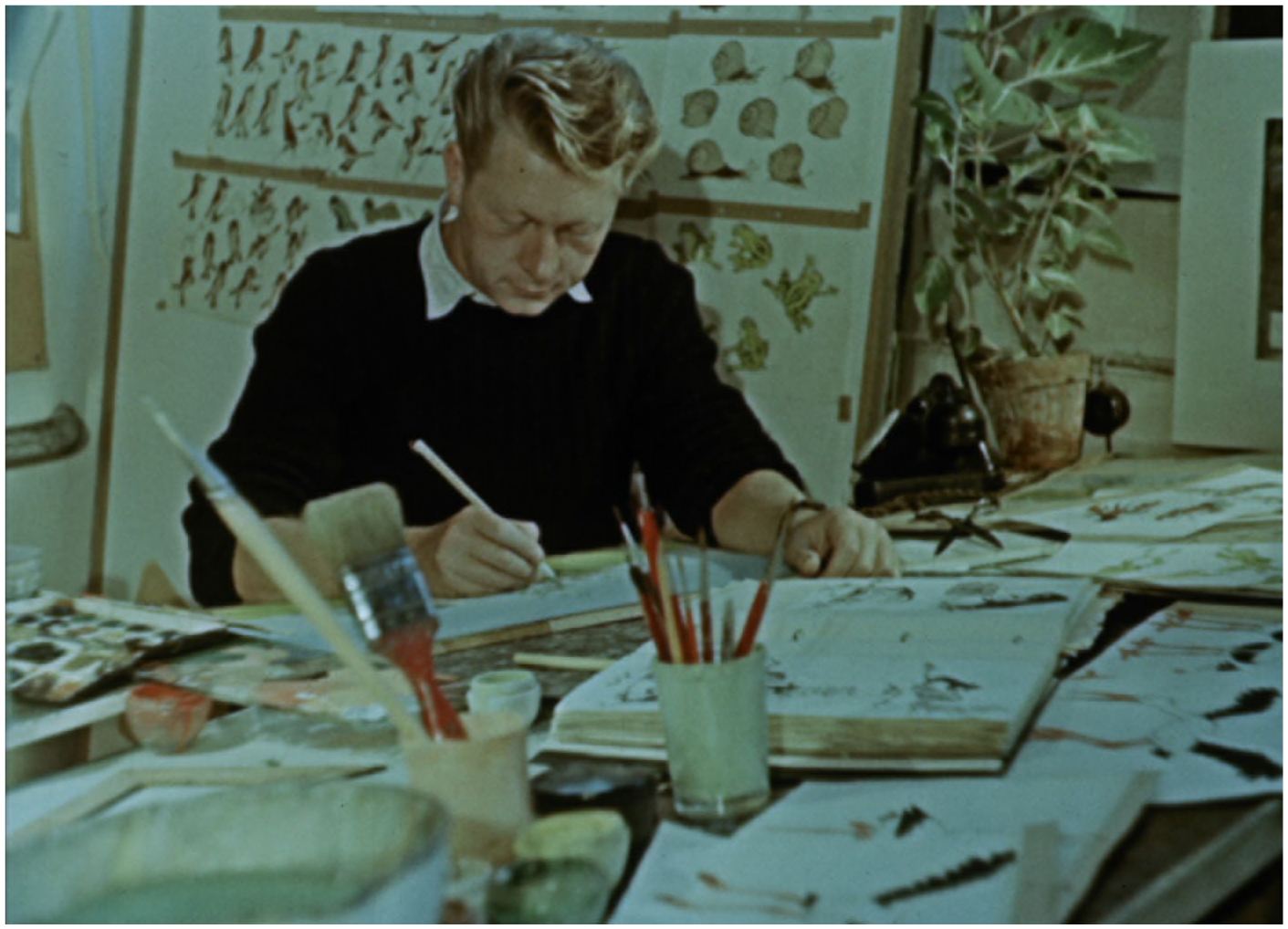
Zdeněk Miler in his workroom at Barrandov ateliers, a frame from a documentary To jsou Bratři v triku (1956). © National Film Archive, Prague, Czech Republic. Reproduced with permission.
Among these newcomers, both Dudešek and Kadleček were graduates of the Střední uměleckoprůmyslová škola (The School of Arts and Crafts) (hereafter UMPRUM) in Gottwaldov – an institution that emerged as a critical talent pipeline for the animation departments in the city. They developed into exceptionally productive filmmakers: Dudešek directed 23 animated films and 77 series episodes throughout his career, while Kadleček directed 37 films and 38 series episodes. Both contributed significantly to additional productions as animators or art directors (26 and 40 films, respectively), primarily on projects under Hermína Týrlová’s direction.
Born in 1926, Dudešek was marginally senior to Kadleček. At ages 19 and 17 respectively in 1945, both had been too young to participate in Protectorate-era animation – a sector that had attracted numerous talented young men seeking employment while avoiding forced labour in the Reich following the 1939 closure of universities in the Protectorate. Their professional development was facilitated by placement in Hermína Týrlová’s animation department, as she demonstrated greater receptiveness than her studio counterpart, Karel Zeman, to offering young collaborators opportunities for independent projects. Both achieved directorial debuts at relatively young ages – 29 and 32, respectively – within three to five years of their initial studio involvement. Despite both coming from small towns approximately 150 kilometres from Gottwaldov, their professional trajectories became inextricably linked with the city through early vocational training: Dudešek apprenticed as a shoemaker at the Baťa company, while Kadleček trained as a carver before pursuing studies at the Academy of Arts, Architecture and Design in Prague, subsequently transferring to UMPRUM in Zlín in 1947. Throughout the 1960s, both Dudešek and Kadleček contributed substantially to Czech animation’s international recognition, earning accolades at prestigious festivals in Bergamo, Venice, and Gijón, and sustained their positions at the same studio throughout careers spanning nearly four decades.
The third Gottwaldov debutant, Zdeněk Rozkopal, served in Karel Zeman’s department as a background painter before advancing to the roles of architect and costume designer. He made his animation debut in 1958 with a new instalment of the Mr. Prokouk series, which Zeman had launched in 1946 as “agitka” (political agitation) shorts. Subsequently, he directed 14 animated, documentary, and live-action films through 1988 and, in his capacity as visual artist and architect, contributed to 32 feature films and television series for Brno and Bratislava television studios (Lukeš, 2024). As we will explain below, the early career paths of these three directors on their way to their debut films were generally replicated by debutants in the 1960s: they usually acquired the necessary entry competences into the profession by studying at UMPRUM, which could be occasionally replaced by the longer experience of working on the films of one of the two department heads.
The other post-war entrants into animation were Vladimír Lehký and Zdeněk Smetana. Having graduated from Prague’s UMPRUM in 1941, the 26-year-old Lehký joined Otakar Blažek-Brenten’s studio in his native Brno in 1945 before relocating to Prague’s Brothers in Trick in the late 1940s. Smetana had received private painting instruction during the Protectorate but lacked connections to AFIT’s professional networks. Consequently, when subjected to forced labour requirements, he worked in a factory where he, at least, had the chance to develop engraving skills. After the end of World War II, he successfully applied to the newly established Brothers in Trick Studio, where a brief demonstration of his drawing abilities secured him an initial position as an in-betweener, with rapid advancement to animator status (Strusková, 2001). In terms of directorial productivity, Lehký and Smetana achieved a substantial output (25 and 37 directed films, respectively) that was quantitatively comparable to that of their Gottwaldov contemporaries. Lehký made his debut at age 35, while Smetana (born 1925) began directing with remarkable speed – merely one year after taking his initial animator position – at age 25, leveraging skills acquired through artistic mentorship and practical factory engraving experience. The last of the newcomers was Jan Karpaš, born in 1913, who did not begin working in animated film until he was 32. He came to the Brothers in Trick Studio in Prague with experience as a theatre designer and the son of an amateur puppeteer. He made his debut in 1955, but for the first 15 years of his career in animated film, he worked primarily as an animator on Jiří Trnka’s films, developing his own directing career more systematically from the late 1950s onwards.
However, these six filmmakers represent significant but rather exceptional cases. Post-war Czechoslovak animation was fundamentally grounded in practitioners trained during the Protectorate period, whose symbolic capital derived from AFIT experience and who constituted the foundation of Czechoslovak animation’s capabilities and subsequent achievements. Among the 21 individuals of our sample who entered animated film production during World War II, Josef Vácha and Karel Zeman were the most senior, both aged 29 at the war’s onset. However, 15 others were 22 or younger, and their attraction to Prague or Zlín studios was equally motivated by the practical necessity of securing employment following university closures and of avoiding forced labour in the Reich, as well as by creative ambitions.
In the post-war period, 13 of these practitioners had directed animated films by 1948, with František Vystrčil being the sole individual to make his directorial debut after 1952. Involuntary departures from animation were rare among those who had achieved directorial status, occurring exclusively in association with the former Brenten studio in Brno and its reputation for substandard output quality. Both Otakar Blažek-Brenten and Jan Fuksa were compelled to abandon the field following severe criticism of the studio’s inferior production standards, while the couple Václav Zykmund and Anna Veselá-Zykmundová terminated their animated film activities in 1952 upon the closure of the Brno puppet film studio, which had succeeded the previous drawn animation facility (Bernard, 2001: 115–146; Mlejnková, 2010: 29; Report of the Deputy for Production Vladimír Václavík on the Liquidation of the Cartoon in Brno, 1949).
The situation at the Polish Se-Ma-For studio differed dramatically regarding pre-1945 animation training. Among the 21 individuals who directed animated films through 1960, only one – Zenon Wasilewski (see Figure 2) – had pre-war animation experience. The emigration of Poland’s pre-war talent pool appears to constitute the most significant factor (Czechoslovak animation lost only two experienced filmmakers to emigration: Karel Dodal and his wife Irena). The outbreak of World War II dispersed numerous Polish animators worldwide or ended their careers in animation, with the majority never returning to post-war socialist Poland and some transitioning from animation to non-animation filmmaking or to crafts. In the immediate aftermath of the war, Polish authorities attempted to attract émigré artists back to the country, and the national film industry representatives Stanisław Wohl and Jerzy Toeplitz – then affiliated with the Czołówka Film Unit of the Polish Army – visited their old friends Franciszka and Stefan Themerson in England, where they moved to in 1940 and 1942, respectively. They came with an appeal for the couple to return to communist Poland and contribute to the rebuilding of its national cinema. When Stefan Themerson asked whether they would be allowed to continue making the kinds of films they had always created – abstract and avant-garde – the response was negative. Consequently, the Themersons declined the offer (Majewski, 2018: 159–179). The rejection of avant-garde approaches foreshadowed the preferences of socially and politically loaded animation in the post-war period.
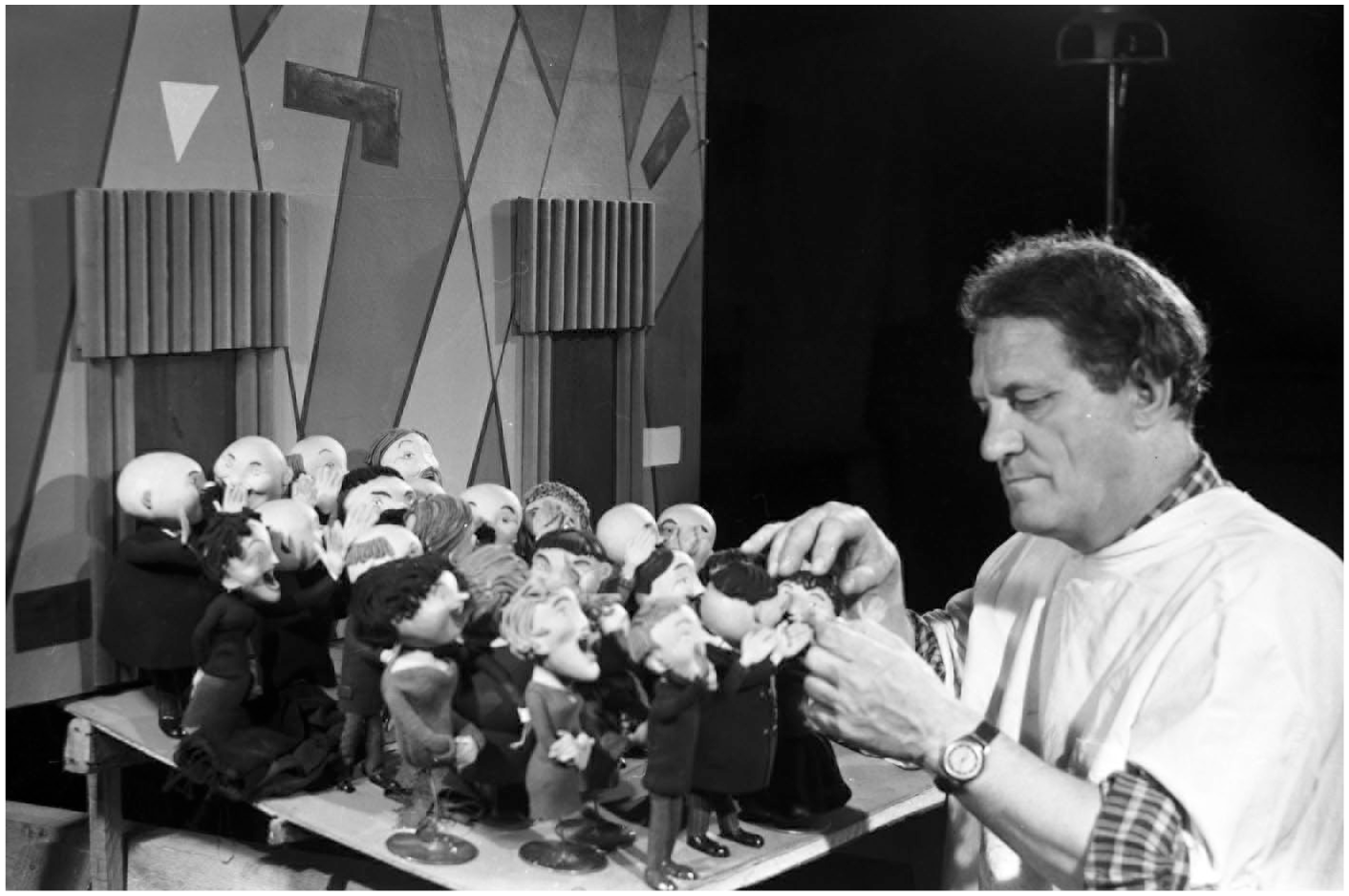
Zenon Wasilewski on the set of the film Uwaga diabeł! (Watch Out, the Devil!, 1959). © Photograph: Mieczysław Biełous, National Film Archive – Audiovisual Institute in Warsaw, Poland. Reproduced with permission.
Because of these factors, none of the pre-war directors – including Stanisław Dobrzyński, Otto Hahn, Jan Jarosz, Eugeniusz Jaryczewski, Włodzimierz Kowańko, Feliks Kuczkowski, Marta and Karol Marczak, and Franciszka and Stefan Themerson – participated in establishing the post-war Polish animation field. Polish post-war animation was instead based on new practitioners, with the sole significant exception of Zenon Wasilewski. Born in 1903, he had entered film production in 1938 through collaboration with the small studio Trio-Film, for whom he created four commercials using plasticine figurines. Following a brief period in 1946–1947, when the Studio Filmów Lalkowych (Puppet Film Studio) in Łódź was led by the production manager Mieczysław Wajnberger, Wasilewski became its head in 1948. He remained the studio’s only full-time director until 1950 and was the most visible figure in its formative years. His first film there, In the Times of King Krakus, and several subsequent productions were created in close collaboration with his sister Irena Wasilewska, his principal collaborator until her death in 1959.
Beyond this fundamental disparity in the number of experienced animators, the dynamics of film debuts in Czechoslovakia and Poland differed markedly due to Se-Ma-For’s sudden expansion of production volume and animation techniques, beginning not earlier than the end of the 1950s (Oczko, 2023). During the first 13 years, 57 films were made, of which 26 were produced in 1959 and 1960. The dramatic production increase coincided with the expansion of creative techniques to encompass cartoons, live-action, and combined film alongside puppet movies, as well as with the acquisition – apart from Tuszyn studio – of a permanent production base in the city of Łódź following a period of dynamic restructuring and mobility prior to 1960 (Ciszewska et al., 2025: 33–72). Eleven debutant directors worked on these films: Lucjan Dembiński, Jadwiga Kędzierzawska, Wacław Kondek, Marek Kononowicz, Maria Krüger, Lechosław Marszałek, Janusz Nasfeter, Kazimierz Oracz, Ryszard Raduszewski, Józef Skrobiński, and Tadeusz Wilkosz. This cohort already exhibited the diversity characteristic of the post-1960s period, including filmmakers whose careers extended no further than single films (Krüger and Kononowicz), those educated in puppet film craft who developed long Se-Ma-For careers (Dembiński and Wilkosz), and those who specialised in live-action films (Kędzierzawska and Nasfeter).
As previously argued, Czechoslovak animation differed significantly from Polish animation in that it remained largely closed to newcomer directors during this period. Despite these fundamental differences, the minimum debut age stayed the same in both Czechoslovak and Polish animation: 25 years. The youngest Se-Ma-For director was Tadeusz Wilkosz, matched by his Czech counterpart Zdeněk Smetana. However, their debuts – Smetana’s in 1950 and Wilkosz’s in 1959 – were separated by nine years: while Wilkosz entered the field during its period of growth and absorption, Smetana’s position as the youngest debutant was determined by the demographics of the first postwar generation, which debuted before 1950. Metaphorically speaking, the first generation’s career trajectories resembled a spring compressed during the Protectorate and released after 1945 – five debuted in their late 20s (Miler, Duba, Látal, Kábrt, and Bedřich, with the youngest, Zdeněk Miler, aged 27), and another five in their early 30s (Možíš, Brdečka, Fuksa, Seydl, Hofman). With the exception of Smetana, they were all old enough during the Protectorate to gain work experience. On one hand, neither Łódź-based nor Czechoslovak animation received significant support from live-action filmmakers; both developed as specialised production areas with specific competencies from inception. On the other hand, Czechoslovak postwar animation formed much earlier and more rapidly by building on wartime experiences: under these conditions, a well-structured positional hierarchy emerged in Czechoslovakia no later than 1947, 15 whereas in Poland it was delayed by about a decade.
1961–1989: Consequences of television expansion
From the 1960s onward, the three animation studios examined in this study encountered several substantial transformations in their organizational structures and relationships with cultural policy. These changes encompassed political upheavals that significantly affected the cultural sector (the normalization 16 process in Czechoslovakia following the Warsaw Pact armies’ invasion, and the imposition of martial law in Poland during the early 1980s), organizational restructuring (Gottwaldov studio’s autonomy as a production unit since 1977), and the establishment of additional animation facilities and departments – new entities included four Czechoslovak Television’s (Československá televise) animation studios in Prague (two studios), Bratislava and Košice (Jirásek, 2020: 99–101; Podlipná and Kunkelová, 2024: 281; Večeřa, 2023), animated film department at the Short Film Studio in Bratislava (Regrutová, 2015: 324–325) (established in 1965), studio Prométheus in Ostrava (1971) (Jánská and Horsáková, 2010), studio affiliated with UMPRUM Prague (since 1960s), three small Prague studios focused on cut-out and puppet animation established since mid-1970s (Máj; U ženských domovů; U Krále železnic), and a private studio established by the film director Milan Horvatovič and servicing Slovak television. In Poland, in 1966, the Studio Filmów Animowanych (Animated Film Studio) in Krakow began, which became independent of Warsaw’s Film Miniatures Studio in 1974 and focused on experimental animation (the studio’s total production reached about 250 films). Telewizyjne Studio Filmów Animowanych (TV Studio of Animated Film) in Poznań was established in 1980 (Sobolewska, 2010). But, when considering individual capacities and competency requirements rather than changes in cultural policy and film industry infrastructure, one factor played a particularly significant role in transforming the conditions for entry into the field of animation: the rising demand for animated content for television broadcasting. This factor significantly changed the position of the Gottwaldov animated film studio, which differed from the other two studios examined here in that it was located outside the country’s cultural and production centres.
The Zlín-based Baťa film production company struggled with a staff shortage due to its distance from Prague, the cultural centre, since its founding in 1927, and the problem became even more pronounced after 1936, when film production was regularised, and working conditions improved with the opening of a new studio building. The small village of Zlín experienced a fivefold population increase during the 1920s, spurred by the industrial expansion of the Baťa shoe factory. As part of Tomáš Baťa’s comprehensive media network (Szczepanik, 2009), a film stage was constructed in the nearby village of Kudlov, adjacent to Zlín. Following World War II and the nationalization of the Baťa company, the ethos of rapid modernization and industrial growth that had previously attracted filmmakers such as Alexander Hackenschmied and Elmar Klos to Zlín began to wane. During the Protectorate, many creative professionals – including future leading animators and directors such as Zdeněk Miler, Josef Kábrt, and Břetislav Dvořák – left Zlín in search of more stable employment opportunities in Prague.
Being out of the cultural and production centre, the Gottwaldov Studio had a limited production output prior to the 1960s. Hermína Týrlová and Karel Zeman, who had both entered the field before 1945 and served as department heads, were responsible for more than two-thirds of the studio’s animated film output prior to 1960. At the beginning of the 1960s, the studio employed a modest workforce of 24 individuals, including directors Týrlová and Zeman, one assistant director, four animators, two cameramen, one camera assistant, one production assistant, three puppeteers, five background painters, two costume designers, two prop makers, and one assistant editor (Proposal for the Establishment of a Children’s Film Studio in Gottwaldov, 1960). At the same time, the studio’s peripheral status was to some extent mitigated by the recognition its output received from both the international film festival sphere and the domain of political authority. Both studios’ department heads, Hermína Týrlová and Karel Zeman, had been winning prestigious awards since 1946, earning accolades from festivals in Cannes, Venice, Brussels, and other international venues. Following the 1948 communist coup, these achievements were acknowledged not only by the state-run film industry but also by Communist Party officials. The international prestige of animated film carried considerable symbolic value for the regime, and the loyalty of Týrlová and Zeman – as prominent artistic figures – was subject to ongoing negotiation. This dynamic was most visibly demonstrated in the years following the Warsaw Pact armies’ invasion of Czechoslovakia in 1968, when Zeman and Týrlová were awarded the title of National Artist in 1970 and 1971, respectively.
This period in Czechoslovak history, following the country’s 1968 invasion, marked a conservative shift in politics and affected the film industry, with changes in upper management, including the head of the Gottwaldov studio. However, unlike the feature film sector, the political transition did not lead to significant personnel purges in animated film production. 17 A more direct and forceful intervention by political authorities into the Gottwaldov studio’s production environment occurred soon after, in 1974, when the Státní bezpečnost (State Security Police, abbreviated as StB) intervened following an improvised satirical puppet performance criticizing the Warsaw Pact armies’ invasion, organized by studio art designer Emil Hauptmann (see Figure 3). This incident resulted in the dismissal and imprisonment of two young talents from the studio’s animation department. Although it is important to note that this was not an explicit crackdown on the artistic field, the firings, interrogations, and subsequent imprisonment profoundly affected the studio’s atmosphere (Exchange of membership cards – interviews with members of the factory organizations, 1970; Investigation file – Emil Hauptmann and Co, 1974; Skopal, 2022a).
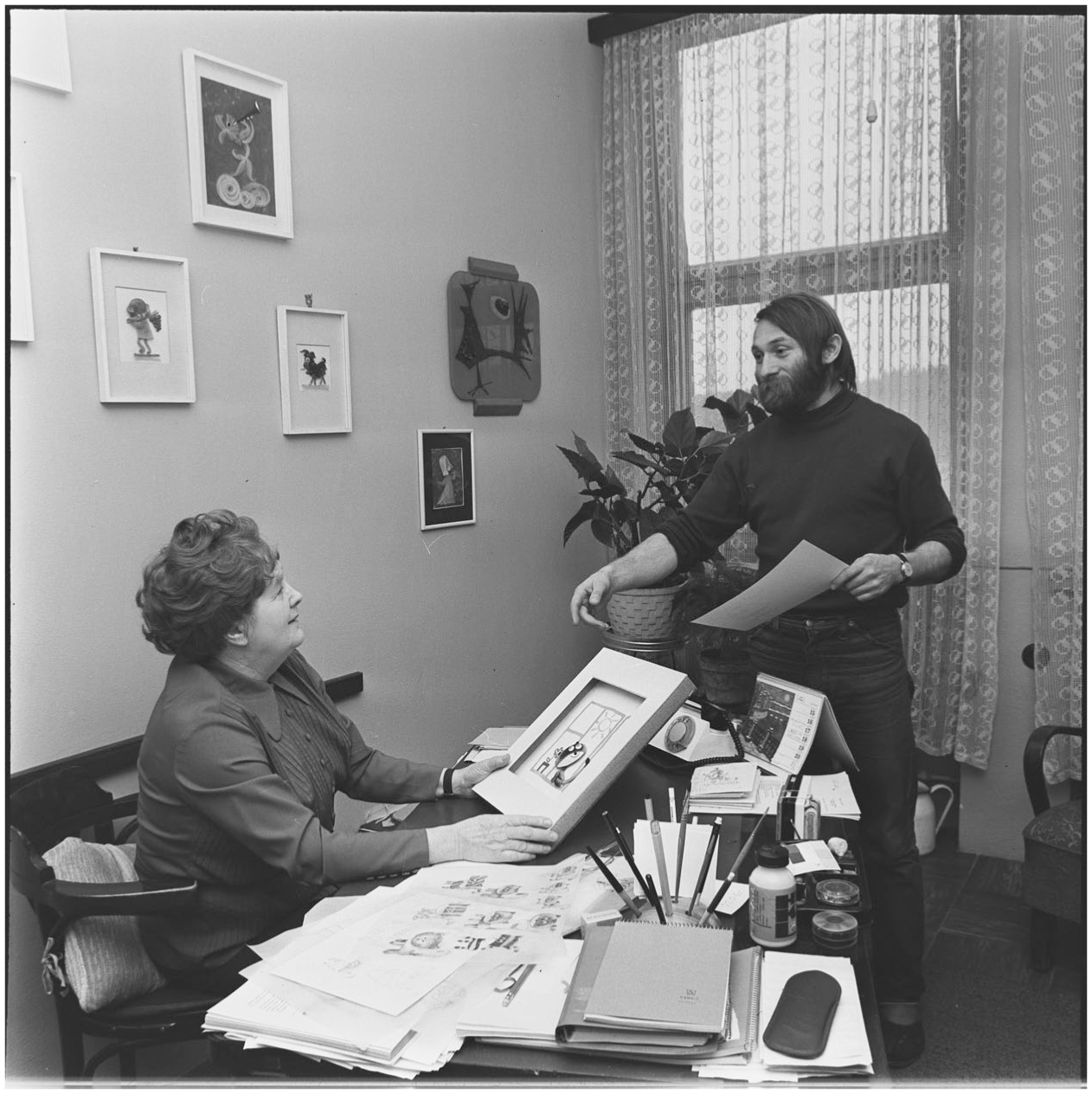
Hermína Týrlová, along with her art designer Emil Hauptmann, is preparing a film adaptation of the stories about the cat Modroočko. In this photo, they are discussing graphic designs. © Photograph by Vít Korčák.
The studio’s productivity was somewhat harmed by these events and the subsequent emigration. It experienced the departure of notable talents such as Jiřina Simajchlová, who made her directorial debut in 1979 before emigrating to the Netherlands in 1983, Ludmila Zemanová and her husband Eugen Spálený, who moved to Canada, and three individuals involved in the previously described trial, who left the country after being released from prison. The emigration after 1968 contrasts with the immediate post-war period, which mainly affected the Polish film industry rather than that of Czechoslovakia, and it differs from the experience of animation studios in Prague, where cases of emigration were relatively rare. 18
Although they had a significant impact, these interferences of political power occurred more sporadically than continuously. More profound shifts in the animation studios – particularly in the studio in Gottwaldov – were driven by a substantial rise in demand for children’s animated films starting in the mid-1960s. This surge was mainly due to the Czechoslovak television network’s new bedtime stories program, which expanded from a single broadcast per week in 1965 to daily broadcasts by 1973. In response, a new department dedicated to cartoons was established at the Gottwaldov Studio to meet the increasing needs of the television network. Between 1966 and 1989, the studio shifted its production focus, creating approximately 370 episodes of the bedtime stories series – an average of 15 episodes per year (Podlipná and Kunkelová, 2024: 302). The fact that the Prague studio, with its significantly larger production capacity, produced animated television series in similar volumes – up to 25 episodes annually – underscores the crucial role of animated television production at the Gottwaldov Studio. Likewise, the Polish Se-Ma-For studio followed a comparable developmental path. From 1962, Se-Ma-For provided service production for the public broadcaster, incorporating animation into its services starting in 1964. During the peak period (1977–1980) of commissioned animated production, Se-Ma-For averaged 23 animated films per year commissioned by television. The demand for television production prompted the peripheral Gottwaldov studio to catch up with the Brothers in Trick and Se-Ma-For studios in both volume and importance to television studios.
Gottwaldov Studio boosted its production by integrating newcomers through three strategies. The first was to attract talent from Prague for long-term collaboration, which succeeded in three notable cases, though with varying success. Igor Ševčík, who had worked as both a director and art designer at the Jiří Trnka Studio and the Gottwaldov Studio since the early 1980s, eventually became the head of the Zlín-based studio (the city had been renamed back to Zlín by then) in 1990. Garik Seko, who left FAMU in Prague before completing his degree, started his animation career at Gottwaldov, where he stayed for 17 years before returning to Prague to work at the Jiří Trnka Studio. Valerie Chmelová, a graduate of both UMPRUM Prague and Divadelní fakulta akademie múzických umění v Praze (Theatre Faculty of the Academy of Performing Arts in Prague), joined the Gottwaldov Studio through the intervention of Kamil Pixa, the director of the Short Film Studio. However, after finishing her debut film and working there for less than two years, she left in 1978, driven by challenges common to peripheral studios: the geographic distance from her partner living in Prague and social resistance within the close-knit Gottwaldov environment, where rumours circulated about her alleged intimate relationship with Pixa (Skopal, 2022b). The most significant recruitment from Prague occurred in 1973, when Bohumil Šejda, previously at the Brothers in Trick Studio, was invited to establish the cartoon department in Gottwaldov. At that time, Šejda was 50 and worked there for the next two decades (Skopal et al., 2025). Unlike the practices at the Gottwaldov Studio, neither the Brothers in Trick Studio in Prague nor Se-Ma-For systematically recruited directors from other regions. 19 Instead, they relied on routine in-house training and informal hiring.
The second strategic method for expanding the pool of animated film directors involved recruiting from other areas of film production. The concentration of different production types, such as documentaries, educational films, commercials, and feature films, at Gottwaldov Studio created favourable conditions for professional versatility and mobility. Antonín Horák, who had worked as a cinematographer on nonfiction films since 1937 and contributed to nearly 300 (mostly animated) films and episodes since 1947, made his directorial debut in animation in 1962 at age 44. Similarly, Jan Iván, mainly known for his documentary work, occasionally directed animated films from 1960 to the early 1990s. At Brothers in Trick Studio, the only notable example of this career path is that of the two cinematographers, Ivan Renč and Boris Baromykin, who made their animation directorial debuts in 1965 and 1978, respectively (-jabl-, 1989). Due to limited information about some of the 98 debutants during this period at Se-Ma-For, it is not yet possible to rule out such mobility. However, none of the studio’s 10 most prolific directors seems to have followed this career path.
The third and most effective method for recruiting new animation directors for the growing production in Gottwaldov involved training local talent and providing opportunities for quick career growth. UMPRUM in Uherské Hradiště, which relocated from Gottwaldov in 1952, played a key role in this process. Although the school did not offer specific animation courses, its emphasis on artistic skills and design equipped graduates with the essential professional abilities. Strong connections between the school and the studio supported this relationship, with film director Jan Dudešek teaching at the school and acting as a main link between the two institutions. Similarly, Jan Staněk, a teacher of applied graphics at the same school, was specially hired by studio director Bohumil Steiner to “shape the artistic profile of cartoon film” and to act as a mediator (Report of the 11th meeting of the management of the Film Studio Gottwaldov, 1977; Steiner, 1978). Of the 19 filmmakers who debuted as directors at the Gottwaldov Studio between the 1960s and 1980s, nine were graduates of the school. Just a narrow majority became directors without formal training from this institution, including several who made their debut later in their careers after working in other parts of production at Gottwaldov, such as Antonín Horák, Jan Iván, and Taťána Havlíčková. Four others transitioned to directing through professional connections (Jindřich Liška, Bohumil Brejcha, Arnošt Kupčík), personal relationships (such as being a son-in-law of Karel Zeman), or teaching positions at UMPRUM (Jan Staněk). Only two filmmakers received specialized secondary education in animation from other cities: Václav Dobrovolný from Brno and Valerie Chmelová from Prague. These three strategies – recruiting experts from central locations, encouraging professional mobility within the versatile studio environment, and building close ties with the local secondary education institution – allowed the studio to leverage the booming demand for children’s animated films to meet television broadcasting needs.
Conclusion
The comparative perspective on the three studios of animated films during the period under discussion reveals two significant phenomena. The first is the distinct temporality in the formation of a fully structured professional milieu in the production of animated films – a process that occurred much more rapidly in Czechoslovakia than in Poland. This difference can be attributed to the accumulation of a diverse group of young talents with both artistic and technical skills around the two key centres of film production in Prague and Zlín. The specific conditions of the Protectorate, where pursuing university education was not possible, and young talent was strongly motivated to join the booming animation film production, contrasts with the radical dismantling of the cinema industry in the General Government territories of former Poland (Pafort-Overduin et al., 2024). Consequently, Czech animators and the Czechoslovak state film industry capitalised on these advantages in post-war international competition, achieving rapid recognition as world-class. In contrast, Polish animation, constrained by a shortage of competent and experienced animators and the emigration of pre-war “pioneers,” underwent this process more than a decade later, reaching an evolved professional environment only at the end of the 1950s. Developments in the two countries therefore differed, despite the fact that they shared the so-called urbanized functionality model in the first 15 post-war years, i.e., the fragmentation of animation production into small stages integrated into the cities (Skopal et al., 2026).
The second phenomenon played a key role since the 1960s. At that time, demand for animated films for children was growing rapidly in the newly established medium of television, which provided a significant stimulus to animation production. Commissioned work for television became the primary focus of the smallest and most isolated of the three studios under review, the studio in Gottwaldov, where the two principal creative figures and department heads, Hermína Týrlová and Karel Zeman, were entering the final phases of their careers at the onset of normalization (in 1970, they were 70 and 60 years old, respectively). The studio’s animated output was largely devoted to routine series production for television, and it used the three strategies described above to secure production capacity, which enabled it to keep pace with the Brothers in Trick and Se-Ma-For studios in this aspect: attracting talents from Prague for long-term collaboration, recruitment from other subfields of film production, and training local talent at the UMPRUM school and providing opportunities for rapid career advancement. 20
The comparison of personnel capacities and professional paths in three animated film studios in two countries revealed elements of exceptionalism in development within the given comparative framework. Future expansion of the studios being compared may further advance understanding of these processes and reveal that what seemed exceptional in a comparison of two Czechoslovak and one Polish studio (i.e., the influence of the German occupation on the above-average accumulation of young talent in animated film, and the demand from television as an opportunity for smaller studios to increase their capacity) was actually shared by other studios in different countries. The thesis of exceptionality is therefore (inevitably) provisional and open to future refinement or challenge as the comparative perspective expands to include more countries.
Footnotes

Ethical considerations
The nature of the research did not require ethical approval according to institutional guidelines.
Consent to participate
Informed consent was obtained from the interview respondents for their participation and the use of their data.
Consent for publication
Not applicable.
Funding
This work was supported by the Czech Science Foundation (GF21-04081K) and the National Science Center, Poland (2020/02/Y/HS2/00015) – research project Animation Studios in Gottwaldov and Lodz (1945/47–1990) — Comparative Collective Biography.
Declaration of conflicting interests
The authors declared no potential conflicts of interest with respect to the research, authorship, and publication of this article.
Data availability statement
The authors of the article and their research teams collected biographical data on animators in the database Animation in Czechoslovakia and Poland, 1945–1990 (Skopal et al., 2025).