






Abstract
We propose a cognitive and neurobiological model by which curiosity regulates affective memory, by positively biasing memory encoding through the promotion of emotion regulation. We begin with a brief overview of curiosity's observed emotional effects. Then we introduce three prominent models of affective memory encoding to suggest that the dopaminergic modulation of encoding associated with curiosity may positively bias memory processes. We situate the role of curiosity role in emotion regulation relative to its promotion of abstract thinking and cognitive flexibility. We then identify the neural processes associated with abstraction and flexibility observed in the left inferior frontal gyrus, the dorsal anterior cingulate cortex, and the lateral prefrontal cortex as the neurobiological mechanisms underlying our framework.
Introduction
In Carroll's famous story “Alice in Wonderland,” we are introduced to a character that is literally dropped into the middle of a world filled with uncertainty and threats (Carroll, 2018). And yet, Alice, and the children reading her story, is able to navigate the world without fear, but rather with eyes wide open with interest. “Curiouser and curiouser” remarks Alice, early on in the text, and perhaps in this comment the reader begins to understand both how Alice is going to persist and how we are meant to engage with the story. Rather than perceiving the oddities of this new world as a series of potential threats, readers are encouraged to encounter them with a sense of wonder. In this way, curiosity, in the midst of a horrifying tale, grants Alice the tools to persistently navigate the uncertain world, Carroll the means to tell the story with aplomb, and the readers the chance to remember it fondly. Echoing these three roles of curiosity in telling the story of “Alice in Wonderland,” we propose a cognitive and neurobiological model by which curiosity may positively bias memory processes by promoting the maintenance of goal-pursuit through cognitive flexibility and aiding emotion regulation through abstract information-processing.
We posit a framework by which adopting a curious mindset regulates emotion through co-occurring regulatory and memory encoding mechanisms. We construe emotion regulation through the lens of memory because affective memory is particularly important to future emotional well-being (Bowen et al., 2018). Affective memory has been observed to operate like a reinforcing feedback loop, such that more positive memories predict future emotionally positive encoding (Philippe et al., 2012; Philippe & Bernard-Desrosiers, 2017; Tov, 2012). Behaviorally, memory processes underlie decision-making (Biderman et al., 2020; Murty et al., 2016) and future simulation (Schacter et al., 2007), both of which are essential for goal-pursuit and subsequent regulatory choices (Carver & Scheier, 1982). Furthermore, the hippocampus (HPC), while often considered in relation to episodic encoding, also has a central role in emotional processing, particularly in the domain of safety learning (Phelps et al., 2004). Because of this, emotional states and neurobiological memory mechanisms can mutually inform one another (Goldfarb & Phelps, 2017), such that understanding of emotional outcomes can be aided by considering underlying memory processes, and vice versa. Indeed, memory-related mechanisms embedded within regulatory contexts may be particularly adaptive in promoting overall well-being (Samide & Ritchey, 2021). For these reasons, our model is structured based on how regulatory and memory processes interact to predict emotional outcomes over time.
We contend that curiosity affords increased cognitive flexibility and abstraction, which serve as regulatory mechanisms that guide information-processing and reduce negative emotion. We hypothesize that these processes are largely reliant on cortical mechanisms and are associated with increased activity in the left inferior frontal gyrus (LIFG), the dorsal anterior cingulate cortex (dACC), and the lateral prefrontal cortex (LPFC). We then argue that curiosity also regulates negative emotion through subcortical circuitry, specifically by promoting dopaminergic modulation of memory encoding in the HPC via the ventral tegmental area (VTA), in turn biasing information-processing away from the amygdala (AMY) and the medial temporal lobe (MTL). Drawing upon existing theories of affective memory, we suggest that the processes outlined above together predict the biasing of information during encoding away from narrow representations of threat toward more integrative, contextualized encoding of the event. Furthermore, we briefly elaborate on the contribution of the ventromedial prefrontal cortex (vmPFC) to emotion and memory integration processes, outlining its importance in understanding the long-term effects of abstract information-processing (Spalding et al., 2018; Zeithamova et al., 2012). Integrating extant research in emotion regulation and affective memory, we propose that this two-pronged recruitment of in-the-moment regulatory mechanisms (LIFG, dACC, and LIFG) and affectively biased encoding mechanisms (VTA projections to the HPC), combine to predict both positive emotion during curious states and improved well-being over time.
In this paper, we first overview preexisting research on curiosity and various emotional outcomes and highlight the need for a model that can account for the current mixed evidence. Then we review curiosity's memory benefits set in the broader foundation of the extant research on affective memory encoding and propose that curiosity may positively bias information during encoding. Next, we situate curiosity in an emotion regulation framework, emphasizing the regulatory roles of abstraction and cognitive flexibility that curiosity affords to regulate emotional response during negative experiences. In this section, we also address alternatives to our memory hypothesis. We then outline some implications of our proposals for everyday affective experience.
Curiosity's Emotional Outcomes
Prior empirical research has largely conceived of curiosity as a particularly rewarding combination of an appetitive drive (interest; Berlyne, 1978) and a motivating information-gap or prediction error, commonly referred to as deprivation (Loewenstein, 1994). Both drives intrinsically motivate individuals to seek out information about phenomena (Dan et al., 2020; Litman, 2008, 2019; Shen et al., 2023). While both deprivation and interest predict that curiosity will lead to approach-oriented behavior, they produce mixed predictions regarding the utility of curiosity in goal-pursuit and the associated emotional impact of curiosity. Interest may distract one from gathering useful information, as it instead focuses the agent on positive emotions of enjoyment and pleasure (Litman, 2005). In contrast, curiosity motivated by deprivation may not only provide useful information but it also results in increased uncertainty and accompanying aversive emotions (van Lieshout et al., 2021). Taken together, these contrasting motivational states make predicting the emotional outcome of curiosity challenging. In this section, we review supportive evidence for curiosity's emotional benefits, as well as opposing evidence for its potential negative effects. We then propose a novel theoretical conceptualization of curiosity as a mindset that can reconcile these competing accounts, before introducing our larger model.
Contemporary study of curiosity emphasizes the importance of emotional contexts and outcomes and has regularly observed associations between curiosity and positive emotion (Silvia, 2008); despite important contextual features that can lead to feelings of distress (discussed below). Research in personality and individual differences has found that higher trait-level curiosity is associated with higher levels of cognitive flexibility (Kashdan et al., 2018), openness to experience (Silvia & Christensen, 2020), and tolerance of uncertainty (Birenbaum et al., 2019); all of which are in turn associated with reductions in symptoms of anxiety and depression (Chiappelli et al., 2021; Deveney & Deldin, 2006; Gentes & Ruscio, 2011). Additionally, diary studies have found that individuals who report higher day-to-day curiosity also report more positive emotions and well-being (Lydon-Staley et al., 2020). Research examining the potential mechanisms underlying this association has found that curiosity helps individuals process adversity by enabling persistent approach behaviors (Kashdan & Steger, 2007) and effective coping strategies (Drake et al., 2022). In summary, curiosity, observed either as a trait or a state, appears to both improve general well-being and bolster resources to navigate negative experiences.
While there is substantial evidence for the attributes of curiosity that support well-being, there is a growing body of research that instead suggests curiosity may have negative effects on emotional states, particularly as it pertains to resolving uncertainty. There is evidence that curiosity may be primarily motivated by aversive feelings of uncertainty (Hsee & Ruan, 2016) and that being curious following uncertainty negatively correlates with subjective reports of well-being (van Lieshout et al., 2021). Additionally, curiosity may not only be motivated by aversive feelings but may also direct information-processing resources toward aversive information (Oosterwijk et al., 2020), or information that is not relevant for goal-achievement (Cabrero et al., 2019). In both cases, curiosity presents a situation in which negative affect could motivate information-seeking that either increases the probability of future negative affect or prioritizes the resolution of uncertainty above other needs (Lau et al., 2020). This evidence suggests that curiosity may reflect a negative emotional experience that engenders information-seeking behaviors that could promote negative emotion or distract from the positive emotional benefits of goal-pursuit (Carver & Scheier, 1990).
Taken together, this indicates a demand for a model of curiosity and emotion that can account for curiosity as being occasionally motivated by negative affect, while nevertheless tending to result in positive emotion and overall well-being. Drawing upon mindset theory (Dweck & Leggett, 1988), we propose that deprivation and interest can be understood as commonly observed motivators of a curious mindset. Mindset theory broadly proposes that implicit beliefs can produce meaning systems that guide cognition and behavior, resulting in unique motivational outcomes (Hong et al., 1999). Here, we operationalize curiosity as a mindset structured by the implicit belief that our experiences can be reduced to information, and by extension, our present experience can be reduced to informational accrual. This conceptualization accounts for observed deprivation and interest motivations underlying information-seeking—as it makes no assumptions about which motivation will characterize the curious mindset—while also providing theoretical understanding of how such distinct motivational processes can often result in similar behavioral and emotional outcomes. In particular, we propose that this mindset, whether motivated by deprivation or interest, affords common regulatory mechanisms during affective encoding. These shared regulatory mechanisms may account for the conflicting emotional predictions for curiosity, as motivated by interest (i.e., appetitive motivation with potential harms) or deprivation (i.e., aversive motivation with potential benefits), if the negative aspects of either experience can come to be recalled less negatively.
We posit that a curious mindset may promote effective coping over time by promoting the construal of experiences as information-gathering opportunities. We argue that this process invokes regulatory and encoding mechanisms that reduce the aversive aspects of potentially negative experiences, regardless of whether the curious mindset is motivated by deprivation or interest. For example, consider two individuals who regularly vape tobacco and begin to seek out information about the health risks associated with the behavior. One of them is prompted toward curiosity by a doctor's appointment in which they are told that nicotine is not a primary cancer-causing agent but that the vape inhalation itself is associated with poor respiratory health. This surprises them (i.e., deprivation) and they then seek out information regarding alternative sources of nicotine (e.g., patches). The other individual is vaping, looks at the vapor, and suddenly wonders what about this thing is harmful, just out of interest in what the answer might be (i.e., interest). Both those individuals arrive at a curious mindset, where the sensory experience of smoking is reduced to information, and both are likely to discover that nicotine itself, while addictive, is not the primary cause of the respiratory health risks posed by vaping. Because both individuals engaged with this information in a motivated, curious state, we propose that they are more likely to remember that information well and with less negativity than if they had adopted an alternative mindset. Given their similar hypothesized outcomes, we conceive of curiosity as a mindset that has similar regulatory and affective memory benefits whether motivated by deprivation or interest. Below, we propose a novel theoretical model linking curiosity as a mindset, affective memory mechanisms, and emotion regulation.
Curiosity and the Regulation of Affective Memory
We propose that, through a combination of encoding and regulatory mechanisms, curiosity positively biases memory of negative experiences and regulates emotion during negative experiences (Figure 1). We first identify dopaminergic memory benefits associated with curiosity (Gruber & Ranganath, 2019) that may positively bias memory during encoding, based on contemporary models of affective memory (Clewett & Murty, 2019). We next identify abstraction (Gilead et al., 2020; Hadar et al., 2021; Yudkin et al., 2019) and cognitive flexibility (Kashdan & Steger, 2007; Kashdan et al., 2018) as regulatory mechanisms underlying curiosity's emotional benefits, that serve to increase psychological distance (Moran & Eyal, 2022) and maintain goal-oriented action (Kashdan et al., 2020), respectively. Finally, we identify two alternative positions or arguments against our model, before arguing that the neural processes underlying abstraction and flexibility address these alternatives and support our proposed framework.
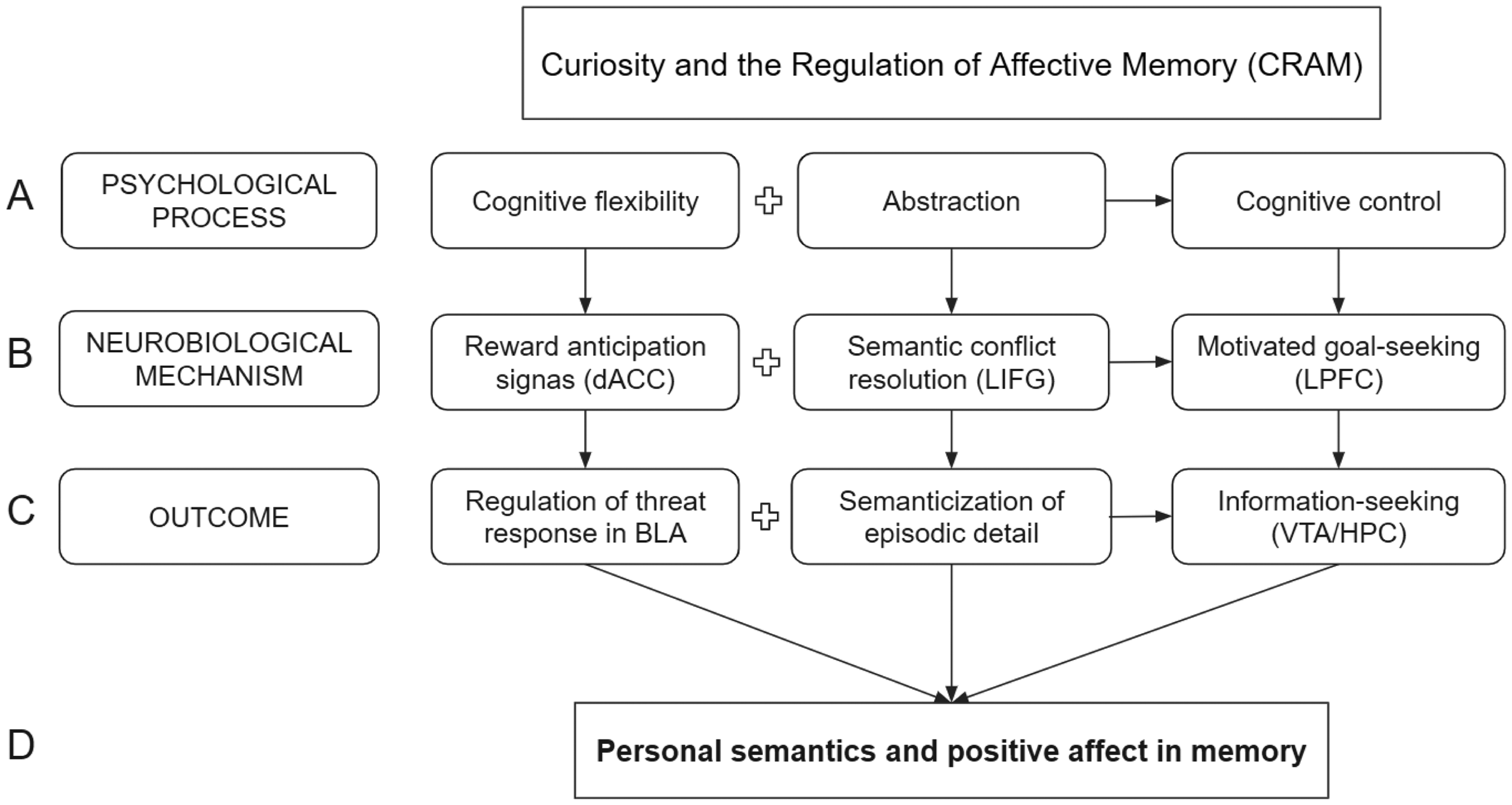
(A) We propose that curiosity implicates cognitive flexibility and abstraction as regulatory mechanisms, which modulate cognitive control to ultimately positively bias memory processes. (B) Neurobiologically, this process likely represents activity in the dorsal anterior cingulate cortex (dACC) signaling the anticipated reward of potential behaviors, and semantic conflict resolution processing in the left inferior frontal gyrus (LIFG) likely promoting abstraction, together predicting motivated goal-seeking processes in the lateral prefrontal cortex (LPFC) broadly. (C) The psychological and neurobiological processes underlying cognitive flexibility and abstraction further predict regulation of threat response in the basolateral amygdala, and semanticization of incoming episodic detail, respectively. Taken together, these likely further modulate the motivated goal-seeking to be both persistent and oriented toward semantics, and the resulting motivated information-seeking is associated with dopaminergic modulation, through the ventral tegmental area (VTA), of memory processes in the hippocampus (HPC). (D) The synthesis of these interacting psychological and neurobiological processes implicated by curious states than together predicts that the negative event may be positively biased during encoding and remembered relative to personal semantics rather than sensory detail.
Before continuing to introduce background and expand on our core arguments, we note two key aspects of how we are conceptualizing the prefrontal and cortical mechanisms we propose within our model. We identify recruitment of the dACC, the LIFG, and the LPFC (incorporating both its dorsal and ventral portions) as underlying the regulatory mechanisms we propose. The first point we would like to clarify is how and why we simultaneously focus on broad mechanisms of cognitive control (i.e., those associated with increased LPFC recruitment; Badre & Wagner, 2007; Nee & D’Esposito, 2017) while also highlighting the contribution of regions that modulate and direct cognitive control in specific ways (i.e., dACC modulation of value-orientation and LIFG associated semantic processing; Shenhav et al., 2013; Stampacchia et al., 2018). There are anatomical and functional distinctions to be made within the LPFC as it relates to cognitive control that is not addressed directly in our model. In particular, the dorsolateral prefrontal cortex (dlPFC) is associated with maintaining and manipulating representations of stored objects and contexts in working memory while the ventrolateral prefrontal cortex (vlPFC) is associated the manipulating schemas within working memory (Badre & Nee, 2018; Badre & Wagner, 2007; D’Esposito et al., 1995, 1999). Furthermore, there is considerable anatomical and functional overlap within the vlPFC and the LIFG. In this paper and for the purposes of this model, we choose to consider the contribution of dlPFC and vlPFC to cognitive control broadly so that our model can encompass both aspects of maintenance and manipulation mechanisms that support information-seeking, while also highlighting specific mechanisms within that process that modulate the motivation (dACC) and focus (LIFG) of said cognitive control.
The second aspect of our conceptualization of prefrontal contributions to our model we would like to address is the lack of primary attention paid to medial prefrontal mechanisms, in particular, activity in the vmPFC which is consistently associated with emotional representation (Mitchell et al., 2022; Roy, Shohamy & Wager, 2012) and regulation (Berkers et al., 2016; Motzkin et al., 2015). While there is some overlap in the function of the dACC and the vmPFC in supporting value-based decision-making and self-control under conditions of uncertainty (Berkman et al., 2017; Shenhav et al., 2013), in our model, we prioritize focus on the role of the dACC. The reason for this is two-fold: (1) evidence suggesting that activity in the dACC is associated with motivation of initial information-seeking choices and (2) evidence that the vmPFC is instead more associated with assigning value propositions to received information based on prior knowledge (Kaanders et al., 2021). Our model is particularly concerned with the emotional impact of the motivational processes underlying the initial choice to engage in information-seeking, and how those bias subcortical memory processes. This focus thus appears to be more closely related to moderation of value-based decision-making by the dACC than the vmPFC. That is not to say that the vmPFC is not involved in these processes but that its contributions are not the primary focus of this model. That being said, we do address the role of the vmPFC as it relates to memory integration processes that are relevant to our model, though again it is not a core element of our proposals.
Curiosity and Affective Memory
Curiosity has consistently been shown to improve learning and memory (Berlyne, 1978; Kang et al., 2009). These memory benefits are likely due to motivational systems implicated by curiosity (Murayama, 2022). Curious states tag information with incentive salience, such that the information becomes motivating in and of itself (Litman, 2005; Murayama et al., 2019; Szumowska & Kruglanski, 2020). Once curiosity motivates information-seeking behavior, the VTA exhibits increased connectivity with the HPC (Gruber et al., 2014, 2016). This coupling of VTA and HPC activity results in dopaminergic modulation of encoding, which in turn prioritizes that information in memory (Gruber & Ranganath, 2019). We argue that this well-studied process for curiosity's memory and learning benefits predicts positive biasing of information during encoding by providing more flexible, integrative representations of past events. To demonstrate this, we begin with an overview of the neurobiological pathways that prioritize affective information during encoding.
We focus on three distinct, but not mutually exclusive, theories concerning the prioritization of affective information during encoding: (1) an emotional binding account, (2) a sensory enhancement account, and (3) a motivational engagement account. Each theory hypothesizes distinct projections into the HPC that meaningfully predict both the quality and strength of the memory, albeit by different mechanisms. The emotional-binding account suggests that prototypical mechanisms binding details within their context are mediated by the HPC (Diana et al., 2007) and are superseded by projections from the central AMY to the MTL, that instead bind detail with emotion. It is argued that this binding results in the prioritization of the emotional features of an event rather than broader contextual details (Ritchey et al., 2019; Yonelinas & Ritchey, 2015). This proposed pathway may be particularly prominent in driving negative episodic memories, whereas positive memories may be more guided by projections from the LPFC to the HPC, resulting in broader memory representations (Ritchey et al., 2011). Though it is important to note that recent evidence suggests that the emotional binding account may be attention dependent, such that focusing attention on broader context during emotional memory encoding may result in prioritization of contextual features (Bogdan et al., 2024). The sensory enhancement account proposes that arousal elicited by negative events leads to the prioritization of episodic encoding, and predicts that AMY-MTL connectivity increases emphasis on sensory detail. Subsequently, there is likely increased perceived vividness of the memory during retrieval (Bowen et al., 2018), which may underlie a focus on negative or distressing information. Prior work has suggested that positive memories are similarly prioritized through AMY-MTL connectivity via interactions between basolateral AMY (BLA) and nucleus accumbens that then projects to the HPC (Beyeler et al., 2018; but see Clewett & Murty, 2019 for an alternative proposal). Finally, the motivational engagement account argues that emotional memory, particularly those that evoke behavioral activation, is best predicted by the neuromodulation of hippocampal encoding that balances states of exploration and behavioral inhibition. Specifically, arousal and noradrenergic modulation would predict encoding of highly salient sensory detail, which are often associated with threat, while behavioral activation and dopaminergic modulation would predict more flexible encoding of a wider array of episodic detail often associated with exploration (Clewett & Murty, 2019).
In our contention that curiosity positively biases memory during encoding, we are aligned most closely with the motivational engagement account of the prioritization of affective information during encoding. We argue that the affective memory mechanisms implicated by curiosity are more closely aligned with the motivational engagement account due to the consistently observed dopaminergic modulation of encoding during curious states (Gruber & Ranganath, 2019). However, it is important to note that most studies that observed VTA-HPC connectivity-related memory benefits during curiosity utilized the same trivia paradigm. In this paradigm, participants rate how curious they are about the answer to a series of trivia questions before undergoing a period of encoding the answers to the trivia in the scanner. Individuals are found to consistently have better memory for the trivia they were curious about, and this improvement in memory has been linked to increased coupling of VTA and HPC during encoding (Gruber et al., 2014). Due to there being relatively few studies that specifically investigate memory benefits of curiosity, and given that those studies have largely depended on the same paradigm, there is a demand for further evidence that curiosity results in the prioritization of information during encoding through dopaminergic modulation. Happily, there is more recent work that helps address this limitation within the study of curiosity and memory. In particular, there is work expanding the trivia that is used in the paradigm so that curiosity can be elicited across a variety of topics (Fastrich et al., 2018), and there are other stimuli being developed to elicit curiosity without depending on trivia (e.g., magic clips; Ozono et al., 2021). These expanded stimuli have been used in studies that found memory benefits of curiosity (Shen et al., 2022), though there is a need for more fMRI research utilizing multiple modes of eliciting curiosity.
We propose that the dopaminergic motivational signals implicated by the information-seeking behavior following the adoption of a curious mindset will result in positive affect at recall. However, the dopaminergic modulation of encoding implicated by a curious mindset, in and of itself, is not sufficient evidence for our framework for two key reasons. Firstly, there are alternative pathways to affective encoding that have been theorized that our framework must address (Bowen et al., 2018; Ritchey et al., 2019). Additionally, our suggestion that curiosity positively biases memory at both encoding and retrieval is currently ill-equipped to explain why curiosity might motivate these memory mechanisms. Below, we propose that curiosity implicates cognitive flexibility and abstraction as regulatory mechanisms. We then address the potential alternative pathways to affective encoding.
Situating Curiosity in an Emotion Regulation Framework
To elaborate on the regulatory mechanisms afforded by adopting a curious mindset, and their impact on affective memory, we situate curiosity in relation to existing control-process theories of emotion and emotion regulation. Control-process theory proposes that self-regulation is motivated and maintained by an individual's assessment of distance from their goal-states, and the required behavior and effort to reduce that distance (Carver & Scheier, 1982). As an extension of this account, emotion regulation is viewed as a form of self-regulation that is motivated by the reduction of the distance between a current emotional state and an emotional goal-state (Carver & Scheier, 1990; Tamir et al., 2020). For the purposes of this paper, we focus on consideration of how curiosity increases a tendency for cognitive flexibility and abstract thought. In so doing, we aim to demonstrate that the regulatory benefits of a curiosity mindset are due to its tendency to increase abstract and flexible information-processing, which may result in positive biases in memory encoding and retrieval.
Curiosity Implicates Cognitive Flexibility as a Regulatory Mechanism
A great deal of research has identified that cognitive flexibility can play an important role in negative emotion regulation (Pruessner et al., 2020), particularly in the context of goal-pursuit. By cognitive flexibility, we refer to the ability to switch regulatory strategies to achieve one's goals. One of the more prominent theories in this space is regulatory focus theory, which presumes that self-regulation—and by consequence emotion regulation—is informed by whether one's goals are oriented toward approaching positive outcomes (i.e., promotion) or avoiding negative outcomes (i.e., prevention) (Scholer & Higgins, 2014). The efficacy of either regulatory focus is dependent on context (Scholer & Higgins, 2014). For example, in a dating relationship, trying to avoid being a bad partner (i.e., prevention focus) may be especially effective in highly evocative threat contexts when they have to reject the advances of others. In contrast, actively trying to be a good partner (i.e., promotion focus) is likely more effective in reward contexts such as planning an anniversary dinner. An individual who cannot flexibly switch regulatory focuses based on dynamic and changing contextual features may thus experience worse emotional outcomes. In this example, discovering that one's partner planned an anniversary dinner to avoid feeling like a bad partner rather than wanting to celebrate the relationship (i.e., being unable to flexibly adjust from a prevention to a promotion focus) may lead to relational tension and a relatively unpleasant evening.
Given that different contexts can benefit more or less from adopting a different regulatory focus, it is no surprise that being flexible in regulatory contexts is important to achieving regulatory success (Bonanno & Burton, 2013). Engaging cognitive flexibility not only increases the likelihood of success by allowing flexible selection of goal-state and strategy to match context (Dajani & Uddin, 2015) but also predicts the maintenance of goal-pursuit despite setbacks (Kashdan et al., 2020). Repeated regulatory failure is highly associated with a wide range of emotional and psychological difficulties (Romer et al., 2021); therefore, the impact of flexibility on self-regulation may explain its consistent association with emotional well-being (Kashdan & Rottenberg, 2010). Unfortunately, maintaining flexibility in the context of emotion regulation can require immense cognitive effort (Pruessner et al., 2020). We posit that evoking a curious mindset may facilitate an information-processing approach that promotes regulatory flexibility while requiring less effortful maintenance of goal-pursuit.
Notably, curiosity is consistently associated with cognitive flexibility, both at the level of personality traits (Birenbaum et al., 2019; Kashdan et al., 2018) and in associated brain activity (Hayden et al., 2011; Tang et al., 2012). At the personality level, both curiosity and cognitive flexibility are associated with higher levels of openness to experience (Kashdan et al., 2020). Neurobiologically, both curiosity (Cervera et al., 2020) and flexibility (Dajani & Uddin, 2015) are associated with activity in the dACC. The dACC is thought to monitor the value proposition of any given cognitively effortful response (Shenhav et al., 2013). This process in the case of cognitive flexibility is operationalized as monitoring the value of flexibly switching between goal-states (Worringer et al., 2019). In the case of curiosity, it may represent monitoring the value of resolving a prediction error through information-search (Gruber et al., 2014). Resolving a prediction error very likely demands flexibility (Iigaya et al., 2020), as one has to update what they previously thought about an object or topic to switch to a more accurate or adaptive perspective.
Curiosity is associated with increased cognitive flexibility (Kashdan & Steger, 2007), and both engage similar neurobiological processes (Hauser et al., 2015; Iigaya et al., 2020), though curiosity is likely distinct in its implication of activity in the striatum associated with motivation (Kang et al., 2009). In fact, activity in the striatum is associated with the same prediction errors that appear to activate curiosity-related dACC activity (Hayden et al., 2011). This suggests that a fundamental aspect of cognitive flexibility, which is the evaluation of the cognitive effort required as worthwhile by activity in the dACC, may be evoked by curiosity through motivational reward signals. Curiosity may motivate the effort necessary to maintain flexibility through dopaminergic signaling, thereby increasing the likelihood of regulatory success due to flexible selection of regulatory strategy and goal-state. This may then result in encoding processes associated with behavioral activation rather than arousal, allowing for the possibility of more positive emotion at recall even if the experience at encoding was negative (Clewett & Murty, 2019).
To directly tie this to a real-world example, consider an individual going through a difficult breakup. Adhering too strongly to one regulatory strategy (e.g., avoiding socializing with mutual friends) may be effective in the short term, but may lead to problematic long-term outcomes. In contrast, we propose that adopting a curiosity-focused mindset (i.e., I wonder how socializing with them will make me feel?) may lead to a more flexible regulatory approach. This approach would involve both elements of preventing negative emotions (e.g., avoiding checking social media on the former partner's birthday) and promoting positive emotions (e.g., approaching said mutual friends to make new memories) and would likely result in more positive post-breakup outcomes. That is, the curious individual may find that the flexible consideration of other goal-states motivates cognitive, or regulatory, flexibility; thereby reducing the effort required to maintain said flexibility. The curious individual can refocus attention and effort toward emotionally beneficent goals or strategies, rather than fixating on the negative features of the situation at hand. In our next section, we build upon this framework by focusing on how adoption of a curiosity mindset may reduce negative reactivity through blunting neural activity associated with negative affect.
Cognitive Flexibility and the Regulation of the BLA in Memory Encoding
To connect cognitive flexibility to our proposed curiosity and affective memory framework, we posit that cognitive flexibility is a regulatory mechanism that facilitates blunting of BLA response. While BLA projections to the ventral striatum have been observed to have positive memory effects (O’Neill et al., 2018), there is substantial variation in the affective outcomes of AMY-VTA connectivity (Walsh & Han, 2014) and the potential influence of the BLA on affective encoding during curiosity must be addressed. Furthermore, there is evidence for the importance of BLA-VTA coupling in the learning of conditioned fear in animal models (de Oliveira et al., 2011; de Souza Caetano et al., 2013), which has been substantiated in human models through evidence of BLA-VTA connectivity underlying memory mechanisms of post-traumatic stress disorder (Patel et al., 2016). Curiosity is associated with dopaminergic signals in the VTA (Murayama et al., 2019) but has not been associated with BLA activation. This is somewhat surprising given that BLA activity is associated with decision-making under uncertainty (Stolyarova et al., 2019), which likely represents a similar process to making information-seeking choices in response to a prediction error (Gruber & Ranganath, 2019). We contend that BLA activity has not been associated with information-seeking under uncertainty due to the cognitive flexibility associated with dACC activation, which regulates the BLA response. Consistent with this account, the dACC has been observed to blunt fear conditioning through neural projections to the BLA (Jhang et al., 2018; Ortiz et al., 2019), and it has been theorized that this regulation of the BLA reflects processes of cognitive flexibility assigning value to motivated behavior in response to uncertainty (Keefer et al., 2021; Soltani & Izquierdo, 2019). Taken together, this suggests that curiosity enables a flexible approach to conditions of uncertainty associated with dACC activation, which then predicts blunting of the BLA response to uncertainty. This results in motivated behavior biasing dopaminergic modulation of encoding through VTA projections to the HPC rather than BLA inputs. Therefore, the cognitive flexibility that promotes the maintenance of goal-pursuit behaviorally (Kashdan et al., 2020) appears to be neurologically consistent with dopaminergic modulation of encoding without BLA input (i.e., the motivational engagement account), making it more likely to result in positive affect at recall (Clewett & Murty, 2019).
Curiosity Implicates Abstraction as a Regulatory Mechanism
There is reason to suspect that cognitive flexibility is not the only regulatory mechanism that curiosity facilitates, or that impacts memory encoding. States of curiosity are also highly related to psychological distance, such that they are often observed together. For example, taking a psychologically distanced standpoint is associated with increases in perceived information needs, and subsequent information-seeking choices (Halamish & Liberman, 2017). Psychological distance in turn is closely connected to the concept of abstraction. Indeed, abstraction of phenomena is thought to be predicated on psychological distance (Gilead et al., 2020), and explicit processing of psychological distance is thought to require abstraction (Liberman & Trope, 2014). Additionally, both psychological distance and abstraction predict increased information-seeking and subsequent integration of information into informed, holistic concepts (Hadar et al., 2021). This can be an emotionally beneficial aspect of information-seeking. For example, someone who has broken up with a long-term partner may seek out information online about how often people make relationship changes in life and observe that it is quite common. They may then integrate that knowledge into an abstract concept of a kind of cultural script for romantic relationships across the lifespan that allows them to place this life transition in a broader narrative that helps them cope with this change.
Neurally, both abstraction (Gilead et al., 2020) and curiosity (Kang et al., 2009) are associated with activity in the LIFG. The LIFG has been observed to represent abstract concepts, process semantic conflict (Roelke & Hofmann, 2020), and control semantic retrieval (Davey et al., 2016). Its invocation during curiosity may be related to controlling relevant semantic recall and conceptual information-search to inform or resolve abstracted predictions (Gilead et al., 2014; Shen et al., 2022). Activity in the LIFG would therefore be particularly relevant to abstraction implicated by curiosity, as its activation would underlie both the resolution of semantic conflict (e.g., prediction error) and the cognitive control of higher-order information seeking.
The psychological distance that curiosity implicates, and that is required for abstract information-processing, has been observed to be emotionally beneficial, allowing individuals to process negative experiences without overwhelming negative emotion (Ayduk & Kross, 2010), thus allowing them to adopt a broader mindset when considering the event. Indeed, even the low-effort self-distancing act of referring to oneself in the third person has demonstrated regulatory benefits (Moser et al., 2017). Kross and Ayduk (2011) have proposed that these benefits may be a result of abstract meaning-making processes that psychological distance enables. Furthermore, it has been theorized that whether or not an abstract, distanced perspective is employed when questioning the causal structure of negative experiences may be what differentiates rumination from reflection (Kross et al., 2005). This explanation is further evidenced by the observation that individuals suffering from depression do not relive negative emotions associated with past memories if they recall the memories from a psychologically distanced standpoint (Kross et al., 2012). In relation to our example of the breakup, a curious individual may recall the relationship in order to inform higher-order conceptual question such as “What form of romantic attachment do I prefer?” In contrast, an individual who processes the breakup in relation to concrete meanings is more likely to relive episodic memories that stimulate negative emotion and may be at increased risk of rumination.
Curiosity, by implicating abstraction, enables individuals to process phenomena from a distance, thereby regulating emotion by prioritizing conceptual reflection over episodic simulation. While the emotional benefits of psychological distance can be understood as potentially separate from abstract information-processing itself, we argue that curiosity promotes psychological distance and its associated benefits through abstraction as an underlying mechanism. We contend this for two primary reasons: (1) The same emotional benefits observed during psychologically distanced conditions are likely to occur during abstraction given that abstraction necessitates psychological distancing (Gilead et al., 2020), and (2) critically, these features of abstraction that occurring during experiencing an event may also generalize to how we store event representations in memory.
Abstraction and the Possible Semanticization of Episodic Detail at Encoding
We draw upon extant research into semanticization of episodic detail (Renoult et al., 2019) and multiple-trace theory (Moscovitch & Gilboa, 2024) to suggest that the abstract information-processing employed by curiosity at encoding could reduce episodic simulation at recall. Semantic memory is thought to form from episodic memories over time (Klooster et al., 2020). There is an observed process by which original episodic memory traces in the HPC are gradually recapitulated into cortical traces associated with personal semantic representations (Renoult et al., 2012). As episodic memory traces coexist with eventual interconnected semantic memory traces, there appears to be competition between recalling episodic detail and semantic concepts that may be resolved by cognitive control mediated by the LIFG (Vatansever et al., 2021). This suggests that while the LIFG has been associated with the resolution of intersemantic conflict (Becker et al., 2020), it may also serve to determine whether or not the effort required to recall and process higher-order semantic meanings is applied (Stampacchia et al., 2018). We propose that abstraction and the associated LIFG activity during encoding may result in bias toward encoding semantic meaning rather than episodic detail. There is evidence for stronger encoding of semantics through LIFG-HPC connectivity (Kaneda et al., 2017), especially if the semantics being encoded relate to prior knowledge (Bein et al., 2020). Abstraction and curiosity are both associated with globalizing semantic processes (Halamish & Liberman, 2017; Yudkin et al., 2019), increasing the likelihood that information at encoding would be perceived relative to prior knowledge. Taken together, we propose that abstraction's cognitive emphasis on global meaning-making processes recruits the LIFG during information-seeking, resulting in semanticization of episodic detail at encoding rather than over time with repeated recall. This semantic emphasis at encoding could then result in less episodic simulation of negative life events encoded while curious.
We contend that this possible early semanticization of episodic detail could be emotionally beneficial across the lifespan, given the central importance of self-semantics in memory to well-being and adaptive decision-making over time (Philippe & Bernard-Desrosiers, 2017; Rathbone et al., 2015). While our model focuses on the emotional benefits of semantic conflict associated with LIFG recruitment during information-processing, it is also possible that vmPFC contributions to semantic integration underlie the proposed long-lasting emotional benefits of abstraction. The vmPFC has been implicated in processes of integrating information attained during reward-mediated learning into generalizable schemas (Bowman & Zeithamova, 2018; Frank, Preston & Zeithamova, 2019; Spalding et al., 2018) that can be applied later on to guide adaptive decision-making (Berkman et al., 2017). To tie these together, we argue that the LIFG is recruited during curious states in order to facilitate semantic competition given the novelty of incoming information. This abstract semantic conflict resolution then likely prioritizes semantics over sensory detail during encoding, which is then integrated into adaptive schemas through vmPFC recruitment. Finally, these integrated schemas continue to guide adaptive decision-making later in life, which underlies the long-term emotional benefit of these processes that are additionally beneficial in the short term.
Curiosity and Recruitment of the dlPFC
One possible argument against our model is that it requires activation from the LPFC broadly, and dlPFC in particular, to achieve the motivated behavior that would result in dopaminergic VTA inputs to the HPC. While reward-related positive emotion memory benefits are consistently observed during information-seeking (Gottlieb et al., 2013) and in the relief of curiosity (Murphy et al., 2021), they are less consistently observed during the initialization of the curious mindset itself. Additionally, coupling of the VTA with the dlPFC is an important aspect of the positive pathway to emotion encoding (Ritchey et al., 2011), and activity in the dlPFC has been demonstrated to predict VTA-related motivation (Ballard et al., 2011) that may serve to transform curious feeling into information-seeking behavior. We argue that the regulatory mechanisms of abstraction and flexibility, and their recruitment of the LIFG and dACC, predict dlPFC recruitment and the motivated information-seeking behavior necessary to achieve VTA response.
Abstract and flexible information-processing, and the accompanying activity in the LIFG and dACC, respectively, is highly associated with activity in the dlPFC. Indeed, the LIFG is largely a distinct functional region contained within the LPFC. Furthermore, abstraction appears to recruit LPFC activity broadly, partially due to its association with semantic processing in the LIFG, which then likely integrates dlPFC activity associated with cognitive control and inhibition (Nee & D’Esposito, 2017; Swick et al., 2008). Curiosity's association with dACC activity appears connected to the coding of the subjective value of acting on perceived uncertainty (Hayden et al., 2011; Kang et al., 2009; Shenhav et al., 2013; Westbrook et al., 2019). We have argued that when adopting a curious mindset, reward predictions in the dACC may reduce the effort required to engage cognitive control (in the LPFC broadly and likely more specifically through dlPFC-associated activity) necessary to achieve greater regulatory success. This prediction is rooted in the shared cognitive control mechanisms implicated by interactions between these regions (Etkin et al., 2015; Frank et al., 2014). Further substantiating this possibility is consistent evidence that the dACC may directly regulate cognitive control processes in the LPFC through subjective valuation of predicted rewards (Khamassi et al., 2015; Lake et al., 2019). In particular, individuals who are reactive to surprise, a well-studied instigator of curiosity and information-seeking (Gottlieb et al., 2020), are more likely to engage in cognitive control through dACC and dlPFC coupling (Vassena et al., 2020). This process, in which surprise signals predict dACC and dlPFC interconnectivity that likely promote the maintenance of effortful cognitive engagement, has been proposed as a fundamental neurobiological mechanism underlying cognitive flexibility generally (Qiao et al., 2022). Additionally, dACC decoupling from the dlPFC has been identified as a neural marker of cognitive fatigue (Müller & Apps, 2019; Wylie et al., 2020), suggesting that valuation of potential informational reward through flexible information-processing in the dACC may be essential for maintaining cognitive control in the dlPFC. Taken together, abstract and flexible information-processing implicated by curiosity would improve cognitive control through connectivity with dlPFC (and LPFC broadly), increasing the likelihood of motivated information-seeking and by extension activating the associated VTA inputs to the HPC during encoding.
Considering the regulatory mechanisms and their interaction with subcortical mechanisms of affective memory involved in curiosity, we now briefly relate what we have argued thus far back to the three models of affective memory that we introduced previously. Turning first to the motivational engagement account, curiosity's implication of dopaminergic modulation of affective memory alone is not evidence enough to suggest that curiosity positively biases memory encoding processes. However, curiosity's association with the neurobiological mechanisms underlying cognitive flexibility and abstraction strengthens that core argument. Specifically, we have argued that cognitive flexibility and abstraction serve to bias encoding mechanisms away from the processes proposed by the emotional-binding account and arousal-based account of affective encoding, thereby aligning affective memory mechanisms during curious states closely with the motivational engagement account. In particular, we want to note how the interaction of cognitive flexibility and abstraction, which predict modulation of cognitive control in the dlPFC by dACC and LIFG activation, is likely to regulate AMY response while also reducing attention to sensory detail. In this way, the key neurobiological mechanisms underlying prioritization of negative memories through emotional-binding or arousal-based processes are relatively bypassed as curiosity simultaneously implicates dopaminergic modulation. Taken together, this suggests that curiosity is considerably likely to engage the affective encoding mechanisms proposed by the motivational engagement account that we have outlined previously. For these reasons, we have contended that states of curiosity are likely to positively bias incoming affective information during encoding.
Addressing Alternatives to the Curiosity and the Regulation of Affective Memory Framework
Thus far, our framework proposes that curiosity employs flexible and abstract information-processing as regulatory mechanisms, and the underlying neural circuitry of these mechanisms further predicts dopaminergic modulation of memory encoding and subsequent positive affect at recall. Given existing theories of affective memory encoding, we identify two primary reasons against this possibility. The first alternative is that the arousal associated with the uncertainty that commonly accompanies curiosity would maintain AMY-MTL connectivity, therefore resulting in the emphasis on sensory detail and emotion binding that is associated with negative affect (Bowen et al., 2018; Lee et al., 2015). We argue that the combination of regulation of AMY subregions by the dACC through cognitive flexibility, and the semanticization of episodic detail through the recruitment of the LIFG by abstraction, together make this alternative unlikely. There is also recent evidence suggesting that whether emotion impairs or improves memory for broader context is attention dependent, such that focusing attention on contextual details despite the salience of the emotional state may facilitate broader relational memory (Bogdan et al., 2024). These findings, in conjunction with our contention that curiosity may facilitate semanticization of episodic detail through behavioral activation, further suggest that seeking out information regarding the broader context of an emotional event is likely to reduce prioritization of sensory detail through arousal-mediated mechanisms. It also suggests that understanding curiosity's role in guiding attention may be particularly relevant for identifying its potential regulatory benefits. The second alternative is that LPFC activation, and the associated motivated behavioral control that appears necessary to achieve the dopaminergic modulation of encoding, may not be sufficiently implicated by curious feeling alone. We have argued that the regulatory mechanisms of flexibility and abstraction predict recruitment of the LPFC broadly to sustain cognitive control and may be a key factor in motivating information-seeking from initial curious feeling.
Implications
In this paper, we have argued that curiosity regulates emotion in memory through interacting encoding and regulatory mechanisms. We propose that the mechanisms of abstraction, flexibility, and motivation combine to predict decreased activations of regions associated with negative emotional encoding and increase the likelihood of dopaminergic encoding of positive emotion in memory. Through these mechanisms, negative experiences can be remembered more positively through the application of curiosity, either at the moment or in later consideration of the event in memory. To make this more concrete using our focal example, consider two individuals who recently experienced a breakup—a curious processor and a concrete processor. The curious processor may focus on other goals (e.g., career), while also processing the breakup based on abstract conceptual meaning-making. Both of these processes are likely to be emotionally beneficial in the moment, encouraging adaptive coping and reduction of negative episodic simulation. Additionally, given the recruitment of the LIFG and dACC to support these processes, the curious individual is likely to encode information surrounding the breakup through pathways of LPFC and VTA projections into the HPC. Later on, as they attempt to reenter dating life, they may recall the breakup relative to meaning-making processes rather than ruminate on highly specific details. This overall positivity bias in memory, and semanticization of the negative experience at encoding, is further likely to predict future regulatory success (Samide & Ritchey, 2021) and adaptive decision-making (Murty et al., 2016). The concrete processor, on the other hand, may be distracted from other goals and focused on the episodic details of the breakup, due to increased arousal-based projection of AMY responses to the MTL. This would predict avoidant behavior at the moment, as well as vivid episodic encoding of sensory detail from the negative event itself. The concrete individual then will likely have to depend on much more effortful cognitive control to begin dating again, due to the negative and highly detailed memory of the previous breakup (Williams et al., 2022). In this way, we contend that curiosity through regulatory and encoding mechanisms promotes well-being during negative experience, and through life. Given the importance of memory processes to emotion regulation (Engen & Anderson, 2018) and future decision-making (Murty et al., 2016), we believe curiosity's dual recruitment of regulatory and memory mechanisms makes it a uniquely effective approach to regulating behavior and emotion over time.
The distinction we make between the curious and concrete processor is relatively consistent with distinctions made in the study of emotion regulation between utilizing cognitive reappraisal (Ochsner & Gross, 2005) to regulate emotion or choosing to suppress or distract from negative aspects of the event. We argue that in our example the concrete processor may still engage in cognitive reappraisal of the event rather than distraction and suppression, but without necessarily motivating the flexibility and abstraction that are evoked by curious states. Indeed, one can reappraise situations in rigid ways which are not always beneficial (Ford & Troy, 2019), and while more creative and flexible reappraisals have much in common with the regulatory mechanisms we associate with curiosity (Wu et al., 2019), motivating these reappraisals are quite difficult especially in demanding contexts (Ford et al., 2017). Therefore, the synthesis of motivational mechanisms with flexibility and abstraction distinguishes curious information-processing from cognitive reappraisal generally, despite having undeniable overlap in some underlying processes and outcomes.
Conclusion
We have proposed that curiosity promotes well-being through a combination of regulatory and encoding mechanisms. Within the construction of our framework are diverse array of interrelated hypotheses that must be tested to confirm or reject aspects of this framework. Among the most important of these, in our mind, is the possibility of semanticization of episodic detail at the encoding of an initial memory trace. Often, through the passage of time, deeply emotionally difficult memories begin to lose their sting as we can place them in relation to a broader, abstracted narrative sense of self. Is it possible that curiosity could produce this kind of distanced, narrative structure of self, earlier in life? This possibility may be quite important for the development of holistic psychological well-being, and the role of various therapeutic techniques in addressing past negative experience. We hope that this possibility, as well as the other possibilities afforded by this framework, stirs the curiosity of the reader.
Footnotes
Declaration of Conflicting Interests
The author(s) declared no potential conflicts of interest with respect to the research, authorship, and/or publication of this article.
Funding
The author(s) received no financial support for the research, authorship, and/or publication of this article.
