







Abstract
Admiration is a social emotion that has implications for behavior, such as leading to a desire to emulate the admired person. This study extends previous findings about admired attributes among emerging adults, by investigating the same topic in Greece and also exploring the relationship between admired person types and admired qualities, gender, and socio-economic status. A total of 198 participants aged 18 to 25 (mean age = 19.46 years; 50% women) provided written descriptions of five attributes that they admire in a non-fictional person. A hybrid coding scheme was used. The most prevalent categories were Drive and Determination, Care and Generativity, and Resilience and Positivity. Some prevalence differences were found by person type, gender and socio-economic status. The findings extend the understanding of admiration in new directions by supporting a high level of cross-cultural consistency in admired attributes, but also some features that are unique to the Greek context.
Admiration is a complex social emotion that leads to a desire in the admiring personality for proximity to, and/or behavioral emulation of, the admired person (Algoe & Haidt, 2009). Attributes that people desire are closely related to their own goals and values (Shin, 2020). What and who young people admire as role models has consequences for social and individual development (Onu et al., 2016). A previous cross-cultural study investigated admiration in emerging adults in the UK, Russia, Iran and China, and showed that young people value the same sorts of attributes, but also that there are cultural differences (Robinson et al., 2016). In the present study, we aimed at extending the findings of the Robinson et al. (2016) study, by investigating the same topic in Greece and exploring the relationship between admired person types, admired qualities, gender, and socio-economic status.
A Socio-Developmental Theoretical Perspective on Admiration
Admiration is a social emotion that comprises affect, cognitive appraisals and action tendencies (Algoe & Haidt, 2009). While most admiration is towards a single individual, couples or groups of people can be admired too (Liu & Lummaa, 2019). When admiration occurs, an individual experiences positive affect as well as cognitive appraisals that the admired person exemplifies excellence and/or virtue. It is a response to knowledge of a person who is physically proximate, or to an idealised figure such as a historical individual or a famous person. It leads to specific action tendencies to cultivate the same skill or virtue and be consciously in contact with the individual, either physically or imaginatively (Fredrickson, 1998; van de Ven, 2017; Zeelenberg et al., 2008). Admiration arises due to the sense of deference that occurs when another person is perceived as better or greater than the self (e.g., Algoe & Haidt, 2009; Sweetman et al., 2013). Because of this perceived hierarchy between self and other, individuals tend to emulate and praise the admired other (Schindler et al., 2015). Research shows they may be inspired to learn new skills (Immordino-Yang, 2010) and to relate with others in specific positive ways, such as opening to accept new perspectives, or adopting different values and ideals (Schindler et al., 2015). Besides, individuals keep their ideals and values activated and accessible so that they are more likely to guide behavior when a situation relevant to these ideals and values arises (Schindler et al., 2013).
Various changes motivated by admiration have been established in related research. For instance, admiring a person who comes out as a LGBTQ+ reduces homophobia (Bartos et al., 2020; Waggoner, 2022), and admiring two-child families influences the women’s desire to have a second child (Liu & Lummaa, 2019). While admiration can promote the desire to become a better person (Van Cappellen et al., 2013), it is important to note that changes motivated by admiration can also be in less socially desired directions. For instance, celebrity admiration is positively associated with anti-vaccination attitudes (Martinez-Berman et al., 2021), people consider celebrities more credible than medical experts with regards to medical advice (Emmers-Sommer & Terán, 2019), and justice-involved children who admire antisocial peers are more likely to misuse opioids (Cushion et al., 2019).
In terms of the developmental trajectory, admiration is important to development during periods when social learning is key, such as adolescence and emerging adulthood. Adolescence and emerging adulthood are also the peak periods of personality change (Roberts et al., 2006), and such change is at least in part volitional and goal-directed (Hudson & Fraley, 2015). As young people form goals and plans to change their personality traits towards these ideals (Woods et al., 2013), admired figures who exemplify positive traits, skills and values can act as role models for what kind of personality to aim for, and for a template of what maturity will look like when achieved (Schlenker et al., 2008). Mentors can act as admired figures in the absence of direct family or friends acting in this role (Arnett, 2014; Dondero, 1997). The nature and focus of admiration differ across culture. For instance, Vauclair et al. (2017) found that Taiwanese people are more likely to admire old people than English people are, and McCutcheon et al. (2021) found that Iranian college students choose celebrities from the religion category more often than American college students, who choose more often celebrities from the modelling category. These research examples agree with the theory that culture can shape the experience of admiration (Zhang et al., 2018).
Research on Admired Attributes
Research has investigated the attributes that are admired by others. Schlenker et al. (2008) studied the relationship of the personality trait of integrity to admired attributes in a sample of 150 students (aged 18 to 24), and found that those higher in integrity spontaneously described their heroes within open-ended descriptions as more principled, honest, spiritual, and benevolently oriented toward others and via closed-ended items as more principled, authentic, beneficent, spiritual, and effective. Meng-Lewis et al. (2021) interviewed 26 residents of Southern England (aged 14 to 61) on how they developed admiration for a celebrity, what attributes they found most attractive and how their admiration guided their actions and behaviors. The participants were mostly attracted to professional talents, knowledge and skills, followed by physical attractiveness. Appreciating and respecting the admirers’ beliefs, attitudes and values was also an important reason for admiring them. Kelan and Mah (2014) interviewed 20 full-time MΒA students in a British business school on a person they admired and on the reasons for admiring this person. Three of the most common characteristics that participants admired were being self-made, being authentic and pursuing passion rather than money.
Robinson et al. (2016) asked 525 adults (aged 18 to 28, mostly students) from Iran, China, Russia and the UK to provide written descriptions of a person older than themselves that they admired. Across all countries, attributes related to care and generativity were the most prevalent. In Iran, China and the UK, the second and third most prevalent admired attributes were Resilience and Positivity, and Drive and Determination, while in Russia, the second and third most prevalent admired attributes were Intellect and Education and Autonomy and Assertiveness. Some cross-cultural differences were also found, pointing to the importance of culture on what attributes are admired. For instance, attributes related to Autonomy and Assertiveness were more prevalent in Russia and in the UK, while mentions of Limitations and Difficulties were more prevalent in China. The Robinson et al. (2016) study was a pioneering cross-cultural study into admiration in emerging adults, but had limitations. For example, it was required that the admired individual was older than the admirer, but did not provide a rationale for this. Thus, for the current study, participants were provided with the option of nominating any individual, irrespective of age, to allow for including peers, social media influencers or other young adults.
The Present Study and the Greek Context
Firstly, this study aims to investigate the attributes and person types that Greek emerging adults aged 18 to 25 admire in real-world individuals, and secondly, to establish whether there are differences in the prevalence of these attributes and person types by gender of admired/admiring person or across socio-economic status groups. Research has provided evidence that emerging adulthood is a definable life stage in Greece (Galanaki & Sideridis, 2019). Similar to the related research in other countries, Greek university students between ages 18 and 25 score high in identity exploration, experimentation/ possibilities, and feeling in-between (Galanaki & Leontopoulou, 2017), and also value psychological attributes rather than social roles as criteria for naming someone an adult (Galanaki & Sideridis, 2019; Petrogiannis, 2011; Vleioras, 2021). In addition, emerging adults in Greece and other Mediterranean countries, compared to emerging adults in the rest of Europe, live longer with their parents, and enter the labor market, get married, and become parents later in life as a result of complex socio-economic and cultural factors (Billari, 2004; Žukauskienė, 2015).
Since this study is largely based on the Robinson et al.’s (2016) cross-cultural study comparing four countries, it is important to consider the cultural similarities and differences between these four countries and Greece. To do so, the Hofstede (2022) framework is of interest. In particular, three cultural dimensions appear relevant to these studies: Individualism-collectivism, Masculinity-femininity and Uncertainty avoidance. The first dimension describes the degree of interdependence between the members of the society. Based on data from Hofstede (2022), the UK scores high on this dimension, while Iran, Russia and Greece score relatively low, and China scores very low. This reflects the fact that, in Greece, people are integrated into strong in-groups, especially represented by the extended family. The second dimension describes what is mostly valued in society, either wanting to be the best (masculinity pole) or caring for others and for quality of life (femininity pole). China and the UK score relatively high on this dimension, Greece scores intermediate, and Iran and Russia score low. This reflects the fact that in Greece, these polar values receive relatively equal attention. Finally, the third dimension measures the extent to which the members of a country feel threatened by ambiguous or unknown situations. Greece and Russia score the highest in this dimension, Iran scores intermediate, and UK and China score low.
We propose a series of hypotheses. On the basis that admiration shows a degree of cross-cultural consistency, we stated the confirmatory prediction that the following five attributes will be the most prevalent in the Greek sample, in line with the results reported by Robinson et al. (2016): Determination and Drive, Care and Generativity, Resilience and Positivity, Intellect and Education and Autonomy and Assertiveness. Within this prediction, we hypothesised that Care and Generativity would be the most common theme given its consistency as top admired attribute across the four cultures of the Robinson et al. (2016) study.
The rationale for including gender is that existing aforementioned research suggests it is the salient variable in understanding admiration. A second confirmatory prediction was that same-gender admiration would be more common than opposite-gender admiration in both males and females, also following the findings of Robinson et al. (2016). Robinson et al. (2016) found that attributes related to Care and Generativity were more frequently mentioned by women than by men, thus we set the confirmatory prediction that this gender difference will be found in the current study too.
We set two exploratory hypotheses. Firstly, we predicted that both male and female participants would nominate more admired persons who they personally know than famous or historical figures they do not know, following the findings of Schlenker et al. (2008), who found 59.2% of admired individuals were personally known to the admirer. With regards to socio-economic status, research offers support to the idea that there are differences between socio-economic groups in emerging adulthood identity and experience (Benson & Elder, 2011; Crocetti et al., 2015; Landberg et al., 2019; Reiffman et al., 2007). Therefore, given the conceptual relationship between admiration, role models and identity formation, we consider socio-economic status to be a potentially important source of differences in admiration. We thus set a second exploratory prediction that admired attributes will differ across socio-economic groups.
Method
Participants
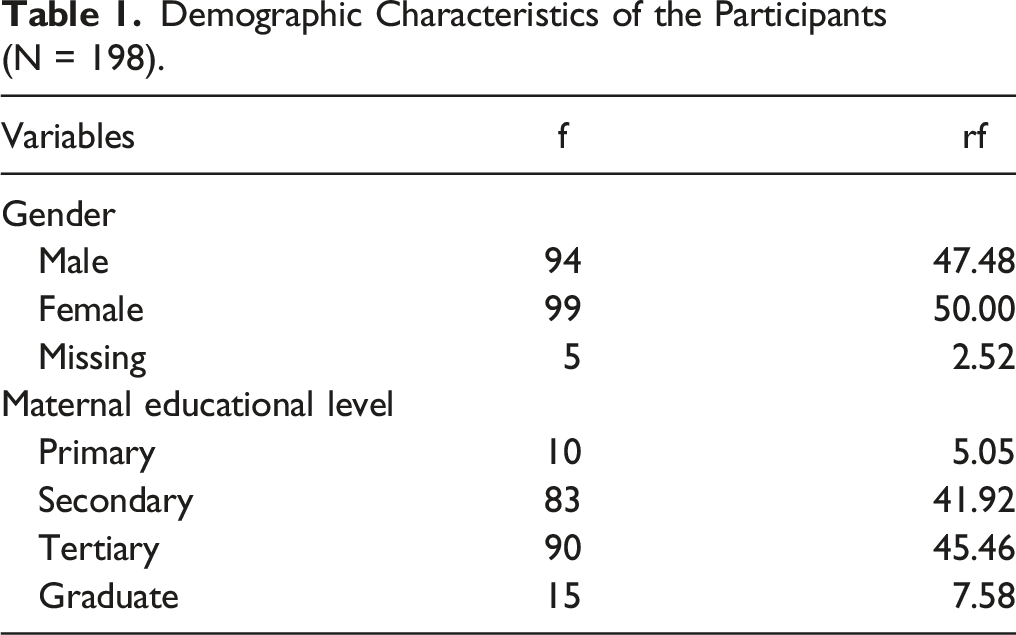
Demographic Characteristics of the Participants (N = 198).
Procedure
Participants filled in a paper-and-pencil version of the questionnaire, after signing an informed consent. To facilitate transcription in a resource-effective manner, student research assistants transcribed the answers in an Excel file, sent it to the first author, and also handed in the completed questionnaires.
Data Collection
Participants filled a demographic form (reporting their gender, age, maternal educational level, religion, language most often spoken at home, whether they are still studying or working and where they grew up). In line with previous research (Arnett, 2016; Hamilton & Hamilton, 2006), the maternal educational level was used as a proxy of the socio-economic status of the participants. Then, they were asked to nominate a person that they admire, write who that person is and the gender of that person, and describe a maximum of five qualities or attributes that they admired. The only restriction on the person to be admired was that this needed to be a real person, i.e., not a fictional figure. No restrictions were set on the person still being alive or not, or on the age of the person.
Coding and Analysis
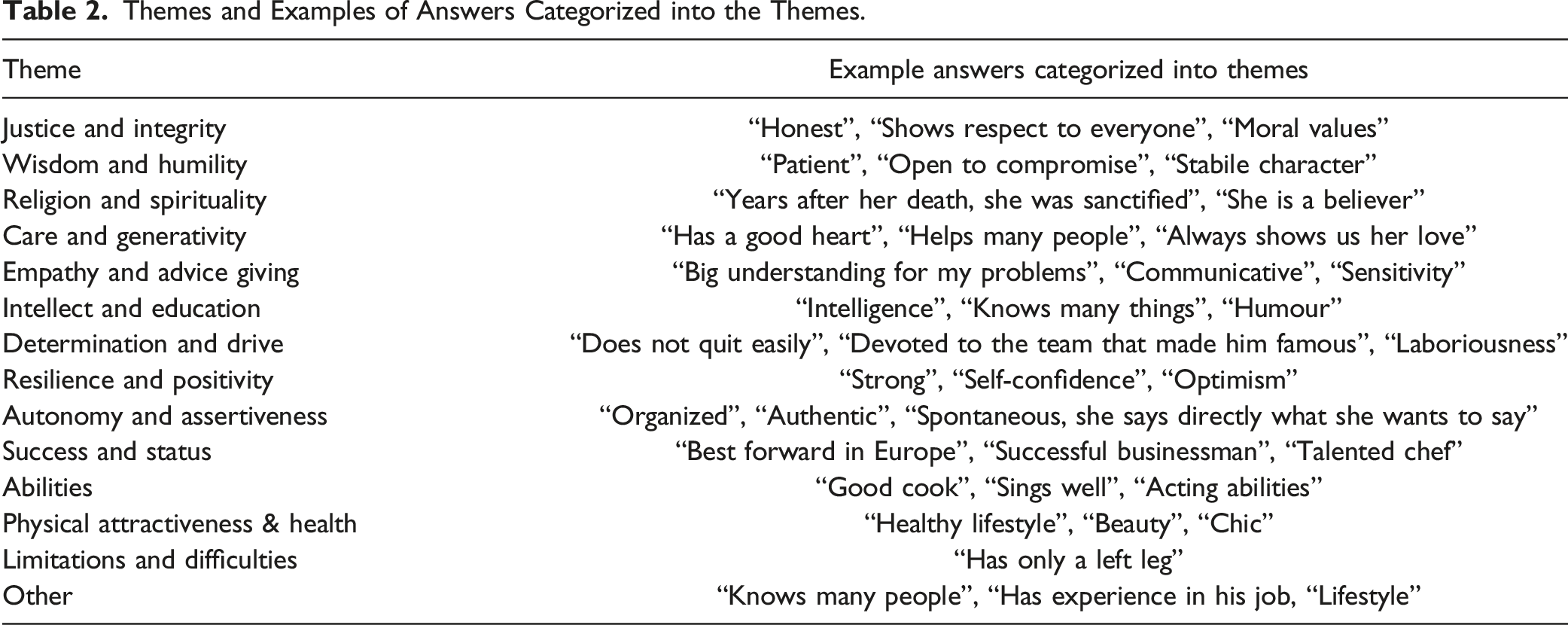
A deductive-inductive hybrid structured thematic analysis was used to code the five reasons for admiring the person (Robinson, 2021). The deductive aspect of this design was the application of a pre-existing framework for coding. Categories from Robinson et al.’s (2016) study of admiration figures were used for this initial deductive framework. These categories were: Justice and Integrity, Wisdom and Humility, Religion and Spirituality, Care and Generativity, Empathy and Advice giving, Intellect and Education, Determination and Drive, Resilience and Positivity, Autonomy and Assertiveness, Success and Status, Physical Attractiveness and Health, and Limitations and Difficulties. Responses were coded on the basis of these themes, however, the inductive element of the design was applied by way of actively keeping open the possibility of addition or refinement of the coding scheme. Indeed, the coding scheme was refined by including two more themes. First, Abilities was distinguished from Success. For instance, the cooking abilities of one’s mother needed to be distinguished from the cooking talent of a famous chef that underpinned their success. Second, the theme Other was added to account for criteria that were considered too vague or unclear to be allocated to a code (for instance, “crazy”, “way of life”, and “author”).
Themes and Examples of Answers Categorized into the Themes.
Statistical Analysis
To test our hypothesis about which would be the most common admired attribute themes, we calculated the prevalence per category. To answer the research questions regarding differences in prevalence by gender and socio-economic status, we conducted 2 × 2 Chi-square tests with theme/no theme as one categorical variable crossed with (a) gender (male /female), and (b) socioeconomic status via maternal education (school level / university level). To test the hypothesis that both male and female participants would nominate more individuals who they know than famous or historical figures, we categorized admired persons in two categories: persons personally known to the admirer (e.g., family, friends, peers) and famous/historical persons not personally known to the participants; and then conducted binomial tests run separately for men and for women. Finally, to test the hypothesis that same-gender admiration would be significantly more common than opposite-gender admiration, we run binomial tests separately for men and for women. Due to the number of significance tests conducted, we set the cut-off for significance at p < .01 to counteract the possibility for a Type I error. We conducted all statistical analyses using JASP (Version 0.14.1; JASP Team, 2020).
Results
Percentage Prevalence (%) of Themes for Total Sample and for Male and Female Participants, in Order of Prevalence.
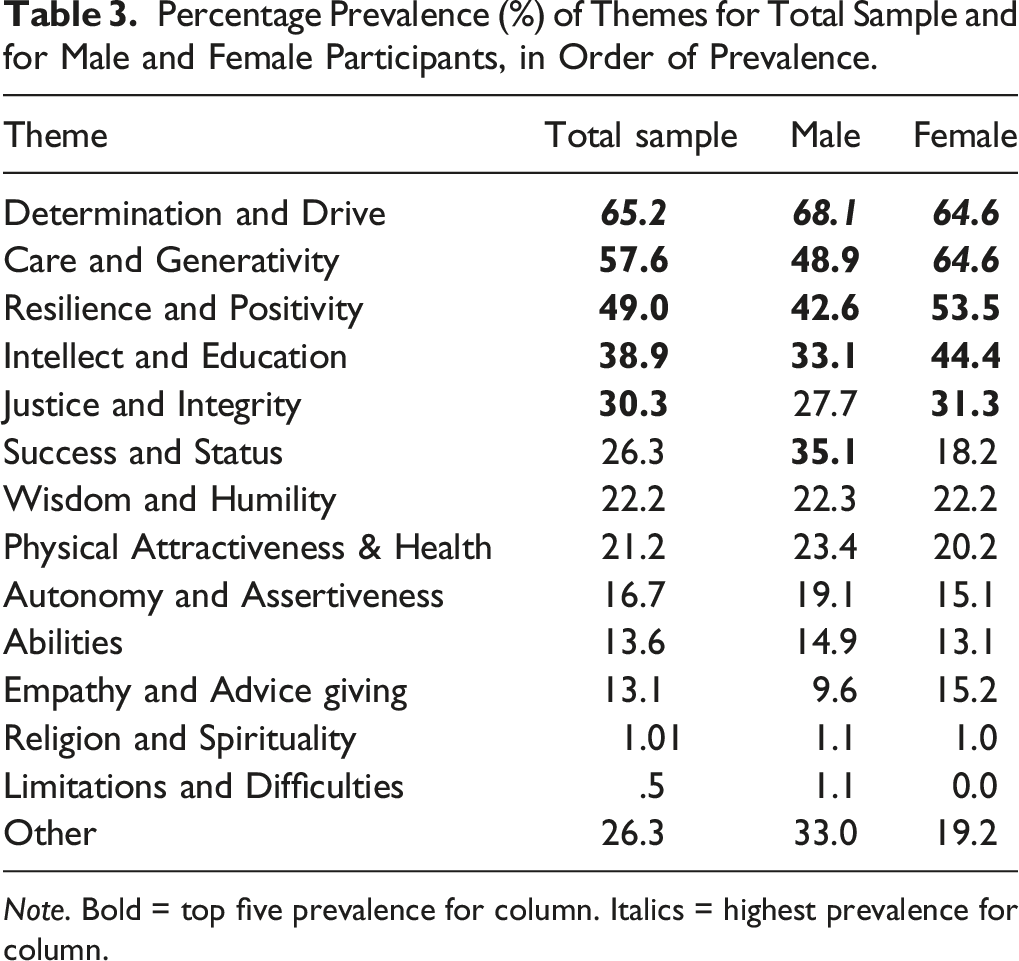
Note. Bold = top five prevalence for column. Italics = highest prevalence for column.
In order to test for differences in theme frequencies between genders and socio-economic status groups Chi-square tests were run. The Chi-square tests exhibited one statistically significant difference per independent variable. In terms of gender differences, it was predicted that Care and Generativity would be more frequently mentioned by female participants. Although there was a marked difference in the predicted direction, the difference was not significant. However, we found that Success and Status was more prevalent in men (35.1%) than in women (18.2%), χ2 (1,198) = 7.10, p = .008, φ = .19. We also found that Intellect and Education was more prevalent in individuals with mothers of university-level education (49.5%) than with mothers of school-level education (26.9%), χ 2 (1,198) = 10.64, p < .001, φ = .23.
In terms of the person types represented among the admired individuals, 77 of the admired persons (38.9%) came from the participant’s close family (e.g., mother, father, siblings, and stepfather), 37 (18.7%) came from the participants’ extended family (e.g., grandfather, grandmother, uncles and aunts), 22 (11.1%) came from the participants’ social circles outside the family (e.g., teachers, friends and partners), and 61 (30.8%) were famous personalities, representing, among others, authors (e.g., Nikos Kazantzakis), athletes (e.g., Christiano Ronaldo and Lefteris Petrounias), showbiz (e.g., Kim Kardashian and Nikos Moutsinas), music (e.g., Shakira and Sokratis Malamas), businessmen (e.g., Steven Jobs and Bill Gates), actors and actresses (e.g., Clint Estwood and Giorgos Mavridis), and arts (Frida Kahlo). Finally, one participant described a male volunteer of the Red Cross, without specifying a specific person.
To test the hypothesis that both male and female participants would nominate more individuals who they know than famous or historical figures, binomial tests run separately for men and for women revealed that there was no statistically significant difference in the proportions of men reporting admiring a directly known person (57.0%, p = .21, Cohen’s g = -.07) and admiring a famous person (43.0%, p = .21, Cohen’s g = .07), while the proportion of women reporting admiring a directly known person was significantly more (78.9%, p < .001, Cohen’s g = .29) and the proportion of women reporting admiring a not-known person was significantly less (21.2%, p < .001, Cohen’s g = −.29) than expected. Therefore, the hypothesis was supported partially, for females only.
To test the hypothesis that same-gender admiration would be significantly more common than opposite-gender admiration, binomial tests run separately for men and for women revealed that the proportion of men reporting a same-gender admiration was more (79.8%, p < .001, Cohen’s g = .30) and the proportion of men reporting an opposite-gender admiration was less (20.2%, p<.001, Cohen’s g = −.30) than expected. No such differences were found between women reporting same-gender admiration (57.6%, p = .159, Cohen’s g = .08) and women reporting an opposite-gender admiration (42.2%, p = .159, Cohen’s g = −.08). Therefore, the hypothesis was supported partially, for males only.
Discussion
The purpose of this study was to investigate the attributes and person types that Greek emerging adults admire, and to establish (a) the relative prevalence of these attributes, (b) the gender of the admired person relative to the admirer, and (c) differences in person types and attributes between genders and socio-economic status groups. We hypothesised that the following attribute themes would be the five most frequently mentioned: Determination and Drive, Care and Generativity, Resilience and Positivity, Intellect and Education and Autonomy and Assertiveness. We further hypothesised that Care and Generativity would be the most commonly mentioned, based on the Robinson et al. (2016) study. Results revealed that the most commonly stated admired attributes were, in order from highest to lowest: Determination and Drive, Care and Generativity, Resilience and Positivity, Intellect and Education, and Justice and Integrity. Therefore, four of the five were correctly predicted. There were two discrepancies with the prediction; firstly, Determination and Drive was the most common theme as opposed to Care and Generativity, and secondly, Justice and Integrity was included in the top five, rather than Autonomy and Assertiveness.
Care and Generativity was the most commonly cited theme across all of the four national samples in the Robinson et al. (2016) study but was not in the present study. The discrepancy may be easy to explain as a methodological artefact of the sampling in the Robinson et al. study being biased towards female participants. In three of the cultures in that study (Russia, Iran and the UK), the samples were 65% to 75% female. The current study was 50% female, so was not subject to overall theme prevalence being affected by one gender or another.
Table 3 shows that Care and Generativity was the most prevalent theme for female participants, equal with Drive and Determination. It may be that in samples that are majority female, this attribute is more likely to come out as the most prevalent. This would fit with related research looking at moral development, that shows an ethic of care to be stronger in female than male individuals (Skoe et al.,1996; Söchting et al., 1994). However, while in the other samples female participants had Care and Generativity as the most prevalent theme, in this sample Drive and Determination (a traditionally masculine value) was as prevalent in the female sample as Care and Generativity. This may reflect the balance of masculinity and femininity that Hofstede’s cross-cultural values research highlights in Greece (Hofstede, 2022).
Two more findings require interpreting. Why are Determination and Drive, first, and Justice and Integrity, second, such popular admired attributes in Greece relative to the cultures studied by Robinson et al. (2016)? The popularity of these admired attributes can be attributed to a general lack of trust to the State to solve problems witnessed by Greek citizens (Organisation for Economic Co-operation and Development, 2021). Together with Italy, Spain and Portugal (countries not represented in Robinson et al., 2016), Greece is characterized by a social welfare system in crisis, mass unemployment, financial insecurity and exclusion (Ferrera, 1996). In such a framework, where there is no one to help, it is not surprising that Greeks are brought up trusting only themselves and their families, and needing to have a strong drive to thrive. This idea is also apparent in phrases frequently stated in the Greek culture, such as “There is no ‘I can’t’, there is ‘I don’t want to’” or “The one that persists, wins”. In this same framework, Greek emerging adults may see justice and integrity as valuable means for navigating through an unfair and unreliable society.
We also hypothesised that differences in theme prevalence would be found across gender and socio-economic status. We predicted that Care and Generativity would be higher in women than men. A difference was found in the predicted direction, but it was not significant. Success and Status was more prevalent as an admired attribute in men than in women. This fits with existing research on sex differences in values; in a cross-cultural study from 70 countries, men consistently value power and achievement higher than women do (Schwartz & Lifschitz, 2006). It also fits with the work on cultural values by Hofstede et al. (2010). For them, a key value dimension upon which cultures can be compared is masculinity vs. femininity. This describes the extent to which the dominant values are competition, achievement and success (masculinity) or caring for others and quality of life (femininity).
A further significant socio-demographic difference emerged: Intellect and Education was more prevalent in individuals with mothers of higher education (higher socio-economic status). This difference may have to do with the intergenerational transmission of educational aspirations (Lazarides et al., 2016) and success (Dubow et al., 2009). It could also be explained by social learning theory, which has previously been conceptually linked to admiration, and posits that individuals learn and develop goals/aspirations based on imitating parents and other role models as children (Fessler & Haley, 2003).
These findings link to the theory of emerging adulthood and to the socio-developmental theoretical framework about admiration that framed the study. In terms of the theoretical approach to admiration, Greek emerging adults show considerable similarity to other cultures in what they admire in others. This supports the social evolution hypothesis of Algoe and Haidt (2009) that admiration has evolved as a social emotion in which prestige is conferred as a form of implicit social credit to older individuals, who then act as prototypes for emulation in other members of the society, thus creating common values and behaviours that bind the society together into a unit that can forge adaptive collective action. The findings also point towards cross-cultural differences and some findings that may relate specifically to Greek culture. Thus, admiration can be meaningfully construed as a function of both cultural social evolutionary processes that manifest as cross-cultural invariants and also culture-specific factors that relate to the importance attached to particular non-universal values and sources of prestige (Hofstede et al., 2010). Furthermore, we found appraisals emphasising both skill-based excellence and moral virtue, which also support the theory of Algoe and Haidt (2009).
Our results support the theoretical understanding of emerging adulthood. Despite the common media portrayal of young adults as narcissistic and lazy, the qualities that this sample of Greek emerging adults admire most are determination, drive, the capacity to care for others and to be generous. This more positive characterisation of the 18-25 age range fits well with Arnett’s conceptualisation of emerging adulthood. Arnett (2013) has actively argued against the notion of this being a narcissistic period of the lifespan, and our study accords with this view.
Limitations and Directions for Future Research
There were a number of limitations to how the study was conducted. We used written qualitative data that allowed participants to convey information about admired individuals in an open, unforced and un-leading way. As a result, the coding scheme for this was not identical to the Robinson et al. (2016) scheme. This suggests that there may be continued room for improvement in the coding system. An additional limitation was that we did not collect information about the participants’ educational status. Also, the responses and thematic analysis in Greek were translated into English for the purposes of the analytical input of the second author and then the report writing. The fact of imperfect linguistic correspondence remains a potential limitation. It is also a challenge to all cross-cultural research that involves word-based data collection, but this should not detract from the importance of cross-cultural work and the use of qualitative data in such studies.
The sampling approach and size used in the study also had limitations. Participants were recruited via a network of student research assistants, and while the eventual sample was varied across key socio-demographic groups, there is uncertainty over whether the findings are nationally representative. Future research on admiration in Greece or across cultures would benefit substantively from recruitment processes via specialist agencies that aim to recruit to nationally representative standards.
The cross-cultural endeavour to understand admiration is still in a nascent state. Further research is needed across more cultures. Future studies should investigate admired attributes, intensity of admiration, the age and gender of admired figures, and the relationship of the admired figure to the individual in question. More work is needed to study admiration in children, adolescents and adults of different ages. The pandemic may have changed the focus and nature of admiration too, so new research following the pandemic is crucial. Admiration of fictional characters is also a relatively unresearched domain, for example cinematic admiration (Niemec, 2012). In terms of linking admiration to theory and research on emerging adulthood, future work on the relationship between dimensions of emerging adulthood, personal values, admired attributes and identity status or aspects of identity in samples of emerging adults is an important next step in linking the socio-cognitive mechanisms of admiration to other socio-cognitive processes that are known to be central to the stage of emerging adulthood. Furthermore, our data suggest that parental variables (i.e., maternal education level) can shape admiration, so exploring links between parenting and admiration would elicit important information on how admiration emerges developmentally.
Footnotes
Acknowledgements
The authors would like to thank two anonymous reviewers for their constructive comments on previous versions of this paper.
Declaration of Conflicting Interests
The author(s) declared no potential conflicts of interest with respect to the research, authorship, and/or publication of this article.
Funding
The author(s) received no financial support for the research, authorship, and/or publication of this article.
Open practices
The raw and quantitative data and the quantitative outputs used in this study are available on an open-source data repository: The design and analysis plans were not preregistered (Vleioras & Robinson, 2022).