






Abstract
Understanding the morbidity events, incidence, and cost associated with each type of retention system used for implant supported prosthesis will help the clinician in better decision making. This study assessed the clinical and cost-effectiveness of the screw- and cement-retained implant-supported single crown and fixed partial denture for the replacement of teeth in partially edentulous jaws, from a health services perspective. A systematic literature search conducted in 10 databases, complemented by 4 journal databases and International Association for Dental Research abstracts, identified 92 studies on the single crown and 40 studies on the fixed partial denture. Minor and major technical complication events, as well as failure events, were extracted from strong- and medium-quality studies. Studies based on similar designs were pooled with a random-effects Poisson regression model. A decision tree was developed to estimate the cost-effectiveness over a 15-y period posttreatment. The initial and maintenance costs to treat technical complication events were based on an American Dental Association survey of 2011 to 2012. Probabilistic sensitivity analysis was used to examine the uncertainty in the data input parameters. Clinical evidence generated from the meta-analysis suggested no statistical difference between the 2 retention systems. The cost-effectiveness is presented as an incremental cost-effectiveness ratio. The evidence from this report suggests that cement retention is the more cost-effective strategy as compared with screw retention prosthesis.
Keywords
Background
Partially edentulous patients are considered a major group of individuals treated with implant-supported (IS) restorations (Jokstad et al. 2009). According to the American College of Prosthodontists (2016) and the American Academy of Implant Dentistry (2016), about 178 million people in United States are partially edentulous. This number is expected to increase to around 200 million in the next 15 y. The Canadian Health Measure Survey (2007–2009; Health Canada 2010) reported that 21.4% of the population aged 15 to 74 y use a partial prosthesis and 71.5% of individuals aged 65 to 74 y are missing ≥1 natural teeth. The consequence of partial edentulism is associated with loss of function, speech, loss of self-esteem, and deterioration in the quality of life (Carr and Brown 2011). Thus, treating these patients is considered a necessity to improve their form and function.
Removable partial denture, conventional tooth-supported fixed partial denture (FPD), and IS prosthesis (IS-P) are the 3 major therapeutic options available for those who miss some but not all of their natural teeth (Carr and Brown 2011). Among the possible therapeutic options, removable partial dentures have the lowest patient acceptance rate. Despite the variable definition of success in dental literature, the reported success rate was 40% at 5 y and 20% at 10 y (Wetherell and Smales 1980; Wilding and Reddy 1987; Vermeulen et al. 1996). FPD has been the treatment of choice for missing teeth in partially edentulous jaws for >6 decades, with an estimated life span of 9.6 to 10.3 y (Creugers et al. 1994; Libby et al. 1997). However, salient conclusions from anecdotal studies suggested that 15% of abutment teeth supporting FPD required endodontic therapy and >20% of abutment were at risk for caries lesions (Walton et al. 1986; Shugars et al. 1998). Additionally, economic comparisons between dental implants and FPDs in a single missing tooth situation concluded that implant restorations would be cost-effective in the long term (Priest and Priest 2004). Based on the facts and the virtue of restoring missing teeth without damaging adjacent teeth or supporting structures, IS-P may be the ideal choice for patients presented with some but not all of their natural teeth.
Among the various parameters that contribute to the success of implant restorations, the method used to retain the prosthesis (retention system) determines the nature and complexity of maintenance events that it undergoes over its life span (Chee and Jivraj 2006). The probability of mechanical and biological complications depends on the type of retention (Chaar et al. 2011). Two types of retention systems (screw retained and cement retained) are extensively used to retain IS fixed restorations.
The systematic reviews and meta-analyses for past 30 y showed similar success and failure rates when cement- or screw-retained prostheses were examined. These studies report the prevalence of higher maintenance (complication events) for IS-P. With the increasing life expectancy, it is assumed that patients will be in need of IS-P to function for decades. Therefore, the evaluation and comparison of costs associated with maintenance events of the screw- and cement-retained IS-P will help patients and clinicians reach an informed decision. However, until now, no such report has addressed the retention system.
Thus, the objective of this report was to compare the cost-effectiveness of the screw- and cement-retained IS-P in treating partial edentulism, based on the best available evidence.
Methods
A health technology assessment (HTA) methodology was applied, and the following scientific questions were posed in this report:
Clinical question: What is the clinical evidence regarding the effectiveness of screw- and cement-retained IS single crown and IS-FPD?
Economic question: What is the cost-effective retention system for IS single crown and IS-FPD in partial edentulism from a health services perspective?
Clinical/ethical question: What are the ethical and legal implications to be considered?
Clinical Effectiveness
A detailed review protocol has been registered with PROSPERO (CRD42015024649). Published literature was identified by searching 10 databases (Ovid interface: MEDLINE, EMBASE, PubMed, INHATA, CRD, CADTH, CENTRAL, Cochrane Registry, clinicaltrials.gov, Google Scholar), complemented by the following additional search: IADR Abstracts and journal databases (Wiley, Elsevier, Quintessence, Sage Pub). The search was not restricted to the year of publication, and the search date was until January 10, 2015. Weekly alerts were established to update the search until October 7, 2015. Both National Library of Medicine MeSH and keywords were used in the search and customized according to the corresponding databases. The Appendix shows the search terms used. A comprehensive systematic review and meta-analysis section of this report are currently under review for publication.
In brief, language restriction was not applied at the initial stage. Study observation periods <1 y were excluded. Systematic reviews, meta-analyses, and consensus statements were excluded after full-text review. In the case of multiple reports of the same cohort at different periods, the report with the longer observation time was included.
Two reviewers independently carried out the review process to identify the potentially relevant studies to be included in this report based on the priori established inclusion and exclusion criteria. Selected full-text articles were retrieved and assessed independently for possible inclusion. Disagreements between the reviewers were discussed until consensus was reached. Kappa interauthor agreement was carried out at the title and abstract evaluation, full-text selection, and quality assessment of the selected full articles. The authors selected the Effective Public Health Practice Project Quality Assessment Tool to appraise the selected studies critically (Armijo-Olivo et al. 2012). The tool rates the quality of article as strong, moderate, or weak based on 6 domains: selection bias, study design, confounders, blinding, data collection, withdrawals, and dropout. Those studies scored weakly were excluded from final analysis.
Information on failure of implants after loading, abutment screw loosening, prosthesis screw loosening, crown loosening, recementation, abutment screw fracture, abutment fracture, prosthesis screw fracture, minor porcelain chip, major porcelain/ceramic veneer fracture, loss of retention, implant fracture, minor biological events, and major biological events were abstracted from the publications directly (Appendix Table 1). From this information, the failure event rate, survival rate based on complication events, and event-free rate (1 – failure events + complication events) were calculated by dividing the total number of events by the total prosthesis exposure time. The total prosthesis exposure time is the sum of 1) the exposure time of the prosthesis that was followed for the whole observation period; 2) the exposure time of the prosthesis until the implant failed; and 3) the exposure time of the prosthesis until its dropout from the observation, for those patients who did not complete the observation period due to change of address, death, or missed appointments. If the information was not available for all these 3 parameters, the total exposure time was derived by multiplying the total number prostheses and the mean observation period. Based on the hypothesis, when the event rate λ is constant over time, the proportion of the population that is event free decreases exponentially over time: s(t) = e – λt, where λ is the event rate and t is the time of observation (Sterne and Kirkwood 2010). Based on this 15-y cumulative survival proportion, the failure proportion and event-free proportion were calculated for the each study with 95% confidence intervals (95% CIs).
Anticipating reasonable heterogeneity among the selected studies, a random-effects model was used to obtain the summary estimate of the proportions. All P values are 2-sided. All statistical and meta-analysis calculations were carried out with commercially available software: Comprehensive Meta-analysis (Biostat, Englewood, NJ, USA) and Stata 13.1 (Stata Corp LP, College Station, TX, USA).
Economic Analysis
Type of Economic Evaluation
The assessment was a cost-effective analysis, with the incremental cost-effectiveness as the primary outcome measure. TreeAge Pro (TreeAge Software, Inc., Williamstown, MA, USA) was used to do economic analysis.
Standard Treatment Strategy
No universal standard care strategy or clinical procedure guideline was available for the type of retention system to be used with IS-P. However, the Group 2 consensus of 2014 (Wismeijer et al. 2014) suggested cement retention for short-span prosthesis and to enhance aesthetics, while screw retention was recommended for minimal interarch space and where retrievability is warranted. Our literature search and data collection were for normal oral health situations without any compromise in interarch space; thus, we considered cement retention as the standard care strategy for our economic evaluation.
Model Structure
A Markov model was used to simulate the lifetime of an IS-P in partially edentulous patients. A decision tree over a 15-y period was developed to estimate the event-free rate. This rate is defined when reconstructions and implants are in function and free from any symptoms and complication events (minor and major technical survival events). Markov models depict the probabilities and time duration for cycles in which individuals remain event free or move on to a different state (failure or minor/major technical service). The model estimates the cost and compares the cost-effectiveness of screw and cement retention system (Fig. 1). The model incorporated both minor and major technical events. Half-year correction was employed to account for unknown translation that occurred between the states within the cycle.

Markov decision tree analysis: (
Data Inputs
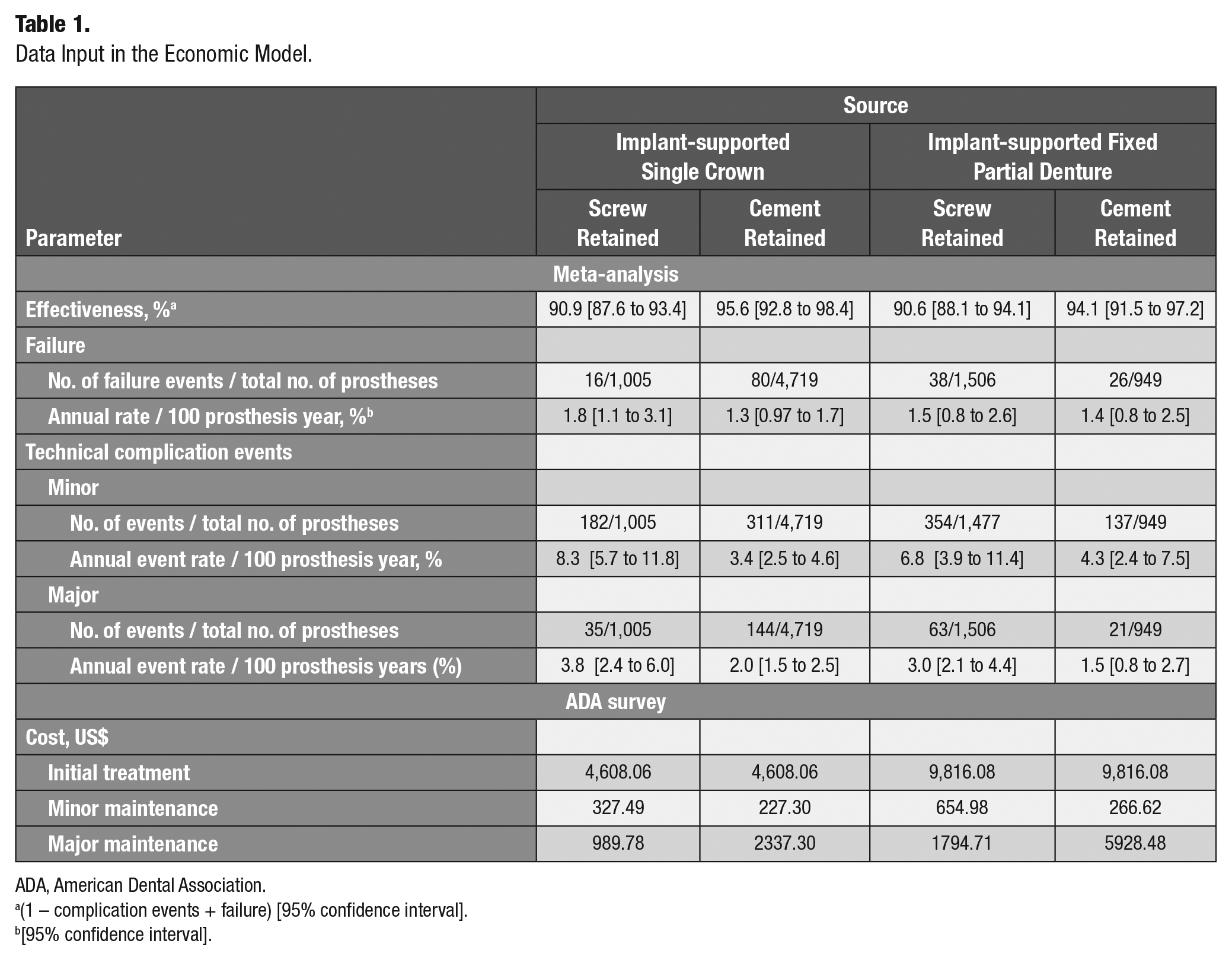
All outcome data were based on the results of our meta-analysis. The 2011–2012 American Dental Association survey (“2011 Survey of Dental Fees, Dental Practice”) was used to calculate the clinical cost (Appendix Table 2). A Markov decision tree analysis model was constructed with the data shown in Table 1. At the starting point, our strategy model was event free. The cost-effective ratio was calculated to determine the rank of each treatment modality.
Data Input in the Economic Model.
ADA, American Dental Association.
(1 – complication events + failure) [95% confidence interval].
[95% confidence interval].
Costs
The costs incorporated within the model included the initial costs of placing implants, abutments, and crowns and the direct costs associated with minor, major, adjustments, and remakes. This analysis was conducted from the perspective of North America.
Assumptions
The following assumptions were made in this economic evaluation:
Initial costs for screw- and cement-retained are the same, assuming that the implant does not need any adjuvants or grafts.
All costs were obtained from the American Dental Association 2011–2012 survey, and the charges of a general dentist were used. U.S. dollars were adjusted to October 15, 2015 (5.8% inflation rate).
Only the direct cost involved in replacement is considered. The overhead cost, loss of time by operators, and patients’ other indirect costs are not considered, because of a lack of information in the public domain and the heterogeneity in methods, materials, and average per-hour earnings.
FPD is considered 3 units supported with 2 free-standing implants.
If the implant fails after loading, we assume that the patient is not going for a new implant.
Minor complication events are prosthetic screw tightening, abutment screw tightening, occlusal material replacement, porcelain chip adjustment for screw-retained prosthesis, and recementation and adjustment for cement-retained prosthesis.
Major complication event means screw maintenance (screw replacement and abutment replacement), cement, sectioning of the old prosthesis, abutment replacement, and crown remake. Assuming cement-retained prosthesis has a limited retrievability option; thus, major complication event maintenance includes crown replacement, and with a better retrievable feature, the screw-retained prosthesis has more abutment replacements rather than crown remakes.
Discounting
Based on the standard recommendation and guidelines (Edejer et al. 2003; Drummond et al. 2015), costs and clinical effectiveness were discounted at a 3% rate in base case analysis.
Analysis
The total initial cost was calculated at $4,608.06 for the IS single crown and at $9,816.08 for the 3-unit IS-FPD, including the laboratory cost. The cost that accounts for maintenance (minor adjustment or major replacement) is tabulated in Table 1.
The annual minor and major technical event rates per 100 prosthesis years were used to calculate the total costs of each restoration (Fig. 2). The 15-y time horizon was chosen because most dental restorative material has a life span of 10 to 15 y.

Annual event rates per 100 prosthesis years for screw- and cement-retained implant-supported single crowns and fixed partial dentures from the pooled meta-analysis data.
Economic analysis in health care is mostly a cost-effective or cost utility analysis in which results are presented as an incremental cost-effectiveness ratio. Cost-effectiveness was calculated with a Monte Carlo simulation of 30,000 samples and 10,000 trials. The lower cost-effectiveness ratio indicates the effective strategy. To validate the Markov decision analysis model, Markov cohort analysis was done to capture each status probability over 5, 10, and 15 y based on 10,000 sample cohorts, and it compared the probability with the meta-analysis data.
Sensitivity
To examine and capture the variability in the cost parameters and clinical effectiveness, 1-way sensitivity analysis and a probabilistic model were implemented. The initial cost of cement- and screw-retained prosthesis, the maintenance cost of cement- and screw-retained prosthesis, and the event-free rate of cement- and screw-retained prosthesis were the various variables used in 1-way sensitivity analysis and probability distribution. Extensive Monte Carlo simulation with 50,000 repetitions was performed to compute the cost-effective acceptance curve, which plots the probabilities with the preferable retention strategies alongside the cost-effective threshold levels. This simulation randomly selects a value from the range of possibilities and distributions defined. Normal, beta, and triangular distributions was used. Additionally, Tornado analysis was planned to capture the variability in the cost and effectiveness parameters. A discount rate of 6% for costs and 0% for clinical effectiveness were applied in sensitivity analysis based on the World Health Organization guidelines (Edejer et al. 2003).
Results
Clinical Effectiveness
Various data sources were used to identify potential citations. Among the 896 citations from the 3,875 titles that were identified by the search, 92 articles addressed the single crown, and 40 articles were on FPD (Appendix Fig.). For the assessment of the effectiveness of the retention system, event-free outcome was used. Events include minor and major survival ones. Based on 5,716 single crowns observed over 27,107.31 y, the 15-y event-free rates were estimated as 57.9% (95% CI: 43.7% to 72.2%) for cement-retained single crowns and 48.8% (95% CI: 37.3% to 60.4%) for screw-retained single crowns. From 2,267 implant/IS FPDs observed over 12,235.46 y, the estimated 15-y event-free rates for screw-retained FPDs was calculated at 55.4% (95% CI: 38.7% to 71%) and for cement retained, 65.2% (95% CI: 47.6% to 79.5%). The type of retention system influenced the incidence of complication events. Within the technical events, screw-retained FPDs exhibited more technical events (minor: 264 of 1,477 FPDs; major: 84 of 1,477 FPDs) as compared with cement-retained restorations. Among the technical events, screw loosening (142 of 145 events) and recementation (59 of 72) were the most common events in single crowns. Screw fracture and abutment fracture were the major complication events for screw-retained FPDs, and remade crown and abutment change were most common with cement-retained FPDs. A summary of the clinical evidence generated from the meta-analysis is shown in the Figure 2.
Economic Aspects
The base case cost-effective analysis of screw- or cement-retained protheses is shown in Table 2. In the base case analysis with a discount rate of 3%, the screw-retained single crown required an additional cost of $450.88 per event-free implant and prosthesis year gained, as compared with the cement-retained single crown. Without discounting, the incremental cost-effectiveness ratio was $1,604.95 per event-free year gained but $361.54 per event-free year gained if a 6% discount rate was applied (Table 2). With a discount rate of 0%, the screw-retained IS-FPD required an additional $15,028.76 per event-free year gained versus the cement-retained IS-FPD. While a discount rate of 3% accounts for $5,317.18 per event-free year gained, a 6% discount rate costs $3,766.10 per event-free year gained by screw-retained IS-FPD against cement-retained IS-FPD (Table 2). Figure 3a shows the cost-effectiveness graph. Both treatment strategies were undominated. Figure 3a shows cost-effective acceptance curves representing a 15-y horizon for single crowns and FPDs and the base case scenario. All cost-effective acceptance curves follow a similar pattern. This is based on the assumption that for low-threshold levels of cost-effectiveness, screw retention has a higher probability of preference. With an increasing threshold level, the likelihood of preferring screw retention decreases, and the probability of choosing cement retention increases. The cost-effectiveness threshold at which cement retention is preferred over screw retention was found to be <$5,000.
Cost-effective Analysis of Screw- and Cement-supported Prosthesis: 0%, 3%, and 6% Discount Rates—Undominated Strategies.
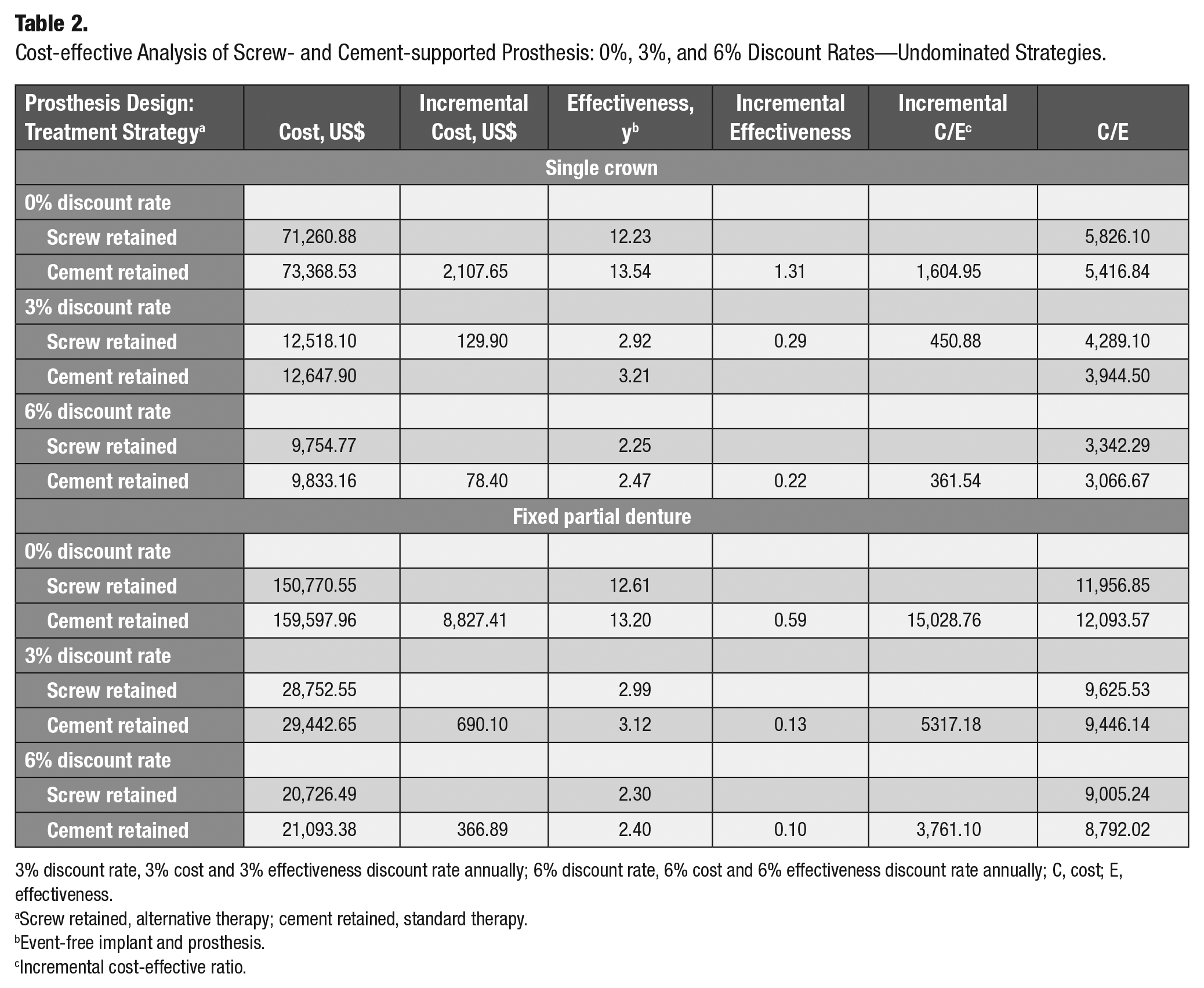
3% discount rate, 3% cost and 3% effectiveness discount rate annually; 6% discount rate, 6% cost and 6% effectiveness discount rate annually; C, cost; E, effectiveness.
Screw retained, alternative therapy; cement retained, standard therapy.
Event-free implant and prosthesis.
Incremental cost-effective ratio.

(
Ethical, Legal, and Safety Considerations
We did not identify any literature pertaining to ethical, social, sociopolitical, and legal issues related to screw or cement retention systems used for IS reconstructions. Thus, we are unable to report any such risks associated with the use of different retention systems. Nonetheless, from included studies, we can confirm that screw- and cement-retained single crowns and FPDs are globally in use. As for the safety concerns, we identified only 1 study that alluded to safety concerns with cement-retained single crowns, when a patient swallowed the IS cemented single crown, with no further actions required (Schwarz et al. 2012).
Discussion
In the past 30 y, IS-P is used as the most common modality to manage partial edentulism. To our knowledge, this is the first HTA report that evaluates retention systems used for IS-P. The clinical effectiveness is leaning on a robust literature search and meta-analysis based on 104 articles. Randomized trials, prospective controlled trials, and prospective and retrospective cohorts with clinical follow-up were all included to increase the vigor of the external validity and limit the sampling variation and extrapolation. This study fulfills the International Network of Agencies for Health Technology Assessment’s checklist for HTA reports. The question to address in this report is “Which is the most cost-effective retention system for IS-P in partially edentulous patients?” The report was prepared from a perspective of health service payers and providers. Thus, the findings of this HTA report are highly relevant not only to dentists but also to health insurers and patients.
Methodological Strength
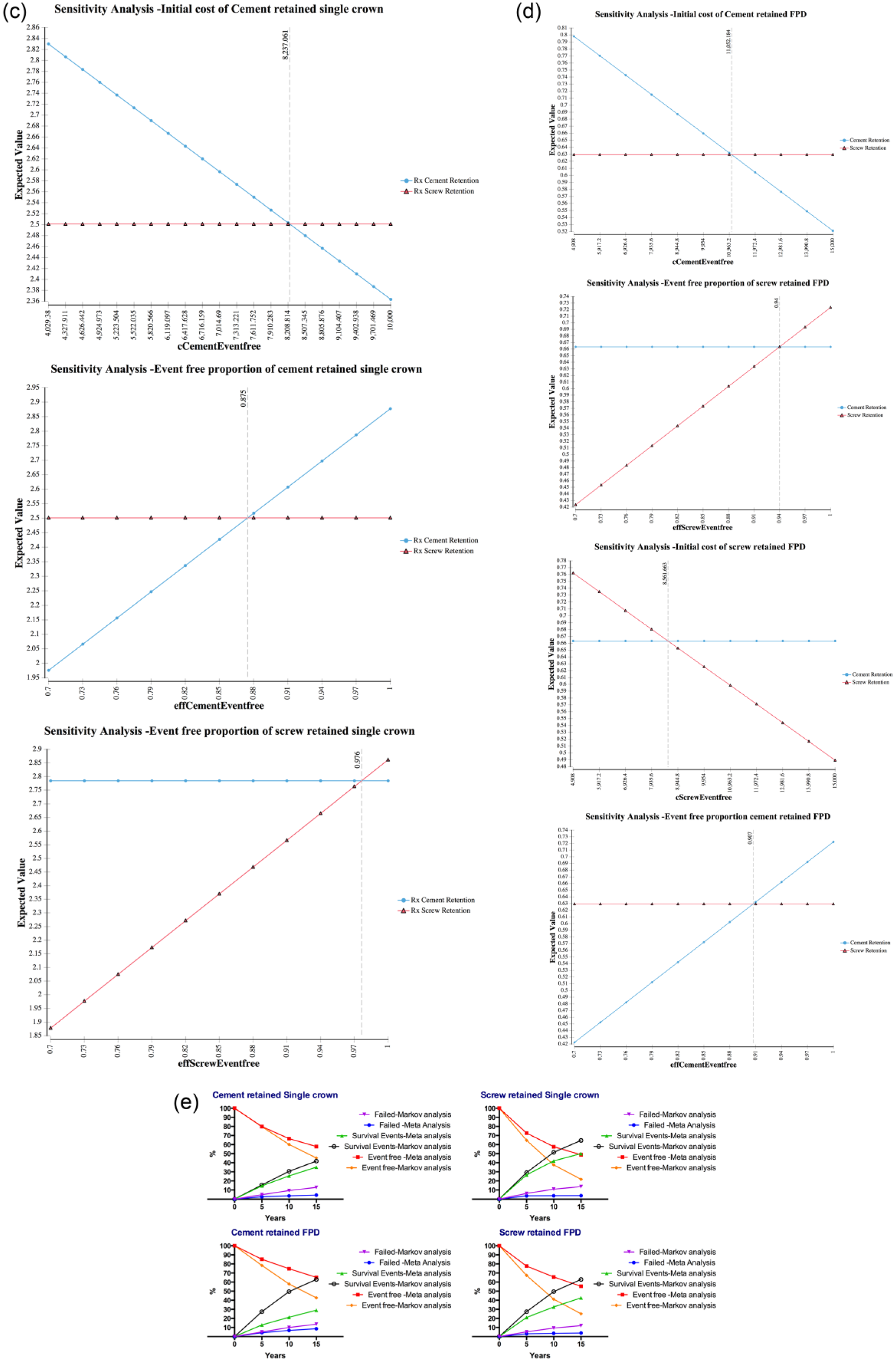
When pooled data were analyzed from several clinical studies, the estimated event rate per 100 reconstructions per year is a useful parameter for statistical comparison of the risk for complication or failure. In the absence of appropriate RCTs, the use of decision modeling is the most appropriate method of analysis (National Institute for Health and Care Excellence 2013). The popular models used in the economic evaluation of health care are the decision tree and the Markov model. Markov models are most useful when health events repeat over time and enable us to incorporate the passage of time (Brennan et al. 2006). In the current study, a decision tree was used to determine the possible prognosis by a series of pathways following treatment with a screw- or cement-retained single crown or FPD. Among the 5 types of model, simulation models represent real-life variability with the use of a random number generator and various distributions (Bouchard et al. 2009). One can perform economic analysis via a cost-effective analysis, a cost-benefit analysis, and a cost utility analysis. However, among these, the cost-effective analysis attempts to robustly identify when more health can be achieved by the same cost or when the same health can be achieved by a lower cost. Equally of importance, the incremental cost-effectiveness is the most practiced method in the economic evaluation of dental care (Gaunt et al. 2008; Pennington et al. 2011; Hens et al. 2012; Schwendicke et al. 2013; Listl et al. 2014). Uncertainty occurs when there is too much variability in available clinical evidence or when the actual value of the parameter is not known. In the present report, this was managed by using probabilistic sensitivity analysis. This has allowed us to screen all possible variable parameter values, and this approach is considered the most robust sensitivity analysis (Bouchard et al. 2009). Figure 3b and c illustrates how the expected value changes across the range of values. For IS single crown, the change of strategy is that screw retention will become an effective strategy if the event-free proportion of screw retention is >97.6%, the initial cost of cement retention is >$8,237.06, and the event-free proportion of cement retention is <87.5%. If the initial cost of IS screw-retained FPD is <$8,561.66, the initial cost of cement retention is >$11,052.18, the event-free proportion of screw retention is >94%, and the event-free proportion of cement retention is <90.7%, then screw retention will be the effective strategy. Figure 3d compares the 5-, 10-, and 15-y event-free, failure, and survival proportions obtained from meta-analysis and Markov cohort analysis. The Markov model shows slight underprediction of the event-free rate and overprediction of the survival rate as compared with the meta-analysis for screw and cement retention as well as single crown and FPD. However, the values are within the confidence intervals of the meta-analysis data.
Validity of Included Studies from a North American Perspective
Despite the limited information available about the type of implant abutment interface from the included studies, to our knowledge all brands of implant and retention systems used in the selected studies were readily available in the North American market. Furthermore, the systematic reviews by Chaar et al. (2011) and Gracis et al. (2012) and the recent randomized clinical trial by Esposito et al. (2015) concluded that incidence of complication events is not influenced by the type of interface.
Summary of the Clinical Evidence
Effectiveness data were gathered from the meta-analysis of randomized controlled clinical trials, prospective controlled trials, and prospective and retrospective cohort studies. When based on the failure rate, our findings suggest that cement-retained single crowns performed well versus screw-retained prostheses. The results of our review are in agreement with the previous systematic reviews (Weber and Sukotjo 2007; Aglieta et al. 2009; Pjetursson et al. 2012; Sailer et al. 2012; Wittenben et al. 2014) in that there was no statistical difference in failure rate of 2 retention systems. However, since our report is the first to consider event free as a success criterion, we do not find it appropriate to compare our effectiveness rate with the existing literature. In addition, although we employed the random-effects model to combine the results among various study designs, the results should be cautiously interpreted based on the considerable heterogeneity observed among the pooled results.
HTA in Context of Decision Making
Any spending choices or decisions that are made about health care incur an opportunity cost. HTA reports provide robust information to inform evidence-based choice and ensure that the benefit of an implemented program exceeds the opportunity cost (Esfandiari and Feine 2011). With both retention options providing low failure rates, the lower maintenance cost and mainly the lower incidence of minor technical events were responsible for the dominance of cement retention over screw retention. Since there is no universal standard for a cost-effectiveness ratio, the lower cost-effectiveness ratio indicates the more cost-effective strategy.
Limitations
This HTA report has some limitations. The economic analysis in this report did not consider all aspects of IS-P, such as minor and major biological events that require maintenance, patient satisfaction, and other prosthetic parameters (e.g., prosthesis material, abutment material, abutment type, implant-abutment condition, and the nature of opposing and adjacent dentition). We were not able to include these variables because of the paucity of data available from the literature. The major limitation of this HTA is the exclusion of biological complication events in the economic analysis; hence, the result of this report should be interpreted with caution.
Moreover, our cost-effectiveness analysis uses limited data to predict long-term outcome, thereby missing late complication or failure. The level of evidence that we had found for effectiveness is not high, because the only available randomized trial that compared screw versus cement IS-P reported no complication events. Although the model design appears robust from a methodological perspective, the credibility of the evidence depends on the credibility of assumptions and the data quality. Patient preference or quality of life was not considered in this assessment, which may limit the number of assumptions when qualitative data are modeled.
Implications for Future Research
This HTA report suggests that in consideration of the cement- versus screw-retained prosthesis for implant-supported crowns, the cement retention is the more effective treatment modality. Based on this research, the following recommendations are suggested:
Improve the reporting of IS-P findings in the literature with comprehensive information on retention systems, prosthesis design, abutment design, material, and cost and time associated with each morbidity event.
Design prospective comparison trials to evaluate the different retention systems while considering the economic evaluation as one of the outcomes along with patient satisfaction.
Conclusion
Within the limitations of this report, the clinical evidence suggests that cement retention shows a lower failure rate than screw retention in IS single crowns. The economic evaluation in this report showed that within a 15-y horizon, cement retention shows a better survival rate and cost-effective strategy than the screw-retained IS-P. Further prospective clinical trials are suggested to confirm this evidence.
Author Contributions
M. Ramamoorthi, contributed to conception, design, data acquisition, and analysis, drafted the manuscript; S. Esfandiari, contributed to conception, design, and data interpretation, critically revised the manuscript. Both authors gave final approval and agree to be accountable for all aspects of the work.
Footnotes

References
Supplementary Material
Please find the following supplemental material available below.
For Open Access articles published under a Creative Commons License, all supplemental material carries the same license as the article it is associated with.
For non-Open Access articles published, all supplemental material carries a non-exclusive license, and permission requests for re-use of supplemental material or any part of supplemental material shall be sent directly to the copyright owner as specified in the copyright notice associated with the article.
