






Abstract
With the growing strategic importance of rare earth elements (REEs) and the urgent demand for red mud resource utilisation, efficient REE extraction from red mud has become a prominent research hotspot. This review systematically clarifies the occurrence modes, content distributions and chemical properties of typical REEs (e.g. La, Y and Sc) in red mud, and comprehensively summarises research advances in mainstream and emerging recovery technologies, including chemical leaching, bioleaching, pyrometallurgy, ion exchange and combined processes. A multidimensional evaluation framework covering recovery efficiency, optimal reaction conditions and environmental impact is established. Core performance indicators of mainstream processes are quantified, enabling systematic technical and environmental comparisons. Targeted process applicability for Bayer, sintering and combined red mud is clarified. Key technical bottlenecks are identified: difficult dealkalisation, radioactive impurity separation challenges and poor economic viability, alongside limitations of current dealkalisation processes, low leaching selectivity and scaling-up challenges. Finally, future research directions and actionable industrialisation strategies are proposed, aiming to provide systematic theoretical support and practical guidance for REE extraction from red mud.
Keywords
Introduction
Red mud is an industrial solid waste generated from bauxite via alkaline leaching for alumina extraction. Rich in iron oxides, it usually presents a reddish colour, and its stockpiling issues have constrained the sustainable development of the alumina industry. Globally, ∼0.8–1.5 tons of newly generated red mud are produced per ton of alumina manufactured, with the annual new output exceeding 150 million tons.1–3 As the world's largest alumina producer, China produces ∼100 million tons of red mud annually; prior to 2020, the comprehensive utilisation rate remained consistently between 6% and 7%. In 2023, following breakthroughs in large-scale utilisation technologies, annual utilisation exceeded 10 million tons, and the utilisation rate rose to around 10%. 4 Large-scale tailings stockpiling not only occupies land and induces geological hazards, but the heavy metals and highly alkaline substances contained therein can also contaminate soil and groundwater through rainwater infiltration. 5 For instance, following the 2010 Ajka dam breach, nearly 1 × 10⁶ m3 of tailings with a pH of 13 contaminated agricultural fields, causing elevated pH levels in soil and water and exceeding the permissible limits for total Na+ and heavy metals.6,7 Currently, REEs are primarily obtained through the mining of rare earth ores; however, REE resources are non-renewable with limited global reserves. According to data released by the U.S. Geological Survey (USGS) in January 2025, in terms of global reserves, the total reserves of rare earth resources worldwide in 2024 were ∼90 million tons, with China accounting for 48.0%, as shown in Figure 1. 8 Long-term intensive mining of rare earth ores has led to the depletion of primary resources. Against this background, extracting rare earth elements (REEs) from red mud has become a critical pathway to alleviate reliance on primary ores and ensure a stable supply of rare earth materials. REEs encompass 17 elements, including the lanthanide series and chemically similar scandium (Sc) and yttrium (Y). Dubbed the ‘industrial vitamins’. 9 REEs are indispensable in new energy, high-end manufacturing and defence technologies due to their exceptional magnetic, optical and electrical properties. Recovering REEs from red mud not only generates economic benefits but also facilitates red mud resource utilisation and mitigates environmental pollution, thus embodying both environmental and strategic value.
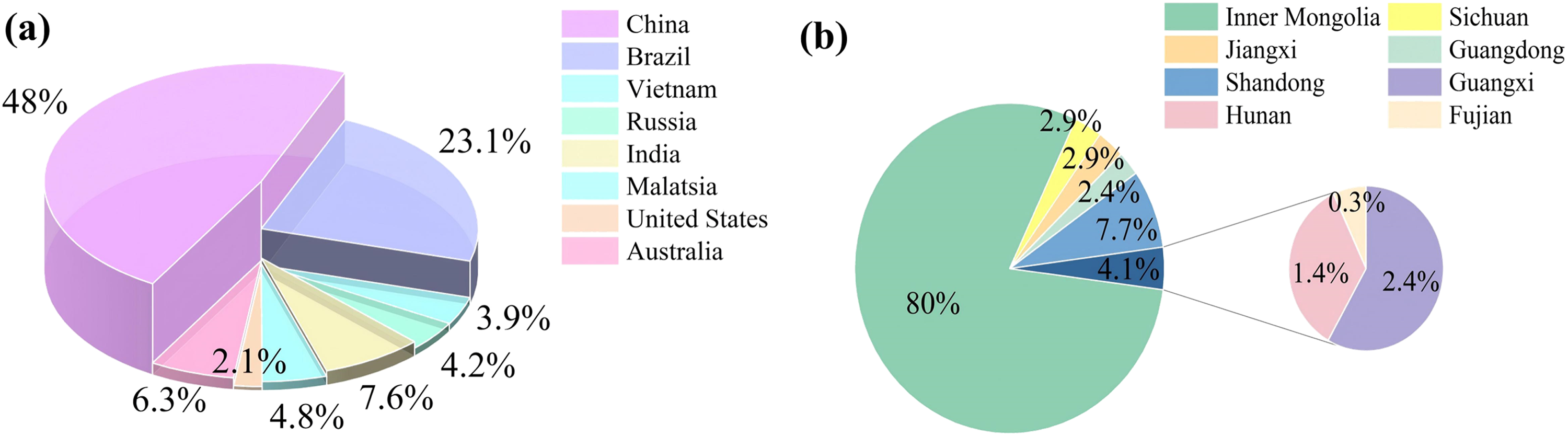
Distribution of global and Chinese rare earth reserves: (a) rare earth reserves in major countries worldwide; and (b) rare earth reserves in major administrative provinces of China. 8
Currently, red mud is utilised in the production of Portland cement, 10 specialty glass, 11 expanded clay aggregates,12–15 adsorbent materials16–21 and concrete.22,23 However, these applications are concentrated in the low-value-added construction materials sector and fail to fully tap into the value of REEs, hampering the balance between environmental and economic sustainability. With advancing technologies, current methods for REE recovery from red mud have become diversified, each with distinct characteristics: hydrometallurgy extracts REEs via acid leaching, solvent extraction and other processes; pyrometallurgy separates elements through high-temperature treatment; biometallurgy achieves leaching via microbial metabolism; ion exchange methods enable the enrichment of specific REEs; and integrated processes combine the advantages of multiple technologies to improve REE recovery efficiency. Taking red mud from the aluminium industry as an example, a multi-stage utilisation model involving magnetised roasting, magnetic separation for iron recovery, and the conversion of tailings into construction materials has been confirmed by numerous empirical studies and review analyses to yield significant resource and environmental benefits. From an economic perspective, He et al. 24 pointed out through a techno-economic analysis that this green process pathway (iron recovery + cement precursor synthesis) can generate a net economic benefit of 300–800 yuan per ton, primarily due to the market value of iron concentrate and cost savings from replacing traditional cement raw materials. From an environmental perspective, Li, 25 in a recent review on low-carbon construction utilising red mud, compiled multiple life cycle assessment (LCA) data sets, indicating that this model can generate 1.5–3.0 tons of CO2 emission reductions per ton of red mud processed. This is primarily attributed to the large-scale substitution of primary iron ore and cement clinker, as well as the avoidance of embodied carbon emissions from landfilling. This approach not only enhances resource utilisation efficiency and reduces energy consumption and carbon emissions but also promotes the sustainable development of the economy.
Although significant progress has been made in REE extraction technologies from red mud – such as hydrometallurgical, pyrometallurgical and biometallurgical methods – they generally suffer from low leaching efficiency, poor selectivity, high reagent and energy consumption and severe secondary pollution. The root cause lies in the low concentration of REEs in red mud (typically only 0.05%–0.2%) and their complex occurrence states. These elements are highly dispersed via isomorphous substitution, rendering direct application of traditional mineral processing methods difficult. This review searched for relevant literature published between 1993 and 2026 in databases such as Web of Science, ScienceDirect and CNKI. We have retained classic, foundational studies from before 2000 that established the theoretical framework for red mud characteristics and processing to ensure the integrity of the technological development timeline. At the same time, we have focused on the latest research advances and industrial practices since 2020. This timeframe accurately reflects the scope of our actual literature collection, balancing the completeness of the historical context with the timeliness of cutting-edge research. The contributions of this review are summarised as follows: it systematically clarifies the occurrence characteristics of REEs in red mud and their constraints on extraction; comprehensively summarises the research progress of mainstream REE recovery technologies; deeply analyses the core technical bottlenecks in this field; and proposes future development directions. The overall structure and technical roadmap of this review are intuitively presented in Figure 2. Thus, this review aims to elucidate the microscale distribution characteristics of REEs in red mud and their constraints on extraction processes, systematically analyse the operating principles of various recovery technologies, their recovery rates under optimal conditions, and the environmental burdens generated during processing, and further identify key scientific issues and technical bottlenecks requiring breakthroughs in this field.
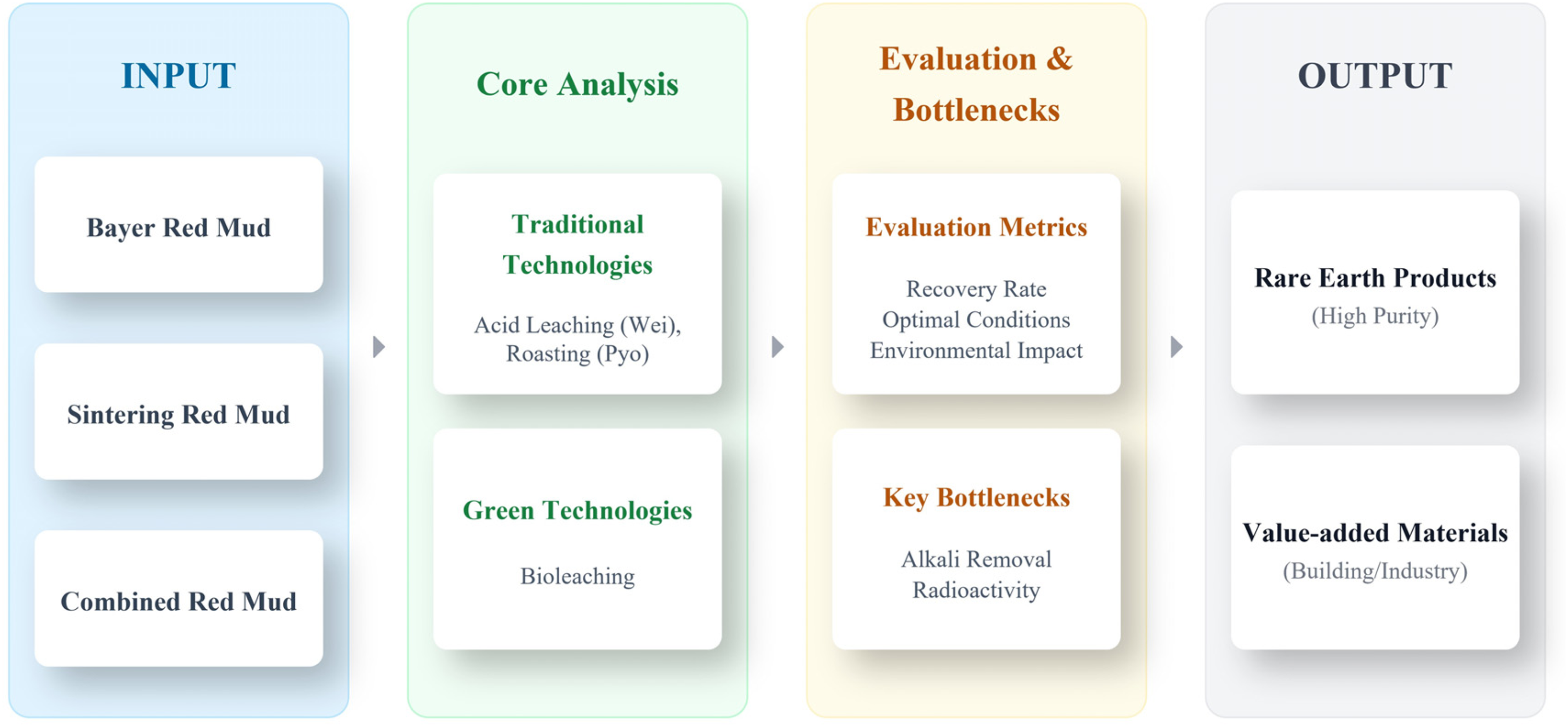
Overview roadmap.
Red mud characteristics and REE occurrence features
Physicochemical properties of red mud and the occurrence state of REEs underpin the selection of recovery technologies; a comprehensive understanding of these characteristics is essential for optimising recovery processes.
Analysis of physicochemical properties and mineral composition of red mud
Red mud has a complex composition that varies with bauxite properties and alumina production processes, leading to differences in hazardous characteristics. However, its main components are consistent: Fe₂O₃, Al₂O₃, SiO₂, CaO, Na₂O, TiO₂ and other oxides. 26 Additionally, red mud contains trace heavy metals (As, Cr, Cd, Hg, Pb and V), radioactive elements (Sr, Ra, Th and U) and REEs. 27
Red mud has a cemented porous structure with a large internal surface area and strong adsorption capacity. Approximately 90% of its particles fall within the 0.005–0.075 mm size range. Key physical parameters are as follows 28 : specific surface area, 64.09–186.9 m2/g; porosity ratio, 2.53–2.95 (much higher than ordinary soils); water content, 86.01%–89.97%; saturation, 94.4%–99.1%; water retention capacity, 79.03%–93.23%; plasticity index, 17.0–30.0; relative density, 2.7–2.9; bulk density, 0.8–1.0; and melting point, 1200 °C–1250 °C. Red mud colour ranges from greyish-white to dark red, depending on iron content. It is a fine-grained powder with strong alkalinity, and its high porosity and specific surface area pose challenges for subsequent REE recovery. 29
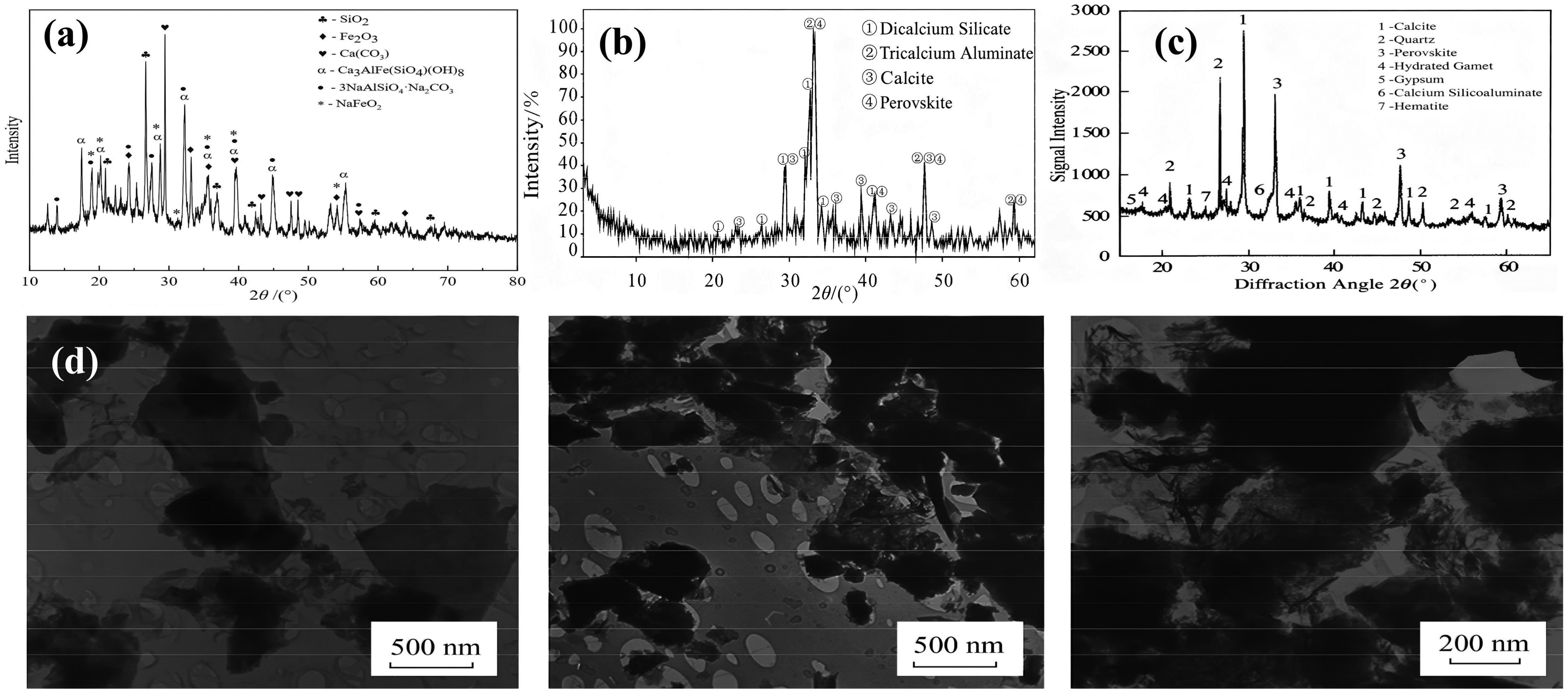
Red mud's chemical composition depends on bauxite properties, alumina production methods and additives introduced during processing. Table 1 presents the chemical composition of different red mud types. Most foreign red mud is produced via the Bayer process; domestically, Bayer process red mud is mainly from Pingguo, Guangxi, while other regions primarily produce sintering or combined process red mud. 31 X-ray diffraction (XRD) patterns of these three red mud types are shown in Figure 3.
Basic chemical composition of red mud. 30

Based on XRD pattern analysis results, the mineral phases of the sintered red mud sample (Guizhou Aluminum Plant) were studied under a transmission electron microscope. As shown in Figure 3(d), the following morphologies were primarily observed: (1) crystalline-like thin-flake or bulk aggregates composed of fine multicomponent particles, predominantly calcareous minerals and aluminosilicates (e.g. tricalcium aluminate); (2) well-dispersed regular-shaped particles (flakes, prisms and grains) that often contain impurities such as dicalcium silicate, calcite and perovskite; and (3) translucent hair-like or filamentous aggregates, mainly consisting of iron oxides and iron-bearing silicates (e.g. hematite and iron-bearing calcium-aluminium garnets). 33
Additionally, red mud also contains REEs such as Sc, Y, La and Ce. Although their concentrations are typically 0.05%–0.2%, the enormous annual output of red mud makes it a potential REE resources reservoir. 35
Regional distribution characteristics and occurrence forms of REEs
From a spatial distribution standpoint, REEs are predominantly dispersed, with uneven distribution across different phases of red mud. Regarding their occurrence form, REEs primarily exist via isomorphous substitution. 36
In terms of elemental composition, light REEs – mainly lanthanum (La) and cerium (Ce) – dominate, while heavy REEs such as dysprosium (Dy), terbium (Tb) and yttrium (Y) are relatively scarce. Scandium (Sc) often occurs as an associated element. REE composition in red mud varies substantially with the alumina production process: Bayer process red mud has a higher proportion of light REEs, whereas sintering process red mud exhibits slightly elevated Sc content.
REE content and occurrence form also differ significantly across typical red mud-producing regions worldwide. For instance, in China, Brazil and Australia: (1) Chinese red mud has an average REE content of 0.3%–0.4%, with some high-grade Bayer process red mud exceeding 0.5%, where light REEs account for over 80%; (2) Brazilian red mud generally contains 0.25%–0.35% REEs, with a relatively higher proportion of heavy REE Y compared to Chinese red mud; and (3) Australian red mud has a lower REE content (typically 0.15%–0.2%) and a more pronounced association with Sc, as shown in Table 2.
Rare earth element (REE) content distribution in typical red mud samples. 35

Figure 4 (Vind et al. 37 ) fully characterises the microscopic distribution of Ce in Bayer process red mud, including BSE images and elemental mapping. In the BSE image, bright regions labelled ‘1’ correspond to calcium-bearing minerals (e.g. calcite) or the aluminosilicate matrix, while dark regions labelled ‘2’ represent Ce micro-enrichment sites. Elemental mapping shows Ce as scattered bright spots, with significant overlap with Al and Ca distributions and no distinct aggregates. This confirms XRD results showing no detectable independent REE minerals.
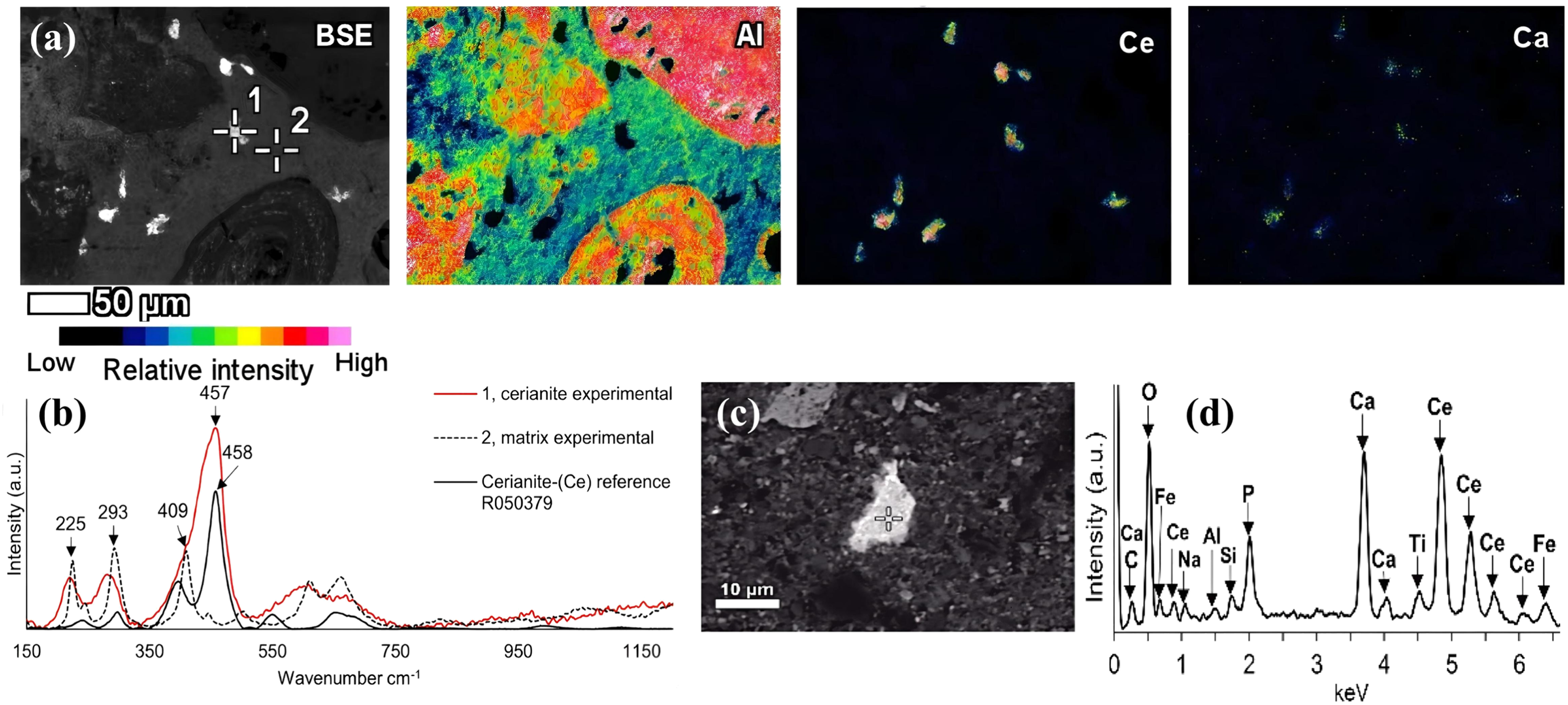
Multidimensional characterisation of Ce microdistribution features: (a) BSE image and EDS elemental mapping; (b) Raman spectra of cerite and its surrounding matrix; (c) BSE image of cerium phosphate; and (d) EDS spectrum of cerium phosphate. 37
This imaging feature arises from unevenly distributed lattice defects in red mud's aluminosilicates and calcium-bearing minerals. Higher defect densities in specific regions facilitate Ce3+ incorporation via isomorphous substitution, forming ‘Ce micro-enriched sites’. This enhances the Ce signal intensity and brightens these local regions. Correspondingly, Ca signal intensity may be lower at these sites due to the fine-grained nature or sparse distribution of calcium-bearing minerals, resulting in a weaker Ca signal than the locally enriched Ce. Chemically, Ce3+ has an ionic radius highly similar to Ca2+, with charge differences compensated by lattice vacancies. Red mud's aluminosilicate minerals frequently contain lattice defects, providing structural conditions for Ce3+ to replace Al3+. Thus, Ce most likely occurs via isomorphous substitution of Al3+ in aluminosilicate lattices or Ca2+ in calcium-bearing minerals (e.g. tricalcium aluminate and calcite).
Raman spectroscopy further confirms this occurrence mode: spectra of Ce microenriched zones differ from Ce reference minerals but closely match matrix spectra, indicating Ce is dispersed within the matrix rather than forming an independent phase. The BSE image of cerium phosphate clearly shows localised bright spots corresponding to Ce enrichment, and the EDS spectrum (Figure 4(d)) simultaneously detects Al, Ca and Ce – further confirming Ce coexists with matrix minerals. This high dispersion explains both the low total REE content (0.3%–0.4%) in Bayer process red mud and the necessity of subsequent acid leaching to dissolve the matrix and release REE ions from the lattice. This provides microscopic evidence for the ‘matrix dissolution first’ rationale in hydrometallurgical acid leaching.
These mineralisation characteristics directly determine the significant differences in rare earth recovery efficiency among red muds from different production processes and geographical sources, even when using the same extraction process. From the perspective of production processes, 90% of the rare earths in Bayer process red mud are embedded in the stable crystal lattices of hematite and perovskite; these must be completely disrupted to release the rare earths, resulting in generally low leaching rates under mild acid leaching conditions; In contrast, in sintered-process red mud, more than 60% of the rare earths exist in easily decomposable calcium-bearing minerals and ion-exchange states, allowing for effective leaching even under low-concentration acid conditions; under the same conditions, the rare earth leaching rate is 20%–30% higher than that of Bayer-process red mud. From a regional origin perspective, Chinese Bayer process red mud derived from gibbsite-type bauxite contains rare earths primarily embedded within the dense hematite lattice, which exhibits high chemical stability and presents the greatest difficulty for direct leaching; Brazilian red mud, derived from gibbsite-type bauxite, contains REEs in the loose, porous goethite phase, making them more susceptible to disruption by leaching agents; the leaching rate of heavy REEs is 30%–40% higher than that of Chinese red mud; Australian red mud has the lowest total rare earth content but the highest proportion of scandium, which is tightly bound within the perovskite lattice, requiring targeted process optimisation to achieve effective recovery. These inherent differences in rare earth distribution imply that a ‘one-size-fits-all’ recovery process cannot achieve optimal efficiency for all types of red mud, highlighting the necessity of process-specific design based on the characteristics of the red mud.
Progress and in-depth efficacy analysis of core REE recovery technologies
In recent years, numerous scholars have conducted extensive research on technologies for recovering REEs from red mud, achieving significant advancements that demonstrate the technical feasibility of such approaches. 38 Each technology operates on distinct principles and exhibits unique characteristics in terms of recovery rates and environmental impacts.
Hydrometallurgy
Hydrometallurgy is currently the mainstream technology for recovering REEs from red mud. It achieves separation and extraction through processes such as dissolution and extraction, characterised by high recovery rates.
Hydrochloric acid (HCl) leaching
The H+ ions generated by the ionisation of HCl disrupt the crystal lattice structure of rare earth minerals. They combine with REE ions (such as Sc3+, Y3+, La3+ etc.) to form soluble chlorides (e.g. ScCl3 and LaCl3), thereby facilitating the transfer of REEs from the solid material into the leachate. The coordination interaction between REE ions and Cl− further promotes mineral dissolution, enhancing leaching efficiency. Wang et al. 39 conducted a comprehensive study on the process conditions for scandium extraction from red mud using HCl as the leaching agent. Results indicated that under conditions of 6 mol/L HCl concentration, a liquid-to-solid ratio of 5:1, and a reaction time of 1 h at 60 °C, the leaching rate of Sc could exceed 85%. Wang et al. 40 focused on red mud, a byproduct of alumina production via the Bayer process at a certain plant, and conducted research on the acid leaching process and kinetics for yttrium. The results indicated that under conditions of red mud particle size of 140 mesh, reaction temperature of 85 °C, liquid-to-solid ratio of 4:1 and acid concentration of 10%, the leaching rate of Y could exceed 80%. Song et al. 41 employed orthogonal experiments to investigate factors influencing lanthanum leaching from red mud using HCl. Results indicated that lanthanum leaching efficiency reached 96.67% under the following optimal conditions: temperature: 109 °C (boiling point), time: 180 min, hydrochloric acid concentration: 8 mol/L and liquid–solid ratio: 8:1. This confirmed the influence of REE ion radius differences on leaching efficiency – La3+ ions, with larger radii, exhibit stronger coordination stability with Cl− ions, resulting in significantly higher leaching rates compared to Sc and Harrar et al. 42 optimised HCl leaching parameters using response surface methodology, determining 2 mol HCl as the optimal concentration. At this concentration, H+ effectively breaks the chemical bonds of rare earth minerals. They also found that 50 °C enhances H+ diffusion rates and reaction activity, while a 10 g/L solid–liquid ratio ensures sufficient contact between mineral particles and the leaching solution, preventing localised incomplete reactions and achieving optimised recovery rates for REEs.
However, low-concentration HCl struggles to disrupt the stable REE crystal lattice, while high concentrations accelerate equipment corrosion, necessitating a balance between leaching efficiency and equipment wear. Additionally, other metal ions in the material (such as Fe3+ and Al3+) compete with H+ for reaction sites, potentially reducing REE selectivity and requiring subsequent impurity removal.
Sulphuric acid leaching
Similar to HCl, the H+ ions released during sulphuric acid dissociation disrupt the mineral lattice, forming soluble sulphates with REE ions and SO42−. The core difference lies in auxiliary mechanisms: Li et al. 43 used red mud from Henan Province as raw material. Under conditions of a liquid-to-solid ratio of 6:1, sulphuric acid volume concentration of 30%, and temperature of 100 °C, leaching for 2 h yielded a scandium leaching rate of 84%. Zhang 44 conducted experiments using red mud from Guangxi. Under conditions of a solid–liquid ratio of 1:3, 60 °C, and a sulphuric acid concentration of 2 mol/L, leaching for 1 h yielded a scandium leaching rate of 63.56%. Abhilash et al. 45 employed 3 mol/L sulphuric acid with a solid–liquid ratio of 10 g/L under magnetic stirring at 200 r/min. This approach avoided the ‘dead zones’ associated with conventional mechanical stirring, ensuring thorough contact between sulphuric acid and red mud particles and reducing ‘local acid consumption’. Leaching at 35 °C for 1 h yielded a lanthanum recovery rate of 99.99%. Cerium, exhibiting slightly higher hydrolysis tendencies than lanthanum, required temperature elevation to 75 °C to suppress hydrolysis, ultimately achieving the same 99.99% recovery rate. This confirms the synergistic enhancement of magnetic stirring and temperature control in improving REE recovery efficiency. Additionally, Zhu et al. 46 added 5% CaF2 as a leaching aid in the sulphuric acid leaching system. As shown in Figure 5, scandium was leached for 60 min at a sulphuric acid concentration of 5–6 mol/L and 90 °C. Subsequently, solvent extraction was performed using 10% P507 at pH = 0.1, ultimately achieving a scandium leaching rate of 92% with an extraction rate exceeding 98%, yielding 99% pure scandium oxide.

Multiscale characterisation of materials related to sulphuric acid leaching: (a) macroscopic morphology of Guangxi red mud 44 ; (b) X-ray diffraction patterns of leaching residues with different calcium fluoride additions; (c) red mud; and (d) SEM image of leaching residue in H2SO4 with added CaF2. 46
The sulphuric acid leaching process presents several challenges: first, the highly corrosive nature of sulphuric acid demands superior equipment material quality, leading to accelerated wear during prolonged operation; second, certain REE sulphates (e.g. Sc₂(SO₄)₃) exhibit lower solubility than their chloride counterparts, potentially precipitating at high concentrations and limiting leaching efficiency; third, impurity removal requires precise control of pH and oxidant dosage – otherwise, REE ions may coprecipitate with Fe(OH)₃, reducing recovery rates.
Nitric acid leaching
Nitric acid exhibits both acidic and oxidising properties. Its acidity disrupts crystal lattices through H+ ions, while its oxidising capacity reduces reducible impurities in minerals (such as Fe2+ and S2−), minimising interference with REE leaching. Concurrently, NO₃− forms coordination compounds with REE ions, enhancing their solubility.
The study by Ochsenkuhn et al. 47 corroborates this mechanism. When using dilute nitric acid to leach REEs from red mud, the Sc leaching rate reached 80%, Y 90%, heavy REEs (Dy, Er and Yb) up to 70%, medium-heavy REEs (Nd, Sm, Eu and Gd) 50% and light REEs (La, Ce and Pr) 30%. This fully demonstrates the differential leaching effects of nitric acid on different REEs. The significant difference in REE ion charge density markedly influences leaching selectivity. Due to their high charge density and strong coordination ability with NO3−, heavy REEs exhibit a leaching rate of 70%, substantially higher than that of medium and light REEs (30%–50%). Experiments by Feng et al. 48 further optimised the nitric acid leaching process, confirming that conditions of 45% HNO3, 60 °C, a liquid-to-solid ratio of 2.5:1 and a leaching time of 90 min simultaneously enhance oxidative destruction of refractory REE minerals and accelerate coordination reaction rates. This achieved a heavy REE leaching rate of 99%, an extraction rate of 98.5% and a total recovery rate of 97.5%. The liquid-to-solid ratio of 2.5:1 and 90 min leaching time ensure thorough contact between nitric acid and mineral particles, preventing local depletion of oxidants or insufficient H+ concentration, thereby achieving optimal leaching results.
Nitric acid presents numerous challenges in leaching processes: its strong oxidising properties and volatility generate NOx emissions, necessitating exhaust treatment equipment that increases process costs; the weak coordination ability of medium and light REEs with NO3− results in low leaching rates, making the enhancement of selective leaching a critical challenge; furthermore, high-concentration nitric acid imposes extremely high corrosion resistance requirements on equipment, with conventional materials prone to corrosion, limiting industrial application.
Organic acid leaching
Organic acids such as citric acid and oxalic acid form stable chelates with REE ions through their carboxyl groups (–COOH), reducing the adsorption energy of REE ions on mineral surfaces and promoting mineral lattice dissolution. Simultaneously, the weak acidity of organic acids allows for the gradual release of H+ ions, preventing localised pH drops that could cause REE precipitation.
Research by Shan et al. 49 indicates that citric acid, owing to its unique multidentate coordination structure (containing three carboxyl groups), exhibits stronger chelating ability towards REE ions compared to monodentate organic acids. When employed as a leaching agent, citric acid demonstrates excellent leaching efficiency for Sc and Y, achieving leaching rates of 88.79% for Sc and 91.93% for Y. The complete solvent extraction process using citric acid has been validated by Shalchian et al. 50 Additionally, oxalic acid is employed in REE leaching from red mud with selective efficacy. Its molecular structure and anions confer high chelation specificity toward REE ions; the research by Li et al. 51 provides comprehensive support for this characteristic: their multi-stage extraction method enhances reaction completeness through repeated solid–liquid contact, achieving REE leaching rates exceeding 80% under specific conditions, with Sc reaching 88.39%. Concurrently, Li et al. confirmed via XRD patterns that oxalic acid selectively disrupts REE-bearing mineral phases. SEM and EDS analyses revealed low residual REE levels in leaching residues, providing direct evidence for oxalic acid's selective leaching efficacy. The temperature effect data reported by Wang et al. 52 provide a critical reference for parameter optimisation in oxalic acid leaching systems, as shown in Figure 6. In addition to oxalic acid, formic acid, acetic acid and their 1:1 mixed acid system have also been employed in studies on the selective leaching of scandium from red mud. Bogomazov et al. 53 used these three systems as leaching agents. In a reactor equipped with an agitator, raw materials were added gradually under continuous monitoring. Once the suspension reached the specified acidity, the addition of red mud was halted. Leaching continued for a period before maintaining a fixed temperature for further leaching. Results showed that at pH = 1.6, all systems achieved maximum scandium recovery rates: 74.4% for formic acid, 67.7% for acetic acid and 70.3% for the 1:1 mixed acid system.
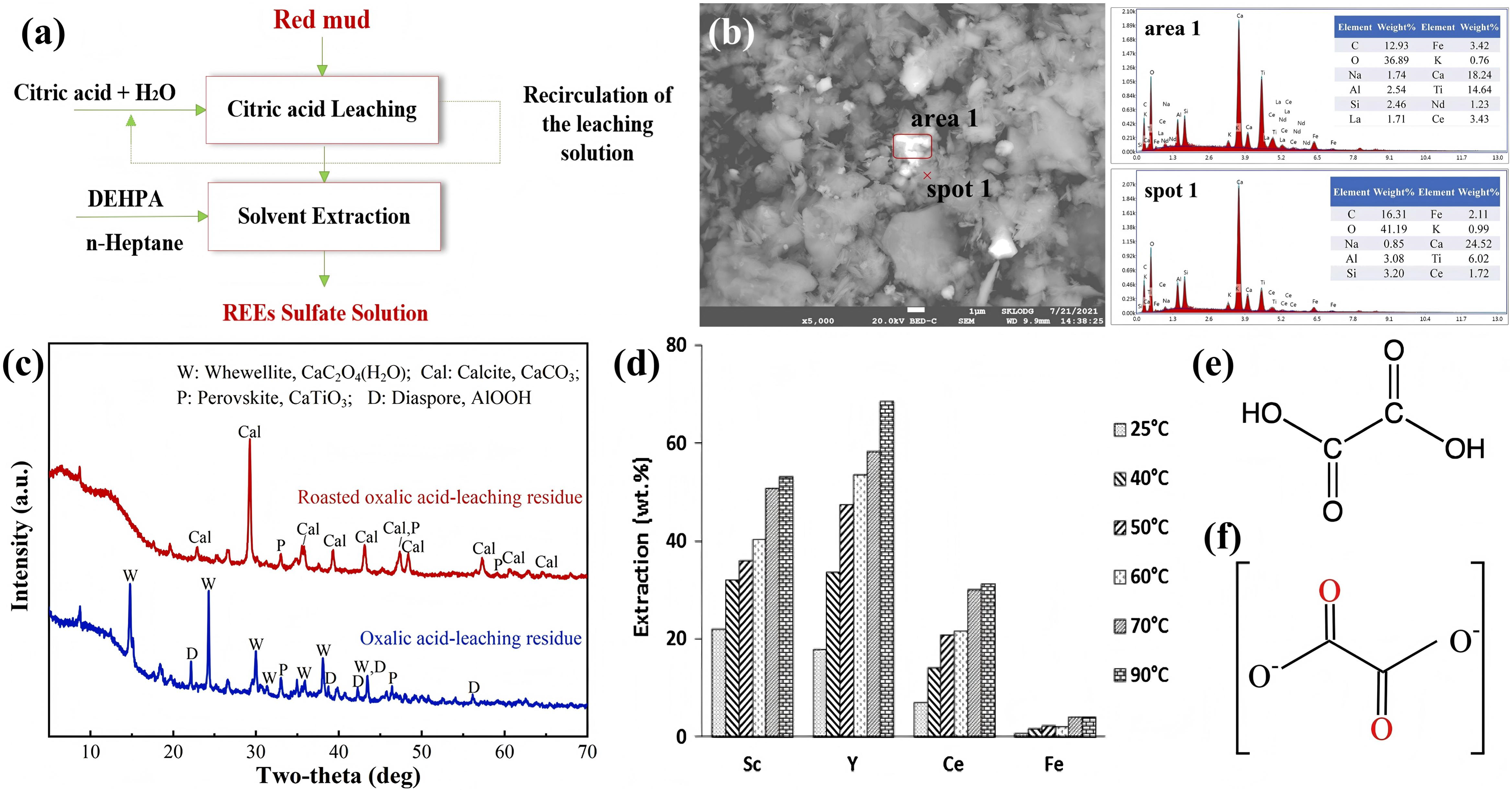
Organic acid leaching patterns: (a) citric acid leaching-solvent extraction process scheme 50 ; (b) SEM image and EDS analysis of oxalic acid leaching residue; (c) XRD patterns of oxalic acid leaching residue before and after calcination 51 ; (d) effect of temperature on citric acid leaching (0.5 N, L/S:50, t:1 h) 52 ; (e) chemical formula of oxalic acid; and (f) oxalate anion.
Organic acids present numerous application challenges. Their low ionisation constants and slow H+ release rates result in leaching reaction rates significantly lower than those of inorganic acids, often requiring extended leaching times or elevated temperatures to advance the reaction. Cost-wise, organic acids are more expensive than inorganic acids. Furthermore, precipitates formed when certain organic acids (such as oxalic acid) react with REEs require subsequent acidification and dissolution, significantly increasing process complexity. Additionally, organic acids are prone to microbial degradation, thus requiring strict control over the pH and temperature of the leaching system to prevent organic acid degradation.
Acidic solvent extraction
The extractant undergoes specific interactions with REE ions via functional groups: P204 (acidic phosphorus extractant) undergoes hydrogen ion exchange (–P = O coordinates with REE ions while releasing H+); Cextrant 230 (neutral phosphorus extractant) forms coordination compounds with REE ions via lone-pair electrons, transferring the REE ions from low-concentration leachate (aqueous phase) to the organic phase to achieve their enrichment.
Le et al. 54 employed Cextrant 230 to recover scandium from the sulphuric acid leachate of red mud. Under optimal conditions, the scandium concentration in the extraction residue decreased from 3.57 to 0.3 mg/L, achieving a scandium recovery rate exceeding 90%. This validated the effectiveness of the mechanism, with the process flow diagram shown in Figure 7. The core of the extraction process lies in parameter optimisation and condition adaptation. Research by Liu et al. 55 provides key references in this regard. Using P204 (diphosphate ester)/sulphonated kerosene as the extractant, a 1% P204 concentration provides sufficient active sites. Combined with a 10:1 organic-to-aqueous phase ratio, this effectively enhances extraction capacity. Regarding temperature, the P204 system reduces hydrolytic losses at 15 °C. Cextrant 230 requires matching the acidity of the sulphuric acid leachate to prevent protonation failure, a conclusion consistent with Le et al.'s experimental results on scandium recovery from red mud sulphuric acid leachate. Furthermore, the selectivity of the extractant directly impacts impurity removal efficiency. P204 exhibits higher selectivity towards Sc than toward impurities such as Fe and Al, ultimately achieving a 97% Sc recovery rate, which further validates the findings of Liu et al.
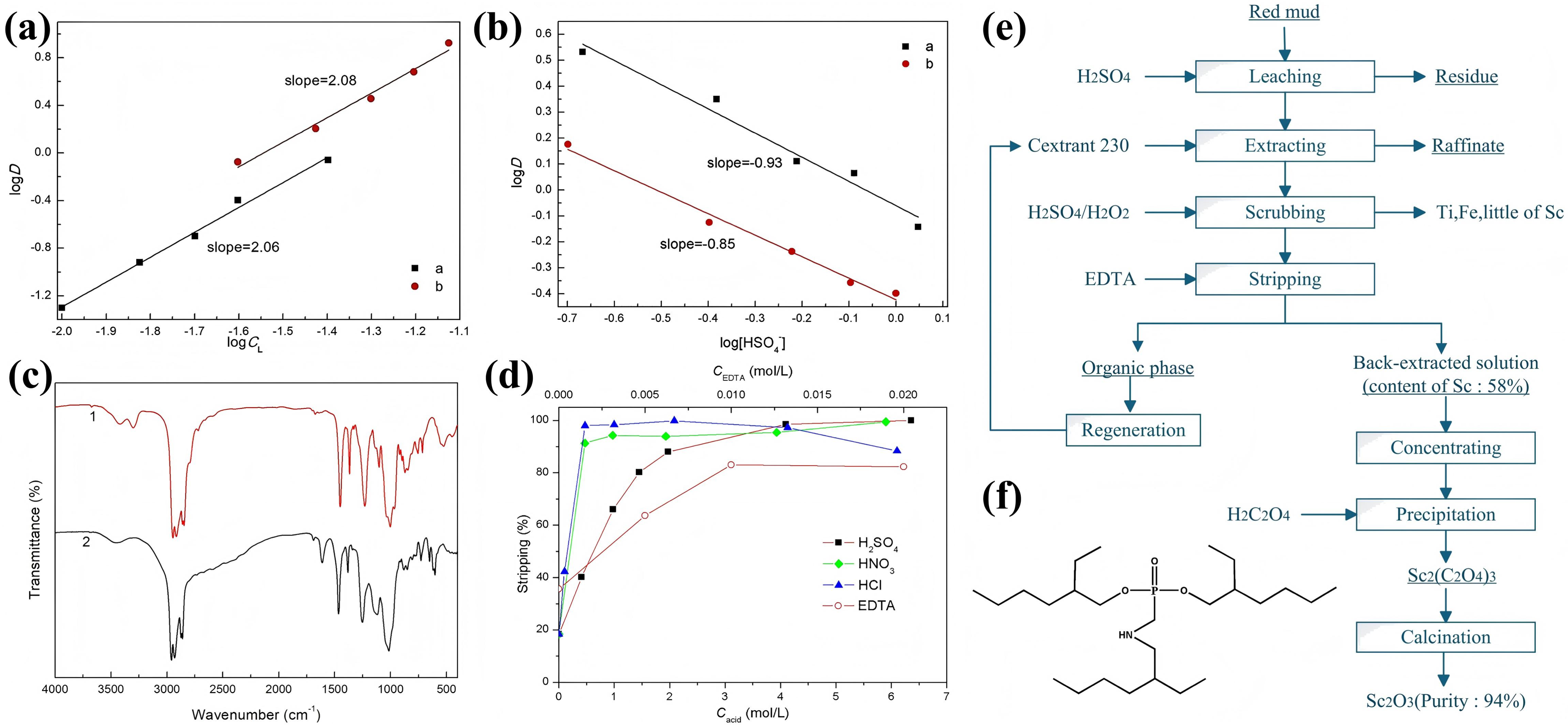
Extractor Cextrant 230: (a) Effect of Cextrant 230 concentration on the Sc3+ distribution ratio. a: 0.001 mol/L Sc3+, 0.01 mol/L H2SO4; b: 0.005 mol/L Sc3+, 0.06 mol/L H2SO4; (b) Effect of sulphite concentration on the Sc3+ distribution ratio. a: 0.01 mol/L Sc3+, 0.1 mol/L Cextrant 2300.23 mol/L H2SO4; b: 0.001 mol/L Sc3+, 0.01 mol/L Cextrant 2300.023 mol/L H2SO4; (c) Infrared spectra of extractant Cextrant 230 and extraction complexes: (1) L; (2) Sc(HSO4)SO4·2L; (d) Removal of loaded scandium using different reagents. Loaded organic phase: Sc concentration in inorganic acid is 0.042 mol/L, Sc concentration in EDTA is 0.010 mol/L; (e) Process flow for Cextrant 230 recovery of scandium from red mud sulphuric acid leachate 54 ; and (f) Molecular structure of Cextrant 230. 56
Impurity ions such as Fe3+ and Al3+ in the leachate exhibit chemical properties similar to REE ions, readily competing with the extractant for binding. This reduces extraction selectivity and impacts recovery rates. The back-extraction stage demands strict acidity control; inadequate control may result in residual REE ions, affecting overall recovery rates; successful parameter control experiences should be referenced. Extractant dissolution loss and regeneration efficiency pose industrial challenges. Inhibiting degradation and loss is a key focus for future research, directly impacting the feasibility of efficient REE enrichment.
In summary, the hydrometallurgical process features a mature technical route and high rare earth leaching efficiency, making it the most widely used technology in current laboratory research and pilot-scale testing. However, the inherent trade-off between leaching efficiency, reagent consumption and environmental risks remains the core challenge hindering its large-scale industrial application.
Pyrometallurgical sulphation roasting
The essence of pyrometallurgical sulphation roasting lies in utilising the acidity of sulphuric acid to dissolve REEs, followed by separating REEs from impurities based on differences in sulphate thermal stability. This process occurs in two stages: during the sulphuric acid mixing stage, H+ ions from H2SO4 ionisation disrupt the oxides of Sc, Fe, Al and Na in red mud through ‘protonic attack’. H+ combines with O2− to form H2O, weakening the metal–oxygen bond. Simultaneously, SO42− forms soluble sulphates with metal ions, converting all metal oxides into sulphates. The differing thermal stabilities of these sulphates lay the foundation for subsequent separation. During calcination, impurity sulphates with low thermal stability decompose into insoluble oxides and release SO2 at high temperatures. In contrast, REE sulphates exhibit high thermal stability, remaining stable below 700 °C. Subsequent leaching releases only REEs into solution, significantly reducing impurity removal costs and acid consumption. Key reactions occurring during sulphurisation calcination for scandium extraction include 57 :
Sulphuric acid mixing stage:



Calcination stage:

Luo et al. 58 optimised the sulphurisation roasting process. With a sulphuric acid dosage of 34 mL (98% concentration), this method prevents metal ion hydrolysis. Operating at 260 °C – below the boiling point of sulphuric acid to avoid volatilisation – and for a duration of 60 min, the 4:1 solid-to-liquid ratio in the leachate provides sufficient moisture. This ensures complete dissolution of the generated Sc2(SO4)3, preventing crystallisation precipitation caused by local supersaturation. Both the liquid and residue leaching rates of scandium in the red mud exceeded 91%. Borra et al. 59 further revealed the regulatory effect of calcination temperature on element separation: at ∼700 °C for 1 h, Fe, Al and Ti sulphates decompose into insoluble oxides, while most REE sulphates remain in sulphate or oxysulphate form at 700 °C. These remain readily soluble in water, forming a high-concentration REE solution that selectively retains REEs in the soluble phase. At a sulphuric acid-to-bauxite residue mass ratio of 1:1, sufficient conversion of Na and Ca into sulphates occurs. Subsequent room-temperature leaching – with either 2 days of agitation or 7 days without agitation – yields ∼60 wt-% extraction of scandium and over 80 wt-% extraction of other REEs. Anawati et al. 60 provided direct microscopic evidence for this temperature-regulated mechanism through their study of Canadian bauxite slag: using a 0.95 mL sulphuric acid/g residue ratio, they conducted sulphation roasting at 200 °C and 400 °C. SEM observations revealed that hydrated iron sulphate crystals formed at 200 °C, while these transformed into anhydrous iron sulphate at 400 °C. This morphological and structural change in the impurity sulphate directly corroborates the temperature's regulatory effect on impurity phase stability. Subsequent water leaching of sulphation-roasted limonite (liquid–solid ratio: 9.5 mL water/g roasted ore) followed by SEM characterisation further revealed the morphological features of leaching products, providing microscopic insights into the transition of REEs from the solid-to-liquid phase. This series of process logic is precisely supported in Figure 8 across three layers: process, microlevel and mechanism.
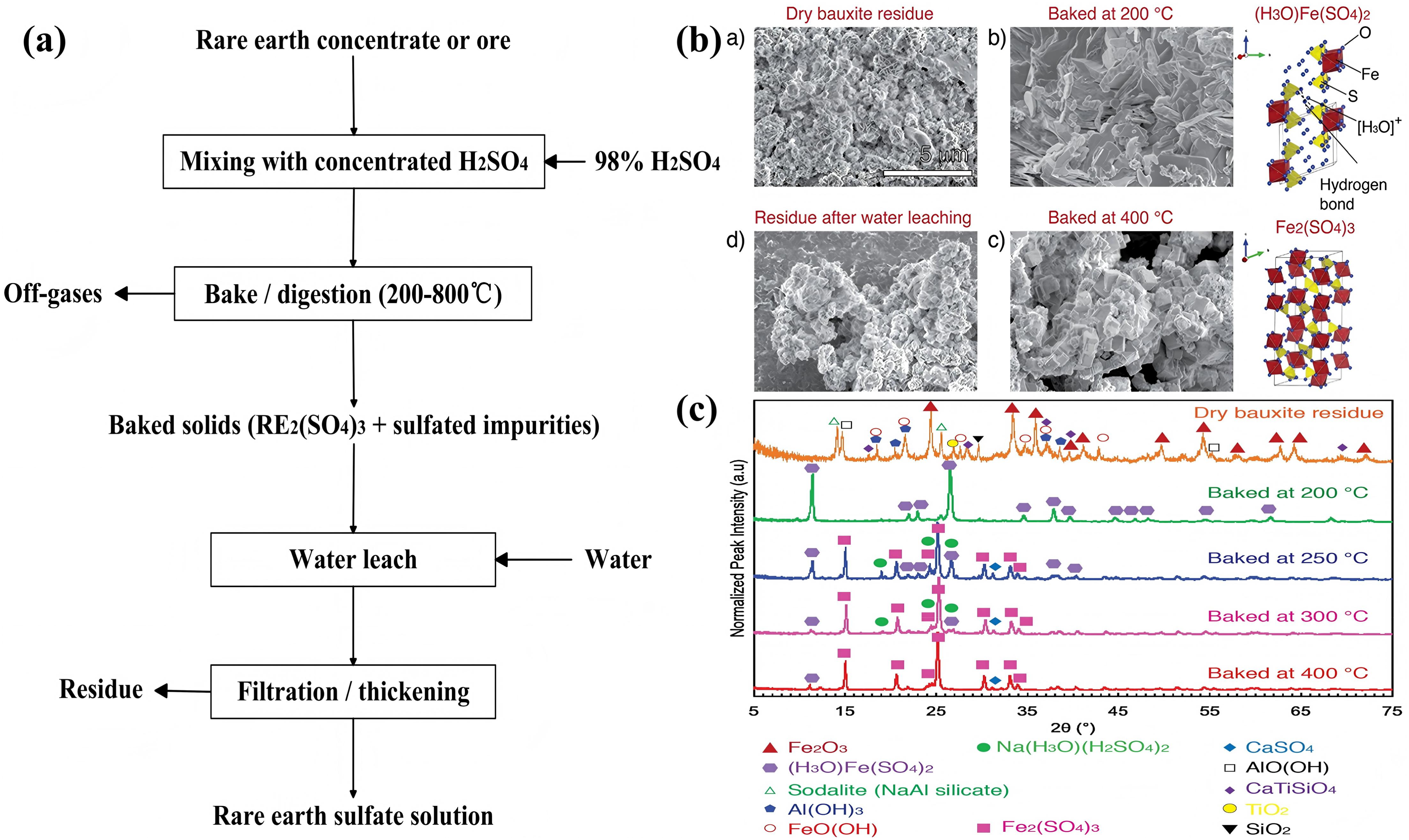
Sulphation roasting: (a) Typical process flow diagram for sulphuric acid treatment of rare earth ore concentrates 59 ; (b) Roasting for 2 h: a) dry red mud; b) scanning electron micrographs images of sulphation-roasted red mud at 200 °C and c) 400 °C along with the crystal structure of ferrous sulphate; d) SEM image of leached sulphation-roasted limonite product; and (c) XRD diffractogram of dry BR and samples baked at different temperatures. All samples were baked for 2 h using 0.95 mL H2SO4/g BR. 60
In pyrometallurgical processes (sulphation calcination) three key technical points exist: first, precisely matching sulphuric acid dosage with calcination temperature to achieve ‘complete acid leaching + zero reagent loss’, preventing REE retention in slag due to insufficient H+ or sulphuric acid volatilisation; second, strictly controlling calcination temperature to enhance impurity decomposition efficiency while ensuring the stability of REE sulphates, this temperature control directly determines subsequent leaching rates; third, intensifying leaching mass transfer (through agitation/liquid–solid ratio) to disrupt diffusion layers and ensure sufficient dissolution space, thereby improving the transfer efficiency of REEs from slag to liquid.
Traditional lime absorption methods exhibit significant shortcomings when treating SO2 tail gas. When SO2 concentrations exceed 10%, calcium sulphite (CaSO3) rapidly crystallises from the lime-SO2 reaction, forming a dense crust on the surface. This crust impedes subsequent reactions, leading to agglomeration within the equipment. Conversely, when SO2 concentrations fall below 5%, insufficient gas solubility in the absorption liquid prevents attainment of the concentration required for effective reactions, resulting in incomplete SO2 removal. To compensate for these limitations of lime absorption, additional high-cost equipment such as ammonia-based desulphurisation systems is often required, further increasing exhaust gas treatment costs.
In summary, the pyrometallurgical process centred on sulphuric acid calcination achieves excellent selective separation of REEs from impurity elements through the regulation of thermal stability, thereby effectively reducing the difficulty of subsequent purification. However, high energy consumption and the cost of exhaust gas treatment remain the key bottlenecks limiting its large-scale application; in practice, it is often used as a pretreatment unit in integrated processes.
Biometallurgy
The core of biometallurgy lies in harnessing the acidic substances and enzymes naturally secreted by microorganisms during their growth and metabolic processes. These substances react chemically with REEs, gradually breaking down the mineral lattice structure and promoting the dissolution of REE ions from the minerals. The entire process requires no additional strong acids or high-temperature environments, demonstrating significant advantages in environmentally friendliness and low-energy consumption.
Acidic substances produced by leaching microorganisms through metabolism can be categorised into inorganic acids and organic acids. Inorganic acid systems (e.g. Acidophilic thermoarchaea and Thiobacillus ferrooxidans) metabolically produce sulphuric acid. They utilise high-concentration H+ to react with O2− in REE minerals, forming H2O. This process effectively weakens metal–oxygen chemical bonds (e.g. Sc–O–Si bonds), facilitating the release of REE ions (Sc3+, Ce3+ etc.) from the mineral lattice. Meanwhile, SO42− forms stable soluble coordination compounds with REE ions (such as [Sc(SO4)3]3−), preventing REE ions from re-adsorbing onto mineral surfaces and significantly enhancing leaching efficiency. Organic acid systems (e.g. Aspergillus niger, RM-10 filamentous fungi) exhibit unique advantages in REE leaching through the secretion of organic acids like citric acid and oxalic acid. The coordination stability constants between organic acid anions (e.g. oxalate anion C2O42−) and REE ions are significantly higher than those of inorganic acid anions, enabling efficient dissolution of stable complexes formed between REEs and Si, Al. Certain microorganisms (such as Aspergillus niger) secrete hydrolytic enzymes (e.g. cellulase and silicase), whose primary function is to disrupt the mineral structures encapsulating REEs – in red mud, REEs are often enclosed within silicate shells. These enzymes can cleave Si–O–Si bonds, exposing the active sites within the REE minerals. This allows acids produced by metabolic processes to directly contact the REEs, thereby enhancing leaching efficiency.
Zhang et al. 61 employed an aerobic–anaerobic two-stage bioleaching method to extract REEs, utilising Acidophilic thermoarchaea as the research subject. By switching oxygen environments, the microorganisms alternately produced sulphuric acid and organic acids, accommodating the coordination requirements of different REE ions to achieve balanced and efficient leaching of Ce, Gd, Y and Sc. The schematic diagram is shown in Figure 9. Under aerobic conditions, the leaching rates for Ce, Gd, Y and Sc were 82.4%, 86.8%, 85.3% and 78.6%, respectively. Under anaerobic conditions, their leaching rates were 86.3%, 93.7%, 90.2% and 74.9%, respectively.
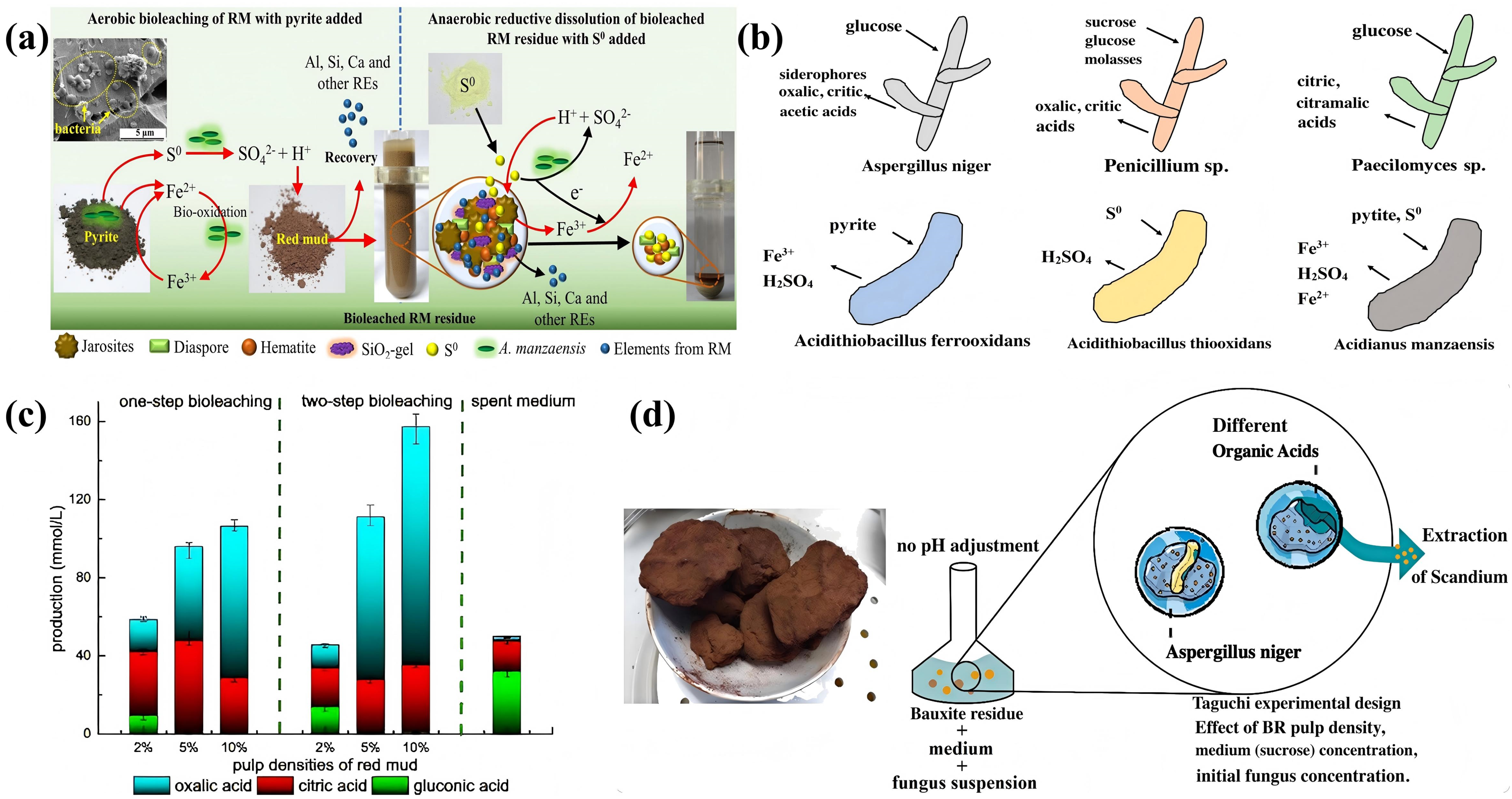
Schematic diagram of bioleaching: (a) schematic diagram of two-stage bioleaching of RM under anaerobic conditions with pyrite addition (left) and anaerobic conditions with S addition (right) 61 ; (b) commonly used microorganisms and their primary metabolic substrates and products, including Aspergillus niger, Penicillium spp., Penicillium sp., Thiobacillus ferrooxidans, Thiobacillus thiooxidans and Manzaia acidibacter 62 ; (c) organic acids produced by different bioleaching methods for RM-10 at varying slurry concentrations 63 ; and (d) leaching of scandium using Aspergillus niger. 64
The microorganisms employed in this type of bioleaching are not isolated cases. Shi et al. 62 summarised common bacterial strains used in REE leaching: these include fungi such as Aspergillus niger and Penicillium species capable of producing organic acids, as well as bacteria like Thiobacillus ferrooxidans and Thiobacillus sulfuris that can generate sulphuric acid. The acidophilic thermophilic archaea utilised by Zhang also fall within this category. Different strains exhibit distinct metabolic substrates (e.g. glucose and sucrose) and products, enabling adaptation to diverse REE leaching requirements. In practical applications, Qu et al. 63 conducted research using Guizhou Chinalco red mud as raw material and a filamentous acid-producing fungus RM-10 isolated from the red mud as the bioleaching agent. Results indicated that at a pulp concentration of 2%, the filamentous structure of RM-10 could fully entangle mineral particles, allowing organoacids produced through metabolism to rapidly diffuse to the mineral surface, thereby preventing ‘local acid depletion’ and enabling REE ions desorbed from mineral surfaces to rapidly diffuse into the solution bulk, preventing ‘local saturation inhibition of leaching’. Under these optimised conditions, one-step bioleaching achieved the highest leaching rates for REEs and radioactive elements, with an Sc leaching rate of 75%.
In addition to fungus RM-10, Aspergillus niger is also a commonly used strain for bioleaching. Kiskira et al. 64 demonstrated a process for leaching scandium using Aspergillus niger: through Taguchi experimental design, they optimised parameters such as pulp concentration and medium concentration, further validating the feasibility and efficiency of fungal bioleaching in REE recovery.
In bioleaching processes, strain adaptation selection must adhere to the principle of ‘precise screening based on red mud characteristics’: for high-silica, hard-to-leach red mud, select Acidophilic thermophilic archaea/Bacillus thuringiensis with strong sulphate production capacity (sulphate can break Si–O bonds); for low-grade red mud, select fungi producing organic acids (Aspergillus niger, RM-10); for red mud containing heavy metal impurities, prioritise indigenous strains (highly stress-tolerant) to prevent inhibition of microbial activity. Furthermore, microbial metabolic activity is highly sensitive to environmental factors such as pH, temperature and dissolved oxygen levels. To maintain stable metabolic efficiency, high-precision control equipment like online pH control systems and oxygen content monitors must be deployed, significantly increasing process complexity.
Biometallurgy leverages the acid/enzyme-producing metabolic characteristics of microorganisms to replace external strong acids and high temperatures, thereby avoiding the generation of polluting gases like SO2. This approach is environmentally friendly and low in energy consumption. Strains can be selectively screened based on the specific composition of red mud, offering strong adaptability. Essentially, it replaces chemical conversion with biological conversion, significantly reducing environmental impact. Limitations include the slow metabolic rates of microorganisms, poor environmental tolerance and limited coordination selectivity, resulting in stringent cultivation conditions. Additionally, extended leaching cycles and lower extraction rates for certain REEs contribute to overall efficiency that remains lower than optimised pyrometallurgical and hydrometallurgical processes.
In short, due to its outstanding environmental benefits and low-carbon emissions, biometallurgy has emerged as a key direction for the development of green, low-carbon processes for rare earth extraction from red mud. However, its industrial application remains constrained by long reaction cycles, stringent process control requirements and low leaching efficiency for hard-to-leach REEs. The key to breakthroughs lies in the targeted modification of mineral-leaching bacterial strains and the optimisation of process control.
Ion exchange method
The essence of ion exchange lies in utilising the specific interaction between the functional groups of ion exchange resins and REE ions to achieve the enrichment and separation of REEs from low-concentration leachate. This process fundamentally comprises two stages: ‘adsorption’ and ‘desorption’. The resin's adsorption capacity for REE ions depends on the chemical properties of its functional groups and the physicochemical characteristics of the REE ions (such as ionic radius, charge and hydrolytic state) – the core reason for its ‘high selectivity’. Desorption primarily relies on high-concentration H+ to disrupt the coordination/electrostatic interactions between the resin and REE ions, transferring the REE ions from the resin phase to the solution phase.
Ochsekühn-Petropoulou et al. 65 stirred red mud slurry with resin in a sulphuric acid medium to selectively adsorb elements such as Sc, Th and U onto the resin. Through filtration and ten-stage countercurrent adsorption, the process involved contacting fresh resin with low-concentration Sc solution and saturated resin with high-concentration Sc solution. Ultimately, 50% of the Sc entered the resin phase, yielding 98%–99% high-purity Sc after purification. This method exhibits high selectivity and effectively enriches target REEs. However, ion exchange resins are relatively costly, and their regeneration and disposal processes are complex. To enhance resin adsorption performance, domestic researchers have developed modified resins. For instance, the amino phosphonic acid resin prepared by Shen et al. 66 exhibited optimal Y adsorption capacity at pH = 5.0. This occurs because at this pH, the resin functional groups are fully dissociated, imparting a negative surface charge that forms stable coordination and electrostatic adsorption with Y3+ ions. Additionally, Y3+ ions remain unhydrolysed, achieving a static saturation adsorption capacity of 143 mg/g resin. During desorption, 2.0–4.0 mol/L HCl serves as the desorbent. The H+ concentration fully replaces Y3+ without damaging the resin structure, enabling ‘high-efficiency desorption and resin reusability’ with a desorption rate of 90%.
However, the resin regeneration process still faces challenges. The resin must repeatedly undergo alternating acid-base treatments involving ‘acid desorption → neutral washing → alkaline activation’. This causes swelling and contraction of the resin matrix, disrupting its porous structure while triggering the loss of functional groups. Typically, after 3–5 regeneration cycles, the resin's adsorption capacity and desorption efficiency decline, necessitating frequent resin replacement and significantly increasing operational and maintenance costs. Additionally, the leachate from red mud contains impurities such as Fe3+ and Al3+ ions. These ions have similar ionic radii and identical charges to REE ions, leading them to compete for resin adsorption sites. Without pretreatment, Fe and Al impurities will remain in the final product. However, the pretreatment process increases process complexity and elevates costs.
Overall, the advantages of ion exchange lie in its high selectivity and process flexibility, with further enhancement of adsorption performance achievable through resin modification. However, its limitations are also significant: specialised resins are costly, leading to high expenses in large-scale applications; desorption and regeneration require precise control of temperature and concentration; and adsorption capacity tends to decline after regeneration, resulting in considerable operational and maintenance challenges.
Emerging combined and enhanced recovery technologies
Traditional single-step hydrometallurgical, pyrometallurgical and bio-metallurgical processes all suffer from inherent limitations, such as the trade-off between leaching efficiency and environmental risks, excessive energy consumption, and overly long reaction cycles. To overcome these limitations, researchers have developed a series of emerging processes based on process coupling, external field enhancement and the development of novel media, which have become core research focuses in the field of rare earth recovery from red mud. This section systematically reviews the research progress of these processes, organising the content into three subsections: combined and integrated processes, physically field-enhanced leaching processes and novel medium-based separation and leaching processes. It clearly elucidates the technical principles, application outcomes and existing limitations of each process.
Combined processes
Combined processes achieve synergistic enhancement of REE recovery efficiency by coupling two or more technical routes, making full use of the advantages of each unit to compensate for their respective limitations. At present, the most widely studied processes include pyrometallurgical–hydrometallurgical combined processes and chemical–biological combined leaching processes.
Pyrometallurgical–hydrometallurgical combined process: The core principle of this process is to use high-temperature pyrometallurgical treatment to disrupt the dense mineral structure of red mud, preferentially remove high-content impurities such as Al and Fe, and fully expose REE active sites, thereby creating favourable conditions for the subsequent hydrometallurgical leaching and enrichment of REEs. This process fundamentally solves the problem of high impurity co-dissolution in conventional direct acid leaching, and significantly improves the selectivity of REE recovery.
Borra et al. 67 calcined red mud with calcium carbonate at 950 °C for 4 h. At this temperature, calcium carbonate decomposed into CaO, which reacted with Al₂O₃ in the red mud to form soluble calcium aluminate. Sc2O3 did not react with CaO and remained in solid form. Subsequent water leaching at 80 °C for 60 min dissolved the soluble calcium aluminate into the aqueous solution, successfully removing 75% of the aluminium content. Fe2O3 in the red mud is reduced to metallic iron by coke at 1500 °C. Exploiting the density difference between iron and slag, gravitational separation removes 98% of Fe, reducing impurity interference. After two-step impurity removal of Al and Fe, Sc₂O₃ in the resulting slag is fully exposed. Leaching in an acidic solution at 90 °C ultimately achieves an 80% Sc leaching rate. Xiao et al. 68 proposed the ‘sodium chloride dissociative roasting-weak magnetic separation-hydrochloric acid leaching’ process. High-temperature segregation roasting decomposes sodium chloride to produce Cl−, promoting the transformation of iron minerals into strongly magnetic Fe₃O₄ while disrupting the encapsulating lattice of Sc. The challenge lies in precisely controlling sodium chloride dosage and roasting parameters (insufficient dosage results in inadequate mineral modification, excessive dosage risks pollution and improper temperature impairs Fe₃O₄ formation). Weak magnetic separation utilises magnetic differences to isolate iron concentrate (iron grade 73.99% and recovery rate 88.99%). Sodium is concentrated in the tailings, requiring optimisation of particle size and magnetic field strength to prevent incomplete separation. Hydrochloric acid leaching dissolves sodium compounds via H+, achieving a high Sc leaching rate of 96.78%. This process demands balancing hydrochloric acid concentration to optimise both leaching efficiency and selectivity. Rivera et al. 69 first mixed red mud with CaO, SiO₂ and coke at varying ratios, then subjected the mixture to high-temperature smelting to disrupt the dense structure of red mud and optimise the phase composition of the slag. They subsequently controlled the slag properties through either ambient cooling or water quenching. Following magnetic separation for iron removal as a pretreatment to reduce impurity interference, they finally achieved efficient REE extraction via high-pressure leaching with hydrochloric acid/sulphuric acid. Experiments demonstrated that ambient-temperature-cooled slag achieved a maximum Sc leaching rate of 90% and ∼95% leaching rates for Y, La and Nd under 100 °C hydrochloric acid high-pressure leaching. Water-cooled slag required heating to 120 °C, yielding REE leaching rates exceeding 85% for all elements. All three examples demonstrate that synergistic use of pyrometallurgical modification and hydrometallurgical leaching enhances leaching efficiency and selectivity, providing an effective pathway for REE resource recovery from red mud.
Chemical–biological combined leaching method: The core of this process is the coupling of ‘chemical pretreatment barrier breaking + targeted bioleaching enrichment’: chemical pretreatment preferentially removes base metal impurities that hinder REE leaching, disrupts the dense structure of red mud, and reduces the toxicity of the system to microorganisms; subsequent bioleaching uses organic acids produced by microbial metabolism to achieve selective dissolution and recovery of REEs, taking into account the efficiency of chemical processes and the environmental friendliness of biological processes.
The specific process described by Ilkhani et al. 70 is as follows: first, 0.23 mol of oxalic acid is mixed with red mud at a slurry concentration of 10 g/L. Leaching occurs at 80 °C and 200 r/min for 4 h, where oxalic acid dissociates into H+ and C2O42− ions to form soluble complexes with Fe, Al and Ti, achieving 98.4% Fe, 98.4% Al and 80% Ti removal while preliminarily leaching 9% Ce, 14% La and 20% Pr; subsequently, the pretreated red mud undergoes bioleaching with the alkali-tolerant bacterium Bacillus foraminis at 40 °C and 160 r/min for 8 days. Bacterial metabolism produces organic acids such as citric acid and malic acid, further dissolving REEs to achieve 35% Pr, 6.3% Ce and 1% La leaching; ultimately, the synergistic effect of chemical pretreatment and bioleaching achieved a total recovery rate of 55% Pr, 15.3% Ce and 15% La. Structural disruption of red mud and metal leaching efficiency were verified using XRD, FTIR, FE-SEM and other characterisation techniques, as shown in Figure 10. In this process, the significant differences in the recovery rates of Pr, Ce and La are primarily determined by the geochemical fractionation characteristics of the REEs in the red mud and their compatibility with the process. On the one hand, Pr exists primarily in the easily leachable trivalent form, whereas over 80% of La is locked in the hard-to-leach residue phase, and more than 90% of Ce is oxidised to CeO₂, a compound with extremely low solubility that cannot be effectively dissolved under the mild conditions of the combined process; On the other hand, the organic acids produced by microbial metabolism exhibit significantly higher complexation and adsorption affinities for Pr3+ than for La3+ and Ce4+, further widening the gap in recovery efficiency.
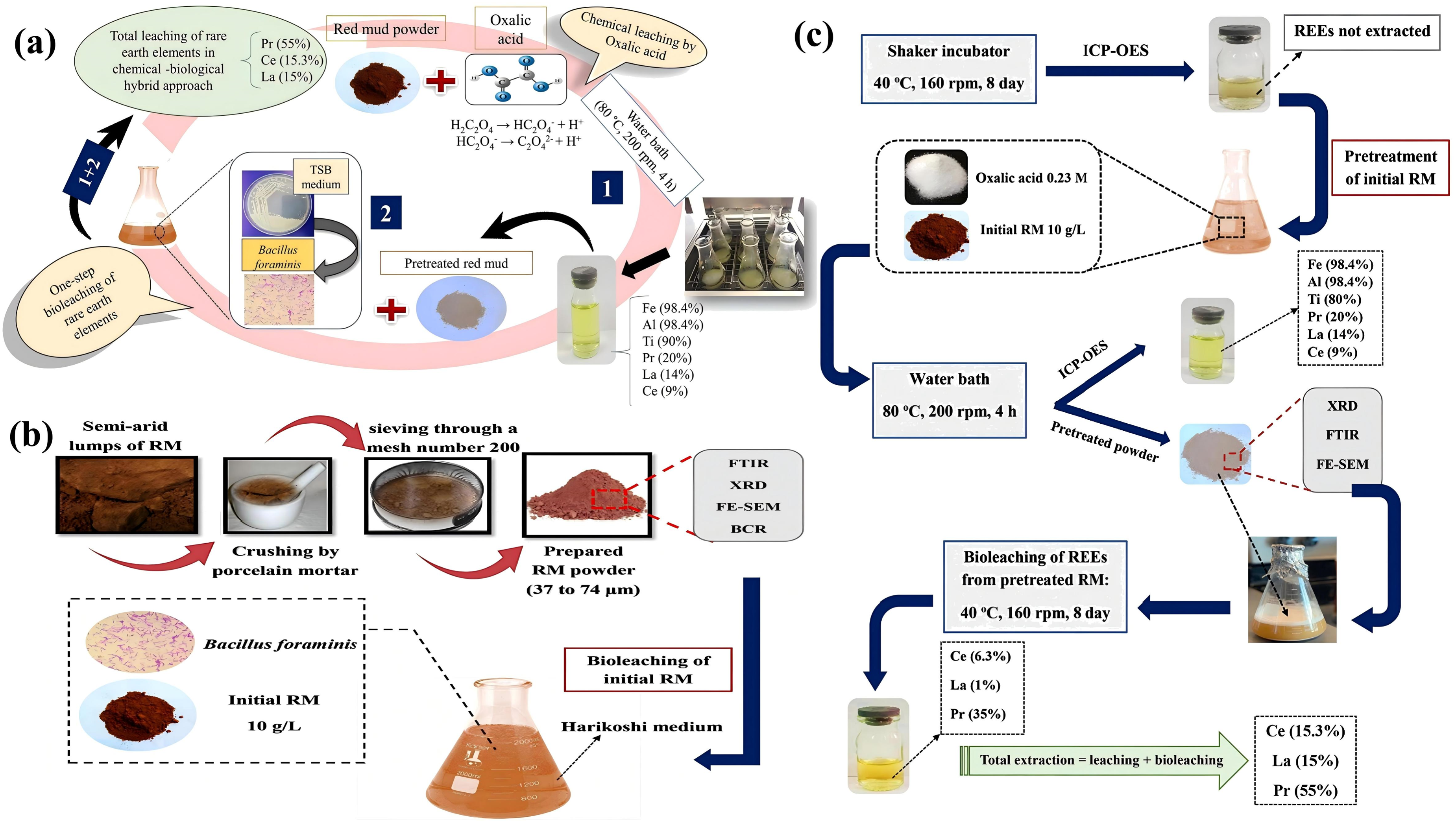
Chemical-biological leaching process: (a) overall schematic diagram; (b) oxalic acid leaching; and (c) biological leaching. 70
Physical field-intensified leaching processes
Physical field-intensified leaching processes use external physical fields (microwave, ultrasonic etc.) to break the mineral lattice of red mud, optimise the mass transfer process of the leaching reaction, and enhance the contact efficiency between leaching agents and REEs, thereby achieving efficient leaching of REEs under milder reaction conditions, shortening the reaction time and reducing reagent consumption. The most representative processes include microwave-assisted leaching (MWAL) and ultrasonic oscillation acid leaching.
MWAL process: The core principle of MWAL is the dual enhancement effect of microwave radiation: on the one hand, the thermal effect of microwave radiation breaks down red mud particles, increases the specific surface area and porosity of the material, and exposes more REE active sites; on the other hand, the non-thermal effect of microwaves enhances the penetration of leaching agents in mineral particles, reduces the activation energy of the leaching reaction, and achieves highly efficient selective recovery of REEs in combination with specific leaching agents. Ebrahimi-Moghaddam et al. 71 employed formic acid as a leaching agent. Leveraging formic acid's ability to form soluble complexes with Nd3+, Pr3+ and Y3+ while exhibiting extremely weak complexation stability with Fe3+ and Ti4+. Under optimised conditions (600 W, 5 min and 1% S/L), they achieved recovery rates of 100%, 91.65% and 60.21% for Nd, Pr and Y, respectively, with Fe leaching < 4%. This significantly suppressed co-dissolution of impurities, demonstrating superior selectivity compared to conventional sulphuric acid leaching. Microstructural analysis (FE-SEM and BET) revealed that microwave irradiation increased the specific surface area of residues from 7.50 to 54.38 m2/g, creating favourable conditions for the reaction, as shown in Figure 11.
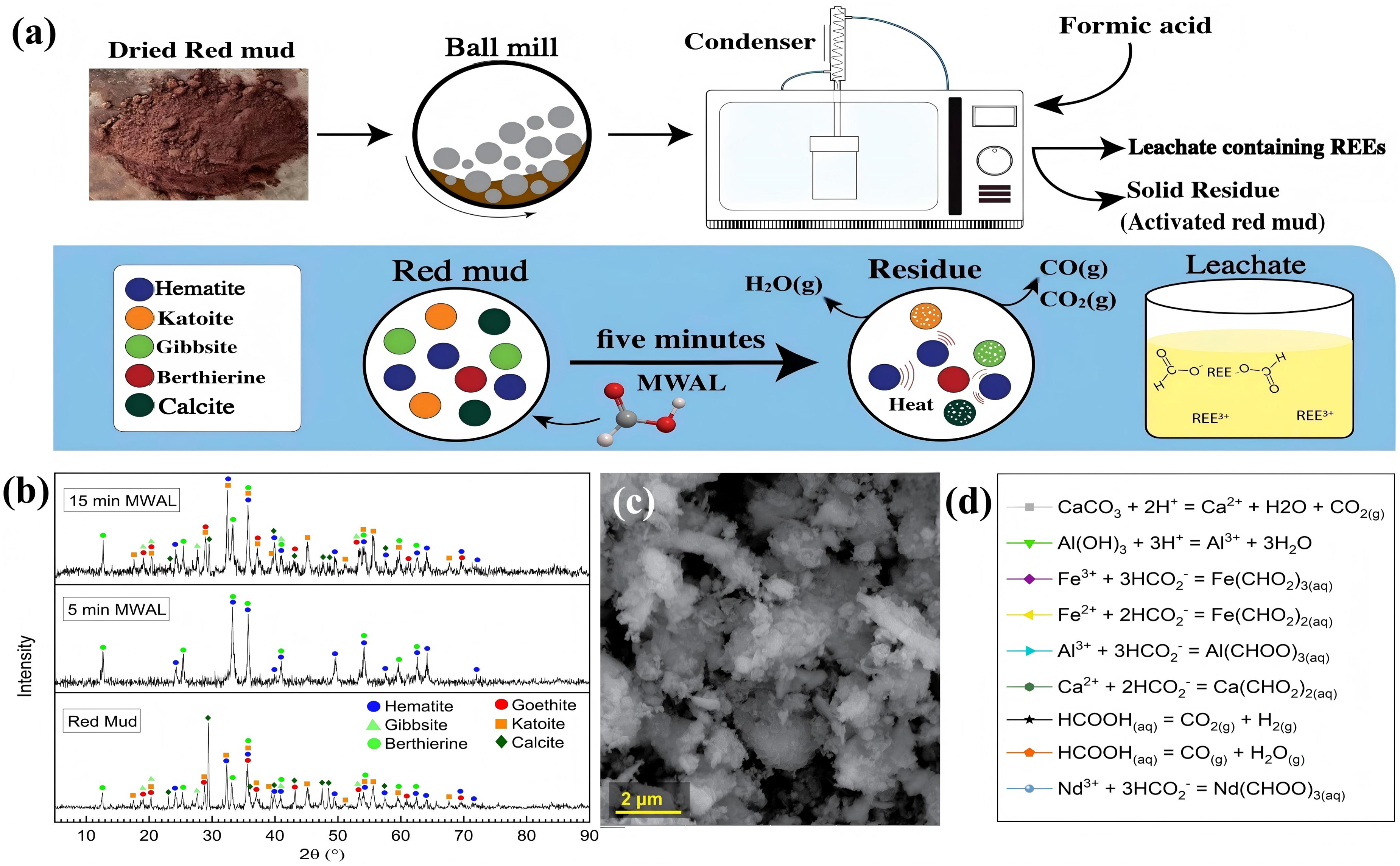
Microwave-assisted leaching of rare earth elements: (a) experimental flowchart; (b) XRD spectra of red mud and leaching residue after 5-minute and 15-minute leaching with 0.6 mol/L formic acid at microwave powers of 5% and 800 W, respectively; (c) FE-SEM high-magnification images of red mud residues after 5 min of microwave-assisted leaching; (d) standard Gibbs reaction equations for possible reactions at different temperatures. 71
It is worth noting that the significant disparity in recovery rates for Nd, Pr and Y observed in this study can be explained by two key mechanisms. The first is the difference in the occurrence states of REEs: the ultra-low iron leaching rate of < 4% indicates that the formic acid system cannot disrupt the iron oxide lattice, while Y is primarily present within this lattice via isomorphous substitution. In contrast, Nd and Pr are mostly distributed in exchangeable states and carbonate complexes, which can be leached without disrupting the lattice. Second, intrinsic differences in complexation capacity: the smaller ionic radius of Y3+ results in formate complexes that are significantly less stable than those of Nd3+ and Pr3+, preventing stable migration and recovery within the leaching system. Reid et al. 72 employed a combined ‘microwave pretreatment-sulphuric acid leaching’ approach for Rio Tinto red mud in Canada. First, microwave pretreatment at 1000 W for 10 min under a nitrogen atmosphere reduced the red mud particle size and increased its specific surface area. Subsequently, optimised sulphuric acid leaching conditions – 1.5 mol H2SO4, 90 °C, a solid–liquid ratio of 1:15 and 30 min leaching – achieved leaching rates of 81.8%, 92.6% and 59.7% for Ce, La and Sc, respectively. Subsequent purification and enrichment via a two-step precipitation method achieved impurity removal exceeding 90% and REE loss below 5%. Both studies validated the enhanced extraction efficiency of microwave-assisted technology for red mud REEs. The formic acid system emphasised selective separation, while the combined sulphuric acid system prioritised high-efficiency recovery and industrial feasibility. Together, they provide diverse, efficient technological pathways for red mud REE resource utilisation.
Ultrasonic oscillation acid leaching: The breakthrough of this process lies in leveraging the cavitation effect and microjet action of ultrasonic waves to overcome the technical bottlenecks of slow mass transfer and incomplete reactions in traditional acid leaching. It synergistically enhances Sc dissolution efficiency through the combined effects of physical fields and chemical leaching. Wang et al. 73 found that under ultrasonic oscillation conditions, microjets shattered the silicoaluminate shells encapsulating Sc in red mud, exposing the internal Sc₂O₃. This accelerated the mass transfer rate of H+ in the leachate, mitigated uneven reactions caused by localised acid consumption, and simultaneously controlled the reaction time to 10 min, temperature to 60 °C, hydrochloric acid concentration of 6 mol/L and a liquid-to-solid mass-volume ratio of 5:1 (mL/g). This solid–liquid ratio ensures uniform ultrasonic propagation, while the 60 °C temperature and 6 mol/L hydrochloric acid concentration, respectively, balance reaction rate and acid consumption, guaranteeing sufficient H+ supply. The technical challenge of this process lies in preventing uneven ultrasonic energy transfer caused by red mud particle agglomeration while balancing acid consumption and equipment energy consumption to control costs. Ultimately, through the synergistic effects of the aforementioned parameters, the Sc leaching rate exceeds 93%. Compared to traditional acid leaching, ultrasonic technology significantly enhances the leaching efficiency and reaction rate of REEs by physically breaking barriers and intensifying mass transfer.
Novel medium-based separation and leaching processes
This type of process breaks through the limitations of traditional inorganic acid leaching agents and conventional extractants, and develops novel leaching and separation media with high selectivity, low environmental risk and good biodegradability, to achieve efficient and green separation and recovery of REEs from red mud, especially for the selective enrichment of low-grade and scattered REEs. The most widely studied processes include ionic liquid leaching and synergistic solvent extraction systems.
Ionic liquid leaching method: The core of this process is ‘Bronsted Acidic Ionic Liquid Dual-Action Mediated Leaching’, which leverages the dual properties of ionic liquids – Bronsted acidity (proton supply) and organic solvent characteristics (selective dissolution) – to achieve synergistic extraction of Sc and Ti without requiring red mud pretreatment. This approach avoids the pollution issues and insufficient selectivity inherent in traditional inorganic acid leaching. The specific process described by Bonomi et al. 74 is as follows: Bronsted acidic ionic liquids are used as the leaching medium, mixed with red mud at a specific slurry concentration, and directly leached for a certain period under suitable temperature and agitation conditions. The ionic liquid first provides H+ through Bronsted acid dissociation, disrupting the aluminosilicate and titanate mineral lattices hosting Sc and Ti in red mud (similar to protonation by traditional acids), thereby releasing Sc3+ and Ti4+ ions from the lattice into the ionic liquid phase; simultaneously, the organic cations and anions in the ionic liquid form stable solvated complexes with Sc3+ and Ti4+ ions. This inhibits re-adsorption or hydrolysis of the target ions, enhancing dissolution selectivity. In contrast, impurity ions such as Fe3+ and Al3+ exhibit weaker complexation with the ionic liquid and are thus less effectively dissolved. Davris et al. 75 further conducted empirical studies using Bronsted acidic ionic liquids such as bis (trifluoromethylsulfonyl) imide (Hbet[TF2N]) as leaching agents. Under conditions of 2.5% pulp concentration, 150 °C leaching temperature and 4–24 h leaching time, they achieved total REE leaching rates of 65%–85%, though the leaching rate for Sc remained relatively low at ∼45%. Overall experimental results demonstrate that this process enables efficient synergistic leaching of Sc and Ti. Compared to traditional inorganic acids like sulphuric acid and hydrochloric acid, the ionic liquid system exhibits more pronounced suppression of impurities, yielding higher purity of target metals in the leachate. This approach provides a novel pathway for the environmentally friendly extraction of REEs from red mud.
The D2EHPA-TBP synergistic solvent extraction method achieves highly selective enrichment of Sc from red mud leachate by leveraging the synergistic effects of proton exchange in the primary extractant and complexation in the co-extractant. Wang et al. 76 employed a sulfonated kerosene solution containing 10% D2EHPA (diethylhexylphosphoric acid) and 5% TBP (tributyl phosphate) as the organic phase. Under conditions of pH = 0.1, this phase was contacted with red mud leachate for 4 min to achieve near-complete extraction of Sc and partial separation of Al and iron. The core mechanism is as follows: D2EHPA, acting as an acidic phosphooxygen extractant, dissociates and releases protons in the low-pH environment. It preferentially undergoes proton exchange reactions with Sc3+ ions, which have a small ionic radius and high charge density, forming hydrophobic complexes that are transferred to the organic phase. TBP, acting as a neutral co-extractant, forms a more stable multivalent system with the aforementioned complex through hydrogen bonding, further enhancing the extraction efficiency and selectivity of Sc. Meanwhile, Al3+ and Fe3+ achieve only partial extraction due to their weaker complexation stability with D2EHPA and suppression by the common-ion effect under strongly acidic conditions. The technical challenges of this process primarily focus on three aspects: first, precise pH control balance the promotion of selective complexation of Sc3+ by the strongly acidic environment with its slight inhibitory effect on D2EHPA dissociation; second, maintaining organic phase stability (D2EHPA readily undergoes hydrolysis under strongly acidic conditions, and the TBP ratio significantly impacts synergistic extraction efficiency – imbalance can cause the synergistic effect to fail); and third, controlling extraction kinetics (reaction rates are influenced by interphase contact conditions; insufficient extraction time leads to incomplete Sc extraction, while excessive time increases the risk of co-extraction of impurities).
In summary, single conventional technologies have inherent limitations that are difficult to break through, while emerging integrated and intensified processes achieve performance improvement through process coupling, physical field intensification and novel medium development, providing diverse technical paths for REE recovery from red mud. However, from laboratory research to industrial application, all the above technologies still face common and insurmountable core bottlenecks, which are derived from the inherent characteristics of red mud and the technical limitations of existing processes, and are systematically analysed in the following section.
Membrane separation and selective precipitation purification technologies
Membrane separation and selective precipitation are efficient and green routes for selective recovery of REEs from impurity-rich leachate of red mud, which can effectively address the interference of Fe3+, Al3+ and other impurities in traditional processes.
Nanofiltration (NF) and ion-exchange membrane separation: NF achieves selective interception and pre-concentration of REEs based on ion-size sieving and charge exclusion. Siddiqui et al.
77
systematically investigated NF for REE recovery from red mud acid leachate. Under optimised conditions of pH 3.5 and operating pressure 1.2 MPa, the REE recovery rate via NF rejection reached ∼90%. The NF process can concentrate REEs and remove partially soluble impurities simultaneously, providing high-quality feed for subsequent purification and reducing the load of solvent extraction or precipitation. Oxalic acid selective precipitation: Oxalic acid precipitation is the most mature and widely used selective precipitation method for REEs. Li et al.
51
verified the selective precipitation of REEs from red mud leachate using oxalic acid. Due to the ultra-low solubility product of rare earth oxalates, REEs can form insoluble precipitates selectively under room temperature, slightly acidic, excess oxalic acid, while Fe and Al impurities remain stable in solution in the form of complexes. This method enables one-step separation of REEs from impurities under mild conditions and low cost, which is suitable for industrial purification of red mud leachate.
In summary, NF and selective oxalic acid precipitation constitute a mild, efficient and green purification tandem for REE recovery from red mud leachate. NF achieves effective pre-concentration and impurity rejection, while oxalic acid precipitation realises high-selectivity REE separation. Together, they effectively reduce the difficulty of subsequent purification, lower reagent consumption and environmental load, providing key technical support for the green and efficient purification of REEs from complex red mud systems.
Quantitative comparison of the comprehensive performance of different REE recovery processes
To address the lack of quantitative comparisons between different technologies in existing reviews, this article systematically compiles the core technical, economic and environmental parameters of mainstream processes for rare earth extraction from red mud, as summarised in Table 3.
Quantitative comparison of core performance of mainstream REE recovery processes from red mud.
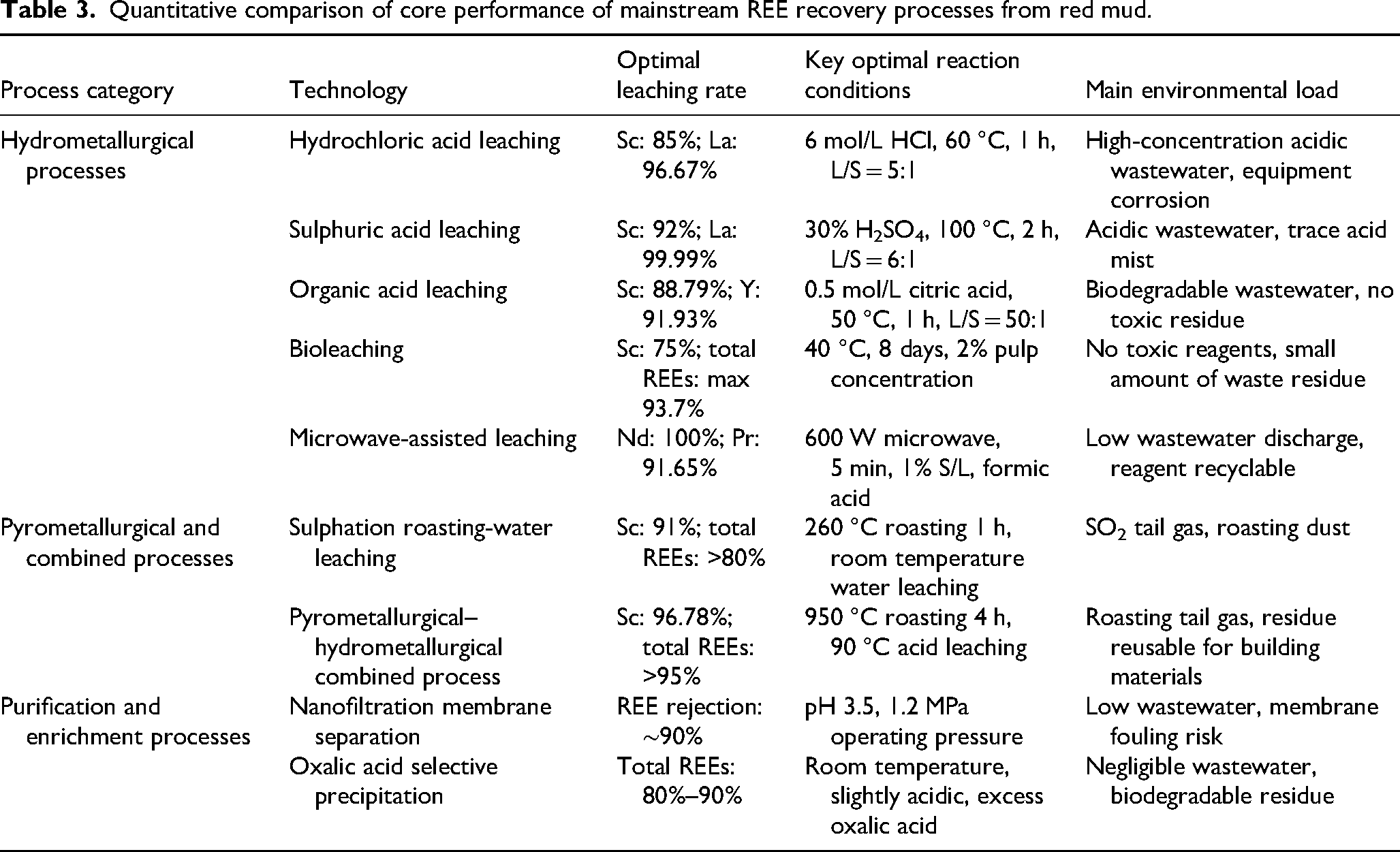
The significant differences in REE leaching rates stem from disparities in ionic radius, valence state and mineral occurrence phases. Light REEs (La, Pr and Nd) predominantly occur in easily leachable carbonate or exchangeable phases; yttrium (Y) isomorphously substitutes in iron-titanium oxide lattices, resisting mild acid attack; cerium (Ce) readily oxidises to insoluble CeO₂ under ambient conditions, resulting in extremely low recovery; scandium (Sc) is tightly associated with perovskite, requiring harsher conditions for effective release.
Based on the aggregated data presented above, this article conducts a comprehensive, integrated comparison of the overall performance of different processes across three dimensions – technical, economic and environmental. NF is prominent in pre-concentration and mild impurity removal with low secondary pollution, whereas oxalic acid precipitation excels in one-step selective separation with high efficiency and low cost. Both processes serve as high-efficiency supplementary purification routes that can be coupled with mainstream leaching technologies to further improve product purity and reduce environmental burdens. In terms of technical performance, the pyrometallurgical–hydrometallurgical combined process achieved the highest rare earth leaching efficiency (up to 96.78% for scandium), followed by the sulphuric acid leaching and sulphidation roasting processes; all three processes achieved leaching efficiencies of over 90% for the target REEs. In contrast, bioleaching, constrained by microbial metabolic rates, exhibited the lowest leaching efficiency under the same time scale. Notably, microwave-assisted leaching and the combined process possess a distinct advantage in separation selectivity, with the co-leaching rate of iron and aluminium controllable within 5%. This represents a reduction of more than one order of magnitude compared to conventional inorganic acid leaching (60%–80%), significantly reducing reagent consumption in subsequent purification stages; simultaneously, microwave-assisted leaching shortens the reaction cycle to 5 min – a reduction of 2–3 orders of magnitude compared to conventional acid leaching and bioleaching – demonstrating immense potential for industrial-scale continuous production. In terms of economics, conventional inorganic acid leaching incurs high total costs driven primarily by subsequent purification processes due to high co-leaching rates of impurities; while the cost of pyrometallurgical processes is primarily driven by energy consumption; conversely, the long reaction cycles of bioleaching and organic acid leaching result in low equipment utilisation rates, which is the main factor limiting their large-scale application. In terms of environmental benefits, conventional inorganic acid leaching generates large volumes of high-concentration acidic wastewater, placing significant pressure on subsequent treatment; organic acid leaching and bioleaching, however, substantially reduce wastewater discharge, and the organic components in the wastewater are biodegradable; sulphation roasting generates sulphur dioxide emissions, requiring additional desulphurisation treatment; in contrast, the leaching residue from the combined process can be directly reused for building materials after roasting, achieving the harmless disposal of solid waste.
Building on the multidimensional comparison of recovery efficiency, energy consumption and environmental impacts across mainstream technologies, combining the rare earth distribution characteristics of different types of red mud discussed in the ‘Regional distribution characteristics and occurrence forms of REEs’ section, this article further clarifies the specific applicability and limitations of each process, overcoming the limitations of generalised technical descriptions. Conventional hydrochloric acid leaching offers a cost-effectiveness advantage only for red mud from the high-calcium sintering process, as the REEs in this type of red mud primarily exist in a calcium-bound form that is easily leached; an 85% scandium leaching rate can be achieved under 6 mol/L hydrochloric acid conditions; however, this process is not suitable for Bayer process red mud, as the acid concentration must be increased to over 10 mol/L to break down the iron–titanium oxide lattice, which would result in excessively high acid consumption and severe equipment corrosion. The combined pyrometallurgical–hydrometallurgical process is specifically designed for high-iron Chinese Bayer process red mud: through roasting, hematite is reduced to metallic iron, releasing the lattice-trapped REEs and pre-removing 98% of iron impurities, thereby resolving the core issue of severe co-leaching of impurities in direct acid leaching. However, its high energy consumption makes it economically unfeasible when applied to low-iron sintered red mud. Sulphation roasting is the only process capable of selectively enriching scandium from low-grade Australian red mud. It disrupts the perovskite lattice at 260 °C and separates scandium from impurities based on differences in sulphate thermal stability. However, this process generates large amounts of sulphur dioxide exhaust gas, requiring expensive desulfurisation equipment. Microwave-assisted organic acid leaching offers unique advantages for Brazilian red mud with high heavy rare earth content. It can selectively leach heavy rare earths such as yttrium under mild conditions, with a co-leaching rate of iron and aluminium below 4%, thereby avoiding the dissolution of large amounts of impurities. However, the high capital investment in equipment limits its large-scale application in red mud dominated by low-value light rare earths. This specific match between the process and red mud provides a clear direction for the industrial application of rare earth extraction from different types of red mud. Despite the clear process-specific applicability, several core technical bottlenecks still hinder large-scale industrialisation, which are analysed in depth in the following section.
Challenges and development prospects of REE recovery technologies
In recent years, key metals such as REEs associated with bauxite have garnered increasing attention from scholars. Extensive research has been conducted on the origin of these key metals, 77 their enrichment mechanisms, 78 , 79 the occurrence states of REEs80,81 and their recovery and utilisation technologies, 82 yielding significant progress. Nevertheless, the inherent characteristics of red mud – including its strong alkalinity, high salinity and radioactivity – have constrained its comprehensive utilisation. To date, no economically viable large-scale disposal or comprehensive utilisation technology has been established, resulting in a global utilisation rate below 10%. The implementation of large-scale, environmentally sound treatment and resource recovery for red mud has become an urgent priority. 83
Key constraints and technical barriers of REE recovery
The industrialisation of REE recovery from red mud is fundamentally constrained by the inherent trade-off between technical efficiency, economic cost and environmental impact. Although various recovery technologies have been developed, there remains a lack of systematic comparative analysis and targeted process-matching guidance for different types of red mud. Building on the core technical, economic and environmental parameters of mainstream processes summarised in Table 3, this article first conducts a systematic evaluation of seven dominant REE recovery technologies across four dimensions consistent with the framework proposed in the abstract, clarifies targeted process matching schemes for different red mud types, and then dissects the core technical bottlenecks and underlying scientific problems restricting large-scale application.
Multi-dimensional performance comparison and process applicability
In terms of technical recovery performance, the pyrometallurgical–hydrometallurgical combined process achieves the highest efficiency, as high-temperature roasting can completely destroy the iron–titanium oxide lattices that encapsulate REEs. Sulphuric acid leaching and microwave-assisted leaching follow closely, both achieving excellent target element recovery under optimal conditions. Organic acid leaching, sulphation roasting-water leaching and hydrochloric acid leaching show moderate performance, while bioleaching exhibits the lowest recovery efficiency on the same time scale due to the slow metabolic rate of microorganisms. The core bottleneck restricting the recovery efficiency of most hydrometallurgical processes is the isomorphous substitution of REEs in stable mineral lattices, which cannot be effectively disrupted under mild conditions.
Regarding energy consumption, bioleaching and organic acid leaching have the lowest energy requirements, as they can complete the leaching process at temperatures between 40 °C and 50 °C without high-temperature treatment. Hydrochloric acid and sulphuric acid leaching require moderate heating to 60 °C and 100 °C, respectively, while microwave-assisted leaching has higher energy consumption due to the operation of microwave equipment. Pyrometallurgical processes, which require heating to 260 °C for sulphation roasting and 950 °C for the combined process, have significantly higher energy consumption that accounts for the majority of their total operational costs.
From an economic perspective, bioleaching has the lowest direct operating cost as it requires no expensive chemical reagents. Organic acid leaching is limited by the high price of reagents such as citric acid, while inorganic acid leaching has moderate direct reagent costs but incurs substantial subsequent purification costs, which account for 40%–60% of the total cost due to the 60%–80% co-leaching rate of iron and aluminium impurities. Microwave-assisted leaching requires high initial equipment investment, and sulphation roasting and the combined process have the highest overall costs, driven by energy consumption and exhaust gas treatment requirements.
In terms of environmental impact, bioleaching and organic acid leaching are the most environmentally friendly options, as they use no toxic reagents and produce biodegradable wastewater. Microwave-assisted leaching generates low volumes of wastewater and allows for leaching agent recycling, while the combined process offers the additional benefit of leaching residue reuse for building material production. Conventional inorganic acid leaching produces large quantities of high-concentration acidic wastewater and causes severe equipment corrosion, with sulphuric acid leaching also generating trace acid mist. Sulphation roasting has the most severe environmental impact due to the generation of large volumes of sulphur dioxide tail gas that requires complex treatment to meet emission standards.
Combined with the mineral composition and REE occurrence characteristics analysed in the ‘Analysis of physicochemical properties and mineral composition of red mud’ and ‘Regional distribution characteristics and occurrence forms of REEs’ sections, this article clarifies the targeted applicability of each technology for the three main industrial red mud types. For Bayer process red mud, which has high iron content and 90% of REEs locked in hematite and perovskite lattices, the optimal process is the pyrometallurgical–hydrometallurgical combined process, which removes 98% of iron impurities in advance and releases lattice-trapped REEs, solving the core problem of high impurity co-leaching. Microwave-assisted leaching serves as a suitable alternative, achieving selective recovery of light REEs with an iron and aluminium co-leaching rate below 4%. Conventional inorganic acid leaching is not applicable, as it requires acid concentrations above 10 mol/L to destroy the stable lattices, leading to excessive reagent consumption and severe equipment corrosion. For the sintering process of red mud, characterised by high calcium content and over 60% of REEs in calcium-binding and ion-exchangeable phases, the optimal process is hydrochloric acid leaching, which achieves excellent scandium recovery under mild conditions with the highest cost performance. Organic acid leaching is a suitable alternative with lower environmental impact, while pyrometallurgical processes are not applicable as their high energy consumption cannot be justified by marginal improvements in recovery rate. For combined process red mud with medium iron and calcium content and mixed REE occurrence, the optimal process is sulphation roasting-water leaching, which achieves selective separation of REEs from impurities based on differences in sulphate thermal stability. Sulphuric acid leaching is a suitable alternative with mature technology, while bioleaching is not applicable due to its long reaction cycle, leading to extremely low equipment utilisation.
Core technical bottlenecks
Alkali in Bayer process red mud exists primarily in two forms: soluble alkali (e.g. NaOH, sodium aluminate and Na2CO3), and insoluble alkali (e.g. hydrated sodium aluminosilicate). 84 These substances not only corrode equipment but also interfere with the leaching process of REEs. The core scientific issue of dealkalisation is the selective removal of lattice-bound structural alkali without destroying the mineral phase encapsulating REEs, so as to avoid REE dissolution loss and excessive impurity leaching. Currently, alkali removal from red mud remains a significant technical challenge.
Zhang et al. 85 investigated alkali removal from red mud through water washing. Results indicated that soaking time and washing frequency significantly influenced removal efficiency. Under conditions of room temperature and a liquid-to-solid ratio of 5:1, soaking red mud for one day and washing it five times or more can remove over 95% of Na+ from red mud. However, water washing only removes soluble alkali and is ineffective against insoluble structural alkali bonded in Si–O–Al lattices, failing to solve the fundamental dealkalisation problem. Khaitan et al. 86 employed hydrochloric acid to neutralise alkali, reducing the pH of red mud from 12.5 to 4.6–8.0. While the acid neutralisation method removes alkali from red mud, it also causes certain metal elements to leach into the leachate and be lost, thereby affecting the subsequent resource utilisation of red mud. 87 The key solution lies in developing selective dealkalisation reagents and mild physical field enhancement to break Si–O–Na bonds specifically, rather than adopting indiscriminate acid corrosion.
Additionally, the presence of trace radioactive elements and other potentially harmful elements commonly associated with red mud poses severe environmental risks, such as surface water and groundwater contamination.88–91 It also contributes to air pollution, as red mud's fine particles are easily dispersed by wind.92,93 Existing separation technologies still face technical bottlenecks in efficiently removing these impurities. Research by Luo et al. 94 indicates that the activity levels of radioactive elements in domestic red mud significantly exceed the limits set by GB 6566-2001 ‘Limits for Radioactive Nuclides in Building Materials’. The core scientific issue of radioactive separation lies in the highly consistent ionic radius and coordination chemical environment between radionuclides and REEs, calcium and iron. Such consistency leads to isomorphous coexistence and solid solution formation within mineral lattices, which fundamentally raises the difficulty of selective separation. Existing physical separation approaches can only remove partial radioactive mineral aggregates and thus present unsatisfactory separation efficiency. Conventional solvent extraction and precipitation processes fail to distinguish radionuclides from REEs and impurity ions, owing to their nearly identical chemical behaviours. Extracting these elements necessitates costly mitigation measures to fully safeguard the environment and worker safety. This process requires advanced mining technologies and substantial investment, presenting another significant obstacle to REE development. 95 The targeted solution is to develop selective extractants or precipitants equipped with specific recognition sites, or to employ sequential phase transformation strategies that enable radionuclide enrichment into a single mineral phase for centralised separation, thereby achieving harmless treatment of bauxite residue.
The resource utilisation of red mud is hampered by its poor economic feasibility and high potential for environmental pollution.96,97 Globally, only a small fraction (ω<10%) of red mud is recycled for applications such as building materials. 98 Effective strategies to improve red mud utilisation often require significantly higher storage costs, estimated at $9–20 per ton, which hinders investment in red mud recovery by alumina producers. 99 Acid leaching, as the mainstream technology for REE recovery from red mud, further exacerbates these challenges: substantial quantities of strong acids such as sulphuric acid and hydrochloric acid are consumed to enhance REE leaching efficiency. This not only increases production costs but also generates significant amounts of acidic waste gases and residues, leading to elevated treatment costs. In terms of energy consumption, processes ranging from leaching and extraction to precipitation and calcination require substantial electrical and thermal energies. Particularly during subsequent refining and purification stages, high-purity REEs production necessitates high temperatures, high pressures, or specialised environments, resulting in sustained high energy consumption. Therefore, the key to enhancing the economic efficiency of the recovery process lies in reducing acid and energy consumption while improving resource utilisation through process optimisation and operational refinement.
To develop more scalable environmentally friendly red mud recycling processes, it is essential to consider not only economic viability but also the impact of these processes on environmental balance and their effects on other industries. 100 Applying biotechnology to recover REEs from red mud offers higher efficiency and environmental benefits, demonstrating significant potential for future applications.101,102
Green innovation pathways and industrialisation strategies for REE recovery
The future development of REE recovery technology from red mud encompasses four core directions:
Development and application of green and efficient leaching agents and extractants: Biomass-derived organic acids, including citric acid, oxalic acid and levulinic acid, have emerged as promising alternatives to conventional inorganic acids for REE leaching. Under optimised conditions (liquid-to-solid ratio 40:1, 70 °C, 60 h), levulinic acid can achieve ∼100% leaching of REEs except scandium from red mud, with the advantages of low corrosivity and good biodegradability.
103
Citric acid, another widely studied bio-based leaching agent, has been shown to achieve 88.79% scandium leaching efficiency and 91.93% yttrium leaching efficiency under mild conditions.
49
For green extraction systems, ionic liquids and deep eutectic solvents have attracted significant attention due to their low volatility and high selectivity. Ionic liquid [HLaur][Tf₂N] achieves 44.4% scandium extraction efficiency and excellent selectivity over aluminium at pH 3.0, with a total scandium extraction efficiency of 94.4% after five stages of countercurrent extraction.
104
Among crown ether-based selective extraction agents, 15-crown-5, 12-crown-4 and 2,2,2-cav-ether are ideal macrocyclic compounds for the selective extraction of scandium. Combined with pH control and oxalic acid elution, they enable the efficient separation and recovery of Sc3+.
105
Synergistic multi-element utilisation and full-chain closed-loop application: Centred on leaching and extraction technologies, pretreatment processes are integrated with the resource utilisation of waste residues and liquids to establish a closed-loop, full-chain recycling system. For instance, microwave pretreatment can be used to disrupt mineral structures via high-frequency electromagnetic waves, or ultrasonic pretreatment to disperse and fracture particles, precisely breaking the crystal lattice of red mud minerals. This fully exposes REE active sites, thereby enhancing processing efficiency.
106
After leaching, REEs are separated using highly selective extractants. The remaining waste liquid is neutralised to recover elements such as Al and Fe for water purification agent production. The leaching residue is uniformly mixed with cement, sand and gravel in specific proportions to produce sintered bricks.
107
Alternatively, the leaching residue can be combined with suitable auxiliary materials to produce high-strength, red mud-based non-fired permeable bricks, as shown in Figure 12.
108
The neutralised waste liquid is recycled as dilution water for flotation agents. This establishes an ‘iron-REE-building materials’ industrial chain that reduces REE recovery costs while minimising red mud accumulation, thereby implementing circular economy principles. Based on research published by Balomenos et al.
101
on the Mud2Metal project, Europe has demonstrated the feasibility of a fully closed-loop utilisation of red mud by establishing a cross-sectoral industrial symbiosis model involving ‘alumina – rare earths – building materials’. By recovering key metals such as rare earths from red mud and using the remaining residues in the production of building materials, this model has successfully achieved both high-efficiency resource valorisation and zero environmental emissions, providing a solution for the full-scale industrial utilisation of red mud that is viable from both economic and environmental perspectives. Microbial screening, genetic engineering and optimised bioleaching: Bioleaching using microorganisms and their metabolites provides an environmentally friendly route for REE recovery. Indigenous strains such as Penicillium tricolour RM-10 isolated from red mud have been systematically studied, achieving 75% Sc leaching efficiency and over 95% dealkalisation rate.
63
Multiple strains, including Aspergillus niger and Gluconobacter oxydans, have been screened and optimised for REE leaching from red mud.
62
Breakthroughs have been achieved in genetically engineered bacteria: Through systems biology-based modification of Gluconobacter oxydans, the inhibitory gene pstS was knocked out, and the key acid-producing gene mgdh was overexpressed. Compared to the wild-type strain, the modified strain demonstrated a 73% increase in rare earth extraction efficiency at a 1% pulp concentration and a 53% increase at a 10% pulp concentration, achieving highly efficient bioleaching under mild conditions. The study confirms that genetic engineering is an effective strategy for overcoming the efficiency bottleneck in bioleaching.
109
Industrial policy support and market incentive mechanisms: To establish a comprehensive environmental regulatory framework for red mud REE recovery, detailed rules governing pollutant emissions throughout the entire process must be formulated. Clear limits for radioactive elements should be defined, and an access list for environmentally friendly leaching and extraction agents should be established to institutionally standardise the industry's green development. Concurrently, market-based incentive mechanisms such as carbon trading and environmental subsidies should be explored to attract more social capital into the red mud REE recovery sector, reducing resource utilisation costs and promoting the industry's long-term green and sustainable development. In December 2024, six ministries of China issued the Action Plan for Comprehensive Utilisation of Red Mud, which sets clear targets and policy support for technology innovation and industrial demonstration.
110
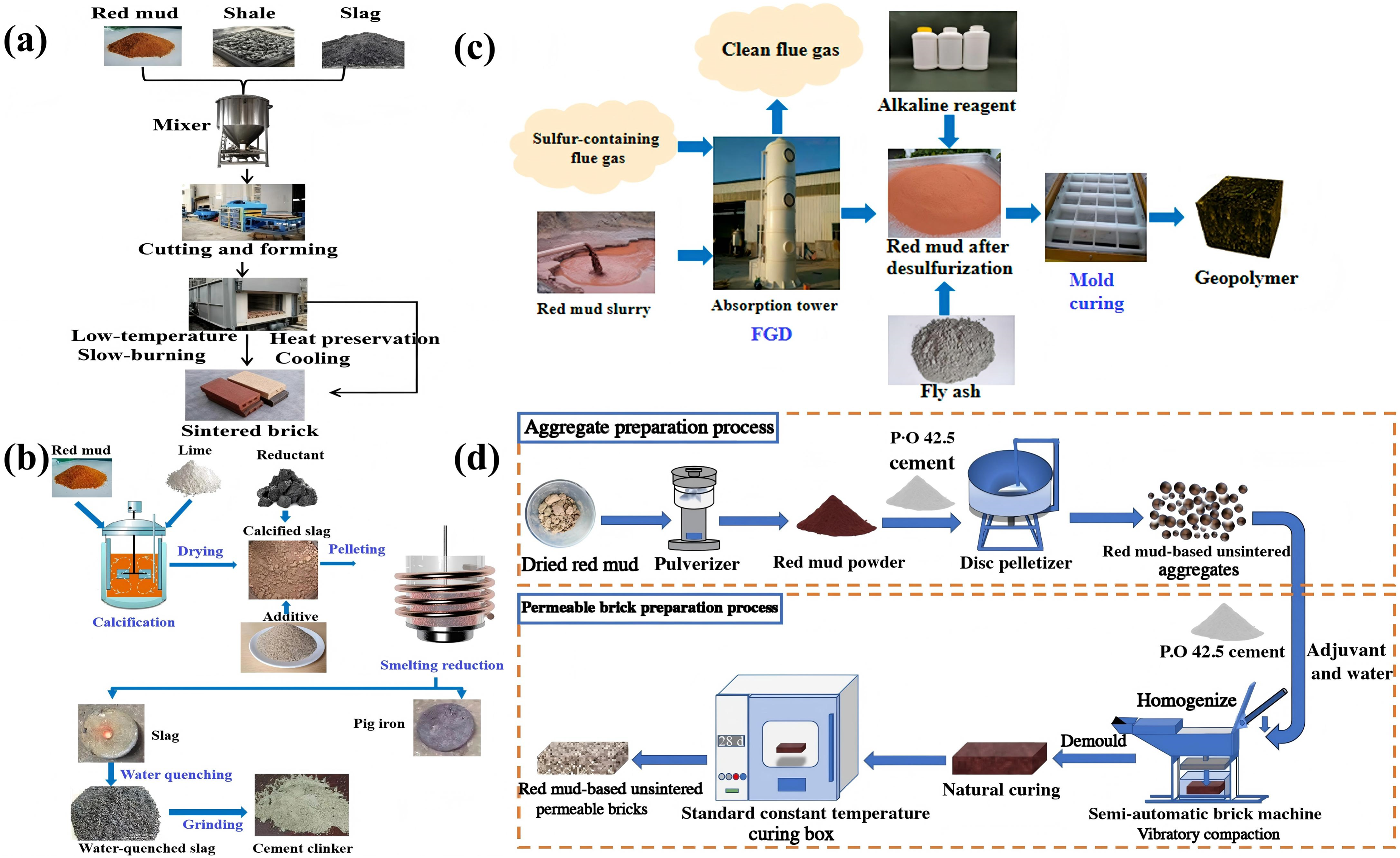
Conclusion
This review systematically summarises the current state of REEs recovery from red mud, with the following core conclusions: REEs are highly dispersed in red mud's mineral lattices via isomorphous substitution. This fundamental characteristic necessitates effective recovery via chemical or high-temperature processes that can fully disrupt the mineral structure. However, existing mainstream recovery technologies have significant limitations: hydrometallurgical acid leaching is efficient but environmentally polluting; pyrometallurgical roasting offers good selectivity but high energy consumption; and biometallurgical methods are environmentally friendly but time-intensive. To date, no single technology has been able to simultaneously achieve high efficiency, low carbon footprint and economic viability. Therefore, industrialisation requires cross-disciplinary collaboration and a focus on three core breakthroughs: developing green, efficient leaching and separation materials; establishing an integrated process chain (pretreatment–extraction–separation–waste residue utilisation); and fostering a regional industrial ecosystem (‘alumina-REE-building materials’) via policies and standards. In summary, REE recovery from red mud is technically feasible, but scaling up its application remains constrained by the gap between scientific principles and engineering practice. Future success will depend on synergistic innovation across green chemistry, process engineering and industrial policy.
Footnotes
Acknowledgements
The authors would like to thank the Open Foundation of State Key Laboratory of Featured Metal Materials and Life-Cycle Safety for Composite Structures (grant no. MMCS2023OF02) and the National Natural Science Foundation of China (grant no. 52474287) and China Postdoctoral Science Foundation (grant no. 2024M751861).

Funding
The authors disclosed receipt of the following financial support for the research, authorship, and/or publication of this article: This work was supported by the China Postdoctoral Science Foundation, National Natural Science Foundation of China, Open Foundation of State Key Laboratory of Featured Metal Materials and Life-cycle Safety for Composite Structures (grant numbers 2024M751861, 52474287 and MMCS2023OF02).
Declaration of conflicting interests
The authors declared no potential conflicts of interest with respect to the research, authorship, and/or publication of this article.