







Abstract
Ultrasonic measurements have been used to characterise the solutionising phenomenon in Rene 80, a Ni based superalloy. Starting material was solutionised at 1204°C for 30–120 min on identical samples. The microstructures of these samples were evaluated by ultrasonic immersion technique, X-ray diffraction and scanning electron microscopy. It was observed that the area fractions and, consequently, the γ′ volume fractions were decreased by increasing the solutionising time. A direct correlation was observed between ultrasonic wave velocity and solutionising time at 1204°C. The ultrasonic compression wave velocity followed a descending pattern similar to that of γ′ area fraction with the increase in solutionising time. The observed variation in ultrasonic velocity has been attributed to the effect of the γ′ dissolution on the elastic constants of the material.
Introduction
Ni based superalloys are widely used in applications requiring strength at high temperatures. The excellent high temperature properties of superalloys are mainly dependent on the unique microstructure of these alloys. The two major phases that may be present in Ni based superalloys are gamma matrix γ and gamma prime γ′. γ is a face centred cubic (fcc) non-magnetic phase that usually contains a high percentage of solid solution elements, such as Co, Fe, Cr and W. All Ni based alloys contain this phase as the matrix.1 γ′ is an ordered fcc (L12) type intermetallic compound with the general formula of A3B. Typically, in a Ni based alloy, γ′ is Ni3(Al,Ti), which Ni and Al dominated, although it is common to add at least as much Ti as Al. The γ′ is a unique intermetallic phase. The strength of γ′ increases as temperature increases; furthermore, the inherent ductility of the γ′ prevents it from being a source of fracture.2
Superalloy designers have increased the operating temperature capabilities of the alloys by gradually increasing the volume fraction of the major fcc strengthening phase γ′-Ni3(Al,Ti) through increased additions of Al and Ti to fcc matrices.3 The mechanical properties of superalloys are strongly dependent upon the size and distribution of the γ′ precipitates. The conventional process of heat treatment for Ni based superalloy consists of solutionising (dissolving γ′ into gamma matrix) and precipitation hardening (precipitation of γ′ in the solution treated matrix).1
Microstructure characterisation of the materials by non-destructive methods, with the aim of evaluating their mechanical properties, has become increasingly important in recent years. The ultrasonic technique has been extensively used for characterisation of microstructure, assessment of defects and evaluation of material properties. The material examination by ultrasonic methods depends on the various properties of the material, including the phase velocity, attenuation and acoustic impedance.4,5
The ultrasonic measurements have been used to characterise precipitation of Cu in 17-4 PH steel,6 carbide and ordered precipitates in Nimonic alloy PE 16,7 and intermetallics in Zircaloy-2.8 The ultrasonic velocity measurements have also been attempted for the characterisation of solutionising and precipitation behaviour in various alloy systems. This includes Al alloys,9 ferritic steel,10 maraging steel,11 Ni based alloys12 and Ti alloys.13 The assessment of microstructural changes in the alloy 6254 and Nimonic 263,14 by ultrasonic techniques has also been reported.
Extensive data on the physical and mechanical properties of superalloys could be found in the literature.2 However, fundamental data relating microstructural features to ultrasonic properties are rarely reported. The objective of the present study was to develop an empirical relation between the ultrasonic velocity and the microstructural changes during the solutionising of Rene 80 superalloy.
Experimental
The material used was the cast Ni based polycrystalline superalloy Rene 80 with a chemical composition of Ni–13·4Cr–0·16C–4·11Mo–3·92W–4·77Ti–9·45Co–2·12Al–0·1Fe–0·04Zr (wt-%). The raw material was produced by vacuum melting process.15 Cylindrical samples, 10 mm long and 15 mm diameter, were prepared from this material and then subjected to the solutionising treatment at 1204°C for 30, 60, 90 and 120 min.
For scanning electron microscopy (SEM) examination, Rene 80 samples were electropolished with a solution of 10%HCl+methanol at 20 V for 20 s and electroetched with 170 mL phosphoric acid+10 mL sulphuric acid and 16 g Cr trioxide at room temperature and 5 V for 3–5 s. The area fractions of particles were measured from SEM images employing the Clemex image analysing system. X-ray diffraction was performed on the surface of the polished samples using a Siemens D500 diffractometer with Cu Kα radiation.
The ultrasonic velocity in the samples was measured by pulse echo immersion ultrasonic method. In this method, the sample is placed in water, and the ultrasonic probe is immersed in water over the inspection area. Ultrasonic compression waves are then emitted into the sample by an ultrasonic probe. Water acts as a coupling agent between the probe and sample. The ultrasonic velocity in the sample is determined by measuring the travel time of the wave inside the material. The experimental system consisted of a high frequency ultrasonic pulser/receiver (Panametrics, Waltham, MA, USA), a 100 MHz analogue to digital converter (gage) and a 25 MHz, 30 mm long and 6 mm diameter standard probe (Panametrics).
Results and discussion
Figure 1 shows the SEM image of the Rene 80 samples after solutionising at 1204°C. The microstructure mainly consists of fcc γ-Ni based matrix (continuous dark region), carbides and intermetallic γ′ precipitate phase (cubical light regions), which is dispersed within the matrix. The γ′ shape has been found to be related to matrix–lattice mismatch. It occurs as a sphere at 0–0·2% lattice mismatch, becomes cubes at mismatches around 0·5–1·0% and then becomes plates at mismatches above around 1·25%.2
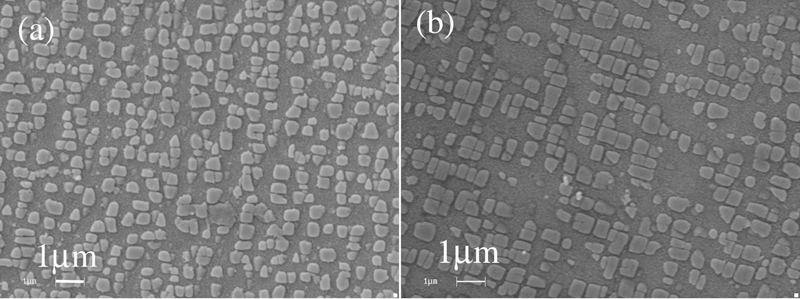
Image (SEM) of Rene 80 sample solutionised for a 30 min and b 90 min
Figure 2 shows the X-ray diffraction patterns of samples solutionised for 30 and 90 min respectively. It can be observed that the ratio of the intensity of the Ni3Al peak over (111) γ peak has drastically increased when the samples are subjected to solutionising for a longer time. It is important to note that this ratio provides a global measurement of the volume fraction of the ordered γ′ precipitates inside the material.16,17
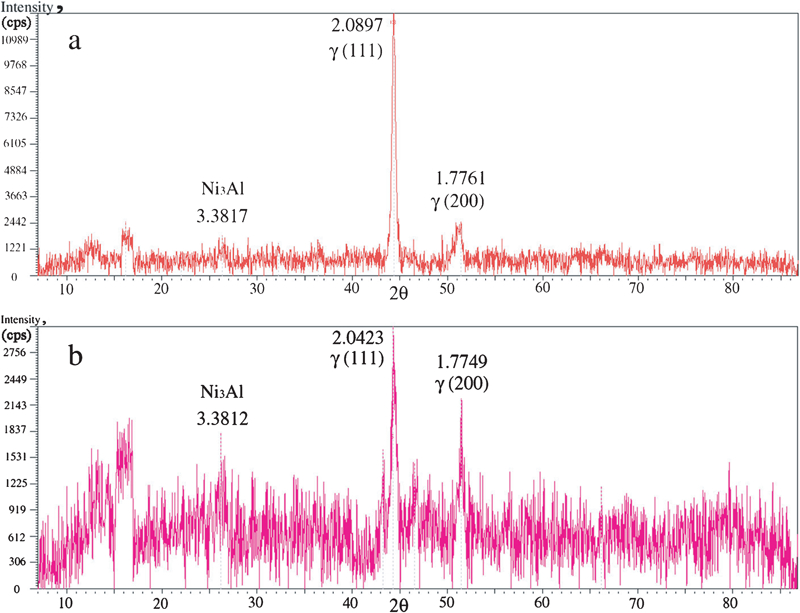
X-ray diffraction patterns of samples solutionised for a 30 min and b 90 min
An image analysis software, Clemex, was used for thresholding the SEM images and measuring γ′area fraction. The software uses the binarisation processing; that is, each pixel has an intensity value ranging from 0 to 250, and a specific range of pixels are assigned with binary values that the computer can manipulate. The variation of the γ′ area fraction with solutionising time is shown in Fig. 3a. It is clear that the area fraction and, consequently, the γ′volume fraction have decreased by increasing the solutionising time. Figure 3b shows the variations in ultrasonic velocity with heating time at 1204°C. It can be observed that the ultrasonic compression wave velocity follows a descending pattern similar to that of Fig. 3a with the increase in the solutionising time.
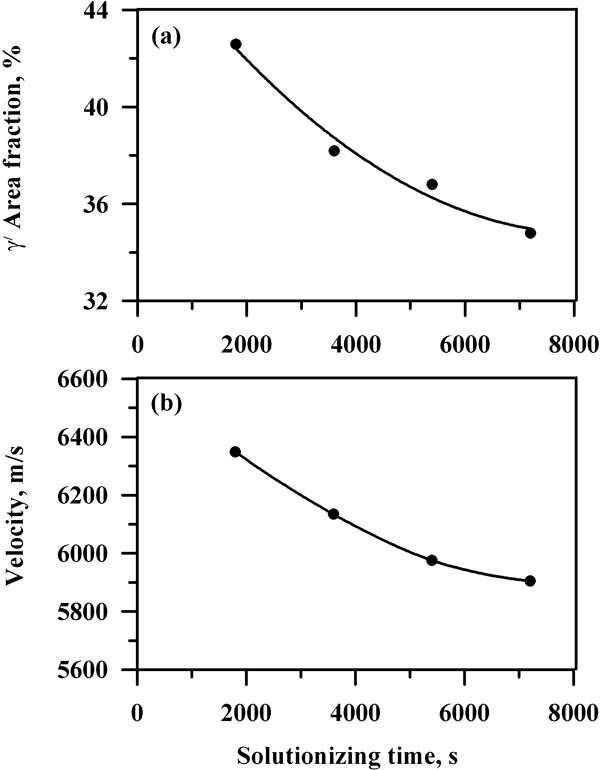
Variation of a γ′ area fraction and b ultrasonic compression wave velocity with solutionising time
The ultrasonic velocity in a material is influenced by its elastic constants and density. In the present study, the γ′ precipitates have high volume fractions. The density of the Ni3Al has been reported to be lower than the average density of the Rene 80 superalloy.18 On the other hand, the fcc gamma matrix of Rene 80 consists principally of Ni, Co, Cr, Mo and W, which result in a density of 8·2 g cm−3 for this matrix. Consequently, the densities of the samples are affected by the change in γ′ volume fraction during the solutionising process. The densities of the samples were measured after solutionising, and it was found that there was no appreciable change in their densities. Variations in densities were in the range of 8·213–8·304 g cm−3.
According to Kumar et al.,12 the changes in ultrasonic velocity upon precipitation of intermetallic phases is attributed primarily to the change in the elastic constants of the alloy's matrix. Moreover, it has also been observed that the ultrasonic velocity has increased in Nimonic 263 specimens, which were thermally aged at 650 and 800°C for durations up to 75 h.5 Therefore, since the ultrasonic velocity is directly related to the elastic moduli of the material, the observed variations in ultrasonic velocity with solutionising time can be attributed to the effect of the precipitation dissolution on the elastic moduli of Rene 80. These observations are in line with those reported by Kumar et al.12 for the influence of precipitation of intermetallic phases on Young's modulus in Ni based superalloys, such as Inconel 625 and Nimonic PE 16.
Conclusions
The precipitation dissolution in Rene 80 has been studied using ultrasonic velocity measurements, X-ray diffraction and SEM. The study clearly revealed that ultrasonic velocity is sensitive to the dissolution of precipitation. A good correlation was observed between the ultrasonic velocity and the solutionising phenomenon; the ultrasonic velocity decreases with the increase in the solutionising time. The observed empirical relationship can be used for quantifying microstructure. Compare with the traditional methods, this is a more cost effective, fast, accurate and non-destructive method. The observed variation in the ultrasonic velocity has been attributed to the effect of the precipitation dissolution on the elastic moduli of the material. Further studies are required in order to identify the extent of variations in each elastic moduli.