







Abstract
Penetration depth of plasma surface modification of inkjet printing polyester fabrics was investigated. A four‐layer stack of woven polyester fabrics was exposed to atmospheric pressure air plasma. Surface morphology and chemical compositions of each fabric layer in the stack were analysed by atomic force microscopy (AFM) and X‐ray photoelectron spectroscopy (XPS). Wetting time was used to evaluate surface hydrophilicity on the top and bottom sides of each fabric layer. It was found that the atmospheric pressure plasma was able to penetrate four layers of polyester fabrics and the effect weakened from the top down. The research of antibleeding property and colour strength reveals that the atmospheric pressure plasma could substantially penetrate two layers of polyester fabrics to observably improve their inkjet printing effect.
Introduction
A non‐thermal (or cold or low temperature) plasma is a partially ionised gas with electron temperatures much higher than ion temperatures. The high energy electrons and low energy molecular species can initiate reactions in the plasma volume without excessive heat causing substrate degradation. Non‐thermal plasmas are particularly suited to apply to textile processing because most textile materials are heat sensitive polymers.1 In this circumstance, the processing efficiency will be potentially improved if the plasma could substantially penetrate more layers of polyester fabrics to observably improve their inkjet printing effect. Some research has been performed on the penetration of plasmas into textiles. As reported by Poll et al., due to fabric structure and collision characteristics, the pressure turns out to be a crucial process parameter for optimal treatment.2 de Geyter et al. treated three layers of a 100% polyester non‐woven in the medium pressure range (0·3–7 kPa) with a dielectric barrier discharge to study the penetration of the plasma through the textile layers.3 However, there is nearly no literature about surface modification with atmospheric pressure plasma to improve the inkjet printing effects of fabrics.
In the authors’ previous work, atmospheric pressure plasma treatment was applied to polyester fabric for pigment inkjet printing. Zhang and Fang showed that images of inkjet printed on treated polyester fabrics exhibited deeper and more vivid colour compared with untreated fabrics.4 The purpose of this research is to study the penetration depth of atmospheric pressure plasma into a stack of woven polyester fabrics for inkjet printing. The surface modification effect of the plasma treatment was characterised by the changes in wetting time on the top and bottom sides of each fabric layer in the stack. Effects of plasma treatment on K/S values and antibleeding properties of each layer were analysed. Atomic force microscopy (AFM) and X‐ray photoelectron spectroscopy (XPS) were employed to determine morphological and chemical changes of the surface after the plasma treatments.
Experimental
Materials
The fabric used in this study was chemically untreated white polyester plain weave fabric (100%, 62 g m−2) with a thickness ∼0·25 mm. Cyan and magenta pigment based ink (Nanocolorants and Digital Printing R&D Centre, Jiangnan University, Wuxi, China) were also used for inkjet printing.
Plasma treatment
The experimental facility (Fig. 1) used in this study was ST/RI pulse plasma surface modification equipment (Shanghai Textile Research Institute, Shanghai, China) which has an active exposure area of approximately 25×25 cm between two copper electrodes with 1–6 mm gap separation. Each copper electrode is embedded in a glass dielectric barrier with a thickness of 6 mm. The device is powered by 0–500 W power supply operating in the frequency of 1 kHz. As schematically shown in this figure, the four‐layer stack of fabrics was directly put into the reactor. The entire dielectric barrier discharge was performed using air at atmospheric pressure for 180 s with a gap distance of 3 mm which have been proved as optimum treatment conditions.4 Samples were then removed and carefully handled in order to avoid possible surface contamination on the fabrics.
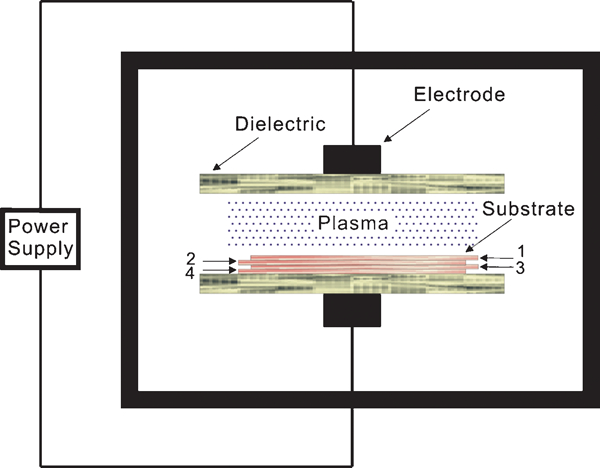
Schematic view of atmospheric pressure plasma treatment system and four layers of stacked polyester fabrics
Inkjet printing procedure
Samples were inkjet printed with Mimaki JV4‐180 digital printer (Mimaki Engineering Co., Ltd, Nagano, Japan) and subsequently baked at 120°C for 3 min with Minni thermo‐350 baker (Roaches International Ltd, Dewsbury, UK).
Surface morphology
Atomic force microscopy (AFM) is a new tool for examining nanostructures.5 The AFM used in this study was CSPM4000 produced by Benyuan Nano‐Instruments Co. Ltd (Beijing, China). The vertical resolution of the machine is 0·1 nm, while the horizontal resolution is 0·2 nm. The scanning mode used was contact mode in this study, and the scanning range was set at a size of 5·0×5·0 μm. All samples were scanned at room temperature in atmosphere.
Surface chemical analysis
Surface chemical composition of polyester fabric was analysed on a RBD upgraded PHI‐5000C ESCA system (PerkinElmer) with Mg Kα radiation (hν = 1253·6 eV). X‐ray anode was run at 250 W and the high voltage was kept at 14·0 kV with a detection angle at 54°. The sample was directly pressed to a self‐supported disc (10×10 mm) and mounted on a sample holder before transfer into the analyser chamber. The spectra were normalised with respect to the C–C peak positioned at 284·6 eV. All measurements were performed shortly after plasma treatment.
Wetting time
A microliter syringe was used to place a distilled water droplet of 3 μL on the fabric surface. The time for the droplets to be completely absorbed into the fabric was taken as the wetting time.6 An average of at least five measurements was taken for each condition. The measurements were performed with DSA‐100 drop shape analyser (KRÜSS GmbH, Hamburg, Germany) to evaluate the wettability of the top and bottom sides of each fabric layer.
Inkjet printing properties
Antibleeding performance
A DZ3‐video focus exchanged microscope (Union Optical Co. Ltd, Tokyo, Japan) with zoom ratio of 14 and total magnification from ×30 to ×5880 (with ½ CCD and 19" monitor) was used to measure the antibleeding performance of the treated and untreated inkjet printing fabrics at ×75 magnification.
Colour strength
The K/S value is useful when formulating colours for inkjet printing. It is assumed that the scattering (S) of pigment depends on the properties of the substrate, while the absorption (K) of light depends on the properties of the colorant. The change of K/S value will reveal the ink absorption of the polyester fabric. Higher K/S value indicates deeper colour.
X‐Rite Premier 8400 colour measurement system (X‐Rite, Grand Rapids, MI, USA) was used to measure the relative colour strength (K/S value) of samples with illuminant D65 and visual angle 10°.
Colour fastness
Rubbing fastness of the printed fabrics was tested according to ISO 105‐X12:1993. A holding clamp was used to mount the specimen on the baseboard of the Crockmeter. The long direction of the specimen was parallel to the track of rubbing. Two tests were performed: one along the direction of the warp/length and the other along the weft/width; a dry rubbing cloth was mounted flatly over the end of the peg on the Crockmeter and held tautly by means of the spring clip provided. The specimen was rubbed back and forth over a straight track 100±8 mm long for 10 times back and forth at a rate of 1 second per cycle. Results of the colour fastness were measured via X‐Rite Premier 8400 colour measurement system and evaluated by numerical values between 1 and 5.
Results and discussion
Surface morphology
The AFM images of 5·0×5·0 μm area on the fibre surfaces in the control and each treated fabric layer in the stacked samples are presented in Fig. 2. The untreated fibre has a relatively smooth surface as shown in Fig. 2e. However, after atmospheric pressure plasma treatment, an increased number of micropits were formed on the fabric surfaces in different layers as shown in Fig. 2a–d. This is the result from the etching effect of the plasma treatments. According to literatures, the main species in the plasma which are responsible for the etching effect are positive ions and photons, with ability to break primary chemical bonds and inducing cross‐linking.7 Much more micropits were formed on layers 1 and 2, indicating that the active species mainly reacted with the substrate surfaces in the first few layers. It is interesting to note that even for layers 3 and 4, some small micropits were still present, indicating that deep penetration of etching effect reached into the fabric layers. Atomic force microscopy images of the treated fabrics showed that atmospheric pressure plasma created micropits whose density, depth and size decreased with increasing fabric layers as reported in the literature.8,9
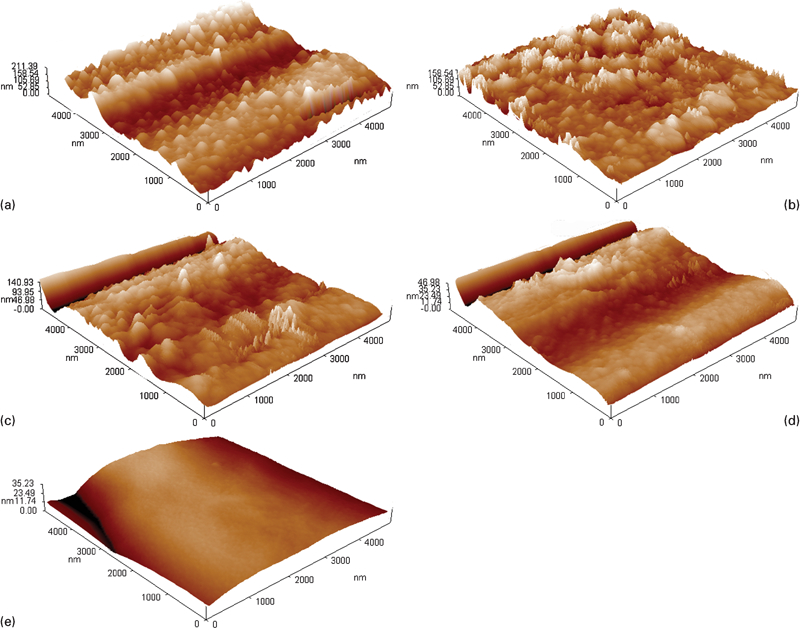
Images (AFM) of a layer 1, b layer 2, c layer 3 and d layer 4 of stacked fabrics and e untreated fabric
X‐ray photoelectron spectroscopy analysis
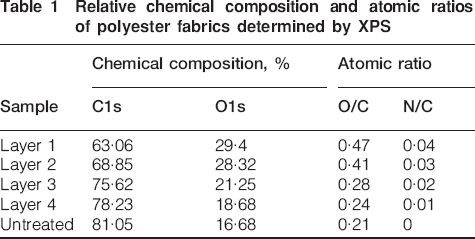
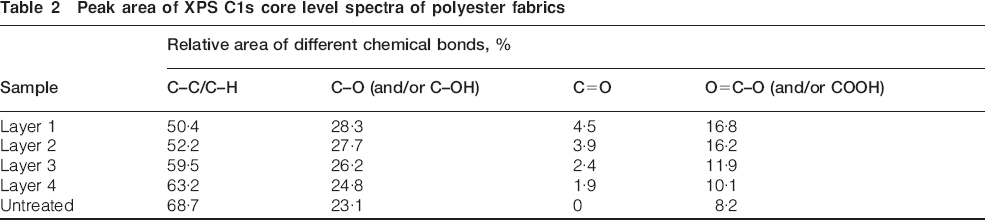
Detailed XPS analysis shown in Table 1 reveals chemistry changes of the surface for top sides of the control and the treated fabric in the stack. The O/C photoelectron peak ratio may imply the surface modification extent. The carbon content decreased while the content of O1s increased, suggesting that oxygen containing polar groups were introduced to the surfaces of all layers of the stacked fabrics exposed to the atmospheric pressure plasma.10,11 The O/C ratio of each fabric layer decreased sequentially from layer 1 to layer 4. However, even for layer 2, the O/C ratio was doubled compared to the untreated surface, indicating that the surface modification of atmospheric pressure plasma could effectively penetrate as deep as the second layer of the fabric.
Relative chemical composition and atomic ratios of polyester fabrics determined by XPS
In order to investigate what chemical functional groups were incorporated into the surface of polymer, deconvolution analysis of C1s peaks was performed. The C1s XPS spectra of original and treated polyester fabrics are presented in Fig. 3. As well documented in the literature, the spectrum of the original polyester contains three peaks at 284·60, 286·10 and 288·75 eV, which may be respectively assigned to C–C/C–H, C–O (and/or C–OH) and O = C–O (and/or COOH).12–15 The scan of the plasma treated surface contains extra C = O peak at 288·10 eV, compared with that of the untreated surface.
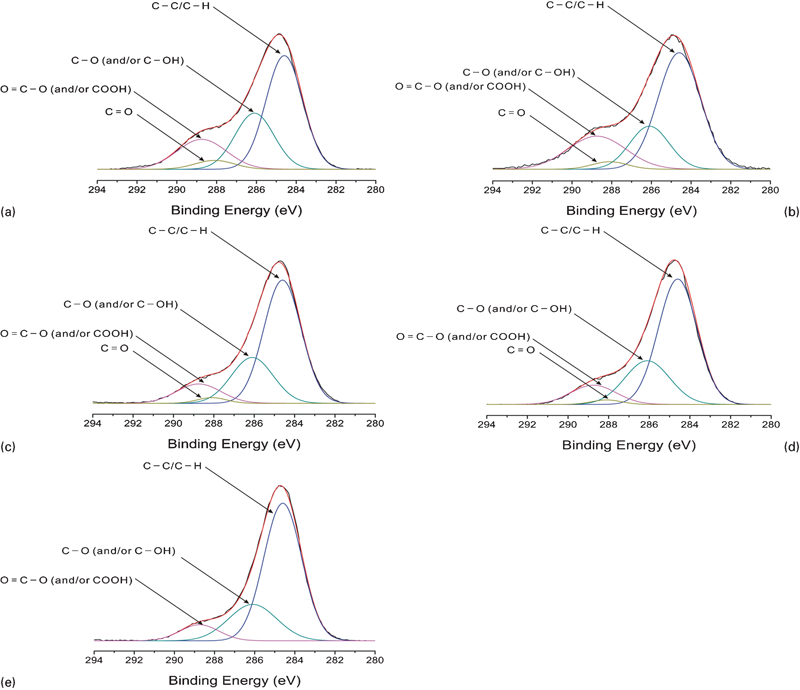
High resolution XPS analysis of C1s peaks of a layer 1, b layer 2, c layer 3 and d layer 4 of stacked fabrics and e untreated fabric
According to the content variation of each chemical component shown in Table 2, the C–C component of each fabric layer significantly decreased after plasma treatment, and at the same time, most of the oxygen containing polar groups such as C = O, C–OH and COOH increased on the surface of treated polyester fibres. This result indicates that some of the C–C bonds in polyester fibre surface may be broken by the plasma treatment, and then the broken C–C bonds will recombine with oxygen atoms produced by plasma to form the oxygen containing polar groups as reported in the literature.16,17
Peak area of XPS C1s core level spectra of polyester fabrics
Wetting time
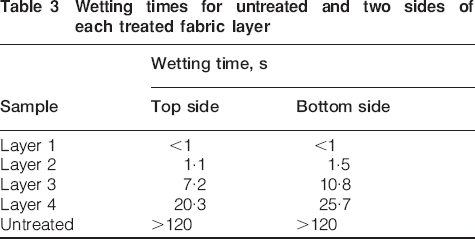
Table 3 shows the water absorption times for the untreated and the two sides of each treated fabric layer. The wetting times for both sides of the fabrics were markedly reduced after plasma treatment. It indicates that the atmospheric pressure plasma treatment is effective not only on the first layer but also on several layers below the surface. In general, the bottom side of the each fabric layer and the fabric in the deeper layer were found to have a longer wetting time. The decrease in water absorption time can be attributed to the increased roughness of the fibre surfaces due to plasma etching and the introduction of more polar groups due to plasma chemical modification.18,19
Wetting times for untreated and two sides of each treated fabric layer
Antibleeding property
Images of 2·0×2·0 mm area on the fibre surfaces which present the antibleeding performance of untreated and each treated layer of the stacked fabrics are shown in Fig. 4. As can be seen in Fig. 4, the bleeding phenomenon of untreated polyester fabric was severe along the weft and warp edges of inkjet printed fabrics. After plasma treatment, the antibleeding performance of layers 1 and 2 was dramatically improved with excellent sharpness. It was due to the hydrophilic improvement of the fabric, consequently expediting the absorption speed and increasing the holding ability of inks. However, the bleeding still appeared on layers 3 and 4 due to the less etching effect and chemical modification.
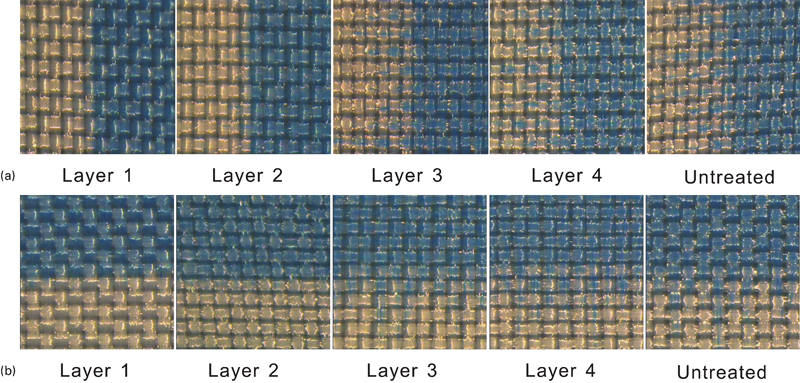
Images of antibleeding performance after inkjet printing with cyan pigment ink on a weft and b warp in each layer of stacked fabrics and untreated fabric
Effects of plasma on colour strength
K/S values of inkjet printing on untreated fabric and each treated fabric layer are summarised in Fig. 5. As can be seen, the cyan K/S value was higher than the magenta one due to the smaller particle size which was propitious to strengthen the pigmentation. The figure also shows that cyan and magenta K/S values of each inkjet printing layer increased after plasma treatment, indicating that the chroma of the sample increased. The etching and the polar groups on the surface of the fabrics induced by plasma improved the antibleeding performance of the polyester fabric, which contributed to the increasing amount of ink colorant staying on per area of the fabric.20 For obvious reasons, the K/S value of each fabric layer sequentially decreased from layer 1 to layer 4. This phenomenon can be summarised that the plasma treatment effect on the fabric surface was gradually reduced as the fabric layer got deeper since the extent of plasma modification of other layers was dependent on the degree of penetration of chemically active species in the plasma. Fortunately, the performance on both layers 1 and 2 are accredited.
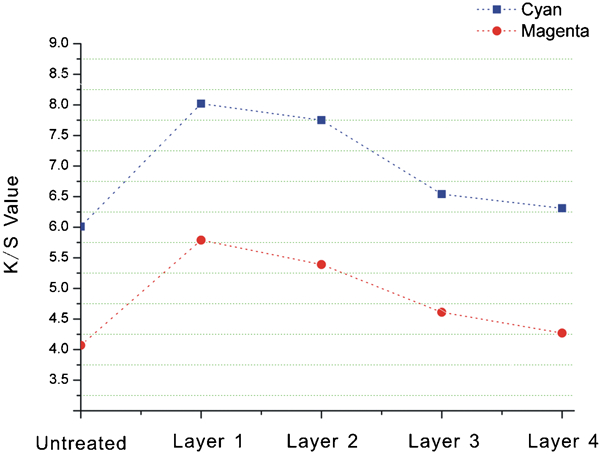
K/S values of inkjet printing on untreated fabric and each treated fabric layer
Colour fastness test
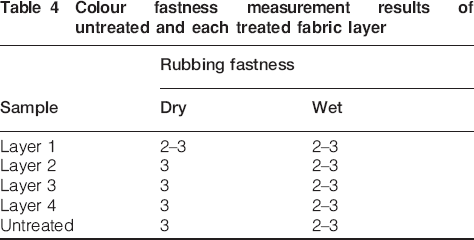
Rubbing fastnesses (dry and wet) of printed polyester fabrics are given in Table 4. Almost every sample had a dry rub of 3 (2–3 of layer 1) and a wet rub of 2–3 which indicated approved colour fastness. The results showed that there was almost no difference on both dry and wet rubbing fastnesses between untreated and each treated fabric layer, indicating that plasma treatment had no effect on the colour fastness of inkjet printed polyester fabrics. The dry rubbing fastness of printed layer 1 reduced 0·5°. This can be attributed to the increased roughness of the fabric surfaces due to the etching effect of plasma.
Colour fastness measurement results of untreated and each treated fabric layer
Conclusion
Penetration of multiple layers of inkjet printing polyester fabric surface modified with atmospheric pressure plasma was possible. After plasma treatment, the top side of the first layer of the stacked polyester fabrics was more wettable than the untreated sample, while it remained the same in terms of flexibility and strength. AFM study and XPS analysis showed that the plasma treatment effect on the fabric was gradually reduced as the fabric layer got deeper since the extent of plasma modification of other layers was dependent on the degree of penetration of chemically active species in the plasma. The research of antibleeding property and colour strength revealed that the atmospheric pressure plasma could substantially penetrate two layers of polyester fabrics to observably improve their inkjet printing effect. This effect also contributes to the deeper and more vivid colour and better antibleeding performance.
Footnotes
Acknowledgements
The authors are grateful for the financial support by New Century Excellent Talents in University (no. NCET‐04‐0495), the Natural Science Foundation of Jiangsu Province (no. BK2007021), National Key Technology R&D Program (no. 2007BAE40B01), NSFC (no. 20474025) and Innovative Research Team of Jiangnan University. The authors also wish to thank Y. San at Cherry Group Co., Ltd, for technical discussion.