







Abstract
Efficiency of atmospheric pressure plasma treatment can be highly enhanced by simultaneous high power ultrasonic irradiation onto the treating surface. It is because ultrasonic waves with a sound pressure level (SPL) above ∼140 dB can reduce the thickness of a boundary gas layer between the plasma and the material surface, and thus, many reactive species generated in the plasma can reach the surface before they are inactivated and can be efficiently utilised for surface modification. In the present work, glass fibre reinforced polyester plates were treated using a dielectric barrier discharge and a gliding arc at atmospheric pressure to study adhesion improvement. The effect of ultrasonic irradiation with the frequency diapason between 20 and 40 kHz at the SPL of ∼150 dB was investigated. After the plasma treatment without ultrasonic irradiation, the wettability was significantly improved. The ultrasonic irradiation during the plasma treatment consistently enhanced the treatment efficiency. The principal effect of ultrasonic irradiation can be attributed to enhancing surface oxidation during plasma treatment. In addition, ultrasonic irradiation can suppress arcing, and the uniformity of the treatment can be improved.
Introduction
Plasma surface modification is attractive because of its environmental compatibility and high treatment efficiency without affecting the textural characteristics of the bulk materials.1 It is generally performed at low pressures but is also possible and often preferable at atmospheric pressure.2, 3 The use of atmospheric pressure plasma can avoid the need for vacuum equipment and permit the treatment of large objects and continuous treatment on production lines.4 – 6 Among atmospheric pressure plasma sources, a dielectric barrier discharge (DBD) is generated between electrodes covered with dielectrics by applying a time varying voltage. In order to ensure stable DBD operation, however, the gap between the electrodes is limited to a few millimetres,3 which restricts the size of the specimens to be treated. In contrast to DBDs, with plasma torches, activated species generated in the plasmas are transported to the site of sample exposure by high speed gas flow. Atmospheric pressure plasma torches include inductively coupled plasmas, cold plasma torches7, 8 and gliding arcs.5, 9 They are applicable for treatment of bulky substrates and substrates with complicated structures.
Glass fibre reinforced polyester (GFRP) materials, due to their high strength/weight ratios and corrosion resistance, are used for a variety of applications in civil engineering, aerospace and automobile industry.10 They usually have smooth surfaces composed mainly of the polyester matrix with low surface energies. Therefore, adhesive joints of GFRP usually require careful surface preparation before adhesive bonding. Mechanical roughening is conventionally applied for the surface preparation of GFRPs.11 However, it needs laborious abrasion followed by solvent cleaning before adhesive bonding for achieving high joint strength. Thus, plasma surface modification can be a good alternative for this application.5, 12 It is reported that the adhesion strength of the surface after 2 s DBD treatment was comparable to or higher than that achieved by the conventional mechanical abrasion method.5 In addition, it is shown that gliding arc treatment improves the adhesion property of GFRP surfaces and that the treatment efficiency highly depends on the temperatures of the electrodes and the gas in the discharge.12
Atmospheric pressure plasma surface modification is generally performed by feeding a process gas into the plasma. A boundary gas layer normally sticks at the material surface, through which reactive species generated in the plasma are diffused for reaction with the surface. Owing to the short lifetime of these species, only a small fraction of them can reach the surface. It is reported that powerful ultrasonic waves with a sound power level (SPL) above ∼140 dB can reduce the thickness of the boundary gas layer.13 – 15 In these works, it is also demonstrated that the treatment efficiency of atmospheric pressure plasma can be highly enhanced by simultaneous high power ultrasonic irradiation onto the treating surface.
In the present work, the surfaces of GFRP plates were treated using a DBD or a gliding arc at atmospheric pressure. The effect of ultrasonic irradiation was investigated for adhesion improvement. Optical emission spectra (OES) were measured for plasma diagnostics. Contact angle measurement, X-ray photoelectron spectroscopy (XPS), time of flight secondary ion mass spectrometry (TOF-SIMS) and atomic force microscopy (AFM) were used for surface characterisation.
Experimental
GFRP plates were cut from a 2 mm thick commercial G-Etronax PM material (Elektro-Isola, Vejle, Denmark). They were cleaned and degreased with acetone and methanol. However, for XPS analysis, they were ultrasonically cleaned in deionised water for 2×5 min, in acetone for 2×5 min and in methanol for 5 min before surface treatment.
An atmospheric pressure DBD was generated between two parallel plane electrodes and driven by an alternating current (ac) (∼40 kHz and 100 W) power supply (Generator 6030; SOFTAL Electronic GmbH, Germany). The set-up is shown in Fig. 1. The ground electrode was covered with an alumina plate, while the powered electrode had a perforated hole covered with a stainless steel mesh for the introduction of ultrasound. Detailed information is provided in Refs. 13 and 14. Helium, argon or air was fed into the plasma at a flowrate of 3 L min−1.
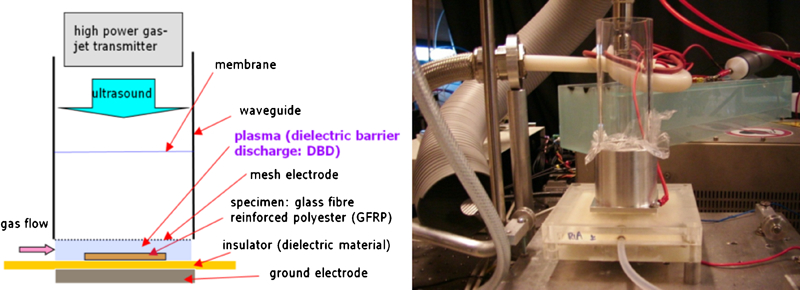
Set-up of ultrasound enhanced DBD
The gliding arc was generated between two 1 mm thick stainless steel blade electrodes with a diverging configuration, driven by an ac power supply (Generator 6030; SOFTAL Electronic GmbH). The arc was extended by an air flow at the flowrate of 20 L min−1. The air flow at the arc ignition directed the GFRP surface at an angle of ∼30°, as shown in Fig. 2. The average power input was obtained by measuring voltage and current with a high voltage probe and a 15··5 Ω current viewing resistor respectively. The input power was adjusted by varying the frequency. A change of the frequency from 33 to 40 kHz corresponds to an input power from ∼260 to 550 W. In order to treat a GFRP plate surface, the plate was fixed on a holder, which moved forward and back at a speed of 180 mm s−1.15 The specimen surfaces were exposed to the discharge twice in 5 s.
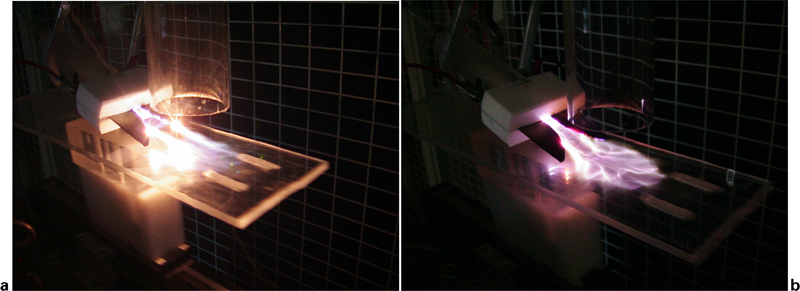
Gliding arc a without and b with ultrasonic irradiation
In both cases, the ultrasonic waves of the frequency diapason between 20 and 40 kHz at the SPL of ∼150 dB can be introduced vertically to the GFRP surface through a cylindrical waveguide (see Figs. 1 and 2).
The OES measurements were performed without a GFRP plate using an optical fibre and a 0··75 m spectrometer equipped with a grating with 3600 grooves/mm and a charge coupled device camera (PI-MAX 1024; Princeton Instruments, USA) for the identification of excited species and estimation of the rotational temperature in the discharge.
Contact angles were measured with deionised water and glycerol in air at room temperature both before and after the plasma treatment for evaluation of the polar component of the surface energy using a contact angle measurement system (CAM100; Crelab Instruments AB, Sweden). The polar component of the surface energy of the GFRP plates was determined by the two-liquid geometric method.12, 16
XPS data were collected using a microfocused, monochromatic Al Kα
X-ray source (1486··6 eV) with a lateral resolution of 30 μm (K-Alpha; Thermo Fisher Scientific, UK) for the GFRP surfaces treated by helium or argon DBD and a double anode Mg source with a lateral resolution of 2 mm for the others to study the changes in elemental compositions at the GFRP surfaces. Atomic concentrations of all elements were calculated by determining the relevant integral peak intensities using the Shirley background. The K-Alpha was also used for a high resolution analysis on the C1s spectra acquired over 30 scans. The binding energies were referred to as the hydrocarbon component (
The TOF-SIMS analyses were performed using a TOF-SIMS IV (ION-TOF GmbH, Münster, Germany). The TOF-SIMSs were acquired using 25 ns pulses of 25 keV Bi+ that were bunched to form ion packets with a nominal temporal extent of <0··9 ns at a repetition rate of 10 kHz, yielding a target current of 1 pA.
The average roughness of the GFRP surfaces was evaluated by AFM (XE-150; PSIA, USA) in Milli-Q water (Millipore Corp., USA) in the contact mode for the GFRP surfaces treated by helium DBD13 and by AFM (N8 NEOS; Bruker Nano GmbH, Herzogenrath, Germany) operating in an intermittent contact mode and using SSS-NCLR cantilevers (NANOSENSORS; Neuchâtel, Switzerland) for those treated by air DBD and gliding arc.14, 15
Results and discussion
Optical emission spectra were measured to identify excited species and estimate the rotational temperature of the discharges. Ultrasonic irradiation did not change the OES of the helium and air DBD significantly. The rotational temperature of N2 in the air DBD was estimated to be approximately 650 K with and without ultrasonic irradiation. On the other hand, the intensity of optical emission of gliding arc, including OH, NO, N2 and
 bands, significantly decreased when ultrasound was irradiated as shown in Fig. 3. The rotational temperatures in the gliding arcs with and without ultrasonic irradiation are estimated to be ∼3000 and 3500 K respectively.15
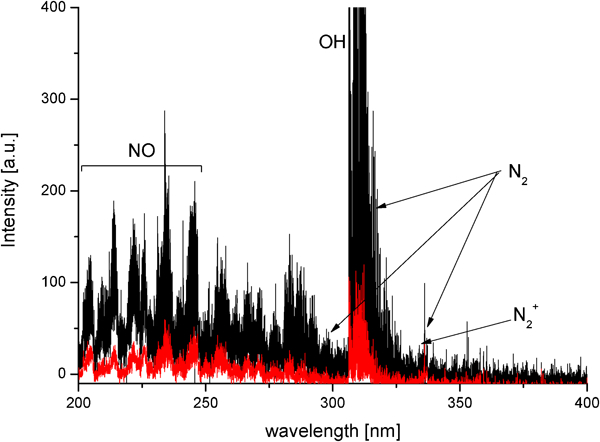
Optical emission spectra of gliding arc with (red) and without (black) ultrasonic irradiation
The waveforms of voltage and current in the helium DBD without ultrasonic irradiation are shown in Fig. 4a. The current waveform shows a few narrow spikes in each excitation, indicating that a glow discharge was generated.2 When the ultrasound was irradiated to the DBD, a higher voltage was required to sustain the plasma at the same power than the plasma without ultrasonic irradiation. In addition, formation of a filamentary discharge was observed with ultrasonic irradiation. It can be identified with complex spiky current waveforms of microdischarges, as shown in Fig. 4b. On the other hand, the air DBD without ultrasonic irradiation is a filamentary discharge with more complex spiky current waveforms, as shown in Fig. 4c. No significant change of the current waveforms is observed with ultrasonic irradiation (Fig. 4d).
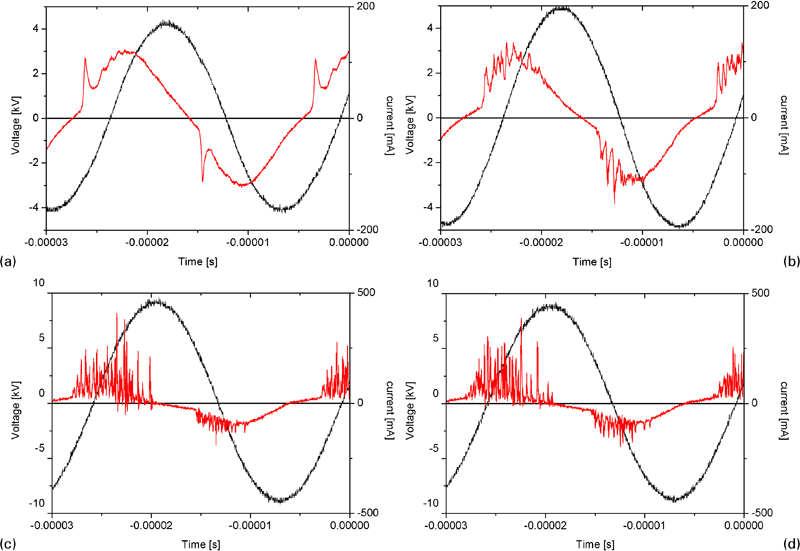
Voltage (black) and current (red. spiky) waveforms for helium DBD and air DBD with and without ultrasonic irradiation (input power, 100 W)
The treatment drastically changed the GFRP surface wettability. The water contact angle on the GFRP plate was ∼84° before the treatment, dropped markedly to ∼30° after 5 s helium DBD plasma treatment without ultrasonic irradiation and tended to decrease further after longer treatments as shown in Fig. 5a. Ultrasonic irradiation during plasma treatment consistently improved the wettability. The treatment also changed the polar component of the surface energy. It was 12··1 mJ m−2 before the treatment, between 58 and 67 mJ m−2 after plasma treatment without ultrasonic irradiation and between 68 and 73 mJ m−2 after plasma treatment with ultrasound irradiation, as shown in Fig. 5b. The polar component of the surface energy increased with ultrasonic irradiation, but it was insensitive to the treatment time.13 Similar results were obtained for the air DBD with and without ultrasonic irradiation.14
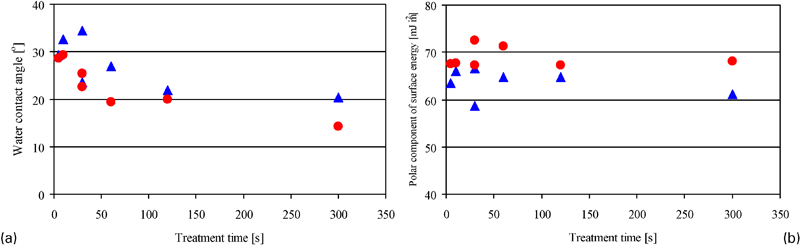
a water contact angle and b polar component of surface energy after helium DBD treatment with (red. circle) and without (blue. triangle) ultrasonic irradiation
For the treatment with gliding arc, plasma exposure time was fixed, and input power to the plasma was changed. As the power increased, the water contact decreased and the polar component of the surface energy increased. Ultrasonic irradiation enhanced these effects as well.15
XPS survey analysis was carried out to analyse the elemental composition of the GFRP surfaces before and after plasma treatments with and without ultrasonic irradiation. The results are summarised in Table 1. After the treatment without ultrasonic irradiation, the oxygen content increased approximately 4–5%, indicating the introduction of oxygen containing polar functional groups on the surfaces. Ultrasonic irradiation further enhanced oxidation at the surface. Since Si contents at the treated and untreated surfaces were negligible, the surfaces of the GFRPs were almost covered with the polyester matrix and thus most of the glass fibre surfaces were not exposed to the plasma.
Elemental composition (at-%) and O/C ratio at GFRP surfaces characterised by XPS
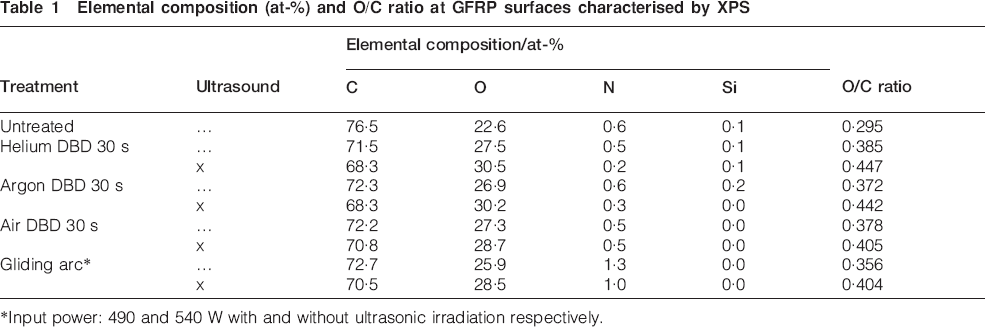
Input power: 490 and 540 W with and without ultrasonic irradiation respectively.
Table 2 summarises curve fitting of the C1s spectra of the GFRP surfaces before and after 30 s helium DBD treatment with and without ultrasonic irradiation. Peaks at approximately 285, 286··5, 289 and >290 eV can be assigned to
Summary of C1s curve fitting for GFRP surfaces characterised by XPS
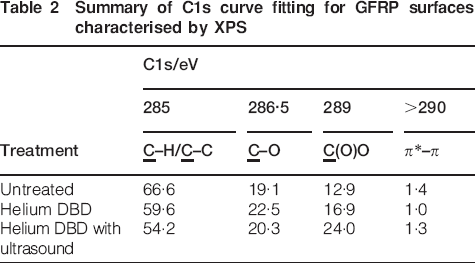
The C1s component peaks at ∼286··5 eV (
During the air DBD treatment without ultrasonic irradiation, occasional arcing was observed. Consequently, the GFRP plate surface was partly damaged, as shown in Fig. 6 (left). It was found that the arc ignition was suppressed during plasma treatment by the ultrasonic irradiation, preventing the GFRP plate from damaging (Fig. 6, right). Randomly distributed oxidised spots were observed in the TOF-SIMS ion image at the GFRP plate surface after the air DBD treatment without ultrasonic irradiation.14 Such spots were not seen at the surface after the air DBD treatment with ultrasonic irradiation. This indicates that ultrasonic irradiation can not only suppress arcing but also improve uniformity of the treatment.
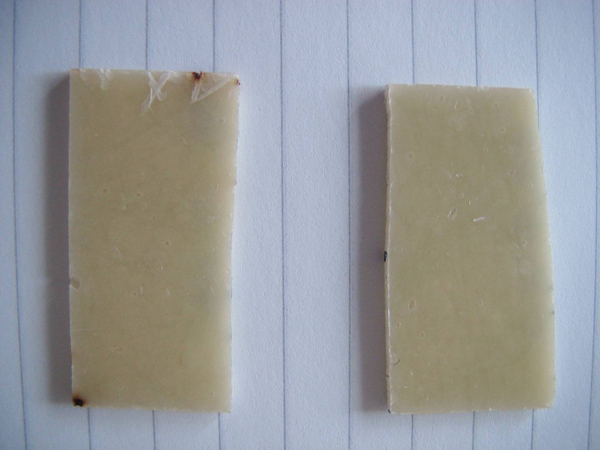
FRP plates treated by air DBD with (right) and without (left) ultrasonic irradiation
AFM was used to measure the surface roughness of the GFRP plates before and after plasma treatment. After each plasma treatment, surface roughness increased. However, no significant difference was seen between with and without ultrasonic irradiation. It is therefore unlikely that ultrasonic irradiation further enhances surface roughening during the treatment.
Conclusion
The GFRP plate surfaces were treated by atmospheric pressure plasmas with or without ultrasonic irradiation for adhesion improvement. Ultrasonic irradiation changed the discharge mode of helium DBD, suppressed arcing and increased uniformity of air DBD and reduced photoemission intensity and the rotational temperature of gliding arc. Plasma treatment consistently improved the wettability and increased the polar component of the surface energy and the oxygen containing polar functional groups at the surfaces. These effects were enhanced when ultrasonic waves were irradiated during the plasma treatment. The GFRP surfaces were roughened by the plasma treatment, but ultrasonic irradiation during the treatment did not significantly increased surface roughness. The principal chemical effect of ultrasonic irradiation can be attributed to enhanced surface oxidation during plasma treatment.
Footnotes
Acknowledgements
This work is supported by a grant from the Ministry of Science, Technology and Innovation through the National Danish Proof of Concept Funding Scheme (grant no. 07-017766).